
 100% FREE ACCESS
12th Standard Syllabus & Materials
12th Standard
TN 12th Computer Applications மின்னணு தரவு பரிமாற்றம் Sample Question Papers Study Material - QB365 Set A
NEW12th Standard
TN 12th Computer Applications மின் - வணிக பாதுகாப்பு அமைப்புகள் Sample Question Papers Study Material - QB365 Set A
NEW12th Standard
TN 12th Computer Applications மின்னணு செலுத்தல் முறைகள் Sample Question Papers Study Material - QB365 Set A
NEW12th Standard
TN 12th Computer Applications மின் - வணிகம் Sample Question Papers Study Material - QB365 Set A
NEW12th Standard
TN 12th Computer Applications திறந்த மூல கருத்துருக்கள் Sample Question Papers Study Material - QB365 Set A
NEW12th Standard
TN 12th Computer Applications வலையமைப்பு வடமிடல் Sample Question Papers Study Material - QB365 Set A

Published on: 01/10/2019
Introduction to Database Management System
Download Tamil Nadu 12th Standard Computer Applications question papers, model tests, one-mark questions, important questions, and public exam papers in PDF format. Free study materials and answer keys for TN State Board students.
Questions + Answers key
Take MCQ Computer Applications Test
1.
Which of the following is a commercial relational models in use
Oracle
DB2
Postgre SQL
Both a and b
2.
Which of the following are the limitations of system
Data Duplication
High Maintenance
Security
All of the above
3.
Which of the following is a not a database?
Oracle
PostgreSQL
SQLite
None of these
4.
The structure representing the organizational view of entire database is known as ______ in MySQL database.
Schema
View
Instance
Table
5.
Communication is established with MySQL using
SQL
Network calls
Java
API’s
6.
_____ represents a “tuple” in a relational database?
Table
Row
Column
Object
7.
Which language is used to request information from a Database?
Relational
Structural
Query
Compiler
8.
State few advantages of Relational databases.
9.
Write the difference between SQL and MySQL
10.
What is view in SQL?
11.
Define Single and Multi valued attributes.
12.
Define Data Model and list the types of data model used.
13.
What are the major parts to form a database
14.
List any 5 privileges available in MySQL for the User.
15.
16.
Explain on Evolution of DBMS.
17.
18.
List the basic concepts of ER Model with suitable example
19.
An attribute is the information about that ____________
20.
___________ is a program or process of copying table contents into a file for future reference
21.
________ is a database tool used by developers and DBA's mainly for visualization
22.
_____________ is a web application written in PHP
23.
__________ who takes care of configuration, installation, performance, security and data backup.
24.
________ is known a predecessor of database system
25.
Database
26.
Double Ellipse
27.
Primary key
28.
Column
29.
Hierarchical Database
1.
(d)
Both a and b
2.
(d)
All of the above
3.
(d)
None of these
4.
(a)
Schema
5.
(a)
SQL
6.
(b)
Row
7.
(c)
Query
8.
Advantages:
(i) High Availability
(ii) High Performance
(iii) Robust Transactions and Support
(iv) Ease of Management
(v) Less Cost
9.
| S.No | SQL | MySQL |
| 1. | SQL is a structured query language. | MySQL is a database software. |
| 2. | SQL is used to query and operate a database system. | MySQL allows data handling, storing, modifying, deleting etc. |
10.
(i) A set of stored queries is known as view in SQL.
(ii) A View contains rows and columns just like a real table.
11.
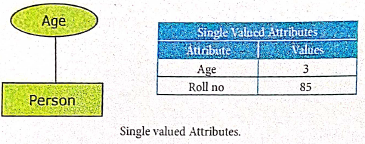
Single Valued Attribute: A single valued attribute contains only one value for the attribute and they don't have multiple numbers of values.
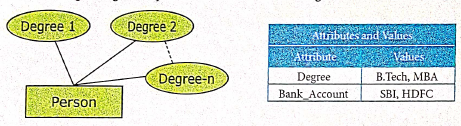
Multi Valued Attribute: A multi valued attribute has more than one value for that particular attribute.
12.
Data models define how the logical structure a database is modeled. Data models define how data is connected to each other and how they are processed andstored inside the system
Types of Data Model :
1) Hierarchical database model
2) Network model
3) Relational model
4) object oriented database model
13.
The three major parts that forms a database are Tables, Queries and Views.
(i) Tables - similar to an excel sheet, containing multiple rows and columns. Where each row is a record and each column is an attribute.
(ii) Queries - It is a question with multiple conditions posted to the database. The records in the database that satisfies the passed conditions are retrieved.
(iii) Views - A set of stored queries.
14.
List of privileges available in MySQL
| Privileges | Action Performed (If Granted) |
|---|---|
| Select_priv | User can select rows from database tables. |
| Insert_priv | User can insert rows into database tables. |
| Update_priv | User can update rows of database tables. |
| Delete_priv | User can delete rows of database tables. |
| Create_priv | User can create new tables in database |
| Alter_priv | User can make changes to the database structure. |
15.
16.
Evolution of DBMS:
(i) The concept of storing the data started before 40 years in various formats.
(ii) In earlier days they have used punched card technology to store the data. Then files were used.
(ii) The file systems were known as predecessor of database system.
(iv) Various access methods in file system were indexed, random and sequential access.
The file system had more limitations like.
Data Duplication : Same data is used by multiple resources for processing, thus created multiple copies of same data wasting the spaces.
High Maintenance : Access control and verifying data consistency needs high maintenance cost.
Security : Less security provided to the data.
(v) So database systems became popular to overcome the above limitations of file system.
17.
18.
ER Modeling basic concepts: The basic concepts of ER model consists of
1. Entity or Entity type
2. Attributes
3. Relationship
(i) Entity (or) Entity type
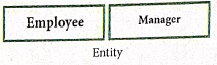
(i) An Entity can be real-world object (or) animation which is easily identifiable by anyone even by a common man.
(ii) Example: In a company's database Employee, HR, Manager are considered as entities, where each of these entity will be having their own attributes.An entity is represented by a rectangular box.
Types of Entity:
(a) Strong Entity
(b) Weak Entity
(c) Entity Instance
(i) Strong Entity
1. Strong entity is not depend on other entity and it will have a primary key.
2. It is represented by one rectangle.

3. For Example Roll Number. Everyone Roll Number varies and it will not be same.
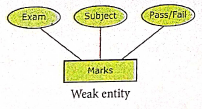
(ii) Weak Entity
1. A weak entity is dependent on other entities and it doesn't have any primary key like strong entity.
2. It is represented by double rectangle.

3. For Example, "Marks" is the weak entity and there is no primary key or unique id. It is depend on the existence of the other entity.
(iii) Entity Instance
1. Instances are the values for the entity. So an Entity Instance denotes the category values for the given entity.
Entities Instances
| Entities | Instances |
| Human | Male, Female |
| Animals | Dog, cats, lion |
| Jobs | Engineer, Doctor, Lawyer |
| Actors | Ajith, Vijay, Vikram |
| Electronics | Laptop, Mobile |
2. Attributes
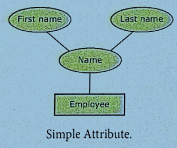
An attribute is the information about that entity and it will entity describe, quantity, qualify, classify and specify and entity. An attribute will always have a single value, that value can be a number or character or string.
Types of attributes :
(i) Key Attribute
(ii) Simple Attributes
(ii) Composite Attributes
(iv) Single Valued Attribute
(v) Multi Valued Attribute
3. Relationship Type
In ER Model, relationship exists between two entities. Three types of relationships are available and the Entity-Relationship (ER) diagram is based on the three types listed below
(i) One-to-One relationship: Consider two entities A and B. One-to-one (1:1) relationship is said to exist in a relational database design, if 0 or 1 instance of entity A is associated with 0 or 1 instance of entity B, and 0 or 1 instance of entity B is associated with 0 or I instance of entity A.
(ii) One-to-Many relationship: Consider two entities A and B. One-to-many (1:N) relationship is said to exist in a relational database design, for 1 instance of entity A there exists 0 or 1 or many instances of entity B, but for 1 instance of entity B there exists 0 ur 1 instance of entity A.
(iii) Many-to-Many relationship: Consider two entities A and B. many-to-many (M:N) relationship is said to exist in a relational database design, for 1 instance of entity A there exists 0 or 1 or many instances of entity B, and for 1 instance of entity B there exists 0 or 1 or many instance of entity A.
In reality one-to-one are in less usage, where as one-to-many and many-to-many are commonly used. However in relational database, many-to-many are converted into one-to-many relationships.
19.
()
Entity
20.
()
Backup
21.
()
MySQL Work bench
22.
()
PHPMYADMIN
23.
()
Database Administrators
24.
()
File system
25.
Sybase
26.
Multivalued Attribute
27.
Unique Key Identifier
28.
Attribute
29.
IMS

12th Standard Syllabus & Materials
12th Standard
TN 12th Computer Applications களப்பெயர் முறைமை (DNS) Sample Question Papers Study Material - QB365 Set A
NEW12th Standard
TN 12th Computer Applications வலையமைப்பு எடுத்துக்காட்டுகள் மற்றும் நெறிமுறைகள் Sample Question Papers Study Material - QB365 Set A
NEW12th Standard
TN 12th Computer Applications கணினி வலையமைப்பு ஓர் அறிமுகம் Sample Question Papers Study Material - QB365 Set A
NEW12th Standard
TN 12th Computer Applications PHP-உடன் MySQL-ஐ இணைத்தல் Sample Question Papers Study Material - QB365 Set A



Tamilnadu Stateboard 12th Standard Subjects

Maths

Chemistry

Physics

Biology

Computer Science

Business Maths and Statistics

Economics

Commerce

Accountancy

History
Computer Applications
Biology
Computer Technology
Computer Applications
Computer Science
Business Maths and Statistics
Commerce
Economics
Maths
Chemistry
Physics
Computer Technology
History
Accountancy

Tamil

English

French
Tamilnadu Stateboard Standards
