
 100% FREE ACCESS
12th Standard Syllabus & Materials
12th Standard
TN 12th Computer Applications மின்னணு தரவு பரிமாற்றம் Sample Question Papers Study Material - QB365 Set A
NEW12th Standard
TN 12th Computer Applications மின் - வணிக பாதுகாப்பு அமைப்புகள் Sample Question Papers Study Material - QB365 Set A
NEW12th Standard
TN 12th Computer Applications மின்னணு செலுத்தல் முறைகள் Sample Question Papers Study Material - QB365 Set A
NEW12th Standard
TN 12th Computer Applications மின் - வணிகம் Sample Question Papers Study Material - QB365 Set A
NEW12th Standard
TN 12th Computer Applications திறந்த மூல கருத்துருக்கள் Sample Question Papers Study Material - QB365 Set A
NEW12th Standard
TN 12th Computer Applications வலையமைப்பு வடமிடல் Sample Question Papers Study Material - QB365 Set A

Published on: 27/11/2019
Introduction to Database Management System
Download Tamil Nadu 12th Standard Computer Applications question papers, model tests, one-mark questions, important questions, and public exam papers in PDF format. Free study materials and answer keys for TN State Board students.
Questions + Answers key
Take MCQ Computer Applications Test
1.
___________ is defined as the system's ability to recover all committed transactions during the failure of storage or the system
Durability
Consistency
Concurrency
All of the above
2.
Which of the following are the limitations of system
Data Duplication
High Maintenance
Security
All of the above
3.
Which is the MySQL instance responsible for data processing?
MySQL Client
MySQL Server
SQL
Server Daemon Program
4.
Communication is established with MySQL using
SQL
Network calls
Java
API’s
5.
_____ represents a “tuple” in a relational database?
Table
Row
Column
Object
6.
What is XAMPP?
7.
What do you mean by table in Relational database model?
8.
What are the various methods to access file system?
9.
What is view in SQL?
10.
Define Single and Multi valued attributes.
11.
Write a short note on Row (or Record or tuple)
12.
What are the major parts to form a database
13.
List few commonly used databases.
14.
Write few commands used by DBA to control the entire database.
15.
List any 5 privileges available in MySQL for the User.
16.
Tabulate the ER diagram notations
17.
Explain the following
1. Primary Key
2. Foreign Key
3. Candidate Key
4. Super Key
5. Composite key
18.
Explain the DDL command of their functions in SQL.
19.
List the basic concepts of ER Model with suitable example
1.
(a)
Durability
2.
(d)
All of the above
3.
(b)
MySQL Server
4.
(a)
SQL
5.
(b)
Row
6.
(i) XAMPP is a free and open source package.
(ii) It was developed by Apache.
(iii) It is a software platform for MySQL, PHP and Peri programming languages.
7.
In relational database model,
(i) Table is defined as the collection of data organized in terms of rows and columns.
(ii) Table is the simple representation of relations. The true relations cannot have duplicate rows
8.
(i) Indexed method
(ii) Random Method
(iii) Sequential Method
9.
(i) A set of stored queries is known as view in SQL.
(ii) A View contains rows and columns just like a real table.
10.
Single Valued Attribute: A single valued attribute contains only one value for the attribute and they don't have multiple numbers of values.
Multi Valued Attribute: A multi valued attribute has more than one value for that particular attribute.
11.
(i) A single entry in a table is called a Row or Record or Tuple.
(ii) Set of related data are represented in a row or tuple.
(iii) The horizontal entity in a table is known as a Record or row.
12.
The three major parts that forms a database are Tables, Queries and Views.
(i) Tables - similar to an excel sheet, containing multiple rows and columns. Where each row is a record and each column is an attribute.
(ii) Queries - It is a question with multiple conditions posted to the database. The records in the database that satisfies the passed conditions are retrieved.
(iii) Views - A set of stored queries.
13.
(i) DB2
(ii) MySQL
(iii) Oracle
(iv) PostgreSQL
(v) SQLite
(vi) SQL Server
(vii) Sybase
14.
(i) USE Database: This command is used to select the database in MySQL for working.
Syntax:
mysql>use test:
Database changed
mysql>
(ii) SHOW Database: Lists all the databases available in the database server.
Syntax:
mysql>show databases;
(iii) SHOW Tables: Lists all the tables available in the current database we are working in.
Syntax: mysql>show tables;
15.
List of privileges available in MySQL
| Privileges | Action Performed (If Granted) |
|---|---|
| Select_priv | User can select rows from database tables. |
| Insert_priv | User can insert rows into database tables. |
| Update_priv | User can update rows of database tables. |
| Delete_priv | User can delete rows of database tables. |
| Create_priv | User can create new tables in database |
| Alter_priv | User can make changes to the database structure. |
16.
| ER Component | Description (how it is represented) | Notation |
|---|---|---|
| Entity - Strong | Simple rectangular box | .JPG) |
| Entity - Weak | Double rectangular boxes | .JPG) |
| Relationships | Rhombus symbol - strong | .JPG) |
| Between Entities | Rhombus within rhombus - Weak | .JPG) |
| Attributes | Ellipse symbol connected to the entity | .JPG) |
| Key Attribute for Entity | Underline the attribute name inside Ellipse | .JPG) |
| Derived Attribute for Entity | Dotted ellipse inside main ellipse | .JPG) |
| Multivalued Attribute for Entity | Double Ellipse | .JPG) |
17.
1. Primary Key:
(i) This key of relational table identifies each record in the table in a unique way.
(ii) A primary key which is a combination of more than one attribute is called a composite primary key.
(iii) The candidate key that is chosen to perform the identification task is called the primary key
2. Foreign Key:
(i) A foreign key is a "copy" of a primary keythat has been exported from one relation into another to represent the existence of a relationship between them
(ii) A foreign key is a copy of the whole of its parent primary key i.e if the primary key is composite, then so is the foreign key.
(iii) Foreign key values do not (usually) have to be unique.
(iv) Foreign keys can also be null.
(v) A composite foreign key cannot have some attribute(s) null and others non-null.
3. Candidate Key:
(i) Each super key is called a candidate key.
(ii) A candidate key is selected from the set of Super Key.
(iii) While selecting candidate key, redundant attributes should not be taken.
(iv) The candidate key is also known as minimal super keys.
4. Super Key:
(i) An attribute or group of attributes, which is sufficient to distinguish every tuple in the relation from every other one is known as Super Key.
5. Composite Key (Compound Key):
(i) A key with more than one attribute to identify rows uniquely in a table is called Composite key.
(ii) This is also known as Compound Key.
18.
SQL - Structured Query Language is a stand. language used for accessing and manipulating databases.
Data Definition Language (DDL)
The DDL commands are used to define database schema (Structure). Also to create and modify the structure of the database object in the database. CREATE, ALTER, DROP,RENAME and TRUNCATE commands belongs to this category.
SOL DDL COMMANDS LIST
| Command | Description |
| CREATE | Used to create database or tables |
| ALTER | Modifies the existing structure of database or table |
| DROP | Deletes a database or table. |
| RENAME | Used to rename an existing object in the database |
| TRUNCATE | Used to delete all table records |
Create Database used to create new SQL Database.
Syntax: CREATE database databasename;
Example: mysql>create database studentDB;
Drop Database - used to remove any of the existing SQL Database.
Syntax: DROP database databasename;
Example: mysql>DROP database studentDB;
TRUNCATE Command:
Syntax: TRUNCATE table tablename;
Example: TRUNCATE table studentDB;
ALTER Command:
Syntax:
ALTER TABLE table_name
ADD column_name column_definition;
Example:
ALTER TABLE student
ADD student_name char(50);
19.
ER Modeling basic concepts: The basic concepts of ER model consists of
1. Entity or Entity type
2. Attributes
3. Relationship
(i) Entity (or) Entity type
(i) An Entity can be real-world object (or) animation which is easily identifiable by anyone even by a common man.
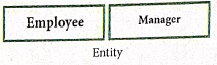
(ii) Example: In a company's database Employee, HR, Manager are considered as entities, where each of these entity will be having their own attributes.An entity is represented by a rectangular box.
Types of Entity:
(a) Strong Entity
(b) Weak Entity
(c) Entity Instance
(i) Strong Entity
1. Strong entity is not depend on other entity and it will have a primary key.
2. It is represented by one rectangle.

3. For Example Roll Number. Everyone Roll Number varies and it will not be same.
(ii) Weak Entity
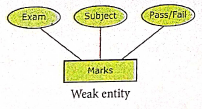
1. A weak entity is dependent on other entities and it doesn't have any primary key like strong entity.
2. It is represented by double rectangle.

3. For Example, "Marks" is the weak entity and there is no primary key or unique id. It is depend on the existence of the other entity.
(iii) Entity Instance
1. Instances are the values for the entity. So an Entity Instance denotes the category values for the given entity.
Entities Instances
| Entities | Instances |
| Human | Male, Female |
| Animals | Dog, cats, lion |
| Jobs | Engineer, Doctor, Lawyer |
| Actors | Ajith, Vijay, Vikram |
| Electronics | Laptop, Mobile |
2. Attributes
An attribute is the information about that entity and it will entity describe, quantity, qualify, classify and specify and entity. An attribute will always have a single value, that value can be a number or character or string.
Types of attributes :
(i) Key Attribute
(ii) Simple Attributes
(ii) Composite Attributes
(iv) Single Valued Attribute
(v) Multi Valued Attribute
3. Relationship Type
In ER Model, relationship exists between two entities. Three types of relationships are available and the Entity-Relationship (ER) diagram is based on the three types listed below
(i) One-to-One relationship: Consider two entities A and B. One-to-one (1:1) relationship is said to exist in a relational database design, if 0 or 1 instance of entity A is associated with 0 or 1 instance of entity B, and 0 or 1 instance of entity B is associated with 0 or I instance of entity A.
(ii) One-to-Many relationship: Consider two entities A and B. One-to-many (1:N) relationship is said to exist in a relational database design, for 1 instance of entity A there exists 0 or 1 or many instances of entity B, but for 1 instance of entity B there exists 0 ur 1 instance of entity A.
(iii) Many-to-Many relationship: Consider two entities A and B. many-to-many (M:N) relationship is said to exist in a relational database design, for 1 instance of entity A there exists 0 or 1 or many instances of entity B, and for 1 instance of entity B there exists 0 or 1 or many instance of entity A.
In reality one-to-one are in less usage, where as one-to-many and many-to-many are commonly used. However in relational database, many-to-many are converted into one-to-many relationships.

12th Standard Syllabus & Materials
12th Standard
TN 12th Computer Applications களப்பெயர் முறைமை (DNS) Sample Question Papers Study Material - QB365 Set A
NEW12th Standard
TN 12th Computer Applications வலையமைப்பு எடுத்துக்காட்டுகள் மற்றும் நெறிமுறைகள் Sample Question Papers Study Material - QB365 Set A
NEW12th Standard
TN 12th Computer Applications கணினி வலையமைப்பு ஓர் அறிமுகம் Sample Question Papers Study Material - QB365 Set A
NEW12th Standard
TN 12th Computer Applications PHP-உடன் MySQL-ஐ இணைத்தல் Sample Question Papers Study Material - QB365 Set A



Tamilnadu Stateboard 12th Standard Subjects

Maths

Chemistry

Physics

Biology

Computer Science

Business Maths and Statistics

Economics

Commerce

Accountancy

History
Computer Applications
Biology
Computer Technology
Computer Applications
Computer Science
Business Maths and Statistics
Commerce
Economics
Maths
Chemistry
Physics
Computer Technology
History
Accountancy

Tamil

English

French
Tamilnadu Stateboard Standards
