
 100% FREE ACCESS
12th Standard Syllabus & Materials
12th Standard
TN 12th Computer Applications மின்னணு தரவு பரிமாற்றம் Sample Question Papers Study Material - QB365 Set A
NEW12th Standard
TN 12th Computer Applications மின் - வணிக பாதுகாப்பு அமைப்புகள் Sample Question Papers Study Material - QB365 Set A
NEW12th Standard
TN 12th Computer Applications மின்னணு செலுத்தல் முறைகள் Sample Question Papers Study Material - QB365 Set A
NEW12th Standard
TN 12th Computer Applications மின் - வணிகம் Sample Question Papers Study Material - QB365 Set A
NEW12th Standard
TN 12th Computer Applications திறந்த மூல கருத்துருக்கள் Sample Question Papers Study Material - QB365 Set A
NEW12th Standard
TN 12th Computer Applications வலையமைப்பு வடமிடல் Sample Question Papers Study Material - QB365 Set A

Published on: 06/01/2020
Introduction to Hypertext Pre-Processor
Download Tamil Nadu 12th Standard Computer Applications question papers, model tests, one-mark questions, important questions, and public exam papers in PDF format. Free study materials and answer keys for TN State Board students.
Questions + Answers key
Take MCQ Computer Applications Test
1.
PHP was invented by __________
RasmusLerdorf
Dennis Ritchie
Bjarne Strousrup
James Goasling
2.
PHP scripting language supports __________ primitive data types.
10
11
12
13
3.
Which of the following PHP statements will output Hello World on the screen?
echo (“Hello World”);
print (“Hello World”);
printf (“Hello World”);
sprintf (“Hello World”);
4.
A PHP script should start with __________ and end with _________:
< php >
< ? php ? >
< ? ? >
< ?php ? >
5.
What does PHP files have a default file extension?
.html
.xml
.php
.ph
6.
Write a Basic Rules for Variable Declaration
7.
Classification of Client Server Architecture Model
8.
Define Webserver.
9.
Define Client Server Architecture.
10.
What is URL?
11.
What do you mean by Resources?
12.
Write the Characteristics of PHP.
13.
Write short notes on PHP operator.
14.
Differentiate Server side and Client Side Scripting language.
15.
Write the features of server side scripting language
16.
What are the three types of syntax in PHP? Explain them in detail.
17.
Explain operators in PHP with example.
18.
Discuss in detail about Website development activities.
19.
Explain client side and server side scripting language.
1.
(a)
RasmusLerdorf
2.
(d)
13
3.
(a)
echo (“Hello World”);
4.
(b)
< ? php ? >
5.
(c)
.php
6.
a. Variable name must always begin with a $ symbol.
b. Variable name can never start with a number.
c. Variable names arecase-sensitive
7.
Client server Architecture is classified into three types, as follows
(i) Single Tier Architecture
(ii) Two Tier-Architecture
(iii) N/Mult/Three tire architecture.
8.
A server is a computer or a device that provides functionalities for other programs of devices called "Client".
9.
A server is a computer or a device that provides functionality for other programs or devices, called "clients". This architecture is called the client server model, and a single overall computation is distributed across multiple processes or devices.
10.
Uniform Resource Locater (URL), refers the address of a specific web page or file on the internet.
11.
(i) Resource is a specific variable.
(ii) It hasa reference to an external resource .
(iii) These variables hold specific handlers to handle files and database connections irrespective PHP program.
12.
(i) Open Source
(ii) Case Sensitive
(iii) Simplicity Program language
(iv) Efficiency Program language
(v) Platform Independent Program language
(vi) Security Program language
(vii) Flexibility Program language
(viii) Real-Time Access Monitoring Program language
13.
Operator is a symbol which is used to perform mathematical and logical operations in the programming languages.
Different types of operators in PHP are:
(i) Arithmetic operators
(ii) Assignment operators
(iii) Comparison operators
(iv) Increment/Decrement operators.
(v) Logical operators and
(vi) String operators
1. Arithmetic operators perform arithmetical operations such as addition, subtraction, multiplication and division etc.
2. Assignment operators are performed with numeric values to store a value in a variable. Default assignment operator is "="
3. Comparison operators perform an action to compare two values.
4. Increment/Decrement operators are used to perform increasing (or) decreasing variable's value.
5. Logical operators are used to combine conditional statements.
6. String operators are two operators which are used to perform string related operations such as concatenation and concatenation assignment.
14.
| Basis for comparison | Server-side scripting | Client-side scripting |
|---|---|---|
| Basic | Works in the back end which could not be visible at the client end. | Works at the front end and script are visible among the users. |
| Processing | Requires server interaction | Does not need interaction with the server |
| Languages involved | PHP, ASP.net,Ruby on Rails, ColdFusion, Python, etcetera. | HTML, CSS, JavaScript, etc. |
| Affect | Could effectively customize the web pages and provide dynamic websites | Can reduce the load to the server. |
| Server-side scripting |
Relatively secure. | Insecure |
15.
(i) Server side scripting languages is used in web development.
(ii) It is alternative for web server and itself to deliver a static web page.
(iii) It is used to provide customized interface for the user.
(iv) It also enables the website owner to hide the source code.
16.
Default Syntax:
The default Syntax begins with " < ?php"and closes with "? > ".
.JPG)
Short open Tags
(i) The Short open Tags begins with " < ?" andcloses with "? > " .
(ii) But admin user has to enable Short style tags settings in php.ini file on the server.
.JPG)
HTML Script embed Tags:
HTML Script embed Tags looks just like HTML scripts tags.
.JPG)
17.
An operator is a symbol that performs a given action on a value or group of values. The values the operation is performed upon are known as operands.
The types of operators in PHP are
(i) Arithmetic operators
(ii) Assignment operators
(iii) Comparison operators
(iv) Increment/Decrement operators
(v) Logical operators and
(vi) String operators
1. Arithmetic operators
Arithmetic operators are used to perform math operations, for example, addition, subtraction, multiplication, and division.
| Operator | Operator Name | Example | Output |
|---|---|---|---|
| + | Addition | 5+2 | 7 |
| - | Subtraction | 5-2 | 3 |
| * | Multiplication | 5*2 | 10 |
| / | Division | 5/2 | 2.5 |
| % | Modulus | 5%2 | 1 |
2. Assignment operators
The assignment operator is used to assign a value to a variable. The assignment operator takes the value of its right-hand operand and assigns it to its left-hand operand.
| Operator | Operator Name | Example | Output |
|---|---|---|---|
| = | Assignment operator | $a = 5; | 5 |
3. Comparison operators
Comparison operators are used to compare two values and determine whether a certain condition is true or false.
| Operator | Operator Name | Example | Output |
|---|---|---|---|
| > | Greater than | 5 > 2 | |
| < | less than | 5<2 | False |
| >= | Greater than or equal to | 5>= 2 | True |
| <= | Less than or equal to | 5<=2 | False |
| == | Equal to | 5==5 5 == 5.0 |
True False |
| === | Identical | 5===5 5===5.0 |
True False |
| != | Not equal | 5!=5 5!=6 |
True False |
| !== | Not identical | 5!==5 5!==5.0 |
True False |
4.Logical Operators:
Logical operators are used to perform logical operations on variables and values.
| Operator | Operator Name | Example | Output |
|---|---|---|---|
| && | Logical AND | (5>3) && (5>7) | False |
| II | Logical OR | (5>3) II (5>7) | True |
| xor | XOR | (5>3) xor (5>7) | True |
| ! | Logical NOT | ! (5>3) | False |
5. Increment and Decrement operators
In PHP, the increment operator ++ is used to increase the value of a variable by 1, and the decrement operator is used to decrease the value of a variable by 1. The increment and decrement operators can be used as either prefix or postfix operators.
| Operator | Name | Output |
|---|---|---|
| ++ (increment operator) |
++ $a Pre-increment | $x = ++ $a |
| ++ (increment operator) |
$a + + Post-increment | $x = $a ++ |
| -- (decrement operator) |
--$a Pre-decrement | $x = --$a |
| -- (decrement operator) |
$a-- Post-decrement | $x = $a-- |
6. String operator
String operators have concatenation operator(.) and concatenation assignment operator(-). Concatenation means adding one or more variables to an existing variable.
| Operator | Name | Example | Output |
|---|---|---|---|
| . (Dot) | Concatenation | $a = 'Hello'; $b = 'World'; $c= $a. $b; |
Hello World |
| .= (Dot equal to) | Concatenation | $a= 'Hello': $b = 'World'; $a .= $b; |
Hello World |
18.
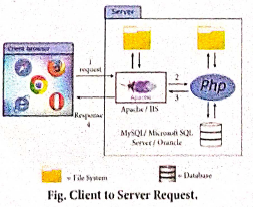
Website development has done by the following activities.
1. Website or webpage is developed by the programmer using PHP script.
2. Entire website codes are moved to web server path in a remote server machine.
3. From the client side, the end user open a browser, types the URL of the website (or) webpage and initiates the request to remote server machine over the network.
4. After receiving the request from client machine the web server tries to compile and interpret the PHP code which is available in remote machine.
5. Response will be generated and sent back to the client machine over the network from webserver.
6. Finally the browser is installed in the client machine receives the response and displays the output to user, as shown in fig.
19.
Client side scripting language:
1. Code that is present in a client's HTML page.
2. The language used for client scripting is Java script. It is the most widely used language for client-side scripting.
3. It is compatible and has the ability to run on any browsers.
4. The browser then downloads that code temporarily and processes it without the server.
5. As a result, it is now faster and easier to do client side scripting and leaving less word for the server.
Server side scripting language:
1. Server side scripting usually happens on the back-end of a website.
2. Server side scripting creates a path for the website to the database and all behind the scene work which organizes and runs a website. In server side scripting, the responses can be customized based on requirement of the user.
3. Example of server side programming language is PHP scripting language.
4. It can be executed via an interpreter which is installed in the webservers or CGI (Common Gateway Interface).
5. The most of the webservers such as Apache Tomcat, Microsoft IIS (Internet Information Server) supports the PHP interpreter module.

12th Standard Syllabus & Materials
12th Standard
TN 12th Computer Applications களப்பெயர் முறைமை (DNS) Sample Question Papers Study Material - QB365 Set A
NEW12th Standard
TN 12th Computer Applications வலையமைப்பு எடுத்துக்காட்டுகள் மற்றும் நெறிமுறைகள் Sample Question Papers Study Material - QB365 Set A
NEW12th Standard
TN 12th Computer Applications கணினி வலையமைப்பு ஓர் அறிமுகம் Sample Question Papers Study Material - QB365 Set A
NEW12th Standard
TN 12th Computer Applications PHP-உடன் MySQL-ஐ இணைத்தல் Sample Question Papers Study Material - QB365 Set A



Tamilnadu Stateboard 12th Standard Subjects

Maths

Chemistry

Physics

Biology

Computer Science

Business Maths and Statistics

Economics

Commerce

Accountancy

History
Computer Applications
Biology
Computer Technology
Computer Applications
Computer Science
Business Maths and Statistics
Commerce
Economics
Maths
Chemistry
Physics
Computer Technology
History
Accountancy

Tamil

English

French
Tamilnadu Stateboard Standards
