
 100% FREE ACCESS
12th Standard Syllabus & Materials
12th Standard
TN 12th Maths Applications of Matrices and Determinants Sample Question Papers Study Material - QB365 Set A
NEW12th Standard
TN 12th Computer Applications மின்னணு தரவு பரிமாற்றம் Sample Question Papers Study Material - QB365 Set A
NEW12th Standard
TN 12th Computer Applications மின் - வணிக பாதுகாப்பு அமைப்புகள் Sample Question Papers Study Material - QB365 Set A
NEW12th Standard
TN 12th Computer Applications மின்னணு செலுத்தல் முறைகள் Sample Question Papers Study Material - QB365 Set A
NEW12th Standard
TN 12th Computer Applications மின் - வணிகம் Sample Question Papers Study Material - QB365 Set A
NEW12th Standard
TN 12th Computer Applications திறந்த மூல கருத்துருக்கள் Sample Question Papers Study Material - QB365 Set A

Published on: 27/11/2019
Algorithmic Strategies
Download Tamil Nadu 12th Standard Computer Science question papers, model tests, one-mark questions, important questions, and public exam papers in PDF format. Free study materials and answer keys for TN State Board students.
Questions + Answers key
Take MCQ Computer Science Test
1.
Which of the following is not an example of data structures?
Control statement
Structure
List
Dictionary
2.
Which of the following is not a characteristic of an algorithm?
Definiteness
Correctness
Data structure
Effectivenes
3.
If a problem can be broken into subproblems which are reused several times, the problem possesses which property?
Overlapping subproblems
Optimal substructure
Memoization
Greedy
4.
The Θ notation in asymptotic evaluation represents
Base case
Average case
Worst case
NULL case
5.
The word comes from the name of a Persian mathematician Abu Ja’far Mohammed ibn-i Musa al Khowarizmi is called?
Flowchart
Flow
Algorithm
Syntax
6.
Give an example. How the time efficiency of an algorithm is measured.
7.
Name the two factors, which decide the efficiency of an algorithm.
8.
What is searching? Write its types.
9.
Who is an Algorist?
10.
Define Pseudo code.
11.
What is dynamic programming? What are the steps involved in dynamic programming?
12.
Write a pseudo code for bubble sort algorithm
13.
What do you understand by Dynamic programming?
14.
Write a note on Asymptotic notation.
15.
Discuss about Algorithmic complexity and its types.
16.
Explain the sorting algorithm that uses n-1 number passes to get the final sorted list.
17.
Differentiate Algorithm and program
18.
Explain the Bubble sort algorithm with example.
19.
Discuss about Linear search algorithm.
1.
(a)
Control statement
2.
(c)
Data structure
3.
(a)
Overlapping subproblems
4.
(b)
Average case
5.
(c)
Algorithm
6.
The time efficiency of an algorithm is measured by different factors. For example, write a program for a defined algorithm, execute it by using any programming language, and measure the total time it takes to run.
7.
(i) Time factor
(ii) Space factor
8.
A searching algorithm is the step-by step procedure used to locate specific data among a collection of data. There are two types of searching are.
(i) Linear Search
(ii) Binary Search
9.
Algorist may refer to,
1. A person skilled in the technique of performing basic decimal arithmetic, known as algorism.
2. A person skilled in the design of algorithms.
3. An algorithmic artist.
10.
Pseudo code is an informal way of Programming language syntax.
11.
Dynamic programming is an algorithmic design method that can be used when the solution to a problem can be viewed as the result of a sequence of decisions. Dynamic Programming approach is similar to divide and conquer.
(i) The given problem will be divided into smaller overlapping sub-problems.
(ii) An optimum solution for the given problem can be achieved by using result of smaller sub-problem.
(iii) Dynamic algorithms uses Memoization.
12.
(i) Start with the first element i.e., index = 0, compare the current element with the next element of the array.
(ii) If the current element is greater than the next element of the array, swap them.
(iii) If the current element is less than the next or right side of the element, move to the next element. Go to Step 1 and repeat until end of the index is reached.
13.
(i) Dynamic programming is an algorithmic design method that can be used when the solution to a problem can be viewed as the result of a sequence of decisions.
(ii) Dynamic programming approach is similar to divide and conquer. The given problem is divided into smaller and yet smaller possible sub-problems.
(iii) Dynamic programming is used whenever problems can be divided into similar sub-problems. So that their results can be re-used to complete the process.
(iv) Dynamic programming approaches are used to find the solution in optimized way. For every inner subproblem, dynamic algorithm will try to check the results of the previously solved sub-problems. The solutions of overlapped sub-problems are combined in order to get the better solution.
14.
Asymptotic Notations are languages that uses meaningful statements about time and space complexity. The following three asymptotic notations are mostly used to represent time complexity of algorithms:
(i) Big O: Big O is often used to describe the worst -case of an algorithm.
(ii) Big \(\Omega \):Big Omega is the reverse Big O, if Big O is used to describe the upper bound (worst - case) of a asymptotic function, Big Omega is used to describe the lower bound (best -case).
(iii) Big \(\Theta \):When an algorithm has complexity with lower bound = upper bound, Say that an algorithm has a complexity O(n log n) and \(\Omega \) (n log n), it's actually has the complexity \(\Theta \) (n log n), which means the running time of that algorithm always falls in n log n in the best-case and worst-case.
15.
The complexity of an algorithm f (n) gives the running time and/or the storage space required by the algorithm in terms of n as the size of input data.
(i) Time Complexity: The Time complexity of an algorithm is given by the number of steps taken by the algorithm to complete the process.
(ii) Space Complexity: Space complexity of an algorithm is the amount of memory required to run to its completion.
16.
(i) Insertion sort is a simple sorting algorithm. It works by taking elements from the list one by one and inserting then in their correct position in to a new sorted list.
(ii) This algorithm builds the final sorted array at the end. This algorithm uses n-1 number of passes to get the final sorted list as per the pervious algorithm as we have discussed.
Pseudo for Insertion sort:
Step 1 - If it is the first element, it is already sorted.
Step 2 - Pick next element
Step 3 - Compare with all elements in the sorted sub-list
Step 4 - Shift all the elements in the sorted sublist that is greater than the value to be sorted Step 5 - Insert the value Step 6 - Repeat until list is sorted.
17.
| Algorithm | Program |
|---|---|
| Algorithm helps to solve a given problem logically and it can be contrasted with the program | Program is an expression of algorithm in a programming language. |
| Algorithm can be categorized based on their implementation methods, design techniques etc | Algorithm can be implemented by structured or object oriented programming approach |
| There is no specific rules for algorithm writing but some guidelines should be followed. | Program should be written for the selected language with specific syntax |
| Algorithm resembles a pseudo code which can be implemented in any language | Program is more specific to a programming language |
18.
Bubble sort algorithm:
(i) Bubble sort algorithm simple sorting algorithm. The algorithm starts at the beginning of the list of values stored in an array. It compares each pair of adjacent elements and swaps them if they are in the unsorted order.
(ii) This comparison and passed to be continued until no swaps are needed, which indicates that the list of values stored in an array is sorted. The algorithm is a comparison sort, is named for the way smaller elements "bubble" to the top of the list.
(iii) Although the algorithm is simple, it is too slow and less efficient when compared to insertion sort and other sorting methods.
(iv) Assume list is an array of n elements. The swap function swaps the values of the given array elements.
Procedure :
(i) Start with the first element i.e., index = 0, compare the current element with the next element of the array.
(ii) If the current element is greater than the next element of the array, swap them.
(iii) If the current element is less than the next or right side of the element, move to the next element. Go to Step 1 and repeat until the end of the index is reached.
(iv) Let's consider an array with values {15, 11, 16, 12, 14, 13} Below, we have a pictorial representation of how bubble sort will sort the given array.
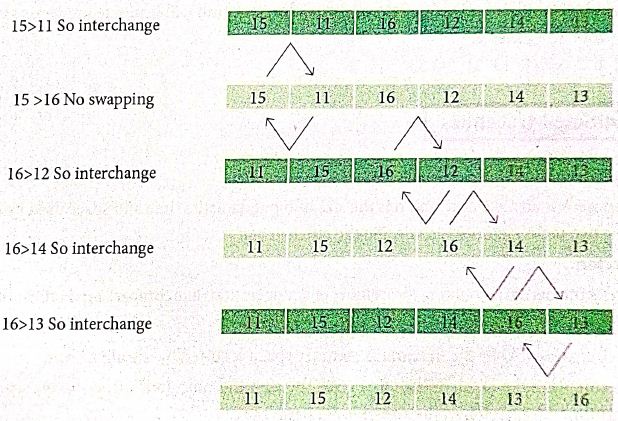
(v) The above pictorial example is for iteration-d. Similarly, remaining iteration can be done. The final iteration will give the sorted array. At the end of all the iterations we will get the sorted values in an array as given below:
| 11 | 12 | 13 | 14 | 15 | 16 |
19.
(i) Linear search also called sequential search is a sequential method for finding a particular value in a list.
(ii) This method checks the search element with each element in sequence until the desired element is found or the list is exhausted. In this searching algorithm, list need not be ordered.
procedure :
1. Traverse the array using for loop
2. In every iteration, compare the target search key value with the current value of the list.
(i) If the values do not match, move on to the next array element.
(ii) If the values match, display the current index and value of the array.
3. If no match is found, display the search element not found.
(iii) To search the number 25 in the array given below, a linear search will go step by step in a sequential order starting from the first element in the given array if the search element is found that index is returned otherwise the search is continued till the last index of the array. In this example number 25 is found at index number 3.
| index | 0 | 1 | 2 | 3 | 4 |
| values | 10 | 12 | 20 | 25 | 30 |
Example 1:
Input: values[] = {5, 34, 65, 12, 77, 35)
target = 77
Output: 4
Example 2:
Input: values[] = [101, 392, 1, 54, 32, 22, 90, 93) target = 200
Output: -1 (not found)

12th Standard Syllabus & Materials
12th Standard
TN 12th Computer Applications வலையமைப்பு வடமிடல் Sample Question Papers Study Material - QB365 Set A
NEW12th Standard
TN 12th Computer Applications களப்பெயர் முறைமை (DNS) Sample Question Papers Study Material - QB365 Set A
NEW12th Standard
TN 12th Computer Applications வலையமைப்பு எடுத்துக்காட்டுகள் மற்றும் நெறிமுறைகள் Sample Question Papers Study Material - QB365 Set A
NEW12th Standard
TN 12th Computer Applications கணினி வலையமைப்பு ஓர் அறிமுகம் Sample Question Papers Study Material - QB365 Set A



Tamilnadu Stateboard 12th Standard Subjects

Maths

Chemistry

Physics

Biology
Computer Science

Business Maths and Statistics

Economics

Commerce

Accountancy

History

Computer Applications
Biology
Computer Technology
Computer Applications
Computer Science
Business Maths and Statistics
Commerce
Economics
Maths
Chemistry
Physics
Computer Technology
History
Accountancy

Tamil

English

French
Tamilnadu Stateboard Standards
