
 100% FREE ACCESS
12th Standard Syllabus & Materials
12th Standard
TN 12th Computer Applications மின்னணு தரவு பரிமாற்றம் Sample Question Papers Study Material - QB365 Set A
NEW12th Standard
TN 12th Computer Applications மின் - வணிக பாதுகாப்பு அமைப்புகள் Sample Question Papers Study Material - QB365 Set A
NEW12th Standard
TN 12th Computer Applications மின்னணு செலுத்தல் முறைகள் Sample Question Papers Study Material - QB365 Set A
NEW12th Standard
TN 12th Computer Applications மின் - வணிகம் Sample Question Papers Study Material - QB365 Set A
NEW12th Standard
TN 12th Computer Applications திறந்த மூல கருத்துருக்கள் Sample Question Papers Study Material - QB365 Set A
NEW12th Standard
TN 12th Computer Applications வலையமைப்பு வடமிடல் Sample Question Papers Study Material - QB365 Set A

Published on: 20/08/2019
Lists, Tuples, Sets and Dictionary
Download Tamil Nadu 12th Standard Computer Science question papers, model tests, one-mark questions, important questions, and public exam papers in PDF format. Free study materials and answer keys for TN State Board students.
Questions + Answers key
Take MCQ Computer Science Test
1.
If python sets - 1 as the index value for the last element is called
Oppositive indexing
Tuple indexing
Reverse index
List indexing
2.
Which of the following is not datatype in Python?
List
Tuples
String
Set
3.
The keys in Python, dictionary is specified by
=
;
+
":"
4.
What is the use of type() function in python?
To create a Tuple
To know the type of an element in tuple.
To know the data type of python object
To create a list.
5.
If List=[17,23,41,10] then List.append(32) will result
[32,17,23,41,10]
[17,23,41,10,32]
[10,17,23,32,41]
[41,32,23,17,10]
6.
What is nested list? Give example.
7.
Write the syntax of creating list. Give example.
8.
Name the four collections of data types in python programming language.
9.
What is set in Python?
10.
How will you access the list elements in reverse order?
11.
Write a python program to read marks of six subjects and to print the marks scored in each subject and show the total marks.
12.
Write a note on the following function used in list.
13.
What is the output for the following code?
14.
How will you find the length of a list? Explain with an example.
15.
What are the difference between List and Dictionary?
16.
List out the set operations supported by python.
17.
How will access all elements of a list? Write the execution table example.
18.
Explain the different set operations supported by python with suitable example.
19.
What the different ways to insert an element in a list. Explain with suitable example.
1.
(c)
Reverse index
2.
(c)
String
3.
(d)
":"
4.
(c)
To know the data type of python object
5.
(b)
[17,23,41,10,32]
6.
(i) Mylist contains another list as an element. This type of list is known as "Nested List': Nested list is a list containing another list as an element.
(ii) Example: Mylist = [ "Welcome", 3.14, 10, [2,4,6] ]
7.
Syntax:
Variable = [element-1, element-2, element-3 ................ elernent-n]
Example:
Marks = [10,23,41,75]
Fruits = ["Apple", "Orange", "Mango", "Banana"]
MyList = [ ]
8.
Python programming language has four collections of data types such as List, Tuples, Set and Dictionary.
9.
(i) In Python, a set is another type of collection data type. A'Set is a mutable and an unordered collection of elements without duplicates.
(ii) That means the elements within a set cannot be repeated. This feature used to include membership testing and eliminating duplicate elements.
10.
Python enables reverse or negative indexing for the list elements. Thus, python lists index in opposite order. The python sets -1 as the index value for the last element in list and -2 for the preceding element and so on. This is called as Reverse Indexing.
11.
Program:
marks=[]
subjects=['Tamil', 'English', 'Physics', 'Chemistry', 'Comp.Science', 'Maths']
for i in range(6):
m=int(input("Enter Mark ="))
marks.append(m)
for j in range(len(marks)):
print(" { }. { }Mark = { } ".format(j1+,subjects [j],marks [j]))
print("Total Marks = ", sum(marks))
Output:
Enter Mark = 45
Enter Mark = 98
Enter Mark = 76
Enter Mark = 28
Enter Mark = 46
Enter Mark = 15
1. Tamil Mark =45
2. English Mark = 98
3. Physics Mark = 76
4. Chemistry Mark = 28
5. Compo Science Mark =46
6. Maths Mark = 15
Total Marks = 308
12.
| max( ) | Returns the maximum value in a list |
max (list) |
MyList=[21, 76, 98, 23] print(maxtMyList) Output: 98 |
| min( ) | Returns the minimum value in a list. |
min (list) |
MyList=[21, 76, 98, 23] print(min(MyList) ) Output: 21 |
| sum( ) | Returns the sum of values in a list. |
sum (list) |
MyList=[21, 76, 98, 23] print(sum(MyList) ) Output: 218 |
13.
MyList = [2, 4, 5, 8, 10]
print ("MyList elements before update ... ")
for x in MyList:
print (x)
MyList[2] = 6
print ("MyList elements after updation ... ")
for y in MyList:
print (y)
Output:
MyList elements before update ...
2
4
5
8
10
MyList elements after updation ...
2
4
6
8
10
14.
(i) The len( ) function in Python is used to find the length of a list. (i.e., the number of elements in a list).
(ii) Usually, the len( ) function is used to set the upper limit in a loop to read all the elements of a list.
(iii) If a list contains another list as an element, len( ) returns that inner list as a single element.
(iv) Example: Accessing single element
> > > MySubject = ['Tamil', 'English', 'Comp', 'Science', 'Maths']
> > > len(MySubject)
4
15.
(i) List is an ordered set of elements. But, a dictionary is a data structure that is used for matching one element (Key) with another (Value).
(ii) The index values can be used to access a particular element. But, in dictionary key represents index. Remember that, key may be a nunmber of a string.
(iii) Lists are used to look up a value whereas a dictionary is used to take one value and look up another value.
16.
Set Operations :
(i) Union : It includes all elements from two or more sets.
(ii) Intersection : It includes the common elements in two sets.
(iii) Difference : It includes all elements that are in first set (say set A) but not in the second set (say set B).
(iv) Symmetric difference : It includes all the elements that are in two sets (say sets A and B) but not the one that are common to two sets.
17.
(i) Loops are used to access all elements from a list. The initial value of the loop must be zero. Zero is the beginning index value of a list.
(ii) Example:
Marks = [10, 23, 41, 75]
i = 0
while i < 4:
print (Marks[i])
i = i + 1
Output:
10
23
41
75
(iii) In the above example, Marks list contains four integer elements i.e., 10, 23, 41, 75. Each element has an index value from 0. The index value of the elements are 0, 1, 2, 3 respectively.
(iv) Here, the while loop is used to read all the elements. The initial value of the loop is zero, and the test condition is < 4, as long as the test condition is true, the loop executes and prints the corresponding output
(iv) During the first iteration, the value of i is zero, where the condition is true. Now, the following statement print (Marks [i] gets executed and prints the value of Marks [0] element ie. 10.
(v) The next statement i = i + 1 increments the value of i from 0 to 1. Now, the flow of control shifts to the while statement for
(vi) checking the test condition. The process repeats to print the remaining elements of Marks list until the test condition of while loop becomes false. The following table shows that the execution of loop and the value to be print.
| Iteration | i | while i < 4 |
print (Marks[i]) | i = i + 1 |
| 1 | 0 | 0< 4 True | Marks [0] =10 | 0+1=1 |
| 2 | 1 | 1 < 4 True | Marks [1]=23 | 1+1=2 |
| 3 | 2 | 2 < 4 True | Marks [2]=41 | 2+1=3 |
| 4 | 3 | 3 < 4 True | Marks [3]=75 | 3+1=4 |
| 5 | 4 | 4 < 4 False |
18.
The python supports the set operations such as Union, Intersection, difference and Symmetric difference.
i) Union:
It includes all elements from two or more sets
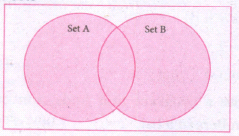
In python, the operator Iis used to union of two sets. The function union ( ) is also used to join two sets in python.
Example:
Program to Join (Union) two sets using union operator
set_A={2,4,6,8}
set_B={'A', 'B', 'C', 'D'}
U_set=set_A l set_B
print (U _set)
Output:
{2, 4, 6, 8, 'A', 'D', 'C', 'B'}
Example:
Program to Join (Union) two sets using union function.
set_A={2,4,6,8}
set_B={'A', 'B', 'C', 'D'}
set_ U=set_ A.Union(set_ B)
print(set_U)
Output:
{'D', 2, 4, 6, 8, 'B', 'C', 'A'}
ii) Intersection:
(i) It includes the common elements in two sets
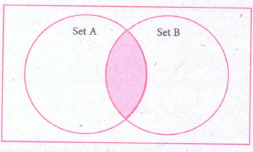
The operator & is used to intersect two sets in python. The function intersection( ) is also used to intersect two sets in python.
Example:
Program to insert two sets using intersection operator
set_A={'A', 2, 4, 'D'}
set_B={'A', 'B', 'C', 'D'}
print(set_A & set_B)
Output:
{'A', 'D'}
Example:
Program to insect two sets using intersection function
set_A={'A', 2, 4, 'D'}
set_B={'A', 'B', 'C', 'D'}
print( set_A.intersection(set_B))
Output:
{'A', 'D'}
iii) Difference
It includes all elements that are in first set (say set A) but not in the second set (say set B)
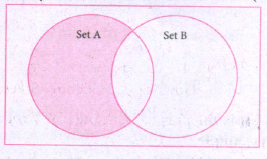
The minus (-) operator is used to difference set operation in python. The function difference() is also sed to difference operation.
Example:
Program to difference of two sets using minus operator
set_A={'A', 2, 4, 'D'}
set_B={'A', 'B', 'C', 'D'}
print(set_A - set B)
Output
{2,4}
Example:
Program to difference of two sets using difference function
set_A={'A', 2, 4, 'D'}
set_B={'A', 'B', 'C', 'D'}
print(set_A.difference( set_B))
Output:
{2,4}
iv) Symmetric difference:
It includes all the elements that are in two sets (say sets A and B) but not the one that are common to two sets.
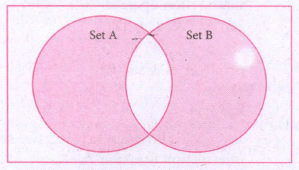
The caret (^) operator is used to symmetric difference set operation in python. The function symmetric_difference( ) is also used to do the same operation.
Example:
Program to symmetric difference of two sets using caret operator
set_A={'A', 2, 4, 'D'}
set_B={'A', 'B', 'C', 'D'}
print(set_A ^ set_B)
Output:
{2, 4, 'B', 'C'}
Example:
Program to difference of two sets using symmetric difference function
set_A={'A', 2, 4, 'D'}
set_B={'A', 'B', 'C', 'D'}
print( se_A.symmetric_ difference (set_B))
Output:
{2, 4, 'B', 'C'}
19.
Inserting elements in a list using insert ( ) :
(i) append ( ) function in Python is used to add more elements in a list. But, it includes elements at the end of a list.
(ii) If you want to include an element at your desired position, you can use insert ( ) function. The insert ( ) function is used to insert an element at any position of a list.
Syntax :
List.insert (position index, element)
Example :
>>> MyList=[34,98,47, Kannan,Gowrisankar','Lenin', 'Sreenivasan' ]
>>> print(MyList)
[34, 98, 47, 'Kannan', 'Gowrisankar', 'Lenin', 'Sreenivasan']
>>> MyList.insert(3, 'Ramakrishnan')
>>> print(MyList)
[34, 98, 47, 'Ramakrishnan', 'Kannan', 'Gowrisankar, 'Lenin', 'Sreenivasan']
Output : [34, 98, 47, 'Ramakrishnan', 'Kannan', 'Gowrisankar', 'Lenin', 'Sreenivasan']
(i) In the above cxample, insert( ) function inserts a new element 'Ramakrishnan' at the index value 3, ie. at the 4th position.
(ii) While inserting a new element in between the existing elements, at a particular location, the existing elements shifts one position to the right.

12th Standard Syllabus & Materials
12th Standard
TN 12th Computer Applications களப்பெயர் முறைமை (DNS) Sample Question Papers Study Material - QB365 Set A
NEW12th Standard
TN 12th Computer Applications வலையமைப்பு எடுத்துக்காட்டுகள் மற்றும் நெறிமுறைகள் Sample Question Papers Study Material - QB365 Set A
NEW12th Standard
TN 12th Computer Applications கணினி வலையமைப்பு ஓர் அறிமுகம் Sample Question Papers Study Material - QB365 Set A
NEW12th Standard
TN 12th Computer Applications PHP-உடன் MySQL-ஐ இணைத்தல் Sample Question Papers Study Material - QB365 Set A



Tamilnadu Stateboard 12th Standard Subjects

Maths

Chemistry

Physics

Biology
Computer Science

Business Maths and Statistics

Economics

Commerce

Accountancy

History

Computer Applications
Biology
Computer Technology
Computer Applications
Computer Science
Business Maths and Statistics
Commerce
Economics
Maths
Chemistry
Physics
Computer Technology
History
Accountancy

Tamil

English

French
Tamilnadu Stateboard Standards
