
 100% FREE ACCESS
12th Standard Syllabus & Materials
12th Standard
TN 12th Computer Applications மின்னணு தரவு பரிமாற்றம் Sample Question Papers Study Material - QB365 Set A
NEW12th Standard
TN 12th Computer Applications மின் - வணிக பாதுகாப்பு அமைப்புகள் Sample Question Papers Study Material - QB365 Set A
NEW12th Standard
TN 12th Computer Applications மின்னணு செலுத்தல் முறைகள் Sample Question Papers Study Material - QB365 Set A
NEW12th Standard
TN 12th Computer Applications மின் - வணிகம் Sample Question Papers Study Material - QB365 Set A
NEW12th Standard
TN 12th Computer Applications திறந்த மூல கருத்துருக்கள் Sample Question Papers Study Material - QB365 Set A
NEW12th Standard
TN 12th Computer Applications வலையமைப்பு வடமிடல் Sample Question Papers Study Material - QB365 Set A

Published on: 21/09/2019
Download Tamil Nadu 12th Standard Computer Science question papers, model tests, one-mark questions, important questions, and public exam papers in PDF format. Free study materials and answer keys for TN State Board students.
Questions + Answers key
Take MCQ Computer Science Test
1.
The command to delete a table including the structure is
DROP
DELETE
DELETE ALL
ALTER TABLE
2.
The process of creating an object is called as:
Constructor
Destructor
Initialize
Instantiation
3.
The keys in Python, dictionary is specified by
=
;
+
":"
4.
Which of the following is the slicing operator?
{ }
[ ]
< >
( )
5.
What is the output of the following snippet?
T=1
while T:
print(True)
break
False
True
0
1
6.
The word comes from the name of a Persian mathematician Abu Ja’far Mohammed ibn-i Musa al Khowarizmi is called?
Flowchart
Flow
Algorithm
Syntax
7.
This symbol is used to print more than one item on a single line.
Semicolon(;)
Dollor($)
comma(,)
Colon(:)
8.
Which scope refers to variables defined in current function?
Local Scope
Global scope
Module scope
Function Scope
9.
10.
11.
What is data consistency?
12.
13.
List the control structures in Python.
14.
15.
What is a List? Give an example.
16.
Differentiate interface and implementation.
17.
What will be the output of the given python program?
str1 = "welcome"
str2 = "to school"
str3 = str1[:2] + str2[len(str2)-2:]
print (str3)
18.
How recursive function works?
19.
List the characteristics of an algorithm.
20.
Explain Ternary operator with examples.
21.
Define Local scope with an example.
22.
Differentiate pure and impure function.
23.
Differentiate DBMS and RDBMS.
24.
Explain the following built-in functions.
(a) id ()
(b) chr ()
(c) round ()
(d) type ()
(e) pow ()
25.
Explain with an example interface and implementation.
26.
\n
27.
%E
28.
100
29.
-
30.
^
1.
(a)
DROP
2.
(d)
Instantiation
3.
(d)
":"
4.
(b)
[ ]
5.
(b)
True
6.
(c)
Algorithm
7.
(c)
comma(,)
8.
(a)
Local Scope
9.
(a)
10.
(c)
11.
Data Consistency means that data values are the same at all instances of a database.
12.
13.
There are three important control Structures
(i) Sequential
(ii) Alternative or Branching
(iii) Iterative or Looping
14.
15.
List is constructed by placing expressions within square brackets separated by commas. List can store multiple values.
Example:
1st := [10, 20]
x, y:= 1st
In the above example x will become 10 and y will become 20.
16.
| Interface | Implementation |
|---|---|
| Interface just defines what an object can do, but won't actually do it. | Implementation carriers out the instructions defined in the interface. |
17.
Output:
Weool
18.
(i) Recursive function is called by some external code.
(ii) If the base condition is met then the program gives meaningful output and exits.
(iii) Otherwise, function does some required processing and then calls itself to continue recursion.
19.
(i) Input
(ii) Output
(iii) Finiteness
(iv) Definiteness
(v) Effectiveness
(vi) Correctness
(vii) Simplicity
(viii) Unambiguous
(ix) Feasibility
(x) Portable
(xi) Independent
20.
(i) Ternary operator is also known as conditional operator that evaluate something based on a condition being true or false.
(ii) It simply allows testing a condition in a single line replacing the multiline if-else making the code compact. The syntax for conditional operator is,
Variable Name = [on_true] if [Test expression]
else [on_false]
(iii) Example:
min = 50 if 49 < 50 else 70 # min = 50
min = 50 if 49 > 50 else 70 # min = 70
21.
(i) Local scope refers to variables defined in current function. Always, a function will first look up for a variable name in its local scope.
(ii) Only if it does not find it there, the outer scopes are checked.
(iii) Look at this example:
|
1. Disp(): |
Entire program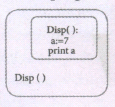 |
Output of the Program 7 |
(iv) On execution of the above code the variable a displays the value 7, because it is defined and available in the local scope.
22.
| S.No | Pure Function | Impure Function |
|---|---|---|
| (i) | The return value of the pure functions solely depends on its arguments passed. | The return value of the impure functions does not solely depend on its arguments passed. |
| (ii) | If you call the pure functions with the same set of arguments, you will always get the same return values. | If you call the impure functions with the same set of arguments. You might get the different return values. |
| (iii) | They do not have any side effects. | They cause side effects. For example: random(),Date() |
| (iv) | They do not modify the arguments which are passed to them | They may modify the arguments which are passed to them |
23.
| Basis of Comparison | DBMS | RDBMS |
|---|---|---|
| Expansion | Database Management System | Relational Database Management System |
| Data storage | Navigational model ie data by linked records | Relational model (in tables). ie data in tables as row and column |
| Data redundancy | Exhibit | Not Present |
| Normalization | Not performed | RDBMS uses normalization to reduce redundancy |
| Data access | Consumes more time | Faster, compared to DBMS. |
| Keys and indexes | Does not use. | used to establish relationship. Keys are used in RDBMS. |
| Transaction management | Inefficient, Error prone and insecure | Efficient and secure |
| Distributed Databases | Not supported | Supported by RDBMS. |
| Example | Dbase, FoxPro. | SQL server, Oracle, mysql, MariaDB, SQLite. |
24.
| Function | Description | Syntax | Example |
| (a) id() | id () Return the "identity" of an objects i.e. The address of the object in memory. Note: The address of x and y may differ in your system. |
id(object) | x = 15 y = 'a' print('address of x is :',id(x)) print ('address of y is :',id (y)) Output: address of x is: 1357486752 address of y is: 13480736 |
| (b) Chr() | Returns the Unicode character for the given ASCII value. This function is inverse of ord() function. | Chr(i) | c=65 d=43 print(chr(c)) print(chr(d)) Output: A + |
| (c) round() | Returns the nearest integer to its input. 1. First argument(number) is used to specify the value to be rounded. |
round (number, [ndigits]) | x = 17.9 y = 22.2 z = -18.3 print('x value is rounded to', round(x)) print('y value ic rounded to', round(y)) print ('z value is rounded to', round(z)) |
| (d) type() | Returns the type of object for the given single object. Note: This function used with single object parameter. |
type(object) | x = 15.2 y = 'a' s = true print(type(x)) print(type(y)) print(type(s)) Output: < class 'float' > < class 'str' > < class 'bool' > |
| (e) pow() | Returns the computation of ab i.e. (a**b) a raised to the power of b. | pow(a, b) | a = 5 b = 2 c = 3.0 print(pow(a, b)) print(pow(a, c)) print(pow(a + b, 3)) Output: 25 125.0 343 |
25.
Interface:
(i) An interface is a set of action that an object can do. For example when you press a light switch, the light goes on, you may not have cared how it splashed the light. In Object Oriented Programnming language, an Interface is a description of all functions.
(ii) In our example, anything that "ACTS LIKE" a light, should have function definitions like turn_on () and a turn_off (). The purpose of interfaces is to allow the Computer to enforce the properties of the class.
Implementation:
(i) Implementation carries out the instructions defined in the interface.
(ii) How the object is processed and executed is the implementation.
(iii) A class declaration combines the external interface (its local state) with an implementation of that interface (the code that carries out the behaviour).
For example, let's take the example of increasing a car's speed.
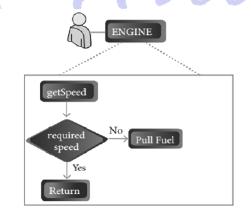
(iv) The person who drives the car doesn't care about the internal working. To increase the speed of the car he just presses the accelerator to get the desired behaviour. Here the accelerator is the interface between the driver (the calling / invoking object) and the engine ( the called object).
(v) In this case, the function call would be speed (70):, this is the interface Internally, the engine of the car is doing all the things but fuel, air, pressure, and electricity come together to create the power to move the vehicle.
(vi) All of these actions are separated from the driver, who just wants to go faster. Thus we separate interface from implementation.
26.
Horizontal Tab
27.
exponential notation
28.
Decimal Literal
29.
Difference
30.
Symmetric difference

12th Standard Syllabus & Materials
12th Standard
TN 12th Computer Applications களப்பெயர் முறைமை (DNS) Sample Question Papers Study Material - QB365 Set A
NEW12th Standard
TN 12th Computer Applications வலையமைப்பு எடுத்துக்காட்டுகள் மற்றும் நெறிமுறைகள் Sample Question Papers Study Material - QB365 Set A
NEW12th Standard
TN 12th Computer Applications கணினி வலையமைப்பு ஓர் அறிமுகம் Sample Question Papers Study Material - QB365 Set A
NEW12th Standard
TN 12th Computer Applications PHP-உடன் MySQL-ஐ இணைத்தல் Sample Question Papers Study Material - QB365 Set A



Tamilnadu Stateboard 12th Standard Subjects

Maths

Chemistry

Physics

Biology
Computer Science

Business Maths and Statistics

Economics

Commerce

Accountancy

History

Computer Applications
Biology
Computer Technology
Computer Applications
Computer Science
Business Maths and Statistics
Commerce
Economics
Maths
Chemistry
Physics
Computer Technology
History
Accountancy

Tamil

English

French
Tamilnadu Stateboard Standards
