
 100% FREE ACCESS
12th Standard Syllabus & Materials
12th Standard
TN 12th Computer Applications மின்னணு தரவு பரிமாற்றம் Sample Question Papers Study Material - QB365 Set A
NEW12th Standard
TN 12th Computer Applications மின் - வணிக பாதுகாப்பு அமைப்புகள் Sample Question Papers Study Material - QB365 Set A
NEW12th Standard
TN 12th Computer Applications மின்னணு செலுத்தல் முறைகள் Sample Question Papers Study Material - QB365 Set A
NEW12th Standard
TN 12th Computer Applications மின் - வணிகம் Sample Question Papers Study Material - QB365 Set A
NEW12th Standard
TN 12th Computer Applications திறந்த மூல கருத்துருக்கள் Sample Question Papers Study Material - QB365 Set A
NEW12th Standard
TN 12th Computer Applications வலையமைப்பு வடமிடல் Sample Question Papers Study Material - QB365 Set A

Published on: 18/07/2019
Download Tamil Nadu 12th Standard Economics question papers, model tests, one-mark questions, important questions, and public exam papers in PDF format. Free study materials and answer keys for TN State Board students.
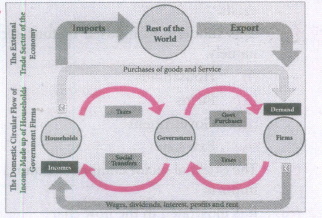
Questions + Answers key
Take MCQ Economics Test
1.
Combination of both capitalism and socialism ________.
Capitalist Economy
Traditional Economy
Mixed Economy
Socialist Economy
2.
Example for Mixed Economy ________.
India
France
China
Both 'a' and 'b'
3.
Father of socialism _________.
Adamsmith
J.M. Keynes
Karl Marx
J.R. Hicks
4.
Planned economy is also known as _________.
Capitalist Economy
Socialist Economy
Mixed Economy
All the above
5.
Macro economics is also known as __________.
Price theory
Income theory
Business cycle
Poverty and unemployment
6.
7.
Macro economics is a study of_________
individuals
firms
a nation
aggregates
8.
Who is regarded as Father of Modern Macro Economics?
Adam Smith
J M Keynes
Ragnar Frisch
Karl Marx
9.
10.
The branches of the subject Economics are
Wealth and Welfare
Production and Consumption
Demand and Supply
Micro and Macro
11.
What are the merits of Mixed Economy?
12.
What is Mixed Economy?
13.
Write down the three types of economic systems.
14.
What is meant by an ‘Economy’?
15.
Define Macro Economics
16.
Draw the Circular flow of income in a three sector economy.
17.
Write any two demerits of capitalism.
18.
Outline major demerits of capitalism.
19.
Enumerate the features of mixed economy.
20.
Indicate the demerits of socialism.
21.
Explain the merits of socialism.
22.
Explain the four sector circular flow model.
23.
Discuss the scope of Macro Economics.
1.
(c)
Mixed Economy
2.
(d)
Both 'a' and 'b'
3.
(c)
Karl Marx
4.
(b)
Socialist Economy
5.
(b)
Income theory
6.
(b)
7.
(d)
aggregates
8.
(b)
J M Keynes
9.
(c)
10.
(d)
Micro and Macro
11.
(i) Rapid Economic Growth
(ii) Balanced Economic Growth
(iii) Economic Equality
(iv) Proper Utilization of Resources
(v) Special Advantages to the Society
12.
(i) In economic system both private and public sectors co-exist.
(ii) It work together towards economic development.
13.
(i) Capitalistic Economy (Capitalism)
(ii) Socialistic Economy (Socialism)
(iii) Mixed Economy (Mixedism)
14.
An Economy is refered to any system or area where economic activities are carried out.
15.
Macro economics is the branch of economics that studies the behaviour and performance of an economy as a whole.
16.
17.
i) Class Struggle:
Capitalism leads to class struggle as it divides the society into capitalists and workers.
ii) Business Cycle:
Free Market System leads to frequent violent economic fluctuations and crisis.
18.
(i) Concentration of wealth and income
(ii) Wastage of Resources
(iii) Class struggle
(iv) Business cycle
(v) Production of non essential goods.
19.
(i) The means of production and properties are owned by private and public.
(ii) Public and Private Sectors co-exist private sectors are profit motivated and public sectors aims at maximum social welfare.
(iii) The national plans prepared by the central planning authority is accepted by all sectors.
(iv) Basic economic problems are solved through the price mechanism and state intervention.
(v) Though the private can own resources, produce and distribute goods and services, the overall control on the economic activities is with the government.
20.
(i) Red tapism and bureaucracy since, approval of many officials is needed.
(ii) Absence of incentive and so productivity is less.
(iii) Limited freedom of choice in the consumption of goods and services.
(iv) The state takes all major decisions. There is concentration and misuse of power.
21.
Merits of Socialism:
1. Reduction m Inequalities:
No one is allowed to own and use private property to exploit others.
2. Rational Allocation of Resources:
The central planning authority allocates the resources in a planned manner. Wastages are minimised and investments are made in a pre planned manner.
3. Absence of Class conflicts:
As inequalities are minimum, there is no conflict between rich and poor class. Society functions in a harmonious manner.
4. End of rade Cycles :
Planning authority takes control over production and distribution of goods and services. Therefore, economic fluctuations can be avoided.
5. Promotes Social Welfare:
Absence of exploitation, reduction in economic inequalities, avoidance of trade cycles and increase in productive efficiency help to promote social welfare.
22.
(1) Circular flow of income in a four sector economy.
(2) In a four sector economy. in addition to household, firms and government, a fourth sector namely, external sector is included.
(3) In real life, only four-sector economy is exists.
(4) This model is composed of four sectors namely.
(i) Households
(ii) Firms
(iii) Government
(iv) External
(5) The external sector comprises exports and imports.
(6) It is illustrated in the flow chart.
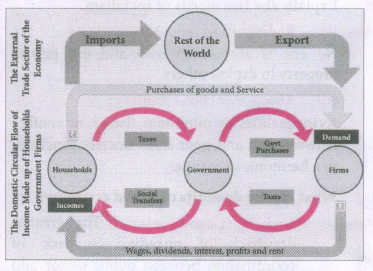
(7) In four sector economy, expenditure for the entire economy include domestic expenditure.
(C + I + G) and net exports (X-M)
(8) Therefore four sector model expressed as
y = C + I + G + (X-M)
23.
National Income:
(i) Measurement of national income and its composition by sectors are the basic aspects of macro economic analysis.
(ii) It gives a long term understanding of the growth process of an economy.
Inflation:
(i) Estimating the general price level based on wholesale price, index, consumer price.
Business Cycle:
(i) Cyclical movements can be studied based on aggregate economic variables.
Poverty and Unemployment:
(i) Clear understanding about the magnitude of poverty and unemployment helps allocation of resources and adapting corrective measures.
Economic Growth:
(i) The growth and development of an economy and the factors determining them could be understood only through macro analysis.
Economic Policies:
(i) Macro Economics is used to frame economic policies.
(ii) Economic policies are used to solve the basic problems, to overcome the obstacles and to achieve growth.

12th Standard Syllabus & Materials
12th Standard
TN 12th Computer Applications களப்பெயர் முறைமை (DNS) Sample Question Papers Study Material - QB365 Set A
NEW12th Standard
TN 12th Computer Applications வலையமைப்பு எடுத்துக்காட்டுகள் மற்றும் நெறிமுறைகள் Sample Question Papers Study Material - QB365 Set A
NEW12th Standard
TN 12th Computer Applications கணினி வலையமைப்பு ஓர் அறிமுகம் Sample Question Papers Study Material - QB365 Set A
NEW12th Standard
TN 12th Computer Applications PHP-உடன் MySQL-ஐ இணைத்தல் Sample Question Papers Study Material - QB365 Set A



Tamilnadu Stateboard 12th Standard Subjects

Maths

Chemistry

Physics

Biology

Computer Science

Business Maths and Statistics
Economics

Commerce

Accountancy

History

Computer Applications
Biology
Computer Technology
Computer Applications
Computer Science
Business Maths and Statistics
Commerce
Economics
Maths
Chemistry
Physics
Computer Technology
History
Accountancy

Tamil

English

French
Tamilnadu Stateboard Standards
