
 100% FREE ACCESS
12th Standard Syllabus & Materials
12th Standard
TN 12th Computer Applications மின்னணு தரவு பரிமாற்றம் Sample Question Papers Study Material - QB365 Set A
NEW12th Standard
TN 12th Computer Applications மின் - வணிக பாதுகாப்பு அமைப்புகள் Sample Question Papers Study Material - QB365 Set A
NEW12th Standard
TN 12th Computer Applications மின்னணு செலுத்தல் முறைகள் Sample Question Papers Study Material - QB365 Set A
NEW12th Standard
TN 12th Computer Applications மின் - வணிகம் Sample Question Papers Study Material - QB365 Set A
NEW12th Standard
TN 12th Computer Applications திறந்த மூல கருத்துருக்கள் Sample Question Papers Study Material - QB365 Set A
NEW12th Standard
TN 12th Computer Applications வலையமைப்பு வடமிடல் Sample Question Papers Study Material - QB365 Set A

Published on: 09/10/2019
Fiscal Economics
Download Tamil Nadu 12th Standard Economics question papers, model tests, one-mark questions, important questions, and public exam papers in PDF format. Free study materials and answer keys for TN State Board students.
Questions + Answers key
Take MCQ Economics Test
1.
What are the main elements of a budget?
2.
Explain the balanced and unbalanced Bidget.
3.
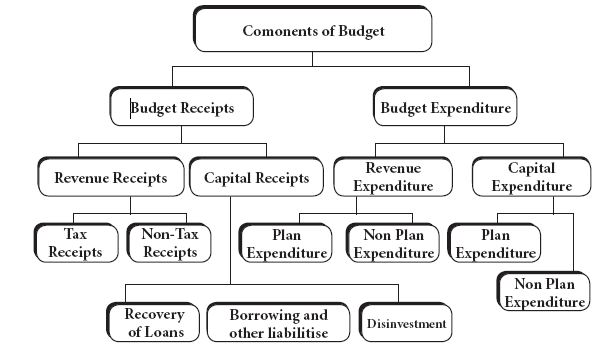
Draw the flow chart depicting components of budget
4.
Mention any three methods of redemption of public debt.
5.
What is primary deficit?
6.
Point out any three differences between direct tax and indirect tax.
7.
State any three characteristics of taxation.
8.
What are the functions of a modern state?
9.
Mention any three similarities between public finance and private finance.
10.
Describe Canons of Taxation.
1.
The following are the sources of revenue of village panchayats.
(i) general property tax,
(ii) taxes on land,
(iii) profession tax, and
(iv) tax on animals and vehicles.
2.
A. Balanced Budget
Balanced budget is a situation, in which estimated revenue of the government during the year is equal to its anticipated expenditure.
B. Unbalanced Budget
The budget in which Revenue & Expenditure are not equal to each other is known as Unbalanced Budget
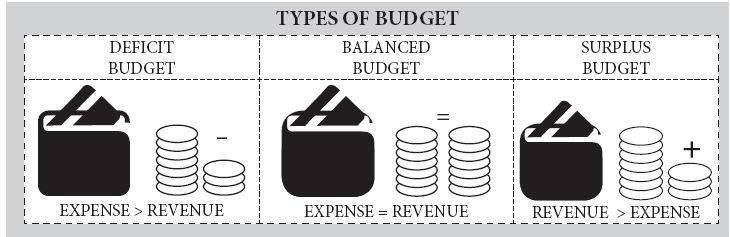
Unbalanced budget is of two types:
1. Surplus Budget
2. Deficit Budget
1. Surplus Budget
(i) The budget is a surplus budget when the estimated revenues of the year are greater than anticipated expenditures.
(ii) Government Estimated revenue > Estimated Government Expenditure.
2. Deficit Budget
(i) Deficit budget is one where the estimated government expenditure is more than expected revenue.
(ii) Government’s estimated Revenue < Government’s proposed Expenditure.
3.
4.
Introduction:
(i) The process of repaying a public debt is called redemption.
(a) Sinking Fund
(i) The Government establishes a separate fund into which every year a fixed amount of money is credited.
(ii) By the time the debt matures, the fund accumulates enough amount to pay off the principal along with interest.
(a) Conversion
(i) An old loan is converted into a new loan.
(ii) A high interest public debt is converted into a low interest public debt.
(c) Budgetary Surplus
(i) When the Government has a surplus budget, it can be used for repaying the debt.
5.
(i) Primary deficit is equal to fiscal deficit minus interest payments. PD = Fiscal deficit (FD) - Interest Payment (IP)
(ii) It shows the real burden of the government and it does not include the interest burden on loans taken in the past.
(iii) It shows the borrowing requirement of the government exclusive of interest payments.
6.
| SI.No | Direct Tax | Indirect Tax |
|---|---|---|
| 1. | Direct tax is levied on person's income and wealth and is paid directly to the government. | It is levied on a person who consumes the goods and services and is paid indirectly to government. |
| 2. | Progressive in nature | Regressive in nature |
| 3. | Falls on the same person. | Falls on different persons. |
| 4. | Burden cannot be shifted. | can be shifted |
| 5. | Tax evasion is possible. | Included in the price of the goods. |
7.
(i) A tax is a compulsory payment made to the government. Refusal to pay the tax is punishable.
(ii) There is no quid pro quo between a taxpayer and public authorities.
(iii) Tax payer cannot claim any specific benefit against the payment of a tax.
(iv) Every tax involves some sacrifice on the part of the tax payer.
(v) A tax is not levied as a fine or penalty for breaking law.
8.
Defence
1. The Government protects the people from external aggression and internal disorder.
2. Through police and military forces it renders protective services.
Judiciary:
1. It provides adequate judicial structure to render justice to all citizens.
Enterprises
1. The regulation and control of private enterprise comes under the government.
Social Welfare:
1. The state provides education, social security, social insurance, health and sanitation for the people.
Infrastructure
1. Modern States build the base for the economic development of the country by creating social and economic infrastructure.
Macro-economic policy
1. The Government follows fiscal policy and monetary policy to achieve macro economic goals.
Social Justice
1. During the process of growth certain sections of the economy gain at the cost of others.
2. Government intervenes with fiscal measures to redistribute income.
Control of Monopoly
1. State intervenes through control of monopolies and restrictive trade practices to curb concentration of economic power.
9.
Rationality
1. Both public finance and private finance are based on rationality.
2. Maximization of welfare and least cost factor combination underlie both.
Limit to borrowing
1. Both have to be restrained with borrowing.
2. Government cannot live beyond its means.
3. There is a limit to deficit financing by the state.
Resource utilisation
1. Both have to make optimum use of their limited resources.
Administration
1. If the administrative machinery is inefficient and corrupt it will result in wastages and losses.
10.
Canon of Ability
1. The Government should impose tax in such a way that the people have to pay taxes according to their ability.
2. Rich person should pay more tax.
Canon of Certainty
1. There is no uncertainty regarding the rate of tax or the time of payment.
Canon of Convenience
1. The method of tax collection and the timing of the tax payment should be convenient to the people.
Canon of Economy
1. The Government should impose only those taxes whose collection costs are very less and cheap.

12th Standard Syllabus & Materials
12th Standard
TN 12th Computer Applications களப்பெயர் முறைமை (DNS) Sample Question Papers Study Material - QB365 Set A
NEW12th Standard
TN 12th Computer Applications வலையமைப்பு எடுத்துக்காட்டுகள் மற்றும் நெறிமுறைகள் Sample Question Papers Study Material - QB365 Set A
NEW12th Standard
TN 12th Computer Applications கணினி வலையமைப்பு ஓர் அறிமுகம் Sample Question Papers Study Material - QB365 Set A
NEW12th Standard
TN 12th Computer Applications PHP-உடன் MySQL-ஐ இணைத்தல் Sample Question Papers Study Material - QB365 Set A



Tamilnadu Stateboard 12th Standard Subjects

Maths

Chemistry

Physics

Biology

Computer Science

Business Maths and Statistics
Economics

Commerce

Accountancy

History

Computer Applications
Biology
Computer Technology
Computer Applications
Computer Science
Business Maths and Statistics
Commerce
Economics
Maths
Chemistry
Physics
Computer Technology
History
Accountancy

Tamil

English

French
Tamilnadu Stateboard Standards
