
 100% FREE ACCESS
12th Standard Syllabus & Materials
12th Standard
TN 12th Computer Applications மின்னணு தரவு பரிமாற்றம் Sample Question Papers Study Material - QB365 Set A
NEW12th Standard
TN 12th Computer Applications மின் - வணிக பாதுகாப்பு அமைப்புகள் Sample Question Papers Study Material - QB365 Set A
NEW12th Standard
TN 12th Computer Applications மின்னணு செலுத்தல் முறைகள் Sample Question Papers Study Material - QB365 Set A
NEW12th Standard
TN 12th Computer Applications மின் - வணிகம் Sample Question Papers Study Material - QB365 Set A
NEW12th Standard
TN 12th Computer Applications திறந்த மூல கருத்துருக்கள் Sample Question Papers Study Material - QB365 Set A
NEW12th Standard
TN 12th Computer Applications வலையமைப்பு வடமிடல் Sample Question Papers Study Material - QB365 Set A

Published on: 20/01/2020
Download Tamil Nadu 12th Standard Economics question papers, model tests, one-mark questions, important questions, and public exam papers in PDF format. Free study materials and answer keys for TN State Board students.
Questions + Answers key
Take MCQ Economics Test
1.
The height of a child increases at a rate given in the table below. Fit the straight line using the method of least-square and calculate the average increase and the standard error of estimate.
| Month | 1 | 2 | 3 | 4 | 5 | 6 | 7 | 8 | 9 | 10 |
| Height: | 52.5 | 58.7 | 65 | 70.2 | 75.4 | 81.1 | 87.2 | 95.5 | 102.2 | 108.4 |
2.
List the major objectives of World Bank.
3.
What are the the Formula for computing Karl Pearson’s Coefficient of correlation?
4.
Consider M = Rs. 1000. M’ = Rs. 500, V = 3, V’ = 2, T = 4000 goods and Find the value of money using Fisher’s quantity theory of
5.
State the importance of the comparative advantage of international trade.
6.
What are the causes of land pollution? What are the remedial measures to control land pollution?
7.
What are the causes for the increase in public debt?
8.
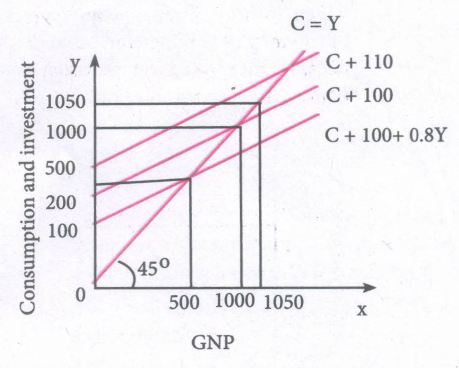
Explain Marginal propensity to consume and multiplier, with the help of a diagram.
9.
Comparison of Classicism and Keynesianism.
10.
Explain the merits of Mixed Economy.
11.
Discuss the economic determinants of economic development.
12.
Explain the methods of debt redemption.
13.
Bring out the functions of World Bank.
14.
Bring out the components of balance of payments account.
15.
Discuss the differences between Internal Trade and International Trade.
16.
Elucidate the functions of Commercial Banks
17.
Briefly explain the subjective and objective factors of consumption function?
18.
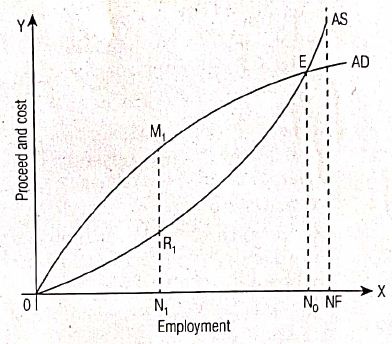
Narrate the equilibrium between ADF and ASF with diagram
19.
Discuss the various methods of estimating the national income of a country.
20.
1.
For Egression Calculations, we draw the following table
| Month(X) | Height(Y) | X2 | XY |
| 1 | 52.5 | 1 | 52.5 |
| 2 | 58.7 | 4 | 117.4 |
| 3 | 65.0 | 9 | 195.0 |
| 4 | 70.2 | 16 | 280.8 |
| 5 | 75.4 | 25 | 377.0 |
| 6 | 81.1 | 36 | 486.6 |
| 7 | 87.2 | 49 | 610.4 |
| 8 | 95.5 | 64 | 764.0 |
| 9 | 102.2 | 81 | 919.8 |
| 10 | 108.4 | 100 | 1084.0 |
| ΣX = 55 | ΣU = 796.2 | ΣX2 = 385 | ΣXY= 4887.5 |
Considering the regression line as Y = a + bX, we can obtain the values of a and b from the above values.
\(a=\frac { \sum { Y } \sum { X } ^{ 2 } }{ { N\sum { X } }^{ 2 }-{ (\sum { X } ) }^{ 2 } } \)
\(a=\frac { 796.2x385-55x4887.5 }{ 10x385-55x55 } \)
\(b=\frac { N\sum { XY-\sum { X } \sum { Y } } }{ N{ \sum { X } }^{ 2 }-{ (\sum { X } ) }^{ 2 } } \)
\(a=\frac { 10x4887.5-55x796.2 }{ 10x385-55x55 } \)
= 6.16
Hence the regression line can be written as
Y = 45.73 + 6.16x
2.
The following are the objectives of the World Bank:
1. To help member countries for economic reconstruction and development.
2. To stimulate long-run capital investment for restoring Balance of Payments (BoP) equilibrium and thereby ensure balanced development of international trade among the member nations.
3. To provide guarantees for loans meant for infrastructural and industrial projects of member nations.
4. To help war ravaged economies transform into peace economies.
5. To supplement foreign private investment by direct loans out of its own funds for productive purposes.
3.
1. \(r=\frac { N\sum { XY-(\sum { X } )(\sum { Y } ) } }{ \sqrt { { N\sum { X } }^{ 2 }-{ (\sum { X } ) }^{ 2 } } \sqrt { { N\sum { Y } }^{ 2 }-{ (\sum { Y } ) }^{ 2 } } } \)
'r' is calculated by Direct Method without taking deviation of terms either from actual mean or assumed mean.
2. r is calculated by taking the Deviation from acutual mean.
\(r=\frac { \sum { xy } }{ { N\sum { X } }^{ 2 }-{ \sum { Y } }^{ 2 } }Where X=(X-\bar { X } ),Y=(\bar { X } )\)
3. 'r' is calculated by taking assumed mean
\(r=\frac { N\sum { dxdy-(\sum { dx } )(\sum { dy } ) } }{ \sqrt { { N\sum { dx } }^{ 2 }-{ (\sum { dx } ) }^{ 2 } } \sqrt { { N\sum { dy } }^{ 2 }-{ (\sum { dy } ) }^{ 2 } } } \)
Where dx refers to deviations of x series from assumed mean (x-x̅), dy refers to
deviations of y series from an assumed mean of (y-y)
1. Σdxdy = Sum of product of the deviations x and y series from their assumed means.
2. Σdx2 = Sum of the squares of the deviations of x series from an assumed mean
3. Σdy2= Sum of the squares of the deviations of y series from an assumed mean
4. Σdx = Sum of the deviation of x series from an assumed mean of x
5. Σdy = Sum of the deviation of y series from an assumed mean of y
4.
P = \(\frac { MV+{ M }^{ 1 }{ V }^{ 1 } }{ T } \)
P = \(\frac { (1000\times 3)+(500\times 2) }{ 4000 } \)
= Rs. 1 Per good
Value of money (1/p) = 1
If the supply of money is double
P = \(\frac { (2000\times 3)+(1000\times 2) }{ 4000 } \)
= Rs. 2 Per good
Value of money (1/p) = 1/2
Thus, when money supply in doubled, i.e., increases from Rs. 4000 to 8000, the price level is doubled. i.e., from Re. 1 per good to Rs. 2 per good and the value of money is halved, i.e., from 1 to 1/2.
P = \(\frac { (500\times 3)+(250\times 2) }{ 4000 } \)
= Rs. 1 Per good
Value of money (1/p) = 1/2
Thus, when money supply is halved, i.e., decreases from Rs. 4000 to 2000, the price level is halved, i.e., from 1 to 1/2, and the value of money is doubled, i.e., from 1 to
5.
(i) The balance of aggregate demand and aggregate supply was first described.
(ii) The cost of goods is determined by the ratio of aggregate demand and supply for them, both domestically and from abroad;
(iii) He theory is true regarding any quantity of goods and any number of countries, as well as for the analysis of trade between different entities.
(iv) In this case, country specialization in some goods depends on the ratio of wage levels in each country;
(v) The theory based the existence of benefits from trade for all countries, taking part in it;
(vi) There become possible to develop foreign economic policy on the scientific foundation.
6.
Causes of Land Pollution:
(i) Deforestation and soil erosion: Deforestation carried out to create drylands is one of the major concerns.
(ii) Agricultural activities: With growing human and pet animal population, demand for food has increased considerably; Farmers often use highly toxic fertilizers and pesticides to get rid off insects, fungi and bacteria from their crops. However the overuse of these chemicals, results in contamination and poisoning of land.
(iii) Mining activities: During extraction and mining activities, several land spaces are created beneath the surface.
(iv) Landfills: Each household produces tones of garbage each year due to changing economic lifestyle of the people. Garbage like plastic, paper, cloth, wood and hospital waste get accumulated.
(v) Industrialization: Due to increasing consumerism more industries were developed which led to deforestation.
(vi) Construction activities: Due to urbanization, large amount of construction activities are taking place. This has resulted in large waste articles like wood, metal, bricks, plastic. These are dumped at the outskirts of urban areas that lead to land pollution.
(vii) Nuclear waste: The leftover radioactive materials, harmful and toxic chemicals affect human health. They are dumped beneath the earth to avoid any casualty.
Remedial measures to control Land Pollution
1. Making people aware about the concept of a Reduce, Recycle and Reuse
2. Buying biodegradable products
3. Minimizing the usage of pesticides
4. Shifting cultivation
5. Disposing unwanted garbage properly either by burning or by burying under the soil.
6. Minimizing the usage of plastics.
7.
(i) War and preparation for war:
Waging war has become one of the important causes for incurring debts by the governments.
(ii) Social obligation:
Modern states are considered to be 'welfare states' and they have to undertake many social obligations like public health, sanitation, education, insurance, transport and communications etc.
(iii) Economic development deficit:
(1) The government has to undertake many projects for economic development of the country.
(2) Construction of railways, power projects, irrigation projects, heavy industries etc. Employment: Most of the governments of modern days face the problem of unemployment and has become the duty to solve this by making huge public expenditure.
(v) Controlling inflation:
The government can withdraw excess money from circulation, by raising public debt and thus prevent prices from rising.
(vi) Fighting depression:
During the depression phase, private investment is lacking.
8.
(i) The propensity to consume refers to the portion of income spent on consumption.
MPC = \(\frac{ΔC}{ΔY}\)
(K) = \(\frac{1}{1-MPC}\)
(ii) The multiplier is the reciprocal of one minus marginal propensity to consume.
(iii) Multiplier is 1/MPS
(iv) The multiplier is therefore define as reciprocal of MPS.
(v) Multiplier is inversely related to MPS and directly with MPC.
Numerically, if MPC is 0.75, MPS is 0.25 and K is 4.
Using formula K = \(\frac{1}{1-MPC}\)
⇒\(\frac{1}{1-0.75}\) = 1/0.25 = 4
∴ Multiplier (K) = 4
| MPC | MPS | K |
|---|---|---|
| 1.00 | 1.00 | 1 |
| 0.10 | 1.90 | 1.11 |
| 0.50 | 0.50 | 2.00 |
| 0.75 | 0.25 | 4.00 |
| 0.90 | 0.10 | 10.00 |
| 1.00 | 0.00 | ∝ |
C = 100 + 0.8Y;
I = 10
Y = C + I
= 100 + 0.8 Y +9p00
.JPG)
0.2Y = 1000
∴ Y = 1000
Here, C = 100 + 0.8y
= 100 + 1000 = 900
S = 100 = I
After I is raised by 10, now I = 110
Y = 100 + 0.8y + 110
0.2y = 210
y = \(\frac{210}{0.2}\) = 1050
Here, C = 100 = 0.8 (1050) = 940,
S = 110 = I
(i) It implies the variables in axis-and axis are equal.
(ii) The MPC is assumed to be at 0.8. (C = 100 + 0.8y)
(iii) The aggregate demand (C + I) curve intersects 45° line at point E.
(iv) The new aggregate demand curve is
C + I = 100 + 0.8Y + 100 + 10
Y = \(\frac{210}{0.2}\)
C = 940; S = 110 = Z
9.
| S.No | Keynesianism | Classicism |
|---|---|---|
| 1. | Short-run equilibrium | Long-run equilibrium |
| 2. | Saving is a vice | Saving is a social virtue |
| 3. | The function of money is a medium of exchange on the one side and a store of value on the other side. | The function of money is to act as a medium of exchange |
| 4. | Macro approach to national problems | Micro foundation to macro problems |
| 5. | State intervention is advocated | Champions of Laissez-fair policy |
| 6. | Applicable to all situations - full employment and less than full employment. | Applicable only to the full employment situation |
| 7. | Capitalism has inherent contradictions | Capitalism is well and good |
| 8. | Budgeting should be adjusted to the requirements of economy. | Balanced budget |
| 9. | The equality between saving and investment is advanced through changes in income. | The equality between saving and investment is achieved through chances of rate of interest. |
| 10. | Rate of interest is determined by the demand for and supply of money. | Rate of interest is determined by saving and investment. |
| 11. | Rate of interest is a flow. | Rate of interest is a stock. |
| 12. | Demand creates its own supply. | Supply creates its own demand. |
| 13. | Rate of interest is a reward for parting with liquidity. | Rate of interest is a reward for saving. |
10.
(a) Rapid Economic Growth:
(i) It promotes rapid economic growth.
(ii) Thus both public requirements and private needs are taken care of.
(b) Balanced Economic Growth:
(i) Mixedism promotes balanced growth of the economy.
(ii) It promotes balanced growth between agriculture and industry.
(c) Proper utilization of Resources:
(i) The government can ensure proper utilization of resources.
(ii) The government controls must of the important activities directly.
(d) Economic Equality:
(i) The government uses progressive rates of taxation.
(ii) Income tax to bring about economic equality.
11.
Natural Resource:
(i) The existence of natural resources in abundance is essential for development.
(ii) But Japan, though it lacks natural resources imports them and achieves faster rate of economic development with the help of technology.
Capital Formation:
(i) Capital formation refers to the net addition to the existing stock of capital goods which are either tangible (plants, machinery) or intangible (health, education).
(ii) Capital formation helps increase productivity of labour, production and income.
(iii) Advanced techniques of production can be used and leads to better utilization of natural resources, industrialization and expansion of markets which are essential for economic progress.
Size of the Market:
(i) Large size of the market would stimulate production, increase employment and raise the National per capita income.
Structural Change:
(ii) Structural change refers to change in the occupational structure of the economy.
(iii) Any economy is divided into primary secondary and tertiary sector.
(iv) Any economy which is predominantly agricultural remains backward.
Financial System:
(i) Financial system implies the existence of an efficient and organized banking system in the country.
(ii) There should be an organized money market to facilitate easy availability of capital.
Marketable Surplus:
(i) It refers to the total amount of farm output cultivated by farmers over and above their family consumption needs.
(ii) This surplus brings income, raises purchasing power, employment and output in other sectors.
Foreign Trade:
(i) A country with favorable balance of trade is always developed.
Economic System:
(i) A country with free market system enjoys better growth rate compared to controlled economies.
12.
Introduction:
(i) The process of repaying a public debt is called redemption.
Sinking Fund
(i) The Government establishes a separate fund into which every year a fixed amount of money is credited.
(ii) By the time the debt matures, the fund accumulates enough amount to pay off the principal along with interest.
Conversion
(i) An old loan is converted into a new loan.
(ii) A high interest public debt is converted into a low interest public debt.
Budgetary Surplus
(i) When the Government has a surplus budget, it can be used for repaying the debt.
Terminal Annuity
(i) Government pays off debt on the basis of terminal annuity in equal annual instalments.
Repudiation
(i) Government does not recognise its obligation to repay the loan.
(ii) But in normal case the Government does not do so; if done it will lose its credibility.
Reduction in Rate of Interest
(i) During financial crisis there is compulsory reduction in the rate of interest.
Capital Levy
(i) When Government imposes levy on the capital assets owned by an individual or any institution, it is called capital levy.
(ii) This levy is imposed on capital assets above a minimum limit on a progressive scale.
(iii) The fund so collected can be used by the Government for paying off war time debt.
13.
Investment for productive purposes
(i) World Bank helps in reconstruction and development of territories of member nations through investment for productive purposes.
(ii) It encourages the development of productive facilities and resources in less developed countries.
Balanced growth of international trade
(i) Promoting the long range balanced growth of trade at international level and the maintaining equilibrium in BoPs of member nations by encouraging international investment.
Provision of loans and guarantees
(i) Arranging the loans or providing guarantee on loans by various other channels and execute important projects.
Promotion of foreign private investment
(i) This is done by means of guarantees on loans and other investment made by private investors.
(ii) The Bank supplements private investment by providing finance for productive purpose out of its own resources or from borrowed funds.
Technical services
(i) The World Bank facilitates different kinds of technical services to the member countries through Staff College and experts.
14.
Introduction
(i) The credit and debit items are shown vertically in the BoP account of a country.
(ii) Horizontally, they are divided into 3 components.
Current Account
(i) It includes all international trade transactions of goods and services, international service transactions (tourism, transportation, royalty fees) and international unilateral transfers (gifts, foreign aid).
Capital Account
(i) Financial transactions consisting of direct investment and purchases of interest bearing financial instruments, non interest bearing demand deposits and gold are included.
Official Reserve Assets Account
(i) Consist of movements of international reserves by governments and official agencies to accommodate imbalances arising from the current and capital accounts.
(ii) The official reserve assets include its gold stock, holdings of its convertible foreign currencies, SDR and its net position in the IMIF.
15.
| S.No |
Internal Trade |
International Trade |
|---|---|---|
| 1 | Trade takes place between different individual and firms within the same nation. | Trade takes place between different individual and firms in different countries. |
| 2 | Labour and capital move freely from one region to another. | Labour and capital do not move easily from one nation to another. |
| 3 | Free flow of goods and services since there are no restrictions. | Goods and services do not easily move from one country to another because of tariff and quota. |
| 4 | There is only one common currency. | There are different currencies. |
| 5 | Physical and geographical conditions of a country are similar. | There are differences in physical and geographical conditions of the two countries. |
| 6 | Trade and financial regulations are same. | Trade and financial regulations, interest rate, trade laws differ between countries. |
| 7 | No difference in political affiliations, customs and habits of the people and government policies. | There are lot of differences in political affiliation, habits, customs of the people and government policies. |
16.
Introduction
The functions of commercial banks are broadly classified into primary, and secondary functions
1) Primary Functions:
Accepting Deposits
Demand Deposits
1. It refers to deposits that can be withdrawn by individuals without any prior notice to the bank.
2. Depositors can withdraw money at any time by writing a withdrawal slip or a cheque or from ATM centres
Time Deposits
1. It refers to deposits that are made for certain committed period of time.
2. It has higher interest.
3. Deposits can be withdrawn only after a specific time period
Advancing Loans
1. Banks grant loans to individuals and businesses in the form of overdraft, cash credit and discounting bills of exchange.
2) Secondary Functions
Agency Functions
1. Commercial banks act as agents of customers by performing various functións.
Collecting Cheques
1. Banks collect cheques and bills of exchange on behalf of their customers through clearing house facilities provided by the central bank.
Collecting Income
1. Banks collect dividends, pension, salaries, rents and interests on investment on behalf of their customers.
2. A credit voucher is sent to customers for information when any income is collected by the bank.
Paying Expenses
1. Telephone bills, insurance premium, school fees and rents can be paid through banks.
2. A debit voucher is sent to customers for information when expenses are paid by the bank.
3) General Utility Functions
Providing Locker Facilities
1. Locker is provided for safe custody of jewellery, shares, debentures and other valuable items.
2. This minimizes the risk of loss due to theft at home.
Issuing Traveller's Cheques
1. Banks issue traveller's cheques to individuals for travelling outside the country.
2. These cheques are safe and easy way to protect money.
Dealing in Foreign Exchange
1. Banks provide foreign exchange to businessmen dealing in exports and imports.
2. But they need to take the permission of the Central Bank for dealing in foreign exchange.
4) Transferring Funds
1. Funds are transferred by means of draft, telephonic transfer and electronic transfer.
5) Letter of Credit
1. Commercial banks issue letters of credit to their customers to certify their credit worthiness.
Underwriting Securities
1. As public have full faith in the credit worthiness of banks, public do not hesitate in buying the securities underwritten by banks.
Electronic Banking
1. It includes services, such as debit cards, credit cards and Internet banking.
6) Other Functions
Money Supply
E.g: A bank lends Rs.5 lakh to an individual and opens a demand deposit in the name of that individual.
1. Bank makes a credit entry of 25 lakh in that account.
2. This leads to creation of demand deposits in that account.
3. Thus, without printing additional money, the supply of money is increased.
Credit Creation
1. It means the multiplication of loans and advances
2. Banks receive deposits from the public and use these deposits to give loans.
3. However, loans offered are many times more than the deposits received by banks.
Collection of Statistics
1. Banks collect and publish statistics relating to trade, commerce and industry and advice customers and public authorities on financial matters.
17.
Introduction
J.M Keynes has divided factors influencing the consumption function into two namely Subjective factors and Objective factors
Subjective Factors
These factors are internal and related to psychological feelings. Keynes lists 8 motives which lead individuals to refrain from spending
Motive of precaution
To build a reserve against unforeseen contingencies. (eg.) Accidents
Motive of foresight
The desire to provide for anticipated future needs. (eg.) Old age
Motive of calculation
The desire to enjoy interest and appreciation.
Motive of improvernent
(i) The desire to enjoy for improving standard of living.
(ii) Motive of financial independence
(iii) Motive of enterprise - desire to do forward trading
(iv) Motive of pride - desire to leave a fortune
(v) Motive of avarice - miserly instinct
(vi) The government institutions, business corporations and firms may also consume mainly because of:
Motive of enterprise
The desire to get resources to carry out further capital investment without debt.
Motive of liquidity
The desire to secure liquid resources to meet emergency
Motive of improvement
The desire to secure a rising income and to demonstrate successful management
Motive of financial prudence
The desire to ensure adequate financial provision against depreciation, obsolescence and to discharge debt.
Objective Factors
They are the external factors which are real and measurable. They can be easily changed in the long run;
Income Distribution
According to VKRV Rao if incone is equally distributed propensity to consume increases
Price level
When price falls, real income rises; people consume more and save more.
Wage level
Consumption expenditure increases with a rise in wages.
Interest rate
Higher interest rate will encourage people to save more money and reduces consumption.
Fiscal Policy
When government reduces tax, disposable income rises and propensity to consume increases.
Consumer credit
The availability of consumer credit at easy installments will encourage people to buy consumer durables like car, fridge, computer
Demographic factors
(i) Size of family, stage in family life cycle, place of residence and occupation affect the consumption pattern
Duesenberry hypothesis
(i) Consumption expenditure depends on current income, past income and standard of living
(ii) As individuals are accustomed to a particular standard of living, they continue to spend the same amount on consumption
(iii) Consumption of the poor people is influenced by the rich. This is called Demonstration effect.
Windfall gain and loss
Unexpected changes in the stock market leads to gain or loss, so consumption function shifts upward or downward.
Conclusion
According to Keynes only the subjective factors do not change in the short-run, so consumption function remains stable in the short period.
18.
Introduction
Under the Keynes theory of employment, a simple two sector economy consisting of the household sector and the business sector is taken to understand the equilibrium between ADF and ASF.
Explanation
1. AD and AS reach equilibrium at E. The employment level is No
2. At ON1employment, the aggregate supply is N1R1. But the aggregate demand is M1N1.
3. The expected level of profit is M1R1.
4. To attain this level of profit, entrepreneurs will employ more labourers, till they reach point E i.e. ONo.
5. Beyond ONo, the aggregate demand curve is below the aggregate supply curve showing loss.
6. So they will never employ more than ONo labour.
7. The equilibrium level of employment need not be the full employment level (No).
8. The difference between No - N1 is the level of unemployment.
Conclusion
Thus the concept of effective demand becomes significant in explaining the under employment equilibrium.
19.
Introduction:
(i) Whatever is produced is either used for consumption or for saving. So, national output can be computed at any of three levels, ie., production, income and expenditure.
(ii) Therefore there are three methods to measure national income.
Product Method (inventory method):
(i) This method measures the output of the country. Gross value of output from different sectors like agriculture, industry, trade, commerce is obtained by the summation of all the values added in the productive process.
(ii) In India, the gross value of the farm output is obtained as follows:
(iii) Total production of 64 agriculture commodities is estimated. The output of each crop is measured by multiplying the area sown by the average yield per hectare.
(iv) Total output of each commodity is valued at market prices.
(v) The aggregate value of total output of these 64 commodities is taken to measure the gross value of agricultural output.
(vi) The net value of the agricultural output is measured by making deductions for the cost of seed, manures and fertilizers, market charges.
(vii) Net value of each sector is measured in this way.
(viii) Double counting should be avoided.
(ix) Value of output used for self consumption should be counted but sale and purchase of second hand durable goods should be excluded.
Income Method (Factor Earning Method):
(i) National income is calculated by adding up all the incomes generated while producing national product.
(ii) Enterprises are classified into industrial groups.
(iii) Factor incomes are grouped under labour income (wages, salaries, fringe benefits), capital income (profit, interest, dividend) and mixed income (farming, sole proprietorship).
\(\mathrm{Y}=\mathrm{w}+\mathrm{r}+\mathrm{i}+\pi+(\mathrm{R}-\mathrm{P})\)
(iv) Transfer payment, receipt from sale of second hand goods, windfall gains and corporate profit tax must not be included.
(v) Imputed value of rent for self occupied houses or offices and Imputed value of services provided by owners of production units are to be included.
Expenditure method (outlay method):
(i) The total expenditure incurred by the society in a particular year is added together.
(ii) It includes personal consumption expenditure (C), net domestic investment (I), Government expenditure on consumption (G) and net exports (X-M).
\(\mathrm{GNP}=\mathrm{C}+\mathrm{I}+\mathrm{G}+(\mathrm{X}-\mathrm{M})\)
(iii) Expenditure on second hand goods, purchase of shares and bonds, transfer payments and expenditure on intermediate goods should not be included.
Conclusion:
Output = Income = Expenditure
(i) This is because the three methods are circular in nature. So, if the 3 methods are done correctly this equation must hold.
20.

12th Standard Syllabus & Materials
12th Standard
TN 12th Computer Applications களப்பெயர் முறைமை (DNS) Sample Question Papers Study Material - QB365 Set A
NEW12th Standard
TN 12th Computer Applications வலையமைப்பு எடுத்துக்காட்டுகள் மற்றும் நெறிமுறைகள் Sample Question Papers Study Material - QB365 Set A
NEW12th Standard
TN 12th Computer Applications கணினி வலையமைப்பு ஓர் அறிமுகம் Sample Question Papers Study Material - QB365 Set A
NEW12th Standard
TN 12th Computer Applications PHP-உடன் MySQL-ஐ இணைத்தல் Sample Question Papers Study Material - QB365 Set A



Tamilnadu Stateboard 12th Standard Subjects

Maths

Chemistry

Physics

Biology

Computer Science

Business Maths and Statistics
Economics

Commerce

Accountancy

History

Computer Applications
Biology
Computer Technology
Computer Applications
Computer Science
Business Maths and Statistics
Commerce
Economics
Maths
Chemistry
Physics
Computer Technology
History
Accountancy

Tamil

English

French
Tamilnadu Stateboard Standards
