
 100% FREE ACCESS
12th Standard Syllabus & Materials
12th Standard
TN 12th Computer Applications மின்னணு தரவு பரிமாற்றம் Sample Question Papers Study Material - QB365 Set A
NEW12th Standard
TN 12th Computer Applications மின் - வணிக பாதுகாப்பு அமைப்புகள் Sample Question Papers Study Material - QB365 Set A
NEW12th Standard
TN 12th Computer Applications மின்னணு செலுத்தல் முறைகள் Sample Question Papers Study Material - QB365 Set A
NEW12th Standard
TN 12th Computer Applications மின் - வணிகம் Sample Question Papers Study Material - QB365 Set A
NEW12th Standard
TN 12th Computer Applications திறந்த மூல கருத்துருக்கள் Sample Question Papers Study Material - QB365 Set A
NEW12th Standard
TN 12th Computer Applications வலையமைப்பு வடமிடல் Sample Question Papers Study Material - QB365 Set A

Published on: 20/01/2020
Download Tamil Nadu 12th Standard Economics question papers, model tests, one-mark questions, important questions, and public exam papers in PDF format. Free study materials and answer keys for TN State Board students.
Questions + Answers key
Take MCQ Economics Test
1.
Enumerate the types of deficit and their meaning.
2.
General Utility Functions of RBI – Discuss.
3.
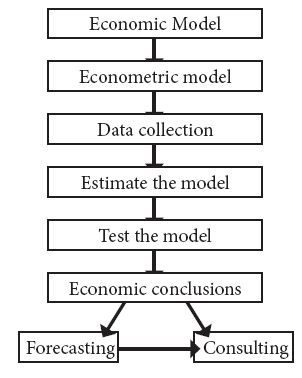
How an econometric model is done?
4.
List the wings of Programme Implementation.
5.
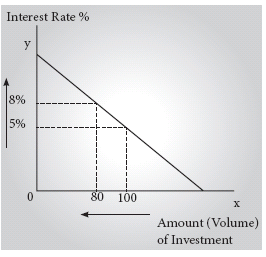
Draw the diagram depicting the Relationship between rate of interest and Investment.
6.
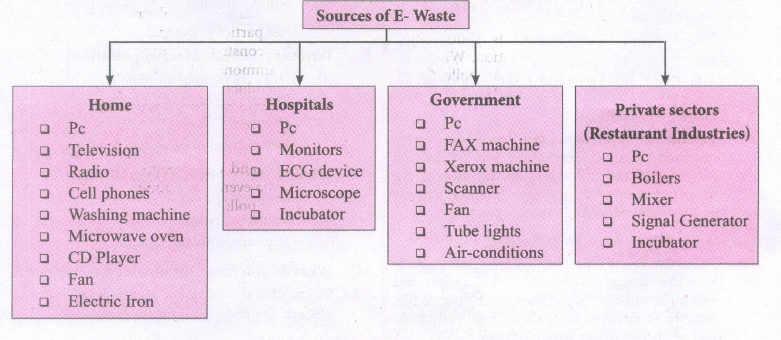
Draw the classification of sources of e-waster.
7.
What is Depreciation?
8.
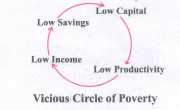
What is vicious circle of poverty?
9.
What are the four measures of Money Supply?
10.
Explain any two merits of socialism.
11.
What are the functions of Statistics?
12.
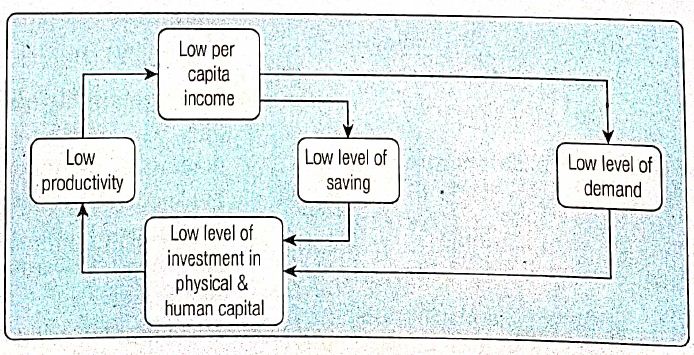
Elucidate major causes of vicious circle of poverty with diagram
13.
What are the functions of a modern state?
14.
What is Multilateral Agreement?
15.
Explain the Net Barter Terms of Trade and Gross Barter Terms of Trade.
16.
Specify the functions of IFCI.
17.
18.
Give short note on Expenditure method.
19.
Briefly explain the two sector circular flow model.
20.
Enumerate the features of mixed economy.
1.
| Types of Defieits | Concept / Meaning |
| Budgetary deficit | Total Revenue. Total Expenditure |
| Revenue Deficit | Revenue Receipts. Revenue Expenditure |
| Effective Revenue Deficit | Revenue Deficit. Grants for creation of capital asset |
| Fiscal Deficit | Total expenditure - (revenue receipts + non debt capital receipts) |
| Primary Deficit | Fiscal deficit. Interest payments |
2.
It implies that commercial banks provide some utility services to customers by performing various functions.
(i) Providing Locker Facilities
Commercial banks provide locker facilities to its customers for safe custody of jewellery, shares, debentures, and other valuable items. This minimizes the risk of loss due to theft at homes. Banks are not responsible for the items in the lockers.
(ii) Issuing Traveler’s Cheques
Banks issue traveler’s cheques to individuals for traveling outside the country. Traveler’s cheques are the safe and easy way to protect money while traveling.
(iii) Dealing in Foreign Exchange
Commercial banks help in providing foreign exchange to businessmen dealing in exports and imports. However, commercial banks need to take the permission of the Central Bank for dealing in foreign exchange.
3.
The following chart depicts how an economic model is done.
4.
The Programme Implementation Wing has three Divisions, namely,
(i) Twenty Point Programme
(ii) Infrastructure Monitoring and Project Monitoring
(iii) Member of Parliament Local Area Development Scheme.
5.
6.
7.
(i) The Depreciation cost (or) capital consumption refers to all those expenditure undertaken by the producers to replace the worn out parts of the capital goods like Machinery, tools, equipments and buildings used up in the production of goods and services.
(ii) These expenditure should be excluded from the Gross output
8.
According to Ragnar Nurkse, low capital formation is one of the basic causes of poverty in UDCs. Low capital formation leads to low productivity. Low productivity results in low income and low income result in low savings and low saving leads to low capital formation. Thus, it forms a vicious circle of poverty.
9.
M1 = Currency, Coins and demand deposits.
M2 = M1 + Saving deposits with post office savings banks.
M3 M2 + Time deposits of all commercial and cooperative banks.
M4 = M3 + Total deposits with post offices.
M1 and M2 are known as narrow money.
M3 and M4 are known as broad money.
The graduations are in decreasing order of liquidity.
10.
i) Reduction in inequalities:
No one is allowed to own and use private property to exploit others.
ii) Ab nee of class conflicts:
As inequalities are minimum, there is no conflict between rich and poor class. Society functions in a harmonious manner.
11.
(I) Statistics presents facts in a definite form.
(ii) It simplifies mass of figures.
(iii) It facilitates comparison.
(iv) It helps in formulating and testing.
(v) It helps in prediction.
(vi) It helps in the formulation of suitable policies.
12.
(i) The cause for vicious circle of poverty is demand and supply.
(ii) On the supply side, the low level of real income leads to low level of saving and investment and to deficiency of capital.
(iii) Deficiency of capital leads to low productivity and back to low income.
(iv) On the demand-side, low level of real income leads to low demand so investment is less, therefore deficiency of capital, low productivity and low income.
13.
Defence
1. The Government protects the people from external aggression and internal disorder.
2. Through police and military forces it renders protective services.
Judiciary:
1. It provides adequate judicial structure to render justice to all citizens.
Enterprises
1. The regulation and control of private enterprise comes under the government.
Social Welfare:
1. The state provides education, social security, social insurance, health and sanitation for the people.
Infrastructure
1. Modern States build the base for the economic development of the country by creating social and economic infrastructure.
Macro-economic policy
1. The Government follows fiscal policy and monetary policy to achieve macro economic goals.
Social Justice
1. During the process of growth certain sections of the economy gain at the cost of others.
2. Government intervenes with fiscal measures to redistribute income.
Control of Monopoly
1. State intervenes through control of monopolies and restrictive trade practices to curb concentration of economic power.
14.
(i) It is a multinational legal or trade agreements between countries.
(ii) It is an agreement between more than two countries but not many.
15.
Net Barter Terms of Trade
1. This was developed by Taussig in 1927.
2. The ratio between the prices of exports and of imports is called net barter terms of trade.
3. Viner calls it commodity terms of trade.
4. \(\mathrm{T}_{\mathrm{n}}=\left(\mathrm{P}_{\mathrm{x}} / \mathrm{P}_{\mathrm{m}}\right) \times 100\)
5. Tn is Net Barter Terms of Trade
6. Px is Index number of export prices
7. Pm is Index number of import prices
8. This measures the gain from International Trade.
9. If Tn is greater than 100, it is terms of trade which means that for a rupee of export, more of imports can be received by a country.
Gross Barter Terms of Trade
1. Developed by Taussig in 1927 as an improvement over the net terms of trade.
2. It is an index of relationship between total physical quantity of imports and the total physical quantity of exports.
\(\mathrm{Tg}=\left(\mathrm{Q}_{\mathrm{m}} / \mathrm{Q}_{\mathrm{x}}\right) \times 100\)
3. Qm is Index of import quantities
4. Qx is Index of export quantities
5. If for a given quantity of export, more quantity of import can be consumed by a country, the terms of trade are favourable.
16.
The IFCI does the following functions
(i) Providing long-term loans in rupees and foreign currencies.
(ii) Underwriting of equity, preference and debenture issues.
(iii) Subscribing to equity, preference and debenture issues.
(iv) Guaranteeing the deferred payments for machinery imported from abroad or purchased in India
(v) Guaranteeing of loans raised in foreign currency from foreign financial institutions.
17.
18.
(i) The total expenditure incurred by the society in a particular year is added.
(ii) It includes personal consumption expenditure (C), net domestic investment (I), Government expenditure on consumption and capital goods (G) and net exports (X - M).
\(\mathrm{GNP}=\mathrm{C}+\mathrm{I}+\mathrm{G}+(\mathrm{X}-\mathrm{M})\)
(iii) Second hand goods, purchase of shares and bonds, transfer payments and expenditure on intermediate goods must not be included.
19.
There are only two sectors - household sector and firm sector.
(i) Household Sector
1. It supplies the factors of production and gets income from the firm sector
2. It buys goods and services with its entire income.
(ii) Firms:
1. It hires factors of production from the household sector.
2. It gets revenue by selling goods and services to the household sectors.
3. The production and sales are equal.
Y = C + I
Y is income
C is consumption
I is investment
20.
(i) The means of production and properties are owned by private and public.
(ii) Public and Private Sectors co-exist private sectors are profit motivated and public sectors aims at maximum social welfare.
(iii) The national plans prepared by the central planning authority is accepted by all sectors.
(iv) Basic economic problems are solved through the price mechanism and state intervention.
(v) Though the private can own resources, produce and distribute goods and services, the overall control on the economic activities is with the government.

12th Standard Syllabus & Materials
12th Standard
TN 12th Computer Applications களப்பெயர் முறைமை (DNS) Sample Question Papers Study Material - QB365 Set A
NEW12th Standard
TN 12th Computer Applications வலையமைப்பு எடுத்துக்காட்டுகள் மற்றும் நெறிமுறைகள் Sample Question Papers Study Material - QB365 Set A
NEW12th Standard
TN 12th Computer Applications கணினி வலையமைப்பு ஓர் அறிமுகம் Sample Question Papers Study Material - QB365 Set A
NEW12th Standard
TN 12th Computer Applications PHP-உடன் MySQL-ஐ இணைத்தல் Sample Question Papers Study Material - QB365 Set A



Tamilnadu Stateboard 12th Standard Subjects

Maths

Chemistry

Physics

Biology

Computer Science

Business Maths and Statistics
Economics

Commerce

Accountancy

History

Computer Applications
Biology
Computer Technology
Computer Applications
Computer Science
Business Maths and Statistics
Commerce
Economics
Maths
Chemistry
Physics
Computer Technology
History
Accountancy

Tamil

English

French
Tamilnadu Stateboard Standards
