
 100% FREE ACCESS
12th Standard Syllabus & Materials
12th Standard
TN 12th Computer Applications மின்னணு தரவு பரிமாற்றம் Sample Question Papers Study Material - QB365 Set A
NEW12th Standard
TN 12th Computer Applications மின் - வணிக பாதுகாப்பு அமைப்புகள் Sample Question Papers Study Material - QB365 Set A
NEW12th Standard
TN 12th Computer Applications மின்னணு செலுத்தல் முறைகள் Sample Question Papers Study Material - QB365 Set A
NEW12th Standard
TN 12th Computer Applications மின் - வணிகம் Sample Question Papers Study Material - QB365 Set A
NEW12th Standard
TN 12th Computer Applications திறந்த மூல கருத்துருக்கள் Sample Question Papers Study Material - QB365 Set A
NEW12th Standard
TN 12th Computer Applications வலையமைப்பு வடமிடல் Sample Question Papers Study Material - QB365 Set A

Published on: 12/11/2019
Download Tamil Nadu 12th Standard Economics question papers, model tests, one-mark questions, important questions, and public exam papers in PDF format. Free study materials and answer keys for TN State Board students.
Questions + Answers key
Take MCQ Economics Test
1.
Fiscal federalism deals with ________.
The division of governmental functions
Financial relations among levels of government
Proper allocation of Resources
All of the above
2.
A Debit cardis a card allowing the holder to transfer money ______ from their bank account when making a purchase.
automatically
electronically
technically
none of the above
3.
According to the supply side of the vicious circle theory of development, a country is poor because
technology levels do not allow for self-sufficiency.
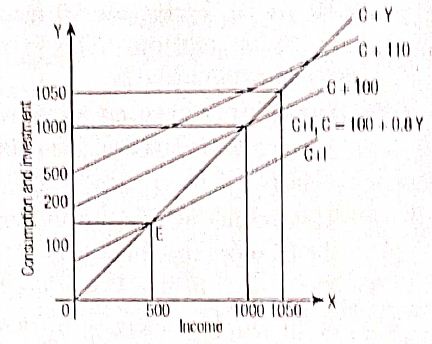
it was previously too poor to save and invest.
underemployment is too widespread
resource allocation is poor.
4.
The achievements of the fund can be summed up as ‘Fund is like an International Reserve Bank.’ Who said this
Haien
Firedman
Arrow
Lancaster
5.
The natural rate of unemployment equals the sum of those who are:
Frictionally and structurally unemployed
Frictionally and cyclically unemployed
Structurally and cyclically unemployed
Frictionally structurally and cyclically unemployed
6.
Scarcity induced inflation has happened in Venezula of the year ______.
2017
2018
2016
2008
7.
Which is not a character of descriptive statistics?
It describes the population under study
It uses hypotheses, testing and predicting on the basis of the outcome
It presents the data in a meaningful way through charts, diagrams, graphs, other than describing in words
It gives the summary of data
8.
The Heckscher-Ohlin model rules out the classical model’s basis for trade by assuming that________ is (are) identical between countries
factor endowments
factor intensities
technology
opportunity costs
9.
Which of the following amount is available for households for their consumption?
Disposable Income
Personal Income
Percapita Income
None of above
10.
A noisy party that keeps neighbors awake is an example of a
negative production externality
positive production externality
negative consumption externality
positive consumption externality
11.
Match the items in the List – I with items in List – II. Select the correct answer from the code given below:
| List - I | List - II |
| I. Y | 1. C + IA + IP |
| II. (β) | 2. ΔI / ΔC |
| III. K | 3. 1/1 - MPC |
| IV. MPS | 4. ΔS / ΔY |
| I | II | III | IV |
| 3 | 2 | 1 | 4 |
| I | II | III | IV |
| 2 | 4 | 1 | 3 |
| I | II | III | IV |
| 2 | 4 | 1 | 3 |
| I | II | III | IV |
| 2 | 3 | 4 | 1 |
12.
Assertion: Planning is an integral part of a Capitalist economy.
Reason: In socialist system, all decisions are undertaken by the central planning authority
Both (A) and (R) are true and (R) is the correct explanation of (A).
Both (A) and (R) are true, but (R) is not the correct explanation of (A)
(A) is true, but (R) is false
(A) is false, but (R) is true
13.
Sarvodaya Plan was advocated by__________
Mahatma Gandhi
J.P.Narayan
S.N Agarwal
M.N. Roy
14.
The major contributor of Carbon monoxide is
Automobiles
Industrial process
Stationary fuel combustion
None of the above
15.
ASEAN meetings are held once in every _______ years
2
3
4
5
16.
Exchange rates are determined in
money market
foreign exchange market
stock market
capital market
17.
Who will act as the banker to the Government of India?
SBI
NABARD
ICICI
RBI
18.
According to Keynes, investment is a function of the MEC and ____.
Demand
Supply
Income
Rate of interest
19.
If every able bodied person who is willing to work at the prevailing wage rate is employed called _______.
Full employment
Under employment
Unemployment
Employment opportunity
20.
Who is regarded as Father of Modern Macro Economics?
Adam Smith
J M Keynes
Ragnar Frisch
Karl Marx
21.
Write a note on Indian Finance Commission.
22.
Discuss Cheap and Dear Money policy.
23.
What are the functions of the ASEAN?
24.
Discuss the features of Capitalist economy.
25.
Discuss the Iimitations of National Income as an index of economic welfare.
26.
Explain non-economic factors determining development?
27.
Explain other types of inflation (on the basis of inducement).
28.
29.
30.
Explain the importance of sustainable development and its goals.
31.
State and explain instruments of fiscal policy.
32.
33.
Illustrate the working of Multiplier.
34.
Describe the types of unemployment.
35.
Define GDP in broad terms
36.
“Super Multiplier” – Define.
37.
Mention the any three Socialist Learning economies.
38.
Why was the SDR created?
39.
Define Comparative Cost Advantage.
40.
Define Correlation.
41.
Define economic development
42.
43.
Define inflation.
44.
Define average propensity to save (APS).
45.
Compare the dissimilarities of Repo Rate and Reverse Repo Rate.
46.
Write a short note on TRIMs
47.
Explain the types of water pollution.
48.
What are the Determinants of Exchange Rates?
49.
What are the difficulties in measuring National Income?
50.
Outline major demerits of capitalism.
51.
State and explain the different kinds of Correlation
52.
Elucidate major causes of vicious circle of poverty with diagram
53.
State any three characteristics of taxation.
54.
State Cambridge equations of value of money.
1.
(a)
The division of governmental functions
2.
(b)
electronically
3.
(b)
it was previously too poor to save and invest.
4.
(a)
Haien
5.
(a)
Frictionally and structurally unemployed
6.
(b)
2018
7.
(b)
It uses hypotheses, testing and predicting on the basis of the outcome
8.
(c)
technology
9.
(a)
Disposable Income
10.
(c)
negative consumption externality
11.
(d)
| I | II | III | IV |
| 2 | 3 | 4 | 1 |
12.
(d)
(A) is false, but (R) is true
13.
(b)
J.P.Narayan
14.
(a)
Automobiles
15.
(b)
3
16.
(b)
foreign exchange market
17.
(d)
RBI
18.
(d)
Rate of interest
19.
(a)
Full employment
20.
(b)
J M Keynes
21.
(i) Finance Commission aims to reduce the fiscal imbalances between the centre and the states (Vertical imbalance) and also between the states (horizontal imbalance). It promotes inclusiveness.
(ii) A Finance Commission is set up once in every 5 years. It is normally constituted two years before the period. It is a temporary Body.
(iii) The 14th Finance Commission was set up in 2013. Its recommendations were valid for the period from 1st April 2015 to 31st March 2020.
(iv) The 15th Finance Commission has been set up in November 2017. Its recommendations will be implemented starting 1 April 2020
22.
A. Monetary Policy: Expansionary Vs. Contractionary
Expansionary policy
i. Expansionary policy is cheap money policy when a monetary authority uses its tools to stimulate the economy.
ii. An expansionary policy maintains short-term interest rates at a lower than usual rate or increases the total supply of money in the economy more rapidly than usual.
iii. It is traditionally used to try to combat unemployment by lowering interest rates in the hope that less expensive credit will entice businesses into expanding.
iv. This increases aggregate demand (the overall demand for all goods and services in an economy), which boosts short-term growth as measured by gross domestic product (GDP) growth.
The Contractionary
i. The Contractionary monetary policy is dear money policy, which maintains short-term interest rates higher than usual or which slows the rate of growth in the money supply or even shrinks it.
ii. This slows short-term economic growth and lessens inflation.
iii. Contractionary monetary policy can lead to increased unemployment and depressed borrowing and spending by consumers and businesses, which can eventually result in an economic recession if implemented too vigorously.
B. The Two Faces of Monetary Policy
| Cheap Money Policy for Inflation |
Dear Money Policy for Recession |
| 1. Borrowing is easy | 1. Borrowing is difficult |
| 2. Consumers buy more | 2. Consumers buy less |
| 3. Businesses expand | 3. Businesses Postpone expansion |
| 4. More people are employed | 4. Unemployment increases |
| 5. People spend more | 5. Production is reduced |
23.
(i) It facilitates free movement of goods, services and investments within ASEAN by creating a single regional market like the European Union.
(ii) It provides free access to the marketers of one member country to the markets of all other member countries, thus fostering growth in the region.
(iii) It improves business competitiveness between businesses from different countries and also narrow developmental gaps between member countries.
(iv) It paves way for market and investment opportunities for the member nations.
(v) It fosters co-operations in many areas including industry and trade.
24.
1. Private Ownership of Property and Law of Inheritance: The basic feature of capitalism is that all resources namely, land, capital, machines, mines etc. are owned by private individuals. The owner has the right to own, keep, sell or use these resources according to his will. The property can be transferred to heirs after death.
2. Freedom of Choice and Enterprise: Each individual is free to carry out any occupation or trade at any place and produce any commodity. Similarly, consumers are free to buy any commodity as per their choice
3. Profit Motive: Profit is the driving force behind all economic activities in a capitalistic economy. Each individual and organization produce only those goods which ensure high profit. Advance technology, division of labour, and specialisation are followed. The golden rule for a producer under capitalism is ‘to maximize profit.’
4. Free Competition: There is free competition in both product and factor market. The government or any authority cannot prevent firms from buying or selling in the market. There is competition between buyers and sellers.
5. Price Mechanism: Price mechanism is the heart of any capitalistic economy. All economic activities are regulated through price mechanism i.e, market forces of demand and supply.
6. Role of Government: As the price mechanism regulates economic activity, the government has a limited role in a capitalistic economy. The government provides basic services such as, defense, public health, education, etc.
7. Inequalities of Income: A capitalist society is divided into two classes – ‘haves’ that is those who own property and ‘have-nots’ who do not own property and work for their living. The outcome of this situation is that the rich become richer and poor become poorer. Here, economic inequality goes on increasing.
25.
(i) The economic welfare depends upon the composition of a goods and services provided.
(ii) Higher GDP with greater environmental hazards such as air, water and soil pollution will be little economic welfare.
(iii) The production of war goods will show the increase in national output but not welfare.
(iv) An increase in per capita income may be due to. employment of women and children Dr forcing workers to. work for long hours. But it will not promote economic welfare.
(v) Therefore the physical quality of life index (PQLI) is considered a better indicator of economic welfare.
26.
1. Human Resources
(i) Human resource is named as human capital because of its power to increase productivity and thereby national income. There is a circular relationship between human development and economic growth.
(ii) If labour is efficient and skilled, its capacity to contribute to growth will be high. For example Japan and China.
2. Technical Know-how: As the scientific and technological knowledge advances, more and more sophisticated techniques steadily raise the productivity levels in all sectors.
3. Political freedom: The process of development is linked with the political freedom.
4. Social organization: People show interest in the development activity only when they feel that the fruits of development will be fairly distributed. Mass participation in development programs is a pre-condition for accelerating the development process.
5. Corruption free administration:
Corruption is a negative factor in the growth process. Unless the countries rootout corruption in their administrative system, the crony capitalists and traders will continue to exploit national resources. The tax evasion tends to breed corruption and hamper economic progress.
6. Desire for development:
The pace of economic growth in any country depends to a great extent on people's desire for development.
7. Moral, ethics and social values:
(i) These determine the efficiency of the market.
(ii) If people are not honest, market cannot function.
8. Casino Capitalism:
If People spend larger proportion of their income and time on entertainment liquor and other illegal activities, productive activities may suffer.
9. Patrimonial Capitalism:
If the assets are simply passed on to children from their parents, the children would not work hard, because the children do not know the value of the assets. Hence productivity will be low.
27.
(i) Currency Inflation:
The excess supply of money in circulation causes rise in price level.
(ii) Credit Inflation
When banks are liberal in lending credit, the money supply increases and thereby rising prices.
(iii) Deficit Induced Inflation:
The deficit budget is generally financed through printing of currency by the Central Bank. As a result, prices rise.
(iv) Profit Induced Inflation:
When the firms aim at higher profit, they fix the price with higher margin. So, prices go up.
(v) Scarcity Induced Inflation:
Scarcity of goods happens either due to fall in production (e.g. farm goods) or due to hoarding and black marketing.
(vi) TaxInducedInflation:
(1) Increase in indirect taxes like excise duty, custom duty and sales tax may lead to rise in price.
(2) This is also called taxflation.
28.
29.
30.
Introduction:
(i) Sustainable development is concerned with the welfare of the present and future generation.
(ii) It aims at satisfying the luxury wants of the rich and the basic necessities of the poor.
Definition:
(i) Sustainable development is development that meets the needs of the present without compromising the ability of future generations to meet their own needs.
Goals:
(i) It is crucial to harmonize three core elements such as economic growth, social inclusion and environmental protection.
(ii) A set of 17 goals for the world's future can be achieved before 2030 with three unanimous principles fixed by United Nations such as Universality, Integration and Transformation.
1) End poverty in all its forms everywhere.
2) End hunger, achieve food security and improved nutrition and promote sustainable agriculture.
3) Ensure healthy lives and promote wellbeing for all at all ages.
4) Ensure inclusive and quality education for all and promote lifelong learning.
5) Achieve gender equality and empower women and girls.
6) Ensure access to water and sanitation for all.
7) Ensure access to affordable, reliable, sustainable and modern energy for all.
8) Promote inclusive and sustainable economic growth, employment and decent work for all.
9) Build resilient infrastructure, promote, sustainable industrialization and foster innovation.
10) Reduce inequality within and among countries.
11) Make cities inclusive, safe, resilient and sustainable.
12) Ensure sustainable consumption and production pattern.
13) Take urgent action to combat climate change and its impacts
14) Conserve and sustainably use the oceans, seas and marine resources.
15) Sustainably manage forests, combat desertification, stop and reverse land degradation, stop biodiversity loss.
16) Promote just, peaceful and inclusive societies.
17) Revitalize the global partnership for sustainable development.
31.
(i) Fiscal Policy is implemented through fiscal instruments also called 'fiscal tools' or fiscal levers - Government expenditure, taxation and borrowing are the instruments of fiscal policy.
Taxation:
(i) Taxes transfer income from the people to the Government.
(ii) Taxes are direct or indirect.
(iii) An increase in tax reduces disposable income.
(iv) So tax should be raised to control inflation.
(v) During depression, taxes are to be reduced.
Public Expenditure:
(i) Public expenditure raises wages and salaries of the employees and so aggregate demand for goods rises.
(ii) So, public expenditure is raised during recession and reduced during inflation.
Public debt:
(i) When Government borrows by floating a loan, there is transfer of funds from the public to the Government.
(ii) At the time of interest payment and repayment of public debt, funds are transferred from Government to public.
32.
33.
Introduction
The concept of multiplier Was first developed by R.F. Khan in terms of employment. J.M Keynes redefined it as investment multiplier.
Definition
Multiplier is defined as the ratio of the change in national income to change in investment.
\(K=\Delta Y / \Delta I\)
The value of multiplier depends on MPC.
\(\mathrm{K}=\frac{1}{1-\mathrm{MPC}} \text { since } \mathrm{MPC}+\mathrm{MPS}=1\)
\(k=\frac{1}{N 118}\)
Multiplier is inversely related to MPS and directly with MPC.
If MPC is, 0.75, MPS is 0.25 then K=4.00
\(\frac{1}{1-0.75} \text { or } \frac{1}{0.25}=4\)
| MPC | MPS | k |
| 0.00 | 1.00 | 1 |
| 0.10 | 0.90 | 1.11 |
| 0.50 | 0.50 | 2.00 |
| 0.75 | 0.25 | 4.00 |
Working
(i) Suppose government undertakes investment expenditure equal to र100 cr on public works.
(ii) Income of labourers and suppliers of materials increases by र100 cr
(iii) If MPC is 0.8 that is 80 %. र80 cr is spent on consumption र20 cr salved
(iv) Suppliers of goods get an income of र80 cr. They spend र64 cr (ie 80% of र80 cr).
(v) In this manner consumption expenditure and increase in income act in a chain like manner.
34.
Cyclical unemployment:
(i) During the downturn phase (recession and depression) of trade cycle, income and output fall leading to cyclical unemployment.
(ii) It is caused by deficiency of effective demand
Structural unemployment:
(i) Unemployment due to massive and deep rooted changes in economic structure leads to structural unemployment.
(ii) Lack of demand for the product or shift in demand to other products cause this type of unemployment.
(iii) (e.g.) rise in demand for mobile phones has adversely affected the demand for cameras, tape recorders
Disguised unemployment:
(i) It occurs in agriculture when more people are there than required. Even if some workers are withdrawn, production does not suffer.
Actual marginal productivity is zero, less or negative.
(i) Seasonal unemployment
1. In agriculture and agro based industries like sugar, production activities are carried out only in some seasons.
2. These industries offer employment only during that season in a year.
3. People remain unemployed during the off season.
4. Seasonal unemployment takes place from demand side also (eg) ice cream industry, holiday resorts
(ii) Frictional unemployment (Temporary unemployment)
1. It arises due to imbalance between supply of labour and demand for labour.
2. It is because of immobility of labour, lack of necessary skills, break down of machinery, shortage of raw materials.
3. The persons who lose jobs and in search of jobs also come under frictional unemployment
(iii) Educated unemployment
1. Educated people are underemployed or unemployed when qualification does not match the job.
2. Faulty education system, lack of employable skills, mass student turnout and preference for white collar jobs are highly responsible for educated unemployment.
35.
(i) GDP stands for Gross Domestic Product. It represents the total market value of a country's output.
(ii) It is the market value of all final goods and services produced within a given period of time by factors of production located within a country.
36.
(i) Hicks has combined the k and β mathematically and given it the name of the Super Multiplier.
(ii) The super multiplier is worked out by combining both induced consumption and induced investment.
37.
1. North Korea
2. China
3. Venezuela
38.
i) The SDR (Special Drawing Right) was created for supplementary 'The World Reserve Currency (asset).
ii) Create global liquidity.
39.
According to Ricardo a country can gain from trade when it produces at relatively lower costs. Even when a country enjoys absolute advantage in both goods, the country would specialize inthe production and export of those goods which are relatively more advantageous.
40.
(i) Correlation is a statistical device that helps to analyse the covariation of two or more variables.
(ii) Correlation is the relationship between two or more variables which vary with the other in the same or the opposite direction.
41.
Development must, therefore, be conceived as a multidimensional process involving major changes in social structures, popular attitudes and national institutions and acceleration of growth, the reduction of inequality and the eradication of absolute poverty.
Michael P. Todaro
42.
43.
(i) "Too much of Money chasing too few goods" - Coulbourn
(ii) "A state of abnormal increase in the quantity of purchasing power" - Gregorye
44.
APS is the ratio of saving to income
APS = \(\frac{S}{Y}\)
45.
| BASIS | REPO RATE | REVERSE REPO RATE |
| Meaning | Repo rate is the rate at which the Central bank of India grants loan to the commercial banks for a short period against government securities | Reverse repo rate is the rate at which the commercial banks grant loan to the Central Bank of India. |
| Purpose | To fulfill the deficiency of funds | To ensure liquidity in the economy |
| Rate | High | Comparatively less. |
| Controls | Inflation | Money supply in the economy |
| Charged on | Repurchase Agreement | Reverse Repurchase Agreement. |
46.
Agreement on Trade Related Investment Measures (TRIMs)
(i) TRIMs are related to conditions or restrictions in respect of foreign investment in the country.
(ii) It calls for introducing equal treatment for foreign companies on par with national companies. TRIMs were widely employed by developing countries.
47.
(i) Surface water pollution:
Hazardous substances coming into contact with this surface water, dissolving or mixing. Physically with the water can be called surface water pollution.
(ii) Ground water pollution:
Ground water contamination occurs when man-made products such as gasoline, oil and chemical get into the ground water.
(iii) Microbiological pollution:
(1) Natural pollution caused by micro - organism like viruses and bacteria.
(2) This natural pollution causes both aquatic and human illness.
48.
Factors determining exchange rates are,
(i) Differentials in Inflation
(ii) Differential in Interest rates
(iii) Current Account Deficits
(iv) Public Debt
(v) Terms of Trade
(vi) Political and Economic Stability
(vii) Recession
(viii) Speculation
49.
(i) Transfer payments
(ii) Difficulties in assessing depreciation allowance.
(iii) Unpaid Services
(iv) Income from illegal activities.
(v) Production for self consumption and changing price.
(vi) Capital Gains
(vii) Statistical problems
50.
(i) Concentration of wealth and income
(ii) Wastage of Resources
(iii) Class struggle
(iv) Business cycle
(v) Production of non essential goods.
51.
Three of the most important ways of classifying correlation are:
(i) Based on the direction of change of variables
Positive Correlation:
(i) The correlation is said to be positive if the values of two variables move in the same direction.
(ii) Ex. Y = a + bx
Negative Correlation:
(i) When the values of variables move in the opposite directions.
(ii) Ex. Y = a - bx
(ii) Based on the number of variables studied.
Simple Correlation:
(i) If only two variables are taken for study.
Multiple Correlations:
(i) If three or more than three variables are studied simultaneously.
\(\operatorname{Ex}: Q_{d}=f\left(P, P_{v}, P, t, y\right)\)
Partial Correlation:
(i) If there are more than two variables but only two variables are considered keeping the other variables constant, then the correlation is said to be Partial Correlation.
(iii) Based on the constancy of the ratio of change between the variables
Linear Correlation:
(i) When on the amount of change in one variable tends to bear a constant ratio to the amount of change in the other.
(ii) Ex. Y = a + bx2
Non Linear:
(i) The amount of change in one variable does not bear a constant ratio to the amount of change in the other variables.
(ii) Ex. Y = a + bx2
52.
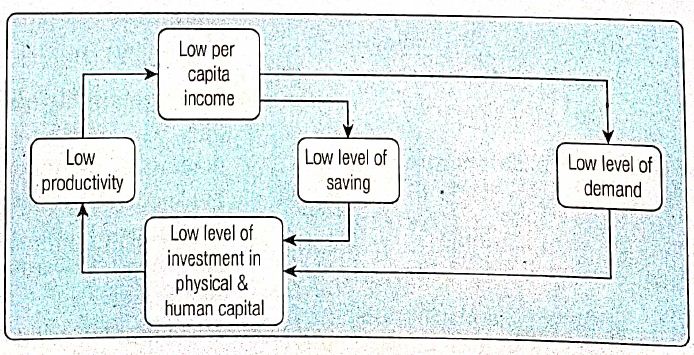
(i) The cause for vicious circle of poverty is demand and supply.
(ii) On the supply side, the low level of real income leads to low level of saving and investment and to deficiency of capital.
(iii) Deficiency of capital leads to low productivity and back to low income.
(iv) On the demand-side, low level of real income leads to low demand so investment is less, therefore deficiency of capital, low productivity and low income.
53.
(i) A tax is a compulsory payment made to the government. Refusal to pay the tax is punishable.
(ii) There is no quid pro quo between a taxpayer and public authorities.
(iii) Tax payer cannot claim any specific benefit against the payment of a tax.
(iv) Every tax involves some sacrifice on the part of the tax payer.
(v) A tax is not levied as a fine or penalty for breaking law.
54.
(i) The Marshall equation is
M = KPY where
(ii) M is the quantity of money
(iii) Y is the aggregate real income of the community
(iv) P is purchasing power of money
(v) K is the fraction of the real income which the public desires to hold in the form of money.
P= M / KY
(vi) The value of money is 1 / P = KY / M.

12th Standard Syllabus & Materials
12th Standard
TN 12th Computer Applications களப்பெயர் முறைமை (DNS) Sample Question Papers Study Material - QB365 Set A
NEW12th Standard
TN 12th Computer Applications வலையமைப்பு எடுத்துக்காட்டுகள் மற்றும் நெறிமுறைகள் Sample Question Papers Study Material - QB365 Set A
NEW12th Standard
TN 12th Computer Applications கணினி வலையமைப்பு ஓர் அறிமுகம் Sample Question Papers Study Material - QB365 Set A
NEW12th Standard
TN 12th Computer Applications PHP-உடன் MySQL-ஐ இணைத்தல் Sample Question Papers Study Material - QB365 Set A



Tamilnadu Stateboard 12th Standard Subjects

Maths

Chemistry

Physics

Biology

Computer Science

Business Maths and Statistics
Economics

Commerce

Accountancy

History

Computer Applications
Biology
Computer Technology
Computer Applications
Computer Science
Business Maths and Statistics
Commerce
Economics
Maths
Chemistry
Physics
Computer Technology
History
Accountancy

Tamil

English

French
Tamilnadu Stateboard Standards
