
 100% FREE ACCESS
12th Standard Syllabus & Materials
12th Standard
TN 12th Computer Applications மின்னணு தரவு பரிமாற்றம் Sample Question Papers Study Material - QB365 Set A
NEW12th Standard
TN 12th Computer Applications மின் - வணிக பாதுகாப்பு அமைப்புகள் Sample Question Papers Study Material - QB365 Set A
NEW12th Standard
TN 12th Computer Applications மின்னணு செலுத்தல் முறைகள் Sample Question Papers Study Material - QB365 Set A
NEW12th Standard
TN 12th Computer Applications மின் - வணிகம் Sample Question Papers Study Material - QB365 Set A
NEW12th Standard
TN 12th Computer Applications திறந்த மூல கருத்துருக்கள் Sample Question Papers Study Material - QB365 Set A
NEW12th Standard
TN 12th Computer Applications வலையமைப்பு வடமிடல் Sample Question Papers Study Material - QB365 Set A

Published on: 03/12/2019
International Economics
Download Tamil Nadu 12th Standard Economics question papers, model tests, one-mark questions, important questions, and public exam papers in PDF format. Free study materials and answer keys for TN State Board students.
Questions + Answers key
Take MCQ Economics Test
1.
_______ are determined in foreign exchange rate.
Rate of interest
Exchange rate
Net Exports
All the above
2.
Comparative cost advantages was developed by
Adam Smith
Ricardo
T.S.Mill
J.R.Hicks
3.
BOP includes
visible items only
invisible items only
both visible and invisible items
merchandise trade only
4.
Who among the following enunciated the concept of single factoral terms of trade?
Jacob Viner
G.S.Donens
Taussig
J.S.Mill
5.
Exchange rates are determined in
money market
foreign exchange market
stock market
capital market
6.
List the assumption of Adam smith trade theory.
7.
What is Foreign Exchange?
8.
Define Comparative Cost Advantage.
9.
What do you mean by Balance of Payments?
10.
11.
Discuss the elements of Automatic Correction in trade disequilibrium.
12.
What are the assumption of Modern theory international trade?
13.
List out the limitations of Modern Theory of International Trade?
14.
What are import quotas?
15.
Distinguish between Balance of Trade and Balance of Payments.
16.
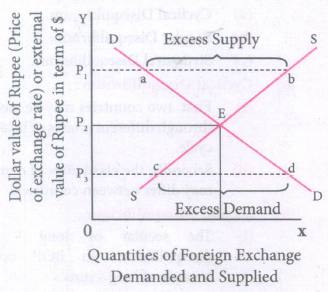
How the Rate of Exchange is determined? Illustrate.
17.
Explain the types of Terms of Trade given by Viner.
1.
(b)
Exchange rate
2.
(b)
Ricardo
3.
(c)
both visible and invisible items
4.
(a)
Jacob Viner
5.
(b)
foreign exchange market
6.
1. There are two countries and two commodities (2 x 2 model).
2. Labour is the only factor of production.
3. Labour units are homogeneous.
4. The cost or price of a commodity is measured by the amount of labour required to produce it.
5. There is no transport cost.
7.
(i) FOREX refers to foreign currencies.
(ii) It is the mechanism through which payments are effected between two countries having different currency systems.
8.
According to Ricardo a country can gain from trade when it produces at relatively lower costs. Even when a country enjoys absolute advantage in both goods, the country would specialize inthe production and export of those goods which are relatively more advantageous.
9.
(i) The balance between the values of goods and services exchanged between two countries.
(ii) It is a trade in both visible and non visible items.
10.
11.
1. Price Adjustments
As a result of foreign exchange outflow from a deficit country to a surplus country, there will be a fall in the money supply in the deficit country and increase in the money supply in the surplus country.
2. Interest Rate Adjustments
The contraction or expansion of money supply resulting from the BoP deficit or surplus leads to a rise or fall in the interest rates. A rise in interest rate in the deficit country will encourage investors to withdraw their funds from abroad and invest in their home country.
3. Income Adjustments
A nation with payments surplus will experience rising income which will increase imports and thereafter equilibrium is restored in Balance of Payments.
4. Capital Flows
Changes in the interest rate consequent to the BoP disequilibrium will encourage capital flows from the surplus nations to deficit nations helping restoration of the BoP equilibrium.
12.
1. There are two countries, two commodities and two factors. (2 x 2 x 2 model).
2. Countries differ in factor endowments.
3. Commodities are categorized in terms of factor intensity.
4. Countries use same production technology.
5. Countries have identical demand conditions.
6. There is perfect competition in both product and factor markets in both the countries.
13.
(i) Factor endowment of a country may change over time.
(ii) The efficiency of the same factor may differ in the two countries. For example: America may be labour scarce in terms of no. of workers
14.
(i) It is a trade restriction that sets a limit on the quantity of a good that can be imported into a country in a given period of time.
(ii) Quotas are used to benefit the producers of good in that economy.
15.
| S.No |
Balance of Trade |
Balance of Payments |
|---|---|---|
| 1 | Only export and import of commodities are included in BoT |
Export and import of commodities and services are included in BoP |
| 2 | i.e. Movement of goods or visible trade | Trade in both visible and non visible items. |
16.
(i) The equilibrium rate of exchange is determined in the foreign exchange market according to the general theory of value, by the interaction of demand and supply,
(ii) Y axis represents exchange rate, be cos value of rupee in terms of dollars
(iii) X axis represents demand and supply of forex.
(iv) E is the equilibrium point where DD intersects SS. The exchange rate is P2.
17.
Single Factoral Terms of Trade
(i) According to Viner, the single factoral terms of trade is an improvement over the commodity terms of trade.
(ii) It represents the ratio of export. price index to the import price index adjusted for changes in the productivity of factors in the production of exports.
\(\mathrm{T}_{\mathrm{f}}=\left(\mathrm{P}_{\mathrm{x}} / \mathrm{P}_{\mathrm{m}}\right) \mathrm{F}_{\mathrm{x}}\)
(iii) Tf is single factoral terms of trade index.
(iv) Fx is productivity in exports.
Double Factoral Terms of Trade
\(\mathrm{T}_{\mathrm{ff}}=\left(\mathrm{P}_{\mathrm{x}} / \mathrm{P}_{\mathrm{m}}\right)\left(\mathrm{F}_{\mathrm{x}} / \mathrm{F}_{\mathrm{m}}\right)\)
(i) It takes into account the productivity in country's exports and productivity of foreign factors.
(ii) Fm is import index (which is measured as index cost in terms of quantity of factors of production employed per unit) of imports.

12th Standard Syllabus & Materials
12th Standard
TN 12th Computer Applications களப்பெயர் முறைமை (DNS) Sample Question Papers Study Material - QB365 Set A
NEW12th Standard
TN 12th Computer Applications வலையமைப்பு எடுத்துக்காட்டுகள் மற்றும் நெறிமுறைகள் Sample Question Papers Study Material - QB365 Set A
NEW12th Standard
TN 12th Computer Applications கணினி வலையமைப்பு ஓர் அறிமுகம் Sample Question Papers Study Material - QB365 Set A
NEW12th Standard
TN 12th Computer Applications PHP-உடன் MySQL-ஐ இணைத்தல் Sample Question Papers Study Material - QB365 Set A



Tamilnadu Stateboard 12th Standard Subjects

Maths

Chemistry

Physics

Biology

Computer Science

Business Maths and Statistics
Economics

Commerce

Accountancy

History

Computer Applications
Biology
Computer Technology
Computer Applications
Computer Science
Business Maths and Statistics
Commerce
Economics
Maths
Chemistry
Physics
Computer Technology
History
Accountancy

Tamil

English

French
Tamilnadu Stateboard Standards
