
 100% FREE ACCESS
12th Standard Syllabus & Materials
12th Standard
TN 12th Computer Applications மின்னணு தரவு பரிமாற்றம் Sample Question Papers Study Material - QB365 Set A
NEW12th Standard
TN 12th Computer Applications மின் - வணிக பாதுகாப்பு அமைப்புகள் Sample Question Papers Study Material - QB365 Set A
NEW12th Standard
TN 12th Computer Applications மின்னணு செலுத்தல் முறைகள் Sample Question Papers Study Material - QB365 Set A
NEW12th Standard
TN 12th Computer Applications மின் - வணிகம் Sample Question Papers Study Material - QB365 Set A
NEW12th Standard
TN 12th Computer Applications திறந்த மூல கருத்துருக்கள் Sample Question Papers Study Material - QB365 Set A
NEW12th Standard
TN 12th Computer Applications வலையமைப்பு வடமிடல் Sample Question Papers Study Material - QB365 Set A

Published on: 06/01/2020
Introduction to Macro Economics
Download Tamil Nadu 12th Standard Economics question papers, model tests, one-mark questions, important questions, and public exam papers in PDF format. Free study materials and answer keys for TN State Board students.
Questions + Answers key
Take MCQ Economics Test
1.
A steady fall in general price level is termed as ___________.
Deflation
Inflation
Trade
To achieve growth
2.
Identify The Father of Socialism
J M Keynes
Karl Marx
Adam Smith
Samuelson
3.
The country following Capitalism is ________________
Russia
America
India
China
4.
Indicate the fundamental economic activities of an economy
Production and Distribution
Production and Exchange
Production and Consumption
Production and Marketing
5.
A steady increase in general price level is termed as_____________.
wholesale price index
Business Cycle
Inflation
National Income
6.
What is Economic Policies?
7.
Who is the controll authority of socialistic economy?
8.
Write down the three types of economic systems.
9.
Classify the economies based on status of development.
10.
11.
Explain are the Demerits of Capitalism.
12.
Write the basis how Economies can be classified into different types.
13.
What are the limitation of Macro Economics.
14.
Enumerate the features of mixed economy.
15.
Describe the different types of economic systems.
16.
Explain the concepts of macro economics.
17.
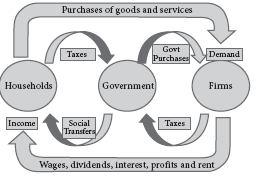
Explain the three sector model of economy with chart.
18.
Compare the features among Capitalism, Secularism and Mixedism
19.
Discuss the scope of Macro Economics.
1.
(a)
Deflation
2.
(b)
Karl Marx
3.
(b)
America
4.
(c)
Production and Consumption
5.
(c)
Inflation
6.
Economic policies are necessary to solve the basic problems to overcome the obstacles and to achieve growth.
7.
(i) Central planning authority is the controlling authority in a socialistic economy.
(ii) All the decisions are under taken by the central planning authority.
(iii) It means all factors of production are nationalized and managed by public authority.
8.
(i) Capitalistic Economy (Capitalism)
(ii) Socialistic Economy (Socialism)
(iii) Mixed Economy (Mixedism)
9.
Economies can be classified into different types based on the Status of Development are
1. Developed
2. Underdeveloped
3. Undeveloped and
4. Developing economies
10.
11.
1. Concentration of Wealth and Income: Capitalism causes concentration of wealth and income in a few hands and thereby increases inequalities of income.
2. Wastage of Resources: Large amount of resources are wasted on competitive advertising and duplication of products.
3. Class Struggle: Capitalism leads to class struggle as it divides the society into capitalists and workers.
4. Business Cycle: Free market system leads to frequent violent economic fluctuations and crises.
5. Production of non essential goods: Even the harmful goods are produced if there is possibility to make profit.
12.
1. Status of Development: Developed, underdeveloped, undeveloped and developing economies.
2. System of Activities: Socialistic and Mixed Economies.
3. Scale of Activities: Small and Large Economies.
4. Nature of Functioning: Static and Dynamic Economies.
5. Nature of Operation: Closed and Open Economies.
6. Nature of Advancement: Traditional and Modern Economies.
7. Level of National Income: Low Income, Middle Income and High Income Economiesapitalistic
13.
Macro economics suffers from certain limitation. They are
(i) There is a danger of excessive generalisation of the economy as a whole.
(ii) It assumes homogeneity among the individual units.
(iii) There is a fallacy of composition. What is good of an individual need not be good for nation and viceversa and, what is good for a country is not good for another country and at another time.
14.
(i) The means of production and properties are owned by private and public.
(ii) Public and Private Sectors co-exist private sectors are profit motivated and public sectors aims at maximum social welfare.
(iii) The national plans prepared by the central planning authority is accepted by all sectors.
(iv) Basic economic problems are solved through the price mechanism and state intervention.
(v) Though the private can own resources, produce and distribute goods and services, the overall control on the economic activities is with the government.
15.
Capitalism:
(i) The means of production are privately owned.
(ii) Manufacturers produce goods and services with profit motive.
(iii) Individual can take up any occupation and develop any skill. E.g. USA.
Socialism:
(i) All resources are owned and operated by the government.
(ii) Public welfare is the main motive.
(iii) There is equality in the distribution of income and wealth. E.g. China
Mixedism:
(i) Both private and public sectors co-exist and work together.
(ii) Resources are owned by individuals and the government. E.g. India
16.
The important concepts used in macro economics are presented below:
(i) Stock and Flow Variables: Variables used in economic analysis are classified as stock and flow. Both stock and flow variables may increase or decrease with time.
(ii) Stock refers to a quantity of a commodity measured at a point of time. In macro economics, money supply, unemployment level, foreign exchange reserves, capital etc are examples of stock variables.
(iii) Flow variables are measured over a period of time. National Income, imports, exports, consumption, production, investment etc are examples of flow variables.
(iv) Economic Models: A model is a simplified representation of real situation. Economists use models to describe economic activities, their relationships and their behaviour. A model is an explanation of how the economy, or part of the economy, works. Most economic models are built with mathematics, graphs and equations, and attempt to explain relationships between economic variables. The commonly used economic models are the supply demand models and circular flow models and Smith models
17.
1. In addition to household and firms, inclusion of the government sector makes this model a three-sector model.
2. The government levies taxes on households and firms, purchases goods and services from firms, and receive factors of production from household sector.
3. On the other hand, the government also makes social transfers such as pension, relief, subsidies to the households.
4. Similarly, Government pays the firms for the purchases of goods and services.
5. The Flow Chart illustrates three- sector economy model
Under three sector model, national income
(Y) is obtained by adding Consumption expenditure (C), Investment expenditure (I) and Government expenditure (G).
Therefore Y = C + I + G
18.
| S.No | Features | Capitalism | Socialism | Mixedism |
|---|---|---|---|---|
| 1. | Ownership of Means of Production | Private Ownership | Public Ownership | Private Ownership and Public Ownership |
| 2. | Economic Motive | Profit | Social Welfare | Social Welfare and Profit Motive |
| 3. | Solution of Central Problems | Free Market System | Central Planning System | Central Planning System and Free Market System |
| 4. | Government Role | Internal Regulation only | Complete Involvement | Limited Role |
| 5. | Income Distribution | Unequal | Equal | Less unequal |
| 6. | Nature of Enterprise | Private Enterprise | Government Enterprise | Both Private and State Enterprises |
| 7. | Economic Freedom | Complete Freedom | Lack of Freedom | Limited Freedom |
| 8 | Major Problem | Inequally | Inefficiency | Inequality and Inefficiency |
19.
National Income:
(i) Measurement of national income and its composition by sectors are the basic aspects of macro economic analysis.
(ii) It gives a long term understanding of the growth process of an economy.
Inflation:
(i) Estimating the general price level based on wholesale price, index, consumer price.
Business Cycle:
(i) Cyclical movements can be studied based on aggregate economic variables.
Poverty and Unemployment:
(i) Clear understanding about the magnitude of poverty and unemployment helps allocation of resources and adapting corrective measures.
Economic Growth:
(i) The growth and development of an economy and the factors determining them could be understood only through macro analysis.
Economic Policies:
(i) Macro Economics is used to frame economic policies.
(ii) Economic policies are used to solve the basic problems, to overcome the obstacles and to achieve growth.

12th Standard Syllabus & Materials
12th Standard
TN 12th Computer Applications களப்பெயர் முறைமை (DNS) Sample Question Papers Study Material - QB365 Set A
NEW12th Standard
TN 12th Computer Applications வலையமைப்பு எடுத்துக்காட்டுகள் மற்றும் நெறிமுறைகள் Sample Question Papers Study Material - QB365 Set A
NEW12th Standard
TN 12th Computer Applications கணினி வலையமைப்பு ஓர் அறிமுகம் Sample Question Papers Study Material - QB365 Set A
NEW12th Standard
TN 12th Computer Applications PHP-உடன் MySQL-ஐ இணைத்தல் Sample Question Papers Study Material - QB365 Set A



Tamilnadu Stateboard 12th Standard Subjects

Maths

Chemistry

Physics

Biology

Computer Science

Business Maths and Statistics
Economics

Commerce

Accountancy

History

Computer Applications
Biology
Computer Technology
Computer Applications
Computer Science
Business Maths and Statistics
Commerce
Economics
Maths
Chemistry
Physics
Computer Technology
History
Accountancy

Tamil

English

French
Tamilnadu Stateboard Standards
