
 100% FREE ACCESS
12th Standard Syllabus & Materials
12th Standard
TN 12th Computer Applications மின்னணு தரவு பரிமாற்றம் Sample Question Papers Study Material - QB365 Set A
NEW12th Standard
TN 12th Computer Applications மின் - வணிக பாதுகாப்பு அமைப்புகள் Sample Question Papers Study Material - QB365 Set A
NEW12th Standard
TN 12th Computer Applications மின்னணு செலுத்தல் முறைகள் Sample Question Papers Study Material - QB365 Set A
NEW12th Standard
TN 12th Computer Applications மின் - வணிகம் Sample Question Papers Study Material - QB365 Set A
NEW12th Standard
TN 12th Computer Applications திறந்த மூல கருத்துருக்கள் Sample Question Papers Study Material - QB365 Set A
NEW12th Standard
TN 12th Computer Applications வலையமைப்பு வடமிடல் Sample Question Papers Study Material - QB365 Set A

Published on: 17/01/2020
Download Tamil Nadu 12th Standard Economics question papers, model tests, one-mark questions, important questions, and public exam papers in PDF format. Free study materials and answer keys for TN State Board students.
Questions + Answers key
Take MCQ Economics Test
1.
Match the correct codes
| 1 | CGST | i | Collected by the Central Government on an intra-state sale (Eg: Within state/ union territory) |
| 2 | SGST | ii | Collected by the State Government on an intra-state sale (Eg: Within state/ union territory) |
| 3 | IGST | iii | One indirect tax for the entire country. |
| 4 | GST | iv | Collected by the Central Government for inter-state sale (Eg: Maharashtra to Tamil Nadu). |
(1) – (i) (2) – (ii) (3) – (iv) (4) – (iii)
(1) – (ii) (2) – (iii) (3) – (iv) (4) – (i)
(1) – (iv) (2) – (iii) (3) – (i) (4) – (ii)
(1) – (i) (2) – (ii) (3) – (iii) (4) – (iv)
2.
The multi-fiber agreement governed the world trade is related to …..?
textiles and garments industry
optic fiber industry
fiber rich food industry
software and technological industry
3.
Consider the following statement with regards to planning commission.
1. It is a central body for making planning in India.
2. Planning commission was constituted on 15th March, 1950.
3. Finance minister is ex-officio chairman of this commission.
4. Final clearance to planning is given by ‘National Development Council’
Select the correct answer from the given codes below:
1 and 2
3 and 4
1, 2 and 4
1, 2, 3 and 4
4.
There are two methods of calculating Standard deviation in an individual series.
deviations taken from actual mean and deviation taken from assumed mean
deviations taken from assumed mean and deviation taken from actual mean
deviations taken from actual median and deviation taken from assumed mean
None of the above
5.
Find the missing term in the following equation.
NNP at factor cost = NNP at Market prices – ________+ Subsidies
Direct taxes
Income of residents
Income of residents abroad
Indirect taxes
6.
Which of the following statement is TRUE?
Eco-Systems may vary in size
Eco-Systems are always very large
Eco-Systems are always very small
None of these is true.
7.
The modern theory of international trade explains the causes for …………….?
comparative cost difference
absolute cost difference
comparative cost similarities
absolute cost similarities
8.
Assertion: The term coined by Manfred D Steger (2002) to denote the new market ideology of globalization.
Reason: The ideology connects nations together through international trade and aiming at global development.
Both (A) and (R) are true and (R) is the correct explanation of (A).
Both (A) and (R) are true, but (R) is not the correct explanation of (A).
(A) is true, but (R) is false
(A) is false, but (R) is true.
9.
The simple accelerated model was made by J.M. Clark in __________
1915
1916
1917
1910
10.
Wages and prices are _____________
flexible
related
homogeneous
none of the above
11.
Econometric is the word coined by
Francis Galton
Ragnar Frish
Karl Person
Spearsman
12.
Long-term plan is also known as_______
Progressive Plans
Non-progressive Plans
Perspective Plans
Non-perspective Plans
13.
Primary cause of Soil pollution is ________
Pest control measures
Land reclamation
Agricultural runoff
Chemical fertilizer
14.
One of the following is NOT a feature of private finance
Balancing of income and expenditure
Secrecy
Saving some part of income
Publicity
15.
Which of the following is not an example of foreign direct investment?
the construction of a new auto assembly plant overseas
the acquisition of an existing steel mill overseas
the purchase of bonds or stock issued by a textile company overseas
the creation of a wholly owned business firm overseas
16.
Repo Rate means.
Rate at which the Commercial Banks are willing to lend to RBI
Rate at which the RBI is willing to lend to commercial banks
Exchange rate of the foreign bank
Growth rate of the economy
17.
__________inflation results in a serious depreciation of the value of money.
Creeping
Walking
running
Hyper
18.
The component of aggregate demand is__________
Personal demand
Government expenditure
Only export
Only import
19.
GNP = _________ + Net factor income from abroad
NNP
NDP
GDP
Personal income
20.
Identify The Father of Socialism
J M Keynes
Karl Marx
Adam Smith
Samuelson
21.
Write briefly about “Structural Adjustment Facility”
22.
Explain the primary function of money.
23.
Why does depreciation is added to national income to calculate GDP when using the income approach but do not do so when using the expenditure approach?
24.
Explain any three leakages of multiplier.
25.
Write short notes on National planning commission.
26.
27.
28.
Write a brief note on flexible exchange rate.
29.
Write any five differences between classicism and Keynesianism.
30.
Briefly explain the two sector circular flow model.
31.
Distinguish between Balanced and Unbalanced Budget.
32.
Explain the steps involved computing the correlation Coefficient.
33.
Elucidate various measures of economic development.
34.
Explain the supply of Money and determinants of money supply in India.
35.
Compare and contrast fixed and flexible exchange rates.
36.
Briefly explain the relationship between GDP growth and the quality of environment.
37.
38.
39.
Explain the types of Terms of Trade given by Viner.
40.
Describe the functions of Reserve Bank of India.
41.
Briefly explain the subjective and objective factors of consumption function?
42.
Describe the types of unemployment.
43.
44.
Compare the features of capitalism and socialism.
45.
Write a brief note on SFCs.
46.
Compare the different term plans.
47.
Comment : “Self-Adjustment not Possible”
48.
What are Subjective Factors?
49.
What are the movements of Business Cycle?
50.
What are environmental goods? Give examples
51.
52.
Define Money.
53.
What is the main feature of rural unemployment ?
54.
Why is self consumption difficult in measuring national income?
1.
(b)
(1) – (ii) (2) – (iii) (3) – (iv) (4) – (i)
2.
(a)
textiles and garments industry
3.
(c)
1, 2 and 4
4.
(a)
deviations taken from actual mean and deviation taken from assumed mean
5.
(d)
Indirect taxes
6.
(a)
Eco-Systems may vary in size
7.
(a)
comparative cost difference
8.
(a)
Both (A) and (R) are true and (R) is the correct explanation of (A).
9.
(c)
1917
10.
(a)
flexible
11.
(b)
Ragnar Frish
12.
(c)
Perspective Plans
13.
(d)
Chemical fertilizer
14.
(d)
Publicity
15.
(c)
the purchase of bonds or stock issued by a textile company overseas
16.
(b)
Rate at which the RBI is willing to lend to commercial banks
17.
(d)
Hyper
18.
(b)
Government expenditure
19.
(c)
GDP
20.
(b)
Karl Marx
21.
(i) The IMF established Structural Adjustment Facility (SAF) in March 1986 to provide additional balance of payments assistance on concessional terms to the poorer member countries.
(ii) In December 1987, the Enhanced Structural Adjustment Facility (ESAF) was set up to augment the availability of concessional resources to low income countries.
(iii) The purpose of SAF and ESAF is to force the poor countries to undertake strong macroeconomic and structural programmes to improve their balance of payments positions and promote economic growth
22.
(i) Money as a medium of exchange: This is considered as the basic function of money. Money has the quality of general acceptability, and all exchanges take place in terms of money.
(ii) Money as a measure of value: The second important function of money is that it measures the value of goods and services.
23.
1. To measure income from all sources including income that results from the replacement of existing plant and equipment.
2. Since national income includes corporate profit after depreciation it must be added in to reconcile it in the GDP accounts with the expenditure approach.
3. The expenditure approach does not leave depreciation out. It is included in gross investment
24.
1. Payment towards past debts.
If a portion of the additional income is used for repayment of old loan, the MPC is reduced and as a result the value of multiplier is cut.
2. Purchase of existing wealth
If income is used in purchase of existing wealth such as land, building and shares money is circulated among people and never enters into the consumption stream. As a result the value of multiplier is affected.
25.
(i) The National planning commission was set up in India in 1950.
(ii) A major function of the planning commission was to formulate a plan for the most effective and balanced utilization of the country's resources".
(iii) The planning commission formulated the First Five Year Plan for the period 1951 - 56.
26.
27.
28.
Also known as floating exchange rate, the exchange rates are freely determined in an open market by market forces of demand and supply.
29.
| S. No: | Keynesianism | Classicism |
| 1. | Short-run equilibrium | Long-run equilibrium |
| 2. | Saving is a vice | Saving is a social virtue. |
| 3. | Money functions as medium of exchange and store of value | Money acts as a medium of exchange |
| 4. | Macro approach to national problems | Micro approach to macro problems |
| 5. | State intervention is advocated | Favoured laissez-faire policy |
30.
There are only two sectors - household sector and firm sector.
(i) Household Sector
1. It supplies the factors of production and gets income from the firm sector
2. It buys goods and services with its entire income.
(ii) Firms:
1. It hires factors of production from the household sector.
2. It gets revenue by selling goods and services to the household sectors.
3. The production and sales are equal.
Y = C + I
Y is income
C is consumption
I is investment
31.
1. Income and Expenditure adjustment
The government adjusts the income to the expenditure while individuals adjust their expenditure to the income. Private finance involves stitching coat according to cloth available whereas public finance decides the cloth according to the need for the coat.
2. Borrowing
The government can borrow from internal and external sources; it can borrow from the people by issuing bonds. However, an individual cannot borrow from himself
3. Right to print currency
The government can print currency. This involves the creation, distribution and monitoring of currency. The private sector cannot create currency.
4. Present vs. future decisions
The public finance is more involved with future planning and making long-term decisions. These investments could include building of schools, hospitals and infrastructure. The private finance makes financial decisions on projects with a short term vision
5. Objective
The public sector’s main objective is to provide social benefit in the economy. The private sector aims to maximize personal benefit i.e. Profit.
6. Coercion to get revenue
The sources of income of a private individual is relatively limited while those of the Government is wide. The Government can use its power and authority
7. Ability to make huge and deliberate changes
The public finance has the ability to make big decisions on income. For example, it can effectively and deliberately adjust the revenue. But individuals cannot make such massive decisions.
32.
Procedure for Computing the Correlation Coefficient: (For Direct and Deviation from actual mean method).
Step- 1 Calculate the mean of two series ‘X’’Y’
Step- 2 Calculate the deviations ‘X’ and Y in two series from their respective mean.
Step- 3 Square each deviations of ‘X’ and ‘Y’ then obtain the sum of the Squared deviation,
Step- 4 Multiply each deviation under X with each deviation under Y and obtain the product of ‘xy’. Then obtain the sum of the product of X, Y. Then obtain the sum of the product of x,y is Σxy.
Step- 5 Substitute the value in the formula.
33.
Economic development is measured on the basis of four criteria
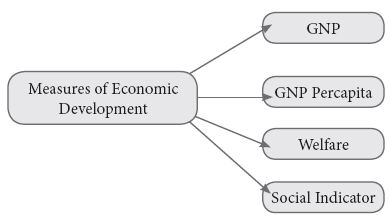
Gross National Product (GNP):
(i) GNP is the total market value of all final goods and services produced within a nation in a particular year, plus income earned by its citizens (including income of those located abroad), minus income of non-residents located in that country.
(ii) GNP is one measure of the economic condition of a country, under the assumption that a higher GNP leads to a higher quality of living, all other things being equal.
GNP per capita:
(i) This relates to increasing in the per capita real income of the economy over the long period
(ii) This indicator of economic growth emphasizes that for economic development the rate of increase in real per capita income should be higher than the growth rate of population.
Welfare:
(i) Economic development is regarded as a process whereby there is an increase in the consumption of goods and services by individuals.
(ii) From the welfare perspective, economic development is defined as a sustained improvement in health, literacy, and standard of living
Social Indicators:
(i) Social indicators are normally referred to as basic and collective needs of the people
(ii) The direct provision of basic needs such as health, education, food, water, sanitation, and housing facilities check social backwardness.
| S/N | Basic need | Indicators |
|---|---|---|
| 1 | Health | Life expectancy at birth |
| 2 | Education | Literacy signifying primary school enrolment as a percent of the population. |
| 3 | Food | Calorie Supply per head |
| 4 | Water supply | Infant mortality and percentage of the population with access to potable water |
| 5 | Sanitation | Infant mortality and percentage of the population with access to sanitation. |
34.
Money Supply in India
Money supply is a stock variable. RBI publishes information for four alternative
measures of Money supply, namely M1, M2, M3 and M4.
M1 = Currency, coins and demand deposits
M2 = M1 + Savings deposits with post office savings banks
M3 = M2 + Time deposits of all commercial and cooperative banks
M4 = M3 + Total deposits with Post offices.
M1 and M2 are known as narrow money
M3 and M4 are known as broad money
Determinants of Money Supply
1. Currency Deposit Ratio (CDR); It is the ratio of money held by the public in currency to that they hold in bank deposits.
2. Reserve deposit Ratio (RDR); Reserve Money consists of two things (a) vault cash in banks and (b) deposits of commercial banks with RBI.
3. Cash Reserve Ratio (CRR); It is the fraction of the deposits the banks must keep with RBI.
4. Statutory Liquidity Ratio (SLR); It is the fraction of the total demand and time deposits of the commercial banks is the form of specified liquid assets.
35.
| BASIS FOR COMPARISON | FIXED EXCHANGE RATE | FLEXIBLE EXCHANGE RATE |
| Meaning | Fixed exchange rate refers to a rate which the government sets and maintains at the same level. | Flexible exchange rate is a rate that varies according to the market forces. |
| Determined by | Government or central bank | Demand and Supply forces |
| Changes in currency price | Devaluation and Revaluation | Depreciation and Appreciation |
| Speculation | Takes place when there is rumor about change in government policy. | Operates to remove external instability by change in Forex rate. |
| Self adjusting mechanism | Operates through variation in supply of money, domestic interest rate and price. | No |
36.
(i) Strong economic growth or high GDP growth leads to excessive use of resources.
(ii) Natural resources are essential inputs for production in many sectors;
(iii) Production and consumption lead to pollution and other pressures on the environments.
(iv) Poor environmental quality affects economic growth and well being by lowering the quantity and quality of resources or due to health impact.
(v) There is the need to balance growth and the sustainability of eco system.
(vi) So we have to ensure our sustainable existence, consume less and curb economic growth.
37.
38.
39.
Single Factoral Terms of Trade
(i) According to Viner, the single factoral terms of trade is an improvement over the commodity terms of trade.
(ii) It represents the ratio of export. price index to the import price index adjusted for changes in the productivity of factors in the production of exports.
\(\mathrm{T}_{\mathrm{f}}=\left(\mathrm{P}_{\mathrm{x}} / \mathrm{P}_{\mathrm{m}}\right) \mathrm{F}_{\mathrm{x}}\)
(iii) Tf is single factoral terms of trade index.
(iv) Fx is productivity in exports.
Double Factoral Terms of Trade
\(\mathrm{T}_{\mathrm{ff}}=\left(\mathrm{P}_{\mathrm{x}} / \mathrm{P}_{\mathrm{m}}\right)\left(\mathrm{F}_{\mathrm{x}} / \mathrm{F}_{\mathrm{m}}\right)\)
(i) It takes into account the productivity in country's exports and productivity of foreign factors.
(ii) Fm is import index (which is measured as index cost in terms of quantity of factors of production employed per unit) of imports.
40.
Introduction
(i) The Reserve Bank of India is India's central banking institution
(ii) It commenced its operations on 1 April 1935 and it was nationalised on 1 Jan, $1949 .$
1) Monetary Authority
(i) It controls the supply of money in the economy to stabilize exchange rate, maintain healthy balance of payment, attain financial stability, control inflation, strengthen banking system.
2) Issuer of currency
(i) It is the sole authority to issue currency
(ii) It also takes action to control the circulation of fake currency.
3) Issuer of Banking License
(i) Every bank has to obtain a banking license from RBI to conduct banking business in India.
4) Banker to the Government
(i) It is the banker to the central and the state governments.
(ii) It provides short term credit, manages all need issues of government loans, services the government debt outstanding
(iii) It advises the government on banking and financial matters.
5) Banker's Bank
(i) It is the bank of all banks in India as it provides loan to banks, accepts the deposit of banks and rediscounts the bills of banks.
6) Lender of last resort
(i) The banks can borrow from RBI by keeping eligible securities as collateral at the time of need when there is no other source.
7) Act as clearing house
(i) For settlement of banking transactions, RBI manages 14 clearing houses.
(ii) It facilitates the exchange of instruments and processing of payment instructions.
8) Custodian of foreign exchange reserves
(i) It administers and enforces the provision of Foreign Exchange Management Acr, 1999.
(ii) RBI buys and sells foreign currency to maintain the exchange rate of Indian rupee vs foreign currencies.
9) Regulator of Economy
(i) It controls the money supply in the system, monitors GDP, Inflation
10) Managing Government securities
(i) RBI administers investments in institutions when they invest specified minimum proportions of their total assets/liabilities in government securities.
11) Regulator and Supervisor of Payment and Settlement Systems
(i) RBI oversees the payment and settlement systems in the country.
(ii) It focuses on the development and functioning of safe, secure and efficient payment and settlement mechanisms.
12) Developmental Role
(i) It develops the quality of banking system in India and ensures that credit is available to the productive sectors of the economy.
(ii) It provides a wide range of promotional functions to support national objectives.
(iii) It establishes institutions which build the financial infrastructure.
(iv) It also helps in expanding access to affordable financial services and promotes financial education and literacy.
13) Publisher of monetary data
(i) It maintains and provides all essential bánking and other economic "data, formulating and critically evaluating the economic policies in India.
(ii) RBI collects, collates and publishes data regularly.
14) Exchange manager and controller
(i) RBI represents India as a member of the International Monetary Fund.
(ii) Most of thé commercial banks are authorized dealers of RBI.
15) Banking Ombudsman Scheme
(i) RBI introduced this Scheme in 1995
(ii) Those who have complaints including online, can appeal to the Ombudsman against the awards and the other decisions of the Banks.
16) Banking Codes and Standards Board of India
(i) To measure the performance of banks against Codes and Standards based on established global practices, the RBI has set up the Banking Codes and Standards Board of India.
41.
Introduction
J.M Keynes has divided factors influencing the consumption function into two namely Subjective factors and Objective factors
Subjective Factors
These factors are internal and related to psychological feelings. Keynes lists 8 motives which lead individuals to refrain from spending
Motive of precaution
To build a reserve against unforeseen contingencies. (eg.) Accidents
Motive of foresight
The desire to provide for anticipated future needs. (eg.) Old age
Motive of calculation
The desire to enjoy interest and appreciation.
Motive of improvernent
(i) The desire to enjoy for improving standard of living.
(ii) Motive of financial independence
(iii) Motive of enterprise - desire to do forward trading
(iv) Motive of pride - desire to leave a fortune
(v) Motive of avarice - miserly instinct
(vi) The government institutions, business corporations and firms may also consume mainly because of:
Motive of enterprise
The desire to get resources to carry out further capital investment without debt.
Motive of liquidity
The desire to secure liquid resources to meet emergency
Motive of improvement
The desire to secure a rising income and to demonstrate successful management
Motive of financial prudence
The desire to ensure adequate financial provision against depreciation, obsolescence and to discharge debt.
Objective Factors
They are the external factors which are real and measurable. They can be easily changed in the long run;
Income Distribution
According to VKRV Rao if incone is equally distributed propensity to consume increases
Price level
When price falls, real income rises; people consume more and save more.
Wage level
Consumption expenditure increases with a rise in wages.
Interest rate
Higher interest rate will encourage people to save more money and reduces consumption.
Fiscal Policy
When government reduces tax, disposable income rises and propensity to consume increases.
Consumer credit
The availability of consumer credit at easy installments will encourage people to buy consumer durables like car, fridge, computer
Demographic factors
(i) Size of family, stage in family life cycle, place of residence and occupation affect the consumption pattern
Duesenberry hypothesis
(i) Consumption expenditure depends on current income, past income and standard of living
(ii) As individuals are accustomed to a particular standard of living, they continue to spend the same amount on consumption
(iii) Consumption of the poor people is influenced by the rich. This is called Demonstration effect.
Windfall gain and loss
Unexpected changes in the stock market leads to gain or loss, so consumption function shifts upward or downward.
Conclusion
According to Keynes only the subjective factors do not change in the short-run, so consumption function remains stable in the short period.
42.
Cyclical unemployment:
(i) During the downturn phase (recession and depression) of trade cycle, income and output fall leading to cyclical unemployment.
(ii) It is caused by deficiency of effective demand
Structural unemployment:
(i) Unemployment due to massive and deep rooted changes in economic structure leads to structural unemployment.
(ii) Lack of demand for the product or shift in demand to other products cause this type of unemployment.
(iii) (e.g.) rise in demand for mobile phones has adversely affected the demand for cameras, tape recorders
Disguised unemployment:
(i) It occurs in agriculture when more people are there than required. Even if some workers are withdrawn, production does not suffer.
Actual marginal productivity is zero, less or negative.
(i) Seasonal unemployment
1. In agriculture and agro based industries like sugar, production activities are carried out only in some seasons.
2. These industries offer employment only during that season in a year.
3. People remain unemployed during the off season.
4. Seasonal unemployment takes place from demand side also (eg) ice cream industry, holiday resorts
(ii) Frictional unemployment (Temporary unemployment)
1. It arises due to imbalance between supply of labour and demand for labour.
2. It is because of immobility of labour, lack of necessary skills, break down of machinery, shortage of raw materials.
3. The persons who lose jobs and in search of jobs also come under frictional unemployment
(iii) Educated unemployment
1. Educated people are underemployed or unemployed when qualification does not match the job.
2. Faulty education system, lack of employable skills, mass student turnout and preference for white collar jobs are highly responsible for educated unemployment.
43.
44.
1. Capitalism and socialism are two extreme and opposite approaches.
2. In capitalism, there is total freedom but in socialism, there is no freedom at all.
3. In capitalism, there is private ownership of means of production but there is public ownership of means of production in socialism.
4. Profit is the driving force behind all economic activities in capitalism but it is social welfare under socialism.
5. Capitalism enjoys free market but in socialism there is central planning.
6. There is unequal income distribution in capitalism but there is equal income distribution in socialism.
7. The major problem in capitalism is inequality but it is inefficiency in socialism.
45.
(i) The government of India passed in 1951 the State Financial Corporations Act and SFCs were set up in many states.
(ii) SFCs are mainly intended for the development of small and medium industrial units within their respective states.
46.
| Short Term Plan | Medium Term Plan | Long Term Plan |
|---|---|---|
| Short - term up to 1 year | Medium-term 3 - 7 years | Long - term over 10 year |
| Short - term planning concerns the plans in a time period of 1 year - operational planning. | Medium – term planning is considered for a time period of 5 years – tactical planning. | Long – term planning is considered for a time period over 10 years – strategic planning. |
47.
i. According to Say‘s Law, full employment is maintained by an automatic and self adjustment mechanism in the long run.
ii. But Keynes had no patience to wait for the long period for he believed that – In the long run we are all dead.
iii. It is not the automatic adjustment process which removes unemployment.
iv. But unemployment can be removed by increase in the rate of investment.
48.
i. Subjective factors are the internal factors related to psychological feelings.
ii. According to Keynes, the subjective factors do not change in the short run and hence consumption function remains stable in the short period.
49.
The movements of business cycles are,
(i) Boom
(ii) Recession
(iii) Depression and
(iv) Recovery
50.
Environmental goods are typically non-market goods, including clear air, clean water, landscape, green transport infrastructure, public parks, rivers, mountains, forest and beaches.
51.
52.
(i) Money is, what money does - Walker:
(ii) Money can be anything that is generally acceptable as a means of exchange and at the same time acts as a measure and a store of value. - Crowther.
53.
The major feature of rural unemployment is the existence of unemployment in the form of disguised unemployment and seasonal unemployment.
54.
(i) Farmers keep a large portion of food and other goods produced on the farm for self consumption.
(ii) This amount varies from person to person.
(iii) The problem is whether this unsold portion should be included in NI or not.

12th Standard Syllabus & Materials
12th Standard
TN 12th Computer Applications களப்பெயர் முறைமை (DNS) Sample Question Papers Study Material - QB365 Set A
NEW12th Standard
TN 12th Computer Applications வலையமைப்பு எடுத்துக்காட்டுகள் மற்றும் நெறிமுறைகள் Sample Question Papers Study Material - QB365 Set A
NEW12th Standard
TN 12th Computer Applications கணினி வலையமைப்பு ஓர் அறிமுகம் Sample Question Papers Study Material - QB365 Set A
NEW12th Standard
TN 12th Computer Applications PHP-உடன் MySQL-ஐ இணைத்தல் Sample Question Papers Study Material - QB365 Set A



Tamilnadu Stateboard 12th Standard Subjects

Maths

Chemistry

Physics

Biology

Computer Science

Business Maths and Statistics
Economics

Commerce

Accountancy

History

Computer Applications
Biology
Computer Technology
Computer Applications
Computer Science
Business Maths and Statistics
Commerce
Economics
Maths
Chemistry
Physics
Computer Technology
History
Accountancy

Tamil

English

French
Tamilnadu Stateboard Standards
