
 100% FREE ACCESS
12th Standard Syllabus & Materials
12th Standard
TN 12th Computer Applications மின்னணு தரவு பரிமாற்றம் Sample Question Papers Study Material - QB365 Set A
NEW12th Standard
TN 12th Computer Applications மின் - வணிக பாதுகாப்பு அமைப்புகள் Sample Question Papers Study Material - QB365 Set A
NEW12th Standard
TN 12th Computer Applications மின்னணு செலுத்தல் முறைகள் Sample Question Papers Study Material - QB365 Set A
NEW12th Standard
TN 12th Computer Applications மின் - வணிகம் Sample Question Papers Study Material - QB365 Set A
NEW12th Standard
TN 12th Computer Applications திறந்த மூல கருத்துருக்கள் Sample Question Papers Study Material - QB365 Set A
NEW12th Standard
TN 12th Computer Applications வலையமைப்பு வடமிடல் Sample Question Papers Study Material - QB365 Set A

Published on: 13/09/2019
Download Tamil Nadu 12th Standard Economics question papers, model tests, one-mark questions, important questions, and public exam papers in PDF format. Free study materials and answer keys for TN State Board students.
Questions + Answers key
Take MCQ Economics Test
1.
Which of the following economies have the unemployment is purely temporary or cyclical or frictional?
Developed Economies
Underdeveloped economies
Developing economics
None of the above
2.
That part of personal income which is actually available to households for consumption and saving is called________
National Disposable Income
Personal Disposable Income
Personal Income
None
3.
Assertion: National Income is considered as an indicator of the economic wellbeing of a country.
Reason: The economic progress of countries is measured in terms of their GDP per capita and their annual growth rate.
Both (A) and (R) are true and (R) is the correct explanation of (A).
Both (A) and (R) are true, but (R) is not the correct explanation of (A).
(A) is true, but (R) is false
(A) is false, but (R) is true
4.
Disposable Income is also known as _________?
Disposable private income
Disposable personal income
Deductible personal income
None of the above
5.
MEC is inversely related to:
Prospective yield
Supply price
Investment
Rate of interest
6.
Find the odd one out
C + I
C + I + G + (X – M)
C + I + G
(X – M)
7.
The term consumption function explains the relationship between ___________ and ___________
Labour and Consumer
Income and Consumption
Consumer and Consumption
Organisation and Consumption
8.
Secondary sector is __________
Industry
Trade
Agriculture
Manufacture
9.
NNP at factor cost = NNP at Market Price - ________ + Subsidies.
Direct taxes
Canons of taxes
Indirect taxes
None of these
10.
Total production equals to __________
total income
gross income
net income
total sales
11.
During _______ the level of economicactivity becomes extremely high.
Boom
Recession
Depression
Recovery
12.
"The purchasing power of money" was a book published by________in 1911
J.M. Keynes
Irving Fisher
Adam smith
Ricardo
13.
________ is a combination of both capitalism and socialism.
Socialistic economy
Capitalistic economy
Traditional economy
Mixed economy
14.
Moral suasion refers.
Optimization
Maximization
Persuasion
Minimization
15.
_____inflation is in no way dangerous to the economy.
walking
running
creeping
galloping
16.
The relationship between total spending on consumption and the total income is the_______.
Consumption function
Savings function
Investment function
aggregate demand function
17.
_________ Flexibility brings equality between saving and investment
Demand
Supply
Capital
Rate of Interest
18.
Per capita income is obtained by dividing the National income by__________
Production
Population of a country
Expenditure
GNP
19.
An economic system where the economic activities of a nation are done both by the private and public together is termed as__________
Capitalistic Economy
Socialistic Economy
Globalisic Economy
Mixed Economy
20.
A steady increase in general price level is termed as_____________.
wholesale price index
Business Cycle
Inflation
National Income
21.
Compare and contrast fiat money and commodity money.
22.
What is Technical Unemployment?
23.
What is the view of Mercantilism about trade?
24.
What is meant by Regulation of consumer's credit?
25.
26.
Define marginal propensity to consume (MPC).
27.
Classify the economies based on status of development.
28.
Write briefly about “Structural Adjustment Facility”
29.
Comment - “Ex ante and Ex post in Says’ Law".
30.
Mention the difference between FDI and FPI.
31.
Indicate the demerits of Mixed Economy.
32.
Specify the functions of IFCI.
33.
Give short note on Expenditure method.
34.
Enumerate the features of mixed economy.
35.
Explain the basic concepts of national income.
36.
Write the functions of BRICS.
37.
What are the objectives of ARDC? Explain.
38.
Explain briefly the Comparative Cost Theory.
39.
Describe the phases of Trade cycle.
40.
Explain the operation of the Accelerator.
41.
Discuss the importance of social accounting in economic analysis.
1.
(a)
Developed Economies
2.
(a)
National Disposable Income
3.
(b)
Both (A) and (R) are true, but (R) is not the correct explanation of (A).
4.
(b)
Disposable personal income
5.
(a)
Prospective yield
6.
(d)
(X – M)
7.
(b)
Income and Consumption
8.
(a)
Industry
9.
(c)
Indirect taxes
10.
(a)
total income
11.
(a)
Boom
12.
(b)
Irving Fisher
13.
(d)
Mixed economy
14.
(c)
Persuasion
15.
(c)
creeping
16.
(a)
Consumption function
17.
(d)
Rate of Interest
18.
(b)
Population of a country
19.
(d)
Mixed Economy
20.
(c)
Inflation
21.
(i) Fiat money includes items that are designated as money that are intrinsically worthless.
(ii) Commodity money are things like gold or silver which have alternative uses other than money.
(iii) They can be used in dental fillings or as jewelry.
22.
i. Modern technology being capital intensive requires lesslabourers and contributes to technological unemployment.
ii. Now a days, invention and innovations lead to the adoption of new techniques there by the existing workers are retrenched
23.
(i) Takes an us-versus - them view of trade
(ii) Other country's gain is our country's loss
24.
The down payment is raised and the number of installments reduced for the credit sal
25.
26.
MPC is the ratio of change in the consumption to the change in income.
MPC = \(\frac{ΔC}{Δ Y}\)
27.
Economies can be classified into different types based on the Status of Development are
1. Developed
2. Underdeveloped
3. Undeveloped and
4. Developing economies
28.
i. Till 1970, India stood fifth in the Fund and it had the power to appoint a permanent Executive Director. India has been one of the major beneficiaries of the Fund assistance.
ii. It has been getting aid from the various Fund Agencies from time to time and has been regularly repaying its debt.
iii. India’s current quota in the IMF is SDRs (Special Drawing Rights) 5,821.5 million, making it the 13th largest quota holding country at IMF with shareholdings of 2.44%.
iv. Besides receiving loans to meet deficit in its balance of payments, India has benefited in certain other respects from the membership of the Fund
29.
1. The statement that supply creates own demand or equivalently that the aggregate in investment equals the aggregate saving always holds good in the ex post sense since it is simply an accounting identity.
2. Say’s law of markets, however, states that these two are equal in ex ante sense, i.e the total quantity which people produce i.e., aggregate supply must be equal to the total quantity which they plan to buy i.e., aggregate demand.
30.
| BASIS FOR COMPARISON | REPO RATE | REVERSE REPO RATE |
| Meaning | FDI refers to the investment made by the foreign investors to obtain a substantial interest in the enterprise located in a different country. | When an international investor, invests in the passive holdings of an enterprise of another country, i.e. investment in the financial asset, it is known as FPI. |
| Degree of control | High | Very less |
| Term | Long term | Short term |
| Investment in | Physical assets | Financial assets |
| Entry and exit | Difficult | Relatively easy. |
| Results in | Transfer of funds, technology and other resources | Capital inflows |
31.
Lack of Co-ordination:
The greatest drawback of Mixedism is lack of co-ordination between public sector and private sector.
Inefficiency:
Most of the public sector enterprises remain inefficient due to lethargic bureaucracy, red tapism and lack of motivation.
Fear of Nationalization:
In mixed economy, the fear of nationalization discourages the private entrepreneurs in their business operations.
32.
The IFCI does the following functions
(i) Providing long-term loans in rupees and foreign currencies.
(ii) Underwriting of equity, preference and debenture issues.
(iii) Subscribing to equity, preference and debenture issues.
(iv) Guaranteeing the deferred payments for machinery imported from abroad or purchased in India
(v) Guaranteeing of loans raised in foreign currency from foreign financial institutions.
33.
(i) The total expenditure incurred by the society in a particular year is added.
(ii) It includes personal consumption expenditure (C), net domestic investment (I), Government expenditure on consumption and capital goods (G) and net exports (X - M).
\(\mathrm{GNP}=\mathrm{C}+\mathrm{I}+\mathrm{G}+(\mathrm{X}-\mathrm{M})\)
(iii) Second hand goods, purchase of shares and bonds, transfer payments and expenditure on intermediate goods must not be included.
34.
(i) The means of production and properties are owned by private and public.
(ii) Public and Private Sectors co-exist private sectors are profit motivated and public sectors aims at maximum social welfare.
(iii) The national plans prepared by the central planning authority is accepted by all sectors.
(iv) Basic economic problems are solved through the price mechanism and state intervention.
(v) Though the private can own resources, produce and distribute goods and services, the overall control on the economic activities is with the government.
35.
The following are some of the concepts used in measuring national income.
1. GDP
2. NNP
3. NNP at factor cost
4. Personal Income
5. Disposable Income
6. Per capita Income
7. Real Income
8. GDP deflator
Gross Domestic Product (GDP)
GDP is the total market value of final and services produced within the country during a year. This is calculated at market prices and is known as GDP at market prices.
Net Domestic Product (NDP)
1. NDP is the value of net output of the economy during the year. Some of the country’s capital equipment wears out or becomes outdated each year during the production process. Gross National Product (GNP)
2. GNP is the total measure of the flow of final goods and services at market value resulting from current production in a country during a year, including net income from abroad.
Net National Product (NNP)(at Market price)
Net National Product refers to the value of the net output of the economy during the year. NNP is obtained by deducting the value of depreciation, or replacement allowance of the capital assets from the GNP.
NNP at Factor cost
NNP refers to the market value of output. Whereas NNP at factor cost is the total of income payment made to factors of production.
Personal Income
Personal income is the total income received by the individuals of a country from all sources before payment of direct taxes in a year. Personal income is never equal to the national income, because the former includes the transfer payments whereas they are not included in national income
Disposable Income
1. Disposable Income is also known as Disposable personal income. It is the individuals income after the payment of income tax. This is the amount available for households for consumption. Per Capita Income.
2. The average income of a person of a country in a particular year is called Per Capita Income. Per capita income is obtained by dividing national income by population.
Real Income
Nominal income is national income expressed in terms of a general price level of a particular year in other words, real income is the buying power of nominal income.
GDP deflator
GDP deflator is an index of price changes of goods and services included in GDP. It is a price index which is calculated by dividing the nominal GDP in a given year by the real GDP for the same year and multiplying it by 100.
36.
(i) It acts as a promoter of more legitimate international system and also advocating reform of the UN security council.
(ii) This group of nation is especially most for South - South framework for cooperation
(iii) It performs as an agent to bridge the increasing gap between developed and developing countries. For instance in the WTO, the BRICS countries are emphasizing to promote a fair order regarding agricultural policies.
(iv) It performs a commendable contribution for assisting developing countries in gaining in areas such as an advantage in trade and climate change negotiations.
(v) It disseminates information and exchange platform beyond economic co-operation.
(vi) It act as a catalytic in protecting the interest of middle powers on global forum.
37.
(i) The agricultural development, an organization is called The Agricultural Refinance Development Corporation.
(ii) It was established by an act of parliament and it started functioning from 1 July, 1953.
(iii) The main aim of ARDC is to bridging the gap in agricultural finance and to extend credit for projects.
Objective of ARDC:
(i) To provide necessary funds by way of refinance to eligible institutions such as the Central land development Banks, State co-operative Banks and Scheduled Banks.
(ii) To subscribe to the debentures floated by the Central land Development Banks, State co-operative Banks, and Scheduled Bank provided they were approved by the RBI.
38.
Introduction
1. David Ricardo formulated comparative cost theory.
2. J. S. Mill, Marshall, Taussig refined it.
Theory
1. Trade can take place even if absolute cost difference is absent but there is comparative cost difference.
Illustration
2. Ricardo's theory is explained with an example of production costs of cloth and wheat in America and India.
(Units of labour needed to produce one unit)
| Country | Cloth | Wheat | Domestic Exchange Ratios |
| America | 100 | 120 | 1 Wheat = 1.2 Cloth |
| India | 90 | 80 | 1 Wheat = 0.88 Cloth |
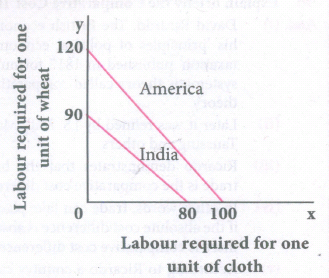
(i) India has absolute advantage in production of both cloth and wheat.
(ii) But, India will produce wheat where she enjoys comparative cost advantage (80 / 120<90 / 100).
(iii) For America the comparative cost disadvantage is lesser in cloth production.
(iv) So America will specialize in cloth production and export it to India in exchange for wheat.
(v) Both nations gains.
(vi) With trade India can get 1 unit of cloth and 1 unit of wheat by using 160 labour units (80+80). With no trade India has to use 170 units of labour (80+90).
(vii) The same explanation applies to America too.
Criticisms
(i) Labour cost is a small portion of the total cost. So the theory based on labour cost is unrealistic,
(ii) Labourers in different countries are not equal in efficiency.
39.
Boom or Prosperity:
1. The employment and the movement of the economy beyond full employment is the characterized features of boom.
2. There is hectic activity, money wages rise, profits increase, interest rates go up, demand for bank credit increases.
3. There is all round optimism.
Recession:
1. The turning point from boom condition is recession.
2. Failure of a company or bank brings a phase of recession.
3. Investments are drastically reduced, production falls, income and profits decline.
4. There is panic in the stock market and business is dull.
5. Liquidity preference of the people rises and money market becomes tight.
Depression:
1. The level of economic activity becomes extremely low.
2. Firms incur loss and close down resulting in unemployment.
3. Interest rate, profits, wages are low.
4. Agricultural class and wage carners are badly affected.
5. Banks do not lend to businessmen.
6. The extreme point of depression is called as "trough".
7. Keynes said that autonomous investment of the government can help the economy to come out of depression.
Recovery:
1. After depression, recovery sets in the upswing.
2. It begins with the revival of demand for capital goods.
3. The demand slowly picks up and in due course there is more production, profit, income, wages and employment.
4. Recovery may be initiated by innovation or investment or by government.
40.
Introduction
A systematic development of the simple accelerator model was made by J.M.Clark, It was further developed by Hicks, Samuelson and Harrod.
Definition
Accelerator coefficient is the ratio between induced investment and an initial change in consumption \(\beta=\frac{\Delta \mathrm{I}}{\Delta \mathrm{C}}\)
Operation
Suppose that in order to produce 1000 consumer goods, 100 machines are needed. Working life of a machine is 10 yrs i.e, every year 10 machines have to be replaced. This is called replacement demand
(i) Suppose that demand for consumer goods rises by 10 % (i.e, from 1000 to 1100)
(ii) This results in increase in demand for 10 more machines
(iii) The total demand for machines is 20 i.e, 10 % increase in demand for consumer goods causes 100 % increase in demand for machine (from 10 to 20 )
Explanation
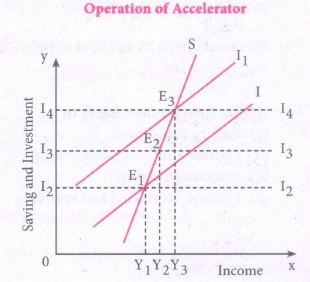
(i) SS is the saving curve.
(ii) II is the investment curve.
(iii) At point E1 the economy is in equilibrium with OY1 income.
(iv) S and I are equal at O2.
(v) Now I increased from OI2 to OI4.
(vi) This increases income from OY1 to OY3 at E2 equilibrium.
(vii) If the increase in investment by I2I4 is purely exogenous, then the increase in income by Y1Y3 would be due to multiplier.
(viii) But in this diagram it is assumed that exogenous investment is only by I2I3 and induced investment is by I3I4.
(ix) Therefore, the increase in income by Y1Y2 is due to the multiplier effect and the increase in income by Y2Y3 is due to the accelerator effect.
41.
Introduction:
National income can be measured by the social accounting method. Under this method, the transactions among various sectors such as firms, households, government are recorded and their interrelationships traced.
Firms:
undertake productive activities. They employ factors of production to produce goods and services.
Households:
Households are consuming entities. They represent the factors of production, who receive payment for services rendered by them to firms. (i) Households consume the goods produced by the firms. There is a circular flow of money between these two groups.
Government:
The Government sector refers to the economic transactions of public bodies at all levels-centre, state and local. Their purchases may be financed through taxation, public borrowings. The government provides public health, education. They satisfy the collective wants of society. But Post Offices and railways are separated from the Government sector and included as "Firms".
Rest of the world:
It relates to international economic transactions - income, export, import external loan transaction, and allied overseas investment income and payments.
Capital sector:
(i) Capital sector refers to saving and investment activities. It includes the transactions of banks, insurance corporations, financial houses. These are not included under "Firms".
(ii) The economy is also divided into primary, secondary tertiary and quaternary sectors.
Conclusion:
The social accounting framework is useful for economists as well as policy makers, because it represents the major economic flows and statistical relationships among various sectors of the economic system. It is possible to forecast the trends of economy more accurately.

12th Standard Syllabus & Materials
12th Standard
TN 12th Computer Applications களப்பெயர் முறைமை (DNS) Sample Question Papers Study Material - QB365 Set A
NEW12th Standard
TN 12th Computer Applications வலையமைப்பு எடுத்துக்காட்டுகள் மற்றும் நெறிமுறைகள் Sample Question Papers Study Material - QB365 Set A
NEW12th Standard
TN 12th Computer Applications கணினி வலையமைப்பு ஓர் அறிமுகம் Sample Question Papers Study Material - QB365 Set A
NEW12th Standard
TN 12th Computer Applications PHP-உடன் MySQL-ஐ இணைத்தல் Sample Question Papers Study Material - QB365 Set A



Tamilnadu Stateboard 12th Standard Subjects

Maths

Chemistry

Physics

Biology

Computer Science

Business Maths and Statistics
Economics

Commerce

Accountancy

History

Computer Applications
Biology
Computer Technology
Computer Applications
Computer Science
Business Maths and Statistics
Commerce
Economics
Maths
Chemistry
Physics
Computer Technology
History
Accountancy

Tamil

English

French
Tamilnadu Stateboard Standards
