
 100% FREE ACCESS
12th Standard Syllabus & Materials
12th Standard
TN 12th Maths Applications of Matrices and Determinants Sample Question Papers Study Material - QB365 Set A
NEW12th Standard
TN 12th Computer Applications மின்னணு தரவு பரிமாற்றம் Sample Question Papers Study Material - QB365 Set A
NEW12th Standard
TN 12th Computer Applications மின் - வணிக பாதுகாப்பு அமைப்புகள் Sample Question Papers Study Material - QB365 Set A
NEW12th Standard
TN 12th Computer Applications மின்னணு செலுத்தல் முறைகள் Sample Question Papers Study Material - QB365 Set A
NEW12th Standard
TN 12th Computer Applications மின் - வணிகம் Sample Question Papers Study Material - QB365 Set A
NEW12th Standard
TN 12th Computer Applications திறந்த மூல கருத்துருக்கள் Sample Question Papers Study Material - QB365 Set A

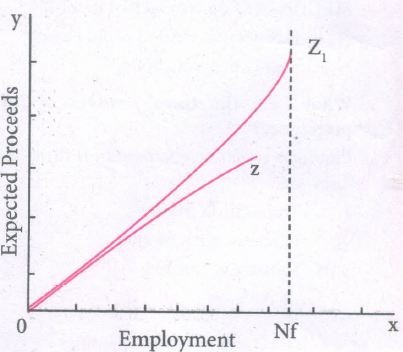
Published on: 06/01/2020
Theories of Employment and Income
Download Tamil Nadu 12th Standard Economics question papers, model tests, one-mark questions, important questions, and public exam papers in PDF format. Free study materials and answer keys for TN State Board students.
Questions + Answers key
Take MCQ Economics Test
1.
'Demand creates its own supply' - who said this.
Socialism
Keynesianism
Classicism
Both 'b' and 'c'
2.
Rate of interest is a stock
Socialism
Keynesianism
Classicism
All the above
3.
________ theory is a turning point in the development of modern economic theory.
Keynes’
Say’s
Classical
Employment
4.
Keynes attributes unemployment to_______.
A lack of effective supply
A lock of effective demand
A lack of both
None of the above
5.
According to Keynes, which type of unemployment prevails in capitalist economy ?
Full employment
Voluntary unemployment
Involuntary unemployment
Under employment
6.
What is Cyclical Unemployment?
7.
What are the four components of aggregate demand?
8.
List out the assumptions of Say’s law.
9.
10.
Define full employment.
11.
What are the economic costs of unemployment?
12.
Write the criticism of Say's Law.
13.
Write a short note on effective demand?
14.
Explain about aggregate supply with the help of diagram.
15.
Write short note on the implications of Say’s law
16.
Draw the diagram for Aggregate supply curves diagram.
17.
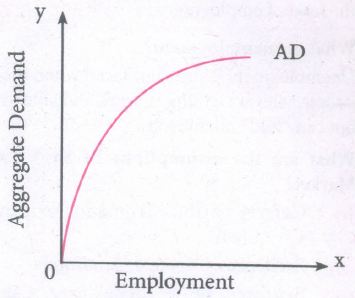
Draw the diagram ADF.
18.
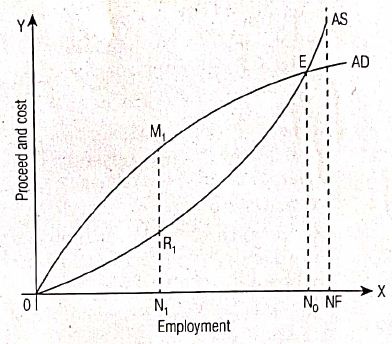
Narrate the equilibrium between ADF and ASF with diagram
19.
Critically explain Say’s law of market.
1.
(b)
Keynesianism
2.
(c)
Classicism
3.
(a)
Keynes’
4.
(b)
A lock of effective demand
5.
(d)
Under employment
6.
1. Cyclical unemployment exists during the downturn phase of trade cycle in the economy.
2. In a business cycle during the period of recession and depression, income and output fall leading to widespread unemployment.
7.
(i) Consumption Demand
(ii) Investment Demand
(iii) Government Expenditure
(iv) Net Export (Export - Import)
8.
1. No single buyer or seller can affect the price.
2. Full employment
3. People are motivated by self interest Market forces determine everything right.
4. Perfect competition exists in labour and product market.
5. There is wage price flexibility.
6. Money acts as medium of exchange.
7. Long run analysis.
8. No overproduction or unemployment.
9.
10.
(i) "Full employment is the absence of involuntary unemployment." - Keynes
(ii) "Full employment is that level of employment at which any further increase in spending would result in an inflationary spiral of wages and prices" - Lerner
11.
i. Whenever resources are unemployed there is always some sort of waste.
ii. In the case of unemployment it manifests itself in the potential production of goods and services irretrievably lost.
iii. There are also other costs such as increased burdens to taxpayers to fund unemployment compensation programs and the individual cost in terms of a loss of self esteem and dignit
12.
The following are the criticisms against Say's law:
(i) According to Keynes, supply does not create its demand. It is not applicable where demand does not increase as much as production increases.
(ii) Automatic adjustment process will not remove unemployment. Unemployment can be removed by increase in the rate of investment.
(iii) Money is not neutral. Individuals hold money for unforeseen contingencies while businessmen keep cash reserve for future activities.
13.
(i) Effective demand denotes money actually spent by the people on products of industry.
(ii) The money which entrepreneurs receive is paid in the form of rent, wages, interest and profit.
(iii) Therefore effective demand equals national income.
(iv) An increase in the aggregate effective demand would increase the level of employment. A decline in total effective demand would lead to unemployment. Therefore,
(v) Thus the total employment of a country can be determined with the help of total demand of a country.
14.
(i) Aggregate supply refers to the value of total output of goods and services produced in an economy in a year ie national product or income.
(ii) The components of aggregate supply are:
(iii) Aggregate (desired) consumption expenditure (C)
(iv) Aggregate (desired) private savings (S)
(v) Net tax payments (T)
(vi) Personal (desired) transfer payments to the foreigners (Rf)
AS = C + S + T + Rf
In this figure 2 aggregate supply curves are drawn for the assumption of fixed money wages and variable wages.
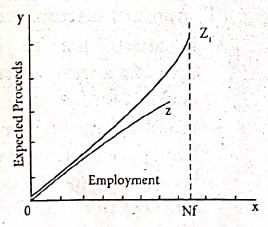
Explanation
(i) Z Curve is linear (fixed money wages)
(ii) Z1 curve is non-linear (wage rate increases with employment)
(iii) When full employment level of Nf is reached output cannot be increased by employing more men.
(iv) So aggregate supply curve becomes inelastic (Vertical straight line).
(v) In reality aggregate supply curve will be like Z1 .
(vi) If prices are high and wages low, the producers will employ more labourers.
(vii) 4YAggregate supply is an important factor in determining the level of economic activity.
15.
(i) There is no possibility for over production or unemployment.
(ii) If there exist unutilized resources, it is profitable to employ them up to full employment.
(iii) There is automatic price mechanism, so no need for government intervention
(iv) Interest flexibility brings about equality between saving and investment.
(v) Money acts as the medium of exchange.
16.
17.
18.
Introduction
Under the Keynes theory of employment, a simple two sector economy consisting of the household sector and the business sector is taken to understand the equilibrium between ADF and ASF.
Explanation
1. AD and AS reach equilibrium at E. The employment level is No
2. At ON1employment, the aggregate supply is N1R1. But the aggregate demand is M1N1.
3. The expected level of profit is M1R1.
4. To attain this level of profit, entrepreneurs will employ more labourers, till they reach point E i.e. ONo.
5. Beyond ONo, the aggregate demand curve is below the aggregate supply curve showing loss.
6. So they will never employ more than ONo labour.
7. The equilibrium level of employment need not be the full employment level (No).
8. The difference between No - N1 is the level of unemployment.
Conclusion
Thus the concept of effective demand becomes significant in explaining the under employment equilibrium.
19.
Introduction
According to J. B. Say "Supply creates its own demand"
Explanation
A person receives his income from production which is spent on the purchase of goods and services produced by others. For the economy as a whole, therefore, total production equals total income.
Criticisms
(i) According to Keynes, supply does not. create its demand. It is not applicable where demand does not increase as much as production increases.
(ii) Automatic adjustment process will not remove unemployment. Unemployment can be removed by increase in the rate of investment.
(iii) Money is not neutral. Individuals hold money for unforeseen contingencies, businessmen keep cash reserve for future activities.
(iv) Say's law is supply creates its own demand and there is no over production. Keynes said that over production is possible
(v) Keynes regards full employment as a special case because there is underemployment in capitalist economies.
(vi) State intervention is needed when there is over production and mass unemployment.

12th Standard Syllabus & Materials
12th Standard
TN 12th Computer Applications வலையமைப்பு வடமிடல் Sample Question Papers Study Material - QB365 Set A
NEW12th Standard
TN 12th Computer Applications களப்பெயர் முறைமை (DNS) Sample Question Papers Study Material - QB365 Set A
NEW12th Standard
TN 12th Computer Applications வலையமைப்பு எடுத்துக்காட்டுகள் மற்றும் நெறிமுறைகள் Sample Question Papers Study Material - QB365 Set A
NEW12th Standard
TN 12th Computer Applications கணினி வலையமைப்பு ஓர் அறிமுகம் Sample Question Papers Study Material - QB365 Set A



Tamilnadu Stateboard 12th Standard Subjects

Maths

Chemistry

Physics

Biology

Computer Science

Business Maths and Statistics
Economics

Commerce

Accountancy

History

Computer Applications
Biology
Computer Technology
Computer Applications
Computer Science
Business Maths and Statistics
Commerce
Economics
Maths
Chemistry
Physics
Computer Technology
History
Accountancy

Tamil

English

French
Tamilnadu Stateboard Standards
