
 100% FREE ACCESS
12th Standard Syllabus & Materials
12th Standard
TN 12th Maths Applications of Matrices and Determinants Sample Question Papers Study Material - QB365 Set A
NEW12th Standard
TN 12th Computer Applications மின்னணு தரவு பரிமாற்றம் Sample Question Papers Study Material - QB365 Set A
NEW12th Standard
TN 12th Computer Applications மின் - வணிக பாதுகாப்பு அமைப்புகள் Sample Question Papers Study Material - QB365 Set A
NEW12th Standard
TN 12th Computer Applications மின்னணு செலுத்தல் முறைகள் Sample Question Papers Study Material - QB365 Set A
NEW12th Standard
TN 12th Computer Applications மின் - வணிகம் Sample Question Papers Study Material - QB365 Set A
NEW12th Standard
TN 12th Computer Applications திறந்த மூல கருத்துருக்கள் Sample Question Papers Study Material - QB365 Set A

Published on: 27/11/2019
Theories of Employment and Income
Download Tamil Nadu 12th Standard Economics question papers, model tests, one-mark questions, important questions, and public exam papers in PDF format. Free study materials and answer keys for TN State Board students.
Questions + Answers key
Take MCQ Economics Test
1.
'Rate of interest is a reward for parting with liquidity' - Its belongs to which theory.
Keynesianism
Socialism
Both 'a' and 'b'
Classicism
2.
Rate of interest is a stock
Socialism
Keynesianism
Classicism
All the above
3.
_________ Flexibility brings equality between saving and investment
Demand
Supply
Capital
Rate of Interest
4.
According to Keynes, which type of unemployment prevails in capitalist economy ?
Full employment
Voluntary unemployment
Involuntary unemployment
Under employment
5.
If every able bodied person who is willing to work at the prevailing wage rate is employed called _______.
Full employment
Under employment
Unemployment
Employment opportunity
6.
What is unemployment?
7.
Write a short note about Keynes theory?
8.
What are the components of aggregate supply ?
9.
10.
Define full employment.
11.
Explain how it might be possible for the unemployment rate to decline even though the number of unemployed is growing
12.
Distinguish between Fictional and Structural unemployment.
13.
Write any five differences between classicism and Keynesianism.
14.
What do you mean by aggregate demand ? Mention its components.
15.
According to classical theory of employment, how wage reduction solve the problem of unemployment diagramatically explain.
16.
Comparison of Classicism and Keynesianism.
17.
List out all assumption of say's law of market?
18.
Narrate the equilibrium between ADF and ASF with diagram
19.
Critically explain Say’s law of market.
1.
(a)
Keynesianism
2.
(c)
Classicism
3.
(d)
Rate of Interest
4.
(d)
Under employment
5.
(a)
Full employment
6.
Unemployment is problem faced when there are people, who are willing to work and able to work but can't find suitable job.
7.
Keynes theory of employment was based on the view of the short run. According to him, the factors of production such as capital goods, supply of labour, technology and efficiency of labour remain unchanged while determining the level of employment.
8.
(i) Aggregate (desired) consumption expenditure (C)
(ii) Aggregate (desired) private savings (S)
(iii) Net tax payments (T)
(iv) Personal (desired) transfer payments to the foreigners (Rf)
AS = C + S + T + Rf
9.
10.
(i) "Full employment is the absence of involuntary unemployment." - Keynes
(ii) "Full employment is that level of employment at which any further increase in spending would result in an inflationary spiral of wages and prices" - Lerner
11.
i. This may be possible if the number of new entrants into the labor force is increasing at a greater rate than the number of people who are becoming unemployed.
ii. Since the unemployment rate is a ratio and the numerator is growing more slowly than the denominator then the unemployment rate will fall.
12.
| S.No | Fictional unemployment | Structural unemployment |
| 1 | Frictional unemployment arises due to imbalance between supply of labour and demand for labour | Structural unemployment is due to drastic change in the structure of the society |
| 2. | This is because of immobility of labour, lack of necessary skills, break down of machinery, shortage of raw materials etc. | Lack of demand for the product or shift in demand to other products cause this type of unemployment |
| 3. | The persons who lose jobs and in search of jobs are also included under frictional unemployment | This kind of unemployment results from massive and deep rooted changes in economic structure |
13.
| S. No: | Keynesianism | Classicism |
| 1. | Short-run equilibrium | Long-run equilibrium |
| 2. | Saving is a vice | Saving is a social virtue. |
| 3. | Money functions as medium of exchange and store of value | Money acts as a medium of exchange |
| 4. | Macro approach to national problems | Micro approach to macro problems |
| 5. | State intervention is advocated | Favoured laissez-faire policy |
14.
(i) In the Keynesian model, output is determined mainly by aggregate demand.
(ii) The aggregate demand is the amount of money which entrepreneurs expect to get by selling the output produced by the labourers employed.
(iii) Aggregate demand (spending) is the amount that households, firms, the governments and the foreign purchasers would like to spend on domestic output
Aggregate demand has four components:
1. Consumption demand (C)
2. Investment demand (I)
3. Government expenditure (G)
Net Export ( export - import) (X - M)
AD = C + I + G + (X - M)
15.
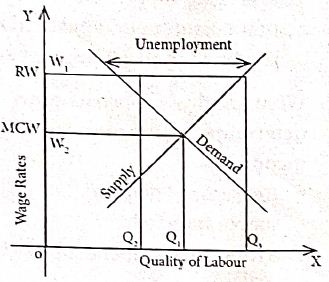
(i) Classical unemployment occurs when real wages are kept above the market clearing wage rate, leading to a surplus of labour supplied.
(ii) Classical unemployment is also called real wage unemployment.
(iii) Unemployment occurs when the worker is willing to accept (Real Wages)(RW) is in excess of those an employer is willing to pay (Market Clearing Wage)(MCW).
(iv) Real wage may be above the equilibrium level because of minimum wage policies or union bargaining.
(v) classical unemployment of Q1-Q2 can be solved by a wage cut.
(vi) If wages are allowed to fall to the market clearing level, unemployment is solved
16.
| S.No | Keynesianism | Classicism |
|---|---|---|
| 1. | Short-run equilibrium | Long-run equilibrium |
| 2. | Saving is a vice | Saving is a social virtue |
| 3. | The function of money is a medium of exchange on the one side and a store of value on the other side. | The function of money is to act as a medium of exchange |
| 4. | Macro approach to national problems | Micro foundation to macro problems |
| 5. | State intervention is advocated | Champions of Laissez-fair policy |
| 6. | Applicable to all situations - full employment and less than full employment. | Applicable only to the full employment situation |
| 7. | Capitalism has inherent contradictions | Capitalism is well and good |
| 8. | Budgeting should be adjusted to the requirements of economy. | Balanced budget |
| 9. | The equality between saving and investment is advanced through changes in income. | The equality between saving and investment is achieved through chances of rate of interest. |
| 10. | Rate of interest is determined by the demand for and supply of money. | Rate of interest is determined by saving and investment. |
| 11. | Rate of interest is a flow. | Rate of interest is a stock. |
| 12. | Demand creates its own supply. | Supply creates its own demand. |
| 13. | Rate of interest is a reward for parting with liquidity. | Rate of interest is a reward for saving. |
17.
Assumption of the Say's law of market:
(i) No single buyer (or) seller of commodity or an input can affect price.
(ii) Full employment.
(iii) People are motivated by self interest and self-interest determines economic decisions.
(iv) The laissez fair policy is essential for an automatic and self adjusting process full employment.
(v) There will be a perfect competition.
(vi) There is wage - price flexibility.
(vii) Money acts only as a medium of exchange.
(viii) Long run analysis.
(ix) There is no possibility for over production or unemployment.
(x) Unutilized resources used until reaches full employment.
(xi) No Government intervention automatic Price adjustment mechanism operated.
18.
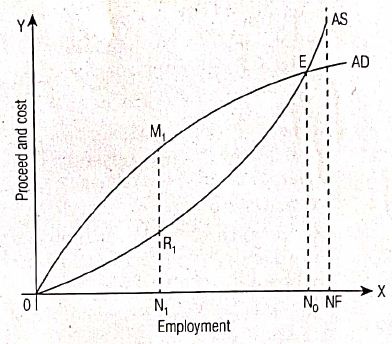
Introduction
Under the Keynes theory of employment, a simple two sector economy consisting of the household sector and the business sector is taken to understand the equilibrium between ADF and ASF.
Explanation
1. AD and AS reach equilibrium at E. The employment level is No
2. At ON1employment, the aggregate supply is N1R1. But the aggregate demand is M1N1.
3. The expected level of profit is M1R1.
4. To attain this level of profit, entrepreneurs will employ more labourers, till they reach point E i.e. ONo.
5. Beyond ONo, the aggregate demand curve is below the aggregate supply curve showing loss.
6. So they will never employ more than ONo labour.
7. The equilibrium level of employment need not be the full employment level (No).
8. The difference between No - N1 is the level of unemployment.
Conclusion
Thus the concept of effective demand becomes significant in explaining the under employment equilibrium.
19.
Introduction
According to J. B. Say "Supply creates its own demand"
Explanation
A person receives his income from production which is spent on the purchase of goods and services produced by others. For the economy as a whole, therefore, total production equals total income.
Criticisms
(i) According to Keynes, supply does not. create its demand. It is not applicable where demand does not increase as much as production increases.
(ii) Automatic adjustment process will not remove unemployment. Unemployment can be removed by increase in the rate of investment.
(iii) Money is not neutral. Individuals hold money for unforeseen contingencies, businessmen keep cash reserve for future activities.
(iv) Say's law is supply creates its own demand and there is no over production. Keynes said that over production is possible
(v) Keynes regards full employment as a special case because there is underemployment in capitalist economies.
(vi) State intervention is needed when there is over production and mass unemployment.

12th Standard Syllabus & Materials
12th Standard
TN 12th Computer Applications வலையமைப்பு வடமிடல் Sample Question Papers Study Material - QB365 Set A
NEW12th Standard
TN 12th Computer Applications களப்பெயர் முறைமை (DNS) Sample Question Papers Study Material - QB365 Set A
NEW12th Standard
TN 12th Computer Applications வலையமைப்பு எடுத்துக்காட்டுகள் மற்றும் நெறிமுறைகள் Sample Question Papers Study Material - QB365 Set A
NEW12th Standard
TN 12th Computer Applications கணினி வலையமைப்பு ஓர் அறிமுகம் Sample Question Papers Study Material - QB365 Set A



Tamilnadu Stateboard 12th Standard Subjects

Maths

Chemistry

Physics

Biology

Computer Science

Business Maths and Statistics
Economics

Commerce

Accountancy

History

Computer Applications
Biology
Computer Technology
Computer Applications
Computer Science
Business Maths and Statistics
Commerce
Economics
Maths
Chemistry
Physics
Computer Technology
History
Accountancy

Tamil

English

French
Tamilnadu Stateboard Standards
