
 100% FREE ACCESS
12th Standard Syllabus & Materials
12th Standard
TN 12th Maths Applications of Matrices and Determinants Sample Question Papers Study Material - QB365 Set A
NEW12th Standard
TN 12th Computer Applications மின்னணு தரவு பரிமாற்றம் Sample Question Papers Study Material - QB365 Set A
NEW12th Standard
TN 12th Computer Applications மின் - வணிக பாதுகாப்பு அமைப்புகள் Sample Question Papers Study Material - QB365 Set A
NEW12th Standard
TN 12th Computer Applications மின்னணு செலுத்தல் முறைகள் Sample Question Papers Study Material - QB365 Set A
NEW12th Standard
TN 12th Computer Applications மின் - வணிகம் Sample Question Papers Study Material - QB365 Set A
NEW12th Standard
TN 12th Computer Applications திறந்த மூல கருத்துருக்கள் Sample Question Papers Study Material - QB365 Set A

Published on: 18/07/2019
Download Tamil Nadu 12th Standard History question papers, model tests, one-mark questions, important questions, and public exam papers in PDF format. Free study materials and answer keys for TN State Board students.
Questions + Answers key
Take MCQ History Test1.
Match and choose the correct answer from the code given below.
| (A) Bala Gangadhar Tilak | 1. Voice of India |
| (B) Dadabhai Naoroji | 2. Madras Time |
| (C) Macaulay | 3. Kesari |
| (D) William Digby | 4. Minute on Indian Education |
2, 4, 1, 3
3, 1, 4, 2
1, 3, 2, 4
4, 2, 3, 1
2.
3.
Find the odd one.
William Jones
Charles Wilkins
Max Muller
Aurobindo Ghose
4.
In which year English Education was introduced in India?
1825
1835
1845
1855
5.
When did Gandhi return to India from South Africa?
1915
1916
1917
1918
6.
Highlight the contribution of missionaries to modern education.
7.
Discuss the importance of Ilbert Bill.
8.
Write a note on Indigo revolt?
9.
Describe the implications of the new land tenures?
10.
What is nationalism?
11.
Name the prominent participants in the inaugural meeting of Madras Mahajana Sabha held in May 1884?
12.
Describe the way in which indentured labour was organized in British India?
13.
Point out the role played by press in creating nationalist consciousness in British India.
14.
What do you know of the Madras visit of the chairman of Indian Reform Society in 1853?
15.
Analyse Macaulay's ‘Minute on Indian Education'.
16.
To what extent the repressive and racist policy measures of the British were responsible for the national awakening in India.
17.
18.
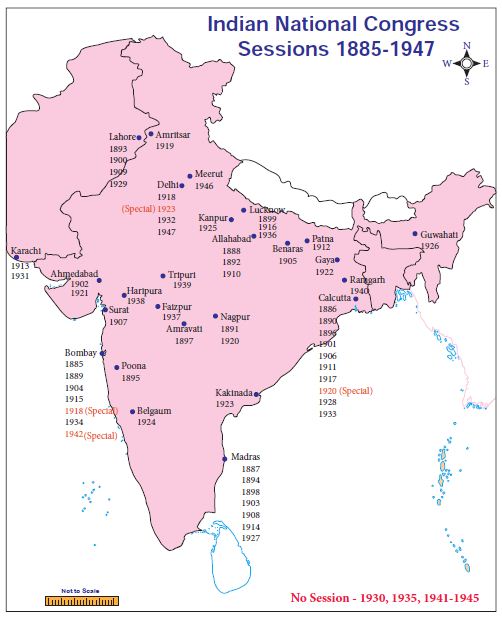
Mark the following on the outline map of India. Venues of Congress Sessions.
1. Bombay
2. Calcutta
3. Madras
4. Ahmedabad
5. Lucknow
6. Kanpur
7. Surat
8. Lahore
9. Poona
10. Allahabad
1.
(b)
3, 1, 4, 2
2.
(a)
3.
(d)
Aurobindo Ghose
4.
(b)
1835
5.
(a)
1915
6.
1) The English Education act was passed by the council of india in 1835.
2) T.B Macaulay drafted this system of education introduced in India.
3) Consequently, the colonial administration started schools, Colleges and Universities, imparting English and modern education, in India.
4) The colonial government Expected this section of educated Indians to be the loyal to the british and act as the pillars of the british Raj.
7.
1) Abolition of custom duty on cotton manufactures imported from England and levy of excise duty on cotton fabrics manufactured in india created nationwide discontent.
2) During the viceroyalty of Ripon the indian judges were empowered through the IIbert Bill to try the europeans.
3) Bit in the face of resistance from the Europeans the bill was amended to suit the European interests.
8.
1) The indigo revolt of 1859-60 was one of the responses from the Indian farmer to the oppressive policy of the British.
2) Indian tenants were forced to grow indigo by their planters who were mostly Europeans. Used to dye the clothes indigo was in high demand in Europe.
9.
1) The British fixed the land revenue in cash without any regard to various contingencies, such as failure of crops, fall in prices and droughts or floods.
2) Moreover, the practice of sale in settlement of debt encouraged money lenders to advance money to landholders and resorting to every kind of trickery to rob them of their property.
10.
1) Nationalism means loyalty and devotion to a nation
2) It is a consciousness or tendency to exalt and place one nation above all the others, emphasising promotion of its culture and interests as opposed to those of other nations.
11.
G. Subramaniam, Viraraghavachari, Ananda Charlu, Rangiah, Balaji Rao and Salem Ramaswamy.
12.
1) The introduction of plantation crops such as coffee, tea and sugar in Empire colonies such as Ceylon (Sri Lanka), Mauritius, Fiji, Malaya, the Caribbean islands, and South Africa required enormous labour.
2) The abolition of slavery in British India in 1843 also facilitated the processes of emigration to Empire colonies. In 1837 the number of immigrant Tamil labourers employed in Ceylon coffee estate was estimated at 10,000.
3) The industry developed rapidly and so did the demand for Tamil labour.
4) In 1846 its presence was estimated at 80,000 and in 1855 at 128,000 persons. In 1877, the famine year, there were nearly 380,000 Tamil labourers in Ceylon.
13.
1) The introduction of printing press in India was an event of great significance. It helped people to spread, modem ideas of self-government, democracy, civil rights and industrialisation.
2) The press became the critic of politics. It addressed the people on several issues affecting the country.
3) Raja Rammohan Roy's Sam bad Kaumudi (1821) in Bengali and Mirat-Ul-Akbar (1822) in Persian played a progressive role in educating the people on issues of public importance.
4) Later on a number of nationalist and vernacular news papers came to be launched to build public opinion and they did yeomen service in fostering nationalist consciousness.
5) Among them Amrit Bazaar Patrika, The Bombay Chronicle, The Tribune, The Indian Mirror, The Hindu and Swadesamitran were prominent.
14.
1) The MNA petition was discussed in the Parliament in March 1853. H.D. Seymour, Chairman of the Indian Reform Society, came to Madras in October 1853.
2) He visited places like Guntur, Cuddalore, Tiruchirappalli, Salem and Tirunelveli.
3) However, as the Charter Act of 1853 allowed British East India Company to continue its rule in India, the MNA organised an agitation for the transfer of British territories in India to the direct control of the Crown.
4) MNA sent its second petition to British Parliament, signed by fourteen thousand individuals, pleading the termination of Company rule in India.
15.
1) The colonial government aided the spread of modem education in India for a different reason than educating and empowering the Indians.
2) With this aim, the English Education Act was passed by the Council of India in 1855. T.B. Macaulay drafted this system of education introduced in India,
3) Consequently, the colonial administration started schools, colleges and universities, imparting English and modem education, in India.
4) Universities were established in Bombay, Madras and Calcutta in 1857.
5) The colonial government expected this section of educated Indians to be loyal to the British and act as the pillars of the British Raj.
6) The British created an educated Indian middle class for their own ends but sneered at it as the Babu class.
7) That every class, however, became the progressive intelligentsia of India and played a leading role in mobilising the people for the liberation of the country.
16.
1) Indian national movement dates its birth from the 1857 uprising. The outrages committed by the British army after putting down the revolt remained "un-avenged".
2) Even the court-martial law and formalities were not observed Officers who sat on the court martial swore that they would hang their prisoners, guilty or innocent and, if any dared to raise his voice against such indiscriminate vengeance, he was silenced by his angry colleagues.
3) Persons condemned to death after the mockery of a trial were often tortured by soldiers before their execution, while the officers looked on approvingly.
4) It is worth recalling what Elphinstone, Governor of Bombay Presidency, wrote to Sir John Lawrence, future Viceroy of India (1864) about the British siege of Delhi during June- September, 1857'. A wholesale vengeance is being taken without distinction of friend or foe. As regards the looting, we have indeed surpassed Nadirshah.'
Racial Discrimination
1) The English followed a policy of racial discrimination.
2) The systematic exclusion of the Indians from higher official positions came to be looked upon as an anti-Indian policy measure and the resultant discontent of the Indian upper classes led the Indians to revolt against the British rule.
3) When civil service examinations were introduced the age limit was fixed at twenty one. When Indians were making it, with a view to debarring the Indians from entering the civil services, the age limit was reduced to nineteen.
4) Similarly, despite requests from Indian educated middle class to hold the civil service examinations simultaneously in India, the Imperial government refused to concede the request.
17.
18.

12th Standard Syllabus & Materials
12th Standard
TN 12th Computer Applications வலையமைப்பு வடமிடல் Sample Question Papers Study Material - QB365 Set A
NEW12th Standard
TN 12th Computer Applications களப்பெயர் முறைமை (DNS) Sample Question Papers Study Material - QB365 Set A
NEW12th Standard
TN 12th Computer Applications வலையமைப்பு எடுத்துக்காட்டுகள் மற்றும் நெறிமுறைகள் Sample Question Papers Study Material - QB365 Set A
NEW12th Standard
TN 12th Computer Applications கணினி வலையமைப்பு ஓர் அறிமுகம் Sample Question Papers Study Material - QB365 Set A



Tamilnadu Stateboard 12th Standard Subjects

Maths

Chemistry

Physics

Biology

Computer Science

Business Maths and Statistics

Economics

Commerce

Accountancy
History

Computer Applications
Biology
Computer Technology
Computer Applications
Computer Science
Business Maths and Statistics
Commerce
Economics
Maths
Chemistry
Physics
Computer Technology
History
Accountancy

Tamil

English

French
Tamilnadu Stateboard Standards

