
 100% FREE ACCESS
12th Standard Syllabus & Materials
12th Standard
TN 12th Computer Applications மின்னணு தரவு பரிமாற்றம் Sample Question Papers Study Material - QB365 Set A
NEW12th Standard
TN 12th Computer Applications மின் - வணிக பாதுகாப்பு அமைப்புகள் Sample Question Papers Study Material - QB365 Set A
NEW12th Standard
TN 12th Computer Applications மின்னணு செலுத்தல் முறைகள் Sample Question Papers Study Material - QB365 Set A
NEW12th Standard
TN 12th Computer Applications மின் - வணிகம் Sample Question Papers Study Material - QB365 Set A
NEW12th Standard
TN 12th Computer Applications திறந்த மூல கருத்துருக்கள் Sample Question Papers Study Material - QB365 Set A
NEW12th Standard
TN 12th Computer Applications வலையமைப்பு வடமிடல் Sample Question Papers Study Material - QB365 Set A

Published on: 13/09/2019
Download Tamil Nadu 12th Standard History question papers, model tests, one-mark questions, important questions, and public exam papers in PDF format. Free study materials and answer keys for TN State Board students.
Questions + Answers key
Take MCQ History Test1.
2.
Assertion: Sarojini Ammaiyar called Jinnah 'the Ambassador of Hindu-Muslim Unity’.
Reason: Jinnah was the chief architect of the Lucknow pact.
A is correct R does not explain A
A is correct and R explanations A.
A is wrong and R is correct.
Both A and R are wrong
3.
Which of the following statements are correct on Orissa famine?
Statement I: In 1866 a million and a half people of Orissa died of starvation.
Statement II: During that time the British exported 200 million pounds of rice to Britain.
Statement III: The Orissa famine prompted Dadabai Naoroji to begin a life long investigation of poverty in India.
I & II
I & III
None of the above
All of the above
4.
Which one of the following is correctly matched?
English Education Act - 1843
The abolition of slavery - 1859
Madras Native Association - 1852
Indigo revolt - 1835
5.
In which year English Education was introduced in India?
1825
1835
1845
1855
6.
When did Gandhi return to India from South Africa?
1915
1916
1917
1918
7.
Mahatma Gandhi was assassinated on
January, 30, 1948
August 15, 1947
January, 30, 1949
October, 2, 1948
8.
Interim Government of 1946 was headed by
Jawaharlal Nehru
Moulana Abul Kalam Azad
Rajendra Prasad
Vallabhai Patel
9.
Find out the correct answer from the following:
(i) Sir Syed Ahmed Khan, the founder of Aligarh movement, was initially supportive of the Congress.
(ii) The Punjab Hindu Sabha founded in 1909 laid the foundation for Hindu communal politics.
statement (i) & (ii) are correct
statement (i) correct (ii) wrong
statement (i) wrong (ii) correct
statement (i) & (ii) are wrong
10.
Which of the following statements about the Kanpur conspiracy case are true?
(i) Trade unions emerged in the jute and cotton textile industries.
(ii) The Communists and trade unionists were charged.
(iii) The case came before session Judge H.E.Holmer.
(iv) The trial and the imprisonment led to some awareness of the Congress activities in India.
i, ii and iii
i, iii and iv
ii, iii and iv
i, ii and iv
11.
Who were the local leaders to accompany Gandhiji to Champaran?
12.
Name the book and weekly published by Annie Besant.
13.
What were the repressive measures adopted by colonial government to crush the growing nationalist movement during 1903-1914?
14.
What was called the mendicant policy of the Moderates?
15.
What was the essence of the JVP Committee’s recommendations?
16.
Why was the Cripps Mission rejected by the Congress?
17.
What do you know of the notorious Sessions Judge of Gorakhpur H.E. Holmes?
18.
Point out the difference between pro-changers and no changers.
19.
Why is Ghadar Movement considered an important episode in India’s freedom struggle.
20.
Write about the swadeshi venture of V.O.C.
21.
22.
What are the hallmarks of our Indian Constitution?
23.
What was the context in which Gandhi thought of Quit India Movement?
24.
Write a short note on TISCO.
25.
Estimate the role of Mahathma Gandhi in the Indian Freedom Struggle.
26.
27.
Evaluate the contributions of Lal-Bal-Pal triumvirate to Indian National Movement.
28.
To what extent the repressive and racist policy measures of the British were responsible for the national awakening in India.
29.
30.
31.
Write an account of the industrial development in colonial India during 1919-1939.
32.
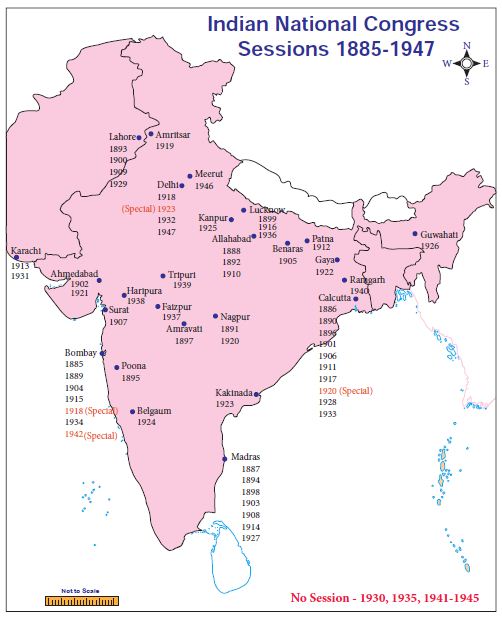
Mark the following on the outline map of India. Venues of Congress Sessions.
1. Bombay
2. Calcutta
3. Madras
4. Ahmedabad
5. Lucknow
6. Kanpur
7. Surat
8. Lahore
9. Poona
10. Allahabad
1.
(a)
2.
(b)
A is correct and R explanations A.
3.
(d)
All of the above
4.
(c)
Madras Native Association - 1852
5.
(b)
1835
6.
(a)
1915
7.
(a)
January, 30, 1948
8.
(a)
Jawaharlal Nehru
9.
(a)
statement (i) & (ii) are correct
10.
(a)
i, ii and iii
11.
Rajendra Prasad, Mazharul Huq, Acharya Kripalani and Mahadeva Desai.
12.
She published a book How India brought for Freedom, a weekly The Commonweal, a daily newspaper New India.
13.
1) In order to crush the growing nationalist movement, the government adopted many measures.
2) Lord Curzon created the Criminal Intelligence Department (CID) in 1903 to secretly collect information on the activities of nationalists.
3) The colonial state also resorted to banning meetings, printing and circulation of seditious materials for propaganda, and by detaining the suspects.
14.
The mendicant policy of the Moderates was appealing to the British by way of prayers and petitions.
15.
1) The demand for linguistic reorganisation of states did not stop.
2) The issue gained centre-stage with Pattabhi Sitaramayya's election as the Congress President at the Jaipur session.
3) A resolution there led to the constitution of a committee with Sardar Vallabhai Patel, Pattabhi Sitaramayya and Jawaharlal Nehru also called the JVP committee.
16.
1. The offer of Dominion Status was too little.
2. The Congress also rejected the idea of nominated members to the constitution-making body and sought elections in the Princely States as in the Provinces.
3. Above all these was the possibility of partition.
4. The negotiations were bound to breakdown and it did.
17.
The case came before Sessions Judge H.E. Holmes who had earned notoriety while serving as Sessions Judge of Gorakhpur for awarding death sentence to 172 peasants for their involvement in the Chauri Chaura case.
18.
pro-changers
1) After suspension of Non-cooperation, Chittaranjan Das and Motilal Nehru proposed a new line of activity.
2) They wanted to return to active politics which included entry into electoral politics and demonstrate that the nationalists were capable of obstructing the working of the reformed legislature by capturing them and arousing nationalist spirit.
3) This group came to be called the 'Swarajists and pro-changers'. In Tamil Nadu, Satyamurti joined this group.
4) The pro-changers launched the Swarajya party as a part of the Congress.
no changers
1) There was another group which opposed council entry and wanted to continue the Gandhian line by mobilizing the masses.
2) This team led by Rajagopalachari, Vallabhai Patel and Rajendra Prasad was called 'No changers'.
3) They argued that electoral politics would divert the attention of nationalists and pull them away from the work of mass mobilization and their issues.
4) They favoured the continuation of the Gandhian constructive programme of spinning, temperance, Hindu-Muslim unity, removal of untouchability and mobilise rural masses and prepare them for new mass movements.
19.
1) The Ghadar Movement was an important episode in India's freedom struggle.
2) A ship named Komagatamaru, filled with Indian immigrants was turned back from Canada. As the ship returned to India several of its passengers were killed or arrested in a clash with the British police.
3) This incident left a deep mark on the Indian nationalist movement.
20.
1) The Swadeshi movement in Tamil Nadu came to national attention in 1906 when V.O.C Chidambaram mooted the idea of launching a swadeshi shipping venture in opposition to the monopoly of the British in navigation through the coast.
2) In 1906, V.O.C registered a joint stock company called The Swadeshi Steam Navigation Company (SSNC) with a capital of Rs 10 Lakh, divided into 40,000 shares of Rs. 25 each. Shares were open only to Indians, Ceylonese and other Asian nationals. V.O.C purchased two steamships, S.S. Gallia and S.S. Lawoe.
3) The initial response of the British administration was to ignore the Swadeshi company.
4) As patronage for Swadeshi Company increased, the European officials exhibited blatant bias and racial partiality against the Swadeshi steamship.
21.
22.
1) Elections were held, based on the 1935 Act, to the Provincial Assemblies in August 1946. These elected assemblies in turn were to elect the Central Assembly, which would also become the Constituent Assembly.
2) The constitution also committed the nation to the principle of universal adult franchise, and an autonomous election commission.
3) The constitution also underscored the independence of the judiciary as much as it laid down sovereign law-making powers with the representatives of the people.
4) The members of the constituent assembly were not averse to learn and pick up features from the constitutions from all over the world; and at the same time they were clear that the exercise was not about copying provisions from the various constitutions from across the world.
23.
The outbreak of Second World War and Britain's decision to involve India in the War without consulting Congress ministries in provinces, provoked the leaders of Indian National Congress and Gandhi.
1. The Congress ministers resigned in protest.
2. The Cripps Mission arrived in March 1942 to assuage the nationalists.
3. But its proposals bore no fruit.
4. Gandhi decided to embark on the Quit India Movement in August 1942.
24.
1) The first major steel industry - Tata Iron and Steel Company (TISCO) - was set up by the Tatas in 1907 as a part of swadeshi effort in Sakchi, Bihar.
2) Prior to this, a group of Europeans had attempted in 1875 to found the Bengal iron Company.
3) Following this, the Bengal Iron and Steel Company was set up in 1889. However, TISCO made a huge headway than the other endeavourers in this sector.
4) Its production increased from 31,000 tons in 1912-13 to 1,81,000 tons in 1917-18.
25.
1) Mohandas Karamchand Gandhi was born in the coastal town of Porbandar in 1869. When he returned to India in 1915 he had a record of fighting against inequalities imposed by the racist government of South Africa.
2) Gandhi certainly wanted to be of help to forces of nationalism in India. He was in touch with leaders India as he had come into contact, with Congress leaders while mobilizing support for the South African Indian cause earlier. Impressed by activities and ideas of Gopala Krishna Gokhale, he acknowledged him as his political Guru.
3) On his return to India, following Gokhale's advice, Gandhi, who was away from India for over two decades, spent a year travelling all over the country acquainting himself with the situation.
4) He established his Sabarmati Ashram at Ahmedabad but did not take active part in political movements including the Home Rule movement.
5) Champaran Movement (1917): It was not difficult for Gandhi to convince the committee of the difficulties of the poor peasants. The report was accepted and implemented resulting in the release of the indigo cultivators of the bondage of European planters who gradually had to withdraw from Champaran itself.
6) Gandhi's call for protest on the issues of Khilafat, and Rowlatt Act and as a response the British government's repressive measures leading to the Jallianwalla Bagh massacre prompted the Congress to launch non-cooperation movement.
7) The Congress boycotted the Sirmon Commission and the first Round Table Conference and intensified the struggle by launching civil disobedience movement, in the wake of fruitless outcome of Second Round Table Conference.
8) Gandhi's Dandi March and Rajaji's Salt March to Vedaranyam in Tamilnadu succeeded in mobilizing the masses 'for the nationalist cause.
26.
27.
1) As pointed out earlier, thanks to the campaigns conducted by Bal Gangadhar Tilak Bipin Chandra Pal and Lala Lajpat Rai, often referred to as the Lal-Bal-Pal triumvirate, Maharashtra, Bengal, Punjab, emerged as the epicentres of militant nationalism during the Swadeshi phase.
2) Aurobindo Ghose was another influential figure in the militant leadership. The nationalism of this form was more assertive compared to the early Indian nationalism.
3) Both the groups, moderate and militant, were well aware of the evils or the wrong doings of the British rule.
4) The moderates, however, worked under the belief that the British rule in India could be reformed by convincing the rulers through representation and petitioning.
5) The militant nationalist, on the other hand, was of the opinion that the colonial rulers would never be amenable to reason, as they would not like to give up the advantages of an empire.
6) Militant nationalism also changed the nature of political pressure from the earlier force of public opinion of educated Indians to the protesting masses.
7) Despite these changes, the militant nationalism phase retained a continuity from the moderate phase.
8) This continuity was evident in the inability to transcend the peaceful method of struggle and for the most parts militant nationalism remained tied to the idea of non-violence. However, they appealed to the patriotic sentiments of the people using the religious symbols.
Swaraj or Political Independence
1) One of the common goals of the militant leaders was to achieve Swaraj or Self Rule. However, the leaders differed on the meaning of Swaraj.
2) For Tilak, Swaraj was restricted to the Indian control over the administration or rule by the natives, but not total severance of relation with Britain.
3) In Bipin Chandra Pal's view, Swaraj was the attainment of complete freedom from any foreign rule.
28.
1) Indian national movement dates its birth from the 1857 uprising. The outrages committed by the British army after putting down the revolt remained "un-avenged".
2) Even the court-martial law and formalities were not observed Officers who sat on the court martial swore that they would hang their prisoners, guilty or innocent and, if any dared to raise his voice against such indiscriminate vengeance, he was silenced by his angry colleagues.
3) Persons condemned to death after the mockery of a trial were often tortured by soldiers before their execution, while the officers looked on approvingly.
4) It is worth recalling what Elphinstone, Governor of Bombay Presidency, wrote to Sir John Lawrence, future Viceroy of India (1864) about the British siege of Delhi during June- September, 1857'. A wholesale vengeance is being taken without distinction of friend or foe. As regards the looting, we have indeed surpassed Nadirshah.'
Racial Discrimination
1) The English followed a policy of racial discrimination.
2) The systematic exclusion of the Indians from higher official positions came to be looked upon as an anti-Indian policy measure and the resultant discontent of the Indian upper classes led the Indians to revolt against the British rule.
3) When civil service examinations were introduced the age limit was fixed at twenty one. When Indians were making it, with a view to debarring the Indians from entering the civil services, the age limit was reduced to nineteen.
4) Similarly, despite requests from Indian educated middle class to hold the civil service examinations simultaneously in India, the Imperial government refused to concede the request.
29.
30.
31.
1) The First World War gave a landmark break to the industrialisation of the country. For the first time, Britain's strategic position in the East was challenged by Japan. The traditional trade routes were vulnerable to attack. To meet the requirements, development of industries in India became necessary.
2) Hence, Britain loosened its grip and granted some concessions to the lndian capitalists. Comparative relaxation of control by the British government and the expansion of domestic market due to the War, facilitated the process of industrialisation. For the first time, an industrial commission was appointed in 1916. During the war-period, the cotton and jute industries showed much growth. Steel industry was yet another sector marked by substantial growth.
3) Other industries showing progress were paper, chemicals, cement, fertilisers, tanning, etc. The first Indian owned paper mill - Couper Paper Mill - was set up in 1882 in Lucknow. Following this, Itaghur Paper Mill and Bengal Paper Mill, both owned by Europeans, were established.
4) Cement manufacturing began in 1904 in Madras with the establishment of South Indian Industries Ltd. Tanning industry began in the late nineteenth century and a government leather factory was set up in 1860 in Kanpur. The first Indian-owned National Tannen was established in 1905 in Calcutta. The gold mining in Kolar also started in the late nineteenth century in the Kolar mining field, Mysore.
5) The inter-war period registered growth jn manufacturing industries. Interestingly the growth rate was far better than Britain and even better than the world average. After a short slug in 1923-24, the output of textile industry began to pick up. During the interwar period, the number of looms and spindles increased considerably.
6) In 1929-30, 44 percent of the total amount of cotton piece goods consumed in India came from outside, but by 1933-34, after the Great Depression, the proportion had fallen to 20.5 percent. Other two industries which registered impressive growth were sugar and cement. The Interwar years saw a growth in the shipping industry too. The Scindia Steam Navigation Company Limited (1919) was the pioneer. In 1939, they even took over the Bombay Steam Navigation CornpanyLtd., a British concern. Eight Indian concerns were operational in this sector. A new phase of production began with the Second World War, which led to the extension of manufacturing industries to machineries, aircrafts, locomotives, and so on.
32.

12th Standard Syllabus & Materials
12th Standard
TN 12th Computer Applications களப்பெயர் முறைமை (DNS) Sample Question Papers Study Material - QB365 Set A
NEW12th Standard
TN 12th Computer Applications வலையமைப்பு எடுத்துக்காட்டுகள் மற்றும் நெறிமுறைகள் Sample Question Papers Study Material - QB365 Set A
NEW12th Standard
TN 12th Computer Applications கணினி வலையமைப்பு ஓர் அறிமுகம் Sample Question Papers Study Material - QB365 Set A
NEW12th Standard
TN 12th Computer Applications PHP-உடன் MySQL-ஐ இணைத்தல் Sample Question Papers Study Material - QB365 Set A



Tamilnadu Stateboard 12th Standard Subjects

Maths

Chemistry

Physics

Biology

Computer Science

Business Maths and Statistics

Economics

Commerce

Accountancy
History

Computer Applications
Biology
Computer Technology
Computer Applications
Computer Science
Business Maths and Statistics
Commerce
Economics
Maths
Chemistry
Physics
Computer Technology
History
Accountancy

Tamil

English

French
Tamilnadu Stateboard Standards

