
 100% FREE ACCESS
12th Standard Syllabus & Materials
12th Standard
TN 12th Computer Applications மின்னணு தரவு பரிமாற்றம் Sample Question Papers Study Material - QB365 Set A
NEW12th Standard
TN 12th Computer Applications மின் - வணிக பாதுகாப்பு அமைப்புகள் Sample Question Papers Study Material - QB365 Set A
NEW12th Standard
TN 12th Computer Applications மின்னணு செலுத்தல் முறைகள் Sample Question Papers Study Material - QB365 Set A
NEW12th Standard
TN 12th Computer Applications மின் - வணிகம் Sample Question Papers Study Material - QB365 Set A
NEW12th Standard
TN 12th Computer Applications திறந்த மூல கருத்துருக்கள் Sample Question Papers Study Material - QB365 Set A
NEW12th Standard
TN 12th Computer Applications வலையமைப்பு வடமிடல் Sample Question Papers Study Material - QB365 Set A

Published on: 21/09/2019
Download Tamil Nadu 12th Standard History question papers, model tests, one-mark questions, important questions, and public exam papers in PDF format. Free study materials and answer keys for TN State Board students.
Questions + Answers key
Take MCQ History Test1.
Why was the Simon Commission boycotted by the Congress
There was no recommendation for bestowing dominion status on India in its report
It did not provide any safeguards for minorities
It had excluded Indians from its fold.
It did not hold any promise for total independence
2.
The Home Rule Movement in south India was started by
Tilak
Annie Besant
B.P. Wadia
Col. H.S. Olcott
3.
Whose name was proposed as president by militant nationalists for the surat session of the Congress?
Aurobindo Ghose
Dadabhai Naoroji
Pherozesha Mehta
Lala Lajpat Rai
4.
In which year English Education was introduced in India?
1825
1835
1845
1855
5.
Communist Party of India was formed in the year
1920
1925
1930
1935
6.
How was the visit of Prince of Wales to India received?
7.
What was called the mendicant policy of the Moderates?
8.
Write a note on Indigo revolt?
9.
10.
Describe the composition of Constituent Assembly.
11.
Name the three British communists sent by the Communist Party of Great Britain to help build the party in India.
12.
What were the demands of the Khilafat Movement presented to the Paris peace conference held in March 1920?
13.
What do you know of Coral Mill Strike of 1908?
14.
Attempt a brief account of early emigration of labourers to Ceylon.
15.
What were the factors which contributed to the poor performance of the Public sector enterprises?
16.
Explain the reasons for the removal of S.C. Bose from the INC.
17.
Write a short note on TISCO.
18.
Highlight the important provisions of Lucknow Pact.
19.
Write a paragraph about the Rajaji Formula.
20.
21.
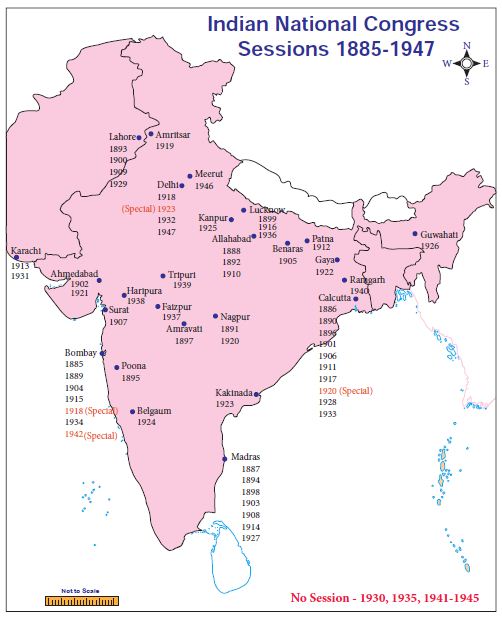
Mark the following on the outline map of India. Venues of Congress Sessions.
1. Bombay
2. Calcutta
3. Madras
4. Ahmedabad
5. Lucknow
6. Kanpur
7. Surat
8. Lahore
9. Poona
10. Allahabad
1.
(c)
It had excluded Indians from its fold.
2.
(b)
Annie Besant
3.
(d)
Lala Lajpat Rai
4.
(b)
1835
5.
(a)
1920
6.
1) The visit of Prince of Wales in 1921 to several cities in India was also boycotted.
2) The calculation of the colonial government that the visit of the Prince would evoke loyal sentiments of the Indian people was proved wrong.
7.
The mendicant policy of the Moderates was appealing to the British by way of prayers and petitions.
8.
1) The indigo revolt of 1859-60 was one of the responses from the Indian farmer to the oppressive policy of the British.
2) Indian tenants were forced to grow indigo by their planters who were mostly Europeans. Used to dye the clothes indigo was in high demand in Europe.
9.
10.
Indians shall make their own constitution was laid down by Gandhi as early as in 1922. Elections were held, based on the 1935 Act, to the Provincial Assemblies in August 1946. These elected assemblies in turn were to elect the Central Assembly, which would also become the Constituent Assembly.
11.
Philip Spratt, Ban Bradley and Lester Hutchinson
12.
The demands of the Khilafat Movement were presented by Mohammad Ali to the diplomats in Paris in March 1920. They were:
1) The Sultan of Turkey's position of Caliph should not be disturbed.,
2) The Muslim sacred places must be handed over to the Sultan and should be controlled by him.
3) The Sultan must be left with sufficient territory to enable him to defend the Islamic faith and
4) The Jazirat-ul-Arab (Arabia, Syria, Iraq, Palestine) must remain under his sovereignty
13.
1) In 1908, the abject working and living conditions of the Coral Mill workers attracted the attention of V.O.C and Siva.
2) In the next few days, both the leaders addressed the mill workers. In March 1908, the workers of the Coral Cotton Mills, inspired by the address went on strike. It was one of the earliest organised labour agitations in India.
3) The strike of the mill workers was fully backed by the nationalist newspapers. The mill owners, however, did not budge and was supported by the government which had decided to suppress the strike.
4) To further increase the pressure on the workers, the leaders were prohibited from holding any meetings in Tuticorin.
5) Finally, the mill owners decided to negotiate with the workers and concede their demands.
14.
1) In 1815, the Governor of Madras received a communication from the Governor of Ceylon asking for "coolies" to work on the coffee plantations.
2) The Madras Governor forwarded this letter to the collector of Thanjavur, who reported that the people were very much attached to the soil and unless some incentive was provided it was not easy to make them move out of their native soil.
3) But the outbreak of two famines (1833 and 1843) forced the people, without any prompting from the government, to leave for Ceylon to work as coolies in coffee and tea plantations under the indentured labour system.
15.
1) Part of the problem lay in the expansion of the public sector into non-strategic areas like tourism, hotels, consumer goods and so on. Services which depended on interactions with consumers were doing badly because of bad staff attitude.
2) Decisions on location were made for political rather than efficiency considerations.
3) Delays in construction resulted in cost overrun, so that the units were overcapitalized.
4) Administrative prices were not always economical.
5) Public sector units were also overstaffed, though the technology of heavy industries did not require so many workers. This increased the operating cost of the units, Inefficiency in management, all are the major factors which contributed to the poor performance of the Public sector enterprises.
16.
1) Subhas Chandra Bose was isolated within the Congress, as most leaders in the organisation's top refused cooperation with him.
2) Bose resigned and the AICC session at Calcutta elected Rajendra Prasad as president.
3) Bose founded the Forward Bloc to function within the Congress and was eventually removed from all positions in the organization in August 1939.
17.
1) The first major steel industry - Tata Iron and Steel Company (TISCO) - was set up by the Tatas in 1907 as a part of swadeshi effort in Sakchi, Bihar.
2) Prior to this, a group of Europeans had attempted in 1875 to found the Bengal iron Company.
3) Following this, the Bengal Iron and Steel Company was set up in 1889. However, TISCO made a huge headway than the other endeavourers in this sector.
4) Its production increased from 31,000 tons in 1912-13 to 1,81,000 tons in 1917-18.
18.
(i) Provinces should be freed as much as possible from Central control in administration and finance.
(ii) Four-fifths of the Central and Provincial Legislative Councils should be elected, and one-fifth nominated.
(iii) Four-fifths of the provincial and central legislatures were to be elected on as broad a franchise as possible.
(iv) Half the executive council members, including those of the central executive council were to be Indians elected by the councils themselves.
(v) The Congress also agreed to separate electorates for Muslims in provincial council elections and for preferences in their favour (beyond the proportions indicated by population) in all provinces except the Punjab and Bengal, where some ground was given to the Hindu and Sikh minorities. This pact paved the way for Hindu-Muslim cooperation in the Khilafat Movement and Gandhi's Non-Cooperation Movement
(vi) The Governments, Central and Provincial, should be bound to act in accordance with resolutions passed by their Legislative Councils unless they were vetoed by the Governor- General or Governors-in-Council and, in that event, if the resolution was passed again after an interval of not less than one year, it should be put into effect;
(vii) The relations of the Secretary of State with the Government of India should be similar to those of the Colonial Secretary with the Governments of the Dominions, and India should have an equal status with that of the Dominions in any body concerned with imperial affairs. The Lucknow Pact.
19.
In April 1944, when the Congress leaders were in jail, C.Rajagopalachari put out a proposal to resolve the issue. It contained the following:
1) A post-war commission to be formed to demarcate the contiguous districts where the Muslims were in absolute majority and a plebiscite of the adult population there to ascertain whether they would prefer Pakistan;
2) In case of a partition there would be a mutual agreement to run certain essential services, like defence or communication;
3) The border districts could choose to join either of the two sovereign states;
4) The implementation of the scheme would wait till after full transfer of power. After his release from prison, Gandhi, in July 1944, proposed talks with Jinnah based on what came to be the 'Rajaji formula'. The talks did not go anywhere.
Wavell Plan:
1) In June 1945 Lord Wavell moved to negotiate and called for the Simla conference.
2) The rest of the Congress leaders, including Jawaharlal Nehru, Sardar Patel and the Congress president, Maulana Abul Kalam Azad were released from jail for this.
3) Wavell convinced Churchill for a Congress-Muslim League coalition government as a way to deal with the post-war political crisis.
4) The Viceroy's proposal before the leaders of all political formations and most prominently the Congress and the Muslim League was setting up of an Executive Council, exclusively with Indians along with himself and the commander-in-chief; equal number of representatives in the council for the caste Hindus and the Muslims and separate representation for the Scheduled Castes; and start of discussions for a new constitution.
5) The proposal displeased everyone. The Simla Conference held between June 25 and July 14-1945 ended without resolution.
6) The talks broke down on the right of the Indian National Congress and the Muslim League to nominate members to the Viceroy's Council.
7) The Muslim League insisted on its exclusive right to nominate Muslim members to the Council.
8) Its demand was that the Congress nominees shall only be caste Hindus and that the Indian National Congress should not nominate a Muslim or a member from the Scheduled Caste.
9) This was seen as a means to further the divide on communal lines and deny the Congress the status of representing the Indian people.
10) Lord Wavell found a council without Muslim League representation as unworkable and thus abandoned the Simla talks.
11) The years between the Lahore resolution of 1940 and the Simla Conference in 1945 marked the consolidation of a Muslim national identity and the emergence of Jinnah as its sole spokesperson.
12) It was at a convention of Muslim League Legislators in Delhi in April 1946, that Pakistan was defined as a 'sovereign independent state.
13) For the first time the League also declared its composition in geographical terms as 'the region consisting of the Muslim majority provinces of Bengal and Assam in the Northeast and the Punjab, North-West Frontier Province, Sind and Baluchistan in the Northwest.
14) The Congress president Maulana Abul Kalam Azad rejected this idea and held that the Congress stood for a united India with complete independence.
15) All these were developments after the Simla conference of June-July 1945 and after Churchill was voted out and replaced by a Labour Party government headed by Clement Attlee.
16) Times had changed in a substantial sense. British Prime Minister, Attlee had declared the certainty of independence to India with only the terms left to be decided.
20.
21.

12th Standard Syllabus & Materials
12th Standard
TN 12th Computer Applications களப்பெயர் முறைமை (DNS) Sample Question Papers Study Material - QB365 Set A
NEW12th Standard
TN 12th Computer Applications வலையமைப்பு எடுத்துக்காட்டுகள் மற்றும் நெறிமுறைகள் Sample Question Papers Study Material - QB365 Set A
NEW12th Standard
TN 12th Computer Applications கணினி வலையமைப்பு ஓர் அறிமுகம் Sample Question Papers Study Material - QB365 Set A
NEW12th Standard
TN 12th Computer Applications PHP-உடன் MySQL-ஐ இணைத்தல் Sample Question Papers Study Material - QB365 Set A



Tamilnadu Stateboard 12th Standard Subjects

Maths

Chemistry

Physics

Biology

Computer Science

Business Maths and Statistics

Economics

Commerce

Accountancy
History

Computer Applications
Biology
Computer Technology
Computer Applications
Computer Science
Business Maths and Statistics
Commerce
Economics
Maths
Chemistry
Physics
Computer Technology
History
Accountancy

Tamil

English

French
Tamilnadu Stateboard Standards

