
 100% FREE ACCESS
12th Standard Syllabus & Materials
12th Standard
TN 12th Computer Applications மின்னணு தரவு பரிமாற்றம் Sample Question Papers Study Material - QB365 Set A
NEW12th Standard
TN 12th Computer Applications மின் - வணிக பாதுகாப்பு அமைப்புகள் Sample Question Papers Study Material - QB365 Set A
NEW12th Standard
TN 12th Computer Applications மின்னணு செலுத்தல் முறைகள் Sample Question Papers Study Material - QB365 Set A
NEW12th Standard
TN 12th Computer Applications மின் - வணிகம் Sample Question Papers Study Material - QB365 Set A
NEW12th Standard
TN 12th Computer Applications திறந்த மூல கருத்துருக்கள் Sample Question Papers Study Material - QB365 Set A
NEW12th Standard
TN 12th Computer Applications வலையமைப்பு வடமிடல் Sample Question Papers Study Material - QB365 Set A

Published on: 30/08/2019
Rise of Nationalism in India
Download Tamil Nadu 12th Standard History question papers, model tests, one-mark questions, important questions, and public exam papers in PDF format. Free study materials and answer keys for TN State Board students.
Questions + Answers key
Take MCQ History Test1.
Assertion: Dadabhai Naoroji was elected thrice as the President of the Indian National Congress.
Reason: The Indian National Movement upto 1905 was dominated by Constitutionalists.
Both A and R are true and R is the correct explanation of A
Both A and R are true but R is not the correct explanation of A
A is true but R is false
A is false but R is true
2.
Which of the following statements are correct on Orissa famine?
Statement I: In 1866 a million and a half people of Orissa died of starvation.
Statement II: During that time the British exported 200 million pounds of rice to Britain.
Statement III: The Orissa famine prompted Dadabai Naoroji to begin a life long investigation of poverty in India.
I & II
I & III
None of the above
All of the above
3.
4.
Who wrote the book - ‘Poverty and Un-British Rule in India’?
Bala Gangadhar Tilak
Gopala Krishna Gokhale
Dadabhai Naoroji
M.G. Ranade
5.
Who was called the ‘Grand Old Man of India?
Bala Gangadhar Tilak
M.K. Gandhi
Dadabhai Naoroji
Subhash Chandra Bose
6.
Identify the prominent early Indian nationalists.
7.
8.
What were the grievances represented by the Madras Native Association in their petition to the British Parliament?
9.
Highlight the contribution of missionaries to modern education.
10.
Discuss the importance of Ilbert Bill.
11.
12.
Attempt a brief account of early emigration of labourers to Ceylon.
13.
Name the prominent participants in the inaugural meeting of Madras Mahajana Sabha held in May 1884?
14.
Describe the way in which indentured labour was organized in British India?
15.
Point out the role played by press in creating nationalist consciousness in British India.
16.
Explain the objectives of the Indian National Congress and contributions of the early nationalists to the cause of India’s liberation from the colonial rule.
17.
To what extent the repressive and racist policy measures of the British were responsible for the national awakening in India.
18.
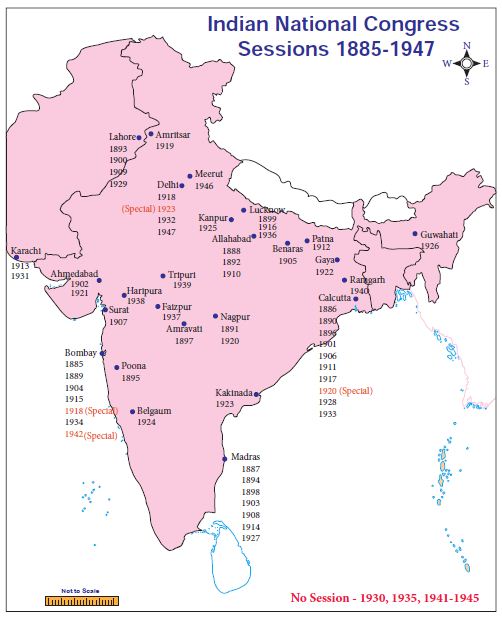
Mark the following on the outline map of India. Venues of Congress Sessions.
1. Bombay
2. Calcutta
3. Madras
4. Ahmedabad
5. Lucknow
6. Kanpur
7. Surat
8. Lahore
9. Poona
10. Allahabad
1.
(c)
A is true but R is false
2.
(d)
All of the above
3.
(a)
4.
(c)
Dadabhai Naoroji
5.
(c)
Dadabhai Naoroji
6.
Dadabhai Naoroji, Gopal Krishna Gokhale, Bipin Chandra Pal, Lala Lajpat Rai, Bal Gangadhar Tilak.
7.
8.
1) In a Petition submitted in December 1852, the MNA pointed out that the ryotwari and zamindari systems had thrown agricultural classes into deep distress.
2) It urged the revival of the ancient village system to free the peasantry from the oppressive interference of the Zamindars and the company officials.
3) The Petition also made a complaint about the judicial system which was slow, Complicated and imperfect.
4) It pointed out that the appointment of the judges without assessing their judicial knowledge and competence in the local languages affected the efficiency of the judiciary.
9.
1) The English Education act was passed by the council of india in 1835.
2) T.B Macaulay drafted this system of education introduced in India.
3) Consequently, the colonial administration started schools, Colleges and Universities, imparting English and modern education, in India.
4) The colonial government Expected this section of educated Indians to be the loyal to the british and act as the pillars of the british Raj.
10.
1) Abolition of custom duty on cotton manufactures imported from England and levy of excise duty on cotton fabrics manufactured in india created nationwide discontent.
2) During the viceroyalty of Ripon the indian judges were empowered through the IIbert Bill to try the europeans.
3) Bit in the face of resistance from the Europeans the bill was amended to suit the European interests.
11.
12.
1) In 1815, the Governor of Madras received a communication from the Governor of Ceylon asking for "coolies" to work on the coffee plantations.
2) The Madras Governor forwarded this letter to the collector of Thanjavur, who reported that the people were very much attached to the soil and unless some incentive was provided it was not easy to make them move out of their native soil.
3) But the outbreak of two famines (1833 and 1843) forced the people, without any prompting from the government, to leave for Ceylon to work as coolies in coffee and tea plantations under the indentured labour system.
13.
G. Subramaniam, Viraraghavachari, Ananda Charlu, Rangiah, Balaji Rao and Salem Ramaswamy.
14.
1) The introduction of plantation crops such as coffee, tea and sugar in Empire colonies such as Ceylon (Sri Lanka), Mauritius, Fiji, Malaya, the Caribbean islands, and South Africa required enormous labour.
2) The abolition of slavery in British India in 1843 also facilitated the processes of emigration to Empire colonies. In 1837 the number of immigrant Tamil labourers employed in Ceylon coffee estate was estimated at 10,000.
3) The industry developed rapidly and so did the demand for Tamil labour.
4) In 1846 its presence was estimated at 80,000 and in 1855 at 128,000 persons. In 1877, the famine year, there were nearly 380,000 Tamil labourers in Ceylon.
15.
1) The introduction of printing press in India was an event of great significance. It helped people to spread, modem ideas of self-government, democracy, civil rights and industrialisation.
2) The press became the critic of politics. It addressed the people on several issues affecting the country.
3) Raja Rammohan Roy's Sam bad Kaumudi (1821) in Bengali and Mirat-Ul-Akbar (1822) in Persian played a progressive role in educating the people on issues of public importance.
4) Later on a number of nationalist and vernacular news papers came to be launched to build public opinion and they did yeomen service in fostering nationalist consciousness.
5) Among them Amrit Bazaar Patrika, The Bombay Chronicle, The Tribune, The Indian Mirror, The Hindu and Swadesamitran were prominent.
16.
The major objectives and demands of INC were
Constitutional
Opportunity for participation in the government was one of the major demands of the Indian National Congress. It demanded Indian representation in the government.
Economic
High land revenue was one of the major factors that contributed to the oppression of the peasants. It demanded reduction in the land revenue and protection of peasants against exploitation of the zamindars. The Congress also advocated the imposition of heavy tax on the imported goods for the benefit of swadeshi goods.
Administrative
Higher officials who had responsibility of administration in India were selected through civil services examinations conducted in Britain. This meant that educated Indians who could not afford to go to London had no opportunity to get high administrative jobs. Therefore, Indianisation of services through simultaneous Indian Civil Services Examinations in England and India was a major demand of the Congress.
Judicial
Because of the partial treatment against the Indian political activists by English judges it demanded the complete separation of the Executive and the Judiciary.
Contributions of Early Nationalists (1885-1915)
1) The early nationalists in the INC came from the elite sections of the society. Lawyers, college and university teachers, doctors, journalists and such others represented the Congress. However, they came from different regions of the country and this made INC a truly a national political organisation.
2) These leaders of the INC adopted the constitutional methods of presenting petitions, prayers and memorandums and thereby earned the moniker of "Moderates".
3) It was also the time some sort of an understanding about colonialism was evolving in India There was no ready-made anti-colonial understanding available for reference in the late nineteenth century when the INC was formed.
4) It was the early nationalists who helped the formulation of the idea of we as a nation. The were developing the indigenous anti-colonial ideology and a strategy on their own which helped future mass leaders like M. K Gandhi.
5) From the late 1890s there were growing differences within the INC Leaders like Bipin Chandra Pal, Bal Gangadhar Tilak and Lala Lajpat Rai were advocating radical appro ache instead of merely writing petitions, prayers and memorandums.
6) These advocates of radical methods came to be called the "extremists" as against those who were identified as moderates. Their objective became clear in 1897 when Tilak raised the clarion call "Swaraj is my birth right and I shall have it".
7) Tilak and his militant followers were now requesting Swaraj -instead of economic or administrative reforms that the moderates were requesting through their petitions and prayers.
8) Though they criticised each other, it would be wrong to place them in the opposing poles. Both moderates and militants, with their own methods, were significant elements of the larger Indian nationalist movement.
9) In fact, they contributed towards the making of the swadeshi movement. The partition of Bengal in 1905, by the colonial government, which you will be studying in the next lesson, was vehemently opposed by the Indians.
10) The swadeshi movement of 1905, directly opposed the British rule and encouraged the ideas of swadeshi enterprise, national education, self-help and use of Indian languages.
11) The method of mass mobilisation and boycott of British goods and institutions suggested by the radicals was also accepted by the Moderates.
17.
1) Indian national movement dates its birth from the 1857 uprising. The outrages committed by the British army after putting down the revolt remained "un-avenged".
2) Even the court-martial law and formalities were not observed Officers who sat on the court martial swore that they would hang their prisoners, guilty or innocent and, if any dared to raise his voice against such indiscriminate vengeance, he was silenced by his angry colleagues.
3) Persons condemned to death after the mockery of a trial were often tortured by soldiers before their execution, while the officers looked on approvingly.
4) It is worth recalling what Elphinstone, Governor of Bombay Presidency, wrote to Sir John Lawrence, future Viceroy of India (1864) about the British siege of Delhi during June- September, 1857'. A wholesale vengeance is being taken without distinction of friend or foe. As regards the looting, we have indeed surpassed Nadirshah.'
Racial Discrimination
1) The English followed a policy of racial discrimination.
2) The systematic exclusion of the Indians from higher official positions came to be looked upon as an anti-Indian policy measure and the resultant discontent of the Indian upper classes led the Indians to revolt against the British rule.
3) When civil service examinations were introduced the age limit was fixed at twenty one. When Indians were making it, with a view to debarring the Indians from entering the civil services, the age limit was reduced to nineteen.
4) Similarly, despite requests from Indian educated middle class to hold the civil service examinations simultaneously in India, the Imperial government refused to concede the request.
18.

12th Standard Syllabus & Materials
12th Standard
TN 12th Computer Applications களப்பெயர் முறைமை (DNS) Sample Question Papers Study Material - QB365 Set A
NEW12th Standard
TN 12th Computer Applications வலையமைப்பு எடுத்துக்காட்டுகள் மற்றும் நெறிமுறைகள் Sample Question Papers Study Material - QB365 Set A
NEW12th Standard
TN 12th Computer Applications கணினி வலையமைப்பு ஓர் அறிமுகம் Sample Question Papers Study Material - QB365 Set A
NEW12th Standard
TN 12th Computer Applications PHP-உடன் MySQL-ஐ இணைத்தல் Sample Question Papers Study Material - QB365 Set A



Tamilnadu Stateboard 12th Standard Subjects

Maths

Chemistry

Physics

Biology

Computer Science

Business Maths and Statistics

Economics

Commerce

Accountancy
History

Computer Applications
Biology
Computer Technology
Computer Applications
Computer Science
Business Maths and Statistics
Commerce
Economics
Maths
Chemistry
Physics
Computer Technology
History
Accountancy

Tamil

English

French
Tamilnadu Stateboard Standards

