
 100% FREE ACCESS
12th Standard Syllabus & Materials
12th Standard
TN 12th Computer Applications மின்னணு தரவு பரிமாற்றம் Sample Question Papers Study Material - QB365 Set A
NEW12th Standard
TN 12th Computer Applications மின் - வணிக பாதுகாப்பு அமைப்புகள் Sample Question Papers Study Material - QB365 Set A
NEW12th Standard
TN 12th Computer Applications மின்னணு செலுத்தல் முறைகள் Sample Question Papers Study Material - QB365 Set A
NEW12th Standard
TN 12th Computer Applications மின் - வணிகம் Sample Question Papers Study Material - QB365 Set A
NEW12th Standard
TN 12th Computer Applications திறந்த மூல கருத்துருக்கள் Sample Question Papers Study Material - QB365 Set A
NEW12th Standard
TN 12th Computer Applications வலையமைப்பு வடமிடல் Sample Question Papers Study Material - QB365 Set A

Published on: 20/10/2025
Download Tamil Nadu 12th Standard Maths question papers, model tests, one-mark questions, important questions, and public exam papers in PDF format. Free study materials and answer keys for TN State Board students.
Questions + Answers key
Take MCQ Maths Test
1.
A man 2 m high walks at a uniform speed of 5 km/ hr away from a lamp post 6 m high. Find the rate at which the length of his shadow increases?
2.
3.
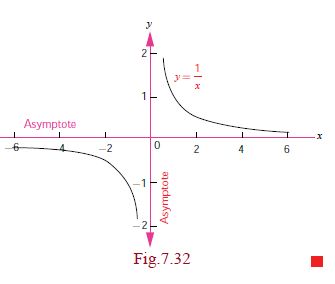
Find the asymptotes of the function f(x) = \(\frac{1}{x}\)
4.
Find the intervals of monotonicity and hence find the local extrema for the function f(x) = x2 − 4x + 4
5.
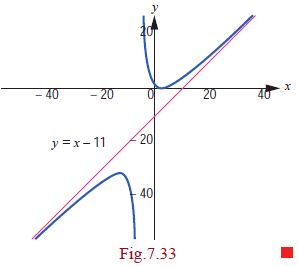
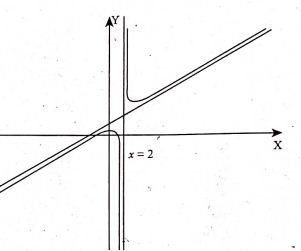
Find the asymptotes of the following curves :\(f(x)=\frac { { x }^{ 2 }+6x-4 }{ 3x-6 } \)
6.
Find the asymptotes of the following curves \(f(x)=\frac { 3x }{ \sqrt { { x }^{ 2 }+2 } } \)
7.
Explain why Rolle’s theorem is not applicable to the following functions in the respective intervals.
\(f(x)=tan x,x \in [0, \pi]\)
8.
A stone is dropped into a pond causing ripples in the form of concentric circles. The radius r of the outer ripple is increasing at a constant rate at 2 cm per second. When the radius is 5 cm find the rate of changing of the total area of the disturbed water?
9.
A particle is fired straight up from the ground to reach a height of s feet in t seconds, where s(t) = 128t −16t2.
(1) Compute the maximum height of the particle reached.
(2) What is the velocity when the particle hits the ground?
10.
The temperature T in celsius in a long rod of length 10 m, insulated at both ends, is a function of length x given by T = x(10 − x). Prove that the rate of change of temperature at the midpoint of the rod is zero.
11.
If f (x) is continuous in closed interval [a,b] and differentiable in open interval (a,b) and if f'(x) > 0, x ∈ (a,b) , then for, x1, x2 ∈ [ a, b ], such that x1 < x2 we have, f (x1) < f (x2 )
12.
Find the intervals of monotonicities of the function f(x) = sin x, xદ[0, 2π]
13.
Evaluate: : \(\underset{x\rightarrow 0^{+}}{lim}\) x log x.
14.
Evaluate: \(\underset{x\rightarrow 0^{+}}{lim}(\frac{1}{x}-\frac{1}{e^{x}-1})\).
15.
Expand sin x in ascending powers x - \(\frac{\pi}{4}\) upto three non-zero terms.
16.
Suppose that for a function f(x), f'(x) ≤ 1for all 1 ≤ x ≤ 4. Show that f(4) - f(1) ≤ 3.
17.
Using the Rolle’s theorem, determine the values of x at which the tangent is parallel to the x -axis for the following functions:
\(f(x)=\sqrt{x}-\frac{x}{3}, x\in [0,9]\)
18.
Find the equations of the tangents to the curve y = \(\frac{x+1}{x-1}\) which are parallel to the line x + 2y = 6.
19.
Find the points on the curve y2 - 4xy = x2 + 5 for which the tangent is horizontal.
20.
A particle moves so that the distance moved is according to the law s(t) = \(s(t)=\frac{t^{3}}{3}-t^{2}+3\). At what time the velocity and acceleration are zero.
21.
A water tank has a shape of an inverted cone with its axis vertical and vertex lower most. Its semi vertical angle is tan−1(0.5). Water is poured into it at a constant rate of 5 cm3/hr. Find the rate at which the level of the water is rising at that instant when the depth of the water is 4 m.
22.
missle fired from ground level rises x metres vertically upwards in t seconds and \(x=100t-\frac { 25 }{ 2 } { t }^{ 2 }\). Find the
(i) initial velocity of the missile
(ii) the time when the height of the missile is maximum
(iii) the maximum height reached
(iv) the velocity which the missile strikes the ground.
23.
Find the local extremum of the function f (x) = x4 + 32x
24.
Discuss the monotonicity and local extrema of the function \(f(x)=log(1+x)-\frac{x}{1+x},x>-1\) and hence find the domain where, \(log(1+x)>\frac{x}{1+x}\)
25.
Evaluate the following limit, if necessary use l ’Hôpital Rule
\(\underset { x\rightarrow \infty }{ lim } \ { \left( 1+\frac { 1 }{ x } \right) }^{ x }\)
26.
Evaluate the following limit, if necessary use l’Hôpital Rule
\(\underset { x\rightarrow { 0 }^{ + } }{ lim } { x }^{ x }\)
27.
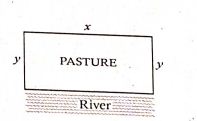
A farmer plans to fence a rectangular pasture adjacent to a river. The pasture must contain1,80,000 sq. mtrs in order to provide enough grass for herds. No fencing is needed along the river. What is the length of the minimum needed fencing material
28.
Find the intervals of monotonicities and hence find the local extremum for the following function:
f(x) = sin x cos x + 5, x ∈ (0,2π)
29.
Find the intervals of monotonicities and hence find the local extremum for the following function:
\(f(x)=\frac { x }{ x-5 } \)
30.
Find the intervals of monotonicities and hence find the local extremum for the following function:
f(x) = 2x3+ 3x2-12x
31.
Find the absolute extrema of the following function on the given closed interval
f(x) = 3x4-4x3 ;[-1, 2]
32.
Show that the two curves x2 − y2 = r2 and xy = c2 where c, r are constants, cut orthogonally
33.
Find the angle between the rectangular hyperbola xy = 2 and the parabola x2 + 4y = 0
34.
A particle moves along a line according to the law s(t) = 2t3 − 9t2 +12t − 4, where t ≥ 0.
(i) At what times the particle changes direction?
(ii) Find the total distance travelled by the particle in the first 4 seconds.
(iii) Find the particle’s acceleration each time the velocity is zero.
35.
36.
If \(f(x)=e^{x} \sin x \text { in }[0, \pi]\) then c in Rolles theorem is ____________
\(\frac{\pi}{6}\)
\(\frac{\pi}{4}\)
\(\frac{\pi}{2}\)
\(\frac{3\pi}{4}\)
37.
38.
The curve y= ax4 + bx2 with ab > 0
has, no horizontal tangent
is concave up
is concave down
has no points of inflection
39.
The maximum product of two positive numbers, when their sum of the squares is 200, is
100
\(25\sqrt { 7 } \)
28
\(24\sqrt { 14 } \)
40.
One of the closest points on the curve x2 - y2 = 4 to the point (6, 0) is
(2,0)
\(\left( \sqrt { 5 } ,1 \right) \)
\(\left( 3,\sqrt { 5 } \right) \)
\(\left( \sqrt { 13 } ,-\sqrt { 3 } \right) \)
41.
The maximum value of the function \(x^{2} e^{-2 x}, x>0\) is
\(\frac { 1 }{ e } \)
\(\frac { 1 }{ 2e } \)
\(\frac { 1 }{ { e }^{ 2 } } \)
\(\frac { 4 }{ { e }^{ 4 } } \)
42.
The maximum slope of the tangent to the curve y = ex sin x, x ∈ [0, 2π] is at
\(x=\frac { \pi }{ 4 } \)
\(x=\frac { \pi }{ 2 } \)
\(x=\pi \)
\(x=\frac { 3\pi }{ 2 } \)
43.
The minimum value of the function |3 - x| + 9 is
0
3
6
9
44.
The number given by the Mean value theorem for the function \(\frac { 1 }{ x } \), x ∈ [1, 9] is
2
2.5
3
3.5
45.
The number given by the Rolle's theorem for the functlon x3 - 3x2, x ∈ [0, 3] is
1
\(\sqrt { 2 } \)
\(\frac { 3 }{ 2 } \)
2
46.
The function sin4 x + cos4 x is increasing in the interval
\(\left[ \frac { 5\pi }{ 8 } ,\frac { 3\pi }{ 4 } \right] \)
\(\left[ \frac { \pi }{ 2 } ,\frac { 5\pi }{ 8 } \right] \)
\(\left[ \frac { \pi }{ 4 } ,\frac { \pi }{ 2 } \right] \)
\(\left[ 0,\frac { \pi }{ 4 } \right] \)
47.
What is the value of the limit \(\lim _{x \rightarrow 0}\left(\cot x-\frac{1}{x}\right) \text { is }\)
0
1
2
∞
48.
The tangent to the curve y2 - xy + 9 = 0 is vertical when
y = 0
\(\\ \\ y=\pm \sqrt { 3 } \)
\(y=\frac { 1 }{ 2 } \)
\(y=\pm 3\)
49.
The slope of the line normal to the curve f(x) = 2cos 4x at \(x=\cfrac { \pi }{ 12 } \) is
\(-4\sqrt { 3 } \)
-4
\(\cfrac { \sqrt { 3 } }{ 12 } \)
\(4\sqrt { 3 } \)
50.
The point on the curve 6y = x3 + 2 at which y-coordinate changes 8 times as fast as x-coordinate is
(4, 11)
(4, -11)
(-4, 11)
(-4,-11)
51.
52.
The position of a particle moving along a horizontal line of any time t is given by s(t) = 3t2 -2t- 8. The time at which the particle is at rest is
t = 0
\(\\ \\ \\ t=\cfrac { 1 }{ 3 } \)
t =1
t = 3
53.
A balloon rises straight up at 10 m/s. An observer is 40 m away from the spot where the balloon left the ground. The rate of change of the balloon's angle of elevation in radian per second when the balloon is 30 metres above the ground.
\(\frac{3}{25} \text { radians } / \mathrm{sec}\)
\(\frac{4}{25} \text { radians } / \mathrm{sec}\)
\(\frac{1}{5} \text { radians } / \mathrm{sec}\)
\(\frac{1}{3} \text { radians } / \mathrm{sec}\)
54.
The volume of a sphere is increasing in volume at the rate of 3 πcm3 / sec. The rate of change of its radius when radius is \(\frac { 1 }{ 2 } \) cm
3 cm/s
2 cm/s
1 cm/s
\(\cfrac { 1 }{ 2 } cm/s\)
1.
Let AB be the lamp post. Let the man CD be at distance x m from lamp post and y m be the length of his shadow at any time t.
Given \(\frac { dx }{ dt } \) = 5 km / hr = 5000 m/hr
ΔABE and CDE are similar
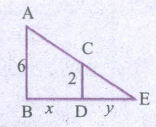
∴ \(\frac { DE }{ CD } =\frac { BE }{ AB } \)
⇒ \(\frac { y }{ 2 } =\frac { x+y }{ 6 } \)
⇒ 6y = 2x+2y
⇒ 4y = 2x
⇒ y = \(\frac { x }{ 2 } \)
⇒ \(\frac { dy }{ dt } =\frac { 1 }{ 2 } \frac { dx }{ dt } =\frac { 1 }{ 2 } \)(5000)
= 2500 m/hr = 2.5 km/hr.
2.
3.
We have,
\(\underset { x\rightarrow { 0 }^{ - } }{ lim } =-\infty \ and\ \underset { x\rightarrow { 0 }^{ x } }{ lim } =\frac { 1 }{ x } =\infty \). Hence, the required vertical asymptote is x = 0 or the y -axis.
As the curve is symmetric with respect to both the axes, y = 0 or the x -axis is also an asymptote.
Hence this (rectangular hyperbola) curve has both the vertical and horizontal asymptotes.
4.
We have,
f(x) = (x-2)2, then
\(f'(x)=2(x-2)=0 \) gives x = 2.
The intervals of monotonicity are \((-\infty,2)\) and \((2,\infty)\)
Since \(f'(x)<0, \forall x \in (-\infty,2)\) for \((-\infty,2)\) the f(x) is strictly decreasing on \((2,\infty)\)
As \(f'(x)>0, \) for \(x \in(2, \infty)\) the function f(x) is strictly increasing on \((2,\infty)\)
Becasue f'(x) changes its sign from negative to positive when passing through x = 2 for the function f(x) it has a local minimum at x = 2
The local minimum value is f(2) = 0.
5.
Given
\(f(x)=\frac { { x }^{ 2 }+6x-4 }{ 3x-6 } \)
\(\underset { x\rightarrow { 2 }^{ + } }{ lim } \frac { { x }^{ 2 }+6x-4 }{ 3x-6 } =\underset { h\rightarrow 0^{ + } }{ lim } \frac { (2+h)^{ 2 }+6(2+h)-4 }{ 3(2+h)-6 } \)
= \(\underset { h\rightarrow 0^{ + } }{ lim } \frac { (2+h)^{ 2 }+6(2+h)-4 }{ 6+3h-6 } \)
= -∞
ஃ x = 2 is the vertical asymptote,
Also
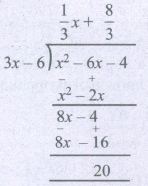
\(\therefore y=\frac { 1 }{ 3 } x+\frac { 8 }{ 3 } \) is the slanting asymptote.
6.
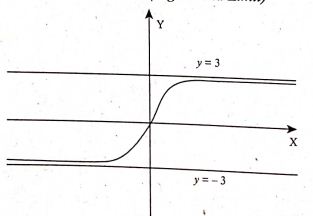
\(f(x)=\frac { 3x }{ \sqrt { { x }^{ 2 }+2 } } \)
\(\underset { x\rightarrow \infty }{ lim } \frac { 3x }{ \sqrt { { x }^{ 2 }+2 } } =\underset { \frac { 1 }{ x } \rightarrow 0 }{ lim } \frac { 3 }{ \sqrt { 1+\frac { 2 }{ { x }^{ 2 } } } } \)
= \(\frac { 3 }{ \sqrt { 1+0 } } =3\)
ஃy = 3 is the horizontal asymptote.
Also \(\underset { x\rightarrow -\infty }{ lim } \frac { 3x }{ \sqrt { { x }^{ 2 }+2 } } =\underset { \frac { 1 }{ x } \rightarrow { 0 }^{ - } }{ lim } \frac { 3 }{ \sqrt { 1+\frac { 2 }{ { x }^{ 2 } } } } =-3\)
ஃ y = -3 is the horizontal asymptote
7.
Given f(x) = tan x, x ∈ [0, π]
Rolle's theorem is not applicable since tan x is not continuous at x = \(\frac{\pi}{2}\) [∵ tan \(\frac{\pi}{2}\) = ∞]
8.
Let r be the radius of the ripple and A be the area of the ripple.
GIven \(\frac { dr }{ dt } \) = 2 cm/sec and r = 5 cm ... (1)
We know A = πr2
Differentiating with respect to 't' we get,
\(\frac { dA }{ dt } \) = π(2r).\(\frac { dr }{ dt } \)
= π(2) (5) (2) [using (1)]
\(\frac { dA }{ dt } \) = 20 πsq.cm/sec.
9.
(i) At the maximum height, the velocity v(t) of the particle is zero.
Now, we find the velocity of the particle at time t.
\(v(t)=\frac{ds}{dt}=128-32t\)
\(v(t)=0 \Rightarrow 128-32t=0 \Rightarrow t=4.\)
After 4 seconds, the particle reaches the maximum height.
The height at t = 4 is s(4) = 128(4) - 16(4)2 = 256 ft.
(ii) When the particle hits the ground then s = 0 .
s = 0 ⇒ 128t −16t2 = 0
⇒ t = 0, 8 seconds.
The particle hits the ground at t = 8 seconds. The velocity when it hits the ground v(8) = –128 ft /s.
10.
We are given that, T = 10x − x2
Hence, the rate of change at any distance from one end is given by \(\frac{dT}{dx}=10-2x \)
The mid point of the rod is at x = 5
Substituting x = 5, we get \(\frac{dT}{dx}=0\)
11.
By the mean value theorem, there exists \(c \in\left(x_{1}, x_{2}\right) \subset(a, b)\) such that,
\(\frac{f\left(x_{2}\right)-f\left(x_{1}\right)}{x_{2}-x_{1}}=f^{\prime}(c)\)
Since \(f^{\prime}(c)>0, \text { and } x_{2}-x_{1}>0 \text { we have } f\left(x_{2}\right)-f\left(x_{1}\right)>0\)
We conclude that, whenever \(x_{1}
12.
f(x) is increasing on \(\left[ 0,\frac { \pi }{ 2 } \right] \) and \(\left[ \frac { 3\pi }{ 2 } ,2\pi \right] \)
13.
This is an indeterminate of the form (0×∞). To evaluate this limit, we first simplify and bring it to the form \((\frac{\infty}{\infty})\) and apply L’Hôpital Rule.
\(\underset{x\rightarrow 0^{+}}{lim}xlog x= \underset{x\rightarrow 0^{+}}{(\frac{log x}{\frac{1}{x}})}\)
\(\underset{x\rightarrow 0^{+}}{lim}(\frac{\frac{1}{x}}{-\frac{1}{x^{2}}})=\underset{x\rightarrow 0^{+}}{lim}(-x)=0.\)
14.
This is an indeterminate of the form \(\infty, -\infty\). To evaluate this limit we first simplify and bring it in the form \((\frac{0}{0})\) and applying the l’Hôpital Rule, we get
\(\frac{x\rightarrow 0^{+}}{lim}(\frac{1}{x}-\frac{1}{e^{x}-1})=\underset{x\rightarrow 0^{+}}{lim}(\frac{e^{x}-x-1}{x(e^{x}-1)})\) \((\frac{0}{0})\)
Now, \(\underset{x\rightarrow 0^{+}}{lim} (\frac{e^{x}-x-1}{x(e^{x}-1)})=\underset{x\rightarrow 0^{+}}{lim}(\frac{e^{x}-1}{xe^{x}+e^{x}-1})\) \((\frac{0}{0})\)
\(=\underset{x\rightarrow 0^{+}}{lim}(\frac{e^{x}}{xe^{x}+2e^{x}})=\frac{1}{2}\)
15.
Let (x) = sin x
fI(x) = cos x
fII(x) = - sin x
fIII(x) = -cos x
⇒ \(f\left( \frac { \pi }{ 4 } \right) =sin\frac { \pi }{ 4 } =\frac { 1 }{ \sqrt { 2 } } \)
\({ f }^{ 1 }\left( \frac { \pi }{ 4 } \right) =cos\frac { \pi }{ 4 } =\frac { 1 }{ \sqrt { 2 } } \)
\({ f }^{ II }\left( \frac { \pi }{ 4 } \right) =sin\frac { \pi }{ 4 } =-\frac { 1 }{ \sqrt { 2 } } \)
\({ f }^{ II }\left( \frac { \pi }{ 4 } \right) =-cos\frac { \pi }{ 4 } =-\frac { 1 }{ \sqrt { 2 } } \)
Taylors' series for f (x) at x = \(\frac { \pi }{ 4 } \) is
\(f(x)=f\left( \frac { \pi }{ 4 } \right) +\frac { { f }^{ I }\left( \frac { \pi }{ 4 } \right) }{ 1! } \left( x-\frac { \pi }{ 4 } \right) +\frac { { f }^{ II }\left( \frac { \pi }{ 4 } \right) }{ 2! } { \left( x-\frac { \pi }{ 4 } \right) }^{ 2 }+\frac { { f }^{ III }\left( \frac { \pi }{ 4 } \right) }{ 3! } { \left( x-\frac { \pi }{ 4 } \right) }^{ 3 }\)+...
\(sinx=\frac { 1 }{ \sqrt { 2 } } +\frac { 1 }{ \sqrt { 2 } } \left( x-\frac { \pi }{ 4 } \right) -\frac { 1 }{ \sqrt { 2 } } \frac { { \left( x-\frac { \pi }{ 4 } \right) }^{ 2 } }{ 2! } -\frac { 1 }{ \sqrt { 2 } } \frac { { \left( x-\frac { \pi }{ 4 } \right) }^{ 3 } }{ 3! } +...\)
\(=\frac { 1 }{ \sqrt { 2 } } \left[ 1+\left( x-\frac { \pi }{ 4 } \right) -\frac { 1 }{ 2! } { \left( x-\frac { \pi }{ 4 } \right) }^{ 2 }-\frac { 1 }{ 3! } { \left( x-\frac { \pi }{ 4 } \right) }^{ 3 }+..... \right] \)
\(sinx=\frac { \sqrt { 2 } }{ 2 } \left[ 1+\frac { 1 }{ 1! } \left( x-\frac { \pi }{ 4 } \right) -\frac { 1 }{ 2! } { \left( x-\frac { \pi }{ 4 } \right) }-\frac { 1 }{ 3! } { \left( x-\frac { \pi }{ 4 } \right) }+..... \right] \)
16.
f'(x) = ≤1 for all 1 ≤ x ≤ 4
Using Lagrange's mean value theorem,
f'(x) = \(\frac { f(b)-f(a) }{ b-a } \) [∵ f(x) is continuous in [1, 4] and differentiable in (1, 4)]
f'(x) = \(\frac{f(4)-f(1)}{4-1}\)
f'(x) = \(\frac { f(4)-f(1) }{ 3} \)
⇒ \(\frac { f(4)-f(1) }{ 3} \) = f'(s)
⇒ \(\frac { f(4)-f(1) }{ 3} \) ≤ 1[∵ f'(x) ≤ 1]
⇒ f(4) - f(1) ≤ 3
Hence proved
17.
a) f(x) is continuous in [0, 9]
b) f(x) is differentiable in (0, 9)
c) f(0) = 0
\(f(9)=\sqrt { 9 } -\frac { 9 }{ 3 } =3-3=0\)
∴ f(0) = f(9)
∴ By Rolle's theorem, there exists C ∈ [0, 9] such that f'(c) = 0
⇒ \({ \frac { 1 }{ 2 } c }^{ \frac { 1 }{ 2 } -1 }-\frac { 1 }{ 3 } =0\)
⇒ \({ \frac { 1 }{ 2 } c }^{ \frac { 1 }{ 2 } -1 }=\frac { 1 }{ 3 } \)
⇒ \(\frac { 1 }{ 2\sqrt { c } } =\frac { 1 }{ 3 } \)
⇒ \(\frac { 1 }{ \sqrt { c } } =\frac { 2 }{ 3 } \)
⇒ \(\sqrt { c } =\frac { 2 }{ 3 } \)
Squaring both sides, c = \(\frac94\) ∈ [0, 9]
18.
Given equation of curve is y = \(\frac{x+1}{x-1}\) and the line is x + 2y = 6
Slope of the tangent to the curve
m1 = \(\frac{dy}{dx}\)
= \(\frac { (x-1)(1)-(x-1)(1) }{ { (x-1) }^{ 2 } } \)
= \(\frac { x-1-x-1 }{ { (x-1) }^{ 2 } } =\frac { -2 }{ { (x-1) }^{ 2 } } \) [Quotient rule]
Slope of the line m2 = \(\frac{-1}{2}\) \(\left[ \frac { co-efficient\ of\ x }{ co-efficient\ of\ y } \right] \)
Since the tangent to the curve and the lines are parallel, m1 = m2
⇒ \(\frac { -2 }{ { (x-1) }^{ 2 } } =\frac { -1 }{ 2 } \)
⇒ 4 = (x - 1)2
⇒ x - 1 = 土 2
⇒ x-1 = 2 or x- 1 = -2
⇒ x = 3 or x = -1
⇒ When x = 3, y = \(\frac{3+1}{3-1}\) = \(\frac42\) = 2
⇒ When x = -1, y = \(\frac{-1+1}{-1-1}=\frac{0}{-2}\) = 0
∴ Equation of the tangent at (3, 2) is
y - 2 = \(\frac{-1}{2}\)(x - 3)
⇒ 2y - 4 = -x + 3
x + 2y -7 = 0
19.
Equation of the given curve is y2 - 4xy = x2 + 5..(1)
Differentiating with respect to 'x' we get,
\(2y\frac { dy }{ dx } -4\left[ x\frac { dy }{ dx } +y(1) \right] =2x\)
⇒ \(2y\frac { dy }{ dx } -4x\frac { dy }{ dx } -4y=2x\)
⇒ \(\frac { dy }{ dx } \) (2y -4x) = 2x + 4y
⇒ \(\frac { dy }{ dx } \) = \(\frac { x+2y }{ y-2x } \)
Since the tangent to the curve is horizontal, \(\frac { dy }{ dx } \) = 0
ஃ \(\frac { x+2y }{ y-2x } \) = 0
⇒ x+ 2y = 0
⇒ x = -2y .....(2)
Substituting (2) in (1) we get,
y2 - 4(-2y)y = (-1y)2 + 5
⇒ y2 + 8y2 = 4y2 + 5
⇒ y2 = 4y2 + 5
⇒ 5y2 = 5
⇒ y2 = 1
⇒ y = 土 1
From (2), When y = 1, x = - 2
When y = -1, x = 2
∴ The required points are (2, -1) and (-2,1)
20.
Distance moved in time 't' is s = \(\frac{t^{3}}{3}-t^{2}+3\)
Velocity at time 't ' is V = \(\frac{ds}{dt}=t^{2}-2t\)
Acceleration at time 't ' is a(t) = \(\frac{dV}{dt}=2t-2\)
Therefore, the velocity is zero when t2 − 2t = 0, that is t = 0, 2. The acceleration is zero when 2t − 2 = 0 . That is at time at time t = 1
21.
\(\frac { 35 }{ 38 } m/h\)
22.
100 m / s, t = 4 sec, 200 m / s, −100 m / s
23.
We have,
f'(x) = 4x3+32 = 0 gives x3 = -8
⇒ x = −2
and f′′(x) = 12 x2
As f''(−2)>0, the function has local minimum at x = −2. The local minimum value is f (−2) = −48
Therefore, the extreme point is (−2, −48) .
24.
We have,
\(f(x)=log(1+x)-\frac{x}{1+x}\)
Therefore, \(f'(x)=\frac{1}{1+x}-\frac{1}{(1+x)^{2}}\)
= \(\frac{x}{(1+x)^{2}}\).
Hence, f′(x) is \(\begin{cases} <0 \ when-1
Therefore f (x) is strictly increasing for x > 0 and strictly decreasing for x < 0. Since f′(x) changes from negative to positive when passing through x = 0, the first derivative test tells us there is a local minimum at x = 0 which is f (0) = 0. Further, for x > 0, f(x) > f (0) = 0 gives
\(log(1+x)-\frac{x}{1+x}>0 \Rightarrow log(1+x)>\frac{x}{1+x}\).
25.
This an indeterminate of the form 1∞
Let \(g(x)={ \left( 1+\frac { 1 }{ x } \right) }^{ x }\)
Taking logarithm, we get,
\(log(g(x))=log{ \left( 1+\frac { 1 }{ x } \right) }^{ x }\)
\(=xlog{ \left( 1+\frac { 1 }{ x } \right) }\)
\(=\frac { { \left( 1+\frac { 1 }{ x } \right) } }{ \frac { 1 }{ x } } \)
\(\therefore \underset { x\rightarrow \infty }{ lim } log(g(x))=\underset { x\rightarrow \infty }{ lim } \frac { { \left( 1+\frac { 1 }{ x } \right) } }{ \frac { 1 }{ x } } =\left( \frac { 0 }{ 0 } form \right) \)
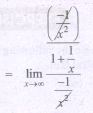
\(=\underset { x\rightarrow \infty }{ lim } \frac { { 1 } }{ \left( 1+\frac { 1 }{ x } \right) } =1\)
But \(\underset { x\rightarrow \infty }{ lim } log(g(x))=log\underset { x\rightarrow \infty }{ lim } g(x)\)
\(\therefore log(\underset { x\rightarrow \infty }{ lim } g(x))=1\)
\({ e }^{ log }(\underset { x\rightarrow \infty }{ lim } g(x))={ e }^{ 1 }=e\Rightarrow (\underset { x\rightarrow \infty }{ lim } g(x))=e\)
\(\Rightarrow \underset { x\rightarrow \infty }{ lim } { \left( 1+\frac { 1 }{ x } \right) }^{ x }=e\)
26.
\(\underset { x\rightarrow { 0 }^{ + } }{ lim } { x }^{ x }\)
This is an indeterminate of the form 00
Let g(x) xx
Taking logarithm, we get
\(log \ g(x)=log({ x }^{ 2 })=xlogx=\frac { log\quad x }{ \frac { 1 }{ x } } \)
\(\therefore \underset { x\rightarrow { 0 }^{ + } }{ lim } log \ g(x)={ \left[ \frac { logx }{ \frac { 1 }{ x } } \right] }=\frac { \infty }{ \infty } \)
\(=\underset { x\rightarrow { 0 }^{ + } }{ lim } \left( \frac { \frac { 1 }{ x } }{ -\frac { 1 }{ { x }^{ 2 } } } \right) \) [by L' Hopital rule]
= \(\underset { x\rightarrow { 0 }^{ + } }{ lim } \frac { 1 }{ x } \times \frac { { x }^{ 2 } }{ 1 } =\underset { x\rightarrow { 0 }^{ + } }{ lim } -x\)
= 0
But \(\underset { x\rightarrow { 0 }^{ + } }{ lim } (log(g(x))=log(\underset { x\rightarrow { 0 }^{ + } }{ lim } (g(x))\)
ஃ \(\underset { x\rightarrow { 0 }^{ + } }{ lim } (log(g(x))=0\)
\(\Rightarrow { e }^{ log }(\underset { x\rightarrow { 0 }^{ + } }{ lim } log(g(x))={ e }^{ 0 }\)
\(\Rightarrow \underset { x\rightarrow { 0 }^{ + } }{ lim } g(x)=1\)
\(\therefore \underset { x\rightarrow { 0 }^{ + } }{ lim } { x }^{ x }=1\)
27.
Let x be the length of the rectangular pasture and y be the breadth of the rectangular pasture.
Given xy = 1,80,000
\(\Rightarrow y=\frac { 1,80,000 }{ x } \)
Since fencing is not needed along the river side,
Perimeter = 2x + y
Letf(x) = 2x+y
= \(2x+\frac { 1,80,000 }{ x } \)
\(f'(x)=2-\frac { 1,80,000 }{ { x }^{ 2 } } \)
f'(x) = 0
\(\Rightarrow 2=\frac { 1,80,000 }{ { x }^{ 2 } } \)
\(\Rightarrow { x }^{ 2 }=90,000\)
\(\Rightarrow x=\pm 300\)
ஃ The critical number is 300, -300
\(f''(x)=-1,80,000\left( \frac { -2 }{ { x }^{ 3 } } \right) =\frac { 360000 }{ { x }^{ 3 } } \)
\(f''\left( 300 \right) =\frac { 360000 }{ \left( 300 \right) ^{ 3 } } >0\)
From (1), when x = 300, \(y=\frac { 1,80,000 }{ 300 } =600\)
ஃ Length of the minimum needed fencing material = 2x + y
= 2(300) + 600 = 600 + 600 = 1200 m
28.
f (x) is defined and differentiable for all x ∈ (0, 2π).
f'(x) = sin x (-sin x) + cos x (cos x)
= cos2 X - sin2 x
= cos2x
f'(x) = 0
\(\Rightarrow cosx=0cos=\frac { \pi }{ 2 } ,cos\frac { 3\pi }{ 2 } ,cos\frac { 5\pi }{ 2 } ,cos\frac { 7\pi }{ 2 } \)
\(\Rightarrow 2x=\frac { \pi }{ 2 } \frac { \pi }{ 2 } ,\frac { 3\pi }{ 2 } ,\frac { 5\pi }{ 2 } ,\frac { 7\pi }{ 2 } \)
\(\Rightarrow x=\frac { \pi }{ 4 } ,\frac { 3\pi }{ 4 } ,\frac { 5\pi }{ 4 } ,\frac { 7\pi }{ 4 } \)
The stationary points are at
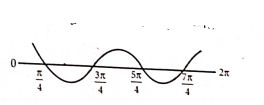
\(x=\frac { \pi }{ 4 } ,\frac { 3\pi }{ 4 } ,\frac { 5\pi }{ 4 } ,\frac { 7\pi }{ 4 } \)
\(\left( 0,\frac { \pi }{ 4 } \right) ,\left( \frac { \pi }{ 4 } ,\frac { 3\pi }{ 4 } \right) \left( \frac { 3\pi }{ 4 } ,\frac { 5\pi }{ 4 } \right) \left( \frac { 5\pi }{ 4 } ,\frac { 7\pi }{ 4 } \right) \left( \frac { 7\pi }{ 4 } ,2\pi \right) \)
| Interval | \(\left( 0,\frac { \pi }{ 4 } \right) ,\) | \(\left( \frac { \pi }{ 4 } ,\frac { 3\pi }{ 4 } \right) \) | \(\left( \frac { 3\pi }{ 4 } ,\frac { 5\pi }{ 4 } \right) \) | \(\left( \frac { 5\pi }{ 4 } ,\frac { 7\pi }{ 4 } \right) \) | \(\left( \frac { 7\pi }{ 4 } ,2\pi \right) \) |
| Sign of f'(x) | Say \(x=\frac { \pi }{ 6 } \) cos \(cos2\times \cfrac { \pi }{ 6 } \) = \(=cos\cfrac { \pi }{ 3 } =\cfrac { 1 }{ 2 } \) +ve |
Say \(x=\cfrac { \pi }{ 2 } \) \(cos2\times \cfrac { \pi }{ 2 } \) = \(cos\pi =-1-ve\) -ve |
Say y = π cos 2π = 1+ve |
Say \(x=\cfrac { 3\pi }{ 2 } \) \(cos2\times \cfrac { 3\pi }{ 2 } \) = cos 3π = -1 |
Say x = 3200 cos 2 x 3200 = cos 640 = cos (360 + 280) = cos 2800 = cos (270 + 10) = sin 100 =+ve |
| monotonicity | Strictly increasing | Strictly decreasing | Strictly increasing | Strictly decreasing | Strictly increasing |
\(\therefore\) f (x) is strictly increasing in \(\left( 0,\frac { \pi }{ 4 } \right) \)\(\left( \frac { 3\pi }{ 4 } ,5\frac { \pi }{ 4 } \right) \left( \frac { 7\pi }{ 4 } ,2\pi \right) \) and strictly decreasing in \(\left( \frac { \pi }{ 4 } ,\frac { 3\pi }{ 4 } \right) \left( \frac { 5\pi }{ 4 } ,\frac { 7\pi }{ 4 } \right) \)
Since f'(x) changes its positionfrom positive to negative at \(x=\frac { \pi }{ 4 } ,\frac { 5\pi }{ 4 } \) there is a local
maximum at \(x=\frac { \pi }{ 4 } ,\frac { 5\pi }{ 4 } \)
\(f\left( \frac { \pi }{ 4 } \right) =sin\frac { \pi }{ 4 } cos\frac { \pi }{ 4 } +5\)
= \(\frac { 1 }{ \sqrt { 2 } } .\frac { 1 }{ \sqrt { 2 } } +5=\frac { 1 }{ 2 } +5=\frac { 11 }{ 2 } \)
\(f\left( \frac { 5\pi }{ 4 } \right) =sin{ \frac { 5\pi }{ 4 } }cos\frac { \pi }{ 4 } +5\)
= \(\left( \frac { -1 }{ \sqrt { 2 } } \right) \left( \frac { -1 }{ \sqrt { 2 } } \right) +5\)
= \(\frac { 1 }{ 2 } +5=\frac { 11 }{ 2 } \)
Also f'(x) changes its position from negative to positive at \(x=\frac { 3\pi }{ 4 } ,\frac { 7\pi }{ 4 } \) there is local mmimum
at \(x=\frac { 3\pi }{ 4 } ,\frac { 7\pi }{ 4 } \)
\(\therefore f\left( \frac { 3\pi }{ 4 } \right) =cos\frac { 3\pi }{ 4 } sin\frac { 3\pi }{ 4 } +5\)
= \(\left( \frac { -1 }{ \sqrt { 2 } } \right) \left( \frac { +1 }{ \sqrt { 2 } } \right) +5=5-\frac { 1 }{ 2 } =\frac { 9 }{ 2 } \)
\(f\left( \frac { 7\pi }{ 4 } \right) =cos\frac { 7\pi }{ 4 } sin\frac { 7\pi }{ 4 } +5\)
= \(cos\left( 2\pi -\frac { \pi }{ 4 } \right) sin\left( 2\pi -\frac { \pi }{ 4 } \right) +5\)
= \(\left( \frac { 1 }{ \sqrt { 2 } } \right) \left( \frac { -1 }{ \sqrt { 2 } } \right) +5\)
= \(\frac { -1 }{ 2 } +5=\frac { 9 }{ 2 } \)
= \(\frac { -1 }{ 2 } +5=\frac { 9 }{ 2 } \)
29.
Given \(f(x)=\frac { x }{ x-5 } \)
f(x) is defined and differentiable for all x∈R-[5]
\(\therefore f'(x)=\frac { (x-5)(1)-x(1) }{ (x-5)^{ 2 } } \)
= \(\frac { x-5-x }{ (x-5)^{ 2 } } =\frac { -5 }{ (x-5)^{ 2 } } \)
f'(x) = 0
\(\Rightarrow \frac { -5 }{ (x-5)^{ 2 } } \neq 0\)
There is no stationary point. The possible intervals are (-∞, 5) and (5, ∞).
| Interval | (-∞, 5) | (5, ∞) |
| Sign of f'(x) | Say x = 0 \(\frac { -5 }{ (-5)^{ 2 } } =\frac { -5 }{ 25 } \) |
Say x = 6 \(\frac { -5 }{ (1)^{ 2 } } =-ve\) |
| monotonicity | Strictly decreasing | Strictly decreasing |
ஃ f (x) is strictly decreasing on (-∞, 5) and (5, ∞).
Since there is no stationary point, the curve does not changes its position.
Hence there is no local extremum.
30.

Given f(x) = 2.0 + 3x2 - 12x
The given function is defined and differentiable for all x ∈(-∞,∞)
f'(x) = 6x2 + 6x - 12
The stationary points are given by
6x2 + 6x - 12 = 0
\(\Rightarrow\) x2 +x-2 = 0
\(\Rightarrow\) (x + 2)(x - 1) = 0
\(\Rightarrow\) x = -2, 1
Hence the intervals of monotonicity are
(-∞, - 2), (-2, 1) and (1, ∞).
| Intervel | (-∞, - 2) | (-2, 1) | (1, ∞) |
| Sign of f'(x) |
Say x = -3 f'(x) = 6(-3)2+6 (-3) -12 = +ve |
Say x = 0 f'(0) = -12 = -ve |
Say x = 2 f'(x) = 6(2)2+ 6(2)-12 = +ve |
| monotoni city | Strictly increasing | Strictly decreasing | Strictly increasing |
ஃ f(x) is strictly increasing on (-∞, - 2)
(1, ∞) and strictly decreasing on (-2, 1).
Since f'(x) changes from positive to negative at x = -2, there is a local maximum at x = -2
\(\therefore\) f(-2) = 2 (2)3 + 3 (2)2 - 12 (-2)
= 2(-8) + 3(4) + 24
= -16+12+24 = 20
Also f'(x) changes from negative to positive at x = 1, there is a local minimum at x = 1.
ஃ f(1) = 2 (1)3 + 3 (1)2 - 12(1)
= 5 -12 = -7
31.
Given f(x) = 3x2 - 4x3 ; [-1, 2]
f'(x) = 12x3 - 12x2
f'(x) = 0
⇒12x3- 12x2 = 0
⇒ 12x2(x-1) = 0
⇒ x = 0 or x = 1
Evaluatingf(x) at the end points x = -1, x = 2 and at the critical number x = 0, x = 1 we get
f(-1) = 3(-1)4-4 (-1)3
= 3 + 4 = 7
f(2) = 3(2)4 - 4(23)
= 48 - 32 =16
f(0) = 0
f(1) = 3(1)4 - 4(1)3
= 3 - 4 = -1
From these values, the absolute maximum is 16 at x = 2 and the absolute minimum is -1 which occurs at x = 1.
32.
Equation of the given curves are x2 - y2 = r2
xy = c2
x2 - y2 = r2
⇒ 2x - 2y\(\frac{dy}{dx}\) = 0
⇒ 2x = 2y\(\frac{dy}{dx}\)
⇒ \(\frac{dy}{dx}=\frac{2x}{2y}=\frac{x}{y}\)
Let (x1, y1) be the point of intersection of the given curves
∴ Slope of tangent to the first curve m1 = \(\frac{x_1}{y_1}\) ..(1)
⇒ xy = c2
⇒ x.\(\frac{dy}{dx}\) = -y
⇒ \(\frac{dy}{dx}=\frac{-y}{x}\)
∴ Slope of the tangent to the first curve m2 = \(\frac{-y_1}{x_1}\)..(2)
Consider m1 m2 = \(\left( \frac { { x }_{ 1 } }{ { y }_{ 1 } } \right) \left( \frac { -{ y }_{ 1 } }{ { x }_{ 1 } } \right) =-1\)
Since m1 m2 = -1, the given two curves cut orthogonally.
33.
Equation of the rectangular hyperbola is xy = 2
⇒ y = \(\frac{2}{x}\)
⇒ x.\(\frac { dy }{ dx } \) + y(1) = 0
⇒ \(\frac { dy }{ dx } \) = \(\frac{-y}{x}\)
Slope of the tangent to the curve m1 =\(\frac{-y}{x}\)
Equation of the parabola is x2+ 4y = 0 ...(2)
⇒2x + 4\(\frac { dy }{ dx } \) = 0
\(\frac { dy }{ dx } \) = \(\frac{-2x}{4}=\frac{-x}{2}\)
Slope of the tangent to the curve m2 = \(\frac{-x}{2}\)
Substituting (1) in (2) we get,
x2 + 4 \((\frac{2}{x})\) = 0 ⇒ x2 + \(\frac{8}{x}\) = 0
⇒ x3 + 8 = 0
⇒ x3 = -8 = (-2)3 ⇒ x = -2
⇒ When x = -2, y = \(\frac{2}{-2}\) = -1
'∴ The point of intersection of RH and parabola is (-2, -2)
'∴ m1 = \(\frac { -y }{ x } =\frac { -(-1) }{ -2 } =\frac { -1 }{ 2 } \)
m2 = \(\frac { -x }{ 2 } =\frac { -(-2) }{ 2 } \) = 1
Let θ be the angle between rectangular hyperbola and parabola
tan \(\theta =\left| \frac { { m }_{ 1 }-{ m }_{ 2 } }{ 1+{ m }_{ 1 }{ m }_{ 2 } } \right| \left| \frac { -\frac { 1 }{ 2 } -1 }{ 1+\left( \frac { 1 }{ 2 } \right) (1) } \right| \)
= \(\left| \frac { -\frac { 3 }{ 2 } }{ 1-\frac { 1 }{ 2 } } \right| =\left| \frac { -\frac { 3 }{ 2 } }{ \frac { 1 }{ 2 } } \right| =\left| -3 \right| =3\)
∴ θ = tan-1 (3)
34.
Given s (t) = 2t3 − 9t2 + 12t ≥ 0
On differentiating we get
V(t) = 6t2-18t+ 12 ... (1)
= 6 (t2 - 3t+ 2)
= 6 (t - 1) (t - 2)
Now V(t) = 0
⇒ 6 (t-1)(t- 2) = 0
⇒ t = 1, 2
The particle changes direction when V(t) changes its sign.
If 0 ≤ t < 1 then both (t - 1) and (t - 2) < 0
⇒ V(t) > 0
If 1 < t < 2 then (t -1) > 0 and (t - 2) < 0
⇒ V(t) < 0
If t > 2 then both (t - 1) and (t - 2) > 0
⇒ V(t) > 0
∴ The particle changes direction when t = 1 and t = 2 sec.
(ii) Total distance travelled by the particle in the first 4 seconds is |s(0)- s (1)| + |s (1) - s (2)| + |s (2) -s (4)|
s(0) = -4
s(1) = 2(1)3 - 9(1)2 + 12 (1) - 4
= 2 - 9 + 12 - 4 = 1
s (2) = 2 \(\times\) 23 - 9 \(\times\) 22 + 12 \(\times\) 2 - 4
= 16 - 36 + 24 - 4
= 0
s (4) = 2(4)3 - 9(4)2 + 12 (4) - 4
= 128 - 144 + 48 - 4 = 28
∴ Is (0) -s (1)|+ Is (1) -s (2)|+ Is (2) -s(4)|
= |-4 - 1| + |1 - 0| + |0 - 28|
= |-5| + |1| + |0 - 28|
= 5 + 1 + 28 = 34 m
(iii) Given s (t) = 2t3 − 9t2 + 12t ≥ 0
[acceleration = \(\frac { dv }{ dt } \)]
When t = 1,
Acceleration = 12 (1) - 18 = -6 m/sec2
When t = 2
Acceleration = 12 (2) - 18 = 6 m/sec2
35.
(b)
36.
(a)
\(\frac{\pi}{6}\)
37.
(c)
38.
(d)
has no points of inflection
39.
(a)
100
40.
(c)
\(\left( 3,\sqrt { 5 } \right) \)
41.
(c)
\(\frac { 1 }{ { e }^{ 2 } } \)
42.
(b)
\(x=\frac { \pi }{ 2 } \)
43.
(d)
9
44.
(c)
3
45.
(d)
2
46.
(c)
\(\left[ \frac { \pi }{ 4 } ,\frac { \pi }{ 2 } \right] \)
47.
(a)
0
48.
(d)
\(y=\pm 3\)
49.
Given equation of the curve is y = 1 + x3 and the line is x + 12y = 12
Slope of the tangent to the curve
m1 = \(\frac { dy }{ dx } \) = 3x2 and the
Slope of the line = m2
= \(\frac{-1}{2}\) \(\left[ \because m=\frac { co-efficient\quad of\quad x }{ co-efficient\quad of\quad y } \right] \)
Since the slope of the tangent to the curve and the line are orthogonal, m1 m2 = - 1.
∴ 3x2\(\left( \frac { -1 }{ 2 } \right) \) = -1
⇒ \(\frac{x^2}{4}\) = 1
⇒ x2 = 4
⇒ x = ±2
When x = 2, y = 1 + 23 = 9
When x = -2, y = 1+ (-2)3
= 1-8 = -7
∴ Equation of the tangent at (2, 9) is
y-9 = 12(x-2) [∵ m1 = 3x2 = 3(2)2 = 12]
∴ y - 9 = 12x - 24
∴ 12x - y = 15
Equation of the tangent at (-2, -7) is
y + 7= 12(x + 2)
⇒ y + 7 = 12x + 24
⇒ 12x - y = -17
50.
(a)
(4, 11)
51.
(b)
52.
(b)
\(\\ \\ \\ t=\cfrac { 1 }{ 3 } \)
53.
(b)
\(\frac{4}{25} \text { radians } / \mathrm{sec}\)
54.
(a)
3 cm/s

12th Standard Syllabus & Materials
12th Standard
TN 12th Computer Applications களப்பெயர் முறைமை (DNS) Sample Question Papers Study Material - QB365 Set A
NEW12th Standard
TN 12th Computer Applications வலையமைப்பு எடுத்துக்காட்டுகள் மற்றும் நெறிமுறைகள் Sample Question Papers Study Material - QB365 Set A
NEW12th Standard
TN 12th Computer Applications கணினி வலையமைப்பு ஓர் அறிமுகம் Sample Question Papers Study Material - QB365 Set A
NEW12th Standard
TN 12th Computer Applications PHP-உடன் MySQL-ஐ இணைத்தல் Sample Question Papers Study Material - QB365 Set A



Tamilnadu Stateboard 12th Standard Subjects
Maths

Chemistry

Physics

Biology

Computer Science

Business Maths and Statistics

Economics

Commerce

Accountancy

History

Computer Applications
Biology
Computer Technology
Computer Applications
Computer Science
Business Maths and Statistics
Commerce
Economics
Maths
Chemistry
Physics
Computer Technology
History
Accountancy

Tamil

English

French
Tamilnadu Stateboard Standards


