
 100% FREE ACCESS
12th Standard Syllabus & Materials
12th Standard
TN 12th Computer Applications மின்னணு தரவு பரிமாற்றம் Sample Question Papers Study Material - QB365 Set A
NEW12th Standard
TN 12th Computer Applications மின் - வணிக பாதுகாப்பு அமைப்புகள் Sample Question Papers Study Material - QB365 Set A
NEW12th Standard
TN 12th Computer Applications மின்னணு செலுத்தல் முறைகள் Sample Question Papers Study Material - QB365 Set A
NEW12th Standard
TN 12th Computer Applications மின் - வணிகம் Sample Question Papers Study Material - QB365 Set A
NEW12th Standard
TN 12th Computer Applications திறந்த மூல கருத்துருக்கள் Sample Question Papers Study Material - QB365 Set A
NEW12th Standard
TN 12th Computer Applications வலையமைப்பு வடமிடல் Sample Question Papers Study Material - QB365 Set A

Published on: 20/10/2025
Download Tamil Nadu 12th Standard Maths question papers, model tests, one-mark questions, important questions, and public exam papers in PDF format. Free study materials and answer keys for TN State Board students.
Questions + Answers key
Take MCQ Maths Test
1.
A steel plant is capable of producing x tonnes per day of a low-grade steel and y tonnes per day of a high-grade steel, where \(y=\frac { 40-5x }{ 10-x } \). If the fixed market price of low-grade steel is half that of high-grade steel, then what should be optimal productions in low-grade steel and high-grade steel in order to have maximum receipts.
2.
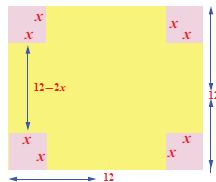
We have a 12 square unit piece of thin material and want to make an open box by cutting small squares from the corners of our material and folding the sides up. The question is, which cut produces the box of maximum volume?
3.
Determine the intervals of concavity of the curve f (x) = (x −1)3. (x − 5), x∈R and, points of inflection if any.
4.
5.
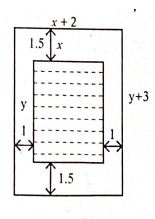
A rectangular page is to contain 24 cm2 of print. The margins at the top and bottom of the page are 1.5 cm and the margins at other sides of the page is 1 cm. What should be the dimensions of the page so that the area of the paper used is minimum.
6.
Find intervals of concavity and points of inflexion for the following function:
\(f(x)=\frac { 1 }{ 2 } \left( { e }^{ x }-{ e }^{ -x } \right) \)
7.
Find the intervals of monotonicities and hence find the local extremum for the following function:
f(x) = sin x cos x + 5, x ∈ (0,2π)
8.
If y = logax then \(dy\over dx\) is equal to _____________
\(1\over a\)
\(1\over x\)
\(1\over xloga\)
\(1\over xlogx\)
9.
10.
11.
The maximum product of two positive numbers, when their sum of the squares is 200, is
100
\(25\sqrt { 7 } \)
28
\(24\sqrt { 14 } \)
12.
One of the closest points on the curve x2 - y2 = 4 to the point (6, 0) is
(2,0)
\(\left( \sqrt { 5 } ,1 \right) \)
\(\left( 3,\sqrt { 5 } \right) \)
\(\left( \sqrt { 13 } ,-\sqrt { 3 } \right) \)
1.
Let the price of low-grade steel be Rs. p per tonne. Then the price of high-grade steel is Rs. 2p per tonne.
The total receipt per day is given by \(R=px+py=px+2p\left( \frac { 40-5x }{ 10-x } \right) \). Hence the problem is to maximise R . Now, simplifying and differentiating R with respect to x , we get
\(R=p\left( \frac { 80-{ x }^{ 2 } }{ 10-x } \right) \)
\(\frac { dR }{ dx } =p\left( \frac { { x }^{ 2 }-20x+80 }{ (10-x)^{ 2 } } \right) \)
\(\frac { dR }{ dx } =-\frac { 40P }{ \left( 10-x \right) ^{ 3 } } \)
Now, \(\frac { dR }{ dx } =0\Rightarrow { x }^{ 2 }-20x+80=0\) and hence \(x=10\pm 2\sqrt { 5 } \)
At \(x=10-2\sqrt { 5 } ,\frac { { d }^{ 2 }R }{ { dx }^{ 2 } } <0\) and hence R will be maximum. If x \(x=10-2\sqrt { 5 } \) then \(y=5-\sqrt { 5 } \)
Therefore the steel plant must produce low-grade and high-grade steels respectively in tonnes per day are \(10-2\sqrt { 5 } \) and \(5-5\sqrt { 5 } \)
2.
Let x = length of the cut on each side of the little squares.
V = the volume of the folded box.
The length of the base after two cuts along each edge of size x is 12 − 2x. The depth of the box after folding is x, so the volume is V = x \(\times\) (12 - 2x)2 Note that,
when x = 0 or 6, the volume is zero and hence there cannot be a box. Therefore the problem is to maximize, V = x \(\times\) (12 - 2x)2, x ∈ (0, 6)
\(\frac { dV }{ dx } ={ (12-2x) }^{ 2 }-4x(12-2x)\)
= (12 − 2x)(12 − 6x).
\(\frac { dV }{ dx } \) = 0 gives the stationary points x = 2, 6. Since 6 ∉ (0, 6) the only stationary point is at x = 2∈(0, 6). Further, \(\frac { dV }{ dx } \)- changes its sign from postive to negative when passing through x = 2 .
Therefore at x = 2 the volume V is local maximum. The local maximum volume value is V = 128 units. Hence the maximum cut can only be 2 units.
3.
The given function is a polynomial of degree 4. Now,
f′(x) = (x −1)3 + 3(x −1)2 . (x − 5)
= 4(x-1)2.(x-4)
f"(x) = 4(x-1)2+2(x-1).(x-4)
= 12(x −1) (x − 3)
Now,
f''(x) = 0 ⇒ x = 1, x = 3
The intervals of concavity are tabulated in the table 7.7.
| Interval | (-∞, 1) | (1, 3) | (3, ∞) |
| Sign of f'(x) | + | - | + |
| Concavity | concave up | concave down | concave up |
 |
 |
 |
The curve is concave upwards on (∞, 1) and (3, ∞) .
The curve is concave downwards on (1, 3) .
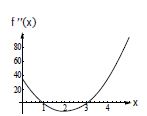
As f′′(x) changes its sign when it passes through x = 1 and x = 3, (1, f(1)) = (1, 0) and (3, f(3)) = (3, −16) are points of inflection for the graph y = f(x). This may be observed from the adjoining figure of the curve f′′(x) .
4.
5.
Let x and y be the length, breadth of the printed rectangular page
Given xy = 24
\(\Rightarrow y=\frac { 24 }{ x } \) ..(1)
Length of the page with margin
= x+1+1 = x+2
breadth of the page with margin
= y + 1.5 + 1.5 = y + 3
Area of the page = (x + 2) (y + 3)
Let f(x) = (x + 2) (y + 3)
= \((x+2)\left( \frac { 24 }{ x } +3 \right) \)
= \(24+3x+\frac { 48 }{ x } +30\)
= \(3x+\frac { 48 }{ x } +30\)
\(f'\left( x \right) =3-\frac { 48 }{ { x }^{ 2 } } \)
\(\Rightarrow { x }^{ 2 }=16\Rightarrow x=\pm 4\)
ஃ The critical number are 4,-4
\(f''\left( x \right) =-48\left( \frac { -2 }{ { x }^{ 3 } } \right) =\frac { 96 }{ { x }^{ 3 } } \)
\(f''\left( 4 \right) =\frac { 96 }{ 64 } >0\)
ஃ f(x) is minimum when x = 4
When \(x=4,y=\frac { 24 }{ 4 } =6\) [From (1)]
ஃ Length of the page = x + 2 = 4 + 2 = 9 cm
Breadth of the page = y + 3 = 6 + 3 = 6 cm
6.
f (x) is defined and differentiable for all x∈(-∞, ∞)
\(f'\left( x \right) =\frac { 1 }{ 2 } \left( { e }^{ x }+{ e }^{ -x } \right) \)
\(f''(x)=\frac { 1 }{ 2 } \left( { e }^{ x }-{ e }^{ -x } \right) \)
f"(x) = 0
\(\Rightarrow \frac { 1 }{ 2 } \left( { e }^{ x }-{ e }^{ -x } \right) =0\Rightarrow { e }^{ x }-{ e }^{ -x }=0\)
\(\Rightarrow { e }^{ x }={ e }^{ -x }\Rightarrow { e }^{ x }=\frac { 1 }{ { e }^{ x } } \)
\(\Rightarrow { e }^{ 2x }=1\Rightarrow { e }^{ 2x }={ e }^{ 0 }\)
\(\Rightarrow 2x=0\Rightarrow x=0\)
The possible intervals are (-∞,0) and (0,∞)
| Intervel | (-∞, 0) | (0, ∞) |
| Sign of f"(x) | Say x = -1 \(\cfrac { 1 }{ 2 } \left( { e }^{ -1 }-{ e }^{ 1 } \right) =-ve\) |
Say x = 1 \(\cfrac { 1 }{ 2 } \left( { e }^{ -1 }-{ e }^{ 1 } \right) =+ve\) |
| Concavity | Concave down | Concave up |
ஃ f(x) is concave up in (0, ∞) and concave down in (∞, 0).
Since f"(x) changes its position from negative to positive, when it passes through x = 0 the points of inflection is (0,1(0))
\(f(0)=\frac { 1 }{ 2 } \left( { e }^{ o }-{ e }^{ o } \right) =\frac { 1 }{ 2 } \left( 1-1 \right) =0\)
ஃ (0, 0) is the point of inflection.
7.
f (x) is defined and differentiable for all x ∈ (0, 2π).
f'(x) = sin x (-sin x) + cos x (cos x)
= cos2 X - sin2 x
= cos2x
f'(x) = 0
\(\Rightarrow cosx=0cos=\frac { \pi }{ 2 } ,cos\frac { 3\pi }{ 2 } ,cos\frac { 5\pi }{ 2 } ,cos\frac { 7\pi }{ 2 } \)
\(\Rightarrow 2x=\frac { \pi }{ 2 } \frac { \pi }{ 2 } ,\frac { 3\pi }{ 2 } ,\frac { 5\pi }{ 2 } ,\frac { 7\pi }{ 2 } \)
\(\Rightarrow x=\frac { \pi }{ 4 } ,\frac { 3\pi }{ 4 } ,\frac { 5\pi }{ 4 } ,\frac { 7\pi }{ 4 } \)
The stationary points are at
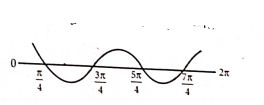
\(x=\frac { \pi }{ 4 } ,\frac { 3\pi }{ 4 } ,\frac { 5\pi }{ 4 } ,\frac { 7\pi }{ 4 } \)
\(\left( 0,\frac { \pi }{ 4 } \right) ,\left( \frac { \pi }{ 4 } ,\frac { 3\pi }{ 4 } \right) \left( \frac { 3\pi }{ 4 } ,\frac { 5\pi }{ 4 } \right) \left( \frac { 5\pi }{ 4 } ,\frac { 7\pi }{ 4 } \right) \left( \frac { 7\pi }{ 4 } ,2\pi \right) \)
| Interval | \(\left( 0,\frac { \pi }{ 4 } \right) ,\) | \(\left( \frac { \pi }{ 4 } ,\frac { 3\pi }{ 4 } \right) \) | \(\left( \frac { 3\pi }{ 4 } ,\frac { 5\pi }{ 4 } \right) \) | \(\left( \frac { 5\pi }{ 4 } ,\frac { 7\pi }{ 4 } \right) \) | \(\left( \frac { 7\pi }{ 4 } ,2\pi \right) \) |
| Sign of f'(x) | Say \(x=\frac { \pi }{ 6 } \) cos \(cos2\times \cfrac { \pi }{ 6 } \) = \(=cos\cfrac { \pi }{ 3 } =\cfrac { 1 }{ 2 } \) +ve |
Say \(x=\cfrac { \pi }{ 2 } \) \(cos2\times \cfrac { \pi }{ 2 } \) = \(cos\pi =-1-ve\) -ve |
Say y = π cos 2π = 1+ve |
Say \(x=\cfrac { 3\pi }{ 2 } \) \(cos2\times \cfrac { 3\pi }{ 2 } \) = cos 3π = -1 |
Say x = 3200 cos 2 x 3200 = cos 640 = cos (360 + 280) = cos 2800 = cos (270 + 10) = sin 100 =+ve |
| monotonicity | Strictly increasing | Strictly decreasing | Strictly increasing | Strictly decreasing | Strictly increasing |
\(\therefore\) f (x) is strictly increasing in \(\left( 0,\frac { \pi }{ 4 } \right) \)\(\left( \frac { 3\pi }{ 4 } ,5\frac { \pi }{ 4 } \right) \left( \frac { 7\pi }{ 4 } ,2\pi \right) \) and strictly decreasing in \(\left( \frac { \pi }{ 4 } ,\frac { 3\pi }{ 4 } \right) \left( \frac { 5\pi }{ 4 } ,\frac { 7\pi }{ 4 } \right) \)
Since f'(x) changes its positionfrom positive to negative at \(x=\frac { \pi }{ 4 } ,\frac { 5\pi }{ 4 } \) there is a local
maximum at \(x=\frac { \pi }{ 4 } ,\frac { 5\pi }{ 4 } \)
\(f\left( \frac { \pi }{ 4 } \right) =sin\frac { \pi }{ 4 } cos\frac { \pi }{ 4 } +5\)
= \(\frac { 1 }{ \sqrt { 2 } } .\frac { 1 }{ \sqrt { 2 } } +5=\frac { 1 }{ 2 } +5=\frac { 11 }{ 2 } \)
\(f\left( \frac { 5\pi }{ 4 } \right) =sin{ \frac { 5\pi }{ 4 } }cos\frac { \pi }{ 4 } +5\)
= \(\left( \frac { -1 }{ \sqrt { 2 } } \right) \left( \frac { -1 }{ \sqrt { 2 } } \right) +5\)
= \(\frac { 1 }{ 2 } +5=\frac { 11 }{ 2 } \)
Also f'(x) changes its position from negative to positive at \(x=\frac { 3\pi }{ 4 } ,\frac { 7\pi }{ 4 } \) there is local mmimum
at \(x=\frac { 3\pi }{ 4 } ,\frac { 7\pi }{ 4 } \)
\(\therefore f\left( \frac { 3\pi }{ 4 } \right) =cos\frac { 3\pi }{ 4 } sin\frac { 3\pi }{ 4 } +5\)
= \(\left( \frac { -1 }{ \sqrt { 2 } } \right) \left( \frac { +1 }{ \sqrt { 2 } } \right) +5=5-\frac { 1 }{ 2 } =\frac { 9 }{ 2 } \)
\(f\left( \frac { 7\pi }{ 4 } \right) =cos\frac { 7\pi }{ 4 } sin\frac { 7\pi }{ 4 } +5\)
= \(cos\left( 2\pi -\frac { \pi }{ 4 } \right) sin\left( 2\pi -\frac { \pi }{ 4 } \right) +5\)
= \(\left( \frac { 1 }{ \sqrt { 2 } } \right) \left( \frac { -1 }{ \sqrt { 2 } } \right) +5\)
= \(\frac { -1 }{ 2 } +5=\frac { 9 }{ 2 } \)
= \(\frac { -1 }{ 2 } +5=\frac { 9 }{ 2 } \)
8.
(c)
\(1\over xloga\)
9.
(d)
10.
(c)
11.
(a)
100
12.
(c)
\(\left( 3,\sqrt { 5 } \right) \)

12th Standard Syllabus & Materials
12th Standard
TN 12th Computer Applications களப்பெயர் முறைமை (DNS) Sample Question Papers Study Material - QB365 Set A
NEW12th Standard
TN 12th Computer Applications வலையமைப்பு எடுத்துக்காட்டுகள் மற்றும் நெறிமுறைகள் Sample Question Papers Study Material - QB365 Set A
NEW12th Standard
TN 12th Computer Applications கணினி வலையமைப்பு ஓர் அறிமுகம் Sample Question Papers Study Material - QB365 Set A
NEW12th Standard
TN 12th Computer Applications PHP-உடன் MySQL-ஐ இணைத்தல் Sample Question Papers Study Material - QB365 Set A



Tamilnadu Stateboard 12th Standard Subjects
Maths

Chemistry

Physics

Biology

Computer Science

Business Maths and Statistics

Economics

Commerce

Accountancy

History

Computer Applications
Biology
Computer Technology
Computer Applications
Computer Science
Business Maths and Statistics
Commerce
Economics
Maths
Chemistry
Physics
Computer Technology
History
Accountancy

Tamil

English

French
Tamilnadu Stateboard Standards


