
 100% FREE ACCESS
12th Standard Syllabus & Materials
12th Standard
TN 12th Maths Applications of Matrices and Determinants Sample Question Papers Study Material - QB365 Set A
NEW12th Standard
TN 12th Computer Applications மின்னணு தரவு பரிமாற்றம் Sample Question Papers Study Material - QB365 Set A
NEW12th Standard
TN 12th Computer Applications மின் - வணிக பாதுகாப்பு அமைப்புகள் Sample Question Papers Study Material - QB365 Set A
NEW12th Standard
TN 12th Computer Applications மின்னணு செலுத்தல் முறைகள் Sample Question Papers Study Material - QB365 Set A
NEW12th Standard
TN 12th Computer Applications மின் - வணிகம் Sample Question Papers Study Material - QB365 Set A
NEW12th Standard
TN 12th Computer Applications திறந்த மூல கருத்துருக்கள் Sample Question Papers Study Material - QB365 Set A

Published on: 20/10/2025
Download Tamil Nadu 12th Standard Maths question papers, model tests, one-mark questions, important questions, and public exam papers in PDF format. Free study materials and answer keys for TN State Board students.
Questions + Answers key
Take MCQ Maths Test
1.
Let p: Jupiter is a planet and q: India is an island be any two simple statements. Give verbal sentence describing each of the following statements.
(i) ¬p
(ii) p ∧ ¬q
(iii) ¬p ∨ q
(iv) p➝ ¬q
(v) p↔q
2.
3.
Compute P(X = k) for the binomial distribution, B(n, p) where
n = 6, \(p=\frac { 1 }{ 3 } \), k = 3
4.
For the random variable X with the given probability mass function as below, find the mean and variance.
\(f(x)=\begin{cases} \begin{matrix} \cfrac { 1 }{ 2 } e^{ -\frac { x }{ 2 } } & for\quad x>0 \end{matrix} \\ \begin{matrix} 0 & otherwise \end{matrix} \end{cases}\)
5.
Evaluate: \(\int ^{\frac{\pi}{2}}_{\frac{\pi}{2}}\)x cos x dx.
6.
Evaluate :\(\int _{ 0 }^{ 1 }{ [2x] } dx\) where [⋅] is the greatest integer function
7.
Solve \(\frac { dy }{ dx } +2y={ e }^{ -x }\)
8.
Explain why Rolle’s theorem is not applicable to the following functions in the respective intervals.
\(f(x)=x-2logx, x\in [2,7]\)
9.
Find the slope of the tangent to the following curves at the respective given points
y = x4 + 2x2 − x at x = 1
10.
For each of the following differential equations, determine its order, degree (if exists)
\({ \left( \frac { { d }^{ 3 }y }{ d{ x }^{ 3 } } \right) }^{ \frac { 2 }{ 3 } }-3\frac { { d }^{ 2 }y }{ d{ x }^{ 2 } } +5\frac { dy }{ dx } +4=0\)
11.
If a continuous random variable X has the p.d.f. f(x) = 4x(x-1)3, then find P(1 ≤ X ≤ 2).
12.
Form the D.E corresponding to y2-2ay+x2=a2 by eliminating ‘a’.
13.
Let G = {1, i, -1, -i} under the binary operation multiplication. Find the inverse of all the elements.
14.
If X is the random variable with distribution function F(x) given by,
\(F(x)=\begin{cases} \begin{matrix} 0 & x<0 \end{matrix} \\ \begin{matrix} x & 0\le x<1 \end{matrix} \\ \begin{matrix} 1 & 1\le x \end{matrix} \end{cases}\)
then find
(i) the probability density function f(x)
(ii) P(0.2 ≤ X ≤ 0.7)
15.
Evaluate the following
\(\int _{ 0 }^{ 2\pi }{ { sin }^{ 7 } } \frac { x }{ 4 } dx\)
16.
Evaluate :\(\int _{ 0 }^{ 1 }{ \frac { 2x+7 }{ { 5x }^{ 2 }+9 } } dx\)
17.
Let us assume that the shape of a soap bubble is a sphere. Use linear approximation to approximate the increase in the surface area of a soap bubble as its radius increases from 5 cm to 5.2 cm. Also, calculate the percentage error.
18.
Evaluate : \(\underset{x\rightarrow 1^{-}}{lim}(\frac{log(1-x)}{cot(\pi x)})\).
19.
Find the tangent and normal to the following curves at the given points on the curve
y = x4 + 2ex at (0, 2)
20.
Find the differential equation of the family of all the parabolas with latus rectum 4a and whose axes are parallel to the x-axis.
21.
Solve : (1+y2)(1 + log x)dx + x dy = 0, given that x = 1,y = 1.
22.
Using the equivalence property, show that p ↔️ q ≡ ( p ∧ q) v (ㄱp ∧ ㄱq)
23.
Verify
(i) closure property
(ii) commutative property
(iii) associative property
(iv) existence of identity and
(v) existence of inverse for the operation ×11 on a subset A = {1, 3, 4, 5, 9} of the set of remainders {0,1, 2, 3, 4, 5, 6, 7, 8, 9,10}
24.
Find the volume of the spherical cap of height h cut of from a sphere of radius r.
25.
Find the area of the region bounded by the curve 2+x−x2+y = 0 , x-axis, x = −3 and x = 3.
26.
The probability density function of random variable X is given by \(f(x)=\begin{cases} \begin{matrix} k & 1\le x\le 5 \end{matrix} \\ \begin{matrix} 0 & otherwise \end{matrix} \end{cases}\) Find
(i) Distribution function
(ii) P(X < 3)
(iii) P(2 < X < 4)
(iv) P(3 ≤ X )
27.
The probability density function random variable X is given by \(f(x)=\begin{cases} \begin{matrix} { 16xe }^{ -4x } & for\quad x>0 \end{matrix} \\ \begin{matrix} 0 & for\quad x\le 0 \end{matrix} \end{cases}\) find the mean and variance of X.
28.
Let w(x, y, z) = \(\frac { 1 }{ \sqrt { { x }^{ 2 }+{ y }^{ 2 }+{ z }^{ 2 } } } ,(x,y,z)\neq (0,0,0)\). Show that \(\frac { { \partial }^{ 2 }w }{ \partial { x }^{ 2 } } +\frac { { \partial }^{ 2 }w }{ \partial { y }^{ 2 } } +\frac { { \partial }^{ 2 }w }{ \partial { z }^{ 2 } } =0\)
29.
The trunk of a tree has diameter 30 cm. During the following year, the circumference grew 6cm.
(i) Approximately, how much did the tree's diameter grow?
(ii) What is the percentage increase in area of the tree's cross-section?
30.
Prove that \(\int ^\frac{\pi}{4}_{0}\) log(1+tan x)dx = \(\frac{\pi}{8}\) log2.
31.
Sketch the curve y = f (x) = x2 − x −6 .
32.
The equation of electromotive force for an electric circuit containing resistance and self inductance is E = Ri + L\(\frac{di}{dt},\) Where E is the electromotive force is given to the circuit, R the resistance and L, the coefficient of induction. Find the current i at time t when E = 0.
33.
Solve the following differential equations
\(\left( 1+3{ e }^{ \frac { y }{ x } } \right) dy+3{ e }^{ \frac { y }{ x } }\left( 1-\frac { y }{ x } \right) dx=0,\) given that y = 0 when x = 1
34.
A particle moves along a horizontal line such that its position at any time t ≥ 0 is given by s(t) = t3 − 6t2 +9 t +1, where s is measured in metres and t in seconds?
(1) At what time the particle is at rest?
(2) At what time the particle changes its direction?
(3) Find the total distance travelled by the particle in the first 2 seconds.
35.
The order and the degree of the differential equation \(x\left(\frac{d^{2} y}{d x^{2}}\right)^{3}+\frac{d^{3} y}{d x^{3}}+x^{2}=0 \text { is }\)__________
3, 1
1, 3
2, 3
3, 2
36.
If \(\int _{ 0 }^{ 2a }{ f(x) } dx=2\int _{ 0 }^{ a }{ f(x) } \) then __________
f(2a -x) = - f(x)
f(2a - x) = f(x)
f(x) is odd
f(x) is even
37.
The statement "If f has a local extremum at c and if f'(c) exists then f'(c) = 0" is ________
the extreme value theorem
Fermat's theorem
Law of mean
Rolle's theorem
38.
The dual of ᄀ(p V q) V [p V (p ∧ ᄀr)] is
ᄀ(p ∧ q) ∧ [p V (p ∧ ᄀr)]
(p ∧ q) ∧ [p ∧ (p V ᄀr)]
ᄀ(p ∧ q) ∧ [p ∧ (p ∧ r)]
ᄀ(p ∧ q) ∧ [p ∧ (pV ᄀr)]
39.
The truth table for (p ∧ q) ∨ ¬q is given below
| p | q | (p ∧ q) ∨ (¬q) |
| T | T | (a) |
| T | F | (b) |
| F | T | (c) |
| F | F | (d) |
Which one of the following is true?
| (a) | (b) | (c) | (d) |
| T | T | T | T |
| (a) | (b) | (c) | (d) |
| T | F | T | T |
| (a) | (b) | (c) | (d) |
| T | T | F | T |
| (a) | (b) | (c) | (d) |
| T | F | F | F |
40.
The value of \(\int _{ -\frac { \pi }{ 2 } }^{ \frac { \pi }{ 2 } }{ { sin }^{ 2 }x\ cos \ x \ dx } \) is
\(\frac{3}{2}\)
\(\frac{1}{2}\)
0
\(\frac{2}{3}\)
41.
If \(\int _{ 0 }^{ a }{ \frac { 1 }{ 4+{ x }^{ 2 } } dx=\frac { \pi }{ 8 } } \) then a is
4
1
3
2
42.
The value of \(\int _{ 0 }^{ \frac { \pi }{ 6 } }{ { cos }^{ 3 }3x\ dx }\ is\)
\(\frac{2}{3}\)
\(\frac{2}{9}\)
\(\frac{1}{9}\)
\(\frac{1}{3}\)
43.
If \(f(x)=\int_{0}^{x} t \cos t d t, \text { then } \frac{d f}{d x}=\)
cos x - x sin x
sin x + x cos x
x cos x
x sin x
44.
If we measure the side of a cube to be 4 cm with an error of 0.1 cm, then the error in our calculation of the volume is
0.4 cu.cm
0.45 cu.cm
2 cu.cm
4.8 cu.cm
45.
If v (x, y) = log (ex + ey), then \(\frac { { \partial }v }{ \partial x } +\frac { \partial v }{ \partial y } \) is equal to
ex + ey
\(\frac{1}{e^x + e^y}\)
2
1
46.
The random variable X has the probability density function
\(f(x)=\left\{\begin{array}{lr}
a x+b & 0<x<1 \\
0 & \text { otherwise }
\end{array}\right.\) and \(E(X)=\frac { 7 }{ 12 } \), then a and b are respectively
1 and \(\frac { 1 }{ 2 } \)
\(\frac { 1 }{ 2 } \) and 1
2 and 1
1 and 2
47.
A pair of dice numbered 1, 2, 3, 4, 5, 6 of a six-sided die and 1, 2, 3, 4 of a four-sided die is rolled and the sum is determined. Let the random variable X denote this sum. Then the number of elements in the inverse image of 7 is
1
2
3
4
48.
49.
The solution of \(\frac{d y}{d x}+p(x) y=0\) is
\(y={ ce }^{ \int { pdx } }\)
\(y={ ce }^{ -\int { pdx } }\)
\(x={ ce }^{ -\int { pdy } }\)
\(x={ce }^{ \int { pdy } }\)
50.
The differential equation representing the family of curves y = Acos(x + B), where A and B are parameters,is
\(\frac { { d }^{ 2 }y }{ { dx }^{ 2 } } -y=0\)
\(\frac { { d }^{ 2 }y }{ { dx }^{ 2 } }+y=0\)
\(\frac { { d }^{ 2 }y }{ { dx }^{ 2 } }=0\)
\(\frac { { d }^{ 2 }x }{ { dy }^{ 2 } }=0\)
51.
The maximum product of two positive numbers, when their sum of the squares is 200, is
100
\(25\sqrt { 7 } \)
28
\(24\sqrt { 14 } \)
52.
One of the closest points on the curve x2 - y2 = 4 to the point (6, 0) is
(2,0)
\(\left( \sqrt { 5 } ,1 \right) \)
\(\left( 3,\sqrt { 5 } \right) \)
\(\left( \sqrt { 13 } ,-\sqrt { 3 } \right) \)
53.
The position of a particle moving along a horizontal line of any time t is given by s(t) = 3t2 -2t- 8. The time at which the particle is at rest is
t = 0
\(\\ \\ \\ t=\cfrac { 1 }{ 3 } \)
t =1
t = 3
54.
The volume of a sphere is increasing in volume at the rate of 3 πcm3 / sec. The rate of change of its radius when radius is \(\frac { 1 }{ 2 } \) cm
3 cm/s
2 cm/s
1 cm/s
\(\cfrac { 1 }{ 2 } cm/s\)
1.
Given p : Jupiter is a planet and
q : India is an island.
(i) ¬p : Jupiter is not a planet.
(ii) p ∧ ¬q : Jupiter is a planet and India is not an island.
(iii) ¬p ∨ q : Jupiter is not a planet or India is an island.
(iv) p➝ ¬q : If Jupiter is a planet then India is not an island.
(v) p↔q : Jupiter is a planet if and only if India is an island.
2.
3.
Given n = 6, \(p=\frac { 1 }{ 3 }\), k = 3
\(P(X=k)=\left( \begin{matrix} n \\ k \end{matrix} \right) { p }^{ k }\left( 1-p \right) ^{ n-k },\)
n = 0,1,2, ... n
\(\therefore P(X=k)=\left( \begin{matrix} n \\ k \end{matrix} \right) { p }^{ k }(1-p)^{ n-k }\)
n = 0,1,2, ... n
\(P(X=3)=\left( \begin{matrix} 6 \\ 3 \end{matrix} \right) \left( \cfrac { 1 }{ 3 } \right) ^{ 3 }\left( 1-p \right) ^{ 6-3 }\)
= \(\left( \begin{matrix} 6 \\ 3 \end{matrix} \right) \left( \cfrac { 1 }{ 3 } \right) ^{ 3 }\left( \cfrac { 2 }{ 3 } \right) ^{ 2 }\)
\(=\frac{6 \times 5 \times 4}{8 \times 2 \times 1} \times \frac{1}{27} \times \frac{8}{27}\)
\(P(X=3)=\frac { 160 }{ 729 }\)
4.
\(f(x)=\begin{cases} \begin{matrix} \frac { 1 }{ 2 } e^{ -\frac { x }{ 2 } } & for\quad x>0 \end{matrix} \\ \begin{matrix} 0 & otherwise \end{matrix} \end{cases}\)
\(\int _{ 0 }^{ \infty }{ x.f(x)dx } =\frac { 1 }{ 2 } \int _{ 0 }^{ \infty }{ x.{ e }^{ \frac { -x }{ 2 } } } dx\)
\(\left[ \int _{ 0 }^{ \infty }{ { e }^{ -ax }.{ x }^{ n }dx=\cfrac { n! }{ { a }^{ n+1 } } } \right] \)
= \(\frac { 1 }{ 2 } \times \frac { 1! }{ \left( \frac { 1 }{ 2 } \right) ^{ 2 } } =\frac { 1 }{ 2 } \times \frac { 1 }{ \frac { 1 }{ 4 } } \)
= \(\frac { 1 }{ 2 } \times \frac { 4 }{ 1 } =2\)
\(E({ X }^{ 2 })=\int _{ 0 }^{ \infty }{ { x }^{ 2 }.f(x) } dx\)
= \(\int _{ 0 }^{ \infty }{ { x }^{ 2 }.\frac { 1 }{ 2 } { e }^{ -\frac { x }{ 2 } } } dx\)
= \(\frac { 1 }{ 2 } \int { { x }^{ 2 }.{ e }^{ -\frac { x }{ 2 } }dx } \)
= \(\frac { 1 }{ 2 } \times \frac { 2! }{ \left( \frac { 1 }{ 3 } \right) ^{ 3 } } =\frac { 1 }{ 2 } \times \frac { 2 }{ \frac { 1 }{ 8 } } \)
= \(\frac { 1 }{ 2 } \times 2\times 8=8\)
ஃVar(X)=E(X2) - [E(x)]2
= 8-22
= 8 - 4 = 4
5.
Let f (x) = x cos x
Then f (−x) = (−x) cos(−x) = −x cos x = − f (x).
So f (x) = x cos x is an odd function.
Hence, applying the property, for odd function f(x), \(\int _{ -a }^{ a }{ f(x)dx=0 } \)
\(\therefore\) we get \(\int _{ -\frac { \pi }{ 2 } }^{ \frac { \pi }{ 2 } }{ xcosx } dx=0\)
6.
\(\int _{ 0 }^{ 1 }{ [2x]dx } =\int _{ 0 }^{ \frac { 1 }{ 2 } }{ [2x] } dx+\int _{ \frac { 1 }{ 2 } }^{ 1 }{ [2x]dx } =\int _{ 0 }^{ \frac { 1 }{ 2 } }{ 0dx+ } \int _{ \frac { 1 }{ 2 } }^{ 1 }{ 1 dx} = 0+[x]^1_{\frac{1}{2}} = 1 -\frac { 1 }{ 2 } =\frac { 1 }{ 2 } \)
7.
Given that \(\frac{dy}{dx}+2y\) = e-x
This is a linear differential equation
Here P = 2 ; Q = e−x.
\(\int { pdx } =\int { 2dx } =2x\)
Thus, I.F.\(={ e }^{ \int { pdx } }={ e }^{ 2x }\)
Hence the solution of (1) is \({ ye }^{ \int { pdx } }=\int { { Qe }^{ \int { Pdx } }dx+C } \)
That is, \({ ye }^{ 2x }=\int { { e }^{ -x }{ e }^{ 2x }dx+C } or\quad { ye }^{ 2x }={ e }^{ x }+C\quad or\quad y={ e }^{ -x }+{ Xe }^{ -2x }\) required solution
8.
Given \(f(x)=x-2logx, x\in [2,7]\)
(i) f(x) is continuous in [2, 7]
(ii) f(x) is differentiable in (2, 7)
f(2) = 2 - 2 log 2
= 2 - log 22 = 2 - log 4
f (7) = 7 - 2 log 7
= 7 - log 72 = 7 - log 49
Since f(2) ≠ f (7), Rolle's theorem is not applicable.
9.
Given y = x4 + 2x2 - x
\(\frac { dy }{ dx } \) = 4x3 + 4x - 1
Slope of the tangent at x = 1 is
m = \(\left( \frac { dy }{ dx } \right) \)(x = 1)
= 4(1)3+ 4 (1) - 1
= 4+4-1 = 7
∴ m = 7
10.
\({ \left( \frac { { d }^{ 3 }y }{ d{ x }^{ 3 } } \right) }^{ \frac { 2 }{ 3 } }-3\frac { { d }^{ 2 }y }{ d{ x }^{ 2 } } +5\frac { dy }{ dx } +4=0\)
Given differential equation is
\({ \left( \frac { { d }^{ 3 }y }{ d{ x }^{ 3 } } \right) }^{ \frac { 2 }{ 3 } }-3\left( \frac { { d }^{ 2 }y }{ d{ x }^{ 2 } } \right) +5\frac { dy }{ dx } +4=0\)
\(\Rightarrow { \left( \frac { { d }^{ 3 }y }{ d{ x }^{ 3 } } \right) }^{ \frac { 2 }{ 3 } }=3\left( \frac { { d }^{ 2 }y }{ d{ x }^{ 2 } } \right) -5\left( \frac { dy }{ dx } \right) -4\)
Taking power 3 both sides,
\(\Rightarrow { \left( \frac { { d }^{ 3 }y }{ d{ x }^{ 3 } } \right) }^{ 2 }={ \left( 3\left( \frac { { d }^{ 2 }y }{ d{ x }^{ 2 } } \right) -5\left( \frac { dy }{ dx } \right) -4 \right) }^{ 3 }\)
The highest derivative is 3 and its power is 2.
∴ Order 3, degree 2.
11.
Given f(x) = 4k (x-1)2, 1 ≤ x ≤ 3.
Since f(x) is a p.d.f\(\int_{1}^{3} f(x) d x=1\)
\( \Rightarrow \int_{1}^{3} 4 k(x-1)^{3} d x =1 \)
\(\Rightarrow 4 k\left[\frac{(x-1)^{4}}{4}\right]_{1}^{3} =1 \)
\(\Rightarrow \ k\left[2^{4}-0^{4}\right] =1 \)
\(\Rightarrow \ 16 k =1 \)
\(\Rightarrow \ k =\frac{1}{16} \)
\(\therefore \mathrm{P}(1 \leq \mathrm{X} \leq 2) =\int_{+1}^{2} f(x) d x \)
\(\Rightarrow \ =\int_{1}^{2} \frac{1}{4}(x-1)^{3} d x \)
\(\Rightarrow 1{ }^{2} =\frac{1}{4}\left[\frac{(x-1)^{4}}{4}\right]_{1}^{2} \)
\( =\frac{1}{16}\left(1^{4}-0^{4}\right)=\frac{1}{16} \)
12.
\(\left( \frac { dy }{ dx } \right) ^{ 2 }\left( { x }^{ 2 }-2{ y }^{ 2 } \right) -4\left( \frac { dy }{ dx } \right) xy-{ x }^{ 2 }=0\)
13.
Clearly 1 is the identity element of (G1)
Inverse of 1 is 1 [∴ (1)(1) = 1]
Inverse of i is -i [∴ (i) (-i) = -i2 = 1]
Inverse of -1 is -1 [∴ (-1)(-1) = 1]
Inverse of is i [∴ (-i)(i) = -i2 = 1]
14.
(i) Differentiating F(x) with respect to x at continuity points of f(x), we get
\(f(x)={ F }^{ 1 }(x)=\begin{cases} \begin{matrix} 0 & x<0 \end{matrix} \\ \begin{matrix} 1 & 0\le x<1 \end{matrix} \\ \begin{matrix} 0 & x\ge 1 \end{matrix} \end{cases}\)
The pdf f(x) is not continuous at x = 0, or at x = 1. We can define f(0) and f(1) in any manner. Choosing f(0) = 1, and f(1) = 0 .
Therefore the probability density function f(x) is
\(f(x)=\begin{cases} \begin{matrix} 1 & 0\le x<1 \end{matrix} \\ \begin{matrix} 0 & otherwise \end{matrix} \end{cases}\)
(ii) P(0.2 ≤ X ≤ 0.7) = F(0.7) − F(0.2)
= 0.7-0.2 = 0.5
\(P(0.2\le X\le 0.7)=\int _{ 0.2 }^{ 0.7 }{ f(x) } dx=\int _{ 0.2 }^{ 0.7 }{ 1dx } =0.5\)
15.
\(Let\quad t=\frac { x }{ 4 } \Rightarrow dt=\frac { dx }{ 4 } \Rightarrow dx=4dt\)
Here n = 7, which is odd
\(\therefore I=4\int _{ 0 }^{ \pi /2 }{ { sin }^{ 7 }tdt } \)
| x | 0 | 2\(\pi\) |
| t | 0 | \(\frac{\pi}{2}\) |
\(=4\times \frac { 6 }{ 7 } \times \frac { 4 }{ 5 } \times \frac { 2 }{ 3 } \times 1\)
\(I=\frac { 64 }{ 35 } \)
16.
\(\int _{ 0 }^{ 1 }{ \frac { 2x+7 }{ { 5x }^{ 2 }+9 } dx } =\int _{ 0 }^{ 1 }{ \frac { 2x }{ { 5x }^{ 2 }+9 } } +7\int _{ 0 }^{ 1 }{ \frac { dx }{ (5{ x }^{ 2 })+{ 3 }^{ 2 } } =\frac { 1 }{ 5 } } log{ [{ 5x }^{ 2 }+9] }_{ 0 }^{ 1 }+\frac { 7 }{ 5 } \int _{ 0 }^{ 1 }{ \frac { dx }{ { x }^{ 2 }{ \left( \frac { 3 }{ \sqrt { 5 } } \right) }^{ 2 } } } \)
\(=\frac { 1 }{ 5 } [log14-log9]+\frac { 7 }{ 5 } \times \frac { \sqrt { 5 } }{ 3 } { \left[ { tan }^{ -1 }\frac { x }{ \left[ \frac { 3 }{ \sqrt { 5 } } \right] } \right] }_{ 0 }^{ 1 }=\frac { 1 }{ 5 } log\frac { 14 }{ 9 } +\frac { 7 }{ 3\sqrt { 5 } } { tan }^{ -1 }\frac { \sqrt { 5 } }{ 3 } \)
17.
Recall that surface area of a sphere with radius r is given by S(r) = 4\(\pi \)r3. Note that even though we can calculate the exact change using this formula, we shall try to approximate the change using the linear approximation. So, using (4), we have
Change in the surface area = S(5.2) - S(5) ≈ S'(5)(0.2)
= 8\(\pi \)(5)(0.2)
= 8\(\pi \) cm2
Exact calculation of the change in the surface gives
S(5.2) − S(5) = 108.16\(\pi \)-100\(\pi \) = cm2.
Percentage error = relative error \(\times\)100 = \(\frac { 8.16\pi -8\pi }{ 8.16\pi } \)\(\times\)100 = 1.9607%
18.
This is an indeterminate form \(\frac{\infty}{\infty}\) and hence we use the l’Hôpital’s Rule to evaluate.
\(\underset{x\rightarrow 1^{-}}{lim}(\frac{log(1-x)}{cot(\pi x)})=\underset{x\rightarrow1^{-}}{lim}(\frac{-\frac{1}{1-x}}{-\pi cosec^{2}(\pi x)})\) \((\frac{\infty}{\infty})\)
On Simplication,
\(=\underset{x\rightarrow-1}{lim}(\frac{sin^{2}(\pi x)}{\pi (1-x)})\) \((\frac{0}{0})\)
again applying the l’Hôpital Rule
\(= \underset{x\rightarrow 1^{-}}{lim}(\frac{2\pi sin(\pi x). cos(\pi x)}{-\pi})\)
=\(\underset{x\rightarrow -1}{lim}(-2 sin(\pi x).cos (\pi x))\)
= 0.
19.
Equating of the given curve is y = x4+ 2ex
\(\frac { dy }{ dx } \) = x4+ 2ex
m = \(\frac { dy }{ dx } \)(0, 2)
= 4(0) + 2e0 = 2(1) = 2
∴ Equating of the tangent is y - y1 = m (x - x1)
⇒ y - 2 = 2 (x - 0)
⇒ y-2 =2x
⇒ 2x - y = -2
Equating of the normal is y -y1 = \(\frac{-1}{m}\) (x-x1)
⇒ y - 2 = -\(\frac12\) (x - 0)
⇒ 2y - 4 = -x
⇒ x + 2y - 4 = 0
20.
The equation of the family of parabolas with latus rectum (4a) and whose axes are parallel to the x-axis is shown in sketch
Let vertex 'V' be (h, k) and focus at 'F" and let
L-L' be latus rectum = 4a
Hence, FL = 2a and VF = a.
Thus 'F' is at (h+a, k).
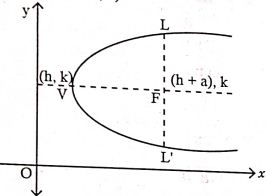
Equation of parabola with vertex at (h, k) and focal length 'a', latus rectum 4a' is
(y - k)2 = 4a(x - h) .......(1)
Differentiating with respect to 'x' we got
2(y - k) \(\frac{dy}{dx}\) = 4a
⇒ (y - k). \(\frac{dy}{dx}\) = 2a ....... (2)
Again differentiating with respect to x,
(y-k) y''+y'\(\times\) y' = 0 ............(3)
From(2),(y-k) = From(2),(y-k) = \(\frac{2a}{y'}\)
Putting in (3), we get
\((\frac{2a}{y'})y''+(y')^2=0 (or) 2ay'' +(y')^3 = 0\)
This is the required differential equation.
21.
\({ tan }^{ -1 }y=\frac { \pi }{ 4 } +\frac { 1 }{ 2 } -\frac { 1 }{ 2 } \left( 1+logx \right) ^{ 2 }\)
22.
It can be obtained by using examples 12.15 and 12.16 that
p↔q ≡ (¬ p ∨ q) ∧ (¬q ∨ p) ... (1)
≡ (¬p∨q) ∧ ( p∨ ¬q) (by Commutative Law) ... (2)
≡ (¬p ∧ ( p ∨ ¬q)) ∨ (q ∧ ( p ∨ ¬q)) (by Distributive Law)
≡ (¬p ∧ p) ∨ (¬p ∧ ¬q) ∨ (q ∧ p) ∨ (q ∧ ¬q) (by Distributive Law)
≡ F ∨ (¬p ∧ ¬q) ∨ (q ∧ p) ∨ F; (by Complement Law)
≡ (¬p ∧ ¬q) ∨ (q ∧ p) ; (by Identity Law)
≡ ( p ∧ q) ∨ (¬p ∧ ¬q) ; (by Commutative Law)
Finally (1) becomes p ↔️ q ≡ ( p ∧ q) v (ㄱp ∧ ㄱq)
23.
The table for the operation x11 is as follows.
| x11 | 1 | 3 | 4 | 5 | 9 |
| 1 | 1 | 3 | 4 | 5 | 9 |
| 3 | 3 | 9 | 1 | 4 | 5 |
| 4 | 4 | 1 | 5 | 9 | 3 |
| 5 | 5 | 4 | 9 | 3 | 1 |
| 9 | 9 | 5 | 3 | 1 | 4 |
Following the same kind of procedure as explained in the previous example, a brief outline of the process of verification of the properties of ×11 on A is given below.
(i) Since each box has an unique element of A, ×11 is a binary operation on A.
(ii) The entries are symmetrical about the main diagonal. Hence ×11 has commutative property.
(iii) As usual, the associative property can be seen to be true.
(iv) The entries of both the row and column headed by the element 1 are identical. Hence 1 is the identity element.
(v) Since the identity 1 exists in each row and each column, the existence of inverse property is assured for ×11. The inverse of 1 is 1, that of 3 is 4, that of 4 is 3, 5 is 9, and, that of 9 is 5.
24.
If the region in the first quadrant bounded by the circle x2 + y2 = r2, the x-axis, the lines x = r − h and x = r is revolved about the x-axis, then the solid generated is a spherical cap of height h cut of from a sphere of radius r. Hence, the required volume is given by
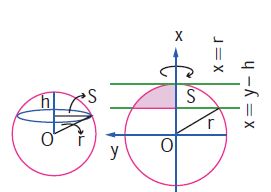
\(V=\pi \int _{ r-h }^{ r }{ { y }^{ 2 }dx=\pi \int _{ r-h }^{ r }{ \left( { r }^{ 2 }-{ x }^{ 2 } \right) dx } =\pi } { \left( { r }^{ 2 }x-\frac { { x }^{ 3 } }{ 3 } \right) }_{ r-h }^{ r }\)
\(=\pi \left( { r }^{ 2 }(r-(r-h)-\frac { \left( { r }^{ 3 }-{ (r-h) }^{ 3 } \right) }{ 3 } \right) =\pi \left( { r }^{ 2 }h-\frac { \left( { r }^{ 3 }-\left( { r }^{ 3 }-3{ r }^{ 2 }h+3{ rh }^{ 2 }-{ h }^{ 3 } \right) \right) }{ 3 } \right) \)
\(\\ =\pi \left( \frac { { 3rh }^{ 2 }-{ h }^{ 3 } }{ 3 } \right) =\frac { 1 }{ 3 } \pi { h }^{ 2 }(3r-h)\)
25.
Equation of the given curve is 2+x-x2+y = 0
| x | 0 | 2 | -1 |
| y | -2 | 0 | 0 |
\(\Rightarrow\)y = x2-x-2
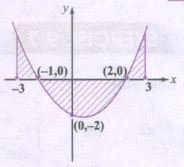
\(\therefore\) Required area= \(\int _{ -3 }^{ -1 }{ ydx } +\int _{ -1 }^{ 2 }{ -y } dx+\int _{ 2 }^{ 3 }{ ydx } \)
\(\\ =\int _{ -3 }^{ -1 }{ \left( { x }^{ 2 }-x-2 \right) } dx\int _{ -1 }^{ 2 }{ (2+x-{ x }^{ 2 })dx } +\int _{ 2 }^{ 3 }{ ({ x }^{ 2 }-x-2) } dx\)
\(={ \left( \frac { { x }^{ 3 } }{ 3 } -\frac { { x }^{ 2 } }{ 2 } -2x \right) }_{ -3 }^{ -1 }+{ \left( 2x+\frac { { x }^{ 2 } }{ 2 } -\frac { { x }^{ 3 } }{ 3 } \right) }_{ -1 }^{ 2 }+{ \left( \frac { { x }^{ 3 } }{ 3 } -\frac { { x }^{ 2 } }{ 2 } -2x \right) }_{ 2 }^{ 3 }\)
\(=\left( -\frac { 1 }{ 3 } -\frac { 1 }{ 2 } +2 \right) -\left( -9-\frac { 9 }{ 2 } +6 \right) +\left( 4+2-\frac { 8 }{ 3 } \right) -\left( -2+\frac { 1 }{ 2 } +\frac { 1 }{ 3 } \right) +\left( 9-\frac { 9 }{ 2 } -6 \right) -\left( \frac { 8 }{ 3 } -2-4 \right) \)
\(\\ =\left( \frac { -2-3+6 }{ 6 } \right) -\left( \frac { -6-9 }{ 2 } \right) +\left( \frac { 18-8 }{ 3 } \right) -\left( \frac { -12+3+2 }{ 6 } \right) +\left( \frac { 6-9 }{ 2 } \right) -\left( \frac { 8-24 }{ 3 } \right) \)
\(=\frac { 1 }{ 6 } +\frac { 15 }{ 2 } +\frac { 10 }{ 3 } +\frac { 7 }{ 6 } -\frac { 3 }{ 2 } +\frac { 16 }{ 3 } \)
\(=\frac { 1+45+20+7-9+32 }{ 6 } =\frac { 90 }{ 6 } =15
\)
26.
Since f (x) is a probability density function, f (x) ≥ 0 and \(\int _{ -\infty }^{ \infty }{ f(x) } dx=1\)
That is \(\int _{ -\infty }^{ 1 }{ 0dx } +\int _{ 1 }^{ 5 }{ kdx } +\int _{ 5 }^{ \infty }{ 0dx } =1\)
\(0+k\left( x \right) _{ 1 }^{ 5 }+0=1\Rightarrow 4k=1\Rightarrow k=\frac { 1 }{ 4 } \)
Therefore the probability density function is
\(f\left( x \right) =\begin{cases} \begin{matrix} \frac { 1 }{ 4 } & 1\le x\le 5 \end{matrix} \\ \begin{matrix} 0 & Otherwise \end{matrix} \end{cases}\)
(i) Distribution function
The distribution function
\(F(x)=P\left( X\le x \right) =\int _{ -\infty }^{ x }{ f(u)dx } \)
When x < 1, \(F(x)=\int _{ -\infty }^{ x }{ f(u)du } =\int _{ -\infty }^{ x }{ oldu } =0\)
When 1 ≤ x ≤ 5 \(F(x)=\int _{ -\infty }^{ x }{ f(u)du=\int _{ -\infty }^{ x }{ 0du } +\int _{ 1 }^{ x }{ odu } +\int _{ 1 }^{ x }{ \frac { 1 }{ 4 } du } =\frac { 1 }{ 4 } (x-1) } \)
When x ≥ 5 \(F(x)=\int _{ -\infty }^{ x }{ f(u) } du=\int _{ -\infty }^{ x }{ odu } +\int _{ 1 }^{ 5 }{ \frac { 1 }{ 4 } du } +\int _{ 1 }^{ 5 }{ \frac { 1 }{ 4 } du } +\int _{ 5 }^{ 5 }{ odu } =1\)
Thus \(F(x)=\begin{cases} \begin{matrix} 0 & x<1 \end{matrix} \\ \begin{matrix} \frac { x-1 }{ 1 } & 1\le x\le 5 \end{matrix} \\ \begin{matrix} 1 & x>5 \end{matrix} \end{cases}\)
(ii) P(X < 3) = P(X ≤ 3) = F(3) = \(\frac { 3-1 }{ 2 } =\frac { 1 }{ 2 } \) (Since F(x) is continuous)
(iii) P(2 < X < 4) = P(2 ≤ X ≤ 4) F(4) - F(2) = \(\frac { 3 }{ 4 } -\frac { 1 }{ 4 } =\frac { 1 }{ 2 } \)
(iv) P(3 ≤ X ) = P(X ≥ 3) = 1− P(X < 3) = 1 - \(1-\frac { 1 }{ 2 } =\frac { 1 }{ 2 } \)
27.
Given \(f(x)=\begin{cases} \begin{matrix} 16{ xe }^{ -4x } & foex>0 \end{matrix} \\ \begin{matrix} 0 & forx\le 0 \end{matrix} \end{cases}\)
Mean :
= \(E(x)=\int _{ 0 }^{ \infty }{ x.f(x)dx } \)
= \(\int _{ 0 }^{ \infty }{ x.16.xe^{ -4x }dx } \)
= \(16\int _{ 0 }^{ \infty }{ { x }^{ 2 } } .{ e }^{ -4x }dx=16\times \frac { 2! }{ { 4 }^{ 3 } } \) \(\left[ \because \int _{ 0 }^{ \infty }{ { x }^{ n }{ e }^{ -ax }dx=\frac { n! }{ { a }^{ n+1 } } } \right] \)
= \(16\times \frac { 2 }{ 64 } \)
\(=\frac { 1 }{ 2 } \)
Variance :
\(E({ x }^{ 2 })=\int _{ 0 }^{ \infty }{ { x }^{ 2 }.f(x)dx } \)
= \(\int _{ 0 }^{ \infty }{ { x }^{ 2 }.{ e }^{ -4x } } dx\)
= \(16\int _{ 0 }^{ \infty }{ { x }^{ 3 }{ e }^{ -4x }dx } \)
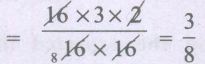
ஃ Var(X) = E(X2) - [E(x)]2
\(
=\frac{3}{8}-\frac{1}{4}
\)
\(=\frac{1}{8}
\)
∴ Var(X) \(=\frac{1}{8}
\)
28.
Given w(x, y, z) = \(\frac { 1 }{ \sqrt { { x }^{ 2 }+{ y }^{ 2 }+{ z }^{ 2 } } }\)
= (x2 + y2 + z2) -\(\frac12\)
\(\frac { \partial w }{ \partial x } =\frac { -1 }{ 2 } ({ x^{ 2 }+{ y }^{ 2 }+{ z }^{ 2 }) }^{ -\frac { 3 }{ 2 } }(2x)\)
= (-x2 + y2 + z2) -\(\frac12\)
\(\frac { { \partial }^{ 2 }w }{ \partial { x }^{ 2 } } =\frac { \partial }{ \partial x } \left( \frac { \partial w }{ \partial x } \right) \)
= -[x\(\left( \frac { -3 }{ 2 } \right) \)( x2 + y2 +z2)\(-\frac32\)
\((\not 2 x)+\left(x^{2}+y^{2}+z^{2}\right)^{\frac{3}{2}}\)
= (x2 + y2 + z2)-\(\frac52\) [-3x2 + x2 +y + z2]
= - (x2 + y2 + z2)-\(\frac52\) [y2 + z2 - 2x2] ....(1)
\(\frac { \partial w }{ \partial y } =\frac { -1 }{ 2 } ({ x^{ 2 }+{ y }^{ 2 }+{ z }^{ 2 }) }^{ -\frac { 3 }{ 2 } }(2y)\)
= -y(x2 +y2 + z2)-\(\frac32\)
\(\frac { { \partial }^{ 2 }w }{ \partial { y }^{ 2 } } =\frac { \partial }{ \partial y } \left( \frac { \partial w }{ \partial y } \right) \)
\(=-\left[y\left(\frac{-3}{\not 2}\right)\left(x^{2}+y^{2}+z^{2}\right)^{\frac{5}{2}}(\not 2 y)+\left(x^{2}+y^{2}+z^{2}\right)^{\frac{3}{2}}(1)\right]\)
= -(x2 + y2 + z2)-\(\frac52 \)
= -(x2 + y2 + z2)-\(\frac52 \) [3y2 + x2 + y2 + z2]
= -(x2 + y2 + z2)-\(\frac52 \) [x2 + y2 + 2z2] ....(2)
Now \(\frac { \partial w }{ \partial z } =\frac { -1 }{ 2 } ({ x^{ 2 }+{ y }^{ 2 }+{ z }^{ 2 }) }^{ -\frac { 3 }{ 2 } }(2z)\)
= -z(x2 + y2 + z2)-\(\frac32 \)
∴ \(\frac { { \partial }^{ 2 }w }{ \partial { z }^{ 2 } } \) = -(x2 + y2 + z2)-\(\frac52 \) [x2 + y2 - 2z2] ...(3)
(1)+(2)+(3)⟶
∴ \(\frac { { \partial }^{ 2 }w }{ \partial { x }^{ 2 } } +\frac { { \partial }^{ 2 }w }{ \partial { y }^{ 2 } } +\frac { { \partial }^{ 2 }w }{ \partial { y }^{ 2 } } \) = -(x2 + y2 + z2)-\(\frac52 \) [y2 + z2 - 2x2 + x2 + z2 - 2y + x2+ y-2z2]
= -(x2 + y2 + z2)-\(\frac52 \)(0) = 0
Hence proved
29.
Diameter = 30 cm
Radius = 15 cm
Circumference (c) = 2πr
\(\frac{dc}{dr}\) = 2π(3) = 6πcm
dc = 2πdr
\(\frac{6}{2π}\) cm = dr
\(\frac{3}{π}\) cm = dr
Approximate growth of the diameter
= 2dr = 2 \(\times\) \(\frac{3}{π}\) cm = \(\frac{6}{2π}\)cm
(ii) A = πr2
dA = π 2r dr
\(d \mathrm{~A}=\not \pi 2(15) \frac{3}{\not \pi} \mathrm{cm}^{2}\)
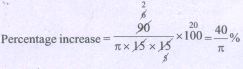
dA = 90 cm2
Area = πr2 = π \(\times\)15 \(\times\) 15 cm2
30.
Let us put I = \(\int ^\frac{\pi}{4}_{0}\) log(1 + tan x) dx
Applying the property \(\int ^{a}_{0}\) f(x) dx =\(\int ^{a}_{0}\)f(a-x) dx in equation (1), we get
I = \(\int ^\frac{\pi}{4}_{0}\) log \([1+tan (\frac{\pi}{4}-x)]\)dx = \(\int ^\frac{\pi}{4}_{0}\) log\([1 + \frac{tan \frac {\pi}{4}- tan x}{1 + tan {\frac {\pi}{4} tan x}}]\) dx
=\(\int ^\frac{\pi}{4}_{0}\) log \([1 + \frac {1 - tan x}{1 + tan x}]\)dx = \(\int ^\frac{\pi}{4}_{0}\) log\([\frac {1+tan x +1 - tan x}{1 + tan x}]\) dx
=\(\int ^\frac{\pi}{4}_{0}\) log \([\frac{2}{1+tanx}]\) dx = \(\int ^\frac{\pi}{4}_{0}\) [log 2 - log (1+tan x)] dx
= log 2 \(\int ^\frac{\pi}{4}_{0}\) dx - \(\int ^\frac{\pi}{4}_{0}\)log (1+tan x)] dx
= \(\frac{\pi}{4}\)log 2 - I
So, we get 2I = \(\frac{\pi}{4}\)log 2.
Hence, we get I = \(\frac{\pi}{8}\)log 2.
31.
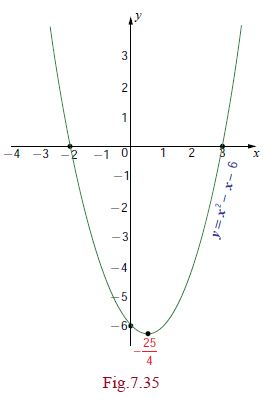
Factorising the given function, we have
y = f (x) = (x − 3)(x + 2) .
(1) The domain of the given function f (x) is the entire real line.
(2) Putting y = 0 we get x = −2, 3. Therefore the x -intercepts are (−2, 0) and (3, 0) putting x = 0 we get y = −6. Therefore the y -intercept is (0, −6).
(3) f'(x) = 2x −1 and hence the critical point of the curve occurs at x = \(\frac{1}{2}\).
(4) f"(x) = 2 > 0,∀x . Therefore at xTherefore at x = \(\frac{1}{2}\) the curve has a local minimum which is \(f\left( \frac { 1 }{ 2 } \right) =-\frac { 25 }{ 4 } .\)
(5) The range of the function is \(y\ge-\frac{25}{4}\)
(6) Since f"(x) = 2 > 0,∀x the function is concave upward in the entire real line.
(7) Since f(x) = 2 ≠ 0, ∀x the curve has no points of inflection
(8) The curve has no asymptotes.
The rough sketch of the curve is shown on the right side.
32.
Given E = Ri + L \(\frac{di}{dt}\)
\(\frac { E }{ L } =\frac { Ri }{ L } +\frac { di }{ dt } \)
\(\Rightarrow \frac { Ri }{ L } +\frac { di }{ dt } =\frac { E }{ L } \)
This is a linear differential equation
\(Here\quad P=\frac { R }{ L } and\quad Q=\frac { E }{ L } \)
\(\therefore \int { pdt } =\int { \frac { R }{ L } dt } =\frac { R }{ L } t\)
\(\therefore I.F={ e }^{ \int { pdt } }={ e }^{ \frac { Rt }{ L } }\)
\(\therefore\) Solution is i\({ e }^{ \int { pdt } }=\int { Q{ e }^{ \int { pdt } }dt+C } \)
\(\Rightarrow i{ e }^{ \frac { Rt }{ L } }=\int { \frac { E }{ L } . } { e }^{ \frac { Rt }{ L } }dt+C\)
\(\therefore i{ e }^{ \frac { Rt }{ L } }=\frac { E }{ L } \frac { { e }^{ \frac { Rt }{ L } } }{ \frac { R }{ L } } dt+C\)
\(i=\frac { E }{ R } { e }^{ \frac { Rt }{ L } }+C\)
\(i=\frac { E }{ R } +c{ e }^{ -\frac { Rt }{ L } }\)
When E = 0,
\(i=0+c{ e }^{ -\frac { Rt }{ L } }\)
\(\Rightarrow i=c{ e }^{ -\frac { Rt }{ L } }\)
33.
The given differential equation may be written
\(\Rightarrow \frac { dy }{ dx } =\frac { -3{ e }^{ \frac { y }{ x } }\left( 1-\frac { y }{ x } \right) }{ 1+3{ e }^{ \frac { y }{ x } } } ...(1)\)
This is a homogeneous differential equation
\(\therefore put\quad y=vx\Rightarrow \frac { dy }{ dx } =v+x\frac { dv }{ dx }\)
\(v+x\frac { dv }{ dx } =\frac { -3{ e }^{ v }(1-v) }{ 1+3{ e }^{ v } }\)
\(\Rightarrow x\frac { dv }{ dx } =\frac { -3{ e }^{ v }(1-v) }{ 1+3{ e }^{ v } } -v\)
\(\Rightarrow \quad x \frac{d v}{d x}=\frac{-3 e^v+3 x e^v-v-3 v e^v}{1+3 e^v}\)
\(=\frac { -3{ e }^{ v }-v }{ 1+3{ e }^{ v } } =-\left( \frac { -3{ e }^{ v }+v }{ 1+3{ e }^{ v } } \right)\)
Separating the variables we get,
\(\frac { 1+3{ e }^{ v } }{ 3{ e }^{ v }+v } dv=-\frac { dx }{ x }\)
\(\Rightarrow log(3{ e }^{ v }+v)=-log\quad x+log\quad c\)
\(\Rightarrow log(3{ e }^{ v }+v)=log\left( \frac { c }{ x } \right) \Rightarrow { 3e }^{ v }+v=\frac { c }{ x }\)
\({ 3e }^{ \frac { y }{ x } }+\frac { y }{ x } =\frac { c }{ x }\)
\(\Rightarrow \frac { 3x{ e }^{ \frac { y }{ x } }+y }{ x } =\frac { c }{ x }\)
\(\Rightarrow y+3x{ e }^{ \frac { y }{ x } }=c\)
Given that y = 0 when x = 1
3(1)e0+ 0 = c \(\Rightarrow\) c = 3
\(\therefore\) (2) becomes, 3x\({ e }^{ \frac { y }{ x } }\)+ y = 3
34.
Given that s(t) = t3 − 6t2 + 9t + 1. On differentiating, we get v(t) = 3t2 -12t + 9 and a(t) = 6t −12.
(i) The particle is at rest when v(t) = 0 . Therefore, v(t) = 3(t −1)(t − 3) = 0 gives t = 1 and t = 3.
(ii) The particle changes direction when v (t) changes its sign. Now.
if 0 ≤ t < 1 then both (t −1) and (t − 3) < 0 and hence, v(t) > 0.
If 1< t < 3 then (t −1) > 0 and (t − 3) < 0 and hence, v(t) < 0.
If t > 3 then both (t −1) and (t − 3) > 0 and hence, v(t) > 0.
Therefore, the particle changes direction when t = 1 and t = 3.
(iii) The total distance travelled by the particle from time t = 0 to t = 2 is given by,
|s(0) − s(1)| + |s(1) − s(2)| = |1− 5 | + | 5 − 3| = 6 metres.
35.
(a)
3, 1
36.
(b)
f(2a - x) = f(x)
37.
(b)
Fermat's theorem
38.
(d)
ᄀ(p ∧ q) ∧ [p ∧ (pV ᄀr)]
39.
(c)
| (a) | (b) | (c) | (d) |
| T | T | F | T |
40.
(d)
\(\frac{2}{3}\)
41.
(d)
2
42.
(b)
\(\frac{2}{9}\)
43.
(c)
x cos x
44.
(d)
4.8 cu.cm
45.
(d)
1
46.
(a)
1 and \(\frac { 1 }{ 2 } \)
47.
(d)
4
48.
(a)
49.
(b)
\(y={ ce }^{ -\int { pdx } }\)
50.
(b)
\(\frac { { d }^{ 2 }y }{ { dx }^{ 2 } }+y=0\)
51.
(a)
100
52.
(c)
\(\left( 3,\sqrt { 5 } \right) \)
53.
(b)
\(\\ \\ \\ t=\cfrac { 1 }{ 3 } \)
54.
(a)
3 cm/s

12th Standard Syllabus & Materials
12th Standard
TN 12th Computer Applications வலையமைப்பு வடமிடல் Sample Question Papers Study Material - QB365 Set A
NEW12th Standard
TN 12th Computer Applications களப்பெயர் முறைமை (DNS) Sample Question Papers Study Material - QB365 Set A
NEW12th Standard
TN 12th Computer Applications வலையமைப்பு எடுத்துக்காட்டுகள் மற்றும் நெறிமுறைகள் Sample Question Papers Study Material - QB365 Set A
NEW12th Standard
TN 12th Computer Applications கணினி வலையமைப்பு ஓர் அறிமுகம் Sample Question Papers Study Material - QB365 Set A



Tamilnadu Stateboard 12th Standard Subjects
Maths

Chemistry

Physics

Biology

Computer Science

Business Maths and Statistics

Economics

Commerce

Accountancy

History

Computer Applications
Biology
Computer Technology
Computer Applications
Computer Science
Business Maths and Statistics
Commerce
Economics
Maths
Chemistry
Physics
Computer Technology
History
Accountancy

Tamil

English

French
Tamilnadu Stateboard Standards


