
 100% FREE ACCESS
12th Standard Syllabus & Materials
12th Standard
TN 12th Maths Applications of Matrices and Determinants Sample Question Papers Study Material - QB365 Set A
NEW12th Standard
TN 12th Computer Applications மின்னணு தரவு பரிமாற்றம் Sample Question Papers Study Material - QB365 Set A
NEW12th Standard
TN 12th Computer Applications மின் - வணிக பாதுகாப்பு அமைப்புகள் Sample Question Papers Study Material - QB365 Set A
NEW12th Standard
TN 12th Computer Applications மின்னணு செலுத்தல் முறைகள் Sample Question Papers Study Material - QB365 Set A
NEW12th Standard
TN 12th Computer Applications மின் - வணிகம் Sample Question Papers Study Material - QB365 Set A
NEW12th Standard
TN 12th Computer Applications திறந்த மூல கருத்துருக்கள் Sample Question Papers Study Material - QB365 Set A

Published on: 20/10/2025
Download Tamil Nadu 12th Standard Maths question papers, model tests, one-mark questions, important questions, and public exam papers in PDF format. Free study materials and answer keys for TN State Board students.
Questions + Answers key
Take MCQ Maths Test
1.
Find the values of the following:
\(\int ^\frac{\pi}{2}_{0}\)sin 5x cos4xdx
2.
Evaluate the following:
\(\int _{ 0 }^{ 1 }{ { x }^{ 3 }{ e }^{ -2x }dx } \)
3.
Evaluate the following integrals using properties of integration:
\(\int _{ -5 }^{ 5 }{ xcos } \left( \frac { { e }^{ x }-1 }{ { e }^{ x }+1 } \right) dx\)
4.
Evaluate \(\int ^{3}_{2} \frac{\sqrt {x}}{\sqrt {5-x}+\sqrt {x}}\)dx.
5.
Evaluate: \(\int _{ 0 }^{ 3 }{ (3{ x }^{ 2 }-4x+5) } dx\)
6.
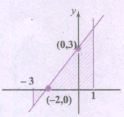
Find the area of the region bounded by 3x − 2y + 6 = 0 , x = −3, x = 1 and x-axis.
7.
Find the area of the region bounded by the line 6x + 5y = 30, x − axis and the lines x = −1 and x = 3.
8.
Evaluate the following:
\(\int _{ 0 }^{ \infty }{ { x }^{ 5 }{ e }^{ -3x }dx } \)
9.
Evaluate the following
\(\int _{ 0 }^{ \pi /2 }{ { sin }^{ 10 }x\quad dx } \)
10.
Evaluate: \(\int ^{\frac{\pi}{2}}_{\frac{\pi}{2}}\)x cos x dx.
11.
Evaluate :\(\int _{ 0 }^{ 1 }{ [2x] } dx\) where [⋅] is the greatest integer function
12.
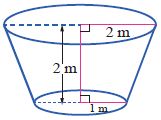
Find, by integration, the volume of the container which is in the shape of a right circular conical frustum.
13.
Find the area of the region common to the circle x2 + y2 = 16 and the parabola y2 = 6x.
14.
Find the area of the region bounded between the curves y = sin x and y = cos x and the lines x = 0 and x = \(\pi\)
15.
16.
If \(\int _{ 0 }^{ \infty }{ { e }^{ -a{ x }^{ 2 } }{ x }^{ 3 }dx=32,\alpha >0,\ find\ \alpha } \)
17.
Show that \(\int ^{1}_{0} (tan ^{-1} x + tan ^{-1}(1-x))\) dx = \(\frac {\pi}{2}\) - loge2
18.
Prove that \(\int ^\frac{\pi}{4}_{0}\) log(1+tan x)dx = \(\frac{\pi}{8}\) log2.
19.
The value of \(\int _{ -1 }^{ 2 }{ |x|dx } \) is
\(\frac{1}{2}\)
\(\frac{3}{2}\)
\(\frac{5}{2}\)
\(\frac{7}{2}\)
20.
If \(\int _{ 0 }^{ x }{ f(t)dt=x+\int _{ x }^{ 1 }{ tf } (t)dt } \), then the value of f (1) is
\(\frac{1}{2}\)
2
1
\(\frac{3}{4}\)
21.
The value of \(\int _{ 0 }^{ a }{ { (\sqrt { { a }^{ 2 }-{ x }^{ 2 } } ) }^{ 3 } } dx\) is
\(\frac { { \pi a }^{3 } }{ 16 } \)
\(\frac { 3\pi { a }^{ 4 } }{ 16 } \)
\(\frac { 3\pi { a }^{2 } }{ 8} \)
\(\frac { 3\pi { a }^{ 4 } }{ 8} \)
22.
If \(f(x)=\int_{1}^{x} \frac{e^{\sin u}}{u} d u, x>1 \text { and }\int_{1}^{3} \frac{e^{\sin x^{2}}}{x} d x=\frac{1}{2}[f(a)-f(1)]\), then one of the possible value of a is
3
6
9
5
23.
The value of \(\int _{ 0 }^{ \frac { \pi }{ 6 } }{ { cos }^{ 3 }3x\ dx }\ is\)
\(\frac{2}{3}\)
\(\frac{2}{9}\)
\(\frac{1}{9}\)
\(\frac{1}{3}\)
24.
If \(\frac{\Gamma(n+2)}{\Gamma(n)}=90\) then n is
10
5
8
9
25.
The value of \(\int _{ 0 }^{ \pi }{ \frac { dx }{ 1+{ 5 }^{ cos\ x } } } \) is
\(\frac{\pi}{2}\)
\(\pi\)
\(\frac{3\pi}{2}\)
\(2\pi\)
26.
The area between y2 = 4x and its latus rectum is
\(\frac{2}{3}\)
\(\frac{4}{3}\)
\(\frac{8}{3}\)
\(\frac{5}{3}\)
27.
The value of \(\int _{ -\frac { \pi }{ 4 } }^{ \frac { \pi }{ 4 } }{ \left( \frac { { 2x }^{ 7 }-{ 3x }^{ 5 }+{ 7x }^{ 3 }-x+1 }{ { cos }^{ 2 }x } \right) dx } \) is
4
3
2
0
28.
The value of \(\int _{ -4 }^{ 4 }{ \left[ { tan }^{ -1 }\left( \frac { { x }^{ 2 } }{ { x }^{ 4 }+1 } \right) +{ tan }^{ -1 }\left( \frac { { x }^{ 4 }+1 }{ { x }^{ 2 } } \right) \right] dx } \) is
\(\pi\)
\(2\pi\)
\(3\pi\)
\(4\pi\)
1.
\(\int _{ 0 }^{ \frac { \pi }{ 2 } }{ { sin }^{ 4 }x{ cos }^{ 6 }xdx=\frac { (6-1) }{ (6+4) } .\frac { (6-3) }{ (6+4-2) } .\frac { (6-5) }{ (6+4-4) } .\frac { (4-1) }{ (4) } .\frac { (4-3) }{ (4-2) } .\frac { \pi }{ 2 } } \)
\(=\frac { (5) }{ (10) } \frac { (3) }{ (8) } \frac { (1) }{ (6) } \frac { (3) }{ (4) } \frac { (1) }{ (2) } \frac { \pi }{ 2 } =\frac { 3\pi }{ 512 } \)
Also, \(\int _{ 0 }^{ \frac { \pi }{ 2 } }{ { sin }^{ 4 }x{ cos }^{ 6 }xdx } =\int _{ 0 }^{ \frac { \pi }{ 2 } }{ { sin }^{ 6 }x{ cos }^{ 4 }xdx } =\frac { (3) }{ (10) } \frac { (1) }{ (8) } \frac { (5) }{ (6) } \frac { (3) }{ (4) } \frac { (1) }{ (2) } \frac { \pi }{ 2 } =\frac { 3\pi }{ 512 } \)
2.
Let \(u={ x }^{ 3 }\quad dv={ e }^{ -2x }\)
\(u_1=3{ x }^{ 2 }{ v }_{ 1 }=\frac { { e }^{ -2x } }{ -2 } \)
\(u_2=6x\quad { v }_{ 2 }=\frac { { e }^{ -2x } }{ 4 } \)
\(u_3=6\quad { v }_{ 3 }=\frac { { e }^{ -2x } }{ -8 } \)
\(u_4 = 0 \quad \ { v }_{ 4 }=\frac { { e }^{ -2x } }{ 16 } \)
Bernoulli's' formula:
\(\int { uvdx } ={ uv }_{ 1 }-u'{ v }_{ 2 }+u"{ v }_{ 3 }-u"'{ v }_{ 4 }+...\)
\(\therefore \int _{ 0 }^{ 1 }{ { x }^{ 3 }{ e }^{ -2x }dx={ \left[ { x }^{ 3 }\left( \frac { { e }^{ -2x } }{ -2 } \right) -3{ x }^{ 2 }\left( \frac { { e }^{ -2x } }{ 4 } \right) +6x\left( \frac { { e }^{ -2x } }{ -8 } \right) -6\left( \frac { { e }^{ -2x } }{ 16 } \right) \right] }_{ 0 }^{ 1 } } \)
\(={ \left[ { e }^{ -2x }\left( \frac { -{ x }^{ 3 } }{ 2 } -\frac { -3{ x }^{ 2 } }{ 4 } -\frac { 3x }{ 4 } -\frac { 3 }{ 8 } \right) \right] }_{ 0 }^{ 1 }\)
\(=\left[ { e }^{ -2 }\left( -\frac { 1 }{ 2 } -\frac { 3 }{ 4 } -\frac { 3 }{ 4 } -\frac { 3 }{ 8 } \right) -{ e }^{ -0 }\left( \frac { -3 }{ 8 } \right) \right] \)
\(={ e }^{ -2 }\left( \frac { -4-12-3 }{ 8 } \right) +\frac { 3 }{ 8 } \)
\(={ e }^{ -2 }\left( \frac { -19 }{ 8 } \right) +\frac { 3 }{ 8 } =\frac { 3 }{ 8 } -\frac { 19 }{ 8 } { e }^{ -2 }\)
3.
Let \(f(x)=xcos\left( \frac { { e }^{ x }-1 }{ { e }^{ x }+1 } \right) \)
\(f(-x)=-x\quad cos\left( \frac { { e }^{ x }-1 }{ { e }^{ x }+1 } \right) \)
\(=-x\quad cos\left( \frac { { e }^{ \frac { 1 }{ x } }-1 }{ { e }^{ \frac { 1 }{ x } }+1 } \right) \)
\(=-x\quad cos\left( \frac { 1-{ e }^{ x } }{ 1+{ e }^{ x } } \right) \)
\(=-x\quad cos\left( -\left( \frac { { e }^{ x }-1 }{ { e }^{ x }+1 } \right) \right) \)
\(=-xcos\left( \frac { { e }^{ x }-1 }{ { e }^{ x }+1 } \right) \)
\([\because cos(-\theta )=cos\theta ]\)
= -f(x)
\(\therefore\) f(x) is an odd function
\(\therefore \int _{ -5 }^{ 5 }{ xcos\left( \frac { { e }^{ x }-1 }{ { e }^{ x }+1 } \right) } dx=0\)
4.
Let us put I = \(\int ^{3}_{2} \frac{\sqrt {x}}{\sqrt {5-x}+\sqrt {x}}\) dx --- (1)
Applying the formula \(\int ^{a}_{b}\) f(x) dx =\(\int ^{a}_{b}\) f(a+b -x) dx, we get
I = \(\int ^{3}_{2} \frac{\sqrt {(2+3-x)}}{\sqrt {5-(2+3-x)}+\sqrt { {(2+3-x)}}}\) dx = \(\int ^{3}_{2} \frac{\sqrt {(5-x)}}{\sqrt {x}+\sqrt { {(5-x}}}\) dx -- (2)
Adding (1) and (2), we get
2I = \(\int ^{3}_{2} \frac{\sqrt {x} + \sqrt {5-x} }{\sqrt {x}+\sqrt { {5-x}}}\) dx =\(\int ^{3}_{2} \) dx = \([x]^{3}_{2}\) = 3 - 2 = 1
Hence, we get I = \(\frac{1}{2}\)
5.
\(\int _{ 0 }^{ 3 }{ (3{ x }^{ 2 }-4x+5) } dx=\int _{ 0 }^{ 3 }{ 3{ x }^{ 2 } } dx-\int _{ 0 }^{ 3 }{ 4x } dx+\int _{ 0 }^{ 3 }{ 5 } dx\)
\(=3\int _{ 0 }^{ 3 }{ { x }^{ 2 } } dx-4\int _{ 0 }^{ 3 }{ c } dx+5\int _{ 0 }^{ 3 }{ dx } \)
\(=3{ \left[ \frac { { x }^{ 3 } }{ 3 } \right] }_{ 0 }^{ 3 }-4{ \left[ \frac { { x }^{ 2 } }{ 2 } \right] }_{ 0 }^{ 3 }+5{ \left[ x \right] }_{ 0 }^{ 3 }\)
= (27 − 0) − 2(9 − 0) + 5(3− 0)
= 27 −18 +15 = 24.
6.
Given equation of line is 3x - 2y + 6 = 0
2y = 3x + 6 \(\Rightarrow\) y = \(\frac{3x+6}{2}\)
| x | 0 | -2 |
| t | 3 | 0 |
\(\therefore Area=\int _{ -3 }^{ -2 }{ -ydx+ydx } +\int _{ -2 }^{ 1 }{ ydx } \)
[\(\because\) the Area is below the x - axis]
\(=\frac { -1 }{ 2 } \int _{ -3 }^{ -2 }{ (3x+6)dx+\frac { 1 }{ 2 } \int _{ -2 }^{ 1 }{ (3x+6)dx } } \)
\(={ \left[ \frac { { 3x }^{ 2 } }{ 2 } +6x \right] }_{ -3 }^{ -2 }+\frac { 1 }{ 2 } { \left[ \frac { { 3x }^{ 2 } }{ 2 } +6x \right] }_{ -2 }^{ 1 }\)
\(=-\frac { 1 }{ 2 } \left[ \left( \frac { 12 }{ 2 } -12 \right) -\left( \frac { 27 }{ 2 } -18 \right) \right] +\frac { 1 }{ 2 } \left[ \left( \frac { 3 }{ 2 } +6 \right) -\left( \frac { 12 }{ 2 } -12 \right) \right] \)
\(=-\frac { 1 }{ 2 } \left[ (-6)-\left( \frac { 27-36 }{ 2 } \right) \right] +\frac { 1 }{ 2 } \left[ \left( \frac { 3+12 }{ 2 } \right) -(-6) \right] \)
\(=-\frac { 1 }{ 2 } \left[ -6+\frac { 9 }{ 2 } \right] +\frac { 1 }{ 2 } \left[ \frac { 15 }{ 2 } +6 \right] \)
\(\\ =-\frac { 1 }{ 2 } \left[ \frac { -3 }{ 2 } \right] +\frac { 1 }{ 2 } \left[ \frac { 27 }{ 2 } \right] =\frac { 3 }{ 4 } +\frac { 27 }{ 4 } =\frac { 30 }{ 4 } =\frac { 15 }{ 2 } \)
\(\therefore\) A = 7.5 sq.units
7.
The region is sketched. It lies above the x − axis. Hence, the required area is given by
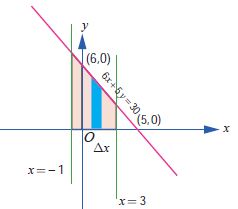
\(A=\int _{ -1 }^{ 3 }{ ydx } =\int _{ -1 }^{ 3 }{ \left( \frac { 30-6x }{ 5 } \right) dx={ \left( \frac { 30x-3{ x }^{ 2 } }{ 5 } \right) }_{ -1 }^{ 3 } } \)
\(=\left( \frac { 90-27 }{ 5 } \right) -\left( \frac { -30-3 }{ 5 } \right) =\frac { 96 }{ 5 } \)
8.
\( \because \int _{ 0 }^{ \infty }{ { x }^{ n }{ e }^{ -ax }dx}=\frac { n! }{ { a }^{ n+1 } } \)
\(n=5,\quad a=3 \)
\(=\frac { 5! }{ { 3 }^{ 6 } } \)
9.
\({ I }_{ n }=\int _{ 0 }^{ \pi /2 }{ { sin }^{ n }x } =\frac { n-1 }{ n } { I }_{ n-2 },n\ge 2\)
\(Let\quad { I }_{ 10 }=\int _{ 0 }^{ \pi /2 }{ { sin }^{ 10 }xdx=\frac { 9 }{ 10 } { I }_{ 8 } } \)
\(=\frac { 9 }{ 10 } \times \frac { 7 }{ 8 } \times { I }_{ 6 }=\frac { 9 }{ 10 } \times \frac { 7 }{ 8 } \times \frac { 5 }{ 6 } \times { I }_{ 4 }\)
\(\\ =\frac { 9 }{ 10 } \times \frac { 7 }{ 8 } \times \frac { 5 }{ 6 } \times \frac { 3 }{ 4 } { I }_{ 2 }\)
\(=\frac { 9 }{ 10 } \times \frac { 7 }{ 8 } \times \frac { 5 }{ 6 } \times \frac { 3 }{ 4 } \times \frac { 1 }{ 2 } \times \frac { \pi }{ 2 } \)
\(=\frac { 315 }{ 1280 } \times \frac { \pi }{ 2 } =\frac { 63\pi }{ 256(2) } =\frac { 63\pi }{ 512 } \)
10.
Let f (x) = x cos x
Then f (−x) = (−x) cos(−x) = −x cos x = − f (x).
So f (x) = x cos x is an odd function.
Hence, applying the property, for odd function f(x), \(\int _{ -a }^{ a }{ f(x)dx=0 } \)
\(\therefore\) we get \(\int _{ -\frac { \pi }{ 2 } }^{ \frac { \pi }{ 2 } }{ xcosx } dx=0\)
11.
\(\int _{ 0 }^{ 1 }{ [2x]dx } =\int _{ 0 }^{ \frac { 1 }{ 2 } }{ [2x] } dx+\int _{ \frac { 1 }{ 2 } }^{ 1 }{ [2x]dx } =\int _{ 0 }^{ \frac { 1 }{ 2 } }{ 0dx+ } \int _{ \frac { 1 }{ 2 } }^{ 1 }{ 1 dx} = 0+[x]^1_{\frac{1}{2}} = 1 -\frac { 1 }{ 2 } =\frac { 1 }{ 2 } \)
12.
Volume of the right circular conical frustum is obtained by revolving the line y = x between x = a and x = b around the x - axis
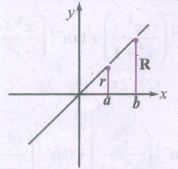
\(\therefore\) Height of the frustum h = b - a
\(\therefore\)Volume \(=\pi \int _{ a }^{ b }{ { x }^{ 2 }dx } =\pi { \left[ \frac { { x }^{ 3 } }{ 3 } \right] }_{ a }^{ b }\)
\(=\frac { \pi }{ 3 } [{ b }^{ 3 }-{ a }^{ 3 }]\)
\(=\frac { \pi }{ 3 } (b-a)({ b }^{ 2 }+ab+{ a }^{ 2 })\)
Now, substitute h = b - a, r = a and R = b we get Volume of the conical frustum
\(\frac { \pi }{ 3 } [h({ R }^{ 2 }+rR+{ r }^{ 2 })]\)
Given h = 2 m, r = 1 m, R = 2 m we get
Required volume \(=\frac { \pi }{ 3 } [2(4+2+1)]\)
\(=\frac { \pi }{ 3 } (14)\)
\(=\frac { 14\pi }{ 3 } \)
13.
Equation of the given circle is x2 + y2 = 16 ...(1)
and the parabola is y2 = 6x. ...(2)
Substituting (2) in (1) we get,
x2 + 6x - 16 = 0 \(\Rightarrow\) (x + 8) (x - 2) = 0
\(\Rightarrow\) (x-4) (x-2) = 0 \(\Rightarrow\) x = 2, 4
\(\Rightarrow\) x = -8, 2
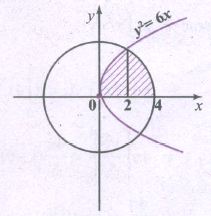
\(\therefore\) Required area = 2
\(\\ \\ \\ \\ \\ \\ \\ \int _{ 0 }^{ 2 }{ Area\ below\ the\ parabola } +\int _{ 2 }^{ 4 }{ Area\ below\ the\ circle } \)
\(=2\left[ \int _{ 0 }^{ 2 }{ \sqrt { 6x } } dx+\int _{ 2 }^{ 4 }{ \sqrt { 16-{ x }^{ 2 } } dx } \right] \)
\(=2\left[ { \left( \frac { \sqrt { 6 } .{ x }^{ \frac { 3 }{ 2 } } }{ \frac { 3 }{ 2 } } \right) }_{ 0 }^{ 2 }+{ \left( \frac { x }{ 2 } \sqrt { 16-{ x }^{ 2 } } +\frac { 16 }{ 2 } { sin }^{ -1 }\left( \frac { x }{ 4 } \right) \right) }_{ 0 }^{ 4 } \right] \)
\(=2\left[ \frac { 2 }{ 3 } \sqrt { 6. } 2\sqrt { 2 } +8{ sin }^{ -1 }\left( \frac { 1 }{ 2 } \right) \right] \)
\(=2\left[ \frac { 4\sqrt { 12 } }{ 3 } +8\left( \frac { \pi }{ 2 } \right) -\sqrt { 12 } -8\left( \frac { \pi }{ 6 } \right) \right] \)
\(=2\left[ \frac { 4\sqrt { 12 } }{ 3 } +4\pi -2\sqrt { 3 } -\frac { 4\pi }{ 3 } \right] \)
\(=2\left[ \frac { 8\sqrt { 3 } -6\sqrt { 3 } }{ 3 } +\frac { 12\pi -4\pi }{ 3 } \right] \)
\(=\left[ \frac { 2\sqrt { 3 } }{ 3 } +\frac { 8\pi }{ 3 } \right] =2\times \frac { 2 }{ 3 } \left[ \sqrt { 3 } +4\pi \right] \)
\(=\frac { 4 }{ 3 } \left[ 4\pi +\sqrt { 3 } \right] \)sq.units
14.
Equation of the given curves are y = sin x ..(1)
Y = cos x ...(2)
from (1) and (2), sin x = cos x
y = sin x
| x | 0 | \(\pi\)/2 |
| y | 0 | 1 |
y = cos x
| x | 0 | \(\pi\)/2 |
| y | 1 | 0 |
\(\Rightarrow x=\frac { \pi }{ 4 } \)
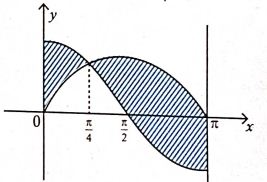
\(\therefore \) Required area = \(2\int _{ \frac { \pi }{ 4 } }^{ \frac { 3\pi }{ 4 } }{ (sinx-cosx)dx } \)
[\(\because\) the area is symmetrical about X - axis]
\(=2{ \left[ -cosx-sinx \right] }_{ \frac { \pi }{ 4 } }^{ \frac { 3\pi }{ 4 } }\)
\(=-2\left[ \left( cos\frac { 3\pi }{ 4 } +sin\frac { 3\pi }{ 4 } \right) -\left( cos\frac { \pi }{ 4 } +sin\frac { \pi }{ 4 } \right) \right] \)
= -2\(\left[ \left( -\frac { 1 }{ \sqrt { 2 } } +\frac { 1 }{ \sqrt { 2 } } \right) -\left( \frac { 1 }{ \sqrt { 2 } } +\frac { 1 }{ \sqrt { 2 } } \right) \right] \)
[cos 135o = cos(180o- 45) = -cos 45o sin135o = sin(180o- 45) = -sin 45o]
\(=-2\left[ \frac { -2 }{ \sqrt { 2 } } \right] =\frac { 4 }{ \sqrt { 2 } } \times \frac { \sqrt { 2 } }{ \sqrt { 2 } } =\frac { 4\sqrt { 2 } }{ 2 } =2\sqrt { 2 } \)
15.
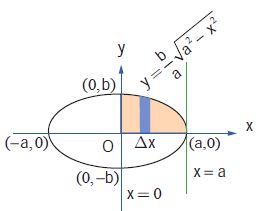
16.
Given \(\int _{ 0 }^{ \infty }{ { e }^{ -a{ x }^{ 2 } }{ x }^{ 3 }dx=32,\alpha >0} \)
| x | 0 | \(\infty\) |
| t | 0 | \(\infty\) |
\(\Rightarrow \int _{ 0 }^{ \infty }{ { e }^{ { -\alpha x }^{ 2 } } } .{ x }^{ 2 }.dx=32\)
\(put\ t= { x }^{ 2 }\)
\(\Rightarrow dt=2x\ dx\)
\(\\ \Rightarrow \frac { dt }{ 2 } = xdx\)
\( \int _{ 0 }^{ \infty }{ { e }^{ -\alpha t }\frac{dt}{2}} \frac { 1 }{ 2 } \int _{ 0 }^{ \infty }{ { e }^{ -\alpha t }.tdt } \)
\( \frac { 1 }{ 2 } \times\frac{1} { \alpha}^{ 2 } \) ...... (1)
Given \(\int^x_0e^{-ax^2}x^3 dx = 32\)
By (1),
\(\Rightarrow \frac { 1! }{ { \alpha }^{ 2 } } =32\times 2\left[ \because \int _{ 0 }^{ \infty }{ { e }^{ -ax }{ x }^{ n }dx=\frac { n! }{ { a }^{ n+1 } } } \right] \)
\(\frac{1}{2}\times \frac{1}{\alpha^2}= 32 \Rightarrow \frac {1}{\alpha ^2}= 64\\ \alpha ^2 = \frac{1}{64}\)
\(\Rightarrow \alpha =\frac { 1 }{ 8 } \)
17.
I =\(\int ^{1}_{0} (tan ^{-1} x + tan ^{-1}(1-x))\) dx
=\(\int ^{1}_{0} (tan ^{-1} x dx + \int ^{1}_{0} tan ^{-1}(1-x)) dx\)
= \(\int ^{1}_{0} (tan ^{-1} x dx + \int ^{1}_{0} tan ^{-1}(1-(1-x)) dx\), Since\(\int ^{a}_{0} f (x) dx = \int ^{a}_{0} f(a-x) dx \)
=\(\int ^{1}_{0} tan ^{-1} x dx + \int ^{1}_{0} tan ^{-1} x dx\)
= 2\(\int ^{1}_{0} tan^{-1} x dx\)
= \([2 \int udv]^1_0\) , Where u = tan-1 x and dν = dx
= 2\([uν - \int udv]^1_0,\) applying integration by parts
= 2\((x tan^{-1} x - \int x \frac{dx}{1+x^2})^{1}_{0}\)
= 2\((x tan^{-1} x - \frac {1}{2} log (1+x^2))^{1}_{0}\)
= \(\frac{\pi}{2} \)- log 2
18.
Let us put I = \(\int ^\frac{\pi}{4}_{0}\) log(1 + tan x) dx
Applying the property \(\int ^{a}_{0}\) f(x) dx =\(\int ^{a}_{0}\)f(a-x) dx in equation (1), we get
I = \(\int ^\frac{\pi}{4}_{0}\) log \([1+tan (\frac{\pi}{4}-x)]\)dx = \(\int ^\frac{\pi}{4}_{0}\) log\([1 + \frac{tan \frac {\pi}{4}- tan x}{1 + tan {\frac {\pi}{4} tan x}}]\) dx
=\(\int ^\frac{\pi}{4}_{0}\) log \([1 + \frac {1 - tan x}{1 + tan x}]\)dx = \(\int ^\frac{\pi}{4}_{0}\) log\([\frac {1+tan x +1 - tan x}{1 + tan x}]\) dx
=\(\int ^\frac{\pi}{4}_{0}\) log \([\frac{2}{1+tanx}]\) dx = \(\int ^\frac{\pi}{4}_{0}\) [log 2 - log (1+tan x)] dx
= log 2 \(\int ^\frac{\pi}{4}_{0}\) dx - \(\int ^\frac{\pi}{4}_{0}\)log (1+tan x)] dx
= \(\frac{\pi}{4}\)log 2 - I
So, we get 2I = \(\frac{\pi}{4}\)log 2.
Hence, we get I = \(\frac{\pi}{8}\)log 2.
19.
(c)
\(\frac{5}{2}\)
20.
(a)
\(\frac{1}{2}\)
21.
(b)
\(\frac { 3\pi { a }^{ 4 } }{ 16 } \)
22.
(c)
9
23.
(b)
\(\frac{2}{9}\)
24.
(d)
9
25.
(a)
\(\frac{\pi}{2}\)
26.
(c)
\(\frac{8}{3}\)
27.
(c)
2
28.
(d)
\(4\pi\)

12th Standard Syllabus & Materials
12th Standard
TN 12th Computer Applications வலையமைப்பு வடமிடல் Sample Question Papers Study Material - QB365 Set A
NEW12th Standard
TN 12th Computer Applications களப்பெயர் முறைமை (DNS) Sample Question Papers Study Material - QB365 Set A
NEW12th Standard
TN 12th Computer Applications வலையமைப்பு எடுத்துக்காட்டுகள் மற்றும் நெறிமுறைகள் Sample Question Papers Study Material - QB365 Set A
NEW12th Standard
TN 12th Computer Applications கணினி வலையமைப்பு ஓர் அறிமுகம் Sample Question Papers Study Material - QB365 Set A



Tamilnadu Stateboard 12th Standard Subjects
Maths

Chemistry

Physics

Biology

Computer Science

Business Maths and Statistics

Economics

Commerce

Accountancy

History

Computer Applications
Biology
Computer Technology
Computer Applications
Computer Science
Business Maths and Statistics
Commerce
Economics
Maths
Chemistry
Physics
Computer Technology
History
Accountancy

Tamil

English

French
Tamilnadu Stateboard Standards


