
 100% FREE ACCESS
12th Standard Syllabus & Materials
12th Standard
TN 12th Maths Applications of Matrices and Determinants Sample Question Papers Study Material - QB365 Set A
NEW12th Standard
TN 12th Computer Applications மின்னணு தரவு பரிமாற்றம் Sample Question Papers Study Material - QB365 Set A
NEW12th Standard
TN 12th Computer Applications மின் - வணிக பாதுகாப்பு அமைப்புகள் Sample Question Papers Study Material - QB365 Set A
NEW12th Standard
TN 12th Computer Applications மின்னணு செலுத்தல் முறைகள் Sample Question Papers Study Material - QB365 Set A
NEW12th Standard
TN 12th Computer Applications மின் - வணிகம் Sample Question Papers Study Material - QB365 Set A
NEW12th Standard
TN 12th Computer Applications திறந்த மூல கருத்துருக்கள் Sample Question Papers Study Material - QB365 Set A

Published on: 20/10/2025
Download Tamil Nadu 12th Standard Maths question papers, model tests, one-mark questions, important questions, and public exam papers in PDF format. Free study materials and answer keys for TN State Board students.
Questions + Answers key
Take MCQ Maths Test
1.
Find the length of the tangent from (2, 3) to the circle \(x^{2}+y^{2}-4 x-3 y+12=0\)
2.
Find the intervals of monotonicity and hence find the local extrema for the function f(x) = x2 − 4x + 4
3.
Explain why Rolle’s theorem is not applicable to the following functions in the respective intervals.
\(f(x)=tan x,x \in [0, \pi]\)
4.
Find the slope of the tangent to the following curves at the respective given points
y = x4 + 2x2 − x at x = 1
5.
If the volume of a cube of side length x is v = x3. Find the rate of change of the volume with respect to x when x = 5 units.
6.
Solve 6x - 7y = 16, 9x - 5y = 35 using (Cramer's rule).
7.
Find centre and radius of the following circles.
2x2+2y2−6x+4y+2 = 0
8.
Find the rank of the following matrices which are in row-echelon form :
\(\left[ \begin{matrix} -2 & 2 & -1 \\ 0 & 5 & 1 \\ 0 & 0 & 0 \end{matrix} \right] \)
9.
Find the rank of the following matrices by minor method:
\(\left[ \begin{matrix} 2 & -4 \\ -1 & 2 \end{matrix} \right] \)
10.
Find the general equation of the circle whose diameter is the line segment joining the points (−4, −2) and (1, 1) is x2+y2+5x+3y+6=0
11.
Prove that the function f(x) = x − sin x is increasing on the real line. Also discuss for the existence of local extrema.
12.
Write the Maclaurin series expansion of the following function
log(1 - x); -1 ≤ x < 1
13.
Find the absolute extrema of the following functions on the given closed interval.
\(f(x)=6x^{ \frac { 3 }{ 4 } }-3x^{ \frac { 1 }{ 3 } };\left[ -1,1 \right] \)
14.
Find the tangent and normal to the following curves at the given points on the curve
y = x4 + 2ex at (0, 2)
15.
Prove that the length of the latus rectum of the hyperbola \(\frac { { x }^{ 2 } }{ { a }^{ 2 } } -\frac { { y }^{ 2 } }{ { b }^{ 2 } } \) = 1 is \(\frac { { 2b }^{ 2 } }{ a } \).
16.
Solve the following system of linear equations by matrix inversion method:
2x + 5y = −2, x + 2y = −3
17.
Reduce the matrix \(\left[ \begin{matrix} 3 & -1 & 2 \\ -6 & 2 & 4 \\ -3 & 1 & 2 \end{matrix} \right] \) to a row-echelon form.
18.
Find the equation of the circle with centre (2, 3) and passing through the intersection of the lines 3x − 2y − 1 = 0 and 4x + y − 27 = 0.
19.
If adj(A) = \(\left[ \begin{matrix} 2 & -4 & 2 \\ -3 & 12 & -7 \\ -2 & 0 & 2 \end{matrix} \right] \), find A.
20.
Find the equations of the tangent and normal to the circle x2 + y2 = 25 at P(-3, 4).
21.
Evaluate the following limit, if necessary use l ’Hôpital Rule
\(\underset { x\rightarrow \infty }{ lim } \ { \left( 1+\frac { 1 }{ x } \right) }^{ x }\)
22.
Find intervals of concavity and points of inflexion for the following function:
\(f(x)=\frac { 1 }{ 2 } \left( { e }^{ x }-{ e }^{ -x } \right) \)
23.
Find the intervals of monotonicities and hence find the local extremum for the following function:
\(f(x)=\frac { { x }^{ 3 } }{ 3 } -logx\)
24.
Find the intervals of monotonicities and hence find the local extremum for the following function:
f(x) = 2x3+ 3x2-12x
25.
Identify the type of conic and find centre, foci, vertices, and directrices of each of the following :
9x2−y2−36x−6y+18 = 0
26.
Identify the type of conic and find centre, foci, vertices, and directrices of each of the following :
\(\frac { { \left( x+1 \right) }^{ 2 } }{ 100 } +\frac { { \left( y-2 \right) }^{ 2 } }{ 64 } =1\)
27.
A tunnel through a mountain for a four lane highway is to have a elliptical opening. The total width of the highway (not the opening) is to be 16 m, and the height at the edge of the road must be sufficient for a truck 4 m high to clear if the highest point of the opening is to be 5 m approximately. How wide must the opening be?
28.
Test for consistency and if possible, solve the following systems of equations by rank method.
2x - y + z = 2, 6x - 3y + 3z = 6, 4x - 2y + 2z = 4
29.
Test for consistency of the following system of linear equations and if possible solve:
x - y + z = -9, 2x - 2y + 2z = -18, 3x - 3y + 3z + 27 = 0.
30.
Show that the line x−y+4 = 0 is a tangent to the ellipse x2+3y2 = 12 . Also find the coordinates of the point of contact.
31.
Solve the following systems of linear equations by Gaussian elimination method:
2x − 2y + 3z = 2, x + 2y − z = 3, 3x − y + 2z = 1
32.
A family of 3 people went out for dinner in a restaurant. The cost of two dosai, three idlies and two vadais is Rs. 150. The cost of the two dosai, two idlies and four vadais is Rs. 200. The cost of five dosai, four idlies and two vadais is Rs. 250. The family has Rs. 350 in hand and they ate 3 dosai and six idlies and six vadais. Will they be able to manage to pay the bill within the amount they had ?
33.
Identify the type of conic and find centre, foci, vertices, and directrices of each of the following :
\(\frac { { \left( x-3 \right) }^{ 2 } }{ 225 } +\frac { { \left( y-4 \right) }^{ 2 } }{ 289 } =1\)
34.
Find the centre, foci, and eccentricity of the hyperbola 11x2 − 25y2 −44x + 50y −256 = 0
35.
The length of the latus rectum of the ellipse \(\frac { { x }^{ 2 } }{ 36 } +\frac { { y }^{ 2 } }{ 49 } \) = 1 is __________
\(\frac { 98 }{ 6 } \)
\(\frac { 72 }{ 7 } \)
\(\frac { 72 }{ 14 } \)
\(\frac { 98 }{ 12 } \)
36.
The eccentricity of the ellipse 9x2+ 5y2 - 30y = 0 is __________
\(\frac13\)
\(\frac23\)
\(\frac34\)
none of these
37.
Equation of tangent at (-4, -4) on x2 = -4y is _____________
2x - y + 4 = 0
2x + y - 4 = 0
2x - y - 12 = 0
2x + y + 4 = 0
38.
If A = \(\left[ \begin{matrix} 3 & -3 & 4 \\ 2 & -3 & 4 \\ 0 & -1 & 1 \end{matrix} \right] \), then adj(adj A) is
\(\left[ \begin{matrix} 3 & -3 & 4 \\ 2 & -3 & 4 \\ 0 & -1 & 1 \end{matrix} \right] \)
\(\left[ \begin{matrix} 6 & -6 & 8 \\ 4 & -6 & 8 \\ 0 & -2 & 2 \end{matrix} \right] \)
\(\left[ \begin{matrix} -3 & 3 & -4 \\ -2 & 3 & -4 \\ 0 & 1 & -1 \end{matrix} \right] \)
\(\left[ \begin{matrix} 3 & -3 & 4 \\ 0 & -1 & 1 \\ 2 & -3 & 4 \end{matrix} \right] \)
39.
If 0 ≤ θ ≤ π and the system of equations x + (sinθ)y - (cosθ)z = 0, (cosθ)x - y +z = 0, (sinθ)x + y - z = 0 has a non-trivial solution then θ is
\(\frac { 2\pi }{ 3 } \)
\(\frac { 3\pi }{ 4 } \)
\(\frac { 5\pi }{ 6 } \)
\(\frac { \pi }{ 4 } \)
40.
If A is a non-singular matrix such that A-1 = \(\left[ \begin{matrix} 5 & 3 \\ -2 & -1 \end{matrix} \right] \), then (AT)−1 =
\(\left[ \begin{matrix} -5 & 3 \\ 2 & 1 \end{matrix} \right] \)
\(\left[ \begin{matrix} 5 & 3 \\ -2 & -1 \end{matrix} \right] \)
\(\left[ \begin{matrix} -1 & -3 \\ 2 & 5 \end{matrix} \right] \)
\(\left[ \begin{matrix} 5 & -2 \\ 3 & -1 \end{matrix} \right] \)
41.
If A = \(\left[ \begin{matrix} 3 & 1 & -1 \\ 2 & -2 & 0 \\ 1 & 2 & -1 \end{matrix} \right] \) and A-1 = \(\left[ \begin{matrix} { a }_{ 11 } & { a }_{ 12 } & { a }_{ 13 } \\ { a }_{ 21 } & { a }_{ 22 } & { a }_{ 23 } \\ { a }_{ 31 } & { a }_{ 32 } & { a }_{ 33 } \end{matrix} \right] \) then the value of a23 is
0
-2
-3
-1
42.
The locus of a point whose distance from (-2,0) is \(\frac { 2 }{ 3 } \) times its distance from the line x = \(\frac { -9 }{ 2 } \) is
a parabola
a hyperbola
an ellipse
a circle
43.
If the two tangents drawn from a point P to the parabola y2 = 4x are at right angles then the locus of P is
2x + 1 = 0
x = −1
2x −1 = 0
x = 1
44.
45.
Area of the greatest rectangle inscribed in the ellipse \(\frac{x^{2}}{a^{2}}+\frac{y^{2}}{b^{2}}=1\) is
2ab
ab
\( \sqrt{ ab}\)
\(\frac { a }{ b } \)
46.
Consider an ellipse whose centre is of the origin and its major axis is along x-axis. If its eccentrcity is \(\frac { 3 }{ 5 } \) and the distance between its foci is 6, then the area of the quadrilateral inscribed in the ellipse with diagonals as major and minor axis of the ellipse is
8
32
80
40
47.
The equation of the circle passing through the foci of the ellipse \(\frac{x^{2}}{16}+\frac{y^{2}}{9}=1\) having centre at (0, 3) is
x2 + y2 − 6y − 7 = 0
x2 + y2 − 6y + 7 = 0
x2+y2−6y−5 = 0
x2+y2−6y+5 = 0
48.
Tangents are drawn to the hyperbola \(\frac { { x }^{ 2 } }{ 9 } -\frac { { y }^{ 2 } }{ 4 } =1\) parallel to the straight line 2x − y = 1. One of the points of contact of tangents on the hyperbola is
\(\left(\frac{9}{2 \sqrt{2}}, \frac{-1}{\sqrt{2}}\right)\)
\(\left(\frac{-9}{2 \sqrt{2}}, \frac{1}{\sqrt{2}}\right)\)
\(\left(\frac{9}{2 \sqrt{2}}, \frac{1}{\sqrt{2}}\right)\)
\((3 \sqrt{3},-2 \sqrt{2})\)
49.
The ellipse \(E_{1}: \frac{x^{2}}{9}+\frac{y^{2}}{4}=1\) is inscribed in a rectangle R whose sides are parallel to the coordinate axes. Another ellipse E2 passing through the point (0, 4) circumscribes the rectangle R. The eccentricity of the ellipse is
\(\frac { \sqrt { 2 } }{ 2 } \)
\(\frac { \sqrt { 3 } }{ 2 } \)
\(\frac { 1 }{ 2 } \)
\(\frac { 3 }{ 4 } \)
50.
If x + y = k is a normal to the parabola y2 = 12x, then the value of k is
3
-1
1
9
51.
The radius of the circle passing through the point(6, 2) two of whose diameter are x + y = 6 and x + 2y = 4 is
10
\( {2} \sqrt {5}\)
6
4
52.
The radius of the circle 3x2 + by2 + 4bx − 6by + b2 = 0 is
1
3
\( \sqrt {10}\)
\( \sqrt {11}\)
53.
The circle x2 + y2 = 4x + 8y +5 intersects the line 3x−4y = m at two distinct points if
15< m < 65
35< m <85
−85 < m < −35
−35 < m < 15
54.
If z is a non zero complex number, such that 2iz2 = \(\bar { z } \) then |z| is
\(\cfrac { 1 }{ 2 } \)
1
2
3
1.
The length of the tangent to the circle \(x^{2}+y^{2}+2 g x+2 f y+c=0\) from the point
\(\left(x_{1}, y_{1}\right) \text { is } \sqrt{x_{1}^{2}+y_{1}^{2}+2 g x_{1}+2 f y_{1}+c}\)
Length of the tangent to the given circle
\(
=\sqrt{x_{1}^{2}+y_{1}^{2}-4 x_{1}-3 y_{1}+12}
\)
\(=\sqrt{2^{2}+3^{2}-4.2-3.3+12}
\)
\(=\sqrt{4+9-8-9+12}
\)
\(=\sqrt{8}
\)
\(=2 \sqrt{2} \text { units }
\)
2.
We have,
f(x) = (x-2)2, then
\(f'(x)=2(x-2)=0 \) gives x = 2.
The intervals of monotonicity are \((-\infty,2)\) and \((2,\infty)\)
Since \(f'(x)<0, \forall x \in (-\infty,2)\) for \((-\infty,2)\) the f(x) is strictly decreasing on \((2,\infty)\)
As \(f'(x)>0, \) for \(x \in(2, \infty)\) the function f(x) is strictly increasing on \((2,\infty)\)
Becasue f'(x) changes its sign from negative to positive when passing through x = 2 for the function f(x) it has a local minimum at x = 2
The local minimum value is f(2) = 0.
3.
Given f(x) = tan x, x ∈ [0, π]
Rolle's theorem is not applicable since tan x is not continuous at x = \(\frac{\pi}{2}\) [∵ tan \(\frac{\pi}{2}\) = ∞]
4.
Given y = x4 + 2x2 - x
\(\frac { dy }{ dx } \) = 4x3 + 4x - 1
Slope of the tangent at x = 1 is
m = \(\left( \frac { dy }{ dx } \right) \)(x = 1)
= 4(1)3+ 4 (1) - 1
= 4+4-1 = 7
∴ m = 7
5.
Given v = x3
Differentiating with respect to x we get,
\(\frac { dv }{ dt } \) = 3x2
When x = 5, \(\frac { dv }{ dt } \) = 3(52) = 75
∴ \(\frac { dv }{ dt } \) when x = 5 is 75 units.
6.
Δ = \(\left| \begin{matrix} 6 & -7 \\ 9 & -5 \end{matrix} \right| \) = -30 + 63 = 33
Δ1 = \(\left| \begin{matrix} 16 & -7 \\ 35 & -5 \end{matrix} \right| \) = -80 + 245 = 165
Δ2 = \(\left| \begin{matrix} 6 & 16 \\ 9 & 35 \end{matrix} \right| \) = 210 - 144 = 66
∴ x = \(\frac { { \triangle }_{ 1 } }{ \triangle } =\frac { 165 }{ 33 } \) = 5
y = \(\frac { { \triangle }_{ 2 } }{ \triangle } =\frac { 66 }{ 33 } \) = 2
∴ Solution set is { 5, 2}
7.
Equation of the circle is
2x2 + 2y2 - 6x + 4y + 2 = 0
Dividing by 2, we get
x2 + y2 - 3x + 2y + 1 = 0
Here 2g = -3 ⇒ g = \(\frac { -3 }{ 2 } \)
2f = 2 ⇒ f = 1
and c = 1
∴ Centre is (-g, -f) = \(\left( \frac { 3 }{ 2 } ,-1 \right) \)
and r = \(\sqrt { { g }^{ 2 }+{ f }^{ 2 }-c } \) = \(\sqrt { { \left( \frac { 3 }{ 2 } \right) }^{ 2 }+{ 1 }^{ 2 }-1 } \)
= \(\sqrt { \frac { 9 }{ 4 } } =\frac { 3 }{ 2 } \) units.
8.
Let A = \(\left[ \begin{matrix} -2 & 2 & -1 \\ 0 & 5 & 1 \\ 0 & 0 & 0 \end{matrix} \right] \). Then A is a matrix of order 3 × 3 and ρ(A) ≤ 3.
The only third order minor is |A| = \(\left| \begin{matrix} -2 & 2 & -1 \\ 0 & 5 & 1 \\ 0 & 0 & 0 \end{matrix} \right| \) = (-2)(5)(0) = 0. So ρ(A) ≤ 2.
There are several second order minors. We find that there is a second order minor, for example, \(\left| \begin{matrix} -2 & 2 \\ 0 & 5 \end{matrix} \right| \) = (-2)(5) = -10 ≠ 0. So, ρ(A) = 2.
Note that there are two non-zero rows. The third row is a zero row.
9.
\(\left[ \begin{matrix} 2 & -4 \\ -1 & 2 \end{matrix} \right] \)
Let A =\(\left[ \begin{matrix} 2 & -4 \\ -1 & 2 \end{matrix} \right] \)
A is a matrix of order 2 \(\times\) 2
∴ \(\rho \)(A) ≤ min(2,2) = 2
The highest order of minor of A is 2
it is \(\left| \begin{matrix} 2 & -1 \\ -1 & 2 \end{matrix} \right| \)= 4 - 4 = 0
So, \(\rho \)(A)<2
Next consider the minor of order 1 |2| = 2 ≠ 0
∴ \(\rho \)(A) = 1
10.
Equation of the circle with end points of the diameter as (x1, y1) and (x2, y2) given in theorem is
(x−x1)(x−x2)+(y−y1)(y−y2) = 0
(x+4)(x−1)+(y+2)(y−1) = 0
x2 + y2 + 3x + y − 6 = 0 which is the required equation of the circle.
11.
Since \(f'(x)=1-cosx\ge0\) and zero at the points \(x=2n\pi, n\in Z\) and hence the function is increasing on the real line.
Since there is no sign change in f′(x) when passing through \(x=2n\pi, n\in Z\) by the first derivative test there is no local extrema.
12.
| Function and its derivatives | log (1-x) cos x and its derivatives | Value at x = 0 |
| f(x) | log (1-x) | log 1 = 0 |
| fI(x) | \(\frac{-1}{1-x}\) = -1(1 - x)-1 | \(\frac{-1}{1}\) = -1 |
| fIl(x) | -1(1-x)-2 | -1 |
| fIIl(x) | -2(1-x)-3 | -2 |
| fIV(x) | -6 (1 - x)-4 | -6 |
| fV(x) | -24 (1 - x)-5 | -24 |
Meclaurin's expansion
\(f(x)=f(0)+\frac { { f }^{ 1 }(0) }{ 1! } x+\frac { { f }^{ II }(0) }{ 2! } { x }^{ 2 }+\frac { { f }^{ III }(0) }{ 3! } { x }^{ 3 }+\).................
log(1-x) = \(0-\frac { 1 }{ 1! } x-\frac { { x }^{ 2 } }{ 2! }- \frac { 2 }{ 3! } { x }^{ 3 }-\frac { { 6x }^{ 4 } }{ 4! } +.....\)
= \(-x-\frac { { x }^{ 2 } }{ 2 } +\frac { { x }^{ 3 } }{ 3 } +\frac { { x }^{ 4 } }{ 4 } \)+ .....
log(1 - x) = \(-\left( x+\frac { { x }^{ 2 } }{ 2 } +\frac { { x }^{ 3 } }{ 3 } +\frac { { x }^{ 4 } }{ 4 } +.... \right) \)
13.
\(f'\left( x \right) =6\times \frac { 4 }{ 3 } { x }^{ \frac { 4 }{ 3 } -1 }-3\times \frac { 1 }{ 3 } { x }^{ \frac { 1 }{ 3 } -1 }\)
= \({ 8x }^{ \frac { 1 }{ 3 } }-x^{ \frac { -2 }{ 3 } }\)
f'(x) = 0
\(\Rightarrow{ 8 }x^{ \frac { 1 }{ 3 } }-\frac { 1 }{ { x }^{ \frac { 2 }{ 3 } } } =0\)
\(\Rightarrow \frac { 8x-1 }{ { x }^{ \frac { 2 }{ 3 } } } =0\)
\(\Rightarrow x=\frac { 1 }{ 8 } \)
Thus, the critical number is \(x=\frac { 1 }{ 8 } \)
Evaluating f(x) at the end points = -1
x = 1 and at the critical number x = \(\frac { 1 }{ 8 } \)
we get
\(f(-1)=6(-1)^{ \frac { 4 }{ 3 } }-3\left( -1 \right) ^{ \frac { 1 }{ 3 } }\)
= 6( 1) - 3 (-1) = 6 + 3 = 9
\(f(1)=6(1)^{ \frac { 4 }{ 3 } }-3(1)^{ \frac { 1 }{ 3 } }=6-3=3\)
\(f\left( \frac { 1 }{ 8 } \right) =6\left( \frac { 1 }{ 8 } \right) ^{ \frac { 4 }{ 3 } }-3\left( \frac { 1 }{ 8 } \right) ^{ \frac { 1 }{ 3 } }\)
=\(6\left( { 2 }^{ -3 } \right) ^{ \frac { 4 }{ 3 } }-3\left( 2^{ -3 } \right) ^{ \frac { 1 }{ 3 } }\)
= \(\frac { 6 }{ 16 } -\frac { 3 }{ 2 } =\frac { 3 }{ 8 } -\frac { 3 }{ 2 } \)
= \(\frac { 3-12 }{ 8 } =\frac { -9 }{ 8 } \)
From these values, the absolute maximum is 9 which occurs at x = -1 and the absolute minimum is \(-\frac { 9 }{ 8 } \) which occurs at x = \(\frac { 1 }{ 8 } \)
14.
Equating of the given curve is y = x4+ 2ex
\(\frac { dy }{ dx } \) = x4+ 2ex
m = \(\frac { dy }{ dx } \)(0, 2)
= 4(0) + 2e0 = 2(1) = 2
∴ Equating of the tangent is y - y1 = m (x - x1)
⇒ y - 2 = 2 (x - 0)
⇒ y-2 =2x
⇒ 2x - y = -2
Equating of the normal is y -y1 = \(\frac{-1}{m}\) (x-x1)
⇒ y - 2 = -\(\frac12\) (x - 0)
⇒ 2y - 4 = -x
⇒ x + 2y - 4 = 0
15.
The latus rectum LL' of the hyperbola passes through S(ae, 0)
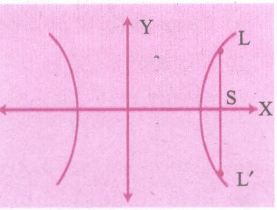
∴ L is (ae, y1)
Substituting L in \(\frac { { x }^{ 2 } }{ { a }^{ 2 } } -\frac { { y }^{ 2 } }{ { b }^{ 2 } } \) = 1 we get,
Substituting L in \(\frac { { x }^{ 2 } }{ { a }^{ 2 } } -\frac { { y }^{ 2 } }{ { b }^{ 2 } } =1\)
\(\frac { { a }^{ 2 }{ e }^{ 2 } }{ { a }^{ 2 } } -\frac { { { y }_{ 1 } }^{ 2 } }{ { b }^{ 2 } } =1\Rightarrow { e }^{ 2 }-\frac { { { y }_{ 1 } }^{ 2 } }{ { b }^{ 2 } } =1\)
\(\Rightarrow { e }^{ 2 }-1=\frac { { { y }_{ 1 } }^{ 2 } }{ { b }^{ 2 } } \) \([{ b }^{ 2 }={ a }^{ 2 }({ e }^{ 2 }-1)\)
\(\Rightarrow { { y }_{ 1 } }^{ 2 }={ b }^{ 2 }({ e }^{ 2 }-1)\) \(\Rightarrow \frac { { b }^{ 2 } }{ { a }^{ 2 } } ={ e }^{ 2 }-1]\)
\(\Rightarrow { { y }_{ 1 } }^{ 2 }={ b }^{ 2 }\left( \frac { { b }^{ 2 } }{ { a }^{ 2 } } \right) \) \(\Rightarrow { { y }_{ 1 } }^{ 2 }=\frac { { b }^{ 4 } }{ { a }^{ 2 } } \)
\(\Rightarrow { y }_{ 1 }=\pm \frac { { b }^{ 2 } }{ a } \)
∴ End points oflatus rectum Land L' are
\(\left( ae,\frac { { b }^{ 2 } }{ a } \right) \) and \(\left( ae,-\frac { { b }^{ 2 } }{ a } \right) \)
Hence, the length of latus rectum LL' = \(\frac { { b }^{ 2 } }{ a } +\frac { { b }^{ 2 } }{ a } =\frac { 2{ b }^{ 2 } }{ a } \) units.
Hence proved.
16.
2x+5y = -2, x+2y = -3
The matrix form of the system is
\(\left( \begin{matrix} 2 & 5 \\ 1 & 2 \end{matrix} \right) \left( \begin{matrix} x \\ y \end{matrix} \right) =\left( \begin{matrix} -2 \\ -3 \end{matrix} \right) \)
⇒ AX = B where
A =\(\left( \begin{matrix} 2 & 5 \\ 1 & 2 \end{matrix} \right) ,B=\left( \begin{matrix} -2 \\ -3 \end{matrix} \right) \)
X =\(\left( \begin{matrix} x \\ y \end{matrix} \right) \)
⇒ = A-1B
|A| = \(\left| \begin{matrix} 2 & 5 \\ 1 & 2 \end{matrix} \right| \)= 4 - 5 = -1 ≠ 0
∴ A-1 =\(\frac { 1 }{ |A| } adjA=\frac { 1 }{ -1 } \left[ \begin{matrix} 2 & -5 \\ -1 & 2 \end{matrix} \right] \)
=\(\left[ \begin{matrix} -2 & 5 \\ 1 & -2 \end{matrix} \right] \)
∴ X = A-1B =\(\left[ \begin{matrix} -2 & 5 \\ 1 & -2 \end{matrix} \right] \left[ \begin{matrix} -2 \\ -3 \end{matrix} \right] \)
= \(\left[ \begin{matrix} 4-15 \\ -2+6 \end{matrix} \right] =\left[ \begin{matrix} -11 \\ 4 \end{matrix} \right] \)
∴ Solution set is x = -11, y = 4
17.
\(\left[ \begin{matrix} 3 & -1 & 2 \\ -6 & 2 & 4 \\ -3 & 1 & 2 \end{matrix} \right] \overset { \begin{matrix} { R }_{ 2 }\longrightarrow { R }_{ 2 }+2{ R }_{ 1 }, \\ { R }_{ 3 }\longrightarrow { R }_{ 3 }+{ R }_{ 1 } \end{matrix} }{ \longrightarrow } \left[ \begin{matrix} 3 & -1 & 2 \\ 0 & 0 & 8 \\ 0 & 0 & 4 \end{matrix} \right] \overset { { R }_{ 3 }\longrightarrow { R }_{ 3 }-\frac { 1 }{ 2 } { R }_{ 2 } }{ \longrightarrow } \left[ \begin{matrix} 3 & -1 & 2 \\ 0 & 0 & 8 \\ 0 & 0 & 0 \end{matrix} \right] \)
Note
\(\left[ \begin{matrix} 3 & -1 & 2 \\ 0 & 0 & 8 \\ 0 & 0 & 0 \end{matrix} \right] \overset { { R }_{ 2 }\longrightarrow { R }_{ 2 }/8 }{ \longrightarrow } \left[ \begin{matrix} 3 & -1 & 2 \\ 0 & 0 & 1 \\ 0 & 0 & 0 \end{matrix} \right] \).
This is also a row-echelon form of the given matrix.
So, a row-echelon form of a matrix is not necessarily unique.
18.
Given centre is (2, 3)
Let us solve 3x- 2y = 1 .....(1)
and 4x+ y = 27 .....(2)
| (1) ⟶ | 3x - 2y = 1 |
| (2) \(\times\) 2 | 8x + 2y = 54 |
| 11x + 0 = 55 |
⇒ x = 5
∴ 3(5) - 2y = 1
⇒ 15 - 2y = 1
⇒ 15-1 = 1
⇒ 14 = 2y
⇒ y = 7
The circle passes through (5, 7)
[∵ distance between (5, 7) and (2, 3)]
r = \(\sqrt { { (5-2) }^{ 2 }+({ 7-3) }^{ 2 } } \)
= \(\sqrt { { 3 }^{ 2 }+{ 4 }^{ 2 } } \)
= \(\sqrt { 9+16 } =\sqrt { 25 } =5\)
Equation of the circle is
(x-h)2+(y-k)2 = r2
(x - 2)2 + (y - 3)2 = 52
x2 - 4x + 4 + y2 - 6y + 9 = 25
x2 + y2 - 4x - 6y + 13 - 25 = 0
x2+y2− 4x − 6y −12 = 0
19.
Given adj A =\(\left[ \begin{matrix} 2 & -4 & 2 \\ -3 & 12 & -7 \\ -2 & 0 & 2 \end{matrix} \right] \)
We know that A = \(\pm \frac { 1 }{ \sqrt { |adjA| } } \) adj (adj A)..(1)
|adj A| = \(2\left| \begin{matrix} 12 & -7 \\ 0 & 2 \end{matrix} \right| +4\left| \begin{matrix} -3 & -7 \\ -2 & 2 \end{matrix} \right| +2\left| \begin{matrix} -3 & 12 \\ -2 & 0 \end{matrix} \right| \)
[Expanded along R1]
= 2(24-0)+4(-6-14)+2(0+24)
= 2(24)+4(-20)+2(24) = 48-80+48
= 96-80 = 16
Now, adj (adj A)
=\(\left[ \begin{matrix} +\left| \begin{matrix} 12 & -7 \\ 0 & 2 \end{matrix} \right| & -\left| \begin{matrix} -3 & -7 \\ -2 & 2 \end{matrix} \right| & +\left| \begin{matrix} -3 & 12 \\ -2 & 0 \end{matrix} \right| \\ -\left| \begin{matrix} -4 & 2 \\ 0 & 2 \end{matrix} \right| & +\left| \begin{matrix} 2 & 2 \\ -2 & 2 \end{matrix} \right| & -\left| \begin{matrix} 2 & -4 \\ -2 & 0 \end{matrix} \right| \\ +\left| \begin{matrix} -4 & 2 \\ 12 & -7 \end{matrix} \right| & -\left| \begin{matrix} 2 & 2 \\ -3 & -7 \end{matrix} \right| & +\left| \begin{matrix} 2 & -4 \\ -3 & 12 \end{matrix} \right| \end{matrix} \right] ^{ T }\)
=\(\left[ \begin{matrix} +(24-0)-(6-14)+(0+24) \\ -(-8-0)+(4+4)-(0-8) \\ +(28-24)-(-14+6)+(24-12) \end{matrix} \right] ^{ T }\)
=\(\left[ \begin{matrix} 24 & 20 & 24 \\ 8 & 8 & 8 \\ 4 & 8 & 12 \end{matrix} \right] ^{ T }=\left[ \begin{matrix} 24 & 8 & 4 \\ 20 & 8 & 8 \\ 24 & 8 & 12 \end{matrix} \right] \)
= \(4\left[ \begin{matrix} 6 & 2 & 1 \\ 5 & 2 & 2 \\ 6 & 2 & 3 \end{matrix} \right] \)
Substituting (2) and (3) in (1) we get,
A = \(\frac { 1 }{ \sqrt { 16 } } .4\left[ \begin{matrix} 6 & 2 & 1 \\ 5 & 2 & 2 \\ 6 & 2 & 3 \end{matrix} \right] \)
A = \(\pm \frac { 4 }{ 4 } \left[ \begin{matrix} 6 & 2 & 1 \\ 5 & 2 & 2 \\ 6 & 2 & 3 \end{matrix} \right] =\pm \left[ \begin{matrix} 6 & 2 & 1 \\ 5 & 2 & 2 \\ 6 & 2 & 3 \end{matrix} \right] \)
20.
Equation of tangent to the circle at P(x1, y1 ) is xx1 yy1 = a2
That is, x(−3) + y(4) = 25
−3x + 4y = 25
Equation of normal is xy1 - yx1 = 0
That is, 4x + 3y = 0
21.
This an indeterminate of the form 1∞
Let \(g(x)={ \left( 1+\frac { 1 }{ x } \right) }^{ x }\)
Taking logarithm, we get,
\(log(g(x))=log{ \left( 1+\frac { 1 }{ x } \right) }^{ x }\)
\(=xlog{ \left( 1+\frac { 1 }{ x } \right) }\)
\(=\frac { { \left( 1+\frac { 1 }{ x } \right) } }{ \frac { 1 }{ x } } \)
\(\therefore \underset { x\rightarrow \infty }{ lim } log(g(x))=\underset { x\rightarrow \infty }{ lim } \frac { { \left( 1+\frac { 1 }{ x } \right) } }{ \frac { 1 }{ x } } =\left( \frac { 0 }{ 0 } form \right) \)
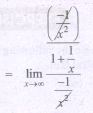
\(=\underset { x\rightarrow \infty }{ lim } \frac { { 1 } }{ \left( 1+\frac { 1 }{ x } \right) } =1\)
But \(\underset { x\rightarrow \infty }{ lim } log(g(x))=log\underset { x\rightarrow \infty }{ lim } g(x)\)
\(\therefore log(\underset { x\rightarrow \infty }{ lim } g(x))=1\)
\({ e }^{ log }(\underset { x\rightarrow \infty }{ lim } g(x))={ e }^{ 1 }=e\Rightarrow (\underset { x\rightarrow \infty }{ lim } g(x))=e\)
\(\Rightarrow \underset { x\rightarrow \infty }{ lim } { \left( 1+\frac { 1 }{ x } \right) }^{ x }=e\)
22.
f (x) is defined and differentiable for all x∈(-∞, ∞)
\(f'\left( x \right) =\frac { 1 }{ 2 } \left( { e }^{ x }+{ e }^{ -x } \right) \)
\(f''(x)=\frac { 1 }{ 2 } \left( { e }^{ x }-{ e }^{ -x } \right) \)
f"(x) = 0
\(\Rightarrow \frac { 1 }{ 2 } \left( { e }^{ x }-{ e }^{ -x } \right) =0\Rightarrow { e }^{ x }-{ e }^{ -x }=0\)
\(\Rightarrow { e }^{ x }={ e }^{ -x }\Rightarrow { e }^{ x }=\frac { 1 }{ { e }^{ x } } \)
\(\Rightarrow { e }^{ 2x }=1\Rightarrow { e }^{ 2x }={ e }^{ 0 }\)
\(\Rightarrow 2x=0\Rightarrow x=0\)
The possible intervals are (-∞,0) and (0,∞)
| Intervel | (-∞, 0) | (0, ∞) |
| Sign of f"(x) | Say x = -1 \(\cfrac { 1 }{ 2 } \left( { e }^{ -1 }-{ e }^{ 1 } \right) =-ve\) |
Say x = 1 \(\cfrac { 1 }{ 2 } \left( { e }^{ -1 }-{ e }^{ 1 } \right) =+ve\) |
| Concavity | Concave down | Concave up |
ஃ f(x) is concave up in (0, ∞) and concave down in (∞, 0).
Since f"(x) changes its position from negative to positive, when it passes through x = 0 the points of inflection is (0,1(0))
\(f(0)=\frac { 1 }{ 2 } \left( { e }^{ o }-{ e }^{ o } \right) =\frac { 1 }{ 2 } \left( 1-1 \right) =0\)
ஃ (0, 0) is the point of inflection.
23.
f(x) is defined and differentiable for all x ∈ (0, ∞).
\(\therefore f'(x)=\frac { { 3x }^{ 2 } }{ 3 } -\frac { 1 }{ x } ={ x }^{ 2 }-\frac { 1 }{ x } \)
\(\Rightarrow { x }^{ 2 }-\frac { 1 }{ x } =0\Rightarrow \frac { { x }^{ 3 }-1 }{ x } =0\)
\(\Rightarrow { x }^{ 3 }-1=0\Rightarrow { x }^{ 3 }1\)
\(\Rightarrow\) x = 1
\(\therefore\) The Stationary point is at x = 1
The possible intervals are (0, 1) and (1, ∞).
| Interval | (0, 1) | (1, ∞) |
| Sign of f'(x) | Say \(x=\cfrac { 1 }{ 2 } \) \(f'(x)=\left( \cfrac { 1 }{ 2 } \right) ^{ 2 }-2\) = \(\cfrac { 1 }{ 4 } -2\) |
Say x = 2 \(f(x){ (2) }^{ 2 }-\cfrac { 1 }{ 2 } \) = \(4-\cfrac { 1 }{ 2 } \) |
| Monotonicity | Strictly decreasing | Strictly increasing |
Since f '(x) changes from negative to positive at x = 1, there is a local minimum at x = 1.
\(\therefore f'\left( 1 \right) =\frac { { 1 }^{ 3 } }{ 3 } -log1\)
= \(\frac { 1 }{ 3 } -o=\frac { 1 }{ 3 } \)
24.

Given f(x) = 2.0 + 3x2 - 12x
The given function is defined and differentiable for all x ∈(-∞,∞)
f'(x) = 6x2 + 6x - 12
The stationary points are given by
6x2 + 6x - 12 = 0
\(\Rightarrow\) x2 +x-2 = 0
\(\Rightarrow\) (x + 2)(x - 1) = 0
\(\Rightarrow\) x = -2, 1
Hence the intervals of monotonicity are
(-∞, - 2), (-2, 1) and (1, ∞).
| Intervel | (-∞, - 2) | (-2, 1) | (1, ∞) |
| Sign of f'(x) |
Say x = -3 f'(x) = 6(-3)2+6 (-3) -12 = +ve |
Say x = 0 f'(0) = -12 = -ve |
Say x = 2 f'(x) = 6(2)2+ 6(2)-12 = +ve |
| monotoni city | Strictly increasing | Strictly decreasing | Strictly increasing |
ஃ f(x) is strictly increasing on (-∞, - 2)
(1, ∞) and strictly decreasing on (-2, 1).
Since f'(x) changes from positive to negative at x = -2, there is a local maximum at x = -2
\(\therefore\) f(-2) = 2 (2)3 + 3 (2)2 - 12 (-2)
= 2(-8) + 3(4) + 24
= -16+12+24 = 20
Also f'(x) changes from negative to positive at x = 1, there is a local minimum at x = 1.
ஃ f(1) = 2 (1)3 + 3 (1)2 - 12(1)
= 5 -12 = -7
25.
9x2- y2- 36x - 6y + 18 = 0
Given equation is 9x2- y2- 36x - 6y + 18 = 0
⇒ 9x2 - 36x - (y2 + 6y) = -18
⇒ 9(x2-4x)-(y2+6y) =-18
⇒ 9(x2 - 4x + 4 - 4) - (y2 + 6y + 9 - 9) = -18
⇒ 9(x-2)2-36-(y+3)2+9 =-18
⇒ 9(x-2)2 - (y+3)2 = -18+36-9
⇒ 9(x - 2)2 - (y + 3)2 = 9
Dividing by 9 we get, \(\frac { { (x-2) }^{ 2 } }{ 1 } -\frac { ({ y+3) }^{ 2 } }{ 9 } =1\)
This is an equation of the hyperbola whose transverse axis is parallel to x-axis.
a2 = 1, b2 = 9
∴ c2 = a2 + b2 = 1 + 9 = 10 ⇒ c = \(\sqrt { 10 } \)
\(e=\sqrt {1-\frac { { b }^{ 2 } }{ { a }^{ 2 } }} =\sqrt { 1-\frac { 9 }{ 1 } } =\sqrt { 10 } \)
a) Center is (2, -3)
⇒ h = 2, k = -3
(b) Foci are (h + c, k), (17 - c, k)
⇒ (2 +\(\sqrt { 10 } \), -3), (2 - \(\sqrt { 10 } \), -3)
(c) Vertic ar (h + a, k) (h - a, k)
⇒ (2+ 1,-3), (2-1,-3)
⇒ (3, -3) (1, -3)
(d) Equation of directrices are x - 2 = \(\pm \frac { a }{ e } \)
⇒ \(x-2=\pm \frac { 1 }{ \sqrt { 10 } } \)
\(x=2\pm \frac { 1 }{ \sqrt { 10 } } \)
⇒ \(x=2+\frac { 1 }{ \sqrt { 10 } } \) and \(x=2-\frac { 1 }{ \sqrt { 10 } } \)
26.
Given equation is \(\frac { { (x-1) }^{ 2 } }{ 100 } +\frac { ({ y-2) }^{ 2 } }{ 64 } =1\)
This is an equation of the ellipse
∴ a2 = 100,b2 = 64
⇒ c2 = a2 - b2
⇒ c2 = 100 - 64 = 36
∴ c = 6
\(\sqrt { 1-\frac { { b }^{ 2 } }{ { a }^{ 2 } } } =\sqrt { 1-\frac { 64 }{ 100 } } =\sqrt { \frac { 100-64 }{ 100 } } \)
\(=\sqrt{\frac{36}{100}}=\frac{\not 6} {\not {10}}\)
∴ c = \(\frac { 3 }{ 5 } \)
(a) Center is (-1, 2) ⇒ h = -1, k = 2
(b) Foci are (h - c, k), (h + c, k) ⇒ (-1 - 6, 2), (-1 + 6, -2) ⇒ (-7, 2), (5, 2)
(c) Vertices are (h - a, k) and (h + a, k) ⇒ (-1 -10,2), (-1 + 10,2) ⇒ (-11, 2), (9, 2)
(d) Equation of directrices are x + 1 = \(\pm \frac { a }{ e } \)
\(\Rightarrow x+1=\pm \frac { 10 }{ \frac { 3 }{ 5 } } \Rightarrow x+1=\pm \frac { 50 }{ 3 } \)
\(\therefore x+1=\frac { 50 }{ 3 } and x+1=-\frac { 50 }{ 3 } \)
\(\Rightarrow x=\frac { 50 }{ 3 } -1\) and \(x=-\frac { 50 }{ 3 } -1\)
\(\Rightarrow x=\frac { 47 }{ 3 } \) and \(x=\frac { -53 }{ 3 } \)
27.
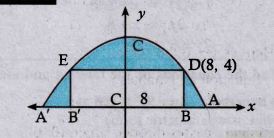
Let the equation of the ellipse be
\(\frac{x^{2}}{a^{2}}+\frac{y^{2}}{b^{2}}=1\)
Length of semi minor axis b = 5
\(\frac{x^{2}}{a^{2}}+\frac{y^{2}}{b^{2}}=1\)
Let BB' be the road width and AA' be the end points of the opening of the tunnel.
Let CB = 8, BD = 1,
D is (8, 4) lies on the ellipse
\(
\frac{8^{2}}{a^{2}}+\frac{4^{2}}{5^{2}}=1
\)
\( \Rightarrow a^{2}=\frac{25}{9} \times 64
\)
\( \Rightarrow a=\frac{40}{3}
\)
The width AA' = 2a
\(=\frac{80}{3}=26.66 \mathrm{~m}\)
The required width is 26.66 m.
28.
2x - y + z = 2, 6x - 3y + 3z = 6, 4x - 2y + 2z = 4
The matrix form of the given system is AX = B where
A =\(\left[ \begin{matrix} 2 & -1 & 1 \\ 6 & -3 & 3 \\ 4 & -2 & 2 \end{matrix} \right] \)
\(X=\left[ \begin{matrix} x \\ y \\ z \end{matrix} \right] B=\left[ \begin{matrix} 2 \\ 6 \\ 4 \end{matrix} \right] \)
Applying elementary row operations on the augment matrix [A|B], we get,
[A|B] =\(\left[ \begin{matrix} 2 & -1 & 1 \\ 6 & -3 & 3 \\ 4 & -2 & 2 \end{matrix}|\begin{matrix} 2 \\ 6 \\ 4 \end{matrix} \right] \overset { { R }_{ 2 }\rightarrow { R }_{ 2 }-3{ R }_{ 1 }\\ { R }_{ 3 }\rightarrow { R }_{ 3 }-2{ R }_{ 1 } }{ \longrightarrow } \left[ \begin{matrix} 2 & -1 & 1 \\ 0 & 0 & 0 \\ 0 & 0 & 0 \end{matrix}|\begin{matrix} 2 \\ 0 \\ 0 \end{matrix} \right] \)
Here \(\rho \)(A) = 1 [∵ only one non zero row]
and \(\rho \)[A|B] = 1 [∵ only one-zero row]
∴ \(\rho \)(A) =\(\rho \)(A|B] = 1< 3 the given system is consistent and has two parameter family of solutions.
So, z = t and y = s where, t \(\in \)R
Writing the equivalent equations from the rowechelon matrix, we get
2x-y+z = 2 .............(1)
y = s
z = t
Substituting (2) and (3) In (1) we get
2x-s+t = 2
⇒ 2x-s+t = 2
⇒ x = \(\frac{1}{2}\)[s-t+2]
∴ Solution set is {\(\frac{1}{2}\)(s-t+2),s,t} here s, t \(\in \) R.
29.
Here the number of unknowns is 3.
The matrix form of the system is AX = B, where
A = \(\left[ \begin{matrix} 1 & -1 & 1 \\ 2 & -2 & 2 \\ 3 & -3 & 3 \end{matrix} \right] \), X = \(\left[ \begin{matrix} x \\ y \\ z \end{matrix} \right] \), B = \(\left[ \begin{matrix} -9 \\ -18 \\ -27 \end{matrix} \right] \).
Applying elementary row operations on the augmented matrix[A | B], we get
[A | B] = \(\left[ \begin{matrix} 1 & -1 & 1 \\ 2 & -2 & 2 \\ 3 & -3 & 3 \end{matrix}|\begin{matrix} -9 \\ -18 \\ -27 \end{matrix} \right] \overset { \begin{matrix} { R }_{ 2 }\longrightarrow { R }_{ 2 }-2{ R }_{ 1 }, \\ { R }_{ 3 }\longrightarrow { R }_{ 3 }-3{ R }_{ 1 } \end{matrix} }{ \longrightarrow } \left[ \begin{matrix} 1 & -1 & 1 \\ 0 & 0 & 0 \\ 0 & 0 & 0 \end{matrix}|\begin{matrix} -9 \\ 0 \\ 0 \end{matrix} \right] \).
So, ρ(A) = ρ ([A | B]) = 1 < 3.
From the echelon form, we get the equivalent equations x - y + z = -9, 0 = 0, 0 = 0.
The equivalent system has one non-trivial equation and three unknowns.
Taking y = s, z = t arbitrarily, we get x - s + t = -9; x = -9 + s - t.
So, the solution is (x = -9 + s - t, y = s, z = t), where s and t are parameters.
The above solution set is a two-parameter family of solutions.
Here, the given system of equations is consistent and has infinitely many solutions which form a two parameter family of solutions.
30.
x2+3y2 = 12
\(\div 12\) we get, \(\frac { { x }^{ 2 } }{ 12 } +\frac { { y }^{ 2 } }{ 4 } =1\)
∴ a2 = 12, b2 = 4
The line x-y+ 4 = 0 can be rewritten as y = x+4.
∴ m = 1, c = 4
The condition for y = mx + 4 to be a tangent to the ellipse is c2 = a2m2 + b2
∴ (4)2 = 12(1)2 + 4
⇒ 16 = 12+4
⇒ 16 = 16
Since the condition is satisfied, the line x - y + 4 = 0 is a tangent to the ellipse x2 + 3y2 = 12.
Also, the point of contact is \(\left( -\frac { { a }^{ 2 }m }{ c } ,\frac { { b }^{ 2 } }{ c } \right) \)
\(\Rightarrow \left( -\frac { 12(1) }{ 4 } ,\frac { 4 }{ 4 } \right) \Rightarrow (-3,1)\)
∴The point of contact is (-3, 1).
31.
2x − 2y + 3z = 2, x + 2y − z = 3, 3x − y + 2z = 1
Transforming the augmented matrix to echelon form, we get
\(\left[ \begin{matrix} 2 & -2 & 3 \\ 1 & 2 & -1 \\ 3 & -1 & 2 \end{matrix}|\begin{matrix} 2 \\ 3 \\ 1 \end{matrix} \right] \overset { { R }_{ 1 }\leftrightarrow { R }_{ 2 } }{ \longrightarrow } \)
\(\left[ \begin{matrix} 1 & 2 & -1 \\ 2 & -2 & 3 \\ 3 & -1 & 2 \end{matrix}|\begin{matrix} 3 \\ 2 \\ 1 \end{matrix} \right] \overset { { R }_{ 2 }\rightarrow { R }_{ 2 }-2{ R }_{ 1 }\\ { R }_{ 3 }\rightarrow { R }_{ 3 }-3{ R }_{ 1 } }{ \longrightarrow } \left[ \begin{matrix} 1 & 2 & -1 \\ 0 & -6 & 5 \\ 0 & -7 & 5 \end{matrix}|\begin{matrix} 3 \\ -4 \\ -8 \end{matrix} \right] \)
\(\overset { { R }_{ 3 }\rightarrow { R }_{ 3 }-{ R }_{ 2 } }{ \longrightarrow } \left[ \begin{matrix} 1 & 2 & -1 \\ 0 & -6 & 5 \\ 0 & -1 & 0 \end{matrix}|\begin{matrix} 3 \\ -4 \\ -4 \end{matrix} \right] \overset { { R }_{ 3 }\rightarrow { 6R }_{ 3 }-2{ R }_{ 2 } }{ \longrightarrow } \)
\(\left[ \begin{matrix} 1 & 2 & -1 \\ 0 & -6 & 5 \\ 0 & 0 & -5 \end{matrix}|\begin{matrix} 3 \\ -4 \\ -20 \end{matrix} \right] \)
Writing the equivalent equations from the rowechelon matrix, we get,
x+2y-z = 3 .......... (1)
-6y + 5z =-4 ..........(2)
-5z = -20 ⇒ z =\(\frac{-20}{-5}\) = 4
Substituting z = 4 in 2 we ge
-6y + 5(4) = -4
⇒ -6y+20 = -4 ⇒ -4 - 20 = -20
⇒ y = \(\frac{-24}{-6}\) = 4
Substituting y = z = 4 in (1) we get
x+ 2(4) -4 = 3
⇒ x + 8 - 4 = 3
⇒ x + 4 = 3
⇒ x = 3 - 4 = -1
∴ Solution set is {-1, 4, 4}
32.
Let the cost of one dosa be Rs. x
The cost of one idli be Rs. y
and the cost of one vadai be Rs. z
By the given data,
2x+ 3y + 2z = 150
2x + 2y + 4z = 200
5x + 4y + 2z = 250
∴ Δ = \(\left| \begin{matrix} 2 & 3 & 2 \\ 2 & 2 & 4 \\ 5 & 4 & 2 \end{matrix} \right| \)
= \(2\left| \begin{matrix} 2 & 4 \\ 4 & 2 \end{matrix} \right| -3\left| \begin{matrix} 2 & 4 \\ 5 & 2 \end{matrix} \right| +2\left| \begin{matrix} 2 & 2 \\ 5 & 4 \end{matrix} \right| \)
= 2(4 - 16) - 3(4 - 20) + 2(8 - 10)
= 2(- 12) - 3(- 16) + 2(- 2)
= - 24 + 48 - 4 = 20
Δ1 = \(\left| \begin{matrix} 150 & 3 & 2 \\ 200 & 2 & 4 \\ 250 & 4 & 2 \end{matrix} \right| \)
Taking 50 common from C3 we get,
= 100\(\left| \begin{matrix} 3 & 3 & 1 \\ 4 & 2 & 2 \\ 5 & 4 & 1 \end{matrix} \right| \)
= \(100\left[ 3\left| \begin{matrix} 2 & 2 \\ 4 & 1 \end{matrix} \right| -3\left| \begin{matrix} 4 & 2 \\ 5 & 1 \end{matrix} \right| +1\left| \begin{matrix} 4 & 2 \\ 5 & 4 \end{matrix} \right| \right] \)
= 100[3(2 - 8) - 3(4 - 10) + 1(16 - 10)]
= 100[3(-6) - 3(- 6) + 6]
= 100[- 18 + 18 + 6] = 600
Δ2 = \(\left| \begin{matrix} 2 & 150 & 2 \\ 2 & 200 & 4 \\ 5 & 250 & 2 \end{matrix} \right| =100\left| \begin{matrix} 2 & 3 & 1 \\ 2 & 4 & 2 \\ 5 & 5 & 1 \end{matrix} \right| \)
= \(100\left[ 3\left| \begin{matrix} 4 & 2 \\ 5 & 1 \end{matrix} \right| -3\left| \begin{matrix} 2 & 2 \\ 5 & 1 \end{matrix} \right| +1\left| \begin{matrix} 2 & 4 \\ 5 & 5 \end{matrix} \right| \right] \)
= 100[2(4 - 10) - 3(2 - 10) + 1(10 - 20)]
= 100[2(- 6) - 3(- 8) + 1(- 10)]
= 100[- 12 + 24 - 10] = 100 [2] = 200
Δ3 = \(\left| \begin{matrix} 2 & 3 & 150 \\ 2 & 2 & 200 \\ 5 & 4 & 250 \end{matrix} \right| =50\left| \begin{matrix} 2 & 3 & 3 \\ 2 & 2 & 4 \\ 5 & 4 & 5 \end{matrix} \right| \)
= \(50\left[ 2\left| \begin{matrix} 2 & 4 \\ 4 & 5 \end{matrix} \right| -3\left| \begin{matrix} 2 & 4 \\ 5 & 5 \end{matrix} \right| +3\left| \begin{matrix} 2 & 2 \\ 4 & 4 \end{matrix} \right| \right] \)
= 50 [2(10 - 16) - 3(10 - 20) + 3(8 - 10)]
= 50[2(- 6) - 3(- 10) +3(- 2)]
= 50 [- 12 + 30 - 6] = 50 [12] = 600
∴ x = \(\frac { { \triangle }_{ 1 } }{ \triangle } =\frac { 600 }{ 20 } \) = 30
y = \(\frac { { \triangle }_{ 2 } }{ \triangle } =\frac { 200 }{ 20 } \) = 10
z = \(\frac { { \triangle }_{ 3 } }{ \triangle } =\frac { 600 }{ 20 } \) = 30
Hence, the price of one dosa be Rs. 30, one idli be Rs. 10 and the price of 1 vadai be Rs. 30.
Also the cost on dosa, six idlies and six vadai is
= 3x + 6y + 6z = 3(30) + 6(10) + 6(30)
= 90 + 60 + 180 = Rs. 330
Since the family had Rs. 350 in hand, they will be able to manage to pay the bill.
33.
\(\frac { { (x-3) }^{ 2 } }{ 225 } +\frac { ({ y-4) }^{ 2 } }{ 289 } =1\)
Given equation is \(\frac { { (x-3) }^{ 2 } }{ 225 } +\frac { ({ y-4) }^{ 2 } }{ 289 } =1\)
This is an equation of the ellipse a2 = 289
b2 = 225 and
c2 = a2 - b2 ⇒ 289 - 225 = 64 ⇒ c = 8.
\(e=\sqrt { \frac { { b }^{ 2 } }{ { a }^{ 2 } } } =\sqrt { 1-\frac { 225 }{ 289 } } =\sqrt { \frac { 289-225 }{ 289 } } \)
\(=\sqrt { \frac { 64 }{ 289 } } =\frac { 8 }{ 17 } \)
(a) Center is (3, 4) ⇒ h = 3, k = 4
(b) foci are (h, k+c), (h, k-c)
⇒ (3, 4 + 8), (3, 4 - 8) ⇒ (3, 12), (3,-4)
(c) Vertices are (h, k - a), (h, k + a)
⇒ (3, 4 -17), (3, 4 + 17) ⇒ (3, -13), (3, 21)
(d) Equations of directrices are y - 4 = \(\pm \frac { a }{ e } \)
\(\Rightarrow y-4=\pm \frac { 17 }{ \frac { 8 }{ 17 } } +4\Rightarrow y-4=\pm \frac { -289 }{ 8 } +4\)
\(\Rightarrow y=\frac { 289 }{ 8 } +4\) and \(y=\frac { -289 }{ 8 } +4\)
\(\Rightarrow y=\frac { 289+32 }{ 2 } \) and \(y=\frac { -289+32 }{ 8 } \)
\(\Rightarrow y=\frac { 321 }{ 8 } \) and \(y=\frac { -257 }{ 8 } \)
34.
Rearranging terms in the equation of hyperbola to bring it to standard form,
we have, 11(x2-4x)-25(y2-2y)-256 = 0
11(x− 2)2−25(y−1)2 = 256−44+25
11(x−2 )2− 25 (y−1)2 = 275
\(\frac { { \left( x-2 \right) }^{ 2 } }{ 25 } -\frac { { \left( y-1 \right) }^{ 2 } }{ 11 } =1\)
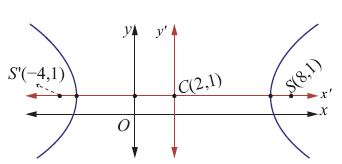
Centre (2, 1) a2 = 25, b2 = 11
c2 = a2 +b2
= 25 +11 = 36
Therefore, c = ±6
and e = \(\frac { c }{ a } =\frac { 6 }{ 5 } \)and the coordinates of foci are(8, 1) and(-4, 1) from figure.
35.
(b)
\(\frac { 72 }{ 7 } \)
36.
(b)
\(\frac23\)
37.
(a)
2x - y + 4 = 0
38.
(a)
\(\left[ \begin{matrix} 3 & -3 & 4 \\ 2 & -3 & 4 \\ 0 & -1 & 1 \end{matrix} \right] \)
39.
(d)
\(\frac { \pi }{ 4 } \)
40.
(d)
\(\left[ \begin{matrix} 5 & -2 \\ 3 & -1 \end{matrix} \right] \)
41.
(d)
-1
42.
(c)
an ellipse
43.
(b)
x = −1
44.
(a)
45.
(a)
2ab
46.
(d)
40
47.
(a)
x2 + y2 − 6y − 7 = 0
48.
(c)
\(\left(\frac{9}{2 \sqrt{2}}, \frac{1}{\sqrt{2}}\right)\)
49.
(c)
\(\frac { 1 }{ 2 } \)
50.
(d)
9
51.
(b)
\( {2} \sqrt {5}\)
52.
(c)
\( \sqrt {10}\)
53.
(d)
−35 < m < 15
54.
(a)
\(\cfrac { 1 }{ 2 } \)

12th Standard Syllabus & Materials
12th Standard
TN 12th Computer Applications வலையமைப்பு வடமிடல் Sample Question Papers Study Material - QB365 Set A
NEW12th Standard
TN 12th Computer Applications களப்பெயர் முறைமை (DNS) Sample Question Papers Study Material - QB365 Set A
NEW12th Standard
TN 12th Computer Applications வலையமைப்பு எடுத்துக்காட்டுகள் மற்றும் நெறிமுறைகள் Sample Question Papers Study Material - QB365 Set A
NEW12th Standard
TN 12th Computer Applications கணினி வலையமைப்பு ஓர் அறிமுகம் Sample Question Papers Study Material - QB365 Set A



Tamilnadu Stateboard 12th Standard Subjects
Maths

Chemistry

Physics

Biology

Computer Science

Business Maths and Statistics

Economics

Commerce

Accountancy

History

Computer Applications
Biology
Computer Technology
Computer Applications
Computer Science
Business Maths and Statistics
Commerce
Economics
Maths
Chemistry
Physics
Computer Technology
History
Accountancy

Tamil

English

French
Tamilnadu Stateboard Standards


