
 100% FREE ACCESS
12th Standard Syllabus & Materials
12th Standard
TN 12th Computer Applications மின்னணு தரவு பரிமாற்றம் Sample Question Papers Study Material - QB365 Set A
NEW12th Standard
TN 12th Computer Applications மின் - வணிக பாதுகாப்பு அமைப்புகள் Sample Question Papers Study Material - QB365 Set A
NEW12th Standard
TN 12th Computer Applications மின்னணு செலுத்தல் முறைகள் Sample Question Papers Study Material - QB365 Set A
NEW12th Standard
TN 12th Computer Applications மின் - வணிகம் Sample Question Papers Study Material - QB365 Set A
NEW12th Standard
TN 12th Computer Applications திறந்த மூல கருத்துருக்கள் Sample Question Papers Study Material - QB365 Set A
NEW12th Standard
TN 12th Computer Applications வலையமைப்பு வடமிடல் Sample Question Papers Study Material - QB365 Set A

Published on: 20/10/2025
Download Tamil Nadu 12th Standard Maths question papers, model tests, one-mark questions, important questions, and public exam papers in PDF format. Free study materials and answer keys for TN State Board students.
Questions + Answers key
Take MCQ Maths Test
1.
If w(x,y, z) = log \(\left( \frac { { 5x }^{ 3 }{ y }^{ 4 }+7{ y }^{ 2 }{ xz }^{ 4 }-{ 75y }^{ 3 }{ z }^{ 4 } }{ { x }^{ 2 }+{ y }^{ 2 } } \right) \) find \(x\frac { \partial w }{ \partial x } +y\frac { \partial w }{ \partial y } +z\frac { \partial w }{ \partial z } \)
2.
W(x, y, z) = xy + yz + zx, x = u - v, y = uv, z = u + v, u ∈ R. Find \(\frac { \partial W }{ \partial u } ,\frac { \partial W }{ \partial v } \), and evaluate them at \(\left( \frac { 1 }{ 2 } ,1 \right) \)
3.
Let z(x, y) = x3 - 3x2y3, where x = set, y = se-t, s, t ∈ R. Find \(\frac { \partial z }{ \partial s } \) and \(\frac { \partial z }{ \partial t } \)
4.
Let U(x, y) = ex sin y, where x = st2, y = s2 t, s, t ∈ R. Find \(\frac { \partial U }{ \partial s } ,\frac { \partial U }{ \partial t } \) and evaluate them at s = t = 1.
5.
Two balls are drawn in succession without replacement from an urn containing four red balls and three black balls. Let X be the possible outcomes drawing red balls. Find the probability mass function and mean for X.
6.
The probability density function of X is given
\(f(x)=\begin{cases} \begin{matrix} { Ke }^{ \frac { -x }{ 3 } } & \begin{matrix} for & x>0 \end{matrix} \end{matrix} \\ \begin{matrix} 0 & \begin{matrix} for & x\le 0 \end{matrix} \end{matrix} \end{cases}\)
Find
(i) the value of k
(ii) the distribution function.
(iii) P(X <3)
(iv) P(5 ≤X)
(v) P(X ≤ 4)
7.
Suppose the amount of milk sold daily at a milk booth is distributed with a minimum of 200 Iitres and a maximum of 600 litres with probability density function
\(\begin{cases} \begin{matrix} k & 200\le x\le 600 \end{matrix} \\ \begin{matrix} 0 & otherwise \end{matrix} \end{cases}\)
Find
(i) the value of k
(ii) the distribution function
(iii) the probability that daily sales will fall between 300 litres and 500 litres?
8.
The cumulative distribution function of a discrete random variable is given by
\(F(x)=\left\{\begin{array}{lc}
0 & -\infty<x<-1 \\
0.15 & -1 \leq x<0 \\
0.35 & 0 \leq x<1 \\
0.60 & 1 \leq x<2 \\
0.85 & 2 \leq x<3 \\
1 & 3 \leq x<\infty
\end{array}\right.\)
Find
(i) the probability mass function
(ii) P(X < 1 ) and
(iii) P(X \(\geq\)2)
9.
Suppose a discrete random variable can only take the values 0, 1, and 2. The probability mass function is defined by
\(\\ \\ \\ \\ \\ f(x)=\begin{cases} \begin{matrix} \frac { { x }^{ 2 }+1 }{ k } & forx=0,1,2 \end{matrix} \\ \begin{matrix} 0 & otherwise \end{matrix} \end{cases}\\ \\ \\ \\ \\ \\ \)
Find
(i) the value of k
(ii) cumulative distribution function
(iii) P(X ≥ 1).
10.
A six sided die is marked '1' on one face, '3' on two of its faces, and '5' on remaining three faces. The die is thrown twice. If X denotes the total score in two throws, find
(i) the probability mass function
(ii) the cumulative distribution function
(iii) P(4 ≤ X < 10)
(iv) P(X ≥ 6)
11.
Find the non-parametric form of vector equation of the plane passing through the point (1, −2, 4) and perpendicular to the plane x + 2y −3z = 11 and parallel to the line \(\frac { x+7 }{ 3 } =\frac { y+3 }{ -1 } =\frac { z }{ 1 } \)
12.
Find the non-parametric form of vector equation, and Cartesian equation of the plane passing through the point (2, 3, 6) and parallel to the straight lines \(\frac { x-1 }{ 2 } =\frac { y+1 }{ 3 } =\frac { z-3 }{ 1 } \) and \(\frac { x+3 }{ 2 } =\frac { y-3 }{ -5 } =\frac { z+1 }{ -3 } \)
13.
Prove by vector method that the perpendiculars (altitudes) from the vertices to the opposite sides of a triangle are concurrent.
14.
15.
Prove that q ➝ p ≡ ¬p ➝ ¬q
16.
Construct the truth table for the following statements.
( p V q) V ¬q
17.
If u(x, y) = \(\frac { { x }^{ 2 }+{ y }^{ 2 } }{ \sqrt { x+y } } \), prove that \(x\frac { \partial u }{ \partial x } +y\frac { \partial u }{ \partial y } =\frac { 3 }{ 2 } u\)
18.
19.
If U(x, y, z) = log (x3 + y3 + z3), find \(\frac { \partial U }{ \partial x } +\frac { \partial U }{ \partial y } +\frac { \partial U }{ \partial z } \)
20.
The probability density function of X is given by \(f(x)=\begin{cases} \begin{matrix} kxe^{ -2x } & forx>0 \end{matrix} \\ \begin{matrix} 0 & for\quad x\le 0 \end{matrix} \end{cases}\) Find the value of k.
21.
A six sided die is marked '2' on one face, '3' on two ofits faces, and '4' on remaining three faces. The die is thrown twice. If X denotes the total score in two throws, find the values of the random variable and number of points in its inverse images.
22.
If \(\vec { a } =\hat { i } +2\hat { j } +3\hat { k } ,\vec { b } =2\hat { i } -\hat { j } +\hat { k } ,\vec { c } =3\hat { i } +2\hat { j } +\hat { k } \) and \(\vec { a } \times (\vec { b } \times \vec { c } )\)= \(l\vec { a } +m\vec { b } +n\vec { c } \) , find the values of l, m, n.
23.
Find the altitude of a parallelepiped determined by the vectors \(\vec { a } =-2\hat { i } +5\hat { j } +3\hat { k } \), \(\hat { b } =\hat { i } +3\hat { j } -2\hat { k } \) and \(\vec { c } =-3\vec { i } +\vec { j } +4\vec { k } \) if the base is taken as the parallelogram determined by \(\vec { b } \) and \(\vec { c } \)
24.
Find the magnitude and direction cosines of the torque of a force represented by \(\hat { 3i } +\hat { 4j } -\hat { 5k } \) about the point with position vector \(\hat { 2i } -\hat { 3j } +\hat { 4k } \) acting through a point whose position vector is \(\hat { 4i } +\hat { 2j } -\hat { 3k } \).
25.
Let p: Jupiter is a planet and q: India is an island be any two simple statements. Give verbal sentence describing each of the following statements.
(i) ¬p
(ii) p ∧ ¬q
(iii) ¬p ∨ q
(iv) p➝ ¬q
(v) p↔q
26.
Determine whether ∗ is a binary operation on the sets given below.
(a*b) = a√b is binary on R
27.
Determine whether the following function is homogeneous or not. If it is so, find the degree.
\(h(x,y)=\frac { 6{ x }^{ 2 }{ y }^{ 3 }-\pi { y }^{ 5 }+9{ x }^{ 4 }y }{ 2020{ x }^{ 2 }+2019{ y }^{ 2 } } \)
28.
In each of the following cases, determine whether the following function is homogeneous or not. If it is so, find the degree.
f(x, y) = x2y + 6x3 + 7
29.
Compute P(X = k) for the binomial distribution, B(n, p) where
n = 6, \(p=\frac { 1 }{ 3 } \), k = 3
30.
For the random variable X with the given probability mass function as below, find the mean and variance.
\(f(x)=\begin{cases} \begin{matrix} \cfrac { 1 }{ 2 } e^{ -\frac { x }{ 2 } } & for\quad x>0 \end{matrix} \\ \begin{matrix} 0 & otherwise \end{matrix} \end{cases}\)
31.
For the random variable X with the given probability mass function as below, find the mean and variance.
\(f(x)=\begin{cases} \begin{matrix} \frac { 1 }{ 10 } & x=2,5 \end{matrix} \\ \begin{matrix} \frac { 1 }{ 5 } & x=0,1,2,3,4 \end{matrix} \end{cases}\)
32.
Find the angle between the straight line \(\vec { r } =(2\hat { i } +\hat { j } +\hat { k } )+t(\hat { i } -\hat { j } +\hat { k } )\) and the plane 2x-y+z = 5
33.
If the vectors \(a\hat { i } +a\hat { j } +c\hat { k } ,\hat { i } +\hat { k } \) and \(c\hat { i } +c\hat { j } +b\hat { k } \) are coplanar, prove that c is the geometric mean of a and b.
34.
If \(\vec { a } =\hat { i } -2\hat { j } +3\hat { k }, \vec { b } =2\hat { i } +\hat { j } -2\hat { k }, \vec { c } =3\hat { i } +2\hat { j } +\hat { k } \) find \(\vec { a } .(\vec { b } \times \vec { c } )\).
35.
The dual of ᄀ(p V q) V [p V (p ∧ ᄀr)] is
ᄀ(p ∧ q) ∧ [p V (p ∧ ᄀr)]
(p ∧ q) ∧ [p ∧ (p V ᄀr)]
ᄀ(p ∧ q) ∧ [p ∧ (p ∧ r)]
ᄀ(p ∧ q) ∧ [p ∧ (pV ᄀr)]
36.
Which one of the following is incorrect? For any two propositions p and q, we have
¬ (p∨q) ≡ ¬ p ∧ ¬q
¬ ( p∧ q)≡¬p ∨ ¬q
¬ (p ∨ q)≡¬p∨¬q
¬(¬p)≡ p
37.
38.
Which one of the following statements has the truth value T?
sin x is an even function
Every square matrix is non-singular
The product of complex number and its conjugate is purely imaginary
\(\sqrt 5\) is an irrational number
39.
Which one of the following is a binary operation on N?
Subtraction
Multiplication
Division
All the above
40.
41.
If u(x, y) = x2+ 3xy + y - 2019, then \(\left.\frac{\partial u}{\partial x}\right|_{(4,-5)}\) is equal to
-4
-3
-7
13
42.
If f (x, y) = exy then \(\frac { { \partial }^{ 2 }f }{ \partial x\partial y } \) is equal to
xyexy
(1 +xy)exy
(1 +y)exy
(1 + x)exy
43.
If \(u(x, y)=e^{x^{2}+y^{2}}\),then \(\frac { \partial u }{ \partial x } \) is equal to
\(e^{x^{2}+y^{2}}\)
2xu
x2u
y2u
44.
A circular template has a radius of 10 cm. The measurement of radius has an approximate error of 0.02 cm. Then the percentage error in calculating area of this template is
0.2%
0.4%
0.04%
0.08%
45.
46.
The probability mass function of a random variable is defined as:
| x | -2 | -1 | 0 | 1 | 2 |
| f(x) | k | 2k | 3k | 4k | 5k |
Then E(X ) is equal to:
\(\frac { 1 }{ 15 } \)
\(\frac { 1 }{ 10 } \)
\(\frac { 1 }{ 3 } \)
\(\frac { 2 }{ 3 } \)
47.
If X is a binomial random variable with expected value 6 and variance 2.4, then P(X = 5) is
\(\left( \frac { 10 }{ 5 } \right) \left( \frac { 3 }{ 5 } \right) ^{ 6 }\left( \frac { 2 }{ 5 } \right) ^{ 4 }\)
\(\left( \frac { 10 }{ 5 } \right) \left( \frac { 3 }{ 5 } \right) ^{ 10 }\)
\(\left( \frac { 10 }{ 5 } \right) { \left( \frac { 3 }{ 5 } \right) }^{ 4 }\left( \frac { 2 }{ 5 } \right) ^{ 6 }\)
\(\left( \frac { 10 }{ 5 } \right) \left( \frac { 3 }{ 5 } \right) ^{ 5 }\left( \frac { 2 }{ 5 } \right) ^{ 5 }\)
48.
Four buses carrying 160 students from the same school arrive at a football stadium. The buses carry, respectively, 42, 36, 34, and 48 students. One of the students is randomly selected. Let X denote the number of students that were on the bus carrying the randomly selected student. One of the 4 bus drivers is also randomly selected. Let Y denote the number of students on that bus. Then E(X) and E(Y) respectively are
50,40
40,50
40.75,40
41,41
49.
If the function \(f(x)=\frac { 1 }{ 12 } \) for a < x < b, represents a probability density function of a continuous random variable X, then which of the following cannot be the value of a and b?
0 and 12
5 and 17
7 and 19
16 and 24
50.
If \(\vec { a } \) and \(\vec { b } \) are unit vectors such that \([\vec { a } ,\vec { b },\vec { a } \times \vec { b } ]=\frac { 1}{ 4 } \), then the angle between \(\vec { a } \) and \(\vec { b } \) is
\(\frac { \pi }{ 6 } \)
\(\frac { \pi }{ 4 } \)
\(\frac { \pi }{ 3 } \)
\(\frac { \pi }{ 2 } \)
51.
52.
53.
If \(\vec { a } .\vec { b } =\vec { b } .\vec { c } =\vec { c } .\vec { a } =0\) , then the value of \([\vec { a } ,\vec { b } ,\vec { c } ]\) is
\(\left| \vec { a } \right| \left| \vec { b } \right| \left| \vec { c } \right| \)
\(\frac{1}{3}\)\(\left| \vec { a } \right| \left| \vec { b } \right| \left| \vec { c } \right| \)
1
-1
54.
If a vector \(\vec { \alpha } \) lies in the plane of \(\vec { \beta } \) and \(\vec { \gamma } \), then
\([\vec { \alpha } ,\vec { \beta } ,\vec { \gamma } ]\) = 1
\([\vec { \alpha } ,\vec { \beta } ,\vec { \gamma } ]\) = -1
\([\vec { \alpha } ,\vec { \beta } ,\vec { \gamma } ]\) = 0
\([\vec { \alpha } ,\vec { \beta } ,\vec { \gamma } ]\) = 2
1.
Given w(x, y, z) = \(\left( \frac { { 5x }^{ 3 }{ y }^{ 4 }+7{ y }^{ 2 }{ xz }^{ 4 }-{ 75y }^{ 3 }{ z }^{ 4 } }{ { x }^{ 2 }+{ y }^{ 2 } } \right) \)
Let (x, y, z) = \(\frac { { 5x }^{ 3 }{ y }^{ 4 }+7{ y }^{ 2 }{ xz }^{ 4 }-{ 75y }^{ 3 }{ z }^{ 4 } }{ { x }^{ 2 }+{ y }^{ 2 } } \)
⇒ w = log f ...(1)
⇒ ew = f
f(λx, λy, λz) = \(\frac { { 5\lambda }^{ 3 }{ x }^{ 3 }{ \lambda }^{ 4 }{ y }^{ 4 }+7{ \lambda }^{ 2 }{ y }^{ 2 }\lambda x{ \lambda }^{ 4 }{ z }^{ 4 }-75{ \lambda }^{ 3 }{ y }^{ 3 }{ \lambda }^{ 4 }{ z }^{ 4 }{ }^{ } }{ { \lambda }^{ 2 }{ x }^{ 2 }+{ \lambda }^{ 2 }{ y }^{ 2 } } \)
= \(\frac { { \lambda }^{ 7 }(5{ x }^{ 3 }{ y }^{ 4 }+7{ y }^{ 2 }{ xz }^{ 4 }-{ 75 }y^{ 3 }{ z }^{ 4 } }{ { \lambda }^{ 2 }({ x }^{ 2 }+{ y }^{ 2 }) } ={ \lambda }^{ 5 }f(x,y,z)\)
∴ f(x, y, z) is a homogeneous function of degree 5.
∴ By Euler's theorem,
\(x.\frac { \partial f }{ \partial x } +y\frac { \partial f }{ \partial y } +z\frac { \partial f }{ \partial z } =5.f\)
⇒ \(x.\frac { \partial }{ \partial x } ({ e }^{ w })+y.\frac { \partial }{ \partial y } ({ e }^{ w })+z.\frac { \partial }{ \partial z } ({ e }^{ w })=5.{ e }^{ w }\) [using (1)]
⇒ \(x.{ e }^{ w }\frac { \partial w }{ \partial x } +y.{ e }^{ w }\frac { \partial w }{ \partial y } +z.{ e }^{ w }\frac { \partial w }{ \partial z } ({ e }^{ w })=5{ e }^{ w }\)
⇒ \(x\frac { \partial w }{ \partial x } +y\frac { \partial w }{ \partial y } +z\frac { \partial w }{ \partial z } \) [Divided by ew]
2.
W(x, y, z) = xy + yz + zx, x =u -v, y = uv, z = u + v; y = uv; z = u
\(\frac { \partial W }{ \partial x }\) = y + z; \(\frac { \partial W }{ \partial y }\) = x + z
∴ \(\frac { \partial W }{ \partial x }\) = uv + u + v;
\(\frac { \partial W }{ \partial y}\) = u - v + u + v;
\(\frac { \partial W }{ \partial z}\) = uv + u - v
\(\frac { dx }{ du } =1;\frac { dy }{ du } =v;\frac { dz }{ du } =1\)
\(\frac { dx }{ dv } =1;\frac { dy }{ dv } =v;\frac { dz }{ dv} =1\)
By chain rule
\(\frac { \partial W }{ \partial u } =\frac { \partial w }{ \partial x } .\frac { dx }{ du } +\frac { \partial w }{ \partial y } .\frac { dy }{ du } +\frac { \partial w }{ \partial z } .\frac { dz }{ du }\)
= (uv +u +v) (1) +2u (v) + (uv +u - v)(1)
\(=u v+u+b+2 u v+u v+u-b\)
\(\frac { \partial W }{ \partial u }\) = 4uv + 2u = 12u (2v + 1)
\({ \left( \frac { \partial W }{ \partial u } \right) }_{ \left( \frac { 1 }{ 2 } ,1 \right) }\) = 2 x \(\frac12\) (2+ 1) = 1(2+ 1) = 3
= (uv + u + v) (-1) + (2u) (u) + (uv + u - v)(1)
\(=-w-u-v+2 u^2+w+u-v\)
= 2u2 - 2v = 2 (u2 - v)
∴ \({ \left( \frac { \partial W }{ \partial v } \right) }_{ \left( \frac { 1 }{ 2 } ,1 \right) }\) = \(2\left( \frac { 1 }{ 4 } -1 \right) =2\left( -\frac { 3 }{ 4 } \right) =-\frac { 3 }{ 2 }\)
3.
Given z(x, y) = x3 - 3x2y3 ; x = set; y = se-t
\(\frac { \partial z }{ \partial s } \) = 3x2 - 6xy3; \(\frac { \partial z }{ \partial y } \) = -9x2y2
∴ \(\frac { \partial z }{ \partial s } \) 3s2e2t - 6 set s3 e-3t
\(\frac { \partial z }{ \partial y } \) = 9s2e2t.s2e-2t
\(\frac { \partial z }{ \partial y } \) = -9s4
\(\frac { \partial z }{ \partial s} \) = et; \(\frac { \partial y }{ \partial s} \) = e-t
\(\frac { \partial x }{ \partial t} \) = set; \(\frac { \partial y }{ \partial s} \) = -se-t
By chain rule;
\(\therefore \frac { \partial z }{ \partial s } =\frac { \partial z }{ \partial x } .\frac { dx }{ ds } +\frac { \partial u }{ \partial y } .\frac { dy }{ dx } \)
= (3s2e2t - 6 s4 e-2t) (et) + (-9s4) (e-t)
= 3s2e3t - 6 s4 e-t -9s4 e-t
\(\frac { \partial z }{ \partial s } \) = 3s2e3t - 15 s4 e-t
By chain rule;
\(\frac { \partial z }{ \partial t } =\frac { \partial z }{ \partial x } .\frac { dx }{ dt } +\frac { \partial z }{ \partial y } .\frac { dy }{ dt } \)
= (3s2e2t - 6 s4e-2t) (set) + (-9 s4) (-se-t)
= 3s3e3t - 6 s5e-t + 9 s5 e-t
= 3s3 e3t + 3 s5e-t
= 3s3(e3t + s2e-t)
4.
Given U (x, y) = ex sin y ; x = st2 ; y = s2t
\(\frac { \partial U }{ \partial x } \) = ex sin y ; \(\frac { \partial U }{ \partial y } \) = ex cos y
\(\frac { \partial U }{ \partial x } \) = \({ e }^{ { st }^{ 2 } }\) sin (s2t)
\(\frac { \partial U }{ \partial y } \) = \({ e }^{ { st }^{ 2 } }\) cos (s2t)
\(\frac{dx}{dt}\) = 2st; \(\frac{dy}{dt}\) = s2
\(\frac{dx}{ds}\) = t2; \(\frac{dy}{ds}\) = 2 st
By chain rule
\(\frac { dU }{ ds } =\frac { \partial U }{ \partial x } .\frac { dx }{ ds } +\frac { \partial U }{ \partial y } .\frac { dy }{ ds } \)
= \({ e }^{ { st }^{ 2 } }\). sin (s2t) (t2) + \({ e }^{ { st }^{ 2 } }\) cos(s2t).(2st)
∴ \({ \left( \frac { \partial U }{ \partial s } \right) }_{ (s=t=1) }\) = e1 sin (1) + 2e1 cos (1)
= e [sin (1) + 2 cos (1)] and
\(\frac { dU }{ dt } =\frac { \partial u }{ \partial x } .\frac { dx }{ dt } +\frac { \partial u }{ \partial y } .\frac { dy }{ dt } \)
= \({ e }^{ { st }^{ 2 } }\) . sin (s2t)(2st) + \({ e }^{ { st }^{ 2 } }\) cos (s2t). (s2)
∴ \({ \left( \frac { \partial U }{ \partial t } \right) }_{ (s=t=1) }\) = 2e1 sin (1) + e1 cos (1)
= e [2 sin (1) + cos (1)]
5.
Let X be the random variablc denotes number of red balls.
Then X take the values 0, 1, 2
Sample space = 7C2 = 21
Let X denote the drawing the red ball.
Then X take the values 0, 1, 2
P(X = 0), X-1 (BB) = 3C2 = 3
P(X = 1), X-1 (BR) = 3C1 x 4C1 = 12
P(X = 2), X-1 (BR) = 3C2 = 6
| Values of random variable | 0 | 1 | 2 | Total |
| Number of elements in inverseimage | 3 | 12 | 6 | 21 |
The probability mass function is
| x | 0 | 1 | 2 |
| f(x) | \(\cfrac { 1 }{ 7 } \) | \(\cfrac { 4 }{ 7 } \) | \(\cfrac { 2 }{ 7 } \) |
Mean :
\(E(x)=\Sigma x.f\left( x \right) \)
= \(0(\frac { 1 }{ 7 } )+1\left( \frac { 4 }{ 7 } \right) +2\left( \frac { 2 }{ 7 } \right) \)
= \(\frac { 4 }{ 7 } +\frac { 4 }{ 7 } =\frac { 8 }{ 7 }\)
6.
Given
\(f(x)=\begin{cases} \begin{matrix} { Ke }^{ \frac { -x }{ 3 } } & \begin{matrix} for & x>0 \end{matrix} \end{matrix} \\ \begin{matrix} 0 & \begin{matrix} for & x\le 0 \end{matrix} \end{matrix} \end{cases}\)
(i) Since f(x) is a probability density function
\(\int _{ -\infty }^{ \infty }{ f(x) } dx=1\)
\(\Rightarrow \int _{ 0 }^{ \infty }{ K.{ e }^{ \frac { -x }{ 3 } } } dx=1\Rightarrow k\frac { \left[ { e }^{ \frac { -x }{ 3 } } \right] ^{ \infty } }{ -\frac { 1 }{ 3 } } \)
\(\Rightarrow -3k\left[ { e }^{ -\infty }-{ e }^{ 0 } \right] =1\) [∵ e∞ = 0, e0 = 1]
\(\Rightarrow 3k=1\Rightarrow k=\frac { 1 }{ 3 } \)
\(\therefore k=\cfrac { 1 }{ 3 } \)
(ii) The distribution function F(x) = \(\int _{ -\infty }^{ x }{ f(u)du } \)
Case 1: x < 0,
\(F(x)=\int _{ -\infty }^{ x }{ f(x)dx=0 } \)
Case 2: x > 0,
\(f(x)=\int _{ -\infty }^{ x }{ f(x)dx } \)
= \(\int _{ -\infty }^{ 0 }{ f(x)dx+\int _{ 0 }^{ x }{ f(x) } dx } \)
= \(0+k\int _{ 0 }^{ x }{ { e }^{ \frac { -x }{ 3 } } } dx\)
= \(\frac { 1 }{ 3 } \left[ \cfrac { { e }^{ \frac { -x }{ 3 } } }{ -\frac { 1 }{ 3 } } \right] =-\left[ { e }^{ -\frac { x }{ 3 } }-{ e }^{ o } \right] \)
= \(-[{ e }^{ -\frac { x }{ 3 } }-1]\)
= \(1-{ e }^{ -\frac { x }{ 3 } }\)
\(\therefore F(x)=\begin{cases} \begin{matrix} 0 & x\le 0 \end{matrix} \\ \begin{matrix} 1-{ e }^{ \frac { -x }{ 3 } } & x>0 \end{matrix} \end{cases}\)
(iii) p(X < 3)
= \(\int _{ 0 }^{ 3 }{ ke^{ -\frac { x }{ 3 } } } dx=\cfrac { 1 }{ 3 } \int _{ 0 }^{ 3 }{ { e }^{ -\frac { x }{ 3 } }dx } \)
= \(\cfrac { 1 }{ 3 } \left[ \frac { { e }^{ -\frac { x }{ 3 } } }{ \frac { -1 }{ 3 } } \right] \)
= -[e-1-e0] = -[e-1-1]
(iv) \(p(5\le X)=p(X\ge 5)=\int _{ 5 }^{ \infty }{ f(x)dx } \)
= \(\int _{ 5 }^{ \infty }{ ke^{ -\frac { x }{ 3 } } } dx=\cfrac { 1 }{ 3 } \cfrac { \left[ { e }^{ -\frac { x }{ 3 } } \right] _{ 5 }^{ \infty } }{ \frac { -1 }{ 3 } } \)
= \(-\left[ { e }^{ -\infty }-e^{ \frac { -3 }{ 5 } } \right] =\left[ 0-{ e }^{ \frac { -5 }{ 3 } } \right] \)
= \({ e }^{ \frac { -5 }{ 3 } }\)
(v) \(p(X\le 4)=\int _{ -\infty }^{ 4 }{ f(x)dx } \)
= \(\int _{ -\infty }^{ 0 }{ f(x)dx+\int _{ 0 }^{ 4 }{ f(x)dx } } \)
= \(0+\int _{ 0 }^{ 4 }{ { ke }^{ -\frac { x }{ 3 } }dx } =k\left[ \frac { { e }^{ -\frac { x }{ 3 } } }{ -\frac { 1 }{ 3 } } \right] _{ 0 }^{ 4 }\)
= \(\cfrac { 1 }{ 3 } \cfrac { \left[ { e }^{ -\frac { x }{ 3 } } \right] _{ 0 }^{ 4 } }{ -\frac { 1 }{ 3 } } =-\left[ { e }^{ \frac { -4 }{ 3 } }-{ e }^{ o } \right] \)
= \(-\left[ { e }^{ \frac { -4 }{ 3 } }-1 \right] =1-{ e }^{ \frac { -4 }{ 3 } }\)
7.
Given \(\begin{cases} \begin{matrix} k & 200\le x\le 600 \end{matrix} \\ \begin{matrix} 0 & otherwise \end{matrix} \end{cases}\)
(i) Since f{x) is a probability density function
\(\int _{ -\infty }^{ \infty }{ f(x)d=1\Rightarrow \int _{ 200 }^{ 600 }{ kda } =1 } \)
\(\Rightarrow k[x]_{ 200 }^{ 600 }=1\Rightarrow k(600-200)=1\)
400 k = 1
\(\Rightarrow k=\frac { 1 }{ 400 } \)
(ii) The distribution function
= \(\int _{ -\infty }^{ x }{ f(u) } du\)
Case 1: x < 200
\(F(x) =\int _{ -\infty }^{ u }{ du } =0\)
Case 1: x < 200 ≤ x ≤ 600
\(\int _{ -\infty }^{ x }{ f(u) } du\)
\(F(x)=\int _{ -\infty }^{ 200 }{ f(u)du } =+\int _{ 200 }^{ x }{ f(u)du } \)
= \( =\frac { 1 }{ 400 }(x-200) =\frac { x }{ 400 } =\frac { 1 }{ 2 } \)
Case 3: x > 600
\(F(x) =\int _{ -\infty }^{ u }{ du } =0\)
\(f(x)= \begin{cases}0, & x<200 \\ \frac{x}{400}-\frac{1}{2}, & 200 \leq x \leq 600 \\ 0, & x>600\end{cases}\)
(iii) P(300 < x < 500)
= \(\int _{ 300 }^{ 500 }{ kdx=\frac { 1 }{ 400 } \left[ x \right] _{ 300 }^{ 500 } } \)
= \(\frac { 1 }{ 400 } \left[ 500-300 \right] =\frac { 200 }{ 400 } =\frac { 1 }{ 2 } \)
8.
(i) The equivalent table is
X | -1 | 0 | 1 | 2 | 3 |
|---|---|---|---|---|---|
F(x) | 0.15 | 0.35 | 0.60 | 0.85 | 1 |
f(x) = P[X= x] | 0.15 | 0.20 | 0.25 | 0.25 | 0.15 |
(ii) P(X <1) = P(X =-1)+P(X =0) =0.35
\(\text { (iii) } P(X \geq 2)=\) P(X =2)+P(X =3) = 0.40
9.
Given
\(\\ \\ \\ \\ \\ f(x)=\begin{cases} \begin{matrix} \frac { { x }^{ 2 }+1 }{ k } & forx=0,1,2 \end{matrix} \\ \begin{matrix} 0 & otherwise \end{matrix} \end{cases}\\ \\ \\ \\ \\ \\ \)
The random variable X take the values 0, 1, 2.
Probability mass function.
| x | 0 | 1 | 2 |
| f(x) | \(\cfrac { 1 }{ k } \) | \(\cfrac { 2 }{ k } \) | \(\cfrac {5 }{ k } \) |
\(\sum _{ i=0 }^{ 2 }{ f(x_{ i })=1\Rightarrow f(0)+f(1)+f(2)=1 } \)
\(\Rightarrow \frac { 0+1 }{ k } +\frac { 1+1 }{ k } +\frac { 4+1 }{ k } \)
\(\Rightarrow \frac { 1 }{ k } +\frac { 2 }{ k } +\frac { 5 }{ k } =1\)
\(\Rightarrow \frac { 8 }{ k } =1\)
\(\Rightarrow k=8\)
(ii) Cumulative distribution function
| x | 0 | 1 | 2 |
| f(x) | \(\cfrac { 1 }{ 8 } \) | \(\cfrac { 2 }{ 8 } \) | 1 |
\(F(0)=P(X<0)\\P(x=0)\\ =\frac { 1 }{ 8 } \)
\(F(1)=P(X = 0)+ P(X = 1)\\
\frac { 1 }{ 8 } +\frac { 2 }{ 8 } =\frac { 3 }{ 8 } \)
\(F(2)=P(X= 0) + P(X = 1) + P(X = 2) = \frac { 1 }{ 8 } +\frac { 2 }{ 8 } +\frac { 5 }{ 8 } =1\)
Cumulative distribution function is
\(f(x)=\begin{cases} \begin{matrix} \frac { 1 }{ 8 } & for & x\le 0 \end{matrix} \\ \begin{matrix} \frac { 2 }{ 8 } +\frac { 1 }{ 8 } & for & \frac { 3 }{ 8 } forx\le 1 \end{matrix} \\ \begin{matrix} \frac { 3 }{ 8 } +\frac { 5 }{ 8 } =1 & for & x\le 2 \end{matrix} \end{cases}\)
(iii) p(x ≥ 1) = p(x = 1) + p(x = 2)
= \(\frac { 2 }{ 8 } +\frac { 5 }{ 8 } \)
\(p(x\ge 1)=\frac { 7 }{ 8 } \)
10.
Let X be the thrown random variable denotes the total in two the thrown a die.
Sample space S
| I/II | 1 | 3 | 3 | 5 | 5 | 5 |
| 1 | 2 | 4 | 4 | 6 | 6 | 6 |
| 3 | 4 | 6 | 6 | 8 | 8 | 8 |
| 3 | 4 | 6 | 6 | 8 | 8 | 8 |
| 5 | 6 | 8 | 8 | 10 | 10 | 10 |
| 5 | 6 | 8 | 8 | 10 | 10 | 10 |
| 5 | 6 | 8 | 8 | 10 | 10 | 10 |
n (S) = 36
X = {2, 4, 6, 8, 10}
| Values of the random variable | 2 | 4 | 6 | 8 | 10 | Total |
| No. of elements in inverse images | 1 | 4 | 10 | 12 | 9 | 36 |
\(p(x=2)=\cfrac { 1 }{ 36 } \)
\(p(x=4)=\cfrac { 4 }{ 36 } \)
\(p(x=6)=\cfrac { 10 }{ 36 } \)
\(p(x=8)=\cfrac { 12 }{ 36 } \)
\(p(x=10)=\cfrac { 9 }{ 36 } \)
(i) Probability mass function is
| x | 2 | 4 | 6 | 8 | 10 |
| f(x) | \(\\ \cfrac { 1 }{ 36 } \) | \(\cfrac { 4 }{ 36 } \) | \(\cfrac { 10 }{ 36 } \) | \(\cfrac { 12 }{ 36 } \) | \(\cfrac { 9 }{ 36 } \) |
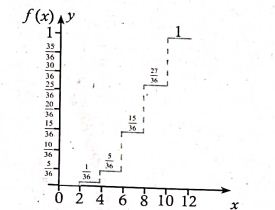
(ii) Cumulative distribution function .
F(x) = p(X ≤ x) = \(\sum_{x_i ≤ x }\)(X = xi)
P(X<2) = 0 for \(\infty\) < x < 2
\(F(2)=\frac { 1 }{ 36 } \)
\(F(4)=\frac { 1 }{ 36 } +\frac { 4 }{ 36 } =\frac { 5 }{ 36 } \)
\(F(6)=\frac { 1 }{ 36 } +\frac { 4 }{ 36 } +\frac { 10 }{ 36 } =\frac { 15 }{ 36 } \)
\(F(8)=\frac { 1 }{ 36 } +\frac { 4 }{ 36 } +\frac { 10 }{ 36 } +\frac { 12 }{ 36 } =\frac { 27 }{ 36 }\)
\(F(10)=\frac { 27 }{ 36 } +\frac { 9 }{ 36 } =\frac { 36 }{ 36 } =1\)
∵ The cumulative distribution function n
\(F(x)=\left\{\begin{array}{lll} 0 & \text { for } & x<2 \\ \frac{1}{36} & \text { for } & x \leq 2 \\ \frac{5}{36} & \text { for } & x \leq 6 \\ \frac{15}{36} & \text { for } & x \leq 8 \\ 1 & \text { for } & x \leq 10 \end{array}\right.\)
(iii) p(4≤ X < 10) = p(x = 4) + p(x = 6) + p(x = 8)
= \(\frac { 4 }{ 36 } +\frac { 10 }{ 36 } +\frac { 12 }{ 36 } +\frac { 26 }{ 36 } =\frac { 13 }{ 18 } \)
(iv) p(x ≥ 6) = p(x = 6) + p(x = 8) + p(x = 10)
= \(\frac { 10 }{ 36 } +\frac { 12 }{ 36 } +\frac { 9 }{ 36 } =\frac { 31 }{ 36 } \)
Sample space = {4 childrens}
11.
Equation of the plane passing through the point
\(=\vec { a } =\hat { i } -2\hat { j } +4 \) .......(1)
Equation of the given plane is x + 2y - 3z = 11
\(\Rightarrow \vec { r } .(\hat { i } +2\hat { j } -3\hat { k } )=11\)
The given plane is perpendicular to the vector \(\hat { i } +2\hat { j } -3\hat { k } \)
∴ The required plane is parallel to the vector
\(\vec { b } =\hat { i } +2\hat { j } -3\hat { k } \).......(2)
The given plane is parallel to the line
\(\frac { x+7 }{ 3 } =\frac { y+3 }{ -1 } =\frac { z }{ 1 } \) Whose direction ratios are 3,-1,1
The required plane is parallel to the vector
\(\vec { c } =3\hat { i } -\hat { j } +\hat { k } \) (3)
∴ The non-parametric vector equation of the plane passing through a point (\(\vec { a } \)) and parallel to two vectors \(\vec { b } \) and \(\vec { c } \) is
\((\vec { r } -\vec { a } ).(\vec { b } \times \vec { c } )=0\)
\(\vec { b } \times \vec { c } =\left| \begin{matrix} \hat { i } & \hat { j } & \hat { k } \\ 1 & 2 & -3 \\ 3 & -1 & 1 \end{matrix} \right| \)
\(=\hat { i } (2-3)-\hat { j } (1+9)+\hat { k } (-1-6)\)
\(=-\hat { i } -10\hat { j } -7\hat { k } \)
\(\therefore (\vec { r } -(\hat { i } -2\hat { j } +4\hat { k } )).(-\hat { i } -10\hat { j } -7\hat { k } )=0\)
\([\vec { r } -(-\hat { i } -10\hat { j } -7\hat { k } )]-[(\hat { i } -2\hat { j } +4\hat { k } ).(-\hat { i } -10\hat { j } -7\hat { k } )]=0\)
\(\Rightarrow \vec { r } .(-\hat { i } -10\hat { j } -7\hat { k } )-[-1+20-28]=0\)
\(\Rightarrow \vec { r } .(-\hat { i } -10\hat { j } -7\hat { k } )\times 9=0\)
\(\Rightarrow \vec { r } .(\hat { i } +10\hat { j } +7\hat { k } )-9=0\)
\(\Rightarrow \vec { r } .(\hat { i } +10\hat { j } +7\hat { k } )=9\)
Let \(\Rightarrow \vec { r } =x\hat { i } +y\hat { j } +z\hat { k } \)
\(\therefore (x\hat { i } +y\hat { j } +z\hat { k } ).(\hat { i } +10\hat { j } +7\hat { k } )=9\)
⇒ x+10y+7z = 9 which is the required Cartesian equation of the plane.
12.
The plane passes through the point.
\(\vec { a } =2\hat { i } +3\hat { j } +6\hat { k } \) and parallel to the lines \(\frac{x-1}{2}\)
\(=\frac { y+1 }{ 3 } =\frac { z-3 }{ 1 } and\frac { x+3 }{ 2 } =\frac { y-3 }{ -5 } =\frac { z+1 }{ -3 } \)
\(\Rightarrow \vec { b } =2\hat { i } +3\hat { j } +\hat { k }\ and\ \vec { c } =2\hat { i } -5\hat { j } -3\hat { k } \)
\(\vec { b } \times \vec { c } =\left| \begin{matrix} \hat { i } & \hat { j } & \hat { k } \\ 2 & 3 & 1 \\ 2 & -5 & -3 \end{matrix} \right| \)
\(=\hat { i } (-9+5)-\hat { j } (-6-2)+\hat { k } (-10-6)\)
\(=-4\hat { i } +8\hat { j } -16\hat { k } \)
The non-parametric vector equation of the plane is
\((\vec { r } .\vec { a } ).(\vec { b } \times \vec { c } )=0,\)
\(\Rightarrow [\vec { r } (2\hat { i } +3\hat { j } +16\hat { k } ).(-4\hat { i } +8\hat { j } -16\hat { k } )]=0\)
\(\Rightarrow [\vec { r } .(-4\hat { i } +8\hat { j } -16\hat { k } )]-(-8+24-96)=0\)
\(\Rightarrow \vec { r } .(-4\hat { i } +8\hat { j } -16\hat { k } )=-80\)
\(\div -4,\) We get
\(\vec { r } .(\hat { i } -2\hat { j } +4\hat { k } )=20\)
\(Let\quad \vec { r } =x\hat { i } +y\hat { j } +z\hat { k } \)
\(\Rightarrow (x\hat { i } +y\hat { j } +z\hat { k } ).(\hat { i } -2\hat { j } +4\hat { k } )=20\)
\(\Rightarrow x=2y+4z=20\)
\(\Rightarrow x-2y+4z-20=0\)
13.
Consider a triangle ABC in which the two altitudes AD and BE intersect at O. Let CO be produced to meet AB at F. We take O as the origin and let \(\vec { OA } =\vec { a } \), \(\vec { OB } =\vec { b} \) and \(\vec { OC } =\vec { c } \)
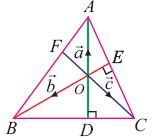
Since \(\vec { AD } \) is perpendicular to \(\vec { BC } \), we have \(\vec { OA } \) is perpendicular to \(\vec { BC } \), and
hence we get \(\vec { OA } \) . \(\vec { BC } \) = 0. That is, \(\vec { a } .(\vec { c } -\vec { b } )=0\), which means
\(\vec { a } .\hat{c}-\hat{a}.\hat{b}=0\)....(1)
Similarly, since \(\vec { BE } \) is perpendicular to \(\vec { CA } \), we have \(\vec { OB } \) is perpendicular to \(\vec { CA } \), and hence we get \(\vec { OB } .\vec { CA } \) = 0.
That is, \(\vec {b } .(\vec {a } -\vec { c } )=0\)
\(\vec { a } .\hat{c}-\hat{b}.\hat{c}=0\).......(2)
Adding equations (1) and (2), gives \(\vec { a } .\hat{c}-\hat{b}.\hat{c}=0\). That is, \(\hat{c}(\hat{a}-\hat{b})=0\)
That is \(\vec { OC } \) . \(\vec { BA } \) = 0.
Therefore, \(\vec { BA } \) is perpendicular to \(\vec { OC} \).
Which implies that \(\vec { CF} \) is perpendicular to \(\vec { AB } \).
Hence, the perpendicular drawn from C to the side AB passes through O. Therefore, the altitudes are concurrent.
14.
15.
| p | q | q ➝ p | ~p | ~q | ~q ➝ ~p |
| T | T | T | F | F | T |
| T | F | T | F | T | T |
| F | T | F | T | F | F |
| F | F | T | T | T | T |
The entries in the columns corresponding q ➝ p and ~p ➝ ~q are identical and hence they are equivalent.
q ➝ p ≡ ~p ➝ ~q
Hence proved
16.
Truth Table for ( p V q) ∧ ~q
| p | q | p V q | ~q | ( p V q) ∧ ~q |
| T | T | T | F | T |
| T | F | T | T | T |
| F | T | T | F | T |
| F | F | F | T | T |
17.
Given u (x, y) = \(\frac { { x }^{ 2 }+{ y }^{ 2 } }{ \sqrt { x+y } } \)
\(u({ \lambda }x,{ \lambda }y)=\frac { { \lambda }^{ 2 }{ x }^{ 2 }+{ { \lambda } }^{ 2 }{ y }^{ 2 } }{ \sqrt { { \lambda }x+{ \lambda }y } } \)
= \(\frac { { { \lambda } }^{ 2 }({ x }^{ 2 }+{ y }^{ 2 }) }{ \sqrt { { \lambda } } (\sqrt { x+y } ) } \)
= \({ { \lambda } }^{ 2-\frac { 1 }{ 2 } }u(x,y)\)
= \({ { \lambda } }^{ \frac { 3 }{ 2 } }u(x,y)\)
∴ u (x, y) is a homogeneous function of degree \(\frac32\)
∴ By Euler's theorem,
\(x\frac { \partial u }{ \partial x } +y\frac { \partial u }{ \partial y } \) = n.u ≍ \(x\frac { \partial u }{ \partial x } +y\frac { \partial u }{ \partial y } =\frac { 3 }{ 2 } u\)
Hence, proved.
18.
19.
Given (x, y, z) = log (x3 + y3 + z3)
\(\frac { \partial U }{ \partial x } =\frac { 1 }{ { x }^{ 3 }+{ y }^{ 3 }+{ z }^{ 3 } } { (3x }^{ 2 });\)
\(\frac { \partial U }{ \partial y } =\frac { { 3y }^{ 2 } }{ { x }^{ 3 }+{ y }^{ 3 }+{ z }^{ 3 } } \) and
\(\frac { \partial U }{ \partial z } =\frac { { 3z }^{ 2 } }{ { x }^{ 3 }+{ y }^{ 3 }+{ z }^{ 3 } } \)
\(\therefore \frac { \partial U }{ \partial x } +\frac { \partial U }{ \partial y } +\frac { \partial U }{ \partial z } =\frac { { 3x }^{ 2 } }{ { x }^{ 3 }+{ y }^{ 3 }+{ z }^{ 3 } } +\frac { { 3y }^{ 2 } }{ { x }^{ 3 }+{ y }^{ 3 }+{ z }^{ 3 } } +\frac { { 3z }^{ 2 } }{ { x }^{ 3 }+{ y }^{ 3 }+{ z }^{ 3 } } \)
\(=\frac { { 3({ x }^{ 2 }+y }^{ 2 }+{ z }^{ 2 }) }{ { x }^{ 3 }+{ y }^{ 3 }+{ z }^{ 3 } } \)
20.
Given \(f(x)=\begin{cases} \begin{matrix} kxe^{ -2x } & forx>0 \end{matrix} \\ \begin{matrix} 0 & for\quad x\le 0 \end{matrix} \end{cases}\)
Since the given function is a probability density function
\(\int _{ -\infty }^{ \infty }{ f(x)dx } \) = 1
\(\Rightarrow k\int _{ 0 }^{ \infty }{ { xe }^{ -2x }dx=1 } \)
\(\Rightarrow k \frac { 1! }{ \left( 2 \right) ^{ 2 } } =1\)
[\(\int _{ 0 }^{ \infty }{ { x }^{ n }e^{ -ax } } =\frac { n! }{ { a }^{ +1 } } \), Here a = 2, n = 1]
\(\Rightarrow \frac { k }{ 4 } =1\\ \Rightarrow k=4\)
21.
Let X be the random variable denotes the total C score is two throws of a die.
Sample space S
| II | 2 | 3 | 3 | 4 | 4 | 4 |
| I | ||||||
| 2 | 4 | 5 | 5 | 6 | 6 | 6 |
| 3 | 5 | 6 | 6 | 7 | 7 | 7 |
| 3 | 5 | 6 | 6 | 7 | 7 | 7 |
| 4 | 6 | 7 | 7 | 8 | 8 | 8 |
| 4 | 6 | 7 | 7 | 8 | 8 | 8 |
| 4 | 6 | 7 | 7 | 8 | 8 | 8 |
n (S) = 36
X = {4,5,6,7,8}
From the sample space
| Values of random variable | 4 | 5 | 6 | 7 | 8 | Total |
| No of points in inverse image | 1 | 4 | 10 | 12 | 9 | 36 |
22.
\(\vec { a } =\hat { i } +2\hat { j } +3\hat { k } ,\vec { b } =2\hat { i } -\hat { j } +\hat { k } ,\vec { c } =3\hat { i } +2\hat { j } +\hat { k } \)
\(\vec { a } .\vec { c } =(\hat { i } +2\hat { j } +3\hat { k } ),(3\hat { i } +2\hat { j } +\hat { k } )\)
= 3+4+3 = 10
\(\vec { a } .\vec { b } =(\hat { i } +2\hat { j } +3\hat { k } ).(2\hat { i } -\hat { j } +\hat { k } )\)
= 2 - 2 + 3 = 3
∴ \((\vec { a } .\vec { c } )\vec { b } -(\vec { a } .\vec { b } )\vec { c } =10\vec { b } -3\vec { c } \)
⇒ \(\vec { a } \times (\vec { b } \times \vec { c } )=10\vec { b } -3\vec { c } \) ..(1)
\([\vec { a } \times (\vec { b } \times \vec { c } )=(\vec { a } .\vec { c } )\vec { b } -(\vec { a } .\vec { b } )\vec { c } ]\)
Given \(\vec { a } \times (\vec { b } \times \vec { c } )=l\vec { a } +m\vec { b } +n\vec { c } \)..(2)
From (1) & (2)
\(10\vec { b } -3\vec { c } =l\vec { a } +m\vec { b } +n\vec { c } \)
Comparing the co-efficients of like terms, we get
l = 0, m = 10 and n = -3
23.
Given \(\vec { a } =-2\hat { i } +5\hat { j } +3\hat { k } \), \(\hat { b } =\hat { i } +3\hat { j } -2\hat { k } \) and \(\vec { c } =-3\vec { i } +\vec { j } +4\vec { k } \)
Volume of the parallelepiped = \(\vec { a } .(\vec { b } \times \vec { c } )\)
= \(\left| \begin{matrix} -2 & 5 & 3 \\ 1 & 3 & -2 \\ -3 & 1 & 4 \end{matrix} \right| \)
= \(-2\left| \begin{matrix} 3 & -2 \\ 1 & 4 \end{matrix} \right| -5\left| \begin{matrix} 1 & -2 \\ - & 4 \end{matrix} \right| +3\left| \begin{matrix} 1 & 3 \\ -3 & 1 \end{matrix} \right| \)
= -2(12+2)-5(4-6)+3(1+9)
= -2(14)-5(-2)+3(10) = -28+10+30
= 12
Vector Area of the base parallelogram = \(\vec { b } \times \vec { c } \)
=\(\left| \begin{matrix} \hat { i } & \hat { j } & \hat { k } \\ 1 & 3 & -2 \\ -3 & 1 & 4 \end{matrix} \right| =\hat { i } \left| \begin{matrix} 3 & -2 \\ 1 & 4 \end{matrix} \right| \hat { j } \left| \begin{matrix} 1 & -2 \\ -3 & 4 \end{matrix} \right| +\hat { k } \left| \begin{matrix} 1 & 3 \\ -3 & 1 \end{matrix} \right| \)
= \(\hat { i } \)(12+2)-\(\hat { j } \)(4-6)+\(\hat { k } \)(1+9)
= \(\hat { i } \)(14)-\(\hat { j } \)(-2)+\(\hat { k } \)(10)
= 14\(\hat { k } \)+2\(\hat { j } \)+10\(\hat { k } \)
Area of the parallelogram =\(\sqrt { { 14 }^{ 2 }+{ 2 }^{ 2 }+{ 10 }^{ 2 } } \)
= \(\sqrt { 196+4+100 } \)
= \(\\ \sqrt { 300 } =10\sqrt { 3 } \)..............(2)
Volume of the parallelepiped = Base area x attitude
∴ Altitude = \(\frac { Volume }{ Base\quad area } =\frac { 12 }{ 10\sqrt { 3 } } =\frac { 6 }{ 5\sqrt { 3 } } \times \frac { \sqrt { 3 } }{ \sqrt { 3 } } \)

= \(\frac { 2\sqrt { 3 } }{ 5 } \) units.
24.
Given \(\vec { F } =3\hat { i } +4\hat { j } -5\hat { k } \)
\(\vec { r } \) = (Force acting through the point) - (force acting to the point)
= \((4\hat { i } +2\hat { j } -3\hat { k } )-(2\hat { i } -\hat { j } +4\hat { k } )\)
= \(2\hat { i } +5\hat { j } -7\hat { k } \)
Torque = \(\vec { c } =\hat { r } \times \hat { F } \)
= \(\left| \begin{matrix} \hat { i } & \hat { j } & \hat { k } \\ 2 & 5 & -7 \\ 3 & 4 & -5 \end{matrix} \right| =\hat { i } \left| \begin{matrix} 5 & -7 \\ 4 & -5 \end{matrix} \right| -\hat { j } \left| \begin{matrix} 2 & -7 \\ 3 & -5 \end{matrix} \right| +\hat { k } \left| \begin{matrix} 2 & 5 \\ 3 & 4 \end{matrix} \right| \)
\(\hat { i } =\hat { i } (-25+28)-\hat { j } (-10+21)+\hat { j } (8-15)\)
= \(3\hat { i } -11\hat { j } -7\hat { k } \)
∴ MagnitudeoftheTorque = \(\sqrt { { 3 }^{ 2 }+(-11)^{ 2 }+(-7)^{ 2 } } \)
= \(\sqrt { 9+121+49 } =\sqrt { 179 } \)
Hence, the direction cosines are \(\left( \frac { 3 }{ \sqrt { 179 } } ,\frac { -11 }{ \sqrt { 179 } } ,\frac { -7 }{ \sqrt { 179 } } \right) \).
25.
Given p : Jupiter is a planet and
q : India is an island.
(i) ¬p : Jupiter is not a planet.
(ii) p ∧ ¬q : Jupiter is a planet and India is not an island.
(iii) ¬p ∨ q : Jupiter is not a planet or India is an island.
(iv) p➝ ¬q : If Jupiter is a planet then India is not an island.
(v) p↔q : Jupiter is a planet if and only if India is an island.
26.
√b is not defined for negative values, b which also ∈ R.
Hence, a√b is not defined for all a, b ∈R
* is not a binary operation on R
27.
\(h(x,y)=\frac { 6{ x }^{ 2 }{ y }^{ 3 }-\pi { y }^{ 5 }+9{ x }^{ 4 }y }{ 2020{ x }^{ 2 }+2019{ y }^{ 2 } } \)
Given \(h(x,y)=\frac { 6{ x }^{ 2 }{ y }^{ 3 }-\pi { y }^{ 5 }+9{ x }^{ 4 }y }{ 2020{ x }^{ 2 }+2019{ y }^{ 2 } } \)
\(h(\lambda x,\lambda y)=\frac { 6{ \lambda }^{ 2 }{ x }^{ 2 }{ \lambda }^{ 3 }{ y }^{ 3 }-\pi { \lambda }^{ 5 }{ y }^{ 5 }+9{ \lambda }^{ 4 }{ x }^{ 4 }\lambda y }{ 2020{ \lambda }^{ 2 }{ x }^{ 2 }+2019{ \lambda }^{ 2 }{ y }^{ 2 } } \)
\(=\frac { { \lambda }^{ 5 }(6{ x }^{ 2 }{ y }^{ 3 }-\pi { y }^{ 5 }+9{ x }^{ 4 }y) }{ { \lambda }^{ 2 }(2020{ x }^{ 2 }+2019{ y }^{ 2 }) } \)
\(
=\lambda^{3} \mathrm{~h}(\mathrm{x}, \mathrm{y})
\)
Thus f is homogeneous with degree 3.
28.
Given f(x, y) = x2y + 6x3 + 7
f(λx, λy) = λ2x2λy + 6λ3x3 + 7
= λ3 x2 y + 6λ3 x3 + 7
≠ λf(x, y)
There is no common λ in this equation.
It is not homogeneous
29.
Given n = 6, \(p=\frac { 1 }{ 3 }\), k = 3
\(P(X=k)=\left( \begin{matrix} n \\ k \end{matrix} \right) { p }^{ k }\left( 1-p \right) ^{ n-k },\)
n = 0,1,2, ... n
\(\therefore P(X=k)=\left( \begin{matrix} n \\ k \end{matrix} \right) { p }^{ k }(1-p)^{ n-k }\)
n = 0,1,2, ... n
\(P(X=3)=\left( \begin{matrix} 6 \\ 3 \end{matrix} \right) \left( \cfrac { 1 }{ 3 } \right) ^{ 3 }\left( 1-p \right) ^{ 6-3 }\)
= \(\left( \begin{matrix} 6 \\ 3 \end{matrix} \right) \left( \cfrac { 1 }{ 3 } \right) ^{ 3 }\left( \cfrac { 2 }{ 3 } \right) ^{ 2 }\)
\(=\frac{6 \times 5 \times 4}{8 \times 2 \times 1} \times \frac{1}{27} \times \frac{8}{27}\)
\(P(X=3)=\frac { 160 }{ 729 }\)
30.
\(f(x)=\begin{cases} \begin{matrix} \frac { 1 }{ 2 } e^{ -\frac { x }{ 2 } } & for\quad x>0 \end{matrix} \\ \begin{matrix} 0 & otherwise \end{matrix} \end{cases}\)
\(\int _{ 0 }^{ \infty }{ x.f(x)dx } =\frac { 1 }{ 2 } \int _{ 0 }^{ \infty }{ x.{ e }^{ \frac { -x }{ 2 } } } dx\)
\(\left[ \int _{ 0 }^{ \infty }{ { e }^{ -ax }.{ x }^{ n }dx=\cfrac { n! }{ { a }^{ n+1 } } } \right] \)
= \(\frac { 1 }{ 2 } \times \frac { 1! }{ \left( \frac { 1 }{ 2 } \right) ^{ 2 } } =\frac { 1 }{ 2 } \times \frac { 1 }{ \frac { 1 }{ 4 } } \)
= \(\frac { 1 }{ 2 } \times \frac { 4 }{ 1 } =2\)
\(E({ X }^{ 2 })=\int _{ 0 }^{ \infty }{ { x }^{ 2 }.f(x) } dx\)
= \(\int _{ 0 }^{ \infty }{ { x }^{ 2 }.\frac { 1 }{ 2 } { e }^{ -\frac { x }{ 2 } } } dx\)
= \(\frac { 1 }{ 2 } \int { { x }^{ 2 }.{ e }^{ -\frac { x }{ 2 } }dx } \)
= \(\frac { 1 }{ 2 } \times \frac { 2! }{ \left( \frac { 1 }{ 3 } \right) ^{ 3 } } =\frac { 1 }{ 2 } \times \frac { 2 }{ \frac { 1 }{ 8 } } \)
= \(\frac { 1 }{ 2 } \times 2\times 8=8\)
ஃVar(X)=E(X2) - [E(x)]2
= 8-22
= 8 - 4 = 4
31.
| x | 0 | 1 | 2 | 3 | 4 | 5 |
| f(x) | \(\cfrac { 1 }{ 5 } \) | \(\cfrac { 1 }{ 5 } \) | \(\cfrac { 1 }{ 10 } \) | \(\cfrac { 1 }{ 5 } \) | \(\cfrac { 1 }{ 5 } \) | \(\cfrac { 1 }{ 10 } \) |
\(\therefore Mean=E(x)=\Sigma xf(x)=0\left( \frac { 1 }{ 5 } \right) +1\left( \frac { 1 }{ 5 } \right) +2\left( \frac { 1 }{ 10 } \right) +3\left( \frac { 1 }{ 5 } \right) +4\left( \frac { 1 }{ 5 } \right) +5\left( \frac { 1 }{ 10 } \right) \)
\(\frac { 1 }{ 5 } +\frac { 1 }{ 5 } +\frac { 3 }{ 5 } +\frac { 4 }{ 5 } +\frac { 1 }{ 2 } \)
= \(\frac { 2+2+6+8+5+ }{ 10 } =\frac { 23 }{ 10 } =2.3\)
= \(f({ x }^{ 2 })=\Sigma { x }^{ 2 }f(x)\)
= \({ 0 }^{ 2 }\left( \frac { 1 }{ 5 } \right) +{ 1 }^{ 2 }\left( \frac { 1 }{ 5 } \right) +2^{ 2 }\left( \frac { 1 }{ 10 } \right) +{ 3 }^{ 2 }\left( \frac { 1 }{ 5 } \right) +{ 4 }^{ 2 }\left( \frac { 1 }{ 5 } \right) +{ 5 }^{ 2 }\left( \frac { 1 }{ 10 } \right) \)
= \(0+\frac { 1 }{ 5 } +\frac { 4 }{ 10 } +\frac { 9 }{ 5 } +\frac { 16 }{ 5 } +\frac { 25 }{ 10 } \)
= \(\frac { 2+4+18+32+25 }{ 10 } =\frac { 81 }{ 10 } =8.1\)
= \(\frac { 2+4+18+32+25 }{ 10 } =\frac { 81 }{ 10 } =8.1\)
Variance = E(X2) - [E(X)]2
= 8.1- (2.3)2
= 8.1- 5.29
= 2.81
32.
The angle between a line \(\vec { r } =\vec { a } +t\vec { b } \) and a plane \(\vec { r } .\vec { n } \) = p with normal \(\vec { n } \) is θ = \(sin^{ -1 }\left( \frac { |\vec { b } .\vec { n } | }{ |\vec { b }| .|\vec { n } | } \right) \quad \)
Here, \(\vec { b } =\hat { i } -\hat { j } +\hat { k } \) and \(\vec { n } =2\hat { i } \hat { j } +\hat { k } \)
So, we get θ = \(sin^{ -1 }\left( \frac { |\vec { b } .\vec { n } | }{ |\vec { b }| .|\vec { n } | } \right) \quad =sin^{ -1 }\left( \frac { |(\hat { i } -\hat { j } +\hat { k } ).(2\hat { i } -\hat { j } +\hat { k } )| }{ |\hat { i } -\hat { j } +\hat { k } ||2\hat { i } -\hat { j } +\hat { k } | } \right) =sin^{ -1 }\left( \frac { 2\sqrt { 3 } }{ 3 } \right) \).
33.
\(\vec { a } \)= \(a\hat { i } +a\hat { j } +c\hat { k } , \vec{b}=\hat { i } +\hat { k } \), \(\vec { c } \)= \(c\hat { i } +c\hat { j } +b\hat { k } \)
Given \(\vec { a } ,\vec { b } \) and \(\vec { c } \) are co-planar
\(\vec { a } .(\vec { b } \times \vec { c } )\) = 0
⇒ \(\left| \begin{matrix} a & a & c \\ 1 & 0 & 1 \\ c & c & b \end{matrix} \right| \) = 0
⇒ \(a\left| \begin{matrix} 0 & 1 \\ c & b \end{matrix} \right| -a\left| \begin{matrix} 1 & 1 \\ c & b \end{matrix} \right| +c\left| \begin{matrix} 1 & 0 \\ c & c \end{matrix} \right| \) = 0
⇒ a(0-c)-a(b-c)+c(c-0) = 0
\(\Rightarrow-\not a c-a b+\not a c+c^{2}=0\)
⇒ c2 = ab ⇒ c =\(\sqrt { ab } \).
Hence c is the geometric mean of a and b.
34.
Given \(\vec { a } =\hat { i } -2\hat { j } +3\hat { k }, \vec { b } =2\hat { i } +\hat { j } -2\hat { k }, \vec { c } =3\hat { i } +2\hat { j } +\hat { k } \)
∴ \(\vec { a } .(\vec { b } \times \vec { c } )=\left| \begin{matrix} 1 & -2 & 3 \\ 2 & 1 & -2 \\ 3 & 2 & 1 \end{matrix} \right| \)
= \(1\left| \begin{matrix} 1 & -2 \\ 2 & 1 \end{matrix} \right| +2\left| \begin{matrix} 2 & -2 \\ 3 & 1 \end{matrix} \right| +3\left| \begin{matrix} 2 & 1 \\ 3 & 2 \end{matrix} \right| \)
= 1(1+4)+2(2+6)+3(4-3)
= 1(5)+2(8)+3(1)
= 5+16+3 = 24
\(\vec { a } .(\vec { b } \times \vec { c } )\) = 24
35.
(d)
ᄀ(p ∧ q) ∧ [p ∧ (pV ᄀr)]
36.
(c)
¬ (p ∨ q)≡¬p∨¬q
37.
(b)
38.
(d)
\(\sqrt 5\) is an irrational number
39.
(b)
Multiplication
40.
(b)
41.
(c)
-7
42.
(b)
(1 +xy)exy
43.
(b)
2xu
44.
(b)
0.4%
45.
(b)
46.
(d)
\(\frac { 2 }{ 3 } \)
47.
(d)
\(\left( \frac { 10 }{ 5 } \right) \left( \frac { 3 }{ 5 } \right) ^{ 5 }\left( \frac { 2 }{ 5 } \right) ^{ 5 }\)
48.
(c)
40.75,40
49.
(d)
16 and 24
50.
(a)
\(\frac { \pi }{ 6 } \)
51.
(c)
52.
(d)
53.
(a)
\(\left| \vec { a } \right| \left| \vec { b } \right| \left| \vec { c } \right| \)
54.
(c)
\([\vec { \alpha } ,\vec { \beta } ,\vec { \gamma } ]\) = 0

12th Standard Syllabus & Materials
12th Standard
TN 12th Computer Applications களப்பெயர் முறைமை (DNS) Sample Question Papers Study Material - QB365 Set A
NEW12th Standard
TN 12th Computer Applications வலையமைப்பு எடுத்துக்காட்டுகள் மற்றும் நெறிமுறைகள் Sample Question Papers Study Material - QB365 Set A
NEW12th Standard
TN 12th Computer Applications கணினி வலையமைப்பு ஓர் அறிமுகம் Sample Question Papers Study Material - QB365 Set A
NEW12th Standard
TN 12th Computer Applications PHP-உடன் MySQL-ஐ இணைத்தல் Sample Question Papers Study Material - QB365 Set A



Tamilnadu Stateboard 12th Standard Subjects
Maths

Chemistry

Physics

Biology

Computer Science

Business Maths and Statistics

Economics

Commerce

Accountancy

History

Computer Applications
Biology
Computer Technology
Computer Applications
Computer Science
Business Maths and Statistics
Commerce
Economics
Maths
Chemistry
Physics
Computer Technology
History
Accountancy

Tamil

English

French
Tamilnadu Stateboard Standards


