
 100% FREE ACCESS
12th Standard Syllabus & Materials
12th Standard
TN 12th Maths Applications of Matrices and Determinants Sample Question Papers Study Material - QB365 Set A
NEW12th Standard
TN 12th Computer Applications மின்னணு தரவு பரிமாற்றம் Sample Question Papers Study Material - QB365 Set A
NEW12th Standard
TN 12th Computer Applications மின் - வணிக பாதுகாப்பு அமைப்புகள் Sample Question Papers Study Material - QB365 Set A
NEW12th Standard
TN 12th Computer Applications மின்னணு செலுத்தல் முறைகள் Sample Question Papers Study Material - QB365 Set A
NEW12th Standard
TN 12th Computer Applications மின் - வணிகம் Sample Question Papers Study Material - QB365 Set A
NEW12th Standard
TN 12th Computer Applications திறந்த மூல கருத்துருக்கள் Sample Question Papers Study Material - QB365 Set A

Published on: 20/10/2025
Download Tamil Nadu 12th Standard Maths question papers, model tests, one-mark questions, important questions, and public exam papers in PDF format. Free study materials and answer keys for TN State Board students.
Questions + Answers key
Take MCQ Maths Test
1.
Find, by integration, the volume of the solid generated by revolving about the x-axis, the region enclosed by y = 2x2, y = 0 and x = 1.
2.
Find the area of the region bounded by 2x − y +1 = 0, y = −1, y = 3 and y-axis
3.
Evaluate the following:
\(\int _{ 0 }^{ 1 }{ \frac { sin(3{ tan }^{ -1 }x){ tan }^{ -1 }x }{ 1+{ x }^{ 2 } } } dx\)
4.
Evaluate the following integrals using properties of integration:
\(\int _{ \frac { \pi }{ 8 } }^{ \frac { 3\pi }{ 8 } }{ \frac { 1 }{ 1+\sqrt { tanx } } dx } \)
5.
Evaluate \(\int ^{3}_{2} \frac{\sqrt {x}}{\sqrt {5-x}+\sqrt {x}}\)dx.
6.
Find the Cartesian form of the equation of the plane \(\overset { \rightarrow }{ r } =\left( s-2t \right) \overset { \wedge }{ i } +\left( 3-t \right) \overset { \wedge }{ j } +\left( 2s+t \right) \overset { \wedge }{ k } \)
7.
A variable plane moves in such a way that the sum of the reciprocals of its intercepts on the coordinate axes is a constant. Show that the plane passes through a fixed point
8.
Prove that \([\vec { a } \times \vec { b } ,\vec { b } \times \vec { c } ,\vec { c } \times \vec { a } ]\) = \([{ \vec { a } ,\vec { b } ,\vec { c } }]^{ 2 }\)
9.
A particle acted upon by constant forces \(\hat { 2j } +\hat { 5j } +\hat { 6k } \) and \(-\hat { i } -\hat { 2j } -\hat { k } \) is displaced from the point (4, −3, −2) to the point (6, 1, −3). Find the total work done by the forces.
10.
Find the area of the region bounded by y = tan x, y = cot x and the lines x = 0, x = \(\frac{\pi}{2}\), y = 0
11.
Find the area of the region in the first quadrant bounded by the parabola y2 = 4x, the line x + y = 3 and y-axis.
12.
Evaluate \(\int ^{\pi}_{-\pi} \frac{cos ^2 x}{1+ a^x}\) dx
13.
Find the image of the point whose position vector is \(\hat { i } +2\hat { j } +3\hat { k } \) in the plane \(\vec { r } .(\hat { i } +2\hat { j } +4\hat { k } )\) = 38
14.
Show that the lines \(\vec { r } =(6\hat { i } +\hat { j } +2\hat { k } )+s(\hat { i } +2\hat { j } -3\hat { k } )\) and \(\vec { r } =(3\hat { i } +2\hat { j } -2\hat { k } )+t(2\hat { i } +4\hat { j } -5\hat { k } )\) are skew lines and hence find the shortest distance between them.
15.
If G is the centroid of a ΔABC, prove that (area of ΔGAB) = (area of ΔGBC) = (area of ΔGCA) = \(\frac{1}{3}\) (area of ΔABC)
16.
Evaluate \(\int _{ 0 }^{ 1 }{ \frac { { e }^{ x } }{ 1+{ e }^{ 2x } } dx } \)
17.
Evaluate the following \(\int _{ 0 }^{ \pi /2 }{ { cos}^{ 7}x\quad dx } \)
18.
Find the acute angle between the planes \(\vec { r } .(2\hat { i } +2\hat { j } +2\hat { k } )\) and 4x-2y+2z = 15.
19.
For any vector \(\vec { a } \), prove that \(\hat { i } \times (\vec { a } \times \hat { i } )+\hat { j } \times (\vec { a } \times \hat { j } )+\hat { k } \times \vec { a } \times \hat { k } =2\vec { a } \).
20.
Find the volume of the parallelepiped whose coterminus edges are given by the vectors \(\hat { 2i } -\hat { 3j } +\hat { 4k } \), \(\hat { i } +\hat { 2j } -\hat { k } \) and \(\hat {3 i } -\hat { j } +\hat { 2k } \)
21.
The value of \(\int_{-3}^{3}\left[\sin ^{-1}\left(\frac{x^{2}+1}{2}\right)+\sec ^{-1}\left(\frac{2}{x^{2}+1}\right)\right] d x\) __________
\(\pi\)
\(2\pi\)
\(3\pi\)
\(4\pi\)
22.
The area bounded by the parabola y2 = x and its latus rectum is __________
\(\frac{4}{3}\)
\(\frac{1}{6}\)
\(\frac{2}{3}\)
\(\frac{8}{3}\)
23.
24.
If \(\int _{ 0 }^{ a }{ \frac { 1 }{ 4+{ x }^{ 2 } } dx=\frac { \pi }{ 8 } } \) then a is
4
1
3
2
25.
The value of \(\int _{ 0 }^{ \frac { \pi }{ 6 } }{ { cos }^{ 3 }3x\ dx }\ is\)
\(\frac{2}{3}\)
\(\frac{2}{9}\)
\(\frac{1}{9}\)
\(\frac{1}{3}\)
26.
The value of \(\int _{ 0 }^{ 1 }{ x{ (1-x) }^{ 99 }dx } \) is
\(\frac{1}{11000}\)
\(\frac{1}{10100}\)
\(\frac{1}{10010}\)
\(\frac{1}{10001}\)
27.
The length of the 丄r from the origin to plane \(\overset { \rightarrow }{ r } .\left( \overset { \wedge }{ 3i } +4\overset { \wedge }{ j } +12\overset { \wedge }{ k } \right) \)= 26 is _____________
2
\(\frac { 1 }{ 2 } \)
26
\(\frac { 26 }{ 169 } \)
28.
The angle between the vector \(3\overset { \wedge }{ i } +4\overset { \wedge }{ j } +\overset { \wedge }{ 5k } \) and the z-axis is ___________
30o
60o
45o
90o
29.
If the line \(\frac { x-2 }{ 3 } =\frac { y-1 }{ -5 }= \frac {z+2 }{ 2 } \) lies in the plane x + 3y - αz + β = 0, then (α, β) is
(-5, 5)
(-6, 7)
(5, -5)
(6, -7)
30.
If \(\vec { a } .\vec { b } =\vec { b } .\vec { c } =\vec { c } .\vec { a } =0\) , then the value of \([\vec { a } ,\vec { b } ,\vec { c } ]\) is
\(\left| \vec { a } \right| \left| \vec { b } \right| \left| \vec { c } \right| \)
\(\frac{1}{3}\)\(\left| \vec { a } \right| \left| \vec { b } \right| \left| \vec { c } \right| \)
1
-1
1.
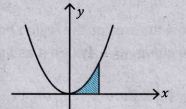
Equation of the given curve is y = 2x2
Volume \(=\pi \int _{ a }^{ b }{ { y }^{ 2 }dx } \)
\(=\pi \int _{ 0 }^{ 1 }{ { (2{ x }^{ 2 }) }^{ 2 } } dx=\pi \int _{ 0 }^{ 1 }{ { 4x }^{ 4 }dx } \)
\(=4\pi { \left[ \frac { { x }^{ 5 } }{ 5 } \right] }_{ 0 }^{ 1 }=\frac { 4\pi }{ 5 } (1-0)\)
\(v=\frac { 4\pi }{ 5 } \) cubic units
2.
Given equation of line is 2x - y + 1 = 0
| x | 0 | -1/2 |
| y | 1 | 0 |
\(\Rightarrow 2x=y-1\Rightarrow x=\frac { y-1 }{ 2 } \)
[\(\because\) the area is left of the x-axis]
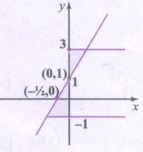
\(\therefore Area\ =\int _{ -1 }^{ 1 }{ -xdy+\int _{ 1 }^{ 3 }{ xdy } } \)
\(=-\frac { 1 }{ 2 } \int _{ -1 }^{ 1 }{ (y-1)dy } +\frac { 1 }{ 2 } \int _{ 1 }^{ 3 }{ (y-1)dy } \)
\(={ -\frac { 1 }{ 2 } { \left[ \frac { { y }^{ 2 } }{ 2 } -y \right] }_{ -1 }^{ 1 }{ +\frac { 1 }{ 2 } }\left[ \frac { { y }^{ 2 } }{ 2 } -y \right] }_{ 1 }^{ 3 }\)
\(=\frac { 1 }{ 2 } \left[ { \left( y-\frac { { y }^{ 2 } }{ 2 } \right) }_{ -1 }^{ 1 }+{ \left( \frac { { y }^{ 2 } }{ 2 } -y \right) }_{ 1 }^{ 3 } \right] \)
\(=\frac { 1 }{ 2 } \left[ \left( 1-\frac { 1 }{ 2 } \right) -\left( 1-\frac { 1 }{ 2 } \right) +\left( \frac { 9 }{ 2 } -3 \right) -\left( \frac { 1 }{ 2 } -1 \right) \right] \)
\(=\frac { 1 }{ 2 } \left[ \frac { 1 }{ 2 } +\frac { 3 }{ 2 } +\frac { 3 }{ 2 } +\frac { 1 }{ 2 } \right] =\frac { 1 }{ 2 } \left[ \frac { 8 }{ 2 } \right] =\frac { 1 }{ 2 } (4)\)
= 2 sq.units
3.
Let \(\int _{ 0 }^{ 1 }{ \frac { sin(3{ tan }^{ -1 }x){ tan }^{ -1 }x }{ 1+{ x }^{ 2 } } } dx\)
\(put\quad { tan }^{ -1 }x=t\Rightarrow \frac { 1 }{ 1+{ x }^{ 2 } } dx=dt\)
\(\Rightarrow \int _{ 0 }^{ \frac { \pi }{ 4 } }{ t\quad sin(3t)dt } =\int _{ 0 }^{ \frac { \pi }{ 4 } }{ tsin3t } dt\)
| x | 0 | 1 |
| t | 0 | \(\frac{\pi}{4}\) |
\(Let\ u=t\ \ v=sin3tdt\)
\(u'=1\ \ { v }_{ 1 }=\frac { -cos3t }{ 3 } \)
\(u'' = 0 \quad { v }_{ 2 }=\frac { -sin3t }{ 9 } \)
Bernoulli's formula:
\(\int { uvdx } =u{ v }_{ 1 }-u'{ v }_{ 2 }\)
\(\int _{ 0 }^{ \frac { \pi }{ 4 } }{ tsin3tdt={ \left[ t\left( \frac { -cos3t }{ 3 } \right) -1\left( \frac { -sin3t }{ 9 } \right) \right] }_{ 0 }^{ \frac { \pi }{ 4 } } } \)
\(=\frac { -1 }{ 9 } { [3tcos3t-sin3t] }_{ 0 }^{ \frac { \pi }{ 4 } }\)
\(=\frac { -1 }{ 9 } \left[ \left( 3\frac { \pi }{ 4 } cos\frac { 3\pi }{ 4 } -sin\frac { 3\pi }{ 4 } \right) -(0-0) \right] \)
\(=\frac { -1 }{ 9 } \left[ \frac { 3\pi }{ 4 } \left( -\frac { 1 }{ \sqrt { 2 } } \right) -\frac { 1 }{ \sqrt { 2 } } \right] \)
\(=\frac { -1 }{ 9 } \left[ \frac { -3\pi -4 }{ 4\sqrt { 2 } } \right] =\frac { 3\pi }{ 36\sqrt { 2 } } +\frac { 4 }{ 36\sqrt { 2 } } \)
\(=\frac { \pi }{ 12\sqrt { 2 } } +\frac { 1 }{ 9\sqrt { 9 } } =\frac { 1 }{ \sqrt { 9 } } \left[ \frac { \pi }{ 12 } +\frac { 1 }{ 9 } \right] \)
4.
\(I=\int _{ \frac { \pi }{ 8 } }^{ \frac { 3\pi }{ 8 } }{ \frac { 1 }{ 1+\sqrt { tanx } } dx } \int _{ \frac { \pi }{ 8 } }^{ \frac { 3\pi }{ 8 } }{ \frac { 1 }{ 1+\frac { \sqrt { sin\quad x } }{ \sqrt { cos\quad x } } } dx } \)
\(=\int _{ \frac { \pi }{ 8 } }^{ \frac { 3\pi }{ 8 } }{ \frac { \sqrt { cos\quad x } }{ \sqrt { cos\quad x } +\sqrt { sin\quad x } } dx\quad \quad ..(1) } \)
By the property,\( \int _{ a }^{ b }{ f(x)dx=\int _{ a }^{ b }{ f(a+b-x)dx } } \)
we get \(I=\int _{ \frac { \pi }{ 8 } }^{ \frac { 3\pi }{ 8 } }{ \frac { \sqrt { cos(\frac { \pi }{ 8 } +\frac { 3\pi }{ 8 } -x) } }{ \sqrt { cos(\frac { \pi }{ 8 } +\frac { 3\pi }{ 8 } -x) } +\sqrt { sin(\frac { \pi }{ 8 } +\frac { 3\pi }{ 8 } -x) } } } dx\)
\(=\int _{ \frac { \pi }{ 8 } }^{ \frac { 3\pi }{ 8 } }{ \frac { \sqrt { cos(\frac { \pi }{ 2 } -x) } }{ \sqrt { cos(\frac { \pi }{ 2 } -x) } +\sqrt { sin(\frac { \pi }{ 2 } -x) } } } dx\)
\(=\int _{ \frac { \pi }{ 8 } }^{ \frac { 3\pi }{ 8 } }{ \frac { \sqrt { sin\quad x } }{ \sqrt { sin\quad x } +\sqrt { cos\quad x } } ...(2) } \)
\((1)+(2)\rightarrow \)
\(2I=\int _{ \frac { \pi }{ 8 } }^{ \frac { 3\pi }{ 8 } }{ \frac { \sqrt { cos\quad x } }{ \sqrt { cos\quad x } +\sqrt { sin\quad x } } dx+\int _{ \frac { \pi }{ 8 } }^{ \frac { 3\pi }{ 8 } }{ \frac { \sqrt { sin\quad x } }{ \sqrt { sin\quad x } +\sqrt { sin\quad x } } } } \)
\(=\int _{ \frac { \pi }{ 8 } }^{ 3\frac { \pi }{ 8 } }{ \frac { \sqrt { cos\quad x } +\sqrt { sin\quad x } }{ \sqrt { cos\quad x } +\sqrt { sin\quad x } } dx=\int _{ \frac { \pi }{ 8 } }^{ \frac { 3\pi }{ 8 } }{ dx={ [x] }_{ \frac { \pi }{ 8 } }^{ \frac { 3\pi }{ 8 } } } } \)
\(2I=\frac { 3\pi }{ 8 } -\frac { \pi }{ 8 } =\frac { 2\pi }{ 8 } =\frac { \pi }{ 4 } \)
\(\therefore I=\frac { \pi }{ 8 } \)
5.
Let us put I = \(\int ^{3}_{2} \frac{\sqrt {x}}{\sqrt {5-x}+\sqrt {x}}\) dx --- (1)
Applying the formula \(\int ^{a}_{b}\) f(x) dx =\(\int ^{a}_{b}\) f(a+b -x) dx, we get
I = \(\int ^{3}_{2} \frac{\sqrt {(2+3-x)}}{\sqrt {5-(2+3-x)}+\sqrt { {(2+3-x)}}}\) dx = \(\int ^{3}_{2} \frac{\sqrt {(5-x)}}{\sqrt {x}+\sqrt { {(5-x}}}\) dx -- (2)
Adding (1) and (2), we get
2I = \(\int ^{3}_{2} \frac{\sqrt {x} + \sqrt {5-x} }{\sqrt {x}+\sqrt { {5-x}}}\) dx =\(\int ^{3}_{2} \) dx = \([x]^{3}_{2}\) = 3 - 2 = 1
Hence, we get I = \(\frac{1}{2}\)
6.
Let \(\overset { \rightarrow }{ r } =x\overset { \wedge }{ i } +y\overset { \wedge }{ j } +z\overset { \wedge }{ k } \)
\(\therefore x\overset { \wedge }{ i } +y\overset { \wedge }{ j } +z\overset { \wedge }{ k } =\left( s-2t \right) \overset { \wedge }{ i } +\left( 3-t \right) \overset { \wedge }{ j } +\left( 2s+t \right) \overset { \wedge }{ k } \)
Equating the co-efficients of like components both sides,
We get, x = s - 2t
y = 3 - t
z = 2s + t
Eliminating x and t using determinates we get
\(\left| \begin{matrix} x \\ y-3 \\ z \end{matrix}\begin{matrix} 1 \\ 0 \\ 2 \end{matrix}\begin{matrix} -2 \\ -1 \\ 1 \end{matrix} \right| =0\)
⇒ x (0+2) -1(y - 3 + z) -2 (2y - 6 - 0) = 0
⇒ 2x - y + 3 - z- 4y + 12 = 0
⇒ 2x - 5y - z + 15 = 0
7.
The equation of the plane having intercepts a, b, c on the x, y, z axes respectively is \(\frac { x }{ a } +\frac { y }{ b } +\frac { z }{ c } =1\).
Since the sum of the reciprocals of the intercepts on the coordinate axes is a constant, we have \(\frac { 1 }{ a } +\frac { 1 }{ b } +\frac { 1 }{ c } =k\), where k is a constant, and which can be written as \(\frac { 1 }{ a } \left( \frac { 1 }{ k } \right) +\frac { 1 }{ b } \left( \frac { 1 }{ k } \right) +\frac { 1 }{ c } \left( \frac { 1 }{ k } \right) =1\)
This shows that the plane \(\frac { x }{ a } +\frac { y }{ b } +\frac { z }{ c } =1\) passes through the fixed point \(\left( \frac { 1 }{ k } ,\frac { 1 }{ k } ,\frac { 1 }{ k } \right) \)
8.
Using the definition of the scalar triple product, we get
\([\vec { a } \times \vec { b } ,\vec { b } \times \vec { c } ,\vec { c } \times \vec { a } ]\) = \((\vec { a } \times \vec { b } ).[(\vec { b } \times \vec { c } )\times (\vec { c } \times \vec { a } )]\) ....(1)
By treating \((\vec { b } \times \vec { c } )\) as the first vector in the vector triple product, we find
\((\vec { b } \times \vec { c } )\times (\vec { c } \times \vec { a } )\) = \(((\vec { b } \times \vec { c } ).\vec { a } )\vec { c } \) - \(((\vec { b } \times \vec { c } ).\vec { c } )\vec { a } )\) = \([{ \vec { a } ,\vec { b } ,\vec { c } }]\vec { c } \)
Using this value in (1), we get
\([\vec { a } \times \vec { b } ,\vec { b } \times \vec { c } ,\vec { c } \times \vec { a } ]\) = \((\vec { a } \times \vec { b } ).([\vec { a } ,\vec { b } ,\vec { c } ]\vec { c } )=[\vec { a } ,\vec { b } ,\vec { c } ](\vec { a } \times \vec { b } ).\vec { c } ={ [\vec { a } ,\vec { b } ,\vec { c } ] }^{ 2 }\)
9.
Resultant of the given forces is \(\hat{F}\) = ( \(\hat { 2j } +\hat { 5j } +\hat { 6k } \) )+ (\(-\hat { i } -\hat { 2j } -\hat { k } \) ) = \(\hat { i } +\hat { 3j } +\hat {5 k } \)
Let A and B be the points (4, −3, −2) and (6, 1, −3) respectively.
Then the displacement vector of the particle is
\(\vec { d } =\vec { AB } =\vec { OB } -\vec { OA } =(\hat { 6i } +\hat { j } -\hat { 3k } )-(\hat { 4i } -\hat { 3j } -\hat { 2k } )=\hat { 2i } +\hat { 4j } -\hat { k } \)
Therefore the work done
w = \(\vec { f } .\vec { d } =(\hat { i } +\hat { 3j } +\hat { 5k } ).(\hat { 2j } +\hat { 4j } -\hat { k } )\) = 9 units.
10.
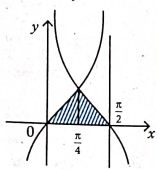
Given equation of the curves are y = tan x, y = cot x.
The intersection of y = tan x and y = cot x are
tan x = cot x \(\Rightarrow\) x = \(\frac{\pi}{2}\)
\(\therefore\) Required area \(=\int _{ 0 }^{ \frac { \pi }{ 4 } }{ (tan\ x-cot\ x)dx } \)
\(={ [-log\ sin\ x+log\ sec\ x] }_{ 0 }^{ \frac { \pi }{ 4 } }\)
\(=log{ \left[ \frac { sec\ x }{ sin\ x } \right] }_{ 0 }^{ \frac { \pi }{ 4 } }==log{ \left[ \frac { 1 }{ sin\ x\ cos\ x } \right] }_{ 0 }^{ \frac { \pi }{ 4 } }\)
\(=-log{ (sin\quad x\ cos\ x) }_{ 0 }^{ \frac { \pi }{ 4 } }\)
\(=-log\left( sin\frac { \pi }{ 4 } .cos\frac { \pi }{ 4 } \right) +log(sin0\quad cos0)\)
\(=-log\left( \frac { 1 }{ \sqrt { 2 } } .\frac { 1 }{ \sqrt { 2 } } \right) +0\)
\(=-log\left( \frac { 1 }{ 2 } \right) =-(log1-log2)=log2\)
11.
First, we find the points of intersection of x + y = 3 and y2 − 4x:
x + y = 3 ⇒ y = 3− x.
\(\therefore\) y2 = 4x ⇒ (3 -x)2 = 4x
⇒ x2 −10x + 9 = 0
⇒ x = 1, x = 9 .
\(\therefore\) x = 1 in x + y = 3 \(\Rightarrow\) y = 2, and x = 9 in x + y = 3 ⇒ y = −6 .
\(\therefore\) (1, 2) and (9,−6) are the points of intersection.
The line x + y = 3 meets the y -axis at (0, 3).
The required area is sketched
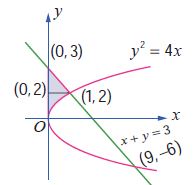
Viewing in the direction of y -axis, on the right bounding curve is given by
\(x=\begin{cases} \frac { { y }^{ 2 } }{ 4 } ,0\le y\le 2 \\ 3-y,2\le y\le 3 \end{cases}\)
\(\therefore A=\int _{ 0 }^{ 2 }{ xdy+\int _{ 2 }^{ 3 }{ xdy } =\int _{ 0 }^{ 2 }{ \frac { { y }^{ 2 } }{ 4 } dy+\int _{ 2 }^{ 3 }{ (3-y) } dy } } \)
\(={ \left( \frac { { y }^{ 3 } }{ 12 } \right) }_{ 0 }^{ 2 }+{ \left( 3y-\frac { { y }^{ 3 } }{ 2 } \right) }_{ 2 }^{ 3 }=\left( \frac { 8 }{ 12 } -0 \right) +\left( 9-\frac { 9 }{ 2 } \right) -\left( 6-\frac { 4 }{ 2 } \right) =\frac { 7 }{ 6 } \)
12.
Let I = \(\int ^{\pi}_{-\pi} \frac{cos ^2 x}{1+ a^x} dx\)-- (1)
Using \(\int ^{b}_{a}\) f(x) dx =\(\int ^{b}_{a}\) f(a+b -x)dx we get,
I = \(\int ^{\pi}_{-\pi} \frac{cos ^2 (\pi -\pi - x)}{1+ a^{\pi -\pi - x}} dx\)
= \(\int ^{\pi}_{-\pi} \frac{cos ^2 (-x)}{1+ a^{-x}} dx\)
= \(\int ^{\pi}_{-\pi} a^x (\frac{cos ^2 x }{a^x+ 1} )dx\) --- (2)
Adding (1) and (2) we get
2I = \(\int ^{\pi}_{-\pi} \frac{cos ^2 x }{a^x+ 1}(a^x+ 1) dx\) = \(\int ^{\pi}_{-\pi} cos ^2 x dx\)
= 2 \(x =\int ^{\pi}_{-\pi} cos ^2 x dx\) (since cos2 x is an even function)
Hence, I = \(\int ^{\pi}_{0} (\frac{1 + cos2x }{2} )dx\)
= \(\frac {1}{2} [ x + \frac {sin 2x}{2}]^{x}_{0}\)
= \(\frac {1}{2} [\pi]\)
= \(\frac {\pi}{2}\)
13.
Here, \(\vec { u } =\hat { i } +2\hat { j } +3\hat { k } ,\vec { n } =\hat { i } +2\hat { j } +4\hat { k } \), p = 38. Then the position vector of the image \(\vec { v } \)of
\(\vec { u } =\hat { i } +2\hat { j } +3\hat { k } \) is given by \(\vec { v } =\vec { u } +\frac { 2[p-(\vec { u } .\vec { n } )] }{ { \left| \vec { n } \right| }^{ 2 } } \vec { n } \)
\(\vec { v } =(\hat { i } +2\hat { j } +3\hat { k } )+\frac { 2[38-(\hat { i } +2\hat { j } +3\hat { k } ).(\hat { i } +2\hat { j } +4\hat { k } ))] }{ (\hat { i } +2\hat { j } +4\hat { k } ).(\hat { i } +2\hat { j } +4\hat { k } ) } (\hat { i } +2\hat { j } +4\hat { k } )\)
That is \(\vec { v } =(\hat { i } +2\hat { j } +3\hat { k } )+2(\frac { [38- 17]}{21})
(\hat { i } +2\hat { j } +4\hat { k } )= (3\hat { i } +6\hat { j } +11\hat { k } )\)
Therefore, the image of the point with position vector \(\hat { i } +2\hat { j } +3\hat { k } \) is \(3\hat { i } +6\hat { j } +11\hat { k } \)
14.
Given lines are
\(\vec { r } =(6\hat { i } +\hat { j } +2\hat { k } )+s(\hat { i } +2\hat { j } -3\hat { k } )\)
\(\vec { a } =6\hat { i } +\hat { j } +2\hat { k } ,\vec { b } =\hat { i } +2\hat { j } -3\hat { k } \)
and \(\vec { r } =(3\hat { i } +2\hat { j } -2\hat { k } )+t(2\hat { i } +4\hat { j } -5\hat { k } )\)
\(\vec { c } =3\hat { i } +2\hat { j } -2\hat { k } \quad and\quad \vec d = 2\hat { i } +4\hat { j } -5\hat { k } \)
Since \(\vec { b } \neq \vec { d } \), they are not parallel and they do not intersect.
Hence the given lines are skew lines.
Shortest distance between the two skew lines
\(\delta =\frac { |(\vec { c } -\vec { a } ).(\vec { b } \times \vec { d } )| }{ |(\vec { b } \times \vec { d } )| } \)
\(\vec { b } \times \vec { d } =\left| \begin{matrix} \hat { i } & \hat { j } & \hat { k } \\ 1 & 2 & -3 \\ 2 & 4 & -5 \end{matrix} \right| \)
\(=\hat { i } (-10+12)-\hat { j } (-5+6)+\hat { k } (4-4)\)
\(=2\hat { i } -\hat { j } \Rightarrow |\vec { b } \times \vec { d } |\quad \sqrt { { 2 }^{ 2 }++(-1)^{ 2 } } =\sqrt { 5 } \)
\(\vec { c } =\vec { a } =(3\hat { i } +2\hat { j } -2\hat { k } )-(6\hat { i } +\hat { j } +2\hat { k } )\)
\(=-3\hat { i } +\hat { j } -4\hat { k } \)
\(\therefore (\vec { c } -\vec { a } ).(\vec { b } \times \vec { d } )=(-3\hat { i } +\hat { j } -4\hat { k } ).(2\hat { i } -\hat { j } )\)
= -6-1 = -7
\(\therefore \delta =\frac { |-7| }{ \sqrt { 5 } } =\frac { 7 }{ \sqrt { 5 } } units\)
15.
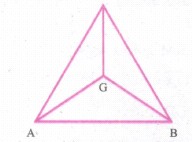
Let the position vector of the vertices of ΔABC be \(\vec { a } \), \(\vec { b } \) and \(\vec { c } \) respectively.
Since G is the centroid of ΔABC, \(\vec { OG } =\frac { \vec { a } +\vec { b } +\vec { c } }{ 3 } \)
Are of ΔGAB, = \(|\vec { AB } \times \vec { AG } |=|(\vec { OB } -\vec { OA } )\times (\vec { OG } -\vec { OA } )|\)
= \(\left| (\vec { b } -\vec { a } )\times \left( \frac { \vec { a } +\vec { b } +\vec { c } }{ 3 } -\vec { a } \right) \right| \)
= \(\left| (\vec { b } -\vec { a } )\times \left( \frac { \vec { a } +\vec { b } +\vec { c } -3\vec { a } }{ 3 } \right) \right| \)
= \(\left| (\vec { b } -\vec { a } )\times \left( \frac { \vec { b } +\vec { c } +2\vec { a } }{ 3 } \right) \right| \)
= \(\frac { 1 }{ 3 } |(\vec { b } -\vec { a } )\times (\vec { a } +\vec { 0 } -2\vec { a } )|\)
= \(\frac { 1 }{ 3 } |\vec { b } \times \vec { b } +\vec { b } \times \vec { c } -2\vec { b } \times \vec { a } -\vec { a } \times \vec { b } -\vec { a } \times \vec { c } +2\vec { a } \times \vec { a } |\)
[∵ cross product is distributive]
= \(\frac { 1 }{ 3 } |\vec { b } \times \vec { c } +2\vec { a } \times \vec { b } -\vec { a } \times \vec { b } +\vec { c } \times \vec { a } |\)
= \(\frac { 1 }{ 3 } |\vec { a } \times \vec { b } +\vec { b } \times \vec { c } +\vec { c } \times \vec { a } |\) \( [\because \vec { b } \times \vec { b } =\vec { 0 } ,\vec { a } \times \vec { a } =\vec { 0 } ,.(1)\vec { a } \times \vec { b } =-\vec { b } \times \vec { a } ]\)
Area of ΔGAC = \(|\vec { CA } \times \vec { AG } |\)
= \(|(\vec { OA } -\vec { OC } )\times (\vec { OG } -\vec { OA } )|\)
\(\left| (\vec { a } -\vec { c } )\times \left( \frac { \vec { a } +\vec { b } +\vec { c } }{ 3 } -\vec { a } \right) \right| \)
= \(\left| (\vec { c } -\vec { a } )\times \left( \frac { \vec { a } +\vec { b } +\vec { c } -3\vec { a } }{ 3 } \right) \right| \)
= \(\frac { 1 }{ 3 } |(\vec { a } -\vec { c } )\times (\vec { b } +\vec { c } -2\vec { a } )|\)
= \(\frac { 1 }{ 3 } |\vec { a } \times \vec { b } +\vec { a } \times \vec { c } -2\vec { a } \times \vec { a } -\vec { c } \times \vec { b } -\vec { c } \times \vec { c } +2\vec { c } \times \vec { a } |\)
= \(\frac { 1 }{ 3 } |\vec { a } \times \vec { b } -\vec { c } \times \vec { a } +\vec { b } \times \vec { c } +2\vec { c } \times \vec { a } |\)
= \(\frac { 1 }{ 3 } |\vec { a } \times \vec { b } +\vec { b } \times \vec { c } +\vec { c } \times \vec { a } |\)
Also area of ΔGBC = \(|\vec { BC } \times \vec { BG } |\)
= \(|\vec { OC } -\vec { OB } )\times (\vec { OG } -\vec { OB } )|\)
= \(\left| (\vec { c } -\vec { a } )\times \left( \frac { \vec { a } +\vec { b } +\vec { c } -\vec { b } }{ 3 } \right) \right| \)
= \(\left| (\vec { c } -\vec { a } )\times \left( \frac { \vec { a } +\vec { b } -2\vec { a } }{ 3 } \right) \right| \)
\(\frac { 1 }{ 3 } |(\vec { c } -\vec { b } )\times (\vec { a } +\vec { c } -2\vec { b } )|\)
= \(\frac { 1 }{ 3 } |\vec { c } \times \vec { a } +\vec { c } \times \vec { c } -2\vec { c } \times \vec { b } -\vec { b } \times \vec { a } -\vec { b } \times \vec { c } +2\vec { b } \times \vec { b } |\)
= \(\frac { 1 }{ 3 } |\vec { c } \times \vec { a } +2\vec { b } \times \vec { c } +\vec { a } \times \vec { b } -\vec { b } \times \vec { c } |\)
\(\frac { 1 }{ 3 } |\vec { c } \times \vec { a } +\vec { b } \times \vec { c } +\vec { a } \times \vec { b } |\)
From (1), (2) and (3),
Area of ΔGAB = Area of ΔGAC = Area of ΔGBC
= \(\frac { 1 }{ 3 } |\vec { a } \times \vec { b } +\vec { b } \times \vec { c } +\vec { c } \times \vec { a } |\)
= \(\frac { 1 }{ 3 } \) Area of ΔABC.
16.
Let I = \(\int _{ 0 }^{ 1 }{ \frac { { e }^{ x } }{ 1+{ e }^{ 2x } } dx } \)
| x | 0 | 1 |
| t | 1 | e |
Put ex = t ⇒ ex dx = dt
∴ \(\int _{ 1 }^{ e }{ \frac { dt }{ 1+{ t }^{ 2 } } dx } { \left[ { tan }^{ -1 }(t) \right] }_{ 1 }^{ e }\)
= tan-1(e) - tan-1(1)
= tan-1(e) -\(\frac { \pi }{ 4 } \)
17.
\({ I }_{ n }=\int _{ 0 }^{ \pi /2 }{ { cos }^{ 7 }xdx=\frac { n-1 }{ n } { I }_{ n-2 },n\ge 2 } \)
\(\therefore { I }_{ 7 }=\int _{ 0 }^{ \pi /2 }{ { cos }^{ 7 }xdx=\frac { 6 }{ 7 } \times \frac { 4 }{ 5 } \times \frac { 2 }{ 3 } \times 1 } =\frac { 16 }{ 35 } \)
18.
The normal vectors of the two given planes \(\vec { r } .(2\hat { i } +2\hat { j } +2\hat { k } )\)= 11 and 4x+2y+2z = 15 are \(\vec { { n }_{ 1 } } =2\hat { i } +2\hat { j } +2\hat { k } \) and \(\vec { { n }_{ 2 } } =4\hat { i } -2\hat { j } +2\hat { k } \) respectively.
If θ is the acute angle between the planes, then we have
\(\theta =cos^{ -1 }\left( \frac { |\vec { { n }_{ 1 } } .\vec { { n }_{ 2 } } | }{ |\vec { { n }_{ 1 } } .\vec { { n }_{ 2 } } | } \right) =cos^{ -1 }\left( \frac { |((2\hat { i } +2\hat { j } +2\hat { k } ).(4\hat { i } -2\hat { j } +2\hat { k } ))| }{ |(2\hat { i } +2\hat { j } +2\hat { k } )||4\hat { i } -2\hat { j } +2\hat { k } | } \right) =cos^{ -1 }\left( \frac { \sqrt { 2 } }{ 3 } \right) \).
19.
Let \(\vec { a } ={ a }_{ 1 }\hat { i } +{ a }_{ 2 }\hat { j } +{ a }_{ 3 }\hat { k } \)
∴ LHS = \(\hat { i } \times (\vec { a } \times \hat { i } )+\hat { j } \times (\vec { a } \times \hat { j } )+\hat { k } \times \vec { a } \times \hat { k }\)
\((\hat { i }. \hat { i } )\vec { a } -(\hat { i } .\hat { a } )\hat { i } +(\hat { j } .\hat { j } )\vec { a } -(\hat { j } .\vec { a } )\hat { j } +(\hat { k } .\hat { k } )\vec { a } -(\hat { k } .\vec { a } )\hat { k } \)
\([\because \vec { a } \times (\vec { b } \times \vec { c } )=(\vec { a } .\vec { c } )\vec { b } -(\vec { a } .\vec { b } )\vec { c } ]\)
\(1.\vec { a } -{ a }_{ 1 }\hat { i } +1.\vec { a } -{ a }_{ 2 }\hat { j } +1.\vec { a } -{ a }_{ 3 }\hat { k } ]\)
\([\because \hat { i } .\hat { i } =\hat { j } .\hat { j } =\hat { k } .\hat { k } =1\)and
\(\hat { i } \vec { a } =\hat { i } ({ a }_{ 1 }\hat { i } +{ a }_{ 2 }\hat { j } +{ a }_{ 3 }\hat { k } )={ a }_{ 1 }\hat { j } .\vec { a } ={ a }_{ 2 }\quad \hat { k } .\vec { a } ={ a }_{ 3 }\)
\(3\vec { a } -({ a }_{ 1 }\hat { i } +{ a }_{ 2 }\hat { j } +{ a }_{ 3 }\hat { k } )\)
= \(3\vec { a } -\vec { a } =2\vec { a } \)
= RHS .
∴ LHS = RHS. Hence proved
20.
We know that the volume of the parallelepiped whose coterminus edges are \(\vec { a } ,\vec { b } ,\vec { c } \) is given by |\([\vec { a } ,\vec { b } ,\vec { c } ]\)|. Here, \(\vec { a } =\hat { 2i } -\hat { 3j } +\hat { 4k } ,\vec { b } =\hat { i } +\hat { 2j } -\hat { k } ,\vec { c } =\hat { 3i } -\hat { j } +\hat { 2k } \)
Since \([\vec { a } ,\vec { b } ,\vec { c } ]\) = \(\left| \begin{matrix} 2 & -3 & 4 \\ 1 & 2 & -1 \\ 3 & -1 & 2 \end{matrix} \right| =-7\) , the volume of the given parallelepiped is \(\left| -7 \right| =7\) cubic units.
21.
(c)
\(3\pi\)
22.
(b)
\(\frac{1}{6}\)
23.
(d)
24.
(d)
2
25.
(b)
\(\frac{2}{9}\)
26.
(b)
\(\frac{1}{10100}\)
27.
(a)
2
28.
(c)
45o
29.
(b)
(-6, 7)
30.
(a)
\(\left| \vec { a } \right| \left| \vec { b } \right| \left| \vec { c } \right| \)

12th Standard Syllabus & Materials
12th Standard
TN 12th Computer Applications வலையமைப்பு வடமிடல் Sample Question Papers Study Material - QB365 Set A
NEW12th Standard
TN 12th Computer Applications களப்பெயர் முறைமை (DNS) Sample Question Papers Study Material - QB365 Set A
NEW12th Standard
TN 12th Computer Applications வலையமைப்பு எடுத்துக்காட்டுகள் மற்றும் நெறிமுறைகள் Sample Question Papers Study Material - QB365 Set A
NEW12th Standard
TN 12th Computer Applications கணினி வலையமைப்பு ஓர் அறிமுகம் Sample Question Papers Study Material - QB365 Set A



Tamilnadu Stateboard 12th Standard Subjects
Maths

Chemistry

Physics

Biology

Computer Science

Business Maths and Statistics

Economics

Commerce

Accountancy

History

Computer Applications
Biology
Computer Technology
Computer Applications
Computer Science
Business Maths and Statistics
Commerce
Economics
Maths
Chemistry
Physics
Computer Technology
History
Accountancy

Tamil

English

French
Tamilnadu Stateboard Standards


