
 100% FREE ACCESS
12th Standard Syllabus & Materials
12th Standard
TN 12th Maths Applications of Matrices and Determinants Sample Question Papers Study Material - QB365 Set A
NEW12th Standard
TN 12th Computer Applications மின்னணு தரவு பரிமாற்றம் Sample Question Papers Study Material - QB365 Set A
NEW12th Standard
TN 12th Computer Applications மின் - வணிக பாதுகாப்பு அமைப்புகள் Sample Question Papers Study Material - QB365 Set A
NEW12th Standard
TN 12th Computer Applications மின்னணு செலுத்தல் முறைகள் Sample Question Papers Study Material - QB365 Set A
NEW12th Standard
TN 12th Computer Applications மின் - வணிகம் Sample Question Papers Study Material - QB365 Set A
NEW12th Standard
TN 12th Computer Applications திறந்த மூல கருத்துருக்கள் Sample Question Papers Study Material - QB365 Set A

Published on: 20/10/2025
Download Tamil Nadu 12th Standard Maths question papers, model tests, one-mark questions, important questions, and public exam papers in PDF format. Free study materials and answer keys for TN State Board students.
Questions + Answers key
Take MCQ Maths Test
1.
Prove that p➝(¬q V r) ≡ ¬pV(¬qVr) using truth table.
2.
If u = sin-1 \(\left( \frac { x+y }{ \sqrt { x } +\sqrt { y } } \right) \), Show that \(x\frac { \partial u }{ \partial x } +y\frac { \partial u }{ \partial y } =\frac { 1 }{ 2 } tanu\)
3.
Find the area of the region bounded by the y-axis and the parabola x = 5 − 4y − y2.
4.
Prove that \(\int ^\frac{\pi}{4}_{0}\) log(1+tan x)dx = \(\frac{\pi}{8}\) log2.
5.
The cumulative distribution function of a discrete random variable is given by
\(F(x)=\left\{\begin{array}{lc}
0 & -\infty<x<-1 \\
0.15 & -1 \leq x<0 \\
0.35 & 0 \leq x<1 \\
0.60 & 1 \leq x<2 \\
0.85 & 2 \leq x<3 \\
1 & 3 \leq x<\infty
\end{array}\right.\)
Find
(i) the probability mass function
(ii) P(X < 1 ) and
(iii) P(X \(\geq\)2)
6.
A radioactive isotope has an initial mass 200mg, which two years later is 50mg. Find the expression for the amount of the isotope remaining at any time. What is its half-life? (half-life means the time taken for the radioactivity of a specified isotope to fall to half its original value).
7.
A rectangular page is to contain 24 cm2 of print. The margins at the top and bottom of the page are 1.5 cm and the margins at other sides of the page is 1 cm. What should be the dimensions of the page so that the area of the paper used is minimum.
8.
Solve the following differential equations:
\(\\ \\ \\ \frac { dy }{ dx } ={ tan }^{ 2 }(x+y)\)
9.
A camera is accidentally knocked off an edge of a cliff 400 ft high. The camera falls a distance of s = 16t2 in t seconds.
(i) How long does the camera fall before it hits the ground?
(ii) What is the average velocity with which the camera falls during the last 2 seconds?
(iii) What is the instantaneous velocity of the camera when it hits the ground?
10.
Find the parametric form of vector equation and Cartesian equations of the plane containing the line \(\vec { r } =(\hat { i } -\hat { j } +3\hat { k } )+t(2\hat { i } -\hat { j } +4\hat { k } )\) and perpendicular to plane \(\vec { r } .(\hat { i } +2\hat { j } +\hat { k } )=8\)
11.
A rod of length 1.2 m moves with its ends always touching the coordinate axes. The locus of a point P on the rod, which is 0.3 m from the end in contact with x -axis is an ellipse. Find the eccentricity.
12.
Investigate for what values of λ and μ the system of linear equations x + 2y + z = 7 , x + y + λz = μ , x + 3y − 5z = 5 has
(i) no solution
(ii) a unique solution
(iii) an infinite number of solutions
13.
Prove that tan-1 x + tan-1 z = tan-1\(\left[ \frac { x+y+z-xyz }{ 1-xy-yz-zx } \right] \)
14.
If z = x + iy is a complex number such that Im \(\left( \frac { 2z+1 }{ iz+1 } \right) =0\) show that the locus of z is 2x2+ 2y2+ x - 2y = 0
15.
Find the vertex, focus, directrix, and length of the latus rectum of the parabola x2−4x−5y−1 = 0.
16.
17.
If 2+i and 3-\(\sqrt{2}\) are roots of the equation x6-13x5+ 62x4-126x3+ 65x2+127x-140 = 0, find all roots.
18.
Find the equation of the circle passing through the points (1, 1 ), (2, -1 ) and (3, 2) .
1.
| p | q | r | ~ q | ~q V r | p➝(¬qVr) | ~p | ~pV(~qVr) |
| T | T | T | F | T | T | F | T |
| T | T | F | F | F | F | F | F |
| T | F | T | T | T | T | F | T |
| T | F | F | T | T | T | F | T |
| F | T | T | F | T | T | T | T |
| F | T | F | F | F | T | T | T |
| F | F | T | T | T | T | T | T |
| F | F | F | T | T | T | T | T |
From the table, it is clear that the column of p➝(¬q V ~r) and ~pV(~q V r) are identical
∴ p➝(¬q V ~r) ≡ ~pV(~q V r)
Hence proved.
2.
Note that the function u is not homogeneous. So we cannot apply Euler’s Theorem for u.
However, note that f(x,y) = \(\frac { x+y }{ \sqrt { x } +\sqrt { y } }\) = sin u is homogeneous; because
f(tx,ty) = \(\frac { tx+ty }{ \sqrt { tx } +\sqrt { ty } } \) = t1/2 f(x, y), \(\forall \) x, y, t\(\ge \)0
Thus f is homogeneous with degree \(\frac { 1 }{ 2 } \) and so by Euler’s Theorem we have
\(x\frac { \partial f }{ \partial x } +y\frac { \partial f }{ \partial y } =\frac { 1 }{ 2 } f(x,y)\).
Now substituting f = sin u in the above equation, we obtain
\(x\frac { \partial (sinu) }{ \partial x } +y\frac { \partial (sinu) }{ \partial y } =\frac { 1 }{ 2 } sin \ u\)
\(x\quad cosu\frac { \partial u }{ \partial x } +y\quad cosu\frac { \partial u }{ \partial x } =\frac { 1 }{ 2 } sin \ u\) ...(19)
Dividing both sides by cosu we obtain
\(x\frac { \partial u }{ \partial x } +y\frac { \partial u }{ \partial y } =\frac { 1 }{ 2 } tan \ u\)
Note:
Solving this problem by direct calculation will be possible; but will involve lengthy calculations.
3.
The equation of the parabola is ( y + 2)2 = −(x−9). The parabola crosses the y- axis at (0, −5) and (0, 1). The vertex is at (9, −2) and the axis of the parabola is y = −2. The required area is sketched
Viewing in the positive direction of x-axis, and making horizontal strips, the required area A is given by
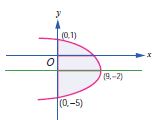
\(A=\int _{ -5 }^{ 1 }{ xdy } =\int _{ -5 }^{ 1 }{ (5-4y-{ y }^{ 2 })dy={ \left[ 5y-2{ y }^{ 2 }-\frac { { y }^{ 3 } }{ 3 } \right] }_{ -5 }^{ 1 }=\frac { 8 }{ 3 } -\left( -\frac { 100 }{ 3 } \right) =36 } \)
4.
Let us put I = \(\int ^\frac{\pi}{4}_{0}\) log(1 + tan x) dx
Applying the property \(\int ^{a}_{0}\) f(x) dx =\(\int ^{a}_{0}\)f(a-x) dx in equation (1), we get
I = \(\int ^\frac{\pi}{4}_{0}\) log \([1+tan (\frac{\pi}{4}-x)]\)dx = \(\int ^\frac{\pi}{4}_{0}\) log\([1 + \frac{tan \frac {\pi}{4}- tan x}{1 + tan {\frac {\pi}{4} tan x}}]\) dx
=\(\int ^\frac{\pi}{4}_{0}\) log \([1 + \frac {1 - tan x}{1 + tan x}]\)dx = \(\int ^\frac{\pi}{4}_{0}\) log\([\frac {1+tan x +1 - tan x}{1 + tan x}]\) dx
=\(\int ^\frac{\pi}{4}_{0}\) log \([\frac{2}{1+tanx}]\) dx = \(\int ^\frac{\pi}{4}_{0}\) [log 2 - log (1+tan x)] dx
= log 2 \(\int ^\frac{\pi}{4}_{0}\) dx - \(\int ^\frac{\pi}{4}_{0}\)log (1+tan x)] dx
= \(\frac{\pi}{4}\)log 2 - I
So, we get 2I = \(\frac{\pi}{4}\)log 2.
Hence, we get I = \(\frac{\pi}{8}\)log 2.
5.
(i) The equivalent table is
X | -1 | 0 | 1 | 2 | 3 |
|---|---|---|---|---|---|
F(x) | 0.15 | 0.35 | 0.60 | 0.85 | 1 |
f(x) = P[X= x] | 0.15 | 0.20 | 0.25 | 0.25 | 0.15 |
(ii) P(X <1) = P(X =-1)+P(X =0) =0.35
\(\text { (iii) } P(X \geq 2)=\) P(X =2)+P(X =3) = 0.40
6.
Let A be the mass of the isotope remaining after t years, and let −k be the constant of proportionality, where k > 0. Then the rate of decomposition is modeled by \(\frac{da}{dt}=-kA,\) where the minus sign indicates that the mass is decreasing. It is a separable equation. Separating the variables,we get\(\frac{da}{dt}=-kdt\).
Integrating on both sides, we get log |A| = −kt + log |C| or A = Ce−kt.
Given that the initial mass is 200mg. That is, A = 200 when t = 0 and thus, C = 200.
Thus, we get A = − 200e-kt.
Also, A =150when t = 2 and therefore, k = \(\frac{1}{2}log(\frac{4}{3})\)
Hence, A(t) = 200e\(\frac{1}{2}log(\frac{4}{3})\) is the mass of isotope remaining after t years.
The half-life th is the time corresponding to A = 100 mg
Thus, \({ t }_{ k }=\frac { 2log\left( \frac { 1 }{ 2 } \right) }{ log\left( \frac { 3 }{ 4 } \right) } \).
7.
Let x and y be the length, breadth of the printed rectangular page
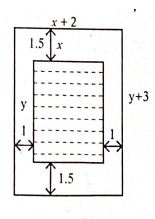
Given xy = 24
\(\Rightarrow y=\frac { 24 }{ x } \) ..(1)
Length of the page with margin
= x+1+1 = x+2
breadth of the page with margin
= y + 1.5 + 1.5 = y + 3
Area of the page = (x + 2) (y + 3)
Let f(x) = (x + 2) (y + 3)
= \((x+2)\left( \frac { 24 }{ x } +3 \right) \)
= \(24+3x+\frac { 48 }{ x } +30\)
= \(3x+\frac { 48 }{ x } +30\)
\(f'\left( x \right) =3-\frac { 48 }{ { x }^{ 2 } } \)
\(\Rightarrow { x }^{ 2 }=16\Rightarrow x=\pm 4\)
ஃ The critical number are 4,-4
\(f''\left( x \right) =-48\left( \frac { -2 }{ { x }^{ 3 } } \right) =\frac { 96 }{ { x }^{ 3 } } \)
\(f''\left( 4 \right) =\frac { 96 }{ 64 } >0\)
ஃ f(x) is minimum when x = 4
When \(x=4,y=\frac { 24 }{ 4 } =6\) [From (1)]
ஃ Length of the page = x + 2 = 4 + 2 = 9 cm
Breadth of the page = y + 3 = 6 + 3 = 6 cm
8.
\(\\ \\ \\ \frac { dy }{ dx } ={ tan }^{ 2 }(x+y)...(1)\)
Take x + y = t
\(\Rightarrow 1+\frac { dy }{ dx } =\frac { dt }{ dx } \)
\(\Rightarrow \frac { dy }{ dx } =\frac { dt }{ dx } -1\)
∴ (1) becomes,
\(\frac { dt }{ dx } -1={ tan }^{ 2 }t\)
\(\Rightarrow \frac { dt }{ dx } ={ tan }^{ 2 }t1\)
\(\Rightarrow \frac { dt }{ dx } ={ sec }^{ 2 }(t)\)
\(\Rightarrow \frac { dt }{ { sec }^{ 2 }t } =dx\)
\(\Rightarrow { cos }^{ 2 }t\quad dt=dx\)
\(\left(\frac{1+\cos 2 t^{\circ}}{2}\right) d t=\mathrm{d} x \quad\left(\because \cos ^2 \theta=\frac{1+\cos 2 \theta}{2}\right)\)
\(\left[ cos\quad 2x=2{ cos }^{ 2 }x-1{ cos }^{ 2 }x=\frac { 1+cos2x }{ 2 } \right] \)
Taking integration on both sides, we get
\(\Rightarrow \left( \frac { 1+cos2\quad t }{ 2 } \right) dt=dx\)
\(\Rightarrow \frac { 1 }{ 2 } \int { (1+cos2t)dt=\int { dx } } \)
\(\Rightarrow \frac { 1 }{ 2 } \left[ t+\frac { sin2t }{ 2 } \right] =x+c\)
\(\Rightarrow \frac { 1 }{ 2 } \left[ t+\frac { 2sintcost }{ 2 } \right] =x+c\)
\(\Rightarrow \frac { 1 }{ 2 } [t+sin\ t\ cost]=x+c\ [\because t=x+y]\)
\(\Rightarrow \frac { 1 }{ 2 } [x+y+sin(x+y)cos(x+y)=x+c\)
9.
Given s (t) = 16t2, height = 400 ft.
⇒ t2 = \(\frac { 400 }{ 16 } =\frac { 100 }{ 4 } \)
t2 = 25
t = 5 sec
(ii) Average velocity = \(\frac { ds }{ dt } \) = 32 t
When t = 2 sec
Average in the last
2 sec = \(\frac { V \ at \ t=3+V \ at \ t=5 }{ 2 } \)
= \(\frac { 32(3)+32(5) }{ 2 } \)
= \(\frac { 96+160 }{ 2 } =\frac { 256 }{ 2 } \)
= 128 f/sec
(iii) Instantaneous Velocity
=\(\frac { ds }{ dt } \) = 32t
When t = 5 sec
Velocity = \(\frac { ds }{ dt } \) = 32(5)
= 160 ft/sec
10.
The plane containing the line
\(\vec { r } =(\hat { i } -\hat { j } +3\hat { k } )+t(2\hat { i } -\hat { j } +4\hat { k } )\)
∴ The required plane is passing through the point \(\vec { a } =\hat { i } -\hat { j } +3\hat { k } \) and parallel to a vector \(\vec { b } =2\hat { i } -\hat { j } +4\hat { k } \) Also, the plane is perpendicular to the plane
\(\vec { c } =\hat { i } +2\hat { j } +\hat { k } \)
∴ The parametric form of vector equation of the plane passing through one point (\(\vec { a } \)) and parallel to two vectors \(\vec { b } \) and \(\vec { c } \)
\(\vec { r } =\vec { a } +s\vec { b } +t\vec { c } \) where s, t ∈ R
⇒ \(\vec { r } .(\hat { i } -\hat { j } +3\hat { k } )+s(2\hat { i } -\hat { j } +4\hat { k } )+t(\hat { i } +2\hat { j } +\hat { k } )\) s, t ∈ R
Cartesian equation is
\(\left| \begin{matrix} x-{ x }_{ 1 } & y-{ y }_{ 1 } & z-{ z }_{ 1 } \\ { b }_{ 1 } & { b }_{ 2 } & { b }_{ 3 } \\ { c }_{ 1 } & { c }_{ 2 } & { c }_{ 3 } \end{matrix} \right| =0\)
\(\Rightarrow \left| \begin{matrix} x-1 & y+1 & z-3 \\ 2 & -1 & 4 \\ 1 & 2 & 1 \end{matrix} \right| =0\)
⇒ (x - 1)(-1 - 8) - (y + 1)(2 - 4) + (z - 3)(4 + 1) = 0
⇒ (x - 1)(-9) - (y + 1)(-2) + (z - 3)5 = 0
⇒ -9x + 9 +2y + 2 + 5z - 15 = 0
⇒ -9x + 2y + 5z - 4 = 0
⇒ 9x - 2y - 5z + 4 = 0
11.
Let AB be the rod and P(x1, y1) be a point on the rod such that AP = 0.3 m.
Draw PD ⊥ x-axis and PC ⊥ y - axis.
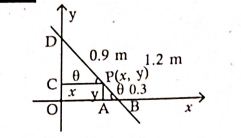
Δ ADP ≅ Δ PCB
∴ \(\frac { PC }{ DA } =\frac { PB }{ AP } =\frac { BC }{ PD } \)
⇒ \(\frac { x_{ 1 } }{ DA } =\frac { 0.9 }{ 0.3 } =\frac { BC }{ { y }_{ 1 } } \)
⇒ \(DA=\frac { 0.3{ x }_{ 1 } }{ 0.9 } =\frac { { x }_{ 1 } }{ 3 } \)
and BC = \(\frac { 0.9{ y }_{ 1 } }{ 0.3 } =\frac { 9 }{ 3 } { y }_{ 1 }=3{ y }_{ 1 }\)
Now OA = OD + DA
= \({ x }_{ 1 }+\frac { { x }_{ 1 } }{ 3 } =\frac { 4{ x }_{ 1 } }{ 3 } \)
OB = OC + BC = y1 + 3y1 = 4y1
But OA2 + OB2 = AB2
⇒ \({ \left( \frac { 4{ x }_{ 1 } }{ 3 } \right) }^{ 2 }+{ \left( 4{ y }_{ 1 } \right) }^{ 2 }={ \left( 1.2 \right) }^{ 2 }\)
⇒ \(\frac { { { x }_{ 1 } }^{ 2 } }{ 9 } +\frac { { { y }_{ 1 } }^{ 2 } }{ 9 } =\frac { 1.44 }{ 16 } =0.09\) ≅ 1
∴ Locus of (x1, y1) is \(\frac { { x }^{ 2 } }{ 9 } +\frac { { y }^{ 2 } }{ 1 } =1\)
Here a2 = 9, b2 = 1
∴ \(e=\sqrt { 1-\frac { { b }^{ 2 } }{ { a }^{ 2 } } } =\sqrt { 1-\frac { 1 }{ 9 } } =\sqrt { \frac { 9-1 }{ 9 } } \)
= \(\sqrt { \frac { 8 }{ 9 } } \)
e = \(\frac { 2\sqrt { 2 } }{ 3 } \)
12.
Here the number of unknowns is 3.
The matrix form of the system is AX = B, where A = \(\left[ \begin{matrix} 1 & 2 & 1 \\ 1 & 1 & \lambda \\ 1 & 3 & -5 \end{matrix} \right] \), X = \(\left[ \begin{matrix} x \\ y \\ z \end{matrix} \right] \), B = \(\left[ \begin{matrix} 7 \\ \mu \\ 5 \end{matrix} \right] \).
Applying elementary row operations on the augmented matrix [A | B], we get
[A | B] = \(\left[ \begin{matrix} 1 & 2 & 1 \\ 1 & 1 & \lambda \\ 1 & 3 & -5 \end{matrix}|\begin{matrix} 7 \\ \mu \\ 5 \end{matrix} \right] \overset { { R }_{ 2 }\leftrightarrow { R }_{ 3 } }{ \longrightarrow } \left[ \begin{matrix} 1 & 2 & 1 \\ 1 & 3 & -5 \\ 1 & 1 & \lambda \end{matrix}|\begin{matrix} 7 \\ 5 \\ \mu \end{matrix} \right] \overset { \begin{matrix} { R }_{ 2 }\longrightarrow { R }_{ 2 }-{ R }_{ 1 }, \\ { R }_{ 3 }\longrightarrow { R }_{ 3 }-{ R }_{ 1 } \end{matrix} }{ \longrightarrow } \left[ \begin{matrix} 1 & 2 & 1 \\ 0 & 1 & -6 \\ 0 & -1 & \lambda -1 \end{matrix}|\begin{matrix} 7 \\ -2 \\ \mu -7 \end{matrix} \right] \overset { { R }_{ 3 }\longrightarrow { R }_{ 3 }+{ R }_{ 2 } }{ \longrightarrow } \left[ \begin{matrix} 1 & 2 & 1 \\ 0 & 1 & -6 \\ 0 & 0 & \lambda -7 \end{matrix}|\begin{matrix} 7 \\ -2 \\ \mu -9 \end{matrix} \right] \).
(i) If λ =7 and μ \(\neq\) 9, then ρ(A) = 2 and ρ([A | B]) = 3. So ρ(A) ≠ ρ([A | B]) Hence the given system is inconsistent and has no solution.
(ii) If λ ≠ 7 and μ is any real number, then ρ(A) = 3 and ρ([A | B]) = 3.
So, ρ(A) = ρ([A | B]) = 3 = Number of unknown. Hence the given system is consistent and has a unique solution.
(iii) If λ = 7 and μ = 9, then ρ(A) = 2 and ρ([A | B]) = 2.
So, ρ(A) = ρ([A | B]) = 2 < Number of unknown. Hence the given system is consistent and has infinite number of solutions.
13.
We know that \({ tan }^{ -1 }x+{ tan }^{ -1 }y={ tan }^{ -1 }\left( \frac { x+y }{ 1-xy } \right) \)
\(\therefore LHS={ tan }^{ -1 }(x)+{ tan }^{ -1 }(y)+{ tan }^{ -1 }(z)\)
= \({ tan }^{ -1 }\left( \frac { x+y }{ 1-xy } \right) +{ tan }^{ -1 }\left( z \right) \)
= \({ tan }^{ -1 }\left( \frac { \frac { x+y }{ 1-xy } +z }{ 1-z\left( \frac { x+y }{ 1-xy } \right) } \right) \) by(1)
= \({ tan }^{ -1 }\left( \frac { \frac { x+y+z(1-xy) }{ 1-xy } }{ \frac { (1-xy)-z(x+y) }{ 1-xy } } \right) \)
= \({ tan }^{ -1 }\left( \frac { \frac { x+y+z-xyz }{ 1-xy } }{ \frac { 1-xy-zx-zy }{ 1-xy } } \right) \)
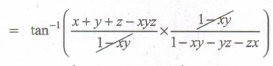
= \({ tan }^{ -1 }\left( \frac { x+y+z-xyz }{ 1-xy-yz-zx } \right) =RHS\)
Hence proved.
14.
Given z = x + iy
Im \(\left( \frac { 2z+1 }{ iz+1 } \right) \)= 0
⇒ Im\(\left( \frac { 2(x+iy)+1 }{ i(x+iy)+1 } \right) \)= 0
⇒ Im\(\left( \frac { (2x+1)+2iy }{ ix+i^{ 2 }y+1 } \right) \)
⇒ Im\(\left( \frac { (2x+1)+2iy }{ ix-y+1 } \right) \)
\(\left( \frac { (2x+1)+iy }{ (1-y)+ix } \right) \)
Multiply and divide by the conjugate of the denominator
We get Im\(\left( \frac { (2x+1)+2iy }{ (1-y)+ix } \times \frac { (1-y)-ix }{ (1-y)-ix } \right) \)=0
⇒ Im\(\left( \frac { (2x+1)+2iy\times (1-y)-ix }{ (1-y)^{ 2 }+{ x }^{ 2 } } \right) \)
Choosing the imaginably part we get,
\(\frac { (2x+1)(-x)+2y(1-y) }{ (1-y)^{ 2 }+{ x }^{ 2 } } \)
⇒ (2x+1)-x+2y(1-y) = 0
⇒ -2x2-x+2y-2y2 = 0
⇒ 2x2+2y2+x-2y = 0
Hence, locus of z is 2x2+2y2+x-2y = 0
15.
For the parabola,
x2- 4x - 5y -1 = 0
x2- 4x = 5y +1
x2−4x +4 = 5y +1+ 4
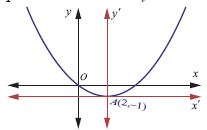
(x − 2)2 = 5(y +1) which is in standard form.
Therefore 4a = 5 and the vertex is (2, -1) , and focus is \(\left( 2,\frac { 1 }{ 4 } \right) \)
Equation of directrix is
y-k+ a = 0
y+1+\(\frac { 5 }{ 4 } \)
4y +9 = 0
Length of latus rectum is 5 units.
16.
17.
Since the coefficients of the equation are all rational numbers, 2+i and 3-\(\sqrt{2}\) are roots, we get 2-i and 3+\(\sqrt{2}\) are also roots of the given equation. Thus (x-(2+i)), (x-(2-i)), (x-(3-\(\sqrt{2}\))) and (x-(3+\(\sqrt{2}\))) are factors. Thus their product.
((x-(2+i))(x-(2-i))(x-(3-\(\sqrt{2}\)))(x-(3+\(\sqrt{2}\))) is a factor of the given polynomial equation.
That is, (x2-4x+5)(x2-6x+7) is a factor. Dividing the given polynomial equation by this factor, we get the other factor as (x2-3x-4) which implies that 4 and −1 are the other two roots. Thus
2+i, 2-i, 3+\(\sqrt{2}\), 3-\(\sqrt{2}\), -1, and 4 are the roots of the given polynomial equation.
18.
Let the general equation of the circle be
x2 +y2 +2gx + 2fy + c = 0 ........ (1)
It passes through points (1, 1), (2, -1) and(3, 2) .
Therefore,
2g+2f+c = -2 ........ (2)
4g−2f+c = -5 ........(3)
6g+4f+c = -13 ...... (4)
(2) – (3) gives −2g + 4f = 3 ... (5)
(4) – (3) gives 2g + 6f = -8 ....(6)
(5) + (6) gives f = \(-\frac { 1 }{ 2 } \)
Substituting f = \(-\frac { 1 }{ 2 } \) in (6), g = -\(\frac { 5 }{ 2 } \)
Substituting f = \(-\frac { 1 }{ 2 } \) and g = - \(\frac { 5 }{ 2 } \) in (2), c = 4 .
Therefore the required equation of the circle is
x2+ y2+ 2\(\left( -\frac { 5 }{ 2 } \right) x+2\left( -\frac { 1 }{ 2 } \right) \)y+4 = 0 and x2 + y2 − 5x − y + 4 = 0.

12th Standard Syllabus & Materials
12th Standard
TN 12th Computer Applications வலையமைப்பு வடமிடல் Sample Question Papers Study Material - QB365 Set A
NEW12th Standard
TN 12th Computer Applications களப்பெயர் முறைமை (DNS) Sample Question Papers Study Material - QB365 Set A
NEW12th Standard
TN 12th Computer Applications வலையமைப்பு எடுத்துக்காட்டுகள் மற்றும் நெறிமுறைகள் Sample Question Papers Study Material - QB365 Set A
NEW12th Standard
TN 12th Computer Applications கணினி வலையமைப்பு ஓர் அறிமுகம் Sample Question Papers Study Material - QB365 Set A



Tamilnadu Stateboard 12th Standard Subjects
Maths

Chemistry

Physics

Biology

Computer Science

Business Maths and Statistics

Economics

Commerce

Accountancy

History

Computer Applications
Biology
Computer Technology
Computer Applications
Computer Science
Business Maths and Statistics
Commerce
Economics
Maths
Chemistry
Physics
Computer Technology
History
Accountancy

Tamil

English

French
Tamilnadu Stateboard Standards


