
 100% FREE ACCESS
12th Standard Syllabus & Materials
12th Standard
TN 12th Maths Applications of Matrices and Determinants Sample Question Papers Study Material - QB365 Set A
NEW12th Standard
TN 12th Computer Applications மின்னணு தரவு பரிமாற்றம் Sample Question Papers Study Material - QB365 Set A
NEW12th Standard
TN 12th Computer Applications மின் - வணிக பாதுகாப்பு அமைப்புகள் Sample Question Papers Study Material - QB365 Set A
NEW12th Standard
TN 12th Computer Applications மின்னணு செலுத்தல் முறைகள் Sample Question Papers Study Material - QB365 Set A
NEW12th Standard
TN 12th Computer Applications மின் - வணிகம் Sample Question Papers Study Material - QB365 Set A
NEW12th Standard
TN 12th Computer Applications திறந்த மூல கருத்துருக்கள் Sample Question Papers Study Material - QB365 Set A

Published on: 20/10/2025
Download Tamil Nadu 12th Standard Maths question papers, model tests, one-mark questions, important questions, and public exam papers in PDF format. Free study materials and answer keys for TN State Board students.
Questions + Answers key
Take MCQ Maths Test
1.
If | z | = 2 show that \(8 \leq|z+6+8 i| \leq 12\)
2.
Find the value of
\(sin\left( { tan }^{ -1 }\left( \frac { 1 }{ 2 } \right) -{ cos }^{ -1 }\left( \frac { 4 }{ 5 } \right) \right) \)
3.
Obtain the Cartesian form of the locus of z = x + iy in each of the following cases:
Im[(1−i)z+1] = 0
4.
Find the value of
\({ cos }^{ -1 }\left( \frac { 1 }{ 2 } \right) +{ sin }^{ -1 }(-1)\)
5.
Show that |z+2−i|<2 represents interior points of a circle. Find its centre and radius.
6.
Find the value of \(\sum _{ k=1 }^{ 8 }{ \left( cos\frac { 2k\pi }{ 9 } +isin\frac { 2k\pi }{ 9 } \right) } \).
7.
Find the value of the expression in terms of x, with the help of a reference triangle.
sin(cos−1(1-x))
8.
Show that cot−1\(\left( \frac { 1 }{ \sqrt { { x }^{ 2 }-1 } } \right) ={ sec }^{ -1 }x,|x|>1\)
9.
If cot-1\(\frac{1}{7}=\theta\), find the value of cos \(\theta\).
10.
The complex numbers u, v, and w are related by \(\frac { 1 }{ u } =\frac { 1 }{ v } +\frac { 1 }{ w } \) If v = 3−4i and w = 4+3i, find u in rectangular form.
11.
For what value of x, the inequality \(\frac { \pi }{ 2 } <{ cos }^{ -1 }(3x-1)<\pi \) holds?
12.
Show that \(\left( \frac { 19+9i }{ 5-3i } \right) ^{ 15 }-\left( \frac { 8+i }{ 1+2i } \right) ^{ 15 }\) is purely imaginary.
13.
A 12 metre tall tree was broken into two parts. It was found that the height of the part which was left standing was the cube root of the length of the part that was cut away. Formulate this into a mathematical problem to find the height of the part which was left standing.
14.
If α, β, γ and \(\delta\) are the roots of the polynomial equation 2x4 + 5x3 − 7x2 + 8 = 0, find a quadratic equation with integer coefficients whose roots are α + β + γ + \(\delta\) and αβ૪\(\delta\).
15.
If α, β, and γ are the roots of the polynomial equation ax3+ bx2+ cx + d = 0, find the value of \(\Sigma \frac { \alpha }{ \beta \gamma } \) in terms of the coefficients.
16.
Find the sum of the squares of the roots of ax4+ bx3+ cx2+ dx + e = 0. \(a \neq 0\)
17.
If α, β and γ are the roots of the cubic equation x3+2x2+3x+4 = 0, form a cubic equation whose roots are, 2α, 2β, 2γ
18.
Construct a cubic equation with roots 1, 2 and 3
19.
If the sides of a cubic box are increased by 1, 2, 3 units respectively to form a cuboid, then the volume is increased by 52 cubic units. Find the volume of the cuboid.
20.
If z1 = 3, z2 = -7i, and z3 = 5 + 4i, show that z1(z2 + z3) = z1 z2 + z1 z3
1.
\( |z|=2 \)
\(|z+6+8 i|=|z|+|6+8 i| \)
\(=2+\sqrt{6^{2}+8^{2}} \)
\(=2+\sqrt{100} \)
= 2 + 10
= 12
\( \therefore|z+6+8 i| \leq 12 \) ............. (1)
\(|z+6+8 i| \geq|| z|-|-6-8 i|| \)
\(=|2-10| \)
\(=|-8|\)
= 8
\(|z+6+8 i| \geq 8\) .............(2)
From 1 and 2 we get
\(8 \leq|z+6+8 i| \leq 12\)
Hence proved
2.
\(sin\left( { tan }^{ -1 }\left( \frac { 1 }{ 2 } \right) -{ cos }^{ -1 }\left( \frac { 4 }{ 5 } \right) \right) \)
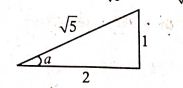
Let \({ tan }^{ -1 }\left( \frac { 1 }{ 2 } \right) =x\Rightarrow \frac { 1 }{ 2 } =tanx\)
\(cosx=\frac { adj }{ hyp } =\frac { 2 }{ \sqrt { 5 } } \)
\(\therefore sinx= \frac { 1 }{ \sqrt { 5 } } \)
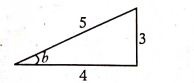
Let \({ cos }^{ -1 }\left( \frac { 4 }{ 5 } \right) =y\Rightarrow \frac { 4 }{ 5 } =cosy\)
\(siny=\frac { opp }{ hyp } =\frac { 3 }{ 5 } \)
\(\therefore sin\left( { tan }^{ -1 }\left( \frac { 1 }{ 2 } \right) \right) -{ cos }^{ -1 }\left( \frac { 4 }{ 5 } \right) \)
= sin (x - y) = sin x cos y - cos x sin y
= \(\frac { 1 }{ \sqrt { 5 } } .\frac { 4 }{ 5 } -\frac { 2 }{ \sqrt { 5 } } .\frac { 3 }{ 5 } \)
= \(\frac { 4 }{ 5\sqrt { 5 } } =\frac { 6 }{ 5\sqrt { 5 } } =\frac { -2 }{ 5\sqrt { 5 } }\)
3.
Im[(1−i)z + 1] = 0
(1-i)z + 1 = (1-i)( x + iy) +1
= x + iy-ix-i2y+1
= x+iy-ix+y+1
= (x + y + 1) + i(y - x)
∴ Im[(1-i)z + 1] = y-x = 0
⇒ x - y = 0
Hence, the Cartesian equation is x - y = 0
4.
\({ cos }^{ -1 }\left( \frac { 1 }{ 2 } \right) +{ sin }^{ -1 }(-1)\)
Let \({ cos }^{ -1 }\left( \frac { 1 }{ 2 } \right) =x\) and -1 = sin y
\(\Rightarrow cosx=\frac { 1 }{ 2 } =cos\frac { \pi }{ 3 } \)
\(x=\frac { \pi }{ 3 } \)
\(siny=-1=-sin\left( \frac { -\pi }{ 2 } \right) \)
= \(-sin\left( \frac { -\pi }{ 2 } \right) \)
\(\left[ \because sin\left( -\theta \right) =-sin\ \theta\ and\ \frac { \pi }{ 2 } \varepsilon \left[ \frac { -\pi }{ 2 } ,\frac { \pi }{ 2 } \right] \right] \)
\(\Rightarrow y=\frac { -\pi }{ 2 } \)
\(\therefore { cos }^{ -1 }\left( \frac { 1 }{ 2 } \right) +{ sin }^{ -1 }\left( -1 \right) =x+y\)
= \(\frac { \pi }{ 3 } -\frac { \pi }{ 2 } =\frac { 2\pi -3\pi }{ 6 } =-\frac { \pi }{ 6 } \)
\(\therefore { cos }^{ -1 }\left( \frac { 1 }{ 2 } \right) +{ sin }^{ -1 }(-1)=-\frac {\pi }{ 6 } \)
5.
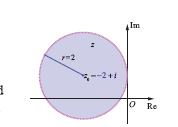
Consider the equation |z+2−i| = 2.
This can be written as |z−(−2+i) | = 2.
The above equation represents the circle with centre z0 = -2+i and radius r = 2. Therefore z + 2−i<2 represents all points inside the circle with centre at −2+i and radius 2 as shown in figure.
6.
\(c\ is\frac { 2\pi }{ 9 } +c\ is\frac { 4\pi }{ 9 } +c\ is\frac { 6\pi }{ 9 } +c\ is\frac { 8\pi }{ 9 } +c\ is\left( \frac { 10\pi }{ 9 } \right) +c\ is\frac { 12\pi }{ 9 } +c\ is\frac { 14\pi }{ 9 } +c\ is\frac { 16\pi }{ 9 } \)
=\(\ c\ is\left( \frac { 2\pi }{ 9 } +\frac { 4\pi }{ 9 } +\frac { 6\pi }{ 9 } +\frac { 8\pi }{ 9 } +\frac { 10\pi }{ 9 } +\frac { 12\pi }{ 9 } +\frac { 14\pi }{ 9 } +\frac { 16\pi }{ 9 } \right) \)

= \(\left[ \because 1+2+3+....+n=\frac { n(n+1) }{ 2 } \right] \)
= c is 8π = [cos(8π)+i sin 8π]
= -1 + i(0) [∴ cos8π = -1 and sin 8π = 0 = -1
7.
sin(cos−1(1-x))
we know that \({ cos }^{ -1 }x={ sin }^{ -1 }\left( \sqrt { 1-{ x }^{ 2 } } \right) \text {if}\ 0\le x\le 1\)
\(\therefore { cos }^{ -1 }\left( 1-x \right) ={ sin }^{ 1 }\sqrt { 1-\left( 1-x \right) ^{ 2 } } \left[ \because 0\le x\le 1 \right] \)
= \({ sin }^{ -1 }\left( \sqrt { 1-\left( 1+{ x }^{ 2 }-2x \right) } \right) \)
= \({ sin }^{ -1 }\left( \sqrt { 1-1-{ x }^{ 2 }+2x } \right) ={ sin }^{ -1 }\left( \sqrt { 2x-{ x }^{ 2 } } \right) \)
\(\therefore sin\left( { cos }^{ -1 }\left( 1-x \right) \right) =sin\left( { sin }^{ -1 }\left( \sqrt { 2x-{ x }^{ 2 } } \right) \right) \)
= \(\sqrt { 2x-{ x }^{ 2 } } \)
8.
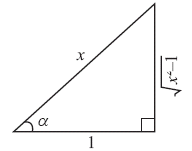
Let cot−1\(\left( \frac { 1 }{ \sqrt { { x }^{ 2 }-1 } } \right) =\alpha \). Then, cot \(\alpha =\frac { 1 }{ \sqrt { { x }^{ 2 }-1 } } \) and α is acute.
We construct a right triangle with the given data.
From the triangle, sec\(\alpha=\frac{x}{1}=x\). Thus, \(\alpha\) = sec-1x
Hence, cot−1\(\left( \frac { 1 }{ \sqrt { { x }^{ 2 }-1 } } \right) ={ sec }^{ -1 }x,|x|>1\)
9.
By definition, cot-1x\(\in(0,\pi)\)
Therefore, cot-1\((\frac{1}{7})\) = \(\theta\) implies \(\theta \in(0,\pi)\)
But cot-1\((\frac{1}{7})\) = \(\theta\) implies cot \(\theta\) = \(\frac{1}{7}\) and hence tan \(\theta\) = 7 and \(\theta\) is acute.
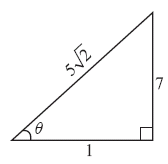
Using tan \(\theta\) = \(\frac{7}{1}\), We construct a right triangle as shown .
Then, we have, cos \(\theta\) = \(\frac{1}{5\sqrt2}\).
10.
Given v = 3-4i, w = 4+3i and \(\frac { 1 }{ u } =\frac { 1 }{ v } +\frac { 1 }{ w } \)
∴ \(\frac { 1 }{ u } =\frac { 1 }{ 3-4i } +\frac { 1 }{ 4+3i } \)
= \(\frac { 3+4i }{ (3-4i)(3+4i) } +\frac { 4-3i }{ (4+3i)(4-3i) } \)
= \(\\ \frac { 3+4i }{ 9-(4i)^{ 2 } } +\frac { 4-3i }{ 16-(3i)^{ 2 } } =\frac { 3+4i }{ 9+16 } +\frac { 4-3i }{ 16+9 } \)
= \(\frac { 3+4i }{ 25 } +\frac { 4-3i }{ 25 } =\frac { 3+4i+4-3i }{ 25 } \)
\(\frac { 1 }{ u } =\frac { 7+i }{ 25 } \)
∴ u = \(\frac { 25 }{ 7+i } \times \frac { 7-i }{ 7-i } =\frac { 25(7-i }{ 7^{ 2 }-({ i }^{ 2 }) } \)
= \(\frac { 25(7-i) }{ 49+1 } =\frac { 25(7-i) }{ 50 } =\frac { 1 }{ 2 } \)(7-i)
∴ u = \(\frac { 1 }{ 2 } \)(7-i) or \(\frac { 7 }{ 2 } \) - \(\frac { i }{ 2 } \)
11.
Given \(\frac { \pi }{ 2 } <{ cos }^{ -1 }(3x-1)<\pi \)
\((cos2\frac { \pi }{ 2 } <3x-1\))
\(\Rightarrow 0<3x-1<-1\)
\(0+1<3x<-1+1\)
\(1<3x<0\)
12.
Let z =\(\left( \frac { 19+9i }{ 5-3i } \right) ^{ 15 }-\left( \frac { 8+i }{ I+2i } \right) ^{ 15 }\)
Here, \(\frac { 19+9i }{ 5-3i } =\frac { (19+9i)(5+3i) }{ (5-3i)(5+3i) } \)
= \(\frac { (95-27)+i(45+57) }{ { 5 }^{ 2 }+{ 3 }^{ 2 } } =\frac { 68+102i }{ 34 } \)
= 2 + 3i ................(1)
and \(\frac { 8+i }{ 1+2i } =\frac { (8+i)(1-2i) }{ (1+2i)(1-2i) } \)
= \(\frac { (8+2)+i(1-16) }{ { 1 }^{ 2 }+{ 2 }^{ 2 } } =\frac { 10-15i }{ 5 } \)
= 2 - 3i .............. (2)
Now z =\(\left( \frac { 19+9i }{ 5-3i } \right) ^{ 15 }-\left( \frac { 8+i }{ 1+2i } \right) ^{ 15 }\)
⇒ z = (2 + 3i)15 - (2 - 3i)15 (by (1) and (2))
Then by definition, \(\bar { z } =\left( \overline { (2+3i)^{ 15 }-(2-3i)^{ 15 } } \right) \)
= \(\left( \overline { 2+3i } \right) ^{ 15 }-\left( \overline { 2-3i } \right) ^{ 15 }\) (using properties of conjugates)
= (2 - 3i)15 - (2 + 3i)15 = -((2 + 3i)15 - (2-3i)15)
⇒ \(\\ \overline { z } \) = -z
Therefore, \(\left( \frac { 19+9i }{ 5-3i } \right) ^{ 15 }-\left( \frac { 8+i }{ 1+2i } \right) ^{ 15 }\) is purely imaginary.
13.
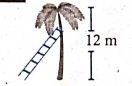
Given that the height of the tree is 12m.
Let x m be the standing part and (12 -x)m be the broken part.
Given \(x=\sqrt [ 3 ]{ 12-x } \)
\(\Rightarrow x=(12-x)^{ \frac { 1 }{ 3 } }\)
Taking power 3 both sides, we get
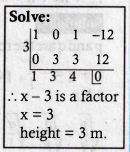
⇒ x3 = 12-x
⇒ x3+ x -12 = 0
which is the required mathematical problem.
14.
Given polynomial equation is
2x4+ 5x3−7x2 + 8 = 0
Here a = 2, b = 5, c = -7, d = 0, e = 8
By Vieta's formula,
\(\alpha +\beta +\gamma +\delta =\frac { -b }{ a } =\frac { -5 }{ 2 } \)
\(\alpha \beta +\alpha \gamma +\alpha \delta +\beta \gamma +\beta \delta +\gamma \delta =\frac { c }{ a } =\frac { -7 }{ 2 } \)
\(\alpha \beta \gamma +\alpha \beta \delta +\alpha \gamma \delta +\beta \gamma \delta =\frac { -d }{ a } =0\)
\(\alpha \beta \gamma \delta =\frac { e }{ a } =\frac { 8 }{ 2 } =4\)
Given roots of quadratic equation are
∝ + β + ૪ + \(\delta \) and ∝β૪\(\delta \)
∴ sum of the roots = (∝+β+૪+\(\delta \)) (∝β૪\(\delta \))
\(=\left( \frac { -5 }{ 2 } +4 \right) =\frac { -5+8 }{ 2 } =\frac { 3 }{ 2 } \)
\(=\left( \alpha +\beta +\gamma +\delta \right) (\alpha \beta \gamma \delta )\)
\(=\left( \frac { -5 }{ 2 } \right) (4)=\frac { -20 }{ 2 } =-10\)
∴ The required quadratic equation is x2-x
(sum of the roots) + product of the roots = 0
\(\Rightarrow { x }^{ 2 }-x\left( \frac { 3 }{ 2 } \right) -10=0\)
\(\Rightarrow { 2x }^{ 2 }-3x-20=0\)
15.
Given ∝, β and ૪ are the roots of ax3 + bx2 + cx + d = 0
\(\therefore \alpha +\beta +\gamma =\frac { -b }{ a } \)
\(\alpha \beta +\beta \gamma +\gamma \alpha =\frac { c }{ a } \)
\(\alpha \beta \gamma =\frac { -d }{ a } \)
Now, \(\sum { \frac { \alpha }{ \beta \gamma } } =\frac { \alpha }{ \beta \gamma } +\frac { \beta }{ \gamma \alpha } +\frac { \gamma }{ \alpha \beta } \)
\(=\frac { { \alpha }^{ 2 }+{ \beta }^{ 2 }+{ \gamma }^{ 2 } }{ \alpha \beta \gamma } \)
\(=\frac { { (\alpha +\beta +\gamma ) }^{ 2 }-2(\alpha \beta +\beta \gamma +\gamma \alpha ) }{ \alpha \beta \gamma } \)
\(=\frac { { \left( -\frac { b }{ a } \right) }^{ 2 }-2\left( \frac { c }{ a } \right) }{ -\frac { d }{ a } } \)
\(=\frac { \frac { { b }^{ 2 } }{ { a }^{ 2 } } -\frac { 2c }{ a } }{ -\frac { d }{ a } } \Rightarrow \frac { { b }^{ 2 }-2ac }{ { a }^{ 2 } } \times \frac { -a }{ d } \)
\(\therefore \frac { \sum { \alpha } }{ \beta \gamma } =-\frac { \left( { b }^{ 2 }-2ac \right) }{- ad } =\frac { 2ac-{ b }^{ 2 } }{ ad } \)
16.
Let α, β, γ and δ be the roots of ax4+ bx3+ cx2+ dx + e = 0
Σ1 = α + β + γ + δ = -\(\frac { b }{ a } \),
Σ2 = αβ + αγ + αδ + βγ + βδ + γδ = \(\frac { c }{ a } \),
Σ3 = αβγ + αβδ + αγδ + βγδ = -\(\frac { d }{ a } \)
Σ4 = αβγδ =\(\frac { e }{ a } \)
We have to find α2 + β2 + γ2 + δ2
Applying the algebraic identity
(a+b+c+d)2 ≡ a2+b2+c2+d2+2(ab+ac+ad+bc+bd+cd),
we get
α2 + β2 + γ2 + δ2 = (α + β + γ + δ)2-2(αβ + αγ + αδ + βγ + βδ + γδ)
= \(\left( \frac { b }{ a } \right) ^{ 2 }-2\left( \frac { c }{ a } \right) \)
= \(\frac { { b }^{ 2 }-2ac }{ { a }^{ 2 } } \).
17.
The roots of x3+2x2+3x+4 = 0 are ∝, β, ૪
∴ ∝+β+૪ = -co-efficient of x2 = -2 ...(1)
∝β + β૪ + ૪∝ = co-effficient of x = 3 ....(2)
-∝β૪ = +4 ⇒ ∝β૪ = -4 ...(3)
Form a cubic equation whose roots are 2∝, 2β, 2૪
2∝+2β+2૪ = 2(∝+β+૪) = 2(-2) = -4 [from (1)]
4∝β+4β૪+4૪∝ = 4(∝β+β૪+୪∝) = 4(3) = 12 [from (2)]
(2∝)(2β)(2૪) = 8(∝β૪) = 8(-4) = -32 [from (3)]
∴ The required cubic equation is
x3-(2∝+2β+2૪)x2 + (2∝β+2β૪+2୪∝)x - (2∝)(2β)(2૪) = 0
⇒ x3+(-4)x2+12x+32 = 0
⇒ x3+4x2+12x+32 = 0
18.
Given roots are 1, 2 and 3
Here a = 1, β = 2 and ૪ = 3
A cubic polynomial equation whose roots are α, β, ૪ is
x3-(α+β+૪)+x2(αβ+β૪+૪α)x-∝β૪ = 0
⇒ x3-(1+1+2)x2(2+6+3)x-6 = 0
⇒ x3-6x2+11x-6 = 0
19.
The length and breadth of the cuboid are x + 1.
x + 2 and x + 3
[∵ they are increased by 1, 2, 3 units]
Also volume = V + 52 .
[since V is increased by 52]
∴ V + 52 = (x +1)(x + 2)(x + 3) .........(1)
⇒ V = (x + 1) (x + 2) (x + 3) - 52
Here a = -1, β = -2, ૪ = -3
⇒ V = x3-x2(α+β+૪)+x(αβ+β૪+૪α)-αβ૪ = 52
⇒ V = x3-x2(-1-2-3)+x(2+6+3)-(-1)(-2)(-3) = 52
⇒ V = x3-x2(-6)+x(11)+6-52
⇒ x3 = x2+6x2+11x+6-52
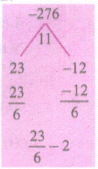
⇒ 6x2+11x-46 = 0
⇒ (6x+23)(x-2) = 0
⇒ (6x+23)(x-2) = 0
⇒ x = 2
∴ Volume of the cube = x3 = 23 = 8.
Volume of a cuboid = 52 + 8 = 60
[∵ x = \(\frac{-23}{6}\) is not possible as x represents the side of the cube]
20.
z1(z2 + z3) = z1z2 + z1z3
Given z1= 3, z2 = -7i, z3 = 5+4i
LHS = z1(z2 + z3)
= 3 [-7i + 5 + 4i]
= 3[5-3i]
= 15-9i
RHS = z1z2 + z1z3
= 3(-7i) + 3(5 + 4i)
= -21i +15 +12i
= -9i +15
= 15-9i
LHS = RHS
∴ z1(z1 + z3) = z1z2 + z1z3
Hence proved

12th Standard Syllabus & Materials
12th Standard
TN 12th Computer Applications வலையமைப்பு வடமிடல் Sample Question Papers Study Material - QB365 Set A
NEW12th Standard
TN 12th Computer Applications களப்பெயர் முறைமை (DNS) Sample Question Papers Study Material - QB365 Set A
NEW12th Standard
TN 12th Computer Applications வலையமைப்பு எடுத்துக்காட்டுகள் மற்றும் நெறிமுறைகள் Sample Question Papers Study Material - QB365 Set A
NEW12th Standard
TN 12th Computer Applications கணினி வலையமைப்பு ஓர் அறிமுகம் Sample Question Papers Study Material - QB365 Set A



Tamilnadu Stateboard 12th Standard Subjects
Maths

Chemistry

Physics

Biology

Computer Science

Business Maths and Statistics

Economics

Commerce

Accountancy

History

Computer Applications
Biology
Computer Technology
Computer Applications
Computer Science
Business Maths and Statistics
Commerce
Economics
Maths
Chemistry
Physics
Computer Technology
History
Accountancy

Tamil

English

French
Tamilnadu Stateboard Standards


