
 100% FREE ACCESS
12th Standard Syllabus & Materials
12th Standard
TN 12th Computer Applications மின்னணு தரவு பரிமாற்றம் Sample Question Papers Study Material - QB365 Set A
NEW12th Standard
TN 12th Computer Applications மின் - வணிக பாதுகாப்பு அமைப்புகள் Sample Question Papers Study Material - QB365 Set A
NEW12th Standard
TN 12th Computer Applications மின்னணு செலுத்தல் முறைகள் Sample Question Papers Study Material - QB365 Set A
NEW12th Standard
TN 12th Computer Applications மின் - வணிகம் Sample Question Papers Study Material - QB365 Set A
NEW12th Standard
TN 12th Computer Applications திறந்த மூல கருத்துருக்கள் Sample Question Papers Study Material - QB365 Set A
NEW12th Standard
TN 12th Computer Applications வலையமைப்பு வடமிடல் Sample Question Papers Study Material - QB365 Set A

Published on: 20/10/2025
Download Tamil Nadu 12th Standard Maths question papers, model tests, one-mark questions, important questions, and public exam papers in PDF format. Free study materials and answer keys for TN State Board students.
Questions + Answers key
Take MCQ Maths Test
1.
Let \(*\) be defined on R by (a \(*\) b) = a + b + ab - 7. Is \(*\) binary on R? If so, find 3 \(*\)\(\left( \frac { -7 }{ 15 } \right) \).
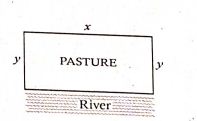
2.
Identify the valid statements from the following sentences.
3.
Determine whether the following function is homogeneous or not. If it is so, find the degree.
\(h(x,y)=\frac { 6{ x }^{ 2 }{ y }^{ 3 }-\pi { y }^{ 5 }+9{ x }^{ 4 }y }{ 2020{ x }^{ 2 }+2019{ y }^{ 2 } } \)
4.
For the random variable X with the given probability mass function as below, find the mean and variance.
\(f(x)=\begin{cases} \begin{matrix} \frac { 1 }{ 10 } & x=2,5 \end{matrix} \\ \begin{matrix} \frac { 1 }{ 5 } & x=0,1,2,3,4 \end{matrix} \end{cases}\)
5.
Assume that the cross section of the artery of human is circular. A drug is given to a patient to dilate his arteries. If the radius of an artery is increased from 2 mm to 2.1 mm, how much is cross-sectional area increased approximately?
6.
Show that \(\int _{ 0 }^{ \pi }{ g(sinx)dx=2 } \int _{ 0 }^{ \frac { \pi }{ 2 } }{ g(sinx)dx, } \) where g(sin x) is a function of sin x.
7.
Evaluate the limit \(\underset{x\rightarrow 0}{lim}(\frac{sin \ mx}{x})\)
8.
Explain why Rolle’s theorem is not applicable to the following functions in the respective intervals.
\(f(x)=tan x,x \in [0, \pi]\)
9.
Find the acute angle between the following lines
2x = 3y = −z and 6x = − y = −4z.
10.
If the vectors \(a\hat { i } +a\hat { j } +c\hat { k } ,\hat { i } +\hat { k } \) and \(c\hat { i } +c\hat { j } +b\hat { k } \) are coplanar, prove that c is the geometric mean of a and b.
11.
Show that \(\neg(p \rightarrow q) \equiv p \wedge \neg q\)
12.
Show that p ➝ q and q ➝ p are not equivalent
13.
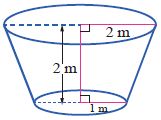
Find, by integration, the volume of the container which is in the shape of a right circular conical frustum.
14.
Let U(x, y) = ex sin y, where x = st2, y = s2 t, s, t ∈ R. Find \(\frac { \partial U }{ \partial s } ,\frac { \partial U }{ \partial t } \) and evaluate them at s = t = 1.
15.
Find the area of the region bounded by y = tan x, y = cot x and the lines x = 0, x = \(\frac{\pi}{2}\), y = 0
16.
The probability density function of random variable X is given by \(f(x)=\begin{cases} \begin{matrix} k & 1\le x\le 5 \end{matrix} \\ \begin{matrix} 0 & otherwise \end{matrix} \end{cases}\) Find
(i) Distribution function
(ii) P(X < 3)
(iii) P(2 < X < 4)
(iv) P(3 ≤ X )
17.
Find the area of the region bounded between the parabola y2 = 4ax and its latus rectum.
18.
For each of the following functions find the gxy, gxx, gyy and gyx.
g(x, y) = xey + 3x2y
19.
Evaluate the following integrals using properties of integration:
\(\int _{ 0 }^{ { sin }^{ 2 }x }{ { sin }^{ -1 }\sqrt { t } dt+\int _{ 0 }^{ { cos }^{ 2 }x }{ { cos }^{ -1 }\sqrt { t } dt } } \)
20.
A farmer plans to fence a rectangular pasture adjacent to a river. The pasture must contain1,80,000 sq. mtrs in order to provide enough grass for herds. No fencing is needed along the river. What is the length of the minimum needed fencing material
21.
Find intervals of concavity and points of inflexion for the following function:
\(f(x)=\frac { 1 }{ 2 } \left( { e }^{ x }-{ e }^{ -x } \right) \)
22.
A camera is accidentally knocked off an edge of a cliff 400 ft high. The camera falls a distance of s = 16t2 in t seconds.
(i) How long does the camera fall before it hits the ground?
(ii) What is the average velocity with which the camera falls during the last 2 seconds?
(iii) What is the instantaneous velocity of the camera when it hits the ground?
23.
\(\vec { a } =2\hat { i } +3\hat { j } -\hat { k } ,\vec { b } =-\hat { i } +2\hat { j } -4\hat { k } ,\vec { c } =\hat { i } +\hat { j } +\hat { k } \) then find the value of \((\vec { a } \times \vec { b } )\times (\vec { c } \times \vec { d } )\).
24.
For any four vectors \(\vec { a } ,\vec { b } ,\vec { c } ,\vec { d } \) we have \((\vec { a } \times \vec { b } )\times (\vec { c } \times \vec { d } )=[\vec { a } ,\vec { b } ,\vec { d } ]\vec { c } -[\vec { a } ,\vec { b } ,\vec { c } ]\vec { d } =[\vec { a } ,\vec { c } ,\vec { d } ]\vec { b } -[\vec { b } ,\vec { c } ,\vec { d } ]\vec { a } \)
25.
Construct the truth table for the following statements.
(¬p ⟶ r) ∧ ( p ↔️ q)
26.
Construct the truth table for the following statements.
( p V q) V ¬q
27.
An urn contains 2 white balls and 3 red balls. A sample of 3 balls are chosen at random from the urn. If X denotes the number of red balls chosen, find the values taken by the random variable X and its number of inverse images
28.
If U(x, y, z) = log (x3 + y3 + z3), find \(\frac { \partial U }{ \partial x } +\frac { \partial U }{ \partial y } +\frac { \partial U }{ \partial z } \)
29.
Evaluate the following definite integrals:
\(\int _{ 0 }^{ \frac { \pi }{ 2 } }{ { e }^{ x }\left( \frac { 1+sinx }{ 1+cosx } \right) dx } \)
30.
Find a linear approximation for the following functions at the indicated points.
f(x) = x3 - 5x + 12, x0 = 2
31.
A six sided die is marked '2' on one face, '3' on two ofits faces, and '4' on remaining three faces. The die is thrown twice. If X denotes the total score in two throws, find the values of the random variable and number of points in its inverse images.
32.
Using the Lagrange’s mean value theorem determine the values of x at which the tangent is parallel to the secant line at the end points of the given interval:
f (x) = (x − 2)(x − 7), x ∈ [3,11]
33.
Find the points where the straight line passes through (6,7, 4) and (8, 4,9) cuts the xz and yz planes.
34.
Find the angle between the lines \(\vec { r } =(\hat { i } +2\hat { j } +4\hat { k } )+t(2\hat { i } +2\hat { j } +\hat { k } )\) and the straight line passing through the points (5, 1, 4) and (9, 2, 12)
35.
The proposition p ∧ (¬p ∨ q) is
a tautology
a contradiction
logically equivalent to p ∧ q
logically equivalent to p ∨ q
36.
| p | q | (p ∧ q) ⟶ ¬q |
| T | T | (a) |
| T | F | (b) |
| F | T | (c) |
| F | F | (d) |
Which one of the following is correct for the truth value of (p ∧ q)⟶ ¬p?
| (a) | (b) | (c) | (d) |
| T | T | T | T |
| (a) | (b) | (c) | (d) |
| F | T | T | T |
| (a) | (b) | (c) | (d) |
| F | F | T | T |
| (a) | (b) | (c) | (d) |
| T | T | T | F |
37.
In the set R of real numbers ‘*’ is defined as follows. Which one of the following is not a binary operation on R?
a*b = min (a.b)
a*b = max (a, b)
a*b = a
a*b = ab
38.
39.
40.
The area between y2 = 4x and its latus rectum is
\(\frac{2}{3}\)
\(\frac{4}{3}\)
\(\frac{8}{3}\)
\(\frac{5}{3}\)
41.
The change in the surface area S = 6x2 of a cube when the edge length varies from xo to xo+ dx is
12 xo+dx
12xo dx
6xo dx
6xo+ dx
42.
If we measure the side of a cube to be 4 cm with an error of 0.1 cm, then the error in our calculation of the volume is
0.4 cu.cm
0.45 cu.cm
2 cu.cm
4.8 cu.cm
43.
If v (x, y) = log (ex + ey), then \(\frac { { \partial }v }{ \partial x } +\frac { \partial v }{ \partial y } \) is equal to
ex + ey
\(\frac{1}{e^x + e^y}\)
2
1
44.
The random variable X has the probability density function
\(f(x)=\left\{\begin{array}{lr}
a x+b & 0<x<1 \\
0 & \text { otherwise }
\end{array}\right.\) and \(E(X)=\frac { 7 }{ 12 } \), then a and b are respectively
1 and \(\frac { 1 }{ 2 } \)
\(\frac { 1 }{ 2 } \) and 1
2 and 1
1 and 2
45.
Four buses carrying 160 students from the same school arrive at a football stadium. The buses carry, respectively, 42, 36, 34, and 48 students. One of the students is randomly selected. Let X denote the number of students that were on the bus carrying the randomly selected student. One of the 4 bus drivers is also randomly selected. Let Y denote the number of students on that bus. Then E(X) and E(Y) respectively are
50,40
40,50
40.75,40
41,41
46.
A random variable X has binomial distribution with n = 25 and p = 0.8 then standard deviation of X is
6
4
3
2
47.
48.
The curve y= ax4 + bx2 with ab > 0
has, no horizontal tangent
is concave up
is concave down
has no points of inflection
49.
The maximum product of two positive numbers, when their sum of the squares is 200, is
100
\(25\sqrt { 7 } \)
28
\(24\sqrt { 14 } \)
50.
One of the closest points on the curve x2 - y2 = 4 to the point (6, 0) is
(2,0)
\(\left( \sqrt { 5 } ,1 \right) \)
\(\left( 3,\sqrt { 5 } \right) \)
\(\left( \sqrt { 13 } ,-\sqrt { 3 } \right) \)
51.
If the distance of the point (1, 1, 1) from the origin is half of its distance from the plane x + y + z + k = 0, then the values of k are
\(\pm 3\)
\(\pm 6\)
-3, 9
3, -9
52.
The angle between the line \(\vec { r } =(\hat { i } +2\hat { j } -3\hat { k } )+t(2\hat { i } +\hat { j } -2\hat { k } )\) and the plane \(\vec { r } .(\hat { i } +\hat { j } )+4=0\) is
0°
30°
45°
90°
53.
If \(\vec { a } \times (\vec { b } \times \vec { c } )=(\vec { a } \times \vec { b } )\times \vec { c } \) where \(\vec { a } ,\vec { b } ,\vec { c } \) are any three vectors such that \(\vec{b} \cdot \vec{c} \neq 0 \text { and } \vec{a} \cdot \vec{b} \neq 0\), then \(\vec { a } \) and \(\vec { c } \) are
perpendicular
parallel
inclined at an angle \(\frac{\pi}{3}\)
inclined at an angle \(\frac{\pi}{6}\)
54.
If \(\vec { a } \) and \(\vec { b } \) are unit vectors such that \([\vec { a } ,\vec { b },\vec { a } \times \vec { b } ]=\frac { 1}{ 4 } \), then the angle between \(\vec { a } \) and \(\vec { b } \) is
\(\frac { \pi }{ 6 } \)
\(\frac { \pi }{ 4 } \)
\(\frac { \pi }{ 3 } \)
\(\frac { \pi }{ 2 } \)
1.
Given a*b = a + b + ab -7, ∀ a,b ∈R
If a ∈R, b∈R then ab ∈ R
(a*b) = a +b+ ab - 7 ∈R
For example, let 1, 2 ∈ R
(1*2) = 1+2+(1)(2)-7
= 2 ∈ R
* a binary operation on R
\(3 *\left(\frac{-7}{15}\right)=3-\frac{7}{15}+\gamma^1\left(\frac{-7}{15_5}\right)-7\)
[Here a = 3, b = \(\frac{-7}{15}\)]
\(=3-\frac { 7 }{ 15 } -\frac { 21 }{ 15 } -7\)
\(\therefore 3*\left( \frac { -7 }{ 15 } \right) =\frac { -88 }{ 15 }\)
2.
(1) Mount Everest is the highest mountain of the world.
(2) 3+ 4 = 8 .
(3) 7 + 5 >10 .
(4) Give me that book.
(5) (10 − x) = 7.
(6) How beautiful this flower is!
(7) Where are you going?
(8) Wish you all success.
(9) This is the beginning of the end.
The truth value of the sentences (1) and (3) are T, while that of (2) is F. Hence they are statements.
The sentence (5) is true for x = 3 and false for x ≠ 3 and hence it may be true or false but not both. So it is also a statement.
The sentences (4), (6), (7), (8) are not statements, because (4) is a command, (6) is an exclamatory, (7) is a question while (8) is a sentence expressing one’s wishes and (9) is a paradox.
3.
\(h(x,y)=\frac { 6{ x }^{ 2 }{ y }^{ 3 }-\pi { y }^{ 5 }+9{ x }^{ 4 }y }{ 2020{ x }^{ 2 }+2019{ y }^{ 2 } } \)
Given \(h(x,y)=\frac { 6{ x }^{ 2 }{ y }^{ 3 }-\pi { y }^{ 5 }+9{ x }^{ 4 }y }{ 2020{ x }^{ 2 }+2019{ y }^{ 2 } } \)
\(h(\lambda x,\lambda y)=\frac { 6{ \lambda }^{ 2 }{ x }^{ 2 }{ \lambda }^{ 3 }{ y }^{ 3 }-\pi { \lambda }^{ 5 }{ y }^{ 5 }+9{ \lambda }^{ 4 }{ x }^{ 4 }\lambda y }{ 2020{ \lambda }^{ 2 }{ x }^{ 2 }+2019{ \lambda }^{ 2 }{ y }^{ 2 } } \)
\(=\frac { { \lambda }^{ 5 }(6{ x }^{ 2 }{ y }^{ 3 }-\pi { y }^{ 5 }+9{ x }^{ 4 }y) }{ { \lambda }^{ 2 }(2020{ x }^{ 2 }+2019{ y }^{ 2 }) } \)
\(
=\lambda^{3} \mathrm{~h}(\mathrm{x}, \mathrm{y})
\)
Thus f is homogeneous with degree 3.
4.
| x | 0 | 1 | 2 | 3 | 4 | 5 |
| f(x) | \(\cfrac { 1 }{ 5 } \) | \(\cfrac { 1 }{ 5 } \) | \(\cfrac { 1 }{ 10 } \) | \(\cfrac { 1 }{ 5 } \) | \(\cfrac { 1 }{ 5 } \) | \(\cfrac { 1 }{ 10 } \) |
\(\therefore Mean=E(x)=\Sigma xf(x)=0\left( \frac { 1 }{ 5 } \right) +1\left( \frac { 1 }{ 5 } \right) +2\left( \frac { 1 }{ 10 } \right) +3\left( \frac { 1 }{ 5 } \right) +4\left( \frac { 1 }{ 5 } \right) +5\left( \frac { 1 }{ 10 } \right) \)
\(\frac { 1 }{ 5 } +\frac { 1 }{ 5 } +\frac { 3 }{ 5 } +\frac { 4 }{ 5 } +\frac { 1 }{ 2 } \)
= \(\frac { 2+2+6+8+5+ }{ 10 } =\frac { 23 }{ 10 } =2.3\)
= \(f({ x }^{ 2 })=\Sigma { x }^{ 2 }f(x)\)
= \({ 0 }^{ 2 }\left( \frac { 1 }{ 5 } \right) +{ 1 }^{ 2 }\left( \frac { 1 }{ 5 } \right) +2^{ 2 }\left( \frac { 1 }{ 10 } \right) +{ 3 }^{ 2 }\left( \frac { 1 }{ 5 } \right) +{ 4 }^{ 2 }\left( \frac { 1 }{ 5 } \right) +{ 5 }^{ 2 }\left( \frac { 1 }{ 10 } \right) \)
= \(0+\frac { 1 }{ 5 } +\frac { 4 }{ 10 } +\frac { 9 }{ 5 } +\frac { 16 }{ 5 } +\frac { 25 }{ 10 } \)
= \(\frac { 2+4+18+32+25 }{ 10 } =\frac { 81 }{ 10 } =8.1\)
= \(\frac { 2+4+18+32+25 }{ 10 } =\frac { 81 }{ 10 } =8.1\)
Variance = E(X2) - [E(X)]2
= 8.1- (2.3)2
= 8.1- 5.29
= 2.81
5.
Given r = 2 mm
dr = (2.1 - 2) = 0.1 mm
Area = πr2
Approximate area dA = 2πr dr
= 2π (2) (0.1)
= 4 π (0.1) = 0.4 π mm2
6.
We know that \(\int _{ 0 }^{ 2a }{ f(x)dx } =2\int _{ 0 }^{ a }{ f(x) } dx\quad if(2a-x)=f(x)\)
Take 2a = \(\pi\) and f(x) = g(sinx)
Then, f(2a-x) = g(sin(\(\pi\)-x)) = g(sinx) = f(x).
\(\therefore \int _{ 0 }^{ 2a }{ f(x)dx } =2\int _{ 0 }^{ a }{ f(x)dx } \)
\(\int _{ 0 }^{ \pi }{ g(sinx)dx } =2\int _{ 0 }^{ \frac { \pi }{ 2 } }{ g(sinx)dx } \)
7.
If we directly substitute x = 0 we get an indeterminate form \(\frac{0}{0}\) and hence we apply the l’Hôpital’s rule to evaluate the limit as
\(\underset{x\rightarrow 0}{lim}(\frac{sin \ mx}{x})\)=\(\underset{x\rightarrow 0}{lim}(\frac{m\times cos \ mx}{1})\)
= m
The next example tells that the limit does not exist.
8.
Given f(x) = tan x, x ∈ [0, π]
Rolle's theorem is not applicable since tan x is not continuous at x = \(\frac{\pi}{2}\) [∵ tan \(\frac{\pi}{2}\) = ∞]
9.
2x = 3y = −z \(\Rightarrow \frac{x}{3}=\frac{y}{2}=\frac{-z}{6}\) (Dividing by 6 all)
\(\Rightarrow \frac{x-0}{3}=\frac{y-0}{2}=
\frac{z-0}{-6}\)....(1)
6x = -y = -4z \(\Rightarrow \frac{x}{2}=\frac{-y}{12}=\frac{-z}{3} \) (Dividing by 6 all)
\(\Rightarrow \frac{x-0}{2}=\frac{y-0}{-12}=\frac{z-0}{-3}\) ....(2)
From (1) & (2), we get
\(\vec b = 3\vec i+2\vec j- 6\vec k\)and \( \vec d = 2\vec i-12\vec j- 3\vec k\)
Angle between lines (1) and (2) = Angle between \(\vec b\ and\ \vec d\)
Acute angle between lines cos 0 = \(\frac{|\vec b . \vec d|}{|\vec b||\vec d|}
\)
\(\vec b . \vec d \)= (\(\vec b = 3\vec i+2\vec j- 6\vec k\)). (\( 2\vec i-12\vec j- 3\vec k\))
6-24+18 = 0
\( \cos \theta=0 \)
\(\theta=\frac{\pi}{2} \text { or } 90^{\circ}\)
10.
\(\vec { a } \)= \(a\hat { i } +a\hat { j } +c\hat { k } , \vec{b}=\hat { i } +\hat { k } \), \(\vec { c } \)= \(c\hat { i } +c\hat { j } +b\hat { k } \)
Given \(\vec { a } ,\vec { b } \) and \(\vec { c } \) are co-planar
\(\vec { a } .(\vec { b } \times \vec { c } )\) = 0
⇒ \(\left| \begin{matrix} a & a & c \\ 1 & 0 & 1 \\ c & c & b \end{matrix} \right| \) = 0
⇒ \(a\left| \begin{matrix} 0 & 1 \\ c & b \end{matrix} \right| -a\left| \begin{matrix} 1 & 1 \\ c & b \end{matrix} \right| +c\left| \begin{matrix} 1 & 0 \\ c & c \end{matrix} \right| \) = 0
⇒ a(0-c)-a(b-c)+c(c-0) = 0
\(\Rightarrow-\not a c-a b+\not a c+c^{2}=0\)
⇒ c2 = ab ⇒ c =\(\sqrt { ab } \).
Hence c is the geometric mean of a and b.
11.
To prove \(\neg(p \rightarrow q) \equiv p \wedge \neg q\)
Truth table for \(\neg(p \rightarrow q)\)
| p | q | \(p \rightarrow q \) | \(\neg(p \rightarrow q)\) |
| T | T | T | F |
| T | F | F | T |
| F | T | T | F |
| F | F | T | F |
Truth table for \(p \wedge \neg q\)
| p | q | \(\neg q\) | \(p \wedge \neg q\) |
| T | T | F | F |
| T | F | T | T |
| F | T | F | F |
| F | F | T | T |
The entries in the column \(\neg(p \rightarrow q) \text { and } p \wedge \neg q\) are identical and they are equivalent.
12.
| p | q | p ➝ q | q ➝ p |
| T | T | T | T |
| T | F | F | T |
| F | T | T | F |
| F | F | T | T |
The entries in column (3) and column (4) are not identical.
13.
Volume of the right circular conical frustum is obtained by revolving the line y = x between x = a and x = b around the x - axis
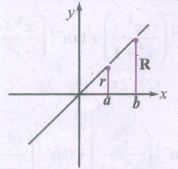
\(\therefore\) Height of the frustum h = b - a
\(\therefore\)Volume \(=\pi \int _{ a }^{ b }{ { x }^{ 2 }dx } =\pi { \left[ \frac { { x }^{ 3 } }{ 3 } \right] }_{ a }^{ b }\)
\(=\frac { \pi }{ 3 } [{ b }^{ 3 }-{ a }^{ 3 }]\)
\(=\frac { \pi }{ 3 } (b-a)({ b }^{ 2 }+ab+{ a }^{ 2 })\)
Now, substitute h = b - a, r = a and R = b we get Volume of the conical frustum
\(\frac { \pi }{ 3 } [h({ R }^{ 2 }+rR+{ r }^{ 2 })]\)
Given h = 2 m, r = 1 m, R = 2 m we get
Required volume \(=\frac { \pi }{ 3 } [2(4+2+1)]\)
\(=\frac { \pi }{ 3 } (14)\)
\(=\frac { 14\pi }{ 3 } \)
14.
Given U (x, y) = ex sin y ; x = st2 ; y = s2t
\(\frac { \partial U }{ \partial x } \) = ex sin y ; \(\frac { \partial U }{ \partial y } \) = ex cos y
\(\frac { \partial U }{ \partial x } \) = \({ e }^{ { st }^{ 2 } }\) sin (s2t)
\(\frac { \partial U }{ \partial y } \) = \({ e }^{ { st }^{ 2 } }\) cos (s2t)
\(\frac{dx}{dt}\) = 2st; \(\frac{dy}{dt}\) = s2
\(\frac{dx}{ds}\) = t2; \(\frac{dy}{ds}\) = 2 st
By chain rule
\(\frac { dU }{ ds } =\frac { \partial U }{ \partial x } .\frac { dx }{ ds } +\frac { \partial U }{ \partial y } .\frac { dy }{ ds } \)
= \({ e }^{ { st }^{ 2 } }\). sin (s2t) (t2) + \({ e }^{ { st }^{ 2 } }\) cos(s2t).(2st)
∴ \({ \left( \frac { \partial U }{ \partial s } \right) }_{ (s=t=1) }\) = e1 sin (1) + 2e1 cos (1)
= e [sin (1) + 2 cos (1)] and
\(\frac { dU }{ dt } =\frac { \partial u }{ \partial x } .\frac { dx }{ dt } +\frac { \partial u }{ \partial y } .\frac { dy }{ dt } \)
= \({ e }^{ { st }^{ 2 } }\) . sin (s2t)(2st) + \({ e }^{ { st }^{ 2 } }\) cos (s2t). (s2)
∴ \({ \left( \frac { \partial U }{ \partial t } \right) }_{ (s=t=1) }\) = 2e1 sin (1) + e1 cos (1)
= e [2 sin (1) + cos (1)]
15.
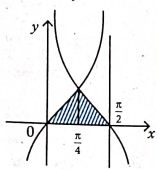
Given equation of the curves are y = tan x, y = cot x.
The intersection of y = tan x and y = cot x are
tan x = cot x \(\Rightarrow\) x = \(\frac{\pi}{2}\)
\(\therefore\) Required area \(=\int _{ 0 }^{ \frac { \pi }{ 4 } }{ (tan\ x-cot\ x)dx } \)
\(={ [-log\ sin\ x+log\ sec\ x] }_{ 0 }^{ \frac { \pi }{ 4 } }\)
\(=log{ \left[ \frac { sec\ x }{ sin\ x } \right] }_{ 0 }^{ \frac { \pi }{ 4 } }==log{ \left[ \frac { 1 }{ sin\ x\ cos\ x } \right] }_{ 0 }^{ \frac { \pi }{ 4 } }\)
\(=-log{ (sin\quad x\ cos\ x) }_{ 0 }^{ \frac { \pi }{ 4 } }\)
\(=-log\left( sin\frac { \pi }{ 4 } .cos\frac { \pi }{ 4 } \right) +log(sin0\quad cos0)\)
\(=-log\left( \frac { 1 }{ \sqrt { 2 } } .\frac { 1 }{ \sqrt { 2 } } \right) +0\)
\(=-log\left( \frac { 1 }{ 2 } \right) =-(log1-log2)=log2\)
16.
Since f (x) is a probability density function, f (x) ≥ 0 and \(\int _{ -\infty }^{ \infty }{ f(x) } dx=1\)
That is \(\int _{ -\infty }^{ 1 }{ 0dx } +\int _{ 1 }^{ 5 }{ kdx } +\int _{ 5 }^{ \infty }{ 0dx } =1\)
\(0+k\left( x \right) _{ 1 }^{ 5 }+0=1\Rightarrow 4k=1\Rightarrow k=\frac { 1 }{ 4 } \)
Therefore the probability density function is
\(f\left( x \right) =\begin{cases} \begin{matrix} \frac { 1 }{ 4 } & 1\le x\le 5 \end{matrix} \\ \begin{matrix} 0 & Otherwise \end{matrix} \end{cases}\)
(i) Distribution function
The distribution function
\(F(x)=P\left( X\le x \right) =\int _{ -\infty }^{ x }{ f(u)dx } \)
When x < 1, \(F(x)=\int _{ -\infty }^{ x }{ f(u)du } =\int _{ -\infty }^{ x }{ oldu } =0\)
When 1 ≤ x ≤ 5 \(F(x)=\int _{ -\infty }^{ x }{ f(u)du=\int _{ -\infty }^{ x }{ 0du } +\int _{ 1 }^{ x }{ odu } +\int _{ 1 }^{ x }{ \frac { 1 }{ 4 } du } =\frac { 1 }{ 4 } (x-1) } \)
When x ≥ 5 \(F(x)=\int _{ -\infty }^{ x }{ f(u) } du=\int _{ -\infty }^{ x }{ odu } +\int _{ 1 }^{ 5 }{ \frac { 1 }{ 4 } du } +\int _{ 1 }^{ 5 }{ \frac { 1 }{ 4 } du } +\int _{ 5 }^{ 5 }{ odu } =1\)
Thus \(F(x)=\begin{cases} \begin{matrix} 0 & x<1 \end{matrix} \\ \begin{matrix} \frac { x-1 }{ 1 } & 1\le x\le 5 \end{matrix} \\ \begin{matrix} 1 & x>5 \end{matrix} \end{cases}\)
(ii) P(X < 3) = P(X ≤ 3) = F(3) = \(\frac { 3-1 }{ 2 } =\frac { 1 }{ 2 } \) (Since F(x) is continuous)
(iii) P(2 < X < 4) = P(2 ≤ X ≤ 4) F(4) - F(2) = \(\frac { 3 }{ 4 } -\frac { 1 }{ 4 } =\frac { 1 }{ 2 } \)
(iv) P(3 ≤ X ) = P(X ≥ 3) = 1− P(X < 3) = 1 - \(1-\frac { 1 }{ 2 } =\frac { 1 }{ 2 } \)
17.
The equation of the latus-rectum is x = a. It intersects the parabola at the points L(a, 2a) and L1 (a, −2). The required area is sketched. By symmetry, the required area A is twice the area bounded by the portion of the parabola
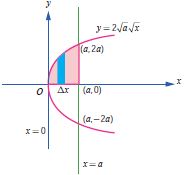
y = 2\(\sqrt a \sqrt x\), x -axis, x = 0 and x = a.
Hence, by taking vertical strips, we get
\(A=2\int _{ 0 }^{ a }{ ydx=2\int _{ 0 }^{ a }{ 2\sqrt { a } \sqrt { x } dx=4 } \sqrt { a } } { \left[ \frac { 2 }{ 3 } { x }^{ \frac { 3 }{ 2 } } \right] }_{ 0 }^{ a }\)
\(=4\sqrt { a } \times \frac { 2 }{ 3 } { a }^{ \frac { 3 }{ 2 } }=\frac { 8{ a }^{ 2 } }{ 3 } \)
18.
g(x, y) = xey + 3x2y
gx = ey + 6xy
gy = xey + 3x2
\({ g }_{ xy }=\frac { \partial }{ \partial x } ({ g }_{ y })={ e }^{ y }+6x\)
\({ g }_{ xx }=\frac { \partial }{ \partial x } ({ g }_{ xy })=0+6y=6y\)
\({ g }_{ yy }=\frac { \partial }{ \partial y } ({ g }_{ y })={ xe }^{ y }\)
\({ g }_{ xy }=\frac { \partial }{ \partial y } ({ g }_{ x })\) = ey + 6
19.
\(put\sqrt { t } =z\Rightarrow \frac { 1 }{ 2\sqrt { t } } dt=dz\)
\(\Rightarrow \frac { 1 }{ 2z } dt=dz\Rightarrow dt=2zdz\)
| t | 0 | sin2x |
| z | 0 | sin x |
| t | 0 | cos2x |
| z | 0 | cos x |
\(\therefore I=\int _{ 0 }^{ sin\quad x }{ 2z{ sin }^{ -1 }zdz } +\int _{ 0 }^{ cosx }{ 2z{ cos }^{ -1 }zdz } ...(1)\)
= I1+ I2
\(=2\int _{ 0 }^{ x }{ \theta sin\theta cos\theta d\theta +2\int _{ \frac { \pi }{ 2 } }^{ x }{ \theta cos\theta (-sin\theta )d\theta } } \)
\(=\int _{ 0 }^{ x }{ \theta 2sin\theta cos\theta d\theta -\int _{ \frac { \pi }{ 2 } }^{ x }{ \theta 1sin\theta cos\theta d\theta } } \)
\(=\int _{ 0 }^{ x }{ \theta sin2\theta d\theta -\int _{ \frac { \pi }{ 2 } }^{ x }{ \theta sin2\theta d\theta } } \)
\([\because sin2\theta =sin\theta cos\theta ]\)
\(=\int _{ 0 }^{ x }{ \theta sin2\theta d\theta \int _{ x }^{ \frac { \pi }{ 2 } }{ \theta sin2\theta d\theta } =\int _{ 0 }^{ \frac { \pi }{ 2 } }{ \theta sin2\theta d\theta } } \)
\(\left[ \because \int _{ a }^{ c }{ f(x)dx+\int _{ c }^{ b }{ f(x)dx=\int _{ a }^{ b }{ f(x)dx } } } \right] \)
\(={ \left[ -\frac { \theta cos2\theta }{ 2 } \right] }_{ 0 }^{ \frac { \pi }{ 2 } }+\int _{ 0 }^{ \frac { \pi }{ 2 } }{ \frac { cos2\theta }{ 2 } d\theta } \)
\(={ \left[ -\frac { \theta cos2\theta }{ 2 } +\frac { sin2\theta }{ 4 } \right] }_{ 0 }^{ \frac { \pi }{ 2 } }\)
\(=\frac { -\frac { \pi }{ 2 } cos\pi }{ 2 } +\frac { sin\pi }{ 4 } -(0+0)\)
\(=\frac { -\frac { \pi }{ 2 } (-1) }{ 2 } +\frac { 0 }{ 4 } =\frac { \pi }{ 4 } \)
20.
Let x be the length of the rectangular pasture and y be the breadth of the rectangular pasture.
Given xy = 1,80,000
\(\Rightarrow y=\frac { 1,80,000 }{ x } \)
Since fencing is not needed along the river side,
Perimeter = 2x + y
Letf(x) = 2x+y
= \(2x+\frac { 1,80,000 }{ x } \)
\(f'(x)=2-\frac { 1,80,000 }{ { x }^{ 2 } } \)
f'(x) = 0
\(\Rightarrow 2=\frac { 1,80,000 }{ { x }^{ 2 } } \)
\(\Rightarrow { x }^{ 2 }=90,000\)
\(\Rightarrow x=\pm 300\)
ஃ The critical number is 300, -300
\(f''(x)=-1,80,000\left( \frac { -2 }{ { x }^{ 3 } } \right) =\frac { 360000 }{ { x }^{ 3 } } \)
\(f''\left( 300 \right) =\frac { 360000 }{ \left( 300 \right) ^{ 3 } } >0\)
From (1), when x = 300, \(y=\frac { 1,80,000 }{ 300 } =600\)
ஃ Length of the minimum needed fencing material = 2x + y
= 2(300) + 600 = 600 + 600 = 1200 m
21.
f (x) is defined and differentiable for all x∈(-∞, ∞)
\(f'\left( x \right) =\frac { 1 }{ 2 } \left( { e }^{ x }+{ e }^{ -x } \right) \)
\(f''(x)=\frac { 1 }{ 2 } \left( { e }^{ x }-{ e }^{ -x } \right) \)
f"(x) = 0
\(\Rightarrow \frac { 1 }{ 2 } \left( { e }^{ x }-{ e }^{ -x } \right) =0\Rightarrow { e }^{ x }-{ e }^{ -x }=0\)
\(\Rightarrow { e }^{ x }={ e }^{ -x }\Rightarrow { e }^{ x }=\frac { 1 }{ { e }^{ x } } \)
\(\Rightarrow { e }^{ 2x }=1\Rightarrow { e }^{ 2x }={ e }^{ 0 }\)
\(\Rightarrow 2x=0\Rightarrow x=0\)
The possible intervals are (-∞,0) and (0,∞)
| Intervel | (-∞, 0) | (0, ∞) |
| Sign of f"(x) | Say x = -1 \(\cfrac { 1 }{ 2 } \left( { e }^{ -1 }-{ e }^{ 1 } \right) =-ve\) |
Say x = 1 \(\cfrac { 1 }{ 2 } \left( { e }^{ -1 }-{ e }^{ 1 } \right) =+ve\) |
| Concavity | Concave down | Concave up |
ஃ f(x) is concave up in (0, ∞) and concave down in (∞, 0).
Since f"(x) changes its position from negative to positive, when it passes through x = 0 the points of inflection is (0,1(0))
\(f(0)=\frac { 1 }{ 2 } \left( { e }^{ o }-{ e }^{ o } \right) =\frac { 1 }{ 2 } \left( 1-1 \right) =0\)
ஃ (0, 0) is the point of inflection.
22.
Given s (t) = 16t2, height = 400 ft.
⇒ t2 = \(\frac { 400 }{ 16 } =\frac { 100 }{ 4 } \)
t2 = 25
t = 5 sec
(ii) Average velocity = \(\frac { ds }{ dt } \) = 32 t
When t = 2 sec
Average in the last
2 sec = \(\frac { V \ at \ t=3+V \ at \ t=5 }{ 2 } \)
= \(\frac { 32(3)+32(5) }{ 2 } \)
= \(\frac { 96+160 }{ 2 } =\frac { 256 }{ 2 } \)
= 128 f/sec
(iii) Instantaneous Velocity
=\(\frac { ds }{ dt } \) = 32t
When t = 5 sec
Velocity = \(\frac { ds }{ dt } \) = 32(5)
= 160 ft/sec
23.
Given \(\vec { a } =2\hat { i } +3\hat { j } -\hat { k } ,\vec { b } =-\hat { i } +2\hat { j } -4\hat { k } ,\vec { c } =\hat { i } +\hat { j } +\hat { k } \)
\(\vec { a } \times \vec { b } =\left| \begin{matrix} \hat { i } & \hat { j } & \hat { k } \\ 2 & 3 & -1 \\ -1 & 2 & -4 \end{matrix} \right| \)
= \(\hat { i } \left| \begin{matrix} 3 & -1 \\ 2 & -4 \end{matrix} \right| -\hat { j } \left| \begin{matrix} 2 & -1 \\ -1 & -4 \end{matrix} \right| +\hat { k } \left| \begin{matrix} 2 & 3 \\ -1 & 2 \end{matrix} \right| \)
= \(\hat { i } (-12+2)-\hat { j } (-8-1)+\hat { k } (4+3)\)
= \(-10\hat { i } +9\hat { j } +7\hat { k } \)
\(\vec { a } \times \vec { c } =\left| \begin{matrix} \hat { i } & \hat { j } & \hat { k } \\ 2 & 3 & -1 \\ 1 & 1 & 1 \end{matrix} \right| =\hat { i } \left| \begin{matrix} 3 & -1 \\ 1 & 1 \end{matrix} \right| -\hat { j } \left| \begin{matrix} 2 & -1 \\ 1 & 1 \end{matrix} \right| +\hat { k } \left| \begin{matrix} 2 & 3 \\ 1 & 1 \end{matrix} \right| \)
= \(\hat { i } (3+1)-\hat { j } (2+1)+\hat { k } (2-3)\)
= \(4\hat { i } -3\hat { j } -\hat { k } \)
∴ \((\vec { a } \times \vec { b } ).(\vec { a } \times \vec { c } )=(-10\hat { i } +9\hat { j } +7\hat { k } ).(4\hat { i } -3\hat { j } -\hat { k } )\)
= -40-27-7 = -74
24.
Taking \(\vec { p } =(\vec { a } \times \vec { b } )\) as a single vector and using the vector triple product expansion, we get
\((\vec { a } \times \vec { b } )\times(\vec{c}\times\vec{d})=\vec{p}\times(\vec{c}\times\vec{d})\)
= \((\vec { p } .\vec { d } )\vec { c } -(\vec { p } .\vec { c } )\vec { d } \)
= \(((\vec { a } \times \vec { b } ).\vec { d } )\vec { c } -((\vec { a } \times \vec { b } ).\vec { c } )\vec { d } =[\vec { a } ,\vec { b } ,\vec { d } ]\vec { c } -[\vec { a } \vec { b } \vec { c } ]\vec { d } \)
Similarly, taking \(\vec { q } \) = \(\vec { c } \times \vec { d } \)
\((\vec { a } \times \vec { b } )\times (\vec { c } \times \vec { d } )=(\vec { a } \times \vec { b } )\times \vec { q } \)
= \((\vec { a } .\vec { q } )\vec { b } -(\vec { b } .\vec { q } )\vec { a } \)
\(= [\vec { a } ,\vec { c }, \vec d ]\vec { b } -[\vec { b } ,\vec { c },\vec d ]\vec { a } \)
25.
Truth Table for (~p ⟶ r) ∧ ( p ↔️ q)
| p | q | r | ~ p | ~ p ⟶ r | p ↔️ q | (~p ⟶ r) ∧ ( p ↔️ q) |
| T | T | T | F | T | T | T |
| T | T | F | F | T | T | T |
| T | F | T | F | T | F | F |
| T | F | F | F | T | F | F |
| F | T | T | T | T | F | F |
| F | T | F | T | F | F | F |
| F | F | T | T | T | T | T |
| F | F | F | T | F | F | F |
26.
Truth Table for ( p V q) ∧ ~q
| p | q | p V q | ~q | ( p V q) ∧ ~q |
| T | T | T | F | T |
| T | F | T | T | T |
| F | T | T | F | T |
| F | F | F | T | T |
27.
Let us denote white and red balls as w1, w2, r1, r2 and r3
The sample space consists of 5C3 = 10 different samples of size 3.
That is S = \(\left\{w_{1} w_{2} r_{1}, w_{1} w_{2} r_{2}, w_{1} w_{2} r_{3}, w_{1} r_{1} r_{2}, w_{1} r_{2} r_{3}, w_{1} r_{1} r_{3}, w_{2} r_{1} r_{2}, w_{2} r_{2} r_{3}, w_{2} r_{1} r_{3}, r_{1} r_{2} r_{3}\right\} .\)
The random variable X takes on the values 1, 2, and 3.
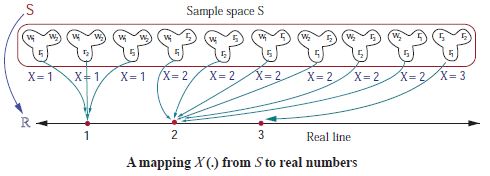
| Values of the Random Variable X | 1 | 2 | 3 | Total |
| Number of elements in inverse images | 3 | 6 | 1 | 10 |
28.
Given (x, y, z) = log (x3 + y3 + z3)
\(\frac { \partial U }{ \partial x } =\frac { 1 }{ { x }^{ 3 }+{ y }^{ 3 }+{ z }^{ 3 } } { (3x }^{ 2 });\)
\(\frac { \partial U }{ \partial y } =\frac { { 3y }^{ 2 } }{ { x }^{ 3 }+{ y }^{ 3 }+{ z }^{ 3 } } \) and
\(\frac { \partial U }{ \partial z } =\frac { { 3z }^{ 2 } }{ { x }^{ 3 }+{ y }^{ 3 }+{ z }^{ 3 } } \)
\(\therefore \frac { \partial U }{ \partial x } +\frac { \partial U }{ \partial y } +\frac { \partial U }{ \partial z } =\frac { { 3x }^{ 2 } }{ { x }^{ 3 }+{ y }^{ 3 }+{ z }^{ 3 } } +\frac { { 3y }^{ 2 } }{ { x }^{ 3 }+{ y }^{ 3 }+{ z }^{ 3 } } +\frac { { 3z }^{ 2 } }{ { x }^{ 3 }+{ y }^{ 3 }+{ z }^{ 3 } } \)
\(=\frac { { 3({ x }^{ 2 }+y }^{ 2 }+{ z }^{ 2 }) }{ { x }^{ 3 }+{ y }^{ 3 }+{ z }^{ 3 } } \)
29.
\(Let\int _{ 0 }^{ \frac { \pi }{ 2 } }{ { e }^{ x }\left( \frac { sinx }{ 1+cosx } \right) dx } \)
\(\int _{ 0 }^{ \frac { \pi }{ 2 } }{ { e }^{ x }\left( \frac { 1+sinx }{ { cos }^{ 2 }\frac { x }{ 2 } } \right) dx } \)
\(\left[ \because cosx=2{ cos }^{ 2 }x-1\Rightarrow 1+cos2x=2{ cos }^{ 2 }x \right] \)
\(=\frac { 1 }{ 2 } \int _{ 0 }^{ \frac { \pi }{ 2 } }{ { e }^{ x }\left( \frac { 1 }{ { cos }^{ 2 }\frac { x }{ 2 } } +\frac { sinx }{ { cos }^{ 2 }\frac { x }{ 2 } } \right) dx } \)
\(=\frac { 1 }{ 2 } \int _{ 0 }^{ \frac { \pi }{ 2 } }{ { e }^{ x }\left( { sec }^{ 2 }\frac { x }{ 2 } +\frac { 2sin\frac { x }{ 2 } cos\frac { x }{ 2 } }{ { cos }^{ 2 }\frac { x }{ 2 } } \right) dx } \)
\(\\ [\because sin2x=2sinx\quad cosx]\)
\(=\frac { 1 }{ 2 } \int _{ 0 }^{ \frac { \pi }{ 2 } }{ { e }^{ x }\left( { sec }^{ 2 }\frac { x }{ 2 } 2tan\frac { x }{ 2 } \right) dx } \)
\(=\frac { 1 }{ 2 } \int _{ 0 }^{ \frac { \pi }{ 2 } }{ { e }^{ x }(f'(x)+f(x)dx } \)
Where \(f(x)=2tan\frac { x }{ 2 } \)
\(=\frac { 1 }{ 2 } .{ e }^{ x }.f(x)={ \left[ \left( \frac { 1 }{ 2 } { e }^{ x }.2tan\frac { x }{ 2 } \right) \right] }_{ 0 }^{ \frac { \pi }{ 2 } }\)
\(={ \left[ { e }^{ x }tan\frac { x }{ 2 } \right] }_{ 0 }^{ \frac { \pi }{ 2 } }\)
\(={ e }^{ \frac { \pi }{ 2 } }tan\frac { \pi }{ 4 } -{ e }^{ 0 }tan0={ e }^{ \frac { \pi }{ 2 } }(1)\)
\(\therefore I={ e }^{ \frac { \pi }{ 2 } }\)
30.
f(x) = x3 - 5x + 12, x0 = 2
f(xo) = 23 - 5(2) + 12
= 8 - 10 + 12 = 10
f'(x) = 3x2 - 5
⇒ f'(xo) = 3 (22) - 5 = 7
∴ L(x) = f(xo) +f'(xo) (x - xo)
= 10 + 7(x - 2)
= 10 + 7x - 14
L(x) = 7x- 4
31.
Let X be the random variable denotes the total C score is two throws of a die.
Sample space S
| II | 2 | 3 | 3 | 4 | 4 | 4 |
| I | ||||||
| 2 | 4 | 5 | 5 | 6 | 6 | 6 |
| 3 | 5 | 6 | 6 | 7 | 7 | 7 |
| 3 | 5 | 6 | 6 | 7 | 7 | 7 |
| 4 | 6 | 7 | 7 | 8 | 8 | 8 |
| 4 | 6 | 7 | 7 | 8 | 8 | 8 |
| 4 | 6 | 7 | 7 | 8 | 8 | 8 |
n (S) = 36
X = {4,5,6,7,8}
From the sample space
| Values of random variable | 4 | 5 | 6 | 7 | 8 | Total |
| No of points in inverse image | 1 | 4 | 10 | 12 | 9 | 36 |
32.
Given f (x) = (x − 2)(x − 7), x ∈ [3,11]
a) f(x) is continuous in [3, 11]
b) f(x) is differentiable in (3, 11)
c) f(11) = (11-2)(11-7)
= (9) (4) = 36
f(3) = (3 - 2)(3 - 7)
= (1)(-4) = - 4
∴ By Lagrange's mean value theorem, there exists c ∈ [3,11] such that f'(c) = \(\frac { f(b)-f(a) }{ b-a } \)
\(\left[ \begin{matrix} f(x)\begin{matrix} = & (x \end{matrix}- & 2) & \begin{matrix} (x & - \end{matrix}7) \\ \begin{matrix} = & { x }^{ 2 } \end{matrix}- & 7x & -2x\begin{matrix} + & 14 \end{matrix} \\ \begin{matrix} = & { x }^{ 2 } \end{matrix}- & 9x & +\begin{matrix} 14 & \end{matrix} \end{matrix} \right] \)
⇒ 2c - 9 = \(\frac{36+4}{11-3}\)
⇒ 3c - 9 = \(\frac{40}{8}\) = 5
⇒ 2c = 14
⇒ c = 7 ∈ [3 , 11]
33.
Let (x1, y1, z1) is (6, 7, 4) and (x2, y2, z2) (8, 4, 9)
The cartesian equation of a straight line passing through two points is
\(\frac { x-{ x }_{ 1 } }{ { x }_{ 2 }-{ x }_{ 1 } } =\frac { y-{ y }_{ 1 } }{ { y }_{ 2 }-{ y }_{ 1 } } =\frac { z-{ z }_{ 1 } }{ { z }_{ 2 }-{ z }_{ 1 } } \)
⇒ \(\frac { x-6 }{ 8-6 } =\frac { y-7 }{ 4-7 } =\frac { z-4 }{ 9-4 } \)
⇒ \(\frac { x-6 }{ 2 } =\frac { y-7 }{ -3 } =\frac { z-4 }{ 5 } \) = s...(1)
⇒ x-6 = 2s
⇒ y-7 = -3s
⇒ y = -3s+7
\(\frac { y-7 }{ -3 } \)=s ⇒ y-7 = -3s ⇒ -3s + 7
\(\frac { z-4 }{ 5 } \) = s
⇒ z-4 = 5s
⇒ z = 5s + 4
∴ Point on the line is (2s + 6, -3s + 7, 5x + 4)...(2)
To find the point of intersection of (1) and x z plane, put y = 0, in (2)
∴ -3s+7 = 0
⇒ -s = -7
⇒ s = \(\frac{7}{3}\)
Put s = \(\frac{7}{3}\) in (2) we get, the point of intersection
as \(\left( 2\left( \frac { 7 }{ 3 } \right) +6,0,5\left( \frac { 7 }{ 3 } \right) +4 \right) \)
⇒ \(\left( \frac { 14 }{ 3 } +6,0,\frac { 35 }{ 3 } +4 \right) \)
⇒ \(\left( \frac { 14+18 }{ 3 } ,0,\frac { 35+12 }{ 3 } \right) \Rightarrow \left( \frac { 32 }{ 3 } ,0,\frac { 47 }{ 3 } \right) \)
To find the point of intersection of (1) and yz plane, put x = 0 in (2)
∴ 2s + 6 = 0
⇒ 2s = -6
⇒ s = -3
∴ (2) ⟶ (2(-3) + 6, -3(-3) + 7, 5(-3)+4)
= (0, 16, -11)
34.
We know that the line \(\vec { r } =(\hat { i } +2\hat { j } +4\hat { k } )+t(2\hat { i } +2\hat { j } +\hat { k } )\) is parallel to the vector \(2\hat { i } +2\hat { j } +\hat { k } \).
Direction ratios of the straight line joining the two given points (5, 1, 4) and (9, 2, 12) are 4,1,8 and hence this line is parallel to the vector \(\hat { 4i } +\hat { j } +8\hat { k } \)
Therefore, the angle between the given two straight lines is
\(\theta ={ cos }^{ -1 }\left( \frac { \left| \vec { b } .\vec { d } \right| }{ \left| \vec { b } \right| \left| \vec { d } \right| } \right) \), where \(\vec { b } \) = \(2\hat { i } +2\hat { j } +\hat { k } \) and \(\vec { d } \) = \(\hat { 4i } +\hat { j } +8\hat { k } \)
Therefore, \(\theta ={ cos }^{ -1 }\left( \frac { \left| (2\hat { i } +2\hat { j } +\hat { k } ).(4\hat { i } +\hat { j } +8\hat { k } ) \right| }{ \left| 2\hat { i } +2\hat { j } +\hat { k } \right| \left| 4\hat { i } +\hat { j } +8\hat { k } \right| } \right) ={ cos }^{ -1 }\left( \frac { 2 }{ 3 } \right) \)
35.
(c)
logically equivalent to p ∧ q
36.
(b)
| (a) | (b) | (c) | (d) |
| F | T | T | T |
37.
(d)
a*b = ab
38.
(c)
39.
(d)
40.
(c)
\(\frac{8}{3}\)
41.
(b)
12xo dx
42.
(d)
4.8 cu.cm
43.
(d)
1
44.
(a)
1 and \(\frac { 1 }{ 2 } \)
45.
(c)
40.75,40
46.
(d)
2
47.
(c)
48.
(d)
has no points of inflection
49.
(a)
100
50.
(c)
\(\left( 3,\sqrt { 5 } \right) \)
51.
(d)
3, -9
52.
(c)
45°
53.
(b)
parallel
54.
(a)
\(\frac { \pi }{ 6 } \)

12th Standard Syllabus & Materials
12th Standard
TN 12th Computer Applications களப்பெயர் முறைமை (DNS) Sample Question Papers Study Material - QB365 Set A
NEW12th Standard
TN 12th Computer Applications வலையமைப்பு எடுத்துக்காட்டுகள் மற்றும் நெறிமுறைகள் Sample Question Papers Study Material - QB365 Set A
NEW12th Standard
TN 12th Computer Applications கணினி வலையமைப்பு ஓர் அறிமுகம் Sample Question Papers Study Material - QB365 Set A
NEW12th Standard
TN 12th Computer Applications PHP-உடன் MySQL-ஐ இணைத்தல் Sample Question Papers Study Material - QB365 Set A



Tamilnadu Stateboard 12th Standard Subjects
Maths

Chemistry

Physics

Biology

Computer Science

Business Maths and Statistics

Economics

Commerce

Accountancy

History

Computer Applications
Biology
Computer Technology
Computer Applications
Computer Science
Business Maths and Statistics
Commerce
Economics
Maths
Chemistry
Physics
Computer Technology
History
Accountancy

Tamil

English

French
Tamilnadu Stateboard Standards


