
 100% FREE ACCESS
12th Standard Syllabus & Materials
12th Standard
TN 12th Maths Applications of Matrices and Determinants Sample Question Papers Study Material - QB365 Set A
NEW12th Standard
TN 12th Computer Applications மின்னணு தரவு பரிமாற்றம் Sample Question Papers Study Material - QB365 Set A
NEW12th Standard
TN 12th Computer Applications மின் - வணிக பாதுகாப்பு அமைப்புகள் Sample Question Papers Study Material - QB365 Set A
NEW12th Standard
TN 12th Computer Applications மின்னணு செலுத்தல் முறைகள் Sample Question Papers Study Material - QB365 Set A
NEW12th Standard
TN 12th Computer Applications மின் - வணிகம் Sample Question Papers Study Material - QB365 Set A
NEW12th Standard
TN 12th Computer Applications திறந்த மூல கருத்துருக்கள் Sample Question Papers Study Material - QB365 Set A

Published on: 20/10/2025
Download Tamil Nadu 12th Standard Maths question papers, model tests, one-mark questions, important questions, and public exam papers in PDF format. Free study materials and answer keys for TN State Board students.
Questions + Answers key
Take MCQ Maths Test
1.
Using Euler's theorem, prove that \(\mathrm{x} \frac{\hat{\partial} u}{\hat{\partial} x}+\mathrm{y} \frac{\hat{\partial} u}{\partial y}=\frac{1}{2} \tan u\) if \(u=\sin ^{-1}\left(\frac{x-y}{\sqrt{x}+\sqrt{y}}\right)\)
2.
Prove that p➝(¬q V r) ≡ ¬pV(¬qVr) using truth table.
3.
Verify
(i) closure property
(ii) commutative property
(iii) associative property
(iv) existence of identity and
(v) existence of inverse for the operation +5 on Z5 using table corresponding to addition modulo 5.
4.
W(x, y, z) = xy + yz + zx, x = u - v, y = uv, z = u + v, u ∈ R. Find \(\frac { \partial W }{ \partial u } ,\frac { \partial W }{ \partial v } \), and evaluate them at \(\left( \frac { 1 }{ 2 } ,1 \right) \)
5.
For each of the following functions find the fx, fy, and show that fxy = fyx
f(x, y) = tan -1 (x/y)
6.
Using the l’Hôpital Rule prove that, \(\underset{x\rightarrow 0^{+}}{lim}(1+x)^{\frac{1}{x}}=e\)
7.
8.
Prove that the ellipse x2 + 4y2 = 8 and the hyperbola x2-2y2 = 4 intersect orthogonally.
9.
Salt is poured from a conveyer belt at a rate of 30 cubic metre per minute forming a conical pile with a circular base whose height and diameter of base are always equal. How fast is the height of the pile increasing when the pile is 10 metre high?
10.
An edge of a variable cube is increasing at the rate of 10 cm / sec. How fast the volume of the cube is increasing when the edge is 5 cm long?
11.
A sphere is made of ice having radius 10 cm. Its radius decreases from 10 cm to 9.8 cm. Find approximations for the following:
(i) change in the volume
(ii) change in the surface area
12.
Use the linear approximation to find approximate values of \(\sqrt [ 3 ]{ 26 } \)
13.
Find the point on the curve y = x2 − 5x + 4 at which the tangent is parallel to the line 3x + y = 7.
14.
Let A =\(\begin{bmatrix} 0 & 1 \\ 1 & 1 \end{bmatrix},B=\begin{bmatrix} 1 & 1 \\ 0 & 1 \end{bmatrix}\)be any two boolean matrices of the same type. Find AvB and A\(\wedge\)B.
15.
16.
Explain why Lagrange’s mean value theorem is not applicable to the following functions in the respective intervals
f(x) = |3x + 1|, x ∈ |-1, 3|
17.
18.
The proposition p ∧ (¬p ∨ q) is
a tautology
a contradiction
logically equivalent to p ∧ q
logically equivalent to p ∨ q
19.
Which one of the following is a binary operation on N?
Subtraction
Multiplication
Division
All the above
20.
21.
If \(f(x)=\frac{x}{x+1}\), then its differential is given by
\(\frac { -1 }{ ({ x+1) }^{ 2 } } dx\)
\(\frac { 1 }{ ({ x+1) }^{ 2 } } dx\)
\(\frac { 1 }{ x+1 } dx\)
\(\frac {- 1 }{ x+1 } dx\)
22.
The percentage error of fifth root of 31 is approximately how many times the percentage error in 31?
\(\frac{1}{31}\)
\(\frac15\)
5
31
23.
24.
The curve y= ax4 + bx2 with ab > 0
has, no horizontal tangent
is concave up
is concave down
has no points of inflection
25.
Angle between y2 = x and x2 = y at the origin is
\({ tan }^{ -1 }\cfrac { 3 }{ 4 } \)
\({ tan }^{ -1 }\left( \cfrac { 4 }{ 3 } \right) \)
\(\cfrac { \pi }{ 2 } \)
\(\cfrac { \pi }{ 4 } \)
26.
1.
\(
\mathrm{u} =\sin ^{-1}\left(\frac{x-y}{\sqrt{x}+\sqrt{y}}\right)
\)
\(\sin \mathrm{u} =\left(\frac{x-y}{\sqrt{x}+\sqrt{y}}\right)=\mathrm{f}(\mathrm{x}, \mathrm{y})
\)
\(
f(\lambda x, \lambda y) =\frac{\lambda x-\lambda y}{\sqrt{\lambda x}+\sqrt{\lambda y}}
\)
\( =\frac{\lambda(x-y)}{\sqrt{\lambda}(\sqrt{x}+\sqrt{y})}
\)
\( =\lambda^{1 / 2} \frac{(x-y)}{(\sqrt{x}+\sqrt{y})}
\)
f is a homogeneous function of degree \(\frac{1}{2}\) By Eulers Theorem
\(
\mathrm{x} \frac{\partial f}{\partial x}+\mathrm{y} \frac{\partial u}{\partial y} =\frac{1}{2} \mathrm{f}
\)
\(\mathrm{x} \frac{\partial}{\partial x} \sin u+\mathrm{y} \frac{\partial}{\partial y} \sin \mathrm{u} =\frac{1}{2} \sin u
\)
\(\mathrm{x} \cos \mathrm{u} \frac{\partial u}{\partial x}+\mathrm{y} \cos \mathrm{u} \frac{\partial u}{\partial y} =\frac{1}{2} \sin \mathrm{u}
\)
\(\mathrm{x} \frac{\partial u}{\partial x}+\mathrm{y} \frac{\partial u}{\partial y} =\frac{1}{2} \frac{\sin u}{\cos u}
\)
\(\mathrm{x} \frac{\partial u}{\partial x}+\mathrm{y} \frac{\partial u}{\partial y} =\frac{1}{2} \tan \mathrm{u}\)
2.
| p | q | r | ~ q | ~q V r | p➝(¬qVr) | ~p | ~pV(~qVr) |
| T | T | T | F | T | T | F | T |
| T | T | F | F | F | F | F | F |
| T | F | T | T | T | T | F | T |
| T | F | F | T | T | T | F | T |
| F | T | T | F | T | T | T | T |
| F | T | F | F | F | T | T | T |
| F | F | T | T | T | T | T | T |
| F | F | F | T | T | T | T | T |
From the table, it is clear that the column of p➝(¬q V ~r) and ~pV(~q V r) are identical
∴ p➝(¬q V ~r) ≡ ~pV(~q V r)
Hence proved.
3.
It is known that Z5 = {[0], [1], [2], [3], [4]}. The table corresponding to addition modulo 5 is as follows: We take reminders {0,1,2,3,4} to represent the classes {[0], [1], [2], [3], [4]}.
| +5 | 0 | 1 | 2 | 3 | 4 |
| 0 | 0 | 1 | 2 | 3 | 4 |
| 1 | 1 | 2 | 3 | 4 | 0 |
| 2 | 2 | 3 | 4 | 0 | 1 |
| 3 | 3 | 4 | 0 | 1 | 2 |
| 4 | 4 | 0 | 1 | 2 | 3 |
(i) Since each box in the table is filled by exactly one element of Z5, the output a +5 b is unique and hence +5 is a binary operation.
(ii) The entries are symmetrically placed with respect to the main diagonal. So +5 has commutative property
(iii) The table cannot be used directly for the verification of the associative property. So it is to be verified as usual
For instance, (2+53)+5 4 = 0+5 4 = 4(mod 5)
and 2+5(3+54) = 2 +5 2 = 4(mod5)
Hence (2+53)+54 = 2+5(3+54)
Proceeding like this one can verify this for all possible triples and ultimately it can be shown that +5 is associative
(iv) The row headed by 0 and the column headed by 0 are identical. Hence the identity element is 0.
(v) The existence of inverse is guaranteed provided the identity 0 exists in each row and each column. From Table, it is clear that this property is true in this case. The method of finding the inverse of any one of the elements of Z5, say 2 is outlined below.
First find the position of the identity element 0 in the III row headed by 2. Move horizontally along the III row and after reaching 0, move vertically above 0 in the IV column, because 0 is in the III row and IV column. The element reached at the topmost position of IV column is 3. This element 3 is nothing but the inverse of 2, because, 2+5 5+ = 0 (mod5). In this way, the inverse of each and every element of Z5 can be obtained. Note that the inverse of 0 is 0, that of 1 is 4, that of 2 is 3, that of 3 is 2, and, that of 4 is 1.
4.
W(x, y, z) = xy + yz + zx, x =u -v, y = uv, z = u + v; y = uv; z = u
\(\frac { \partial W }{ \partial x }\) = y + z; \(\frac { \partial W }{ \partial y }\) = x + z
∴ \(\frac { \partial W }{ \partial x }\) = uv + u + v;
\(\frac { \partial W }{ \partial y}\) = u - v + u + v;
\(\frac { \partial W }{ \partial z}\) = uv + u - v
\(\frac { dx }{ du } =1;\frac { dy }{ du } =v;\frac { dz }{ du } =1\)
\(\frac { dx }{ dv } =1;\frac { dy }{ dv } =v;\frac { dz }{ dv} =1\)
By chain rule
\(\frac { \partial W }{ \partial u } =\frac { \partial w }{ \partial x } .\frac { dx }{ du } +\frac { \partial w }{ \partial y } .\frac { dy }{ du } +\frac { \partial w }{ \partial z } .\frac { dz }{ du }\)
= (uv +u +v) (1) +2u (v) + (uv +u - v)(1)
\(=u v+u+b+2 u v+u v+u-b\)
\(\frac { \partial W }{ \partial u }\) = 4uv + 2u = 12u (2v + 1)
\({ \left( \frac { \partial W }{ \partial u } \right) }_{ \left( \frac { 1 }{ 2 } ,1 \right) }\) = 2 x \(\frac12\) (2+ 1) = 1(2+ 1) = 3
= (uv + u + v) (-1) + (2u) (u) + (uv + u - v)(1)
\(=-w-u-v+2 u^2+w+u-v\)
= 2u2 - 2v = 2 (u2 - v)
∴ \({ \left( \frac { \partial W }{ \partial v } \right) }_{ \left( \frac { 1 }{ 2 } ,1 \right) }\) = \(2\left( \frac { 1 }{ 4 } -1 \right) =2\left( -\frac { 3 }{ 4 } \right) =-\frac { 3 }{ 2 }\)
5.
\({ f }_{ y }=\frac { 1 }{ 1+\frac { { x }^{ 2 } }{ { y }^{ 2 } } } \left( \frac { -x }{ { y }^{ 2 } } \right) =\frac { -\frac { x }{ { y }^{ 2 } } }{ \frac { { x }^{ 2 }+{ y }^{ 2 } }{ { { x }{ x }^{ 2 } } } } \)
= \(\frac { -x }{ { x }^{ 2 }+{ y }^{ 2 } } \)
\({ f }_{ x }=\frac { 1 }{ 1+\frac { { x }^{ 2 } }{ { { y }^{ 2 } } } } \left( \frac { 1 }{ y } \right) =\frac { \frac { 1 }{ y } }{ \frac { { x }^{ 2 }+{ y }^{ 2 } }{ { { y }^{ 2 } } } } \)
\(=\frac { y }{ { { x }^{ 2 }+{ y }^{ 2 } } } \)
\({ f }_{ xy }=\frac { \partial }{ \partial x } ({ f }_{ y })\)
\({ f }_{ xy }=-\left[ \frac { { (x }^{ 2 }+{ y }^{ 2 })(1)-x{ (2x) } }{ { ({ x }^{ 2 }+{ y }^{ 2 }) }^{ 2 } } \right] \)
\(=-\left[ \frac { { x }^{ 2 }+{ y }^{ 2 }-2{ x }^{ 2 } }{ { ({ x }^{ 2 }+{ y }^{ 2 }) }^{ 2 } } \right] \)
\(=-\left[ \frac { { y }^{ 2 }-{ x }^{ 2 } }{ { ({ x }^{ 2 }+{ y }^{ 2 }) }^{ 2 } } \right] \)
\(=\frac { x^{ 2 }-{ y }^{ 2 } }{ { ({ x }^{ 2 }+{ y }^{ 2 }) }^{ 2 } } \) ...(1)
\({ f }_{ xy }=\frac { \partial }{ \partial y } ({ f }_{ x })\)
\({ f }_{ xy }=\frac { ({ x }^{ 2 }+{ y }^{ 2 })(1)-y(2y) }{ ({ x }^{ 2 }+{ { y }^{ 2 }) }^{ 2 } } \)
\(=\frac { { x }^{ 2 }+{ y }^{ 2 }-2{ y }^{ 2 } }{ ({ x }^{ 2 }+{ { y }^{ 2 }) }^{ 2 } } \)
\(=\frac { { x }^{ 2 }-{ y }^{ 2 } }{ ({ x }^{ 2 }+{ { y }^{ 2 }) }^{ 2 } } \) ...(2)
∴ From (1) and (2), fxy = fyz
6.
This is an indeterminate of the form \(1^{\infty}\).
Let \(g(x)=(1+x)^{\frac{1}{x}}\). Taking the logarithm, we get
\(log \ g(x)=\frac{log(1+x)}{x}\)
\(\underset{x\rightarrow 0^{+}}{lim} log (g(x))=\underset{x\rightarrow 0^{+}}{lim}(\frac{log(1+x)}{x})\) \((\frac{0}{0})\)
=\(\underset{x\rightarrow0^{+}}{lim}(\frac{\frac{1}{1+x}}{1})\) (by 1’Hôpital Rule)
= 1.
But, \(\underset{x\rightarrow0^{+}}{lim}log g(x)=log(\underset{x\rightarrow 0^{+}}{lim} g(x))\)
Therefore, log\((\underset{x\rightarrow 0^{+}}{lim} g(x))=1\).
Hence by exponentiating, we get, \(\underset{x\rightarrow 0^{+}}{lim}g(x)=e.\)
7.
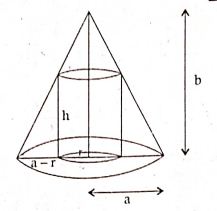
8.
Let the point of intersection of the two curves be (a,b) . Hence,
\(a^{2}+4b^{2}=8\) and \(a^{2}-2b^{2}=4\) ...(4)
It is enough if we show that the product of the slopes of the two curves evaluated at (a, b) is −1.
Differentiation of \(x^{2}+4y^{2}=8\) with respect x, gives
\(2x+8y=\frac{dy}{dx}=0\).
Therefore \(\frac{dy}{dx}= -\frac{-x}{4y}\),
\((\frac{dy}{dx})_{(a,b)}=m_{1}= -\frac{a}{4b}\)
Differentiation of x2-2y2 = 4 with respect to x, gives
\(2x-4y\frac{dy}{dx}=0\)
Therefore, \(\frac{dy}{dx}=\frac{x}{2y}\),
at \((a,b)(\frac{dy}{dx})=m_{2}= \frac{a}{4b}\).
Therefore, \(m_{1}\times m_{2}=(-\frac{a}{4b})\times (\frac{a}{2b})= -\frac{a^{2}}{8b^{2}}\) ...(5)
Applying the ratio of proportions in (4), we get
\(\frac{a^{2}}{-16-16}=\frac{b^{2}}{-8+4}=\frac{1}{-2-4}\)
Therefore, \(\frac{a^{2}}{b^{2}}=\frac{32}{4}=8\) Substituting in (5), we get \(m_{1}\times m_{2}=-1\) Hence, the curves cut orthogonally.
9.
Let h and r be the height and the base radius. Therefore h = 2r. Let V be the volume of the salt cone.
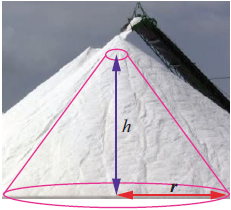
\(V=\frac{1}{3}\pi r^{2}h=\frac{1}{12}\pi h^{3}; \frac{dV}{dt}=30\) mtr3 / min.
Hence, \(\frac{dV}{dt}=\frac{1}{4}\pi h^{2}\frac{dh}{dt}\)
Therefore, \(\frac{dh}{dt}=4 \frac{dV}{dt}.\frac{1}{\pi h^{2}}\)
That is, \(\frac{dh}{dt}=4\times30\times \frac{1}{100 \pi}\)
=\(\frac{6}{5\pi}\) mtr / min.
10.
Let x be the length of the edge of a cube and V be its volume at any time 't'
\(
\mathrm{V}=\mathrm{x}^{3} \text { and } \frac{d x}{d t} =10 \mathrm{~cm} / \mathrm{sec}
\)
\(\frac{d V}{d t} =3 \mathbf{x}^{2} \frac{d x}{d t}
\)
\( =3 \mathrm{x}^{2}(10)
\)
\(\frac{d V}{d t} =30 \mathrm{x}^{2}
\)
\(\left(\frac{d V}{d t}\right)_{x=5} =30(5)^{2}=750 \mathrm{~cm}^{3} / \mathrm{sec}\)
Volume of the cube is increasing at the rate of 750 cm3 / sec
11.
Volume of sphere = \(\frac43\)πr2
Given r = 10 cm
\(\frac{dr}{dt}\) = - 0.2
V = \(\frac43\)πr3
Change in Volume
= \(\frac{4}{\not 3} \pi . \not 3 r^{2} \frac{d r}{d t}\)
= 4π(10)2 (-0.2)
= 400 π (-0.2) = -80 πcm3
∴ Volume decreases by 80 π cm3
Surface area of sphere = 4πr2
Change 10 surrace area = 4 π2r\(\frac{dr}{dt}\)
= 8π(10) (-0.2)
= -\(\frac{80π\times2}{10}\) = -16 π cm2
∴ Surface area decreases by 16 π cm2
12.
Let f(x) = \(x^\frac13\), xo = 27, ∆x = -1
∴ \(\sqrt [ 3 ]{ 26 } =f(27)+{ f }^{ ' }(27)\)
\(f(27)={ (27) }^{ \frac { 1 }{ 3 } }={ (2^{ 3 }) }^{ \frac { 1 }{ 3 } }={ 3 }^{ 1 }=3\)
\({ f }^{ ' }(x)=\frac { 1 }{ 3 } x^{ \frac { 1 }{ 3 } -1 }=\frac { 1 }{ 3 } { x }^{ \frac { 2 }{ 3 } }=\frac { 1 }{ { 3x }^{ \frac { 2 }{ 3 } } } \)
∴ \({ f }^{ ' }(27)=\frac { 1 }{ { 3(27)x }^{ \frac { 2 }{ 3 } } } =\frac { 1 }{ { { { 3(3 }^{ 3 } }) }^{ \frac { 2 }{ 3 } } } =\frac { 1 }{ 3({ 3 }^{ 2 }) } =\frac { 1 }{ 27 } \)
∴ (1) becomes
\(\sqrt [ 3 ]{ 26 } =3+\frac { 1 }{ 27 } (-1)\)
= 3 - \(\frac{1}{27}\)(-1)
= 3 - \(\frac{1}{27}\) = 3 - 0.037
\(\sqrt [ 3 ]{ 26 } \) = 2.963
13.
Given curve is y = x2 − 5x + 4 and the line is 3x + y = 7
Slope of the tangent to the curve
\({ m }_{ 1 }=\frac { dx }{ dt } \) = 2x - 5
Slope of the line = \({ m }_{ 2}=\frac { dx }{ dt } \) = -3
\(\left[ \because m=\frac { co-efficient \ of \ x }{ co-efficient \ of \ y } \right] \)
Since the tangent of the curve and the lines are parallel, their slopes are equal.
∴ m1 = m2
⇒ 2x - 5 = -3
⇒ 2x = 2
⇒ x = 1
Substituting x = 1 in y = x2 - 5x + 4 we get
y = 12-5(1)+4 = 0
∴ The required point is (1, 0).
14.
Then A∨ B =\(\begin{bmatrix} 0 & 1 \\ 1 & 1 \end{bmatrix}\vee \begin{bmatrix} 1 & 1 \\ 0 & 1 \end{bmatrix}=\begin{bmatrix} 0\vee 1 & 1\vee 1 \\ 1\vee 0 & 1\vee 1 \end{bmatrix}=\begin{bmatrix} 1 & 1 \\ 1 & 1 \end{bmatrix}\)
\(A\wedge B=\begin{bmatrix} 0 & 1 \\ 1 & 1 \end{bmatrix}\wedge \begin{bmatrix} 1 & 1 \\ 0 & 1 \end{bmatrix}=\begin{bmatrix} 0\wedge 1 & 1\wedge 1 \\ 1\wedge 0 & 1\wedge 1 \end{bmatrix}=\begin{bmatrix} 0 & 1 \\ 0 & 1 \end{bmatrix}\)
15.
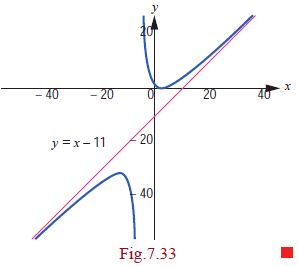
16.
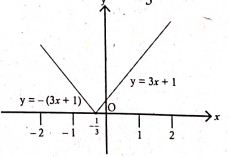
f(x) = |3x + 1|, x ∈ |-1, 3|
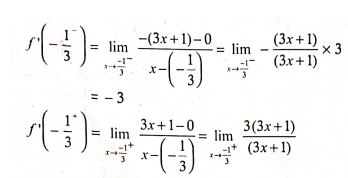
Since \(LHL \neq RHL, f'(-\frac{1}{3})\) does not exist.
Hence, Lagrange's mean value theorem is not applicable.
17.
(b)
18.
(c)
logically equivalent to p ∧ q
19.
(b)
Multiplication
20.
(b)
21.
(b)
\(\frac { 1 }{ ({ x+1) }^{ 2 } } dx\)
22.
(b)
\(\frac15\)
23.
(c)
24.
(d)
has no points of inflection
25.
(c)
\(\cfrac { \pi }{ 2 } \)
26.
(b)

12th Standard Syllabus & Materials
12th Standard
TN 12th Computer Applications வலையமைப்பு வடமிடல் Sample Question Papers Study Material - QB365 Set A
NEW12th Standard
TN 12th Computer Applications களப்பெயர் முறைமை (DNS) Sample Question Papers Study Material - QB365 Set A
NEW12th Standard
TN 12th Computer Applications வலையமைப்பு எடுத்துக்காட்டுகள் மற்றும் நெறிமுறைகள் Sample Question Papers Study Material - QB365 Set A
NEW12th Standard
TN 12th Computer Applications கணினி வலையமைப்பு ஓர் அறிமுகம் Sample Question Papers Study Material - QB365 Set A



Tamilnadu Stateboard 12th Standard Subjects
Maths

Chemistry

Physics

Biology

Computer Science

Business Maths and Statistics

Economics

Commerce

Accountancy

History

Computer Applications
Biology
Computer Technology
Computer Applications
Computer Science
Business Maths and Statistics
Commerce
Economics
Maths
Chemistry
Physics
Computer Technology
History
Accountancy

Tamil

English

French
Tamilnadu Stateboard Standards


