
 100% FREE ACCESS
12th Standard Syllabus & Materials
12th Standard
TN 12th Computer Applications மின்னணு தரவு பரிமாற்றம் Sample Question Papers Study Material - QB365 Set A
NEW12th Standard
TN 12th Computer Applications மின் - வணிக பாதுகாப்பு அமைப்புகள் Sample Question Papers Study Material - QB365 Set A
NEW12th Standard
TN 12th Computer Applications மின்னணு செலுத்தல் முறைகள் Sample Question Papers Study Material - QB365 Set A
NEW12th Standard
TN 12th Computer Applications மின் - வணிகம் Sample Question Papers Study Material - QB365 Set A
NEW12th Standard
TN 12th Computer Applications திறந்த மூல கருத்துருக்கள் Sample Question Papers Study Material - QB365 Set A
NEW12th Standard
TN 12th Computer Applications வலையமைப்பு வடமிடல் Sample Question Papers Study Material - QB365 Set A

Published on: 20/10/2025
Download Tamil Nadu 12th Standard Maths question papers, model tests, one-mark questions, important questions, and public exam papers in PDF format. Free study materials and answer keys for TN State Board students.
Questions + Answers key
Take MCQ Maths Test
1.

2.
Find the distance from the point (1, -1, 2) to the plane \(\vec{r}=(\hat{i}+\hat{j}+\hat{k})+s(\hat{i}-\hat{j})+t(\hat{i}-\hat{k})\)
3.
Find the point of intersection of the line passing through the two points (1, 1, -1); (-1, 0, 1) and the xy-plane.
4.
Find the equation of the hyperbola in each of the cases given below:
foci(±2, 0), eccentricity = \(\frac { 3 }{ 2 } \)
5.
Find the position of the point (6, - 5) relative to the hyperbola \(\frac{x^{2}}{9}-\frac{y^{2}}{25}=1\)
6.
Find value of \(\tan \left(\cos ^{-1} x\right)\) and hence evaluate \(\tan \left(\cos ^{-1} \frac{8}{17}\right)\)
7.
The position vector of the point of intersection of the straight line \(\vec{r}=\vec{a}+t \vec{b}\) and the plane \(\vec{r} \cdot \vec{n}=p \text { is } \vec{a}+\left(\frac{p-(\vec{a} \cdot \vec{n})}{\vec{b} \cdot \vec{n}}\right) \vec{b}, \text { provided } \vec{b} \cdot \vec{n} \neq 0\)
8.
The distance between two parallel planes \(a x+b y+c z+d_{1}=0 \text { and } a x+b y+c z+d_{2}=0\) is given by \(\frac{\left|d_{1}-d_{2}\right|}{\sqrt{a^{2}+b^{2}+c^{2}}}\)
9.
The shortest distance between the two skew lines \(\vec{r}=\vec{a}+s \vec{b} \text { and } \vec{r}=\vec{c}+t \vec{d}\) is given by \(\delta=\frac{|(\vec{c}-\vec{a}) \cdot(\vec{b} \times \vec{d})|}{|\vec{b} \times \vec{d}|}, \text { where }|\vec{b} \times \vec{d}| \neq 0\)
10.
If \(\vec{a}, \vec{b}, \vec{c} \text { and } \vec{p}, \vec{q}, \vec{r}\) are any two systems of three vectors, and if \(\vec{p}=x_{1} \vec{a}+y_{1} \vec{b}+z_{1} \vec{c}\) \(\vec{q}=x_{2} \vec{a}+y_{2} \vec{b}+z_{2} \vec{c}, \text { and, } \vec{r}=x_{3} \vec{a}+y_{3} \vec{b}+z_{3} \vec{c}\) then \([\vec{p}, \vec{q}, \vec{r}]=\left|\begin{array}{lll} x_{1} & y_{1} & z_{1} \\ x_{2} & y_{2} & z_{2} \\ x_{3} & y_{3} & z_{3} \end{array}\right|[\vec{a}, \vec{b}, \vec{c}]\)
11.
The equation of a circle with (x1, y1 ) and (x2, y2 ) as extremities of one of the diameters of the circle is (x − x1)(x − x2 ) + ( y − y1 )( y − y2) = 0
12.
The circle passing through the points of intersection (real or imaginary) of the line lx+my+n = 0 and the circle x2 + y2 +2gx+2 fy+c =0 is the circle of the form
x2 + y2 + 2gx + 2 fy + c +\(\lambda\) (lx + my + n) = 0 \(\lambda \in \mathbb{R}^{1}\)
13.
Find the value of \({ cos }^{ -1 }\left( cos\frac { \pi }{ 7 } cos\frac { \pi }{ 17 } -sin\frac { \pi }{ 7 } sin\frac { \pi }{ 17 } \right) .\)
14.
Find the angle between the line \(\vec { r } =(2\hat { i } -\hat { j } +\hat { k } )+t(\hat { i } +2\hat { j } -2\hat { k } )\) and the plane \(\vec { r } =(6\hat { i } +3\hat { j } +2\hat { k } )=8\)
15.
Find the vector and Cartesian equations of the plane passing through the point with position vector \(2\hat { i } +6\hat { j } +3\hat { k } \) and normal to the vector \(\hat { i } +3\hat { j } +5\hat { k } \)
16.
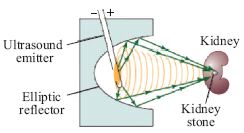
The equation of the ellipse is \(\frac { { \left( x-11 \right) }^{ 2 } }{ 484 } +\frac { { y }^{ 2 } }{ 64 } =1\). ( x and y are measured in centimeters) where to the nearest centimeter, should the patient’s kidney stone be placed so that the reflected sound hits the kidney stone?
17.
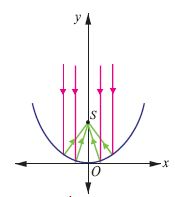
The equation y = \(\frac { 1 }{ 32 } \)x2 models cross sections of parabolic mirrors that are used for solar energy. There is a heating tube located at the focus of each parabola; how high is this tube located above the vertex of the parabola?
18.
Simplify: \({ tan }^{ -1 }\frac { x }{ y } -{ tan }^{ -1 }\frac { x-y }{ x+y } \)
19.
Show that the absolute value of difference of the focal distances of any point P on the hyperbola is the length of its transverse axis.
20.
Find the equation of the hyperbola in each of the cases given below:
passing through (5, −2) and length of the transverse axis along x axis and of length 8 units.
21.
Prove by vector method that the median to the base of an isosceles triangle is perpendicular to the base.
22.
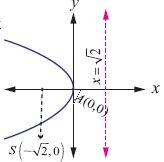
Find the equation of the parabola with focus \(\left( -\sqrt { 2 } ,0 \right) \) and directrix x =\(\sqrt { 2 } \).
23.
If the equation 3x2+(3−p)xy+qy2−2px = 8pq represents a circle, find p and q. Also determine the centre and radius of the circle.
24.
Find the equation of circles that touch both the axes and pass through (-4, -2) in general form.
25.
Find the equation of the circle with centre (2, -1) and passing through the point (3, 6) in standard form.
1.
2.
The given plane is passing through the point (1, 1, 1) and parallel to two vectors \((\hat{i}-\hat{j})\) and \((\hat{j}-\hat{k})\)
The corresponding Cartesian equation is of the form
\(\left|\begin{array}{ccc} x-x_{1} & y-y_{1} & z-z_{1} \\ l_{1} & m_{1} & n_{1} \\ l_{2} & m_{2} & n_{2} \end{array}\right|=0\left\{\begin{array}{c} \left(x_{1}, y_{1}, z_{1}\right)=(1,1,1) \\ \left(l_{1}, m_{1}, n_{1}\right)=(1,-1,0) \\ \left(l_{2}, m_{2}, n_{2}\right)=(0,1,-1) \end{array}\right.\)
\(\text { i.e., }\left|\begin{array}{ccc} x-1 & y-1 & z-1 \\ 1 & -1 & 0 \\ 0 & 1 & -1 \end{array}\right|=0 \text { i.e., } x+y+z-3=0\)
Here \((\left.x_{1}, y_{1}, z_{1}\right)\) = (1, -1, 2)
Distance \( =\left|\frac{a x_{1}+b y_{1}+c z_{1}+d}{\sqrt{a^{2}+b^{2}+c^{2}}}\right|=\left|\frac{1-1+2-3}{\sqrt{1+1+1}}\right| \)
\( =\frac{1}{\sqrt{3}} \text { units } \)
3.
The equation of the line passing through (1, 1, -1) and (-1,0, 1) is
\(\frac{x-1}{2}=\frac{y-1}{1}=\frac{z+1}{-2}\)
It meets the xy-plane i.e. z = 0
\(\therefore \frac{x-1}{2}=\frac{y-1}{1}=\frac{1}{-2} \Rightarrow x=0, y=\frac{1}{2}\)
The required point is \(\left(0, \frac{1}{2}, 0\right)\)
4.
\(a\left( \frac { 3 }{ 2 } \right) =2\Rightarrow a\frac { 4 }{ 3 } \)
b2 = a2(e2 - 1)
\(\Rightarrow b^{2}=\frac{16}{9}\left(\frac{9}{4}-1\right)=\frac{16}{9}\left(\frac{9-4}{4}\right)=\frac{\not 16}{9} \times \frac{5}{4}\)
⇒ \({ b }^{ 2 }=\frac { 4\times 5 }{ 9 } =\frac { 20 }{ 9 } \)
∴ Equation of the hyperbola is \(\frac { { x }^{ 2 } }{ { a }^{ 2 } } -\frac { { y }^{ 2 } }{ { b }^{ 2 } } =1\)
⇒ \(\frac { { x }^{ 2 } }{ \frac { 16 }{ 9 } } -\frac { { y }^{ 2 } }{ \frac { 20 }{ 9 } } =1\)
⇒ \(\frac { { 9x }^{ 2 } }{ 16 } -\frac { 9{ y }^{ 2 } }{ 20 } =1\)
.JPG)
5.
The given equation is of the hyperbola is
\(\frac{x^{2}}{9}-\frac{y^{2}}{25}=1\)
We know that the point P (x, y) lies outside, on or inside the hyperbola
\(\frac{x^{2}}{a^{2}}-\frac{y^{2}}{b^{2}}=1\)
According as \(\frac{x_{1}^{2}}{a^{2}}-\frac{y_{1}^{2}}{b^{2}}-1<0,=\text { or }>0\)
According to the given problem,
\( \frac{x_{1}^{2}}{a^{2}}-\frac{y_{1}^{2}}{b^{2}}-1 =\frac{6^{2}}{9}-\frac{(-5)^{2}}{25}-1 \)
\( =\frac{26}{9}-\frac{25}{25}-1 \)
\( =4-1-1 =2>0 \)
Therefore, the point (6, - 5) lies inside the hyperbola
\(\frac{x^{2}}{9}-\frac{y^{2}}{25}=1\)
6.
Let \(\cos ^{-1} x=\theta \text {, then } \cos \theta=x, \text { where } \theta \in[0, \pi]\)
Therefore \(\tan \left(\cos ^{-1} x\right)=\tan \theta=\frac{\sin \theta}{\cos \theta}\)
\(=\frac{\sqrt{1-\cos ^{2} \theta}}{\cos \theta}=\frac{\sqrt{1-x^{2}}}{x}\)
Hence \(\tan \left(\cos ^{-1} \frac{8}{17}\right)=\frac{\sqrt{1-\left(\frac{8}{17}\right)^{2}}}{\frac{8}{17}}=\frac{15}{8}\)
7.
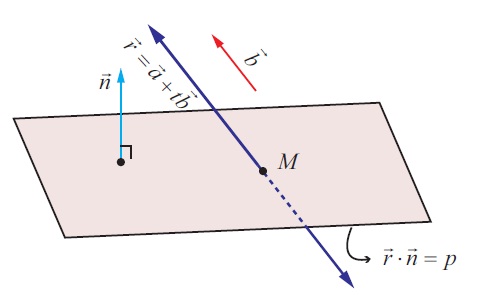
Let \(\vec{r}=\vec{a}+t \vec{b}\) be the equation of the given line which is not parallel to the given plane whose equation is \(\text { So, } \vec{b} \cdot \vec{n} \neq 0\) .
Let \(\vec{u}\) be the position vector of the meeting point of the line with the plane. Then \(\vec{u}\) satisfies both \(\vec{r}=\vec{a}+t \vec{b}\) and \(\vec{r} \cdot \vec{n}=p\) for some value of t , say t1. So, We get
\( \vec{u}=\vec{a}+t \vec{b} \) ...(1)
\(\vec{u} \cdot \vec{n}=p\) ...(2)
Substuting (1) in (2), we get
\( \left(\vec{a}+t_{1} \vec{b}\right) \cdot \vec{n}=p \)
\(\text { or } \quad \vec{a} \cdot \vec{n}+t_{1}(\vec{b} \cdot \vec{n})=p \ \)
\(\text { or } \ \ t_{1}=\frac{p-(\vec{a} \cdot \vec{n})}{\vec{b} \cdot \vec{n}}\)
\(\text { or } \ t_{1}=\frac{p-(\vec{a} \cdot \vec{n})}{\vec{b} \cdot \vec{n}}\)
Substuting (3) in (1), we get
\(\vec{u}=\vec{a}+\left(\frac{p-(\vec{a} \cdot \vec{n})}{\vec{b} \cdot \vec{n}}\right) \vec{b}, \vec{b} \cdot \vec{n} \neq 0\)
8.
Let A (x1 , y1 , z1) be any point on the plane ax + by + cz + d2 = 0 , then we have
\(a x_{1}+b y_{1}+c z_{1}+d_{2}=0 \Rightarrow a x_{1}+b y_{1}+c z_{1}=-d_{2}\)
The distance of the plane ax + by + cz + d1 = 0 from the point A (x1 , y1 , z1) is given by
\(\delta=\frac{\left|a x_{1}+b y_{1}+c z_{1}+d_{1}\right|}{\sqrt{a^{2}+b^{2}+c^{2}}}=\frac{\left|d_{1}-d_{2}\right|}{\sqrt{a^{2}+b^{2}+c^{2}}}\)
Hence, the distance between two parallel planes ax + by + cz + d1 = 0 and ax + by + cz + d2 = 0 is given by \(\delta=\frac{\left|d_{1}-d_{2}\right|}{\sqrt{a^{2}+b^{2}+c^{2}}}\)
9.
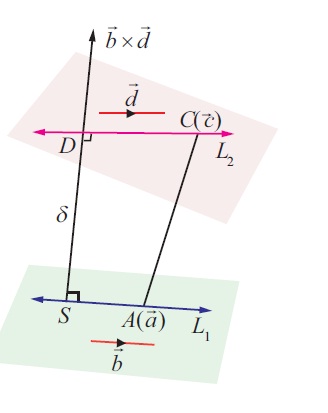
The two skew lines \(\vec{r}=\vec{a}+s \vec{b} \text { and } \vec{r}=\vec{c}+t \vec{d}\) are denoted by L1 and L2 respectively.
Let A and C be the points on L1 and L2 with position vectors \(\vec{a} \text { and } \vec{c}\) respectively.
From the given equations of skew lines, we observe that L1 is parallel to the vector \(\vec{b}\) and L2 is parallel to the vector \(\vec{d}\) So, \(\vec{b} \times \vec{d}\) is perpendicular to the lines L1 and L2 .
Let SD be the line segment perpendicular to both the lines L1 and L2 . Then the vector \(\overrightarrow{S D} \) is perpendicular to the vectors \(\vec{b}\) and \(\vec{d}\) and therefore it is parallel to the vector \(\vec{b} \times \vec{d}\) .
So, \(\frac{\vec{b} \times \vec{d}}{|\vec{b} \times \vec{d}|}\) is a unit vector in the direction of \(\overrightarrow{S D} \) Then, the shortest distance \(|\overrightarrow{S D}|\) is the absolute value of the projection of \(\overrightarrow{AC} \) and \(\overrightarrow{S D} \). That is
\(\delta=|\overrightarrow{S D}|=\mid \overrightarrow{A C}\) (Unit vector in the direction of \(\overrightarrow{S D})|=|(\vec{c}-\vec{a}) \cdot \frac{\vec{b} \times \vec{d}}{|\vec{b} \times \vec{d}|} \mid\)
\(\delta=\frac{|(\vec{c}-\vec{a}) \cdot(\vec{b} \times \vec{d})|}{|\vec{b} \times \vec{d}|}, \text { where }|\vec{b} \times \vec{d}| \neq 0\)
10.
If \(\vec{a}, \vec{b}, \vec{c}\) are non-coplanar and
\(\left|\begin{array}{lll} x_{1} & y_{1} & z_{1} \\ x_{2} & y_{2} & z_{2} \\ x_{3} & y_{3} & z_{3} \end{array}\right| \neq 0\)
then the three vectors \(\vec{p}=x_{1} \vec{a}+y_{1} \vec{b}+z_{1} \vec{c}, \quad \vec{q}=x_{2} \vec{a}+y_{2} \vec{b}+z_{2} \vec{c}, \text { and }, \vec{r}=x_{3} \vec{a}+y_{3} \vec{b}+z_{3} \vec{c}\) are also non-coplanar.
11.
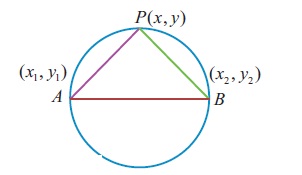
Let A (x1, y1) and B (x2, y2) be the two extremities of the diameter AB and P(x, y) be any point on the circle. Then \(\angle A P B=\frac{\pi}{2}\) (angle in a semi-circle).
Therefore, the product of slopes of AP and PB is equal to -1.
That is, \(\left(\frac{\left(y-y_{1}\right)}{\left(x-x_{1}\right)}\right)\left(\frac{\left(y-y_{2}\right)}{\left(x-x_{2}\right)}\right)=-1\) yielding the equation of the required circle as (x − x 1)(x − x2 ) + ( y − y1 )( y − y2 ) = 0
12.
Let the circle be S : x2 + y2 +2gx+2 fy+c = 0 , … (1)
and the line be L : lx+my+n = 0 . … (2)
Consider S +\(\lambda\) L = 0 . That is x2 + y2 + 2gx + 2 fy + c +\(\lambda\) (lx + my + n) = 0 ....(3)
Grouping the terms of x, y and constants, we get \(x^{2}+y^{2}+x(2 g+\lambda l)+y(2 f+\lambda m)+c+\lambda n=0\) which is a second degree equation in x and y with coefficients of x2 and y2 equal and there is no xy term.
If (\(\alpha\), \(\beta\) ) is a point of intersection of S and L satisfying equation (1) and (2), then it satisfies equation (3).
Hence S + \(\lambda\)L = 0 represents the required circle.
13.
\({ cos }^{ -1 }\left( cos\frac { \pi }{ 7 } cos\frac { \pi }{ 17 } -sin\frac { \pi }{ 17 } sin\frac { \pi }{ 17 } \right) .\)
\({ cos }^{ -1 }\left( cos\left( \frac { \pi }{ 7 } +\frac { \pi }{ 17 } \right) \right) \)
\(\left[ \therefore cosA\ cosB-sinA\ sinB=cos(A+B) \right] \)
= \({ cos }^{ -1 }\left( cos\left( \frac { 24\pi }{ 119 } \right) \right) \) \(\left[ \therefore \frac { 24\pi }{ 119 } \varepsilon \left[ 0,\pi \right] \right] \)
= \(\frac { 24\pi }{ 119 } \)
14.
Equation of given plane is
\(\vec { r } .\left( 6\hat { i } +3\hat { j } +2\hat { k } \right) =8\)
\(\therefore { \vec { n } }_{ 1 }=6\hat { i } +3\hat { j } +2\hat { k } \)
and the line is \(\vec { r } =\left( 2\hat { i } -\hat { j } +\hat { k } \right) +t\left( \hat { i } +2\hat { j } -2\hat { k } \right) \)
\(\therefore \vec { b } =\hat { i } +2\hat { j } -2\hat { k } \)
Angle between a line and a plane is
\(sin\theta =\frac { \left| \vec { b } .\vec { n } \right| }{ \left| \vec { b } \right| \left| \vec { n } \right| } =\cfrac { \left| 6(1)+3(2)+2(-2) \right| }{ \sqrt { { 1 }^{ 2 }+{ 2 }^{ 2 }+\left( -2 \right) ^{ 2 }.\sqrt { { 6 }^{ 2 }+{ 3 }^{ 2 }+{ 2 }^{ 2 } } } } \)
= \(\frac { 6+6-4 }{ \sqrt { 9 } .\sqrt { 36+9+4 } } =\frac { 8 }{ \sqrt { 9 } .\sqrt { 49 } } =\frac { 8 }{ 3\left( 7 \right) } =\frac { 8 }{ 21 } \)
\(\therefore \theta ={ sin }^{ -1 }\left( \cfrac { 8 }{ 21 } \right) \)
15.
Given \(\vec { a } \) = \(2\hat { i } +6\hat { j } +3\hat { k } \)
\(\vec { n } \) = \(\hat { i } +3\hat { j } +5\hat { k } \)
Vector form of the evaluation of the plane passing through one point (\(\vec { a } \)) and normal to a vector (\(\vec { n } \)) is
\(\vec { r } .\vec { n } =\vec { a } .\vec { n }\)
\(=\vec { r } .(\hat { i } +3\hat { j } +5\hat { k } )=(2\hat { i } +6\hat { j } +3\hat { k } ).(\hat { i } +3\hat { j } +5\hat { k } )\)
= 2 + 18 + 15
\(\Rightarrow \vec { r } .(\hat { i } +3\hat { j } +5\hat { k } )=35\)
Its Cartesian equation will be
\(a(x-{ x }_{ 1 })+b(y-{ y }_{ 1 })+c(z-{ z }_{ 1 })=0\)
1(x-2)+3(y-6)+5(z-3) = 0
[\(\because ({ x }_{ 1 },{ y }_{ 1 },{ z }_{ 1 }\) is (2, 6, 3) and a, b, c = 1, 3, 5]
\(\Rightarrow\) x-2 + 3y-18 + 5z-15 = 0
\(\Rightarrow\) x + 3y + 5z - 35 = 0
\(\Rightarrow\) x + 3y + 5z = 35
16.
The equation of the ellipse is \(\frac { { \left( x-11 \right) }^{ 2 } }{ 484 } +\frac { { y }^{ 2 } }{ 64 } =1\). The origin of the sound wave and the kidney stone of patient should be at the foci in order to crush the stones.
a2 = 484 and b2 = 64
c2 = a2 -b2
= 484-64
= 420
c \(\simeq \) 20.5
Therefore the patient’s kidney stone should be placed 20.5 cm from the centre of the ellipse.
17.
Equation of the parabola is y = \(\frac { 1 }{ 32 } \)x2
That is x2 = 32y ; the vertex is (0, 0)
= 4 (8)y
\(\Rightarrow a=8\)
So the heating tube needs to be placed at focus (0, a)
Hence the heating tube needs to be placed 8 units above the vertex of the parabola.
18.
\({ tan }^{ -1 }\left( \frac { x }{ y } \right) -{ { tan }^{ -1 }\left( \frac { x-y }{ x+y } \right) }\)
= \(tan^{ -1 }\left( \frac { \frac { x }{ y } -\frac { x-y }{ x+y } }{ 1+\frac { x }{ y } \left( \frac { x-y }{ x+y } \right) } \right)\)
\(\left[ \because { tan }^{ -1 }x-{ tan }^{ -1 }y={ tan }^{ -1 }\left( \frac { x-y }{ 1+xy } \right) \right]\)
= \({ tan }^{ -1 }\left( \frac { \frac { x(x+y)-y(x-y) }{ y(x+y) } }{ \frac { y(x+y)+x(x-y) }{ y(x+y) } } \right)\)
\(\begin{aligned}
& =\tan ^{-1}\left(\frac{\frac{x^2+y y-y y+y^2}{y(x+y)}}{\frac{y y+y^2+x^2-y y}{y(x+y)}}\right) \\
& =\tan ^{-1}\left(\frac{x^2+y^2}{y(x+y)} \times \frac{y(x+y)}{x^2+y^2}\right)
\end{aligned}\)
= tan-1(1)
= \(\frac { \pi }{ 4 }\)
19.
Let P(x, y) be any point on the hyperbola
\(\frac { { x }^{ 2 } }{ { a }^{ 2 } } -\frac { { y }^{ 2 } }{ { b }^{ 2 } } =1\)
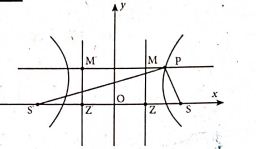
Then by definition, SP = ePM and S'P = ePM'
SP = ePM ⇒ SP = e(NK)
= e(CN - CK)
= \(e\left( x-\frac { a }{ e } \right) \) = ex - a
= and S'P = ePM' ⇒ S'P = e(NK')
⇒ e(CN + CK') = \(e\left( x+\frac { a }{ e } \right) \) = ex + a
∴ S'P -SP = (ex + a) - (ex - a)
ex + a - ex + a = 2a (constant)
= length of the transverse axis.
20.
Passing through (5, -2) length of the transverse axis is a long x-axis and of length 8 units.
2a = 8 ⇒ a = 4
Since the transverse axis is along x-axis, centre is (0, 0)
Equation of the hyperbola is
\(\frac { { x }^{ 2 } }{ 16 } -\frac { { y }^{ 2 } }{ b^{ 2 } } =1\)
Since (5, -2)passes through the parabola,
\(\frac { 25 }{ 16 } -\frac { 4 }{ { b }^{ 2 } } \Rightarrow \frac { 4 }{ { b }^{ 2 } } =\frac { 25 }{ 16 } -1=\frac { 25-16 }{ 16 } =\frac { 9 }{ 16 } \)
∴ \({ b }^{ 2 }=\frac { 16\times 4 }{ 9 } =\frac { 64 }{ 9 } \)
∴ Equation of the hyperbola is
\(\frac { { x }^{ 2 } }{ 16 } -\frac { { y }^{ 2 } }{ \frac { 64 }{ 9 } } =1\Rightarrow \frac { { x }^{ 2 } }{ 16 } -\frac { 9{ y }^{ 2 } }{ 64 } =1\)
21.
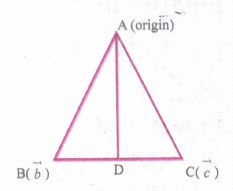
Let ABC be an isosceles triangle with AB = AC and let AD is the median
D is mid-point of BC.
\(
\overrightarrow{A D}=\frac{1}{2}(\overrightarrow{A B}+\overrightarrow{A C})
\)
\( \overrightarrow{B C}=\overrightarrow{B A}+\overrightarrow{A C}
\)
\( \overline{D A} \cdot \overrightarrow{D B}=-\overrightarrow{A D} \cdot\left(\frac{-1}{2} \overrightarrow{C B}\right)
\)
\(=-\overrightarrow{A D} \cdot\left(\frac{1}{2} \overrightarrow{B C}\right)
\)
\(=\frac{1}{2} \overrightarrow{A D} \cdot \overrightarrow{B C}
\)
\(=\frac{1}{4}(\overrightarrow{A B}+\overrightarrow{A C}) \cdot(\overrightarrow{B A}+\overrightarrow{A C})
\)
\(=\frac{1}{4}(\overrightarrow{A B}+\overrightarrow{A C}) \cdot(\overrightarrow{A C}-\overrightarrow{A B}) \)
\(=\frac{1}{4}[(\overrightarrow{A C} \cdot \overrightarrow{A C})-(\overrightarrow{A B} \cdot \overrightarrow{A B})]
\)
\(=\frac{1}{4}\left(A C^{2}-A B^{2}\right)
\)
\(=\frac{1}{4}(0)=0
\)
\(\overrightarrow{D A} \cdot \overrightarrow{D B}=0\)
\(\overrightarrow{D A} \perp \overrightarrow{D B}\)
22.
Parabola is open left and axis of symmetry as x-axis and vertex (0, 0)
Then the equation of the required parabola is
(y - 0)2 = -4\(\sqrt { 2 } \) (x - 0)
y2 = -4\(\sqrt { 2 } \) x
23.
Given equation of the circle is
3x2 + (3 - p)xy + qy2 - 2px = 8pq
For the circle, co-efficient of xy = 0
⇒ 3-p = 0 ⇒ p = 3
Also, co-efficient of x2 = co-efficient of y2
⇒ 3 = q
∴ Equation of the circle is
3x2 + 3y2 - 6x = 8(3)(3)
3x2 + 3y2 - 6x - 72 = 0
Dividing by 3, we get
x2 + y2 - 2x - 24 = 0
Here 2g = - 2⇒ g = - 1
f = 0 and c = - 24
Centre is (-g, -f) (1, 0)
and r = \(\sqrt { { g }^{ 2 }+{ f }^{ 2 }-c } \)
= \(\sqrt { { (-1 })^{ 2 }+0+24 } \)
= \(\sqrt { 25 } \) = 5 units.
24.
Since the circles touch both the axes. Its equation will be
(x + a)2 + (y + a)2 = a2 ...............(1)
It passes through (-4, -2)
∴ (-4 + a)2 + (-2 + a)2 = a2
\(16+\not a^{2}+8 a+4+a^{2}+4 a=\not a^{2}\)
⇒ a2 + 12a + 20 = 0
⇒ (a + 10)(a + 2) = 0
a = -10 or -2
.JPG)
Case (i):
When a = -10, (1) becomes
(x + 10)2 + (y + 10)2 = 102
\(\Rightarrow x^{2}+\not 100+20 x+y^{2}+\not 100+20 y=160\)
⇒ x2 + y2+ 20x + 20y + 100 = 0
Case (ii):
When a = -2, (1) becomes
⇒ (x + 2)2 + (y + 2)2 = 22
\(x^{2}+4 x+4+y^{2}+4 y+\not 4 = \not 4\)
x2 + y2+ 4x + 4y + 4 = 0
Hence, equation of the circles are
x2 + y2+ 4x + 4y + 4 = 0
or x2 + y2+ 20x + 20y + 100 = 0
25.
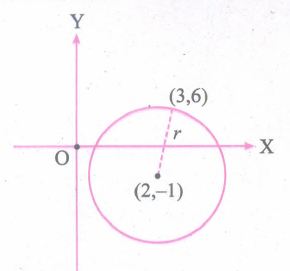
Given centre is (2, -1) and passing through the point (3, 6)
∴ r = distance between (2, -1) and (3, 6)
= \(\sqrt { { (2-3) }^{ 2 }+(-1{ -6) }^{ 2 } } \)
= \(\sqrt { { (-1) }^{ 2 }+({ -7) }^{ 2 } } \)
= \(\sqrt { 1+49 } =\sqrt { 50 } \)
∴ Equation of the circle is
(x - h)2 + (y - k)2 = r2
(x−2)2+(y+1)2 = \({ (\sqrt { 50 } })^{ 2 }\)
(x−2)2+(y+1)2 = 50

12th Standard Syllabus & Materials
12th Standard
TN 12th Computer Applications களப்பெயர் முறைமை (DNS) Sample Question Papers Study Material - QB365 Set A
NEW12th Standard
TN 12th Computer Applications வலையமைப்பு எடுத்துக்காட்டுகள் மற்றும் நெறிமுறைகள் Sample Question Papers Study Material - QB365 Set A
NEW12th Standard
TN 12th Computer Applications கணினி வலையமைப்பு ஓர் அறிமுகம் Sample Question Papers Study Material - QB365 Set A
NEW12th Standard
TN 12th Computer Applications PHP-உடன் MySQL-ஐ இணைத்தல் Sample Question Papers Study Material - QB365 Set A



Tamilnadu Stateboard 12th Standard Subjects
Maths

Chemistry

Physics

Biology

Computer Science

Business Maths and Statistics

Economics

Commerce

Accountancy

History

Computer Applications
Biology
Computer Technology
Computer Applications
Computer Science
Business Maths and Statistics
Commerce
Economics
Maths
Chemistry
Physics
Computer Technology
History
Accountancy

Tamil

English

French
Tamilnadu Stateboard Standards


