
 100% FREE ACCESS
12th Standard Syllabus & Materials
12th Standard
TN 12th Computer Applications மின்னணு தரவு பரிமாற்றம் Sample Question Papers Study Material - QB365 Set A
NEW12th Standard
TN 12th Computer Applications மின் - வணிக பாதுகாப்பு அமைப்புகள் Sample Question Papers Study Material - QB365 Set A
NEW12th Standard
TN 12th Computer Applications மின்னணு செலுத்தல் முறைகள் Sample Question Papers Study Material - QB365 Set A
NEW12th Standard
TN 12th Computer Applications மின் - வணிகம் Sample Question Papers Study Material - QB365 Set A
NEW12th Standard
TN 12th Computer Applications திறந்த மூல கருத்துருக்கள் Sample Question Papers Study Material - QB365 Set A
NEW12th Standard
TN 12th Computer Applications வலையமைப்பு வடமிடல் Sample Question Papers Study Material - QB365 Set A

Published on: 20/10/2025
Download Tamil Nadu 12th Standard Maths question papers, model tests, one-mark questions, important questions, and public exam papers in PDF format. Free study materials and answer keys for TN State Board students.
Questions + Answers key
Take MCQ Maths Test
1.
Find the order and degree of \(y+\frac { dy }{ dx } =\frac { 1 }{ 4 } \int { ydx } \)
2.
Solve \(\frac { dy }{ dx } +2y={ e }^{ -x }\)
3.
Find the differential equation of the family of parabolas y2 = 4ax, where a is an arbitrary constant.
4.
Find value of m so that the function y = emx is a solution of the given differential equation, y''− 5y' + 6y = 0
5.
Show that each of the following expressions is a solution of the corresponding given differential equation.
y = 2x2; xy' = 2y
6.
Express each of the following physical statements in the form of differential equation.
A saving amount pays 8% interest per year, compounded continuously. In addition, the income from another investment is credited to the amount continuously at the rate of Rs. 400 per year.
7.
Show that the function y=Acos2x-Bsin2x is a solution of the D.E y2+4y=0
8.
Solve \(\frac { dy }{ dx } +\frac { { y }^{ 2 } }{ { x }^{ 2 } } =\frac { y }{ x } \)
9.
Solve the following differential equations or show that the solution of
\(\\ \\ \\ \frac { dy }{ dx } =\sqrt { \frac { 1-{ y }^{ 2 } }{ 1-{ x }^{ 2 } } } \)
10.
Solve \((1+{ x }^{ 2 })\frac { dy }{ dx } =1+{ y }^{ 2 }\)
11.
Find the differential equation of the family of parabolas with vertex at (0, −1) and having axis along the y-axis.
12.
Find the differential equation of the family of circles passing through the origin and having their centres on the x -axis.
13.
At 10.00 A.M. a woman took a cup of hot instant coffee from her microwave oven and placed it on a nearby Kitchen counter to cool. At this instant the temperature of the coffee was 180o F, and 10 minutes later it was 160o F. Assume that constant temperature of the kitchen was 70oF.
(i) What was the temperature of the coffee at 10.15 A.M.? \(\left[\log \frac{9}{11}=-0.6061\right]\)
(ii) The woman likes to drink coffee when its temperature is between 130oF and 140oF between what times should she have drunk the coffee? \(\left[\log \frac{6}{11}=-0.2006\right]\)
14.
Assume that the rate at which radioactive nuclei decay is proportional to the number of such nuclei that are present in a given sample. In a certain sample 10% of the original number of radioactive nuclei have undergone disintegration in a period of 100 years. What percentage of the original radioactive nuclei will remain after 1000 years?
15.
Solve the Linear differential equation:
\(\frac { dy }{ dx } =\frac { { sin }^{ 2 }x }{ 1+{ x }^{ 3 } } -\frac { { 3x }^{ 2 } }{ 1+{ x }^{ 3 } } y\)
16.
Solve the Linear differential equation:
x sin x \(\frac { dy }{ dx }\) + (x cos x + sin x) y = sinx
17.
Solve the Linear differential equation:
\((1-{ x }^{ 2 })\frac { dy }{ dx } -xy=1\)
18.
Solve yeydx = (y3+2xey)dy
19.
Solve (1+x3)\(\frac { dy }{ dx } \)+ 6x2y = 1+x2.
20.
Solve the following differential equations
\(\left[ x+y\quad cos\left( \frac { y }{ x } \right) \right] dx=x\ cos\left( \frac { y }{ x } \right) dy\)
21.
Solve the following differential equations:
\(\frac { dy }{ dx } -x\sqrt { 25-{ x }^{ 2 } } =0\)
22.
Solve : \(\frac { dy }{ dx } =\sqrt { 4x+2y-1 } \)
23.
The solution of the differential equation \(y \cos x d x=\left(y e^{y} \log y+e^{y}\right) d y \text { is }\)__________
sin y = ex log x + c
sin x = ex log y + c
sin x = ex + log y + c
none of these
24.
P is the amount of certain substance left in after time t. If the rate of evaporation of the substance is proportional to the amount remaining, then
P = Cekt
P = Ce-kt
P = Ckt
Pt = C
25.
The degree of the differential equation \(y(x)=1+\frac { dy }{ dx } +\frac { 1 }{ 1.2 } { \left( \frac { dy }{ dx } \right) }^{ 2 }+\frac { 1 }{ 1.2.3 } { \left( \frac { dy }{ dx } \right) }^{ 3 }+....\) is
2
3
1
4
26.
27.
The order and degree of the differential equation \(\sqrt { sinx } (dx+dy)=\sqrt { cos x } (dx-dy)\) is
1, 2
2, 2
1, 1
2, 1
1.
order 2 ; degree 1
2.
Given that \(\frac{dy}{dx}+2y\) = e-x
This is a linear differential equation
Here P = 2 ; Q = e−x.
\(\int { pdx } =\int { 2dx } =2x\)
Thus, I.F.\(={ e }^{ \int { pdx } }={ e }^{ 2x }\)
Hence the solution of (1) is \({ ye }^{ \int { pdx } }=\int { { Qe }^{ \int { Pdx } }dx+C } \)
That is, \({ ye }^{ 2x }=\int { { e }^{ -x }{ e }^{ 2x }dx+C } or\quad { ye }^{ 2x }={ e }^{ x }+C\quad or\quad y={ e }^{ -x }+{ Xe }^{ -2x }\) required solution
3.
The equation of the family of parabolas is given by y2 ax = 4, a is an arbitrary constant. ... (1)
Differentiating both sides of (1) with respect to x , we get 2y\(\frac{dy}{dx}=4a\Rightarrow a=\frac{y}{2}\frac{dy}{dx}\)
Substituting the value of a in (1) and simplifying, we get \(\frac{dy}{dx}=\frac{y}{2x}\) as the required differential equation.
4.
y''− 5y' + 6y = 0 ......(1)
Given y = emx .....(2)
Differentiating cquation (2) w.r.t 'x', we get
\(\frac{dy}{dx} = em^x . m\)
To find the value of m:
Given y" - 5y' + 6y = 0
emx . m2 -5emx+ 6emx = 0
emx [m- 5m +6] = 0
m - 5m + 6 = 0
(m - 3) (m - 2) = 0
m = 3, 2
5.
y = 2x2 ; xy' = 2y
Consider y = ax2 ...(1)
Differentiating with respect to 'x' we get,
⇒ \(\frac { dy }{ dx } = 2.2x\) ...(2)
Multiply by x on both sides, we get,
x = \(\frac { dy }{ dx } = 2.2x\)
y' = 2y is a given differential equation
Thus y = 2x2 satislies the differential equation
xy' = 2y
Hence y = 2x2 is a solution of the differential equation xy' = 2y.
6.
Let x represent the principal in the saving amount.
R = 8% and N = 1.
∴ Interest = \(\frac { PNR }{ 100 } =\frac { x\times 1\times 8 }{ 100 } =\frac { 2x }{ 25 } \)
∴ Given \(\frac { dx }{ dt } \) = interest + Rs. 400.
∴ \(\frac { dx }{ dt } =\frac { 2x }{ 25 } +400\)
7.
prove
8.
Given \(\frac { dy }{ dx } +\frac { { y }^{ 2 } }{ { x }^{ 2 } } =\frac { y }{ x } \)
\(\Rightarrow \frac { dy }{ dx } =\frac { y }{ x } -\frac { { y }^{ 2 } }{ { x }^{ 2 } } ...(1)\)
This is a homogeneous differential equation
put y = vx
\(\Rightarrow \frac { dy }{ dx } =v+x\frac { dv }{ dx } \)
∴ (1) becomes,
\(v+x\frac { dv }{ dx } =\frac { vx }{ x } -\frac { { v }^{ 2 }{ x }^{ 2 } }{ { x }^{ 2 } } =v-{ v }^{ 2 }\)
\(x\frac { dv }{ dx } =v-{ v }^{ 2 }-v=-v\)
\(\therefore \frac { dv }{ { v }^{ 2 } } =\frac { -dx }{ x } \)
\(\Rightarrow \int { \frac { dv }{ { v }^{ 2 } } =-\int { \frac { dx }{ x } } } \)
\(\Rightarrow \frac { -1 }{ v } =-log\quad x+c\)
\(\Rightarrow \frac { -1 }{ \frac { y }{ x } } =-log\quad x+c\)
\(\Rightarrow \frac { -x }{ y } +logx=c\)
9.
Separating the variables we get,
\(\frac { dy }{ \sqrt { 1-{ y }^{ 2 } } } \frac { dx }{ \sqrt { 1-{ x }^{ 2 } } } \)
Taking Integration on both sides, we get
\(\int \frac{d y}{\sqrt{1-y^{2}}}=\int \frac{d x}{\sqrt{1-x^{2}}}\)
sin-1y = sin-1 x + c
10.
Given that \((1+{ x }^{ 2 })\frac { dy }{ dx } =1+{ y }^{ 2 }\) ..(1)
The given equation is written in the variables separable form
\(\frac { dy }{ { 1+y }^{ 2 } } =\frac { dx }{ { 1+x }^{ x } } \) ...(2)
Integrating both sides of (2), we get tan−1 tan−1x +C.
But tan-1 y - tan-1 x = tan-1 \(\left( \frac { y-x }{ 1+xy } \right) .\) ...(4)
Using (4) in (3) leads to tan-1 \(\left( \frac { y-x }{ 1+xy } \right)\) = C, which implies \(\frac { y-x }{ 1+xy } \) = tan C = a (say).
Thus, y − x = a(1+ xy) gives the required solution
11.
Equation of family of parabolas with axis as y axis is given by,
(x-0) = 4a(y-k) .... (1)
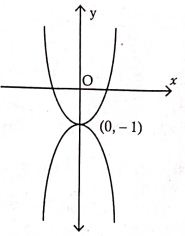
Given: Vertex at (0, - 1).
Putting k = -1 in (1), we get
⇒ x2 = \(\pm\)4a(y + 1) ....(2)
Differentiating with respect to 'x'
2x = \(\pm\)4a\(\left( \frac { dy }{ dx } \right) \) ....(3)
⇒ 4a = \(\frac { 2x }{ \frac { dy }{ dx } } \)
\(\frac{x^2}{2x} = \frac{y+1}{\frac{dt}{dx}}\)
ie) \(x \frac{dy}{dx}-2(y+1) =0\)
This is the required differential equation.
12.
Given the circles centre on r-axis & the circle is passing through the origin.
Let it be (r, 0) & its radius r.
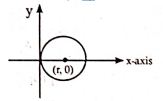
Equation of the circle is
(x - a)2 + (y - b)2 = r2
(x - r)2 + (y - 0)2 = r2
⇒ x2 - 2xr + r2 + y2 = r2
⇒ x2 - 2xr + y2 = 0 ...(1)
defferentiating equation (1) with respect to 'x' we get
⇒ 2x - 2r + 2y \(\frac { dy }{ dx } =0\)
⇒ 2x + 2y \(\frac { dy }{ dx } =2r\)
⇒ x + y \(\frac { dy }{ dx } =r\) ...(2)
Substituting r value in equation (1), we get
x2 - 2x \(\left( x+y\frac { dy }{ dx } \right) +{ y }^{ 2 }=0\)
\(\Rightarrow \ { x }^{ 2 }-{ 2x }^{ 2 }-2xy\frac { dy }{ dx } +{ y }^{ 2 }=0\)
\(\Rightarrow \ { -x }^{ 2 }{ -2x }y\left( \frac { dy }{ dx } \right) { +y }^{ 2 }\)
Multiply by '-', we get
\(\Rightarrow \ { x }^{ 2 }{ +2x }y\left( \frac { dy }{ dx } \right) { -y }^{ 2 }\) which is the required differential equation.
13.
Let T be the temperature of the coffee at time t
and Tm' the temperature of the kitchen.
By Newton's law of cooling
\(\frac { dT }{ dt } =K(T-{ T }_{ m })\)
\(\Rightarrow \frac { dT }{ dt } =K(T-70)\)
\(\Rightarrow \int { \frac { dT }{ T-70 } =K\int { dt } } \)
\(\Rightarrow log(T-70)=kt+logC\)
\(\Rightarrow log(T-70)-logC=Kt\)
\(\Rightarrow log\left( \frac { T-70 }{ C } \right) =Kt\)
\(\Rightarrow \frac { T-70 }{ C } ={ e }^{ Kt }\)
\(\Rightarrow T-70={ Ce }^{ Kt }...(1)\)
\(\\ When\ t=0,\ T={ 180 }^{ o }F\)
\(\therefore { 180 }^{ o }-{ 70 }^{ o }={ Ce }^{ 0 }\)
\(\Rightarrow C={ 11 }0^{ 0 }\)
\(\\ \therefore (1)\Rightarrow T-70=110{ e }^{ Kt } ..(2)\)
\(When\ t=0,T=160\)
\(\therefore 160-70=110{ e }^{ 10K }\)
\(90=110{ e }^{ 10K }\)
\(\Rightarrow { e }^{ 10K }=\frac { 9 }{ 11 } \)
\(\Rightarrow { e }^{ K }={ \left( \frac { 9 }{ 11 } \right) }^{ \frac { 1 }{ 10 } }...(3)\)
(i) when t = 15, (2) becomes,
\(\Rightarrow T-70=110{ \left( \frac { 9 }{ 11 } \right) }^{ \frac { 1 }{ 10 } \times 15 }\)
\(=110{ \left( \frac { 9 }{ 11 } \right) }^{ \frac { 3 }{ 2 } }\)
\(=110\times { \left( \frac { 9 }{ 11 } \right) }\left( \sqrt { \frac { 9 }{ 11 } } \right) \)
\(=110\times \frac { 9 }{ 11 } \times \frac { 3 }{ \sqrt { 11 } } \)
\(=\frac { 270 }{ \sqrt { 11 } } =\frac { 270 }{ 3.32 } =81.33\)
\(\Rightarrow\) T=81.33+70=151.3F
\(\therefore\) T = 151.3F
\(\therefore\) The temperature of the coffee at 10.15 am is 151.3F
(ii) when T = 130F, (2) becomes
T-70 = 110ekt ...(2)
\(\Rightarrow\) 130-70 = 110ekt
60 = 110ekt
ekt = \(\frac{6}{11}\)
\({ \left( \frac { 9 }{ 11 } \right) }^{ \frac { t }{ 10 } }=\frac { 6 }{ 11 } \)
\(\frac { t }{ 10 } =\frac { log\left( \frac { 6 }{ 11 } \right) }{ log\left( \frac { 9 }{ 11 } \right) } \)
\(=\frac { log(0.545) }{ log(0.818) } =\frac { -0.264 }{ -0.087 } \)
= 3.34
t = 30.34min
T = 140F (2)becomes
140-70 = 110ekt ...(2)
\(\Rightarrow 70={ 110e }^{ kt }\)
\({ e }^{ kt }=\frac { 7 }{ 11 } \)
\({ \left( \frac { 9 }{ 11 } \right) }^{ \frac { t }{ 10 } }=\frac { 7 }{ 11 } \)
\(\frac { t }{ 10 } =\frac { log\left( \frac { 7 }{ 11 } \right) }{ log\left( \frac { 7 }{ 11 } \right) } =\frac { -0.197 }{ -0.087 } \)
= 2.26
t = 22.6min
\(\therefore\) Between 10.22 min to 10.30 min, the woman should have drunk the coffee.
14.
Let there be N radioactive nuclei in a sample at any time t and let No be the initial number of radioactive nuclei.
Then \(\frac{dN}{dt}\infty N\)
\(\Rightarrow \frac { dN }{ dt } =-\lambda N\)
Where \(\lambda>0\) is a constant
\(\Rightarrow \frac { dN }{ N } =-\lambda dt\)
\(\int { \frac { dN }{ N } } =-\lambda dt\)
\(\int { \frac { dN }{ N } =-\lambda \int { dt } } \)
\(\Rightarrow log\ N=-\lambda t+C\ ...(1)\)
\(T\quad t=0,\ we\ have\ N={ N }_{ 0 }\)
\(\therefore log{ N }_{ 0 }=0+C\)
\(\Rightarrow C=log{ N }_{ 0 }\)
\(\therefore\)(1) becomes, log N = -\(\lambda t+log{ N }_{ 0 }\)
\(\Rightarrow log\frac { N }{ { N }_{ 0 } } =-\lambda t\quad ...(2)\)
It is given that 10% of the original number of nuclei have undergone disintegration in a period of 100 years.
Whent= 100 \(N={ N }_{ 0 }-\frac { 10 }{ 100 } \times { N }_{ 0 }=\frac { { 9N }_{ 0 } }{ 10 } \)
Substituting in (2) we get
\(log\quad \frac { 9 }{ 10 } =-100\lambda \)
\(\Rightarrow \lambda =-\frac { 1 }{ 100 } log\frac { 9 }{ 10 } \)
Substituting in (2) we get,
\(log\frac { N }{ { N }_{ 0 } } =\left( \frac { 1 }{ 100 } log\frac { 9 }{ 10 } \right) t\)
when t = 1000,
\(log\frac { N }{ { N }_{ 0 } } =\frac { 1 }{ 100 } log\left( \frac { 9 }{ 10 } \right) \times 1000\)
\(=10log\left( \frac { 9 }{ 10 } \right) \)
\(\Rightarrow log\frac { N }{ { N }_{ 0 } } ={ \left( \frac { 9 }{ 10 } \right) }^{ 10 }\)
\(\Rightarrow \frac { N }{ { N }_{ 0 } } ={ \left( \frac { 9 }{ 10 } \right) }^{ 10 }\)
\(\Rightarrow \frac { N }{ { N }_{ 0 } } \times 100={ \left( \frac { 9 }{ 10 } \right) }^{ 10 }\times 100=\frac { { 9 }^{ 10 } }{ { 10 }^{ 8 } } \)
Hence, \(\frac { { 9 }^{ 10 } }{ { 10 }^{ 8 } } \%\) of radioactive nuclei will remain after 1000 years,
15.
\(\frac { dy }{ dx } +\frac { { 3x }^{ 2 }y }{ 1+{ x }^{ 3 } } =\frac { { sin }^{ 2 }x }{ 1+{ x }^{ 3 } } \)
This is a linear differential equation
\(\therefore P=\frac { { 3x }^{ 2 } }{ 1+{ x }^{ 3 } } ;Q=\frac { { sin }^{ 2 }x }{ 1+{ x }^{ 3 } } \)
\(\therefore \int { pdx } =\int { \frac { { 3x }^{ 2 } }{ 1+{ x }^{ 3 } } dx } =log(1+{ x }^{ 3 })\)
\(\therefore I.F.={ e }^{ \int { pdx } }={ e }^{ log(1+{ x }^{ 3 }) }=(1+{ x }^{ 3 })\)
\(\therefore\)The solution is \({ ye }^{ \int { pdx } }=\int { Q{ e }^{ \int { pdx } }dx+c } \)
\(\Rightarrow y(1+{ x }^{ 3 })=\int { \frac { { sin }^{ 2 }x }{ 1+{ x }^{ 3 } } (1+{ x }^{ 3 })dx+c } \)
\(cos2x=1-2{ sin }^{ 2 }x\)
\(sin2x=\frac { 1-cos2x }{ 2 } =\int { { sin }^{ 2 }xdx+c } \)
\(\Rightarrow y(1+{ x }^{ 3 })=\int { \frac { 1-cos2x }{ 2 } } dx+c\)
\(\Rightarrow y(1+{ x }^{ 3 })=\frac { x }{ 2 } -\frac { sin2x }{ 4 } +c\)
16.
The given differential equation can be written as
\(\frac{x \sin x}{x \sin x} \frac{d y}{d x}+\frac{(x \cos x+\sin x) y}{x \sin x} =\frac{\sin x}{x \sin x}\)
\(\frac{d y}{d x}+\left(\frac{x \cos x}{x \sin x}+\frac{\sin x}{x \sin x}\right) y =\frac{1}{x} \)
\(\frac{d y}{d x}+\left(\cot x+\frac{1}{x}\right) y =\frac{1}{x}\)
This is of the form \( \frac{d y}{d x}+P y=\mathrm{Q} \), where
\(\mathrm{P}=\cot x+\frac{1}{x} ; \mathrm{Q}=\frac{1}{x} \text {. }\)
Thus, the given differential equation is linear.
\( \text { I.F }=e^{\int h t s}=e^{\int(x+x+16 x d t}=e^{b \text { bedex+ive }} \)
\( =e^{\ln (\sin a)}=x \sin x\)
So, the solution of the given differential equatior is given by
\(\mathrm{y} \times \mathrm{I} . \mathrm{F} =\int(Q \times I . F) d x+c \)
\(\mathrm{y}(x \sin x) =\int \frac{1}{x} x \sin x d x+c \)
\( =\int \sin x d x+c \)
\(\mathrm{y}(x \sin x) =-\cos x+c\)
\(xy \sin x+\cos x=\mathrm{c}\) is the required solution.
17.
The given differential equation can be written as
\(\frac { dy }{ dx } +\left( \frac { -x }{ 1-{ x }^{ 2 } } \right) y=\frac { 1 }{ 1-{ x }^{ 2 } } \)
This is of the form \(\frac{dy}{dx}+Py = Q\)
where \( P=\frac { -x }{ 1-{ x }^{ 2 } } ;Q=\frac { 1 }{ 1-{ x }^{ 2 } } \)
Thus, the given differential equation is linear.
\(\int { pdx } =\int { \frac { -x }{ 1-{ x }^{ 2 } } dx } =\frac { 1 }{ 2 } \int { \frac { -2x }{ 1-{ x }^{ 2 } } dx } \)
\(=\frac { 1 }{ 2 } log(1-{ x }^{ 2 })=log\sqrt { 1-{ x }^{ 2 } } \)
\(\therefore I.F.={ e }^{ \int { pdx } }={ e }^{ log\sqrt { 1-{ x }^{ 2 } } }=\sqrt { 1-{ x }^{ 2 } } \)
So, the required solution is given by
\({[\mathrm{y} \times \mathrm{I} . \mathrm{F}] } =\int[Q \times I . F] d x+c \)
\(y \times \sqrt{1-x^2} =\int \frac{1}{1-x^2} \sqrt{1-x^2} d x+c \)
\( =\int \frac{1}{\sqrt{1-x^2}} \frac{\sqrt{1-x^2}}{\sqrt{1-x^2}} d x+c \)
\( =\int \frac{1}{\sqrt{1-x^2}} d x+c \)
\(\div \sqrt{1-x^2}, \frac{y \sqrt{1-x^2}}{\sqrt{1-x^2}} =\frac{\sin ^{-1} x}{\sqrt{1-x^2}}+\frac{c}{\sqrt{1-x^2}} \)
\(\mathrm{y} =\frac{\sin ^{-1} x+c}{\sqrt{1-x^2}}+c\left(1-x^2\right)^{-1 / 2}\)
Which is a required solution.
18.
The given equation can be written as \(\frac { dy }{ dx } -\frac{2}{y}x=y^2e^{-y}\).
This is a linear differential equation. Here \(P=-\frac { 2 }{ y } ;Q={ y }^{ 2 }{ e }^{ -y }\)
\(\int { pdy } =\int { -\frac { 2 }{ y } dy=-2log|y|=log{ |y| }^{ -2 } } =log\left( \frac { 1 }{ { y }^{ 2 } } \right) ,\)
Thus, \(I.F={ e }^{ \int { Pdy } }={ e }^{ log\left( \frac { 1 }{ { y }^{ 2 } } \right) }=\frac { 1 }{ { y }^{ 2 } } .\)
Hence the solution is \(x{ e }^{ \int { Pdy } }=\int { Q{ e }^{ \int { Pdy } }dy+C } \)
Thus, \(x\left( \frac { 1 }{ { y }^{ 2 } } \right) =\int { { y }^{ 2 }{ e }^{ -y } } \left( \frac { 1 }{ { y }^{ 2 } } \right) dy+C=\int { { e }^{ -y }dy+C } =-{ e }^{ -y }+C\)or x = −y2e−y +Cy2 is the required solution
19.
Here, to make the coefficient of \(\frac { dy }{ dx } \) unity, divide both sides by (1+x3).
Then the equation is \(\frac { dy }{ dx } +\frac { { 6x }^{ 2 }y }{ 1+{ x }^{ 3 } } =\frac { 1+{ x }^{ 2 } }{ 1+{ x }^{ 3 } } \)
This is a linear differential equation in y.
Here, \(P=\frac { { 6x }^{ 2 } }{ 1+{ x }^{ 3 } } ;Q=\frac { 1+{ x }^{ 2 } }{ 1+{ x }^{ 3 } } \)
\(\int { Pdx } =\int { \frac { { x }^{ 2 } }{ 1+{ x }^{ 3 } } dx } =2log|1+{ x }^{ 3 }|=log{ |1+{ x }^{ 3 }| }^{ 2 }=log{ ({ 1+x }^{ 3 }) }^{ 2 }\)
Thus, I.F.\(={ e }^{ \int { Pdx } }={ e }^{ log{ ({ 1+x }^{ 3 }) }^{ 2 } }={ (1+{ x }^{ 3 }) }^{ 2 }\)
Hence the solution is \(ye^{ \int { Pdx } }=\int { { Qe }^{ \int { Pdx } }dx+C. } \)
Thus is, \(y{ (1+{ x }^{ 2 }) }^{ 2 }=\int { \frac { 1+{ x }^{ 2 } }{ 1+{ x }^{ 3 } } } { (1+{ x }^{ 3 }) }^{ 2 }dx+C=\int { (1+{ x }^{ 2 }) } (1+{ x }^{ 3 })dx+C=\int { (1+{ x }^{ 2 }+{ x }^{ 3 }+{ x }^{ 5 }) } dx+C\) \(or\ y{ (1+{ x }^{ 3 }) }^{ 2 }=x+\frac { { x }^{ 3 } }{ 3 } +\frac { { x }^{ 4 } }{ 4 } +\frac { x^{ 6 } }{ 6 } +C\)
\(and\quad y=\frac { 1 }{ { (1+{ x }^{ 3 }) }^{ 2 } } \left[ x+\frac { { x }^{ 3 } }{ 3 } +\frac { { x }^{ 4 } }{ 4 } +\frac { x^{ 6 } }{ 6 } +C \right] \)is the required solution.
20.
\(\left[ x+y\ cos\left( \frac { y }{ x } \right) \right] dx=x\ cos\left( \frac { y }{ x } \right) dy\)
\(\Rightarrow \frac { dy }{ dx } =\frac { x+ycos\left( \frac { y }{ x } \right) }{ xcos\left( \frac { y }{ x } \right) } ...(1)\)
This is homogeneous differential equation
\(\therefore put\ y=vx\)
\(\Rightarrow \frac { dy }{ dx } =v+x\frac { dv }{ dx } ...(2)\)
Substituing (2) in (1)we get,
\(v+x\frac { dv }{ dx } =\frac { x+vxcosv }{ xcosv } \)
\(\frac { x(1+vcosv) }{ xcosv } =\frac { 1+vcosv }{ cosv } \)
\(\Rightarrow x\frac { dv }{ dx } =\frac { 1+vcosv }{ cosv } -v\)
\(=\frac { 1+vcosv-vcosv }{ cosv } \)
\(=\frac { 1 }{ cosv } \)
\(cosv\ dv=\frac { dx }{ x } \)
On integration, we obtain
\(\Rightarrow \int { cos\ v\ dv } =\int { \frac { dx }{ x } } \)
\(\Rightarrow sin\ v=log\ |x|+log\ |c|\)
\(\Rightarrow sin\left( \frac { y }{ x } \right) =log|cx|\)
\([\because y=vx\Rightarrow v=\frac { y }{ x } ]\)
which gives the required solution.
21.
\(\Rightarrow \frac { dy }{ dx } -x\sqrt { 25-{ x }^{ 2 } } \)
\(\Rightarrow \frac { dy }{ dx } -x\sqrt { 25-{ x }^{ 2 } } \)dx
put 25 - x2 = t2
⇒ -2x dx = 2t dt
x dx = -dt
Putting in (1),
⇒ x dx = \(\frac{-dt}{2}\)
dy = t \(\times\)(-t) dt
Integrating on both sides,
\(
\int d y =-\int t^2 d t
\)
\(y =\frac{-t^3}{3}+C_1 \Rightarrow 3 y+t^3=3 C_1
\)
\(3 y+\left(25-x^2\right)^{\frac{3}{2}} =C\)
22.
By putting z = 4x + 2y −1, we have
z' = 4+2y' = 4+2\(\sqrt z\)
hence \(\frac { dz }{ 4+2\sqrt { z } } =dx\).
Integrating, \(\int { \frac { dz }{ 4+2\sqrt { 2 } } =x+C } \)
Putting z = u2 , we have
\(\int { \frac { dz }{ 4+2\sqrt { 2 } } =\frac { udu }{ u+2 } =u-2|u+2|+C } \)
or \(\sqrt z\) - 2 In(\(\sqrt z\) + 2) = x+C
from which on substituting z = 4x + 2y −1, we have the general solution
\(\sqrt { 4x+2y-1 } -2\quad In(\sqrt { 4x+2y-1 } +2)=x+C\)
23.
(b)
sin x = ex log y + c
24.
(b)
P = Ce-kt
25.
(c)
1
26.
(d)
27.
\({ I }_{ n }=\int _{ 0 }^{ \pi /2 }{ { cos }^{ 7 }xdx=\frac { n-1 }{ n } { I }_{ n-2 },n\ge 2 } \)
\(\therefore { I }_{ 7 }=\int _{ 0 }^{ \pi /2 }{ { cos }^{ 7 }xdx=\frac { 6 }{ 7 } \times \frac { 4 }{ 5 } \times \frac { 2 }{ 3 } \times 1 } =\frac { 16 }{ 35 } \)

12th Standard Syllabus & Materials
12th Standard
TN 12th Computer Applications களப்பெயர் முறைமை (DNS) Sample Question Papers Study Material - QB365 Set A
NEW12th Standard
TN 12th Computer Applications வலையமைப்பு எடுத்துக்காட்டுகள் மற்றும் நெறிமுறைகள் Sample Question Papers Study Material - QB365 Set A
NEW12th Standard
TN 12th Computer Applications கணினி வலையமைப்பு ஓர் அறிமுகம் Sample Question Papers Study Material - QB365 Set A
NEW12th Standard
TN 12th Computer Applications PHP-உடன் MySQL-ஐ இணைத்தல் Sample Question Papers Study Material - QB365 Set A



Tamilnadu Stateboard 12th Standard Subjects
Maths

Chemistry

Physics

Biology

Computer Science

Business Maths and Statistics

Economics

Commerce

Accountancy

History

Computer Applications
Biology
Computer Technology
Computer Applications
Computer Science
Business Maths and Statistics
Commerce
Economics
Maths
Chemistry
Physics
Computer Technology
History
Accountancy

Tamil

English

French
Tamilnadu Stateboard Standards


