
 100% FREE ACCESS
12th Standard Syllabus & Materials
12th Standard
TN 12th Computer Applications மின்னணு தரவு பரிமாற்றம் Sample Question Papers Study Material - QB365 Set A
NEW12th Standard
TN 12th Computer Applications மின் - வணிக பாதுகாப்பு அமைப்புகள் Sample Question Papers Study Material - QB365 Set A
NEW12th Standard
TN 12th Computer Applications மின்னணு செலுத்தல் முறைகள் Sample Question Papers Study Material - QB365 Set A
NEW12th Standard
TN 12th Computer Applications மின் - வணிகம் Sample Question Papers Study Material - QB365 Set A
NEW12th Standard
TN 12th Computer Applications திறந்த மூல கருத்துருக்கள் Sample Question Papers Study Material - QB365 Set A
NEW12th Standard
TN 12th Computer Applications வலையமைப்பு வடமிடல் Sample Question Papers Study Material - QB365 Set A

Published on: 20/10/2025
Download Tamil Nadu 12th Standard Maths question papers, model tests, one-mark questions, important questions, and public exam papers in PDF format. Free study materials and answer keys for TN State Board students.
Questions + Answers key
Take MCQ Maths Test
1.
Find the area bounded by the curve y = x3 and the line y = x.
2.
An arch is in the form of a semi-ellipse whose span is 48 feet wide. The height of the arch is 20 feet. How wide is the arch at a height of 10 feet above the base?
3.
Prove p⟶(q⟶r) ☰ (p ∧ q)⟶r without using truth table.
4.
If u = sin-1 \(\left( \frac { x+y }{ \sqrt { x } +\sqrt { y } } \right) \), Show that \(x\frac { \partial u }{ \partial x } +y\frac { \partial u }{ \partial y } =\frac { 1 }{ 2 } tanu\)
5.
Evaluate the following integrals using properties of integration:
\(\int _{ 0 }^{ { sin }^{ 2 }x }{ { sin }^{ -1 }\sqrt { t } dt+\int _{ 0 }^{ { cos }^{ 2 }x }{ { cos }^{ -1 }\sqrt { t } dt } } \)
6.
Suppose the amount of milk sold daily at a milk booth is distributed with a minimum of 200 Iitres and a maximum of 600 litres with probability density function
\(\begin{cases} \begin{matrix} k & 200\le x\le 600 \end{matrix} \\ \begin{matrix} 0 & otherwise \end{matrix} \end{cases}\)
Find
(i) the value of k
(ii) the distribution function
(iii) the probability that daily sales will fall between 300 litres and 500 litres?
7.
Solve the Linear differential equation:
\(\frac { dy }{ dx } =\frac { { sin }^{ 2 }x }{ 1+{ x }^{ 3 } } -\frac { { 3x }^{ 2 } }{ 1+{ x }^{ 3 } } y\)
8.
A rectangular page is to contain 24 cm2 of print. The margins at the top and bottom of the page are 1.5 cm and the margins at other sides of the page is 1 cm. What should be the dimensions of the page so that the area of the paper used is minimum.
9.
Solve \(2{ tan }^{ -1 }x={ cos }^{ -1 }\frac { 1-{ a }^{ 2 } }{ 1+{ a }^{ 2 } } -{ cos }^{ -1 }\frac { 1-{ b }^{ 2 } }{ 1+{ b }^{ 2 } } ,a>0,b>0\)
10.
Solve the equation z3+ 8i = 0, where \(z \in \mathbb{C}\)
11.
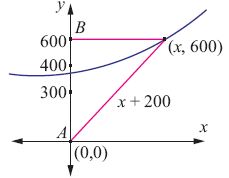
Two coast guard stations are located 600 km apart at points A(0, 0) and B(0, 600). A distress signal from a ship at P is received at slightly different times by two stations. It is determined that the ship is 200 km farther from station A than it is from station B. Determine the equation of hyperbola that passes through the location of the ship.
12.
In a T20 match, a team needed just 6 runs to win with 1 ball left to go in the last over. The last ball was bowled and the batsman at the crease hit it high up. The ball traversed along a path in a vertical plane and the equation of the path is y = ax2 + bx + c with respect to a xy-coordinate system in the vertical plane and the ball traversed through the points (10, 8), (20, 16) (40, 22) can you conclude that the team won the match?
Justify your answer. (All distances are measured in metres and the meeting point of the plane of the path with the farthest boundary line is (70, 0).)
13.
Prove by vector method that the perpendiculars (altitudes) from the vertices to the opposite sides of a triangle are concurrent.
14.
If the equations x2 + px + q = 0 and x2 + p'x + q' = 0 have a common root, show that it must be equal to \(\frac { pq'-p'q }{ q-q' } \) or \(\frac { q-q' }{ p'-p } \).
15.
Let G = {1, i, -1, -i} under the binary operation multiplication. Find the inverse of all the elements.
16.
An urn contains 2 white balls and 3 red balls. A sample of 3 balls are chosen at random from the urn. If X denotes the number of red balls chosen, find the values taken by the random variable X and its number of inverse images
17.
Evaluate \(\int _{ 0 }^{ 1 }{ { x }^{ 5 }{ (1-{ x }^{ 2 }) }^{ 5 }dx } \)
18.
Prove, using mean value theorem, that \(|sin \alpha-sin\beta|\le |\alpha-\beta|, \alpha, \beta \in R\)
19.
Solve \((1+{ x }^{ 2 })\frac { dy }{ dx } =1+{ y }^{ 2 }\)
20.
Find the domain of
g(x) = sin−1x + cos−1x
21.
Solve the following systems of linear equations by Cramer’s rule:
\(\frac { 3 }{ x } \) + 2y = 12, \(\frac { 2 }{ x } \) + 3y = 13
22.
Prove that the length of the latus rectum of the hyperbola \(\frac { { x }^{ 2 } }{ { a }^{ 2 } } -\frac { { y }^{ 2 } }{ { b }^{ 2 } } \) = 1 is \(\frac { { 2b }^{ 2 } }{ a } \).
23.
Using vector method, prove that if the diagonals of a parallelogram are equal, then it is a rectangle
24.
Form a polynomial equation with integer coefficients with \(\sqrt { \frac { \sqrt { 2 } }{ \sqrt { 3 } } } \) as a root.
25.
Solve: \(\frac{d y}{d x}+\mathrm{y}=\mathrm{e}^{-x}\)
26.
Let A = {a +\(\sqrt5\) b : a,b∈Z}. Check whether the usual multiplication is a binary operation on A.
27.
An egg of a particular bird is very nearly spherical. If the radius to the inside of the shell is 5 mm and radius to the outside of the shell is 5.3 mm, find the volume of the shell approximately.
28.
Evaluate :\(\int _{ 0 }^{ 1 }{ [2x] } dx\) where [⋅] is the greatest integer function
29.
A stone is dropped into a pond causing ripples in the form of concentric circles. The radius r of the outer ripple is increasing at a constant rate at 2 cm per second. When the radius is 5 cm find the rate of changing of the total area of the disturbed water?
30.
Find the value, if it exists. If not, give the reason for non-existence.
sin-1 [sin5]
31.
Find the acute angle between the following lines
\(\vec { r } =(4\hat { i } -\hat { j } )+t(\hat { i } +2\hat { j } -2\hat { k } )\), \(\hat{r}=(\hat { i } +2\hat { j } -2\hat { k } )+s(\hat {- i } -2\hat { j } +2\hat { k } )\)
32.
Find the square roots of 4+3i
33.
Obtain the equation of the circle for which (3, 4) and (2, -7) are the ends of a diameter.
34.
If adj(A) = \(\left[ \begin{matrix} 0 & -2 & 0 \\ 6 & 2 & -6 \\ -3 & 0 & 6 \end{matrix} \right] \), find A−1.
35.
The volume, when the region bounded by y = x, y = 1, x = 0 is rotated about y axis __________
\(\frac{\pi}{2}\)
\(\frac{\pi}{6}\)
\(\frac{\pi}{3}\)
\(\pi\)
36.
\(\lim _{x \rightarrow \infty} \frac{x^{2}}{e^{x}}=\) ____________
2
0
\(\infty\)
1
37.
The equation of the directrix of the parabola \(y^{2}=x+4 \text { is }\)_____________
\(x=\frac{15}{4} \)
\(x=-\frac{15}{4} \)
\(x=-\frac{17}{4}\)
\(x=\frac{17}{4} \)
38.
If x is a continuous random variable then P(x ≥ a) =
\(P(x \ < \ a)\)
\(P(a\le x\le b)\)
\(P\left( x>a \right) \)
\(1-P\left( x\le a-1 \right) \)
39.
In the set R of real numbers ‘*’ is defined as follows. Which one of the following is not a binary operation on R?
a*b = min (a.b)
a*b = max (a, b)
a*b = a
a*b = ab
40.
41.
If \(u(x, y)=e^{x^{2}+y^{2}}\),then \(\frac { \partial u }{ \partial x } \) is equal to
\(e^{x^{2}+y^{2}}\)
2xu
x2u
y2u
42.
If the function \(f(x)=\frac { 1 }{ 12 } \) for a < x < b, represents a probability density function of a continuous random variable X, then which of the following cannot be the value of a and b?
0 and 12
5 and 17
7 and 19
16 and 24
43.
44.
The differential equation of the family of curves y = Aex + Be−x, where A and B are arbitrary constants is
\(\frac { { d }^{ 2 }y }{ { dx }^{ 2 } } +y=0\)
\(\frac { { d }^{ 2 }y }{ { dx }^{ 2 } } -y=0\)
\(\frac { { d }y }{ { dx } } +y=0\)
\(\frac { { d }y }{ { dx } } -y=0\)
45.
The abscissa of the point on the curve \(f\left( x \right) =\sqrt { 8-2x } \) at which the slope of the tangent is -0.25 ?
-8
-4
-2
0
46.
The amplitude of \(\frac{1}{i}\) is equal to _______
0
\(\frac { \pi }{ 2 } \)
-\(\frac { \pi }{ 2 } \)
\(\pi \)
47.
The two planes 3x + 3y - 3z - 1 = 0 and x + y - z + 5 = 0 are _____________
mutually perpendicular
parallel
inclined at 45o
inclined at 30
48.
The system of equations x + 2y + 3z = 1, x - y + 4z = 0, 2x + y + 7z = 1 has ___________
One solution
Two solution
No solution
Infinitely many solution
49.
If (AB)-1 = \(\left[ \begin{matrix} 12 & -17 \\ -19 & 27 \end{matrix} \right] \) and A-1 = \(\left[ \begin{matrix} 1 & -1 \\ -2 & 3 \end{matrix} \right] \), then B-1 =
\(\left[ \begin{matrix} 2 & -5 \\ -3 & 8 \end{matrix} \right] \)
\(\left[ \begin{matrix} 8 & 5 \\ 3 & 2 \end{matrix} \right] \)
\(\left[ \begin{matrix} 3 & 1 \\ 2 & 1 \end{matrix} \right] \)
\(\left[ \begin{matrix} 8 & -5 \\ -3 & 2 \end{matrix} \right] \)
50.
If \(\vec { a } \times (\vec { b } \times \vec { c } )=(\vec { a } \times \vec { b } )\times \vec { c } \) where \(\vec { a } ,\vec { b } ,\vec { c } \) are any three vectors such that \(\vec{b} \cdot \vec{c} \neq 0 \text { and } \vec{a} \cdot \vec{b} \neq 0\), then \(\vec { a } \) and \(\vec { c } \) are
perpendicular
parallel
inclined at an angle \(\frac{\pi}{3}\)
inclined at an angle \(\frac{\pi}{6}\)
51.
The equation of the circle passing through the foci of the ellipse \(\frac{x^{2}}{16}+\frac{y^{2}}{9}=1\) having centre at (0, 3) is
x2 + y2 − 6y − 7 = 0
x2 + y2 − 6y + 7 = 0
x2+y2−6y−5 = 0
x2+y2−6y+5 = 0
52.
53.
z1, z2 and z3 are complex number such that z1 + z2 + z3 = 0 and |z1| = |z2| = |z3| = 1 then z12 + z22 + z33 is
3
2
1
0
54.
1.
The line y = x lies above the curve y = x3 in the first quadrant y = x3 lies above the line y = x in the third quadrant.
To get the point of intersection solve the curves y = x3, y = x
\(
\mathbf{x}^{3} =\mathrm{x}
\)
\(\mathrm{x}^{3}-\mathrm{x} =0
\)
\(\mathbf{x}\left(\mathrm{x}^{2}-\mathrm{x}\right) =0 \quad \Rightarrow \quad \mathrm{x}=0, \mathrm{x}=\pm 1\)
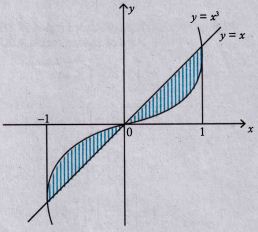
The required Area
\(
=\int_{-1}^{0}[g(x)-f(x)] d x+\int_{0}^{1}[f(x)-g(x)] d x
\)
\(=\int_{-1}^{0}\left(x^{3}-x\right) d x+\int_{0}^{1}\left(x-x^{3}\right) d x
\)
\(=\left[\frac{x^{4}}{4}-\frac{x^{2}}{2}\right]_{-1}^{0}+\left[\frac{x^{2}}{2}-\frac{x^{4}}{4}\right]_{0}^{1}
\)
\(=0-\frac{1}{4}-\frac{1}{2}+\frac{1}{2}-0-\frac{1}{4}
\)
\(=-\frac{1}{4}+\frac{1}{2}+\frac{1}{2}-\frac{1}{4}=\frac{1}{2} \)
2.
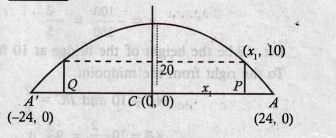
Take the midpoint of the base as the centre c(0, 0)
Since the base wide is 48 feet, the vertices A and A' are (24, 0) and (-24, 0) respectively. Clearly 2a = 48 and b = 20
The corresponding equation is
\(\frac{x^{2}}{24^{2}}+\frac{y^{2}}{20^{2}}=1\) .............(1)
Let x1 be the distance between the pole whose height is 10 m and the center.
Then (x1, 10) satisfies the equation (1)
\(\therefore \frac{x_{1}^{2}}{24^{2}}+\frac{10^{2}}{20^{2}}=1 \Rightarrow x_{1}=12 \sqrt{3}\)
Width of the arch = 2x1 = 24√3 feet
3.
Prove that p⟶(q⟶r) = (p ∧ q)⟶r without using truth table. From example we know that p⟶ q = ~p V q
Consider LHS = p⟶(q⟶r)
= p ⟶ (~q V r) [Implication Law]
= ~p V (~q V r) [Implication Law]
= (~p V ~q) V r [associative property]
= ~(p ∧ q) V r [using Demorgan's law]
= (p ∧ q) ⟶ r [Implication Law]
Hence proved.
4.
Note that the function u is not homogeneous. So we cannot apply Euler’s Theorem for u.
However, note that f(x,y) = \(\frac { x+y }{ \sqrt { x } +\sqrt { y } }\) = sin u is homogeneous; because
f(tx,ty) = \(\frac { tx+ty }{ \sqrt { tx } +\sqrt { ty } } \) = t1/2 f(x, y), \(\forall \) x, y, t\(\ge \)0
Thus f is homogeneous with degree \(\frac { 1 }{ 2 } \) and so by Euler’s Theorem we have
\(x\frac { \partial f }{ \partial x } +y\frac { \partial f }{ \partial y } =\frac { 1 }{ 2 } f(x,y)\).
Now substituting f = sin u in the above equation, we obtain
\(x\frac { \partial (sinu) }{ \partial x } +y\frac { \partial (sinu) }{ \partial y } =\frac { 1 }{ 2 } sin \ u\)
\(x\quad cosu\frac { \partial u }{ \partial x } +y\quad cosu\frac { \partial u }{ \partial x } =\frac { 1 }{ 2 } sin \ u\) ...(19)
Dividing both sides by cosu we obtain
\(x\frac { \partial u }{ \partial x } +y\frac { \partial u }{ \partial y } =\frac { 1 }{ 2 } tan \ u\)
Note:
Solving this problem by direct calculation will be possible; but will involve lengthy calculations.
5.
\(put\sqrt { t } =z\Rightarrow \frac { 1 }{ 2\sqrt { t } } dt=dz\)
\(\Rightarrow \frac { 1 }{ 2z } dt=dz\Rightarrow dt=2zdz\)
| t | 0 | sin2x |
| z | 0 | sin x |
| t | 0 | cos2x |
| z | 0 | cos x |
\(\therefore I=\int _{ 0 }^{ sin\quad x }{ 2z{ sin }^{ -1 }zdz } +\int _{ 0 }^{ cosx }{ 2z{ cos }^{ -1 }zdz } ...(1)\)
= I1+ I2
\(=2\int _{ 0 }^{ x }{ \theta sin\theta cos\theta d\theta +2\int _{ \frac { \pi }{ 2 } }^{ x }{ \theta cos\theta (-sin\theta )d\theta } } \)
\(=\int _{ 0 }^{ x }{ \theta 2sin\theta cos\theta d\theta -\int _{ \frac { \pi }{ 2 } }^{ x }{ \theta 1sin\theta cos\theta d\theta } } \)
\(=\int _{ 0 }^{ x }{ \theta sin2\theta d\theta -\int _{ \frac { \pi }{ 2 } }^{ x }{ \theta sin2\theta d\theta } } \)
\([\because sin2\theta =sin\theta cos\theta ]\)
\(=\int _{ 0 }^{ x }{ \theta sin2\theta d\theta \int _{ x }^{ \frac { \pi }{ 2 } }{ \theta sin2\theta d\theta } =\int _{ 0 }^{ \frac { \pi }{ 2 } }{ \theta sin2\theta d\theta } } \)
\(\left[ \because \int _{ a }^{ c }{ f(x)dx+\int _{ c }^{ b }{ f(x)dx=\int _{ a }^{ b }{ f(x)dx } } } \right] \)
\(={ \left[ -\frac { \theta cos2\theta }{ 2 } \right] }_{ 0 }^{ \frac { \pi }{ 2 } }+\int _{ 0 }^{ \frac { \pi }{ 2 } }{ \frac { cos2\theta }{ 2 } d\theta } \)
\(={ \left[ -\frac { \theta cos2\theta }{ 2 } +\frac { sin2\theta }{ 4 } \right] }_{ 0 }^{ \frac { \pi }{ 2 } }\)
\(=\frac { -\frac { \pi }{ 2 } cos\pi }{ 2 } +\frac { sin\pi }{ 4 } -(0+0)\)
\(=\frac { -\frac { \pi }{ 2 } (-1) }{ 2 } +\frac { 0 }{ 4 } =\frac { \pi }{ 4 } \)
6.
Given \(\begin{cases} \begin{matrix} k & 200\le x\le 600 \end{matrix} \\ \begin{matrix} 0 & otherwise \end{matrix} \end{cases}\)
(i) Since f{x) is a probability density function
\(\int _{ -\infty }^{ \infty }{ f(x)d=1\Rightarrow \int _{ 200 }^{ 600 }{ kda } =1 } \)
\(\Rightarrow k[x]_{ 200 }^{ 600 }=1\Rightarrow k(600-200)=1\)
400 k = 1
\(\Rightarrow k=\frac { 1 }{ 400 } \)
(ii) The distribution function
= \(\int _{ -\infty }^{ x }{ f(u) } du\)
Case 1: x < 200
\(F(x) =\int _{ -\infty }^{ u }{ du } =0\)
Case 1: x < 200 ≤ x ≤ 600
\(\int _{ -\infty }^{ x }{ f(u) } du\)
\(F(x)=\int _{ -\infty }^{ 200 }{ f(u)du } =+\int _{ 200 }^{ x }{ f(u)du } \)
= \( =\frac { 1 }{ 400 }(x-200) =\frac { x }{ 400 } =\frac { 1 }{ 2 } \)
Case 3: x > 600
\(F(x) =\int _{ -\infty }^{ u }{ du } =0\)
\(f(x)= \begin{cases}0, & x<200 \\ \frac{x}{400}-\frac{1}{2}, & 200 \leq x \leq 600 \\ 0, & x>600\end{cases}\)
(iii) P(300 < x < 500)
= \(\int _{ 300 }^{ 500 }{ kdx=\frac { 1 }{ 400 } \left[ x \right] _{ 300 }^{ 500 } } \)
= \(\frac { 1 }{ 400 } \left[ 500-300 \right] =\frac { 200 }{ 400 } =\frac { 1 }{ 2 } \)
7.
\(\frac { dy }{ dx } +\frac { { 3x }^{ 2 }y }{ 1+{ x }^{ 3 } } =\frac { { sin }^{ 2 }x }{ 1+{ x }^{ 3 } } \)
This is a linear differential equation
\(\therefore P=\frac { { 3x }^{ 2 } }{ 1+{ x }^{ 3 } } ;Q=\frac { { sin }^{ 2 }x }{ 1+{ x }^{ 3 } } \)
\(\therefore \int { pdx } =\int { \frac { { 3x }^{ 2 } }{ 1+{ x }^{ 3 } } dx } =log(1+{ x }^{ 3 })\)
\(\therefore I.F.={ e }^{ \int { pdx } }={ e }^{ log(1+{ x }^{ 3 }) }=(1+{ x }^{ 3 })\)
\(\therefore\)The solution is \({ ye }^{ \int { pdx } }=\int { Q{ e }^{ \int { pdx } }dx+c } \)
\(\Rightarrow y(1+{ x }^{ 3 })=\int { \frac { { sin }^{ 2 }x }{ 1+{ x }^{ 3 } } (1+{ x }^{ 3 })dx+c } \)
\(cos2x=1-2{ sin }^{ 2 }x\)
\(sin2x=\frac { 1-cos2x }{ 2 } =\int { { sin }^{ 2 }xdx+c } \)
\(\Rightarrow y(1+{ x }^{ 3 })=\int { \frac { 1-cos2x }{ 2 } } dx+c\)
\(\Rightarrow y(1+{ x }^{ 3 })=\frac { x }{ 2 } -\frac { sin2x }{ 4 } +c\)
8.
Let x and y be the length, breadth of the printed rectangular page
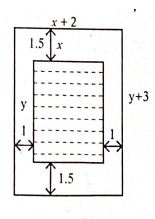
Given xy = 24
\(\Rightarrow y=\frac { 24 }{ x } \) ..(1)
Length of the page with margin
= x+1+1 = x+2
breadth of the page with margin
= y + 1.5 + 1.5 = y + 3
Area of the page = (x + 2) (y + 3)
Let f(x) = (x + 2) (y + 3)
= \((x+2)\left( \frac { 24 }{ x } +3 \right) \)
= \(24+3x+\frac { 48 }{ x } +30\)
= \(3x+\frac { 48 }{ x } +30\)
\(f'\left( x \right) =3-\frac { 48 }{ { x }^{ 2 } } \)
\(\Rightarrow { x }^{ 2 }=16\Rightarrow x=\pm 4\)
ஃ The critical number are 4,-4
\(f''\left( x \right) =-48\left( \frac { -2 }{ { x }^{ 3 } } \right) =\frac { 96 }{ { x }^{ 3 } } \)
\(f''\left( 4 \right) =\frac { 96 }{ 64 } >0\)
ஃ f(x) is minimum when x = 4
When \(x=4,y=\frac { 24 }{ 4 } =6\) [From (1)]
ஃ Length of the page = x + 2 = 4 + 2 = 9 cm
Breadth of the page = y + 3 = 6 + 3 = 6 cm
9.
\(2{ tan }^{ -1 }x={ cos }^{ -1 }\frac { 1-{ a }^{ 2 } }{ 1+{ a }^{ 2 } } -{ cos }^{ -1 }\frac { 1-{ b }^{ 2 } }{ 1+{ b }^{ 2 } } ,a>0,b>0\)
Let \(a=tan\ \theta \ b=tan\phi \)
\(\therefore { cos }^{ -1 }\left( \frac { 1-{ a }^{ 2 } }{ 1+a^{ 2 } } \right) ={ cos }^{ -1 }\left( \frac { 1-{ tan }^{ 2 }\theta }{ 1+{ tan }^{ 2 }\theta } \right) \)
= \({ cos }^{ -1 }\left( cos2\theta \right) =2\theta \) ...(1)
\(\left[ \because cos2\theta =\frac { 1-{ tan }^{ 2 }\theta }{ 1+{ tan }^{ 2 }\theta } \right] \)
Also \({ cos }^{ -1 }\left( \frac { 1-{ b }^{ 2 } }{ 1+{ b }^{ 2 } } \right) ={ cos }^{ -1 }\left( \frac { 1-{ tan }^{ 2 }\phi }{ 1+tan^{ 2 } } \right) \)
= \(cos^{ -1 }\left( cos2\Phi \right) \)
\(\therefore 2{ tan }^{ -1 }x=2\theta -2\phi =2(\theta -\phi )\)
[using (1) and (2)]
\(\Rightarrow tan^{ -1 }x=\theta -\phi \)
\(\Rightarrow x=tan\left( \theta -\phi \right) =\frac { tan\theta -tan\phi }{ 1+tan\theta tan\phi } \)
\(\left[ \because tan\left( A-B \right) =\frac { tanA-tanB }{ 1+tanAtanB } \right] \)
\(\Rightarrow x=\frac { a-b }{ 1+ab } \), a > 0
10.
Let \({ z }^{ 3 }+8i=0\)
\(\Rightarrow\) z3 = -8i
= \(8(-i)=8\left( cos\left( -\frac { \pi }{ 2 } +2k\pi \right) isin\left( -\frac { \pi }{ 2 } +2k\pi \right) \right) \),k\(\in Z\)
\(z=\sqrt [ 3 ]{ 8 } \left( cos\left( \frac { -\pi +4k\pi }{ 6 } \right) +isin\left( \frac { -\pi +4k\pi }{ 6 } \right) \right) \)
Taking k = 0, 1, 2 we get,
k = 0, \(z=2\left( cos\left( -\frac { \pi }{ 6 } \right) +isin\left( -\frac { \pi }{ 6 } \right) \right) =2\left( -\frac { 1 }{ 2 } -i\frac { \sqrt { 3 } }{ 2 } \right) =2\left( \frac { \sqrt { 3 } }{ 2 } -i\frac { 1 }{ 2 } \right) \)
k = 1, \(z=2\left( cos\left( \frac { \pi }{ 2 } \right) +isin\left( \frac { \pi }{ 2 } \right) \right) =2=\left( 0+i \right) =0+2i=2i\)
k = 2,\(z=2\left( xcos\left( \frac { 7\pi }{ 6 } \right) +isim\left( \frac { 7\pi }{ 6 } \right) \right) =2\left( cos\left( \pi +\frac { \pi }{ 6 } \right) \right) +isin\left( \pi +\frac { \pi }{ 6 } \right) \)
= \(2\left( -cos\left( \frac { \pi }{ 6 } \right) -isin\left( \frac { \pi }{ 6 } \right) \right) =2\left( -\frac { \sqrt { 3 } }{ 2 } -i\frac { 1 }{ 2 } \right) =-\sqrt { 3 } -i\)
The values of z are \(\sqrt { 3 } -i,2i\) and \(-\sqrt { 3 } -i\)
11.
Since the centre is located at (0, 300), midway between the two foci, which are the coast guard stations, the equation is \(\frac { { \left( y-300 \right) }^{ 2 } }{ { a }^{ 2 } } -\frac { { \left( x-0 \right) }^{ 2 } }{ { b }^{ 2 } } =1\).... (1)
To determine the values of a and b, select two points known to be on the hyperbola and substitute each point in the above equation.
The point(0, 400) lies on the hyperbola, since it is 200 km further from Station A than from station B.
\(\frac { { \left( 400-300 \right) }^{ 2 } }{ { a }^{ 2 } } -\frac { O }{ { b }^{ 2 } } =1\frac { { 100 }^{ 2 } }{ a^{ 2 } } =1,{ a }^{ 2 }=10000.\) There is also a point (x, 600) on the hyperbola such that 6002+ x2 = (x + 200)2
360000 + x2 = x2+400x+40000
x = 800
Substituting in (1), we have \(\frac { { \left( 600-300 \right) }^{ 2 } }{ 10000 } -\frac { { \left( 800-0 \right) }^{ 2 } }{ { b }^{ 2 } } =1\)
\(9-\frac { 640000 }{ { b }^{ 2 } } =1\)
b2 = 80000
Thus the required equation of the hyperbola is \(\frac { { \left( y-300 \right) }^{ 2 } }{ 10000 } -\frac { { x }^{ 2 } }{ 80000 } =1\)
The ship lies somewhere on this hyperbola. The exact location can be determined using data from a third station.
12.
The path y = ax2 + bx + c passes through the points (10, 8), (20, 16), (40, 22). So, we get the system of equations 100a + 10b + c = 8, 400a + 20b + c = 16, 1600a + 40b + c = 22. To apply Cramer’s rule, we find
Δ = \(\left| \begin{matrix} 100 & 10 & 1 \\ 400 & 20 & 1 \\ 1600 & 40 & 1 \end{matrix} \right| =1000\left| \begin{matrix} 1 & 1 & 1 \\ 4 & 2 & 1 \\ 16 & 4 & 1 \end{matrix} \right| \) = 1000 [-2 + 12 - 6] = -6000,
Δ1 = \(\left| \begin{matrix} 8 & 10 & 1 \\ 16 & 20 & 1 \\ 22 & 40 & 1 \end{matrix} \right| =20\left| \begin{matrix} 4 & 1 & 1 \\ 8 & 2 & 1 \\ 11 & 4 & 1 \end{matrix} \right| \) = 20[-8 + 3 + 10] = 100,
Δ2 = \(\left| \begin{matrix} 100 & 8 & 1 \\ 400 & 16 & 1 \\ 1600 & 22 & 1 \end{matrix} \right| =200\left| \begin{matrix} 1 & 4 & 1 \\ 4 & 8 & 1 \\ 16 & 11 & 1 \end{matrix} \right| \) = 200[-3 + 48 - 84] = -7800,
Δ3 = \(\left| \begin{matrix} 100 & 10 & 8 \\ 400 & 20 & 16 \\ 1600 & 40 & 22 \end{matrix} \right| =2000\left| \begin{matrix} 1 & 1 & 4 \\ 4 & 2 & 8 \\ 16 & 4 & 11 \end{matrix} \right| \) = 2000[-10 + 84 - 64] = 20000.
By Cramer’s rule, we get a = \(\frac { { \Delta }_{ 1 } }{ \Delta } =-\frac { 1 }{ 60 } \), b = \(\frac { { \Delta }_{ 2 } }{ \Delta } =\frac { 7800 }{ 6000 } =\frac { 78 }{ 60 } =\frac { 13 }{ 10 } \), c = \(\frac { { \Delta }_{ 3 } }{ \Delta } =\frac { 20000 }{ 6000 } =-\frac { 20 }{ 6 } =-\frac { 10 }{ 3 } \).
So, the equation of the path is y = \(\frac { 1 }{ 60 } { x }^{ 2 }+\frac { 13 }{ 10 } x-\frac { 10 }{ 3 } \).
When x = 70, we get y = 6. So, the ball went by 6 metres high over the boundary line and it is impossible for a fielder standing even just before the boundary line to jump and catch the ball. Hence the ball went for a super six and the team won the match.
13.
Consider a triangle ABC in which the two altitudes AD and BE intersect at O. Let CO be produced to meet AB at F. We take O as the origin and let \(\vec { OA } =\vec { a } \), \(\vec { OB } =\vec { b} \) and \(\vec { OC } =\vec { c } \)
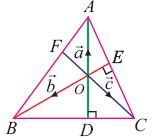
Since \(\vec { AD } \) is perpendicular to \(\vec { BC } \), we have \(\vec { OA } \) is perpendicular to \(\vec { BC } \), and
hence we get \(\vec { OA } \) . \(\vec { BC } \) = 0. That is, \(\vec { a } .(\vec { c } -\vec { b } )=0\), which means
\(\vec { a } .\hat{c}-\hat{a}.\hat{b}=0\)....(1)
Similarly, since \(\vec { BE } \) is perpendicular to \(\vec { CA } \), we have \(\vec { OB } \) is perpendicular to \(\vec { CA } \), and hence we get \(\vec { OB } .\vec { CA } \) = 0.
That is, \(\vec {b } .(\vec {a } -\vec { c } )=0\)
\(\vec { a } .\hat{c}-\hat{b}.\hat{c}=0\).......(2)
Adding equations (1) and (2), gives \(\vec { a } .\hat{c}-\hat{b}.\hat{c}=0\). That is, \(\hat{c}(\hat{a}-\hat{b})=0\)
That is \(\vec { OC } \) . \(\vec { BA } \) = 0.
Therefore, \(\vec { BA } \) is perpendicular to \(\vec { OC} \).
Which implies that \(\vec { CF} \) is perpendicular to \(\vec { AB } \).
Hence, the perpendicular drawn from C to the side AB passes through O. Therefore, the altitudes are concurrent.
14.
Given equation are \({ x }^{ 2 }px+q=0\) ............(1)
and \({ x }^{ 2 }+p'x+q'=0\) ..........(2)
Let ∝ be the common root for (1) and (2)
∴ ∝2 + p∝ + q = 0 .........(3)
and ∝2+ p'∝ + q' = 0 .............(4)
Solving (3) and (4) by cross multiplication method we get
p q 1 p
p' q' 1 p'
\(\Rightarrow \frac { { \alpha }^{ 2 } }{ pq'-p'q } =\frac { \alpha }{ q-q' } =\frac { 1 }{ p'-p } \)
consider \(\frac { { \alpha }^{ 2 } }{ pq'-p'q } =\frac { \alpha }{ q-q' } \)
\(\Rightarrow \frac { { \alpha }^{ 2 } }{ \alpha } =\frac { pq'-p'q }{ q-q' } \)
\(\alpha =\frac { pq'-p'q }{ q-q } \)
Consider \(\frac { \alpha }{ q-q' } =\frac { 1 }{ p'-p } \Rightarrow \alpha =\frac { q-q' }{ p'-p } \)
Hence its roots are \(\frac { pq'-p'q }{ q-q' } or\quad \frac { q-q' }{ p'-p } \)
15.
Clearly 1 is the identity element of (G1)
Inverse of 1 is 1 [∴ (1)(1) = 1]
Inverse of i is -i [∴ (i) (-i) = -i2 = 1]
Inverse of -1 is -1 [∴ (-1)(-1) = 1]
Inverse of is i [∴ (-i)(i) = -i2 = 1]
16.
Let us denote white and red balls as w1, w2, r1, r2 and r3
The sample space consists of 5C3 = 10 different samples of size 3.
That is S = \(\left\{w_{1} w_{2} r_{1}, w_{1} w_{2} r_{2}, w_{1} w_{2} r_{3}, w_{1} r_{1} r_{2}, w_{1} r_{2} r_{3}, w_{1} r_{1} r_{3}, w_{2} r_{1} r_{2}, w_{2} r_{2} r_{3}, w_{2} r_{1} r_{3}, r_{1} r_{2} r_{3}\right\} .\)
The random variable X takes on the values 1, 2, and 3.
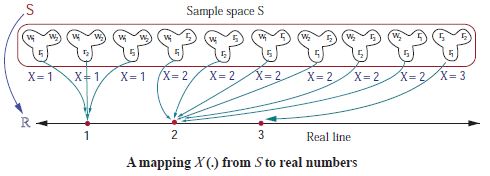
| Values of the Random Variable X | 1 | 2 | 3 | Total |
| Number of elements in inverse images | 3 | 6 | 1 | 10 |
17.
Put x = sin \(\theta\). Then, dx = cos \(\theta\) d \(\theta\)
when x = 0, sin \(\theta\) = 0 and so \(\theta\) = 0. When x = 1, sin \(\theta\) = 1 and so \(\theta =\frac{\pi}{2}\)
Hence, we get
\(I=\int _{ 0 }^{ \frac { \pi }{ 2 } }{ { sin }^{ 5 }\theta { (1-{ sin }^{ 2 }\theta ) }^{ 5 }cos\theta d\theta } \)
\(=\int _{ 0 }^{ \frac { \pi }{ 2 } }{ { sin }^{ 5 }\theta { cos }^{ 11 }\theta d\theta =\frac { 10 }{ 16 } \times \frac { 8 }{ 14 } \times \frac { 6 }{ 12 } \times \frac { 4 }{ 10 } \times \frac { 2 }{ 8 } \times \frac { 1 }{ 6 } =\frac { 1 }{ 336 } } \)
By applying the reduction formula III iteratively, we get the following results (stated without proof):
\(\int _{ 0 }^{ 1 }{ { x }^{ m }{ (1-x) }^{ n }dx } =\frac { m!\times n! }{ (m+n+1)! } \), where m and n are positive integers
18.
Let f (x) = sin x which is a differentiable function in any open interval. Consider an interval \([\alpha, \beta]\). Applying the mean value theorem there exists \(c \in (\alpha, \beta)\) such that,
\(\frac{sin \beta - sin \alpha}{\beta-\alpha}=f'(c)=cos(c)\)
Therefore, \(\frac{sin \beta - sin \alpha}{\beta-\alpha}=|cos(c)|\le1\)
Hence, \(|sin\alpha-sin\beta|\le |\alpha-\beta|\)
Remark
If we take \(\beta=0\) in the above problem, we ge \(|sin \alpha|\le |\alpha|\)
19.
Given that \((1+{ x }^{ 2 })\frac { dy }{ dx } =1+{ y }^{ 2 }\) ..(1)
The given equation is written in the variables separable form
\(\frac { dy }{ { 1+y }^{ 2 } } =\frac { dx }{ { 1+x }^{ x } } \) ...(2)
Integrating both sides of (2), we get tan−1 tan−1x +C.
But tan-1 y - tan-1 x = tan-1 \(\left( \frac { y-x }{ 1+xy } \right) .\) ...(4)
Using (4) in (3) leads to tan-1 \(\left( \frac { y-x }{ 1+xy } \right)\) = C, which implies \(\frac { y-x }{ 1+xy } \) = tan C = a (say).
Thus, y − x = a(1+ xy) gives the required solution
20.
Given g(x) = sin-1 x + cos-1x
From the definition of sin-1x.
\(-1\le x\le 1\) ...(1)
Also from the definition of cos-1x
\(-1\le x\le 1\) .........(2)
\(\therefore \) From (1) & (2),
Domain ofg(x) = [-1, 1] U [-1, 1]
= [-1, 1]
Hence the domain of g(x) is [-1, 1].
21.
\(\frac { 3 }{ x } \) + 2y = 12, \(\frac { 2 }{ x } \) + 3y = 13
Let \(\frac { 1 }{ x } \)
∴ z+2y = 12, 2z+3z = 13
∴ Δ = \(\left| \begin{matrix} 3 & 2 \\ 2 & 3 \end{matrix} \right| \)= 9 - 4 = 5
Δ1 = \(\left| \begin{matrix} 12 & 2 \\ 13 & 3 \end{matrix} \right| \)= 36 - 26 = 10
Δ2 = \(\left| \begin{matrix} 3 & 12 \\ 2 & 13 \end{matrix} \right| \)= 39 - 26 = 10
∴ z = \(\frac { { \triangle }_{ 1 } }{ \triangle } =\frac { 10 }{ 5 } =2\Rightarrow \frac { 1 }{ x } =2\Rightarrow x=\frac { 1 }{ 2 } \)
y = \(\frac { { \triangle }_{ 2 } }{ \triangle } =\frac { 15 }{ 5 } \) = 3
∴ Solution set {\(\frac{1}{2}\), 3}
22.
The latus rectum LL' of the hyperbola passes through S(ae, 0)
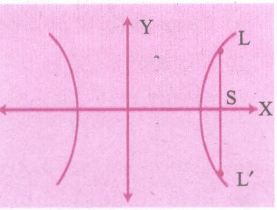
∴ L is (ae, y1)
Substituting L in \(\frac { { x }^{ 2 } }{ { a }^{ 2 } } -\frac { { y }^{ 2 } }{ { b }^{ 2 } } \) = 1 we get,
Substituting L in \(\frac { { x }^{ 2 } }{ { a }^{ 2 } } -\frac { { y }^{ 2 } }{ { b }^{ 2 } } =1\)
\(\frac { { a }^{ 2 }{ e }^{ 2 } }{ { a }^{ 2 } } -\frac { { { y }_{ 1 } }^{ 2 } }{ { b }^{ 2 } } =1\Rightarrow { e }^{ 2 }-\frac { { { y }_{ 1 } }^{ 2 } }{ { b }^{ 2 } } =1\)
\(\Rightarrow { e }^{ 2 }-1=\frac { { { y }_{ 1 } }^{ 2 } }{ { b }^{ 2 } } \) \([{ b }^{ 2 }={ a }^{ 2 }({ e }^{ 2 }-1)\)
\(\Rightarrow { { y }_{ 1 } }^{ 2 }={ b }^{ 2 }({ e }^{ 2 }-1)\) \(\Rightarrow \frac { { b }^{ 2 } }{ { a }^{ 2 } } ={ e }^{ 2 }-1]\)
\(\Rightarrow { { y }_{ 1 } }^{ 2 }={ b }^{ 2 }\left( \frac { { b }^{ 2 } }{ { a }^{ 2 } } \right) \) \(\Rightarrow { { y }_{ 1 } }^{ 2 }=\frac { { b }^{ 4 } }{ { a }^{ 2 } } \)
\(\Rightarrow { y }_{ 1 }=\pm \frac { { b }^{ 2 } }{ a } \)
∴ End points oflatus rectum Land L' are
\(\left( ae,\frac { { b }^{ 2 } }{ a } \right) \) and \(\left( ae,-\frac { { b }^{ 2 } }{ a } \right) \)
Hence, the length of latus rectum LL' = \(\frac { { b }^{ 2 } }{ a } +\frac { { b }^{ 2 } }{ a } =\frac { 2{ b }^{ 2 } }{ a } \) units.
Hence proved.
23.
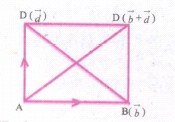
Let ABCD be a parallelogram such that its diagonals AC and BD are equal.
Taking A as the origin, let the p.v. of B and D be \(\vec { b } \)and \(\vec { d } \) respectively.
Then \(\vec { AB } =\vec { b } \) and \(\vec { AD } =\vec { d } \)
Using triangle law of addition of vectors is ΔABC, we get
\(\vec { AB } +\vec { BC } =\vec { AC } \)
⇒ \(\vec { AB } +\vec { AD } =\vec { AC } \)
⇒ \(\vec { b } +\vec { d } =\vec { AC } \)
Using triangle law of addition of vectors in ΔABD, we get \(\vec { AB } +\vec { BD } =\vec { AD } \)
⇒ \(\vec { b } +\vec { BD } =\vec { d } \)
⇒ \(\vec { BD } =\vec { d } -\vec { b } \)
In parallelogram ABCD we have AC = BD
⇒ \(|\vec { AC } |=|\vec { BD } |\)
⇒ \(|\vec { AC } |^{ 2 }=|\vec { BD } |^{ 2 }\)
⇒ \(|\vec { b } +\vec { d } |^{ 2 }=|\vec { d } -\vec { b } |^{ 2 }\)
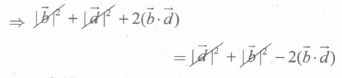
⇒ \(4(\vec { b } .\vec { d } )=0\Rightarrow \vec { b } .\vec { d } =0\)=0
⇒ \(\vec { b } \bot \vec { d } \)
⇒ \(\vec { AB } \bot \vec { AD } \)
Hence, ABCD is a rectangle.
24.
Since \(\sqrt { \frac { \sqrt { 2 } }{ \sqrt { 3 } } } \) is a root, x-\(\sqrt { \frac { \sqrt { 2 } }{ \sqrt { 3 } } } \) is a factor. To remove the outermost square root, we take x +\(\sqrt { \frac { \sqrt { 2 } }{ \sqrt { 3 } } } \) as another factor and find their product.
\(\left( x+\sqrt { \frac { \sqrt { 2 } }{ \sqrt { 3 } } } \right) \left( x-\sqrt { \frac { \sqrt { 2 } }{ \sqrt { 3 } } } \right) ={ x }^{ 2 }-\frac { \sqrt { 2 } }{ \sqrt { 3 } } \)
Still we didn’t achieve our goal. So we include another factor x2+\(\sqrt { \frac { \sqrt { 2 } }{ \sqrt { 3 } } } \) and get the product.
\(\left( { x }^{ 2 }-\frac { \sqrt { 2 } }{ \sqrt { 3 } } \right) \left( { x }^{ 2 }+\frac { \sqrt { 2 } }{ \sqrt { 3 } } \right) ={ x }^{ 4 }-\frac { 2 }{ 3 } \)
So, 3x4- 2 = 0 is a required polynomial equation with the integer coefficients.
Now we identify the nature of roots of the given equation without solving the equation. The idea comes from the negativity, equality to 0, positivity of Δ = b2- 4ac.
25.
\( \frac{d y}{d x}+y=e^{-x} \)
\(\frac{d y}{d x}+P y=Q \)
comparing, we get P = 1, Q = e-x
\( \text {I.F } =\mathrm{e}^{\int \mathrm{Pdx}} \)
\(=\mathrm{e}^{\int \mathrm{dx} x} \)
\(\text {I.F } =\mathrm{e}^{x} \)
The general solution,
\( y(\text { I.F }) =\int Q(I . F) d x+C \)
\(y^{x} =\int e^{-x} \times e^{x} d x+c \)
\(y^{x} =\int d x+c \)
\(y^{x} =x+c \)
\(y =x e^{-x}+c e^{-x}(\text { or }) \)
\(y =e^{-x}(x+c) \)
26.
A = {a+\(\sqrt5\) b:a,b ∈ z}
Let C = a+\(\sqrt5\) b
B = c+\(\sqrt5\)d∈A
where a, b, c, d ∈ Z
[∵ ac + 5bd∈Z and ad+bc ∈Z]
∴ B = (a+\(\sqrt5\)b).(c+\(\sqrt5\)d)
= ac+\(\sqrt5\)ad+cb\(\sqrt5\) + 5bd
= (ac+5bd)+\(\sqrt5\)(ad+bc)∈A
∴ C.B ∈A∀ a, b, c, d∈Z
∴ Usual multiplicaition is a binary operation on.
27.
Volume of sphere = \(\frac43\) πr3
Given r = 5 mm
⇒ dr = (5.3 - 5) = 0.3 mm
\(\text { Approximate volume }=\frac{4}{\not 3} \pi \cdot \not 3 r^{2} d r\)
= 4π (52) (0.3)
= 100 π (0.3)
= 30π mm3
28.
\(\int _{ 0 }^{ 1 }{ [2x]dx } =\int _{ 0 }^{ \frac { 1 }{ 2 } }{ [2x] } dx+\int _{ \frac { 1 }{ 2 } }^{ 1 }{ [2x]dx } =\int _{ 0 }^{ \frac { 1 }{ 2 } }{ 0dx+ } \int _{ \frac { 1 }{ 2 } }^{ 1 }{ 1 dx} = 0+[x]^1_{\frac{1}{2}} = 1 -\frac { 1 }{ 2 } =\frac { 1 }{ 2 } \)
29.
Let r be the radius of the ripple and A be the area of the ripple.
GIven \(\frac { dr }{ dt } \) = 2 cm/sec and r = 5 cm ... (1)
We know A = πr2
Differentiating with respect to 't' we get,
\(\frac { dA }{ dt } \) = π(2r).\(\frac { dr }{ dt } \)
= π(2) (5) (2) [using (1)]
\(\frac { dA }{ dt } \) = 20 πsq.cm/sec.
30.
sin-1 [sin5]
We know that \({ sin }^{ -1 }\left( sin5 \right) =0\quad if\quad \theta \varepsilon \left[ \frac { -\pi }{ 2 } ,\frac { \pi }{ e } \right] \)
Consiideerning the approximation \(\frac { \pi }{ 2 } =\frac { 11 }{ 7 } \)
\(5=5\times \frac { 11 }{ 7 } \times \frac { 7 }{ 11 } =5\times \frac { \pi }{ 2 } \times \frac { 7 }{ 11 } =\frac { 35\pi }{ 22 } \notin \left[ -\frac { \pi }{ 2 } ,\frac { \pi }{ 2 } \right] \)
But \(5-2\pi =5-2\times \frac { 22 }{ 7 } =5-\frac { 44 }{ 7 } =\frac { 35z44 }{ 7 } \)
= \(\frac { -11 }{ 7 } \varepsilon \left( -\frac { \pi }{ 2 } ,\frac { \pi }{ 2 } \right) \)
\(5-2\pi \notin \left[ -\frac { \pi }{ 2 } ,\frac { \pi }{ 2 } \right] \)
\({ sin }^{ -1 }\left( sin5 \right) ={ sin }^{ -1 }\left( sin(5-2\pi ) \right) \)
= \(5-2\pi \quad \)
31.
Given lines are \(\vec { r } =(4\hat { i } -\hat { j } )+t(\hat { i } +2\hat { j } -2\hat { k } )\) \([\vec { r } =\vec { a } +t\vec { b } ]\)
∴ \(\vec { b } =\hat { i } +2\hat { j } -2\hat { k } \)
and \(\vec { r } =(\hat { i } -2\hat { j } +4\hat { k } )+s(-\hat { i } -2\hat { j } +2\hat { k } )\)
∴ \(\vec { d } =-\hat { i } -2\hat { j } +2\hat { k } \)
Let θ be the angle between the given lines
Then cos θ = \(\frac { \vec { b } .\vec { d } }{ |\vec { b } ||\vec { d } | } \)
= \(\frac { (\hat { i } +2\hat { j } -2\hat { k } ).(-\hat { i } -2\hat { j } +2\hat { k } ) }{ \sqrt { { 1 }^{ 2 }+{ 2 }^{ 2 }+(-2)^{ 2 } } .\sqrt { (-1)^{ 2 }+{ (-2) }^{ 2 }+{ (2) }^{ 2 } } } \)
= \(\frac { -1-4-4 }{ \sqrt { 9 } .\sqrt { 9 } } =\frac { -9 }{ 9 } \) = -1
∴ cos θ = -1
⇒ cos-1(-1)
⇒ θ = 0
32.
let z = |4+3i|
= \(\\ \sqrt { { 4 }^{ 2 }+{ 3 }^{ 2 } } =\sqrt { 16+9 } =\sqrt { 25 } \)
\(\sqrt { a+ib } =\pm \sqrt { \frac { |z|+a }{ 2 } } +i\frac { b }{ |b| } \sqrt { \frac { |z|-a }{ 2 } } \)
[Here |z| = 5, a = 4, b = 3]
\(\sqrt { 4+3i } =\pm \sqrt { \frac { 5+4 }{ 2 } } +i\frac { 3 }{ |3| } \sqrt { \frac { 5-4 }{ 2 } } \)
= \(\pm \sqrt { \frac { 9 }{ 2 } } +i\frac { 3 }{ 3 } \sqrt { \frac { 1 }{ 2 } } \)
= \(\pm \frac { 3 }{ \sqrt { 2 } } + \frac { i }{ \sqrt { 2 } } \)
Aliter :
Square root of 4 + 3i
Formula method
\(\sqrt{a+i b}=\pm\left[\sqrt{\frac{\sqrt{a^{2}+b^{2}}+a}{2}}+i \frac{b}{|b|} \sqrt{\frac{\sqrt{a^{2}+b^{2}}-a}{2}}\right]\)
Now, \(|4+3 i|=\sqrt{4^{2}+3^{2}}=\sqrt{16+9}=\sqrt{25}=5\)
\(\therefore \sqrt{4+3 i}=\pm\left[\sqrt{\frac{5+4}{2}}+i \sqrt{\frac{5-4}{2}}\right]\)
\(=\pm\left[\frac{3}{\sqrt{2}}+i \frac{1}{\sqrt{2}}\right]\)
33.
Given ends of diameter are (3, 4)(2, -7)
∴ Equation of the circle is
(x - x1)(x - x2) + (y - y1)(y - y2) = 0
⇒ (x - 3)(x - 2) + (y - 4)(y + 7) = 0
⇒ x2 - 2x - 3x + 6 + y2 + 7y - 4y - 28 = 0
⇒ x2 + y2 − 5x + 3y − 22 = 0
34.
Given adj (A) =\(\left[ \begin{matrix} 0 & -2 & 0 \\ 6 & 2 & -6 \\ -3 & 0 & 6 \end{matrix} \right] \)
We know that A-1 = ±\(\frac { 1 }{ \sqrt { |adjA| } } \) (adj A) ...............(1)
|adj A| = 0 + 2\(\left| \begin{matrix} 6 & -6 \\ -3 & 6 \end{matrix} \right| \) + 0
[Expanded along R1]
= 2(36-18) = 2(18) = 36
∴ A-1 = \(\pm \frac { 1 }{ \sqrt { 36 } } \left[ \begin{matrix} 0 & -2 & 0 \\ 6 & 2 & -6 \\ -3 & 0 & 6 \end{matrix} \right] \)
= \(\pm \frac { 1 }{ 6 } \left[ \begin{matrix} 0 & -2 & 0 \\ 6 & 2 & -6 \\ -3 & 0 & 6 \end{matrix} \right] \).
35.
(c)
\(\frac{\pi}{3}\)
36.
(b)
0
37.
(c)
\(x=-\frac{17}{4}\)
38.
(c)
\(P\left( x>a \right) \)
39.
(d)
a*b = ab
40.
(d)
41.
(b)
2xu
42.
(d)
16 and 24
43.
(a)
44.
(b)
\(\frac { { d }^{ 2 }y }{ { dx }^{ 2 } } -y=0\)
45.
(b)
-4
46.
(c)
-\(\frac { \pi }{ 2 } \)
47.
(b)
parallel
48.
(d)
Infinitely many solution
49.
(a)
\(\left[ \begin{matrix} 2 & -5 \\ -3 & 8 \end{matrix} \right] \)
50.
(b)
parallel
51.
(a)
x2 + y2 − 6y − 7 = 0
52.
(a)
53.
(d)
0
54.
(a)

12th Standard Syllabus & Materials
12th Standard
TN 12th Computer Applications களப்பெயர் முறைமை (DNS) Sample Question Papers Study Material - QB365 Set A
NEW12th Standard
TN 12th Computer Applications வலையமைப்பு எடுத்துக்காட்டுகள் மற்றும் நெறிமுறைகள் Sample Question Papers Study Material - QB365 Set A
NEW12th Standard
TN 12th Computer Applications கணினி வலையமைப்பு ஓர் அறிமுகம் Sample Question Papers Study Material - QB365 Set A
NEW12th Standard
TN 12th Computer Applications PHP-உடன் MySQL-ஐ இணைத்தல் Sample Question Papers Study Material - QB365 Set A



Tamilnadu Stateboard 12th Standard Subjects
Maths

Chemistry

Physics

Biology

Computer Science

Business Maths and Statistics

Economics

Commerce

Accountancy

History

Computer Applications
Biology
Computer Technology
Computer Applications
Computer Science
Business Maths and Statistics
Commerce
Economics
Maths
Chemistry
Physics
Computer Technology
History
Accountancy

Tamil

English

French
Tamilnadu Stateboard Standards


