
 100% FREE ACCESS
12th Standard Syllabus & Materials
12th Standard
TN 12th Computer Applications மின்னணு தரவு பரிமாற்றம் Sample Question Papers Study Material - QB365 Set A
NEW12th Standard
TN 12th Computer Applications மின் - வணிக பாதுகாப்பு அமைப்புகள் Sample Question Papers Study Material - QB365 Set A
NEW12th Standard
TN 12th Computer Applications மின்னணு செலுத்தல் முறைகள் Sample Question Papers Study Material - QB365 Set A
NEW12th Standard
TN 12th Computer Applications மின் - வணிகம் Sample Question Papers Study Material - QB365 Set A
NEW12th Standard
TN 12th Computer Applications திறந்த மூல கருத்துருக்கள் Sample Question Papers Study Material - QB365 Set A
NEW12th Standard
TN 12th Computer Applications வலையமைப்பு வடமிடல் Sample Question Papers Study Material - QB365 Set A

Published on: 20/10/2025
Download Tamil Nadu 12th Standard Maths question papers, model tests, one-mark questions, important questions, and public exam papers in PDF format. Free study materials and answer keys for TN State Board students.
Questions + Answers key
Take MCQ Maths Test
1.
Solve \(\tan ^{-1}\left(\frac{x-1}{x-2}\right)+\tan ^{-1}\left(\frac{x+1}{x+2}\right)=\frac{\pi}{4}\)
2.
Solve the equation \(15 x^{3}-23 x^{2}+9 x-1=0\) whose roots are in harmonic progression
3.
Let p and q be rational numbers so that \(\sqrt{p} \text { and } \sqrt{q}\) are irrational numbers; further let one of \(\sqrt{p} \text { and } \sqrt{q}\) be not a rational multiple of the other. If \(\sqrt{p}+\sqrt{q}\) is a root of a polynomial equation with rational coefficients, then \(\sqrt{p}-\sqrt{q},-\sqrt{p}+\sqrt{q}, \text { and }-\sqrt{p}-\sqrt{q}\) are also roots of the same polynomial equation.
4.
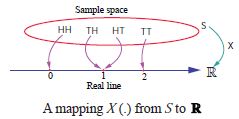
Suppose two coins are tossed once. If X denotes the number of tails,
(i) write down the sample space
(ii) find the inverse image of 1
(iii) the values of the random variable and number of elements in its inverse images
5.
A truck travels on a toll road with a speed limit of 80 km/hr. The truck completes a 164 km journey in 2 hours. At the end of the toll road the trucker is issued with a speed violation ticket. Justify this using the Mean Value Theorem.
6.
Find the direction cosines of the straight line passing through the points (5, 6, 7) and (7, 9, 13). Also, find the parametric form of vector equation and Cartesian equations of the straight line passing through two given points.
7.
Forces of magnit \(5\sqrt { 2 } \) and \(10\sqrt { 2 } \) units acting in the directions \(\hat { 3i } +\hat { 4j } +\hat { 5k } \) and \(\hat { 10i } +\hat { 6j } -\hat { 8k } \) respectively, act on a particle which is displaced from the point with position vector \(\hat { 4i } -\hat { 3j } -\hat { 2k } \) to the point with position vector \(\hat { 6i } +\hat { j } -\hat { 3k } \). Find the work done by the forces.
8.
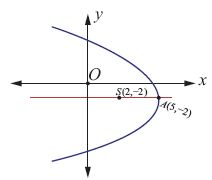
Find the equation of the parabola whose vertex is (5, -2) and focus (2, -2)
9.
Find the length of Latus rectum of the parabola y2 = 4ax.
10.
Find the value of sin-1\(\left( sin\frac { 5\pi }{ 9 } cos\frac { \pi }{ 9 } +cos\frac { 5\pi }{ 9 } sin\frac { \pi }{ 9 } \right) \).
11.
Find the equation of the hyperbola whose centre is (2, 1), one of the foci is (8, 1) and the corresponding directrix is x = 4
12.
At what point on the curve y = x2 on [-2, 2] is the tangent parallel to X-axis?
13.
The probability that a certain kind of component will survive a electrical test is \(\frac { 3 }{ 4 } \). Find the probability that exactly 3 of the 5 components tested survive.
14.
Evaluate the limit \(\underset{x\rightarrow 0}{lim}(\frac{sin \ mx}{x})\)
15.
If the volume of a cube of side length x is v = x3. Find the rate of change of the volume with respect to x when x = 5 units.
16.
Find centre and radius of the following circles.
2x2+2y2−6x+4y+2 = 0
17.
Find the volume of the parallelepiped whose coterminous edges are represented by the vectors \(-6\hat { i } +14\hat { j } +10\hat { k } ,14\hat { i } -10\hat { j } -6\hat { k } \) and \(2\hat { i } +4\hat { j } -2\hat { k } \)
18.
The orbit of Halley’s Comet is an ellipse 36.18 astronomical units long and by 9.12 astronomical units wide. Find its eccentricity.
19.
If x2+2(k+2)x+9k = 0 has equal roots, find k.
20.
Is cos-1(-x) = \(\pi\)-cos−1(x) true? Justify your answer.
21.
Verify \((\vec{a} \times \vec{b}) \times(\vec{c} \times \vec{d})=[\vec{a}, \vec{b}, \vec{d}] \vec{c}-[\vec{a}, \vec{b}, \vec{c}] \vec{d}\) for \( \vec{a}=\hat{i}+\hat{j}+\hat{k}, \vec{b}=2 \hat{i}+\hat{k}, \vec{c}=2 \hat{i}+\hat{j}+\hat{k}, \) \( \vec{d}=\hat{i}+\hat{j}+2 \hat{k}\)
22.
Show that the equation of the normal at '\(\theta\)' to the curve \(\mathbf{x}=a \cos ^{3} \theta, \mathbf{y}=a \sin ^{3} \theta\) is \(x \cos \theta-y \sin \theta=a \cos 2 \theta\)
23.
An urn contains 4 Green and 3 Red balls. Find the probability distribution of the number of red balls in 3 draws when a baII is drawn at random with replacement. Also find its mean and variance.
24.
Find the centre, foci and eccentricity of the hyperbola \(12 x^{2}-4 y^{2}-24 x+32 y-124=0\)
25.
The cumulative distribution function of a discrete random variable is given by
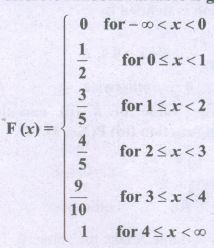
Find
(i) the probability mass function
(ii) P(X < 3) and
(iii) P(X \(\ge \)2).
26.
Discuss the monotonicity and local extrema of the function \(f(x)=log(1+x)-\frac{x}{1+x},x>-1\) and hence find the domain where, \(log(1+x)>\frac{x}{1+x}\)
27.
28.
Find the coordinates of the foot of the perpendicular and length of the perpendicular from the point ( 4, 3, 2) to the plane x + 2y + 3z = 2.
29.
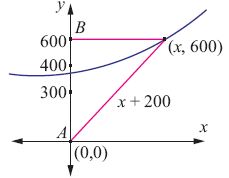
Two coast guard stations are located 600 km apart at points A(0, 0) and B(0, 600). A distress signal from a ship at P is received at slightly different times by two stations. It is determined that the ship is 200 km farther from station A than it is from station B. Determine the equation of hyperbola that passes through the location of the ship.
30.
Prove that \({ tan }^{ -1 }x+{ tan }^{ -1 }\frac { 2x }{ 1-{ x }^{ 2 } } ={ tan }^{ -1 }\frac { 3x-{ x }^{ 3 } }{ 1-{ 3x }^{ 2 } } ,|x|<\frac { 1 }{ \sqrt { 3 } } \)
31.
Find the equations of the two tangents that can be drawn from (5, 2) to the ellipse 2x2+7y2 = 14 .
32.
If a1, a2, a3, ... an is an arithmetic progression with common difference d, prove that tan\( \left[ tan^{ -1 }\left( \frac { d }{ 1+{ a }_{ 1 }{ a }_{ 2 } } \right) +tan^{ -1 }\left( \frac { d }{ 1+{ a }_{ 2 }{ a }_{ 3 } } \right) +....tan^{ -1 }\left( \frac { d }{ 1+{ a }_{ n }{ a }_{ n-1 } } \right) \right] =\frac { { a }_{ n }-{ a }_{ 1 } }{ 1+{ a }_{ 1 }{ a }_{ n } } \)
33.
In triangle, ABC the points, D, E, F are the midpoints of the sides BC, CA and AB respectively. Using vector method, show that the area of ΔDEF is equal to \(\frac{1}{4}\)(area of ΔABC )
34.
Find all zeros of the polynomial x6- 3x5- 5x4 + 22x3- 39x2- 39x + 135, if it is known that 1+2i and \(\sqrt{3}\) are two of its zeros.
35.
36.
The probability mass function of a discrete random variable f(x) is _______
f(x) = 1
f(x) \(\ge\) 1
f(x) \(\ge\) 0
f(x) = 0
37.
38.
An asymptote to the curve y2 (a + 2x) = x2 (3a - x) is ____________
x = 3a
\(x=-\frac{a}{2}\)
\(x=\frac{a}{2}\)
x = 0
39.
40.
41.
42.
The slope of the line normal to the curve f(x) = 2cos 4x at \(x=\cfrac { \pi }{ 12 } \) is
\(-4\sqrt { 3 } \)
-4
\(\cfrac { \sqrt { 3 } }{ 12 } \)
\(4\sqrt { 3 } \)
43.
44.
The number of normals that can be drawn from a point to the parabola y2 = 4ax is __________
3
2
0
1
45.
The domain of cos-1(x2 - 4) is______
[3, 5]
[-1, 1]
\(\left[ -\sqrt { 5 } ,-\sqrt { 3 } \right] \cup \left[ \sqrt { 3 } ,\sqrt { 5 } \right] \)
[0, 1]
46.
The equation \(\sqrt { x+1 } -\sqrt { x-1 } =\sqrt { 4x-1 } \) has ____________
no solution
one solution
two solution
more than one solution
47.
If the distance of the point (1, 1, 1) from the origin is half of its distance from the plane x + y + z + k = 0, then the values of k are
\(\pm 3\)
\(\pm 6\)
-3, 9
3, -9
48.
If \(\vec { a } =2\hat { i } +3\hat { j } -\hat { k } ,\vec { b } =\hat { i } +2\hat { j } -5\hat { k } ,\vec { c } =3\hat { i } +5\hat { j } -\hat { k } ,\) then a vector perpendicular to \(\vec { a } \) and lies in the plane containing \(\vec { b } \) and \(\vec { c } \) is
\(-17\hat { i } +21\hat { j } -97\hat { k } \)
\(17\hat { i } +21\hat { j } -123\hat { k } \)
\(-17\hat { i } -21\hat { j } +97\hat { k } \)
\(-17\hat { i } -21\hat { j } -97\hat { k } \)
49.
If the coordinates at one end of a diameter of the circle x2 + y2 − 8x − 4y + c = 0 are (11, 2), the coordinates of the other end are
(-5, 2)
(-3, 2)
(5, -2)
(-2, 5)
50.
The ellipse \(E_{1}: \frac{x^{2}}{9}+\frac{y^{2}}{4}=1\) is inscribed in a rectangle R whose sides are parallel to the coordinate axes. Another ellipse E2 passing through the point (0, 4) circumscribes the rectangle R. The eccentricity of the ellipse is
\(\frac { \sqrt { 2 } }{ 2 } \)
\(\frac { \sqrt { 3 } }{ 2 } \)
\(\frac { 1 }{ 2 } \)
\(\frac { 3 }{ 4 } \)
51.
The length of the diameter of the circle which touches the x - axis at the point (1, 0) and passes through the point (2, 3).
\(\frac { 6 }{ 5 } \)
\(\frac { 5 }{ 3 } \)
\(\frac { 10 }{ 3 } \)
\(\frac { 3 }{ 5 } \)
52.
53.
\(\sin ^{-1} \frac{3}{5}-\cos ^{-1} \frac{12}{13}+\sec ^{-1} \frac{5}{3}-\operatorname{cosec}^{-1} \frac{13}{12}\) is equal to
2\(\pi\)
\(\pi\)
0
tan-1\(\frac{12}{65}\)
54.
1.
\(\tan ^{-1}\left(\frac{x-1}{x-2}\right)+\tan ^{-1}\left(\frac{x+1}{x+2}\right)=\frac{\pi}{4}\)
\(\Rightarrow \ \tan ^{-1}\left(\frac{\frac{x-1}{x-2}+\frac{x+1}{x+2}}{1-\left(\frac{x-1}{x-2}\right)\left(\frac{x+1}{x+2}\right)}\right)=\frac{\pi}{4}\)
\(\Rightarrow\left(\frac{\frac{(x-1)(x+2)+(x+1)(x-2)}{(\not x-\not 2)(\not x+\not 2)}}{\frac{(x-2)(x+2)-(x-1)(x+1)}{(\not x-\not 2)(\not x+\not 2)}}\right)=\tan \frac{\pi}{4}=1\)
\(\Rightarrow \ \frac{x^{2}+x-2+x^{2}-x-2}{\left(x^{2}-4\right)-\left(x^{2}-1\right)}=1\)
\(\Rightarrow \ \frac{2 x^{2}-4}{x^{2}-4-x^{2}+1}=1\)
\(
\Rightarrow 2 x^{2}-4=-3
\)
\(\Rightarrow 2 x^{2}=-3+4=1
\)
\(\Rightarrow x^{2}=\frac{1}{2}
\)
\(\Rightarrow x=\frac{1}{\sqrt{2}}\)
2.
Let the roots are in H.P. Then their reciprocals are in A.P.
\( \frac{15}{x^{3}}-\frac{23}{x^{2}}+\frac{9}{x}-1=0 \)
\( 15-23 x+9 x^{2}-x^{3}=0 \)
\(x^{3}-9 x^{2}+23 x-15=0\)
Since the roots are in A.P. Assume that the roots are in the form a-d, a, a + d
\( \Sigma_{1}=a-d+a+a+d =9 \)
\(3 a =9 \)
\(a =3 \)
\(\Sigma_{3}=(a-d)(a)(a+d) =15 \)
\(a\left(a^{2}-d^{2}\right) =15 \)
\(3\left(9-d^{2}\right) =15 \)
\(9-d^{2} =\frac{15}{3} \)
\(9-d^{2} =5 \\d^{2} =4
\)
\(d =\pm 2 \)
a = 3, d = 2 then roots are 1, 3, 5
a = 3, d = -2 then roots are 5, 3, 1
3.
4.
(i) The sample space S = {H,T}\(\times\){H,T}
That is S = {TT,TH,HT,HH}
(ii) Let X : S ⟶R be the number of tails
Then X (TT) = 2 (2 Tails)
X (TH ) = 1 (1 Tail)
X (HT) = 1 (1 Tail)
and X (HH) = 0 (0 Tails).
Then X is a random variable that takes on the values 0, 1 and 2.
Let X (ω) denotes the number of tails, this gives
\(\\ \\ \\ \\ \\ \\ X\left( \omega \right) =\begin{cases} \begin{matrix} 2 & if\omega =TT \end{matrix} \\ \begin{matrix} 1 & if\omega =HT,TH \end{matrix} \\ \begin{matrix} 0 & if\omega =HH \end{matrix} \end{cases}\)
The inverse images of 1 {TH, HT} . That is X-1{1} = {TH, HT}.
(iii) Number of elements in inverse images are shown in the table.
| Values of the Random Variable | 0 | 1 | 2 | Total |
| Number of elements in inverse image | 1 | 2 | 1 | 4 |
5.
Let f (t) be the distance travelled by the trucker in 't' hours. This is a continuous function in [0, 2] and differentiable in (0, 2). Now, f (0) = 0 and f (2) =164. By an application of the Mean Value Theorem, there exists a time c such that, \(f'(c)=\frac{164-0}{2-0}=82>80\)
Therefore at some point of time, during the travel in 2 hours the trucker must have travelled with a speed more than 80 km which justifies the issuance of a speed violation ticket.
6.
Let \(\vec { b } =5\hat { i } +6\hat { j } +7\hat { k } \) and \(\vec { a } =7\hat { i } +9\hat { j } +13\hat { k } \)
The parametric form of vector equation of a straight line passing through two points \(\vec { a } \) and \(\vec { b } \) is
\(\vec { r } =\vec { a } +t(\vec { b } -\vec { a } )\)
∴ \(\vec { r } =(7\hat { i } +9\hat { j } +13\hat { k } )+t(7-5)\hat { i } +(9-6)\hat { j } +(13-7)\hat { k } \)
\(\vec { r } =(7\hat { i } +9\hat { j } +13\hat { k } )+t(2\hat { i } +3\hat { j } +6\hat { k } ),t\in R\)
The Cartesian equation of a straight line passing through two points as
\(\frac { x-{ x }_{ 1 } }{ { x }_{ 2 }-{ x }_{ 1 } } =\frac { y-{ y }_{ 1 } }{ { y }_{ 2 }-{ y }_{ 1 } } =\frac { z-{ z }_{ 1 } }{ { z }_{ 2 }-{ z }_{ 1 } } \) [(x1,y1,z1) is (7,9,13) (x2,y2,z2) is (5,6,7))
\(\frac { x-7 }{ 5-7 } =\frac { y-9 }{ 6-9 } =\frac { z-13 }{ 7-13 } \)
⇒ \(\frac { x-7 }{ -2 } =\frac { y-9 }{ -3 } =\frac { z-13 }{ -6 } \)
= \(\frac { x-7 }{ 2 } =\frac { y-9 }{ 3 } =\frac { z-13 }{ 6 } \)
7.
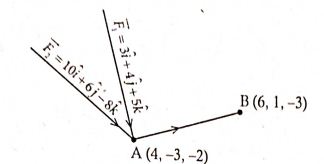
Let \(\vec { { F }_{ 1 } } \) and \(\vec { { F }_{ 2 } } \) be the two forces given
Given \(|\vec { { F }_{ 1 } } |=5\sqrt { 2 } \) and its direction is along \(3\hat { i } +4\hat { j } +5\hat { k } \)
∴ \(\vec { { F }_{ 1 } } =5\sqrt { 2 } \) (unit vector of \(3\hat { i } +4\hat { j } +5\hat { k } \))
= \(5\sqrt { 2 } \frac { (3\hat { i } +4\hat { j } +5\hat { k } ) }{ \sqrt { { 3 }^{ 2 }+{ 4 }^{ 2 }+{ 5 }^{ 2 } } } \) \(\left[ \because \hat { n } =\frac { \vec { n } }{ |\vec { n } | } \right] \)
= \(5\sqrt { 2 } \frac { (3\hat { i } +4\hat { j } +5\hat { k } ) }{ \sqrt { 9+16+25 } } =\frac { 5\sqrt { 2 } (3\hat { i } +4\hat { j } +5\hat { k } ) }{ 5\sqrt { 2 } } \)
= \(3\hat { i } +4\hat { j } +5\hat { k } \)
and \(\vec { { F }_{ 2 } } =10\sqrt { 2 } \) (unit vector of \(10\hat { i } +6\hat { j } -8\hat { k } \))
= \(10\sqrt { 2 } \frac { (10\hat { i } +6\hat { j } -8\hat { k } ) }{ \sqrt { { 10 }^{ 2 }+{ 6 }^{ 2 }+(-8)^{ 2 } } } \)
\(=\frac{10 \sqrt{\not 2}(10 \hat{i}+6 \hat{j}-8 \hat{k})}{10 \sqrt\not {2}}\)
= \(10\hat { i } +6\hat { j } -8\hat { k } \)
∴ Resistant force \(\vec { F } =\vec { { F }_{ 1 } } +\vec { { F }_{ 2 } } \)
=\((3\hat { i } +4\hat { j } +5\hat { k } )+(10\hat { i } +6\hat { j } -8\hat { k } )\)
\(\vec { F } =13\hat { i } +10\hat { j } -3\hat { k } \)
\(\hat { d } \) = displacement to the point - displacement from the point
= \((6\hat { i } +\hat { j } -3\hat { k } )-(4\hat { i } -3\hat { j } -2\hat { k } )\)
= \(2\hat { i } +4\hat { j } -\hat { k } \)
∴ Work done
w = \(\vec { F } .\vec { d } =(13\hat { i } +10\hat { j } -3\hat { k } ).(2\hat { i } +4\hat { j } -\hat { k } )\)
w = 13(2) + 10(4) - 3(-1) = 26 + 40 + 3
w = 69 units.
8.
Given vertex A(5, -2) and focus S(2, -2) and the focal distance
AS = a = 3
Parabola is open left and symmetric about the line parallel to x -axis.
Then, the equation of the required parabola is
(y + 2)2 = −4(3)(x − 5)
y2 + 4y + 4 = −12x + 60
y2 + 4y +12x − 56 = 0
9.
Equation of the parabola is y2 = 4ax
Latus rectum LL′ passes through the focus (a, 0)
Hence the point L is (a, y1)
Therefore y12 = 4a2
Hence y1 = ±2a
The end points of latus rectum are (a, 2a) and (a, -2a)
10.
\(={ sin }^{ -1 }\left( sin\frac { 5\pi }{ 9 } cos\frac { \pi }{ 9 } +cos\frac { 5\pi }{ 9 } sin\frac { \pi }{ 9 } \right) \)
= \({ sin }^{ - }\left( sin\left( \frac { 5\pi }{ 9 } +\frac { \pi }{ 9 } \right) \right) \)
(\(\because \) sin A cos B + cos A sin B = sin (A + B))
= \({ sin }^{ -1 }\left( sin\left( \frac { 6\pi }{ 9 } \right) \right) \)
= \({ sin }^{ -1 }\left( sin\left( \frac { 2\pi }{ 3 } \right) \right) \)
= \({ sin }^{ -1 }\left( sin\left( \pi -\frac { \pi }{ 3 } \right) \right) \) \(\left[ \because \frac { 2\pi }{ 3 } \notin \left[ \frac { -\pi }{ 2 } ,\frac { \pi }{ 2 } \right] \right] \)
= \({ sin }^{ -1 }\left( sin\frac { \pi }{ 3 } \right) \) \(\left( \because sin\left( \pi -\theta \right) =sin\theta \right) \)
= \(\frac { \pi }{ 3 } \) \(\left[ \because \frac { \pi }{ 3 } \quad \varepsilon \left[ \frac { -\pi }{ 2 } ,\frac { \pi }{ 2 } \right] \right] \)
11.
From the given data the equation is of the form
\(\frac{(x-h)^{2}}{a^{2}}-\frac{(y-k)^{2}}{b^{2}}=1\)
Centre C (h, k) is (2, 1)
CF = ae = 6
(Draw CZ perpendicular to x = 4)
The distance between the centre and directrix
\( C Z=\frac{a}{e}=2 \)
(a e)\( \frac{a}{e}=6 \times 2 \Rightarrow a^{2} =12 \)
\(\frac{a e}{a / e} =\frac{e}{2} \Rightarrow e^{2}=3 \)
\(b^{2} =a^{2}\left(e^{2}-1\right) \)
\(\therefore b^{2} =12(3-1)=24\)
The required equation is
\(\frac{(x-2)^{2}}{12}-\frac{(y-1)^{2}}{24}=1\)

12.
Y = x2 is continuous on [-2, 2] and differentiable on [-2, 2]
f(a) = f(-2) = (-2)2 = 4
f(b) = f(2) = 22 = 4
∴ f(a) = f(b)
Since the tangent is parallel to X - axis, f'(c) = 0
⇒ 2c = 0
⇒ c = 0
∴ When c = 0, y = 0
∴ AE (0, 0) the tangent is parallel to X- axis.
13.
Given \(p=\frac { 3 }{ 4 }\)
n = 5
P(X = x) = nCxpx (1-p)n-x
\(P(X=3)={ 5C }_{ 3 }\left( \frac { 3 }{ 4 } \right) ^{ 3 }\left( 1-\frac { 3 }{ 4 } \right) ^{ 2 }\)
\(P(X=3)={ 5C }_{ 2 }\left( \frac { 3 }{ 4 } \right) ^{ 3 }\left( \frac { 1 }{ 4 } \right) ^{ 2 }\) [∵nCr = nCn-r]
\(P(X=3)=\frac{5 \times 4}{2 \times 1} \times \frac{3 \times 3 \times 3}{4 \times 4 \times 4 \times 4 \times 4}\)
= \(\frac { 135 }{ 512 }\)
14.
If we directly substitute x = 0 we get an indeterminate form \(\frac{0}{0}\) and hence we apply the l’Hôpital’s rule to evaluate the limit as
\(\underset{x\rightarrow 0}{lim}(\frac{sin \ mx}{x})\)=\(\underset{x\rightarrow 0}{lim}(\frac{m\times cos \ mx}{1})\)
= m
The next example tells that the limit does not exist.
15.
Given v = x3
Differentiating with respect to x we get,
\(\frac { dv }{ dt } \) = 3x2
When x = 5, \(\frac { dv }{ dt } \) = 3(52) = 75
∴ \(\frac { dv }{ dt } \) when x = 5 is 75 units.
16.
Equation of the circle is
2x2 + 2y2 - 6x + 4y + 2 = 0
Dividing by 2, we get
x2 + y2 - 3x + 2y + 1 = 0
Here 2g = -3 ⇒ g = \(\frac { -3 }{ 2 } \)
2f = 2 ⇒ f = 1
and c = 1
∴ Centre is (-g, -f) = \(\left( \frac { 3 }{ 2 } ,-1 \right) \)
and r = \(\sqrt { { g }^{ 2 }+{ f }^{ 2 }-c } \) = \(\sqrt { { \left( \frac { 3 }{ 2 } \right) }^{ 2 }+{ 1 }^{ 2 }-1 } \)
= \(\sqrt { \frac { 9 }{ 4 } } =\frac { 3 }{ 2 } \) units.
17.
Let \(\vec { a } =-6\hat { i } +14\hat { j } +10\hat { k } \), \(\vec { b } =14\hat { i } -10\hat { j } -6\hat { k } \) and \(\vec { c } =2\hat { i } +4\hat { j } -2\hat { k } \)
Volume of the parallelepiped having \(\vec { a } ,\vec { b } \) and \(\vec { c } \) as its co-terminus edges is \(\vec { a } .(\vec { b } \times \vec { c } )\).
∴ \(\vec { a } .(\vec { b } \times \vec { c } )=\left| \begin{matrix} -6 & 14 & 10 \\ 14 & -10 & -6 \\ 2 & 4 & -2 \end{matrix} \right| \)
= \(-6\left| \begin{matrix} -10 & -6 \\ 4 & -2 \end{matrix} \right| -14\left| \begin{matrix} 14 & -6 \\ 2 & -2 \end{matrix} \right| +10\left| \begin{matrix} 14 & -10 \\ 2 & 4 \end{matrix} \right| \)
= -6(20 + 24) - 14(-28 + 12) + 10(56 + 20)
= -6(44) -14(-16) + 10(76)
= -264 + 224 + 760 = 720.
∴ Volume of the required parallelepiped = 720 cubic units.
18.
Given that 2a = 36.18, 2b = 9.12 , we get
e = \(\sqrt { 1-\frac { { b }^{ 2 } }{ { a }^{ 2 } } } =\frac { \sqrt { { a }^{ 2 }-{ b }^{ 2 } } }{ a } \) = \(\frac { \sqrt { { \left( \frac { 36.18 }{ 2 } \right) }^{ 2 }{ \left( \frac { 9.12 }{ 2 } \right) }^{ 2 } } }{ \frac { 36.18 }{ 2 } } \)
\(\frac { \sqrt { { \left( 18.09 \right) }^{ 2 }-{ \left( 4.56 \right) }^{ 2 } } }{ \left( 8.09 \right) } \approx0.97\)
19.
Here Δ = b2−4ac = 0 for equal roots. This implies 4(k + 2)2 = 4(9)k. This implies k = 4 or 1.
20.
cos-1(-x) = \(\pi\)-cos−1(x)
Let cos-1(-x) = \(\theta \) ..(1)
\(\Rightarrow -x=cos\theta \)
\(\Rightarrow x=-cos\theta =cos\theta =cos\left( \pi -\theta \right) \)
\(\Rightarrow \pi -\theta ={ cos }^{ -1 }\left( x \right) \)
\(\Rightarrow \theta =\pi -{ cos }^{ -1 }x\) ...(2)
From (1) & (2) \({ cos }^{ -1 }\left( -x \right) =\pi -{ cos }^{ -1 }\left( x \right) \)
\({ cos }^{ -1 }\left( -x \right) =\pi -{ cos }^{ -1 }\left( x \right) \) is true.
21.
\(\vec{a} \times \vec{b}=\left|\begin{array}{ccc}
\hat{i} & \hat{j} & \hat{k} \\
1 & 1 & 1 \\
2 & 0 & 1
\end{array}\right|=\hat{i}+\hat{j}-2 \hat{k}\)
\(\vec{c} \times \vec{d}=\left|\begin{array}{lll}
\hat{i} & \hat{j} & \hat{k} \\
2 & 1 & 1 \\
1 & 1 & 2
\end{array}\right|=\hat{i}-3 \hat{j}+\hat{k}\)
\((\vec{a} \times \vec{b}) \times(\vec{c} \times \vec{d})=\left|\begin{array}{ccc}
\hat{i} & \hat{j} & \hat{k} \\
1 & 1 & -2
\end{array}\right|=-5 \hat{i}-3 \hat{j}-4 \hat{k}\) .......(1)
\([\vec{a}, \vec{b}, \vec{c}]=\left|\begin{array}{ccc}
1 & 1 & 1 \\
2 & 0 & 1 \\
2 & 1 & 1
\end{array}\right|=1\)
\([\vec{a}, \vec{b}, \vec{c}]=\left|\begin{array}{lll}
1 & 1 & 1 \\
2 & 0 & 1 \\
1 & 1 & 2
\end{array}\right|=-2\)
\(
{[\vec{a}, \vec{b}, \vec{d}] \vec{c}-[\vec{a}, \vec{b}, \vec{c}] \vec{d} } =(-4 \hat{i}-2 \hat{j}-2 \hat{k})-(\hat{i}+\hat{j}+2 \hat{k})
\)
\( =-5 \hat{i}-3 \hat{j}-4 \hat{k}\) .........(2)
\( (1), (2) \Rightarrow(\vec{a} \times \vec{b}) \times(\vec{c} \times \vec{d})=[\vec{a}, \vec{b}, \vec{d}] \vec{c}-[\vec{a}, \vec{b}, \vec{c}] \vec{d}\)
22.
\( \mathrm{x} =a \cos ^{3} \theta \mathrm{y} =a \sin ^{3} \theta \)
\(\frac{d x}{d \theta} =-3 a \cos ^{2} \theta \sin \theta \frac{d y}{d \theta} =3 a \sin ^{2} \theta \cos \theta\)
Slope of the tangent \( \frac{d y}{d x}=\frac{\frac{d y}{d \theta}}{\frac{d x}{d \theta}}=\frac{3 a \sin ^{2} \theta \cos \theta}{-3 a \cos ^{2} \theta \sin \theta} \)
\(=-\frac{\sin \theta}{\cos \theta}=\mathrm{m} \)
Slope of the normal = \(\frac{\cos \theta}{\sin \theta}=-\frac{1}{m}\)
Equation of normal is \(y-y_{1}=-\frac{1}{m}\left(x-x_{1}\right)\)
\( \Rightarrow \quad y-a \sin ^{3} \theta =\frac{\cos \theta}{\sin \theta}\left(x-a \cos ^{3} \theta\right) \)
\(y \sin \theta-a \sin ^{4} \theta =x \cos \theta-a \cos ^{4} \theta \)
\(x \cos \theta-y \sin \theta =a\left(\cos ^{4} \theta-\sin ^{4} \theta\right) \)
\( =a\left(\cos ^{2} \theta+\sin ^{2} \theta\right)\left(\cos ^{2} \theta-\sin ^{2} \theta\right) \)
\(\therefore x \cos \theta -y \sin \theta=a \cos 2 \theta \)
Hence Proved.
23.
Let X be random variable of denoting number of red balls
X = {0, 1, 2, 3}
n(S) = 7 \(\times\)7 \(\times\)7 = 343
| x | 0 | 1 | 2 | 3 |
| Number of elements in inverse image | 64 | 144 | 108 | 27 |
Probability mass function
| x | 0 | 1 | 2 | 3 | Total |
| f(x) | \(\frac{64}{343}\) | \(\frac{64}{144}\) | \(\frac{64}{108}\) | \(\frac{64}{27}\) | 1 |
Mean:
\(
\mu=\mathrm{E}(\mathrm{X})= 0 \times \frac{64}{343}+1 \times \frac{144}{343}
+2 \times \frac{108}{343}+3 \times \frac{27}{343} \\
\)
\(= \frac{9}{7}
\)
Variance:
\(
\mathrm{E}\left(\mathrm{X}^{2}\right)= 0 \times \frac{64}{343}+1^{2} \times \frac{144}{343}+2^{2} \times \frac{108}{343}
+3^{2} \times \frac{27}{343}=\frac{117}{49}
\)
Variance \( =E\left(X^{2}\right)-[E(X)]^{2} =\frac{117}{49}-\left(\frac{9}{7}\right)^{2}
\)
\( =\frac{36}{49}\)
24.
Rearranging terms in the equation of hyperbola to bring it to standard form,
We have,
\(
12\left(x^{2}-2 x\right)-4\left(y^{2}-8 y\right)-124 =0
\)
\(12(x-1)^{2}-4(y-4)^{2} =124+12-64
\)
\(12(x-1)^{2}-4(y-4)^{2} =72
\)
\(\frac{(x-1)^{2}}{6}-\frac{(y-4)^{2}}{18} =1\)
Centre (1, 4); a2 = 6;
\(
b^{2} =18
\)
\(c^{2} =a^{2}+b^{2}
\)
\( =6+18
\)
\(c^{2} =24
\)
\(c =\pm 2 \sqrt{6}
\)
\(e =\frac{c}{a}=\frac{2 \sqrt{6}}{6}\)
eccentricity, \(e=\frac{\sqrt{6}}{3}\)
centre (h, k) = (1, 4)
foci \(
=(h, \pm c+k)
\)
\(=(1, \pm 2 \sqrt{6}+4)
\)
\( =(1,2 \sqrt{6}+4) 8(1,-2 \sqrt{6}+4)\)
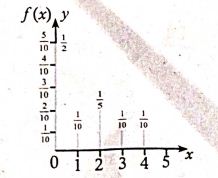
25.
(i) Probability mass function
For a discrete random variable we have
f(x) = p(X = x)
\(\therefore f(0)=F(0)=\frac { 1 }{ 2 } \)
f(1) = F(1) - F(0)
= \(\frac { 3 }{ 5 } -\frac { 1 }{ 2 } =\frac { 6-5 }{ 10 } =\frac { 1 }{ 10 } \)
f(2) = F(2)-F(1)
= \(\frac { 4 }{ 5 } -\frac { 3 }{ 5 } =\frac { 1 }{ 5 } \)
f(3) = F(3) - F(2)
\(\frac { 9 }{ 10 } -\frac { 4 }{ 5 } =\frac { 9-8 }{ 10 } =\frac { 1 }{ 10 } \)
f(4) = F(4)-F(3)
= \(1-\frac { 9 }{ 10 } =\frac { 1 }{ 10 } \)
ஃThe probability mass function is
| X | 0 | 1 | 2 | 3 | 4 |
| f(x) | \(\cfrac { 1 }{ 2 } \) | \(\cfrac { 1 }{ 10 } \) | \(\cfrac { 1 }{ 5 } \) | \(\cfrac { 1 }{ 10 } \) | \(\cfrac { 1 }{ 10 } \) |
(ii) p(x < 3) = p(x = 0) + p(x = 1) + p(x = 2)
= \(\frac { 1 }{ 2 } +\frac { 1 }{ 10 } +\frac { 1 }{ 5 } =\frac { 5+1+2 }{ 10 } =\frac { 8 }{ 10 } \)
= \(\frac { 4 }{ 5 } \)
(iii) p(x≥2) = p(x = 2) + p(x = 3) + p(x = 4)
= \(\frac { 1 }{ 5 } +\frac { 1 }{ 10 } +\frac { 1 }{ 10 } =\frac { 2+1+1 }{ 10 } =\frac { 4 }{ 10 } \)
= \(\frac { 2 }{ 5 } \)
26.
We have,
\(f(x)=log(1+x)-\frac{x}{1+x}\)
Therefore, \(f'(x)=\frac{1}{1+x}-\frac{1}{(1+x)^{2}}\)
= \(\frac{x}{(1+x)^{2}}\).
Hence, f′(x) is \(\begin{cases} <0 \ when-1
Therefore f (x) is strictly increasing for x > 0 and strictly decreasing for x < 0. Since f′(x) changes from negative to positive when passing through x = 0, the first derivative test tells us there is a local minimum at x = 0 which is f (0) = 0. Further, for x > 0, f(x) > f (0) = 0 gives
\(log(1+x)-\frac{x}{1+x}>0 \Rightarrow log(1+x)>\frac{x}{1+x}\).
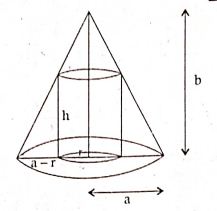
27.
28.
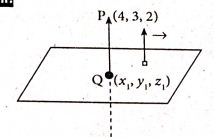
Given equation of plane is x + 2y + 3z = 2
Length of perpendicular from (4, 3, 2) to the plane is
\(d=\cfrac { 4+2\left( 3 \right) +3\left( 2 \right) }{ \sqrt { { 1 }^{ 2 }+{ 2 }^{ 2 }+{ 3 }^{ 2 } } } =\cfrac { 4+6+6 }{ \sqrt { 14 } } \)
= \(\cfrac { 14 }{ \sqrt { 14 } } =\cfrac { \sqrt { 14 } .\sqrt { 14 } }{ \sqrt { 14 } } =\sqrt { 14 } \) units
Let us find the image of the point (4,3,2) to the plane x + 2y + 3z = 2
Here \(\vec { u } =4\hat { i } +3\hat { j } +2\hat { k } ,\vec { n } =\hat { i } +2\hat { j } +3\hat { k } \)
Then the image \(\vec { v } =\vec { u } +\cfrac { 2\left[ p-\left( \vec { u } .\vec { n } \right) \right] }{ \left| \vec { n } \right| ^{ 2 } } \)
\(\vec { v } =\left( 4\hat { i } +3\hat { j } +2\hat { k } \right) +\cfrac { 2\left[ 2-\left( 4+6+6 \right) \right] }{ \left( \sqrt { { 1 }^{ 2 }+{ 2 }^{ 2 }+{ 3 }^{ 2 } } \right) } \left( \hat { i } +2\hat { j } +3\hat { k } \right) \)
= \(\left( 4\hat { i } +3\hat { j } +2\hat { k } \right) +\frac { 2\left( 2-16 \right) }{ 14 } \left( \hat { i } +2\hat { j } +3\hat { k } \right) \)
= \(\left( 4\hat { i } +3\hat { j } +2\hat { k } \right) +\cfrac { 2\left( -14 \right) }{ 14 } \left( \hat { i } +2\hat { j } +3\hat { k } \right) \)
= \(\left( 4\hat { i } +3\hat { j } +2\hat { k } \right) -2\left( \hat { i } +2\hat { j } +3\hat { k } \right) \)
= \(\left( 4\hat { i } +3\hat { j } +2\hat { k } \right) -2\left( \hat { i } +4\hat { j } -6\hat { k } \right) \)
= \(2\hat { i } -\hat { j } -4\hat { k } \)
\(\therefore\) The foot of the \(\bot \) from (4, 3, 2) to the plane is
\(\cfrac { \left( 4\hat { i } +3\hat { j } +2\hat { k } \right) +\left( 2\hat { i } -\hat { j } -4\hat { k } \right) }{ 2 } \)
= \(\cfrac { 6\hat { i } +2\hat { j } -2\hat { k } }{ 2 } =3\hat { i } +\hat { j } -\hat { k } \)
Hence, the co-ordinates of the foot of the perpendicular is (3, 1, -1)
29.
Since the centre is located at (0, 300), midway between the two foci, which are the coast guard stations, the equation is \(\frac { { \left( y-300 \right) }^{ 2 } }{ { a }^{ 2 } } -\frac { { \left( x-0 \right) }^{ 2 } }{ { b }^{ 2 } } =1\).... (1)
To determine the values of a and b, select two points known to be on the hyperbola and substitute each point in the above equation.
The point(0, 400) lies on the hyperbola, since it is 200 km further from Station A than from station B.
\(\frac { { \left( 400-300 \right) }^{ 2 } }{ { a }^{ 2 } } -\frac { O }{ { b }^{ 2 } } =1\frac { { 100 }^{ 2 } }{ a^{ 2 } } =1,{ a }^{ 2 }=10000.\) There is also a point (x, 600) on the hyperbola such that 6002+ x2 = (x + 200)2
360000 + x2 = x2+400x+40000
x = 800
Substituting in (1), we have \(\frac { { \left( 600-300 \right) }^{ 2 } }{ 10000 } -\frac { { \left( 800-0 \right) }^{ 2 } }{ { b }^{ 2 } } =1\)
\(9-\frac { 640000 }{ { b }^{ 2 } } =1\)
b2 = 80000
Thus the required equation of the hyperbola is \(\frac { { \left( y-300 \right) }^{ 2 } }{ 10000 } -\frac { { x }^{ 2 } }{ 80000 } =1\)
The ship lies somewhere on this hyperbola. The exact location can be determined using data from a third station.
30.
\(LHS={ tan }^{ -1 }x+{ tan }^{ -1 }\frac { 2x }{ 1-{ x }^{ 2 } } \)
= \({ tan }^{ -1 }\left( \frac { x+\frac { 2x }{ 1-{ x }^{ 2 } } }{ 1-x\left( \frac { 2x }{ 1-{ x }^{ 2 } } \right) } \right) \)
= \({ tan }^{ -1 }\left( \frac { \frac { x(1-{ x }^{ 2 })+2x }{ 1-{ x }^{ 2 } } }{ \frac { 1-{ x }^{ 2 }-2{ x }^{ 2 } }{ 1-{ x }^{ 2 } } } \right) \)
= \({ tan }^{ -1 }\left( \frac { \frac { x-{ x }^{ 3 }+2x }{ 1-{ x }^{ 2 } } }{ \frac { 1-3x^{ 2 } }{ 1-{ x }^{ 2 } } } \right) \quad \left[ \because |x|<\frac { 1 }{ \sqrt { 3 } } \right] \)
= \({ tan }^{ -1 }\left( \frac { 3x-{ x }^{ 3 } }{ 1-{ x }^{ 2 } } \times \frac { 1-{ x }^{ 2 } }{ 1-{ 3x }^{ 2 } } \right) \)
If 3x2 < 1
⇒ \( |x|<\frac { 1 }{ \sqrt { 3 } }\)
31.
Equation of the ellipse is 2x2 + 7y2 = 14
\(\div \) we get, \(\frac { { x }^{ 2 } }{ 7 } +\frac { { y }^{ 2 } }{ 2 } =1\)
∴ a2 = 7, b2 = 2
The condition for the line y = mx + c to be a tangent to the ellipse is
\(y=mx\pm \sqrt { { a }^{ 2 }{ m }^{ 2 }+{ b }^{ 2 } } \) ....(1)
(5, 2) lies on (1) and a2 = 7, b2 = 2
∴ 2 = \(m(5)\pm \sqrt { 7{ m }^{ 2 }+2 } \)
2 - 5m = \(\pm \sqrt { 7{ m }^{ 2 }+2 } \)
Squaring both sides we get,
(2, - 5m)2 = 7m2 + 2
4 + 25m2- 20m = 7m2 + 2
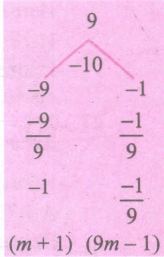
18m2-2m + 1 = 0 (\(\div \)2)
On factorising we get,
(m-1)(9m-1) = 0
∴ m -1 = 0 or
9m-1 = 0
⇒ m = 1 or \(\frac { 1 }{ 9 } \)
When m = 1, (1) becomes
y = \(1(x)\pm \sqrt { 7{ m }^{ 2 }+2 } \)
⇒ y = x \(x\pm \sqrt { 7+2 } \) ⇒ y = \(\pm \)3
y= x + 3 ⇒ x - y - 3 = 0
When m = \(\frac { 1 }{ 9 } \) (1) becomes
\(y=\frac { 1 }{ 9 } (x)\pm \sqrt { 7\left( \frac { 1 }{ 81 } \right) +2 } \)
⇒ \(y=\frac { x }{ 9 } +\sqrt { \frac { 7+162 }{ 81 } } \)
\(y=\frac { x }{ 9 } +\frac { 13 }{ 9 } \)
⇒ 9y = x + 13 ⇒ x -9y + 13 = 0
Hence the equation of tangents are x - y - 3 = 0 and x −9y + 13 = 0
32.
Now, \(tan^{ -1 }\left( \frac { d }{ 1+{ a }_{ 1 }{ a }_{ 2 } } \right) =tan^{ -1 }\frac { { a }_{ n }-{ a }_{ 1 } }{ 1+{ a }_{ 1 }{ a }_{ n } } =tan^{ -1 }{ a }_{ 2 }-tan^{ -1 }{ a }_{ 1 }\)
Similarly, \(tan^{ -1 }\left( \frac { d }{ 1+{ a }_{ 1 }{ a }_{ 2 } } \right) =tan^{ -1 }\left( \frac { { a }_{ n }-{ a }_{ 1 } }{ 1+{ a }_{ 1 }{ a }_{ n } } \right) =tan^{ -1 }{ a }_{ 3 }-tan^{ -1 }{ a }_{ 2 }\)
Continuing inductively, we get
\(tan^{ -1 }\left( \frac { d }{ 1+{ a }_{ n }{ a }_{ n-1 } } \right) =tan^{ -1 }\left( \frac { { a }_{ n }-{ a }_{ n-1 } }{ 1+{ a }_{ n }{ a }_{ n-1 } } \right) =tan^{ -1 }{ a }_{ n }-tan^{ -1 }{ a }_{ n-1 }\)
Adding vertically, we get
\(tan^{ -1 }\left( \frac { d }{ 1+{ a }_{ 1 }{ a }_{ 2 } } \right) +tan^{ -1 }\left( \frac { d }{ 1+{ a }_{ 2 }{ a }_{ 3 } } \right) +....+tan^{ -1 }\left( \frac { d }{ 1+{ a }_{ n }{ a }_{ n-1 } } \right) tan[tan^{ -1 }{ a }_{ n }-{ tan }^{ -1 }{ a }_{ 1 }]\\ \)
\(tan\left[ tan^{ -1 }\left( \frac { d }{ 1+{ a }_{ 1 }{ a }_{ 2 } } \right) +tan^{ -1 }\left( \frac { d }{ 1+{ a }_{ 2 }{ a }_{ 3 } } \right) +...+tan^{ -1 }\left( \frac { d }{ 1+{ a }_{ n }{ a }_{ n-1 } } \right) \right] =tan\left[ tan^{ -1 }{ a }_{ n }-tan^{ -1 }a_{ 1 } \right] \)\(=\left[ tan^{ -1 }\left( \frac { { a }_{ n }-{ a }_{ 1 } }{ 1+{ a }_{ 1 }{ a }_{ n } } \right) \right] =\frac { { a }_{ n }-{ a }_{ 1 } }{ 1+{ a }_{ 1 }{ a }_{ n } } \)
33.
In triangle ABC, consider A as the origin. Then the position vectors of D, E, F are given by \(\frac { \vec { AB } +\vec { AC } }{ 2 } ,\frac { \vec { AC } }{ 2 } ,\frac { \vec { AB } }{ 2 } \) respectively.
Since \(\left| \vec { AB } \times \vec { AC } \right| \) is the area of the parallelogram formed by the two vectors \(\vec { AB }\), \(\vec { AC } \) as adjacent sides, the area of ΔABC is \(\frac{1}{2}\) \(\left| \vec { AB } \times \vec { AC } \right| \). Similarly, considering ΔDEF, we get
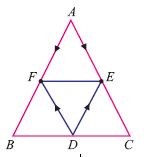
the area of ΔDEF = \(\frac{1}{2}\) \(\left| \vec { DE } \times \vec { DF } \right| \)
= \(\frac{1}{2}\) \(\left| (\vec { AE }-\vec{AD}) \times (\vec { AF }-\vec{AD}) \right|\)
= \(\left| \frac { \vec { AB } }{ 2 } \times \frac { \vec { AC } }{ 2 } \right| \)
= \(\frac14\) \(\left( \frac { 1 }{ 2 } \left| \vec { AB } \times \vec { AC } \right| \right) \)
= \(\frac14\)(the area of ΔABC)
34.
Let f(x) x6-3x5-5x4+22x3-39x2-39x+135
Given (1+2i) is a root \(\Rightarrow\)(-2i) is also a root
Also \(\sqrt3\) is a root \(\Rightarrow\)-\(\sqrt3\) is also a root.
Hence, the factors of f(x) are [x - (1 + 2i)]
[x-(1-2i)] [x\(\sqrt3\)] [x+\(\sqrt3\)]
[(x-1)-2i] [(x-1)+2i] [x-\(\sqrt3\)][x+\(\sqrt3\)]
((x-1)2+22)(x2-3) = (x2-2x+1+4)(x2-3)
\(\Rightarrow\) factor of f(x) is (x2-2x+5)(x2-3)
\(\Rightarrow\)x4-3x2-2x3+6x+5x2-15
\(\Rightarrow\)(x4-3x2-2x3+6x-15) is a factor of f(x)
To find the other factor, let us divide f(x) by
x4 - 2x3 + 2x2 + 6x - 15
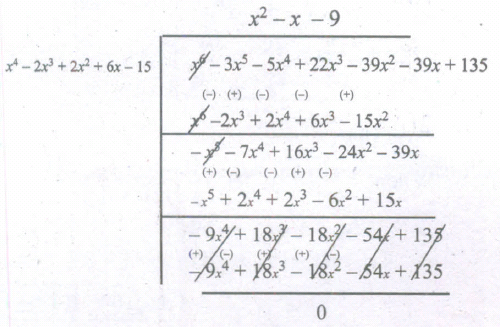
The other factor is x2 - x - 9
\(\Rightarrow x=\frac { 1\pm \sqrt { { (-1) }^{ 2 }-4(1)(-9) } }{ 2 } \left[ \because x=\frac { -b\pm \sqrt { { b }^{ 2 }-4ac } }{ 2a } \right] \)
\(\Rightarrow x=\frac { 1\pm \sqrt { 37 } }{ 2 } \)
Hence the roots are
1 - 2i, 1 + 2i, \(\sqrt { 3 }, -\sqrt { 3 }, \frac { 1+\sqrt { 37 } }{ 2 } ,\frac { 1-\sqrt { 37 } }{ 2 } \).
35.
(c)
36.
(c)
f(x) \(\ge\) 0
37.
(d)
38.
(b)
\(x=-\frac{a}{2}\)
39.
(b)
40.
(d)
41.
(c)
42.
Given equation of the curve is y = 1 + x3 and the line is x + 12y = 12
Slope of the tangent to the curve
m1 = \(\frac { dy }{ dx } \) = 3x2 and the
Slope of the line = m2
= \(\frac{-1}{2}\) \(\left[ \because m=\frac { co-efficient\quad of\quad x }{ co-efficient\quad of\quad y } \right] \)
Since the slope of the tangent to the curve and the line are orthogonal, m1 m2 = - 1.
∴ 3x2\(\left( \frac { -1 }{ 2 } \right) \) = -1
⇒ \(\frac{x^2}{4}\) = 1
⇒ x2 = 4
⇒ x = ±2
When x = 2, y = 1 + 23 = 9
When x = -2, y = 1+ (-2)3
= 1-8 = -7
∴ Equation of the tangent at (2, 9) is
y-9 = 12(x-2) [∵ m1 = 3x2 = 3(2)2 = 12]
∴ y - 9 = 12x - 24
∴ 12x - y = 15
Equation of the tangent at (-2, -7) is
y + 7= 12(x + 2)
⇒ y + 7 = 12x + 24
⇒ 12x - y = -17
43.
(b)
44.
(a)
3
45.
(c)
\(\left[ -\sqrt { 5 } ,-\sqrt { 3 } \right] \cup \left[ \sqrt { 3 } ,\sqrt { 5 } \right] \)
46.
(a)
no solution
47.
(d)
3, -9
48.
(d)
\(-17\hat { i } -21\hat { j } -97\hat { k } \)
49.
(b)
(-3, 2)
50.
(c)
\(\frac { 1 }{ 2 } \)
51.
(c)
\(\frac { 10 }{ 3 } \)
52.
(c)
53.
(c)
0
54.
(a)

12th Standard Syllabus & Materials
12th Standard
TN 12th Computer Applications களப்பெயர் முறைமை (DNS) Sample Question Papers Study Material - QB365 Set A
NEW12th Standard
TN 12th Computer Applications வலையமைப்பு எடுத்துக்காட்டுகள் மற்றும் நெறிமுறைகள் Sample Question Papers Study Material - QB365 Set A
NEW12th Standard
TN 12th Computer Applications கணினி வலையமைப்பு ஓர் அறிமுகம் Sample Question Papers Study Material - QB365 Set A
NEW12th Standard
TN 12th Computer Applications PHP-உடன் MySQL-ஐ இணைத்தல் Sample Question Papers Study Material - QB365 Set A



Tamilnadu Stateboard 12th Standard Subjects
Maths

Chemistry

Physics

Biology

Computer Science

Business Maths and Statistics

Economics

Commerce

Accountancy

History

Computer Applications
Biology
Computer Technology
Computer Applications
Computer Science
Business Maths and Statistics
Commerce
Economics
Maths
Chemistry
Physics
Computer Technology
History
Accountancy

Tamil

English

French
Tamilnadu Stateboard Standards


