
 100% FREE ACCESS
12th Standard Syllabus & Materials
12th Standard
TN 12th Maths Applications of Matrices and Determinants Sample Question Papers Study Material - QB365 Set A
NEW12th Standard
TN 12th Computer Applications மின்னணு தரவு பரிமாற்றம் Sample Question Papers Study Material - QB365 Set A
NEW12th Standard
TN 12th Computer Applications மின் - வணிக பாதுகாப்பு அமைப்புகள் Sample Question Papers Study Material - QB365 Set A
NEW12th Standard
TN 12th Computer Applications மின்னணு செலுத்தல் முறைகள் Sample Question Papers Study Material - QB365 Set A
NEW12th Standard
TN 12th Computer Applications மின் - வணிகம் Sample Question Papers Study Material - QB365 Set A
NEW12th Standard
TN 12th Computer Applications திறந்த மூல கருத்துருக்கள் Sample Question Papers Study Material - QB365 Set A

Published on: 20/10/2025
Download Tamil Nadu 12th Standard Maths question papers, model tests, one-mark questions, important questions, and public exam papers in PDF format. Free study materials and answer keys for TN State Board students.
Questions + Answers key
Take MCQ Maths Test
1.
Let X be a continuous random variable and f(x) is defined as: \(f(x)= \begin{cases}k x(1-x)^{10} & , 0<x<1 \\ 0 & , \text { Otherwise }\end{cases}\)Find the value of k.
2.
Solve: \(\frac{dy}{dx}=\)(4x + y + 1)2
3.
If μ and σ2 are the mean and variance of the discrete random variable X, and E(X + 3) =10 and E(X + 3)2 = 116, find μ and \(\sigma\)2
4.
The probability density function of X is given by \(f(x)=\begin{cases} \begin{matrix} kxe^{ -2x } & forx>0 \end{matrix} \\ \begin{matrix} 0 & for\quad x\le 0 \end{matrix} \end{cases}\) Find the value of k.
5.
Solve \((1+{ x }^{ 2 })\frac { dy }{ dx } =1+{ y }^{ 2 }\)
6.
Show that y = ax + \(\frac { b }{ x } \), x ≠ 0 is a solution of the differential equation x2 y" + xy' - y = 0.
7.
Form the differential equation of all straight lines touching the circle x2 + y2 = r2.
8.
Find the length of Latus rectum of the parabola y2 = 4ax.
9.
If y = 2\(\sqrt2\)x + c is a tangent to the circle x2 + y2 = 16, find the value of c.
10.
Find the equation of the circle described on the chord 3x + y + 5 = 0 of the circle x2 + y2 = 16 as diameter.
11.
If 10 coins are tossed, find the probability that exactly 5 heads appears.
12.
Solve: \(\frac{dy}{dx}+y=e^{-x}\)
13.
A pair of fair dice is rolled once. Find the probability mass function to get the number of fours.
14.
Compute P(X = k) for the binomial distribution, B(n, p) where
n = 9, \(p=\frac { 1 }{ 2 } \), k = 7
15.
For the random variable X with the given probability mass function as below, find the mean and variance.
\(f(x)=\begin{cases} \begin{matrix} \cfrac { 1 }{ 2 } e^{ -\frac { x }{ 2 } } & for\quad x>0 \end{matrix} \\ \begin{matrix} 0 & otherwise \end{matrix} \end{cases}\)
16.
Solve \(\frac { dy }{ dx } +2y={ e }^{ -x }\)
17.
Show that each of the following expressions is a solution of the corresponding given differential equation.
y = aex + be−x; y − y = 0
18.
For each of the following differential equations, determine its order, degree (if exists)
\(\sqrt { \frac { dy }{ dx } } -4\frac { dy }{ dx } -7x=0\)
19.
The orbit of Halley’s Comet is an ellipse 36.18 astronomical units long and by 9.12 astronomical units wide. Find its eccentricity.
20.
Determine whether x + y − 1 = 0 is the equation of a diameter of the circle x2 + y2 − 6x + 4y + c = 0 for all possible values of c .
21.
If X is the random variable with distribution function F(x) given by,
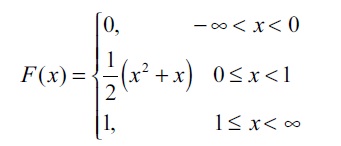
then find (i) the probability density function f(x)
(ii) P(0.3 ≤ X ≤ 0.6)
22.
The probability density function of X is given
\(f(x)=\begin{cases} \begin{matrix} { Ke }^{ \frac { -x }{ 3 } } & \begin{matrix} for & x>0 \end{matrix} \end{matrix} \\ \begin{matrix} 0 & \begin{matrix} for & x\le 0 \end{matrix} \end{matrix} \end{cases}\)
Find
(i) the value of k
(ii) the distribution function.
(iii) P(X <3)
(iv) P(5 ≤X)
(v) P(X ≤ 4)
23.
The cumulative distribution function of a discrete random variable is given by
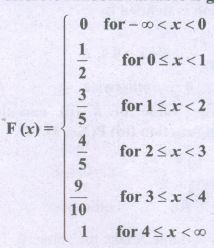
Find
(i) the probability mass function
(ii) P(X < 3) and
(iii) P(X \(\ge \)2).
24.
Suppose a discrete random variable can only take the values 0, 1, and 2. The probability mass function is defined by
\(\\ \\ \\ \\ \\ f(x)=\begin{cases} \begin{matrix} \frac { { x }^{ 2 }+1 }{ k } & forx=0,1,2 \end{matrix} \\ \begin{matrix} 0 & otherwise \end{matrix} \end{cases}\\ \\ \\ \\ \\ \\ \)
Find
(i) the value of k
(ii) cumulative distribution function
(iii) P(X ≥ 1).
25.
At 10.00 A.M. a woman took a cup of hot instant coffee from her microwave oven and placed it on a nearby Kitchen counter to cool. At this instant the temperature of the coffee was 180o F, and 10 minutes later it was 160o F. Assume that constant temperature of the kitchen was 70oF.
(i) What was the temperature of the coffee at 10.15 A.M.? \(\left[\log \frac{9}{11}=-0.6061\right]\)
(ii) The woman likes to drink coffee when its temperature is between 130oF and 140oF between what times should she have drunk the coffee? \(\left[\log \frac{6}{11}=-0.2006\right]\)
26.
Water at temperature 100oC cools in 10 minutes to 80oC in a room temperature of 25oC.
Find
(i) The temperature of water after 20 minutes
(ii) The time when the temperature is 40oC
\(\left[ { log }_{ e }\frac { 11 }{ 15 } =-0.3101;{ log }_{ e }5=1.6094 \right] \)
27.
The equation of electromotive force for an electric circuit containing resistance and self inductance is E = Ri + L\(\frac{di}{dt},\) Where E is the electromotive force is given to the circuit, R the resistance and L, the coefficient of induction. Find the current i at time t when E = 0.
28.
In a murder investigation, a corpse was found by a detective at exactly 8 p.m. Being alert, the detective also measured the body temperature and found it to be 70oF. Two hours later, the detective measured the body temperature again and found it to be 60oF. If the room temperature is 50oF, and assuming that the body temperature of the person before death was 98.6oF, at what time did the murder occur? [log(2.43) = 0.88789; log(0.5)=-0.69315]
29.
Solve the Linear differential equation:
\(\frac { dy }{ dx } +\frac { 3y }{ x } =\frac { 1 }{ { x }^{ 2 } } \), given that y = 2 when x = 1
30.
Solve the differential equation \({ ye }^{ \frac { x }{ y } }dx=\left( { xe }^{ \frac { x }{ y } }+y \right) dy\)
31.
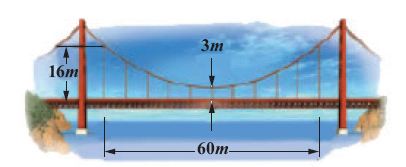
Parabolic cable of a 60m portion of the roadbed of a suspension bridge are positioned as shown below. Vertical Cables are to be spaced every 6m along this portion of the roadbed. Calculate the lengths of first two of these vertical cables from the vertex.
32.
Prove that the point of intersection of the tangents at ‘t1’ and ‘t2’ on the parabola y2 = 4ax is \(\left[ at_{ 1 }t_{ 2 },a({ t }_{ 1 }+{ t }_{ 2 }) \right] .\)
33.
Find the equations of tangent and normal to the ellipse x2+4y2 = 32 when \(\theta =\frac { \pi }{ 4 } \)
34.
Find the equation of the circle through the points (1, 0),(-1, 0) , and (0, 1)
35.
The I.F. of cosec x \(\frac{dy}{dx}+y\) sec2 x = 0 is ___________
esec x
etan x
esec x tan x
esec2 x
36.
37.
If cosx is an integrating factor of the differential equation \(\frac{dy}{dx}+Py= Q\), then P = ___________
-cot x
cot x
tan x
-tan x
38.
39.
If X is a binomial random variable with expected value 6 and variance 2.4, then P(X = 5) is
\(\left( \frac { 10 }{ 5 } \right) \left( \frac { 3 }{ 5 } \right) ^{ 6 }\left( \frac { 2 }{ 5 } \right) ^{ 4 }\)
\(\left( \frac { 10 }{ 5 } \right) \left( \frac { 3 }{ 5 } \right) ^{ 10 }\)
\(\left( \frac { 10 }{ 5 } \right) { \left( \frac { 3 }{ 5 } \right) }^{ 4 }\left( \frac { 2 }{ 5 } \right) ^{ 6 }\)
\(\left( \frac { 10 }{ 5 } \right) \left( \frac { 3 }{ 5 } \right) ^{ 5 }\left( \frac { 2 }{ 5 } \right) ^{ 5 }\)
40.
41.
Let X represent the difference between the number of heads and the number of tails obtained when a coin is tossed n times. Then the possible values of X are
i + 2n, i = 0,1,2... n
2i- n, i = 0,1,2... n
n - i, i = 0,1,2... n
2i + 2n, i = 0, 1, 2...n
42.
A random variable X has binomial distribution with n = 25 and p = 0.8 then standard deviation of X is
6
4
3
2
43.
The integrating factor of the differential equation \(\frac{d y}{d x}+P(x) y=Q(x)\) is x, then P(x)
x
\(\frac { { x }^{ 2 } }{ 2 } \)
\(\frac{1}{x}\)
\(\frac{1}{x^2}\)
44.
45.
46.
47.
The differential equation representing the family of curves y = Acos(x + B), where A and B are parameters,is
\(\frac { { d }^{ 2 }y }{ { dx }^{ 2 } } -y=0\)
\(\frac { { d }^{ 2 }y }{ { dx }^{ 2 } }+y=0\)
\(\frac { { d }^{ 2 }y }{ { dx }^{ 2 } }=0\)
\(\frac { { d }^{ 2 }x }{ { dy }^{ 2 } }=0\)
48.
When the eccentricity of a ellipse becomes zero, then it becomes a __________
straight line
circle
point
parabola
49.
If (0, 4) and (0, 2) are the vertex and focus of a parabola then its equation is ___________
x2 + 8y = 32
y2 + 8x = 32
x2 - 8y = 32
y2 - 8x = 32
50.
If x + y = k is a normal to the parabola y2 = 12x, then the value of k is
3
-1
1
9
51.
The area of quadrilateral formed with foci of the hyperbolas \(\frac{x^{2}}{a^{2}}-\frac{y^{2}}{b^{2}}=1 \text { and } \frac{x^{2}}{a^{2}}-\frac{y^{2}}{b^{2}}=-1\)
4(a2+b2)
2(a2+b2)
a2 +b2
\(\frac { 1 }{ 2 } \)(a2+b2)
52.
If P(x, y) be any point on 16x2 + 25y2 = 400 with foci F1 (3, 0) and F2 (-3, 0) then PF1 + PF2 is
8
6
10
12
53.
The radius of the circle 3x2 + by2 + 4bx − 6by + b2 = 0 is
1
3
\( \sqrt {10}\)
\( \sqrt {11}\)
54.
The circle x2 + y2 = 4x + 8y +5 intersects the line 3x−4y = m at two distinct points if
15< m < 65
35< m <85
−85 < m < −35
−35 < m < 15
1.
\(
\int_{-\infty}^{\infty} f(x) \mathrm{dx}=1
\)
\(\int_{-\infty}^{0} 0 \mathrm{dx}+\int_{0}^{1} \mathrm{kx}(1-x)^{10} \mathrm{dx}+\int_{1}^{\infty} 0 \mathrm{dx}=1
\)
\(\int_{0}^{1} k x(1-x)^{10} \mathrm{dx}=1
\)
\(\int_{0}^{1}(1-x)(1-1+x)^{10} \mathrm{dx}=1
\)
\(k \int_{0}^{1}(1-x)(\mathrm{x})^{10} \mathrm{dx}=1
\)
\([\therefore \left.k \int_{0}^{1} \mathrm{f}(\mathrm{x}) \mathrm{dx}=\int_{0}^{10} \mathrm{f}(\mathrm{a}-\mathrm{x}) \mathrm{dx}\right]
\)
\(
k \int_{0}^{1}(1-x)(x)^{10} d x =1
\)
\(k \int_{0}^{1}\left(x^{10}-x^{11}\right) d x =1
\)
\(k\left[\frac{x^{11}}{11}-\frac{x^{12}}{12}\right]_{0}^{1} =1
\)
\(k\left[\frac{1}{11}-\frac{1}{12}\right] =1
\)
\(k\left[\frac{1}{132}\right] =1\)
k = 132
2.
Given \(\frac{dy}{dx}=\) (4x + y + 1)2....(1)
put 4x + y + 1 = z
\(\Rightarrow 4+\frac { dy }{ dx } =\frac { dz }{ dx } \)
\(\Rightarrow \frac { dy }{ dx } =\frac { dz }{ dx } -4\)
Substituting these in (1) we get,
\(\frac { dz }{ dx } -4={ z }^{ 2 }\)
\(\Rightarrow \frac { dz }{ dx } ={ z }^{ 2 }+4\)
\(\Rightarrow \int { \frac { dz }{ { z }^{ 2 }+4 } } =\int { dx } \)
\(\\ \Rightarrow \frac { 1 }{ 2 } { tan }^{ -1 }\left( \frac { z }{ 2 } \right) =x+c\)
\(\\ \Rightarrow \frac { 1 }{ 2 } { tan }^{ -1 }\left( \frac { 4x+y+1 }{ 2 } \right) =x+c\)
3.
Given E(X + 3) = 10
E(aX + b) = aE(X) + b
⇒ E(X) + 3 = 10
E(X) + 3 = 10
⇒ E(X) = 7
⇒μ = 7 ...(1)
E(X + 3)2 = 116
E(X2 + 6x + 9) 116
E(X2) + 6E(X) + 9 = 116 [ஃ E(9) = 9]
E(X2) + 6(7) + 9 = 116
E(X2) + 116 - 42 - 9 116 - 51
E(X2) = 65 ...(2)
Var(X) = E(X2) - [E(X)2]
65 - 72 = 65 - 49 = 16
ஃμ = 7 and σ2 = 16.
4.
Given \(f(x)=\begin{cases} \begin{matrix} kxe^{ -2x } & forx>0 \end{matrix} \\ \begin{matrix} 0 & for\quad x\le 0 \end{matrix} \end{cases}\)
Since the given function is a probability density function
\(\int _{ -\infty }^{ \infty }{ f(x)dx } \) = 1
\(\Rightarrow k\int _{ 0 }^{ \infty }{ { xe }^{ -2x }dx=1 } \)
\(\Rightarrow k \frac { 1! }{ \left( 2 \right) ^{ 2 } } =1\)
[\(\int _{ 0 }^{ \infty }{ { x }^{ n }e^{ -ax } } =\frac { n! }{ { a }^{ +1 } } \), Here a = 2, n = 1]
\(\Rightarrow \frac { k }{ 4 } =1\\ \Rightarrow k=4\)
5.
Given that \((1+{ x }^{ 2 })\frac { dy }{ dx } =1+{ y }^{ 2 }\) ..(1)
The given equation is written in the variables separable form
\(\frac { dy }{ { 1+y }^{ 2 } } =\frac { dx }{ { 1+x }^{ x } } \) ...(2)
Integrating both sides of (2), we get tan−1 tan−1x +C.
But tan-1 y - tan-1 x = tan-1 \(\left( \frac { y-x }{ 1+xy } \right) .\) ...(4)
Using (4) in (3) leads to tan-1 \(\left( \frac { y-x }{ 1+xy } \right)\) = C, which implies \(\frac { y-x }{ 1+xy } \) = tan C = a (say).
Thus, y − x = a(1+ xy) gives the required solution
6.
Given y = ax + \(\frac { b }{ x } \) .......(1)
Differentiating with respect to x
y' = ax - \(\frac { b }{ x ^2} \) ......(2)
Differentiating again with respect to x
\(y'' = \frac{-b(-2)}{x^3}= \frac{2b}{x^3}
\)
\(Now, x^2y'' + xy'-y
\)
\( = x^2 \times \frac{2b}{x^3}+x(a- \frac{b}{x^2})-(ax+\frac{b}{x})
\)
\(= 2\times (\frac{b}{x})+ax-(\frac{b}{x})-ax-(\frac{b}{x})\)
= 0
Hence, y = ax + b is the solution of the differential equation x2y"+xy'-y = 0.
7.
Given circle equation be x2 y2 = r2
Let y = mx + c be the family of lines which touches the circle.
The condition for y = mx + c be all straight lines which towards the given circle x2 y2 = r2 (1 + m2)
\(c=\sqrt { { 1+m }^{ 2 } } \)
Hence, equation of tangent to the circle is .......(1)
y = mx + r\(\sqrt { { 1+m }^{ 2 } } \) .......(1)
Differentiating with respect to x,
\(\frac { dy }{ dx } =m\quad ...(2)\)
Substituting 'm' in (1) we get,
\(y= \left( \frac { dy }{ dx } \right) \times x \pm r\sqrt { 1+{ \left( \frac { dy }{ dx } \right) }^{ 2 } } \)
\(y-x\left( \frac { dy }{ dx } \right) =\pm r\sqrt { 1+{ \left( \frac { dy }{ dx } \right) }^{ 2 } } \)
Squaring both sides we get,
\(\Rightarrow { \left[ y-x\left( \frac { dy }{ dx } \right) \right] }^{ 2 }={ r }^{ 2 }\left[ 1+{ \left( \frac { dy }{ dx } \right) }^{ 2 } \right] \)
This is the differential equation of all straight lines touching the circle x2 y2 = r2
8.
Equation of the parabola is y2 = 4ax
Latus rectum LL′ passes through the focus (a, 0)
Hence the point L is (a, y1)
Therefore y12 = 4a2
Hence y1 = ±2a
The end points of latus rectum are (a, 2a) and (a, -2a)
9.
Given that equation of the circle is
x2 + y2 = 16
⇒ a2 = 16
and equation of the tangent is
y = \( 2\sqrt { 2 } \)x + c
⇒ m = \( 2\sqrt { 2 } \) and c = c
[∵ y = mx + c is the tangent]
The condition for the line y = mx + c is a tangent to the circle x2 +y2 = a2 is
c2 = a2 (1 + m2)
⇒ c2 = 16(1 + \(\left( { \left( 2\sqrt { 2 } \right) }^{ 2 } \right) \)
⇒ c2 = 16(1 + 8)
⇒ c2 = 16(9)
⇒ c = ± 4(3)
⇒ ±12
10.
Equation of the circle passing through the points of intersection of the chord and circle by
Theorem is x2 + y2−16+\(\lambda \)(3x + y + 5) = 0 .
The chord 3x + y + 5 = 0 is a diameter of this circle if the centre\(\left( \frac { -3\lambda }{ 2 } \frac { -\lambda }{ 2 } \right) \) lies on the chord.
So we have 3\(\left( \frac { -3\lambda }{ 2 } \right) \)-\(\frac { -\lambda }{ 2 } \)+5 = 0,
\(\frac { -9\lambda }{ 2 } \)-\(\frac { \lambda }{ 2 } \)+5 = 0,
−5λ + 5 = 0 ,
λ = 1.
Therefore, the equation of the required circle is x2 + y2+3x + y −11 = 0.
11.
Given = 10
\(
\mathrm{P}(\mathrm{H})=\frac{1}{2} \Rightarrow p=\frac{1}{2}
\)
\(\therefore q-1-p \)
\(=1-\frac{1}{2}=\frac{1}{2} \)
\(\mathrm{P}(\mathrm{X}=x)=n \mathrm{C}_{x} p^{x}(1-p)^{n-x} \)
\(x=0,1,2, \ldots n
\)
\(\therefore \mathrm{P}(\mathrm{X}=5)=10 \mathrm{C}_{5} p^{5} q^{5}
\)
\(=10 \mathrm{C}_{5}\left(\frac{1}{2}\right)^{5}\left(\frac{1}{2}\right)^{5}
\)
\(=10 C_{5}\left(\frac{1}{2}\right)^{10}\)
12.
This is a linear differential equation
Here P = 1, Q = e-x
\(\therefore \int { p\ dx } =\int { 1.dx } =x\)
\(I.F={ e }^{ \int { pdx } }={ e }^{ x }\)
The solution is
\({ ye }^{ \int { pdx } }\int { { Qe }^{ \int { p\ dx } }dx+c } \)
\(\Rightarrow y{ e }^{ x }=\int { { e }^{ -x }.{ e }^{ x }dx+c=\int { dx+c } } \)
\(\int { y{ e }^{ x }=x+c } \)
13.
\(S=\left|\begin{array}{l} (1,1),(1,2),(1,3),(1,4),(1,5),(1,6) \\ (2,1),(2,2),(2,3),(2,4),(2,5),(2,6) \\ (3,1),(3,2),(3,3),(3,4),(3,5),(3,6) \\ (4,1),(4,2),(4,3),(4,4),(4,5),(4,6) \\ (5,1),(5,2),(5,3),(5,4),(5,5),(5,6) \\ (6,1),(6,2),(6,3),(6,4),(6,5),(6,6) \end{array}\right|\)
Let X be a random variable whose values x are the number of fours.
The sample space S is given in the table.
It can also be written as
S = {(i, j)} , where i = 1, 2, 3, 6 and j = 1, 2, 3, 6
Therefore X takes on the values of 0, 1 and 2.
We observe that
(i) X = 0, if (i, j) for i ≠ 4, j≠ 4,
(ii) X = 1, if (1, 4), (2, 4), (3, 4), (5, 4), (6, 4), (4, 1), (4, 2), (4, 3), (4, 5), (4, 6)
(iii) X = 2, if (4, 4) ,
Therefore,
| Values of the Random Variable X | 0 | 1 | 2 | Toatal |
| Number of elements in inverse images | 25 | 10 | 1 | 36 |
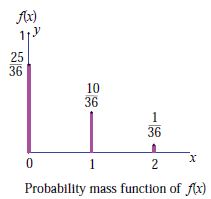
The probabilities are
\(f(0)=P(X=0)\cfrac { 25 }{ 36 } \)
\(f(1)=P(X=1)=\cfrac { 10 }{ 36 } \)
and \(f(20=P(X=2)=\cfrac { 1 }{ 36 } \)
Clearly the function f(x) satisfies the conditions
(i) f (x) ≥ 0, for x = 0, 1, 2 and
(ii) \(\underset { x }{ \Sigma } f(x)=\sum _{ x=0 }^{ x=-2 }{ f(x) } =f(0)+f(1)+f(2)=1\)
\(=\frac{25}{36}+\frac{10}{36}+\frac{1}{36}=1\)
The probability mass function is presented as
| x | 0 | 1 | 2 |
| f(x) | \(\frac { 25 }{ 36 } \) | \(\frac { 10 }{ 36 } \) | \(\frac { 1 }{ 36 } \) |
(or)
\(f(x)=\begin{cases} \begin{matrix} \frac { 25 }{ 36 } & for \ x=0 \end{matrix} \\ \begin{matrix} \frac { 10 }{ 36 } & for \ x=1 \end{matrix} \\ \begin{matrix} \frac { 1 }{ 36 } & for \ x=2 \end{matrix} \end{cases}\)
14.
\(\mathrm{n}=9, \mathrm{p}=\frac{1}{2}, \mathrm{k}=7
\)
\(
\mathrm{P}(X=x)={ }^{n} C_{x} p^{x} q^{n-x}, x=0,1,2, \ldots, n
\)
\(p =\frac{1}{2}
\)
\(q =1-p=\frac{1}{2} \)
\(P(X=7) ={ }^{9} C_{7}\left(\frac{1}{2}\right)^{7}\left(\frac{1}{2}\right)^{2}
\)
\( =\frac{9 \times 8}{2} \times \frac{1}{2^{9}} \)
\( =36 \times \frac{1}{512}=\frac{9}{128}
\)
15.
\(f(x)=\begin{cases} \begin{matrix} \frac { 1 }{ 2 } e^{ -\frac { x }{ 2 } } & for\quad x>0 \end{matrix} \\ \begin{matrix} 0 & otherwise \end{matrix} \end{cases}\)
\(\int _{ 0 }^{ \infty }{ x.f(x)dx } =\frac { 1 }{ 2 } \int _{ 0 }^{ \infty }{ x.{ e }^{ \frac { -x }{ 2 } } } dx\)
\(\left[ \int _{ 0 }^{ \infty }{ { e }^{ -ax }.{ x }^{ n }dx=\cfrac { n! }{ { a }^{ n+1 } } } \right] \)
= \(\frac { 1 }{ 2 } \times \frac { 1! }{ \left( \frac { 1 }{ 2 } \right) ^{ 2 } } =\frac { 1 }{ 2 } \times \frac { 1 }{ \frac { 1 }{ 4 } } \)
= \(\frac { 1 }{ 2 } \times \frac { 4 }{ 1 } =2\)
\(E({ X }^{ 2 })=\int _{ 0 }^{ \infty }{ { x }^{ 2 }.f(x) } dx\)
= \(\int _{ 0 }^{ \infty }{ { x }^{ 2 }.\frac { 1 }{ 2 } { e }^{ -\frac { x }{ 2 } } } dx\)
= \(\frac { 1 }{ 2 } \int { { x }^{ 2 }.{ e }^{ -\frac { x }{ 2 } }dx } \)
= \(\frac { 1 }{ 2 } \times \frac { 2! }{ \left( \frac { 1 }{ 3 } \right) ^{ 3 } } =\frac { 1 }{ 2 } \times \frac { 2 }{ \frac { 1 }{ 8 } } \)
= \(\frac { 1 }{ 2 } \times 2\times 8=8\)
ஃVar(X)=E(X2) - [E(x)]2
= 8-22
= 8 - 4 = 4
16.
Given that \(\frac{dy}{dx}+2y\) = e-x
This is a linear differential equation
Here P = 2 ; Q = e−x.
\(\int { pdx } =\int { 2dx } =2x\)
Thus, I.F.\(={ e }^{ \int { pdx } }={ e }^{ 2x }\)
Hence the solution of (1) is \({ ye }^{ \int { pdx } }=\int { { Qe }^{ \int { Pdx } }dx+C } \)
That is, \({ ye }^{ 2x }=\int { { e }^{ -x }{ e }^{ 2x }dx+C } or\quad { ye }^{ 2x }={ e }^{ x }+C\quad or\quad y={ e }^{ -x }+{ Xe }^{ -2x }\) required solution
17.
y = aex + be−x; y − y = 0
Consider y = aex + be−x
Differentiating with respect to 'x' we get,
\(\frac { dy }{ dx } = ae^{x} -be^{-x} \)
Again differentiating, we get
\(\frac { d^2y }{ dx^2 } = ae^{x} -be^{-x} \)
\(\frac { d^2y }{ dx^2 } = y\)
\(\frac { d^2y }{ dx^2 } - y = 0\) is a required differential equation.
Thus y = aex + be−x satisfies the diferential| equation y"- y = 0
Hence y = aex + be−x is a solution of the differential equation y"- y = 0
18.
\(\sqrt { \frac { dy }{ dx } } -4\frac { dy }{ dx } -7x=0\)
The given differential equation is
\(\sqrt { \frac { dy }{ dx } } =4\frac { dy }{ dx } +7x\)
Squaring both sides,
\(\frac { dy }{ dx } =\quad { \left( 4\frac { dy }{ dx } +7x \right) }^{ 2 }\)
\(16{ \left( \frac { dy }{ dx } \right) }^{ 2 }+{ 49 }x^{ 2 }+56x{ \left( \frac { dy }{ dx } \right) }\)
The highest derivative is 1 and its maximum power is 2.
∴ Order 1, degree 2.
19.
Given that 2a = 36.18, 2b = 9.12 , we get
e = \(\sqrt { 1-\frac { { b }^{ 2 } }{ { a }^{ 2 } } } =\frac { \sqrt { { a }^{ 2 }-{ b }^{ 2 } } }{ a } \) = \(\frac { \sqrt { { \left( \frac { 36.18 }{ 2 } \right) }^{ 2 }{ \left( \frac { 9.12 }{ 2 } \right) }^{ 2 } } }{ \frac { 36.18 }{ 2 } } \)
\(\frac { \sqrt { { \left( 18.09 \right) }^{ 2 }-{ \left( 4.56 \right) }^{ 2 } } }{ \left( 8.09 \right) } \approx0.97\)
20.
Centre of the circle is (3,-2) which lies on x + y − 1 = 0. So the line x + y − 1 = 0 passes through the centre and therefore the line x + y −1 = 0 is a diameter of the circle for all possible values of c .
21.
Given
(i) The probability density function. Differentiating F(x) with respect to 'x' at continuity points of F(x), we get
\(F(x)=\begin{cases} \begin{matrix} 0 & x<0 \end{matrix} \\ \begin{matrix} \frac { 1 }{ 2 } ({ 2x }+1) & 0\le x<1 \end{matrix} \\ \begin{matrix} 1 & x\ge 1 \end{matrix} \end{cases}\)
(ii) \(p(0.3\le X\le 0.6)=\int _{ 0.3 }^{ 0.6 }{ f(x)dx } \)
= \(\int _{ 0.3 }^{ 0.6 }{ \frac { 1 }{ 2 } \left( 2x+1 \right) dx } =\frac { 1 }{ 2 } \left[ \frac { { 2x }^{ 2 } }{ 2 } +x \right] _{ 0.3 }^{ 0.6 }\)
= \(\frac { 1 }{ 2 } \left( { x }^{ 2 }+x \right) _{ 0.3 }^{ 0.6 }=\frac { 1 }{ 2 } \left[ \left( { 0.6 }^{ 2 }+0.6 \right) -\left( { 0.3 }^{ 2 }+0.3 \right) \right] \)
= \(\frac { 1 }{ 2 } \left[ \left( .36.6 \right) \right] -\left( .09+0.3 \right) ]\)
= \(\frac { 1 }{ 2 } \left[ 0.96-.39 \right] =\frac { 0.57 }{ 2 } =0.285\)
= 0.285
22.
Given
\(f(x)=\begin{cases} \begin{matrix} { Ke }^{ \frac { -x }{ 3 } } & \begin{matrix} for & x>0 \end{matrix} \end{matrix} \\ \begin{matrix} 0 & \begin{matrix} for & x\le 0 \end{matrix} \end{matrix} \end{cases}\)
(i) Since f(x) is a probability density function
\(\int _{ -\infty }^{ \infty }{ f(x) } dx=1\)
\(\Rightarrow \int _{ 0 }^{ \infty }{ K.{ e }^{ \frac { -x }{ 3 } } } dx=1\Rightarrow k\frac { \left[ { e }^{ \frac { -x }{ 3 } } \right] ^{ \infty } }{ -\frac { 1 }{ 3 } } \)
\(\Rightarrow -3k\left[ { e }^{ -\infty }-{ e }^{ 0 } \right] =1\) [∵ e∞ = 0, e0 = 1]
\(\Rightarrow 3k=1\Rightarrow k=\frac { 1 }{ 3 } \)
\(\therefore k=\cfrac { 1 }{ 3 } \)
(ii) The distribution function F(x) = \(\int _{ -\infty }^{ x }{ f(u)du } \)
Case 1: x < 0,
\(F(x)=\int _{ -\infty }^{ x }{ f(x)dx=0 } \)
Case 2: x > 0,
\(f(x)=\int _{ -\infty }^{ x }{ f(x)dx } \)
= \(\int _{ -\infty }^{ 0 }{ f(x)dx+\int _{ 0 }^{ x }{ f(x) } dx } \)
= \(0+k\int _{ 0 }^{ x }{ { e }^{ \frac { -x }{ 3 } } } dx\)
= \(\frac { 1 }{ 3 } \left[ \cfrac { { e }^{ \frac { -x }{ 3 } } }{ -\frac { 1 }{ 3 } } \right] =-\left[ { e }^{ -\frac { x }{ 3 } }-{ e }^{ o } \right] \)
= \(-[{ e }^{ -\frac { x }{ 3 } }-1]\)
= \(1-{ e }^{ -\frac { x }{ 3 } }\)
\(\therefore F(x)=\begin{cases} \begin{matrix} 0 & x\le 0 \end{matrix} \\ \begin{matrix} 1-{ e }^{ \frac { -x }{ 3 } } & x>0 \end{matrix} \end{cases}\)
(iii) p(X < 3)
= \(\int _{ 0 }^{ 3 }{ ke^{ -\frac { x }{ 3 } } } dx=\cfrac { 1 }{ 3 } \int _{ 0 }^{ 3 }{ { e }^{ -\frac { x }{ 3 } }dx } \)
= \(\cfrac { 1 }{ 3 } \left[ \frac { { e }^{ -\frac { x }{ 3 } } }{ \frac { -1 }{ 3 } } \right] \)
= -[e-1-e0] = -[e-1-1]
(iv) \(p(5\le X)=p(X\ge 5)=\int _{ 5 }^{ \infty }{ f(x)dx } \)
= \(\int _{ 5 }^{ \infty }{ ke^{ -\frac { x }{ 3 } } } dx=\cfrac { 1 }{ 3 } \cfrac { \left[ { e }^{ -\frac { x }{ 3 } } \right] _{ 5 }^{ \infty } }{ \frac { -1 }{ 3 } } \)
= \(-\left[ { e }^{ -\infty }-e^{ \frac { -3 }{ 5 } } \right] =\left[ 0-{ e }^{ \frac { -5 }{ 3 } } \right] \)
= \({ e }^{ \frac { -5 }{ 3 } }\)
(v) \(p(X\le 4)=\int _{ -\infty }^{ 4 }{ f(x)dx } \)
= \(\int _{ -\infty }^{ 0 }{ f(x)dx+\int _{ 0 }^{ 4 }{ f(x)dx } } \)
= \(0+\int _{ 0 }^{ 4 }{ { ke }^{ -\frac { x }{ 3 } }dx } =k\left[ \frac { { e }^{ -\frac { x }{ 3 } } }{ -\frac { 1 }{ 3 } } \right] _{ 0 }^{ 4 }\)
= \(\cfrac { 1 }{ 3 } \cfrac { \left[ { e }^{ -\frac { x }{ 3 } } \right] _{ 0 }^{ 4 } }{ -\frac { 1 }{ 3 } } =-\left[ { e }^{ \frac { -4 }{ 3 } }-{ e }^{ o } \right] \)
= \(-\left[ { e }^{ \frac { -4 }{ 3 } }-1 \right] =1-{ e }^{ \frac { -4 }{ 3 } }\)
23.
(i) Probability mass function
For a discrete random variable we have
f(x) = p(X = x)
\(\therefore f(0)=F(0)=\frac { 1 }{ 2 } \)
f(1) = F(1) - F(0)
= \(\frac { 3 }{ 5 } -\frac { 1 }{ 2 } =\frac { 6-5 }{ 10 } =\frac { 1 }{ 10 } \)
f(2) = F(2)-F(1)
= \(\frac { 4 }{ 5 } -\frac { 3 }{ 5 } =\frac { 1 }{ 5 } \)
f(3) = F(3) - F(2)
\(\frac { 9 }{ 10 } -\frac { 4 }{ 5 } =\frac { 9-8 }{ 10 } =\frac { 1 }{ 10 } \)
f(4) = F(4)-F(3)
= \(1-\frac { 9 }{ 10 } =\frac { 1 }{ 10 } \)
ஃThe probability mass function is
| X | 0 | 1 | 2 | 3 | 4 |
| f(x) | \(\cfrac { 1 }{ 2 } \) | \(\cfrac { 1 }{ 10 } \) | \(\cfrac { 1 }{ 5 } \) | \(\cfrac { 1 }{ 10 } \) | \(\cfrac { 1 }{ 10 } \) |
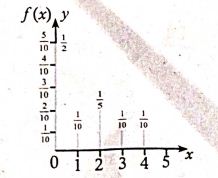
(ii) p(x < 3) = p(x = 0) + p(x = 1) + p(x = 2)
= \(\frac { 1 }{ 2 } +\frac { 1 }{ 10 } +\frac { 1 }{ 5 } =\frac { 5+1+2 }{ 10 } =\frac { 8 }{ 10 } \)
= \(\frac { 4 }{ 5 } \)
(iii) p(x≥2) = p(x = 2) + p(x = 3) + p(x = 4)
= \(\frac { 1 }{ 5 } +\frac { 1 }{ 10 } +\frac { 1 }{ 10 } =\frac { 2+1+1 }{ 10 } =\frac { 4 }{ 10 } \)
= \(\frac { 2 }{ 5 } \)
24.
Given
\(\\ \\ \\ \\ \\ f(x)=\begin{cases} \begin{matrix} \frac { { x }^{ 2 }+1 }{ k } & forx=0,1,2 \end{matrix} \\ \begin{matrix} 0 & otherwise \end{matrix} \end{cases}\\ \\ \\ \\ \\ \\ \)
The random variable X take the values 0, 1, 2.
Probability mass function.
| x | 0 | 1 | 2 |
| f(x) | \(\cfrac { 1 }{ k } \) | \(\cfrac { 2 }{ k } \) | \(\cfrac {5 }{ k } \) |
\(\sum _{ i=0 }^{ 2 }{ f(x_{ i })=1\Rightarrow f(0)+f(1)+f(2)=1 } \)
\(\Rightarrow \frac { 0+1 }{ k } +\frac { 1+1 }{ k } +\frac { 4+1 }{ k } \)
\(\Rightarrow \frac { 1 }{ k } +\frac { 2 }{ k } +\frac { 5 }{ k } =1\)
\(\Rightarrow \frac { 8 }{ k } =1\)
\(\Rightarrow k=8\)
(ii) Cumulative distribution function
| x | 0 | 1 | 2 |
| f(x) | \(\cfrac { 1 }{ 8 } \) | \(\cfrac { 2 }{ 8 } \) | 1 |
\(F(0)=P(X<0)\\P(x=0)\\ =\frac { 1 }{ 8 } \)
\(F(1)=P(X = 0)+ P(X = 1)\\
\frac { 1 }{ 8 } +\frac { 2 }{ 8 } =\frac { 3 }{ 8 } \)
\(F(2)=P(X= 0) + P(X = 1) + P(X = 2) = \frac { 1 }{ 8 } +\frac { 2 }{ 8 } +\frac { 5 }{ 8 } =1\)
Cumulative distribution function is
\(f(x)=\begin{cases} \begin{matrix} \frac { 1 }{ 8 } & for & x\le 0 \end{matrix} \\ \begin{matrix} \frac { 2 }{ 8 } +\frac { 1 }{ 8 } & for & \frac { 3 }{ 8 } forx\le 1 \end{matrix} \\ \begin{matrix} \frac { 3 }{ 8 } +\frac { 5 }{ 8 } =1 & for & x\le 2 \end{matrix} \end{cases}\)
(iii) p(x ≥ 1) = p(x = 1) + p(x = 2)
= \(\frac { 2 }{ 8 } +\frac { 5 }{ 8 } \)
\(p(x\ge 1)=\frac { 7 }{ 8 } \)
25.
Let T be the temperature of the coffee at time t
and Tm' the temperature of the kitchen.
By Newton's law of cooling
\(\frac { dT }{ dt } =K(T-{ T }_{ m })\)
\(\Rightarrow \frac { dT }{ dt } =K(T-70)\)
\(\Rightarrow \int { \frac { dT }{ T-70 } =K\int { dt } } \)
\(\Rightarrow log(T-70)=kt+logC\)
\(\Rightarrow log(T-70)-logC=Kt\)
\(\Rightarrow log\left( \frac { T-70 }{ C } \right) =Kt\)
\(\Rightarrow \frac { T-70 }{ C } ={ e }^{ Kt }\)
\(\Rightarrow T-70={ Ce }^{ Kt }...(1)\)
\(\\ When\ t=0,\ T={ 180 }^{ o }F\)
\(\therefore { 180 }^{ o }-{ 70 }^{ o }={ Ce }^{ 0 }\)
\(\Rightarrow C={ 11 }0^{ 0 }\)
\(\\ \therefore (1)\Rightarrow T-70=110{ e }^{ Kt } ..(2)\)
\(When\ t=0,T=160\)
\(\therefore 160-70=110{ e }^{ 10K }\)
\(90=110{ e }^{ 10K }\)
\(\Rightarrow { e }^{ 10K }=\frac { 9 }{ 11 } \)
\(\Rightarrow { e }^{ K }={ \left( \frac { 9 }{ 11 } \right) }^{ \frac { 1 }{ 10 } }...(3)\)
(i) when t = 15, (2) becomes,
\(\Rightarrow T-70=110{ \left( \frac { 9 }{ 11 } \right) }^{ \frac { 1 }{ 10 } \times 15 }\)
\(=110{ \left( \frac { 9 }{ 11 } \right) }^{ \frac { 3 }{ 2 } }\)
\(=110\times { \left( \frac { 9 }{ 11 } \right) }\left( \sqrt { \frac { 9 }{ 11 } } \right) \)
\(=110\times \frac { 9 }{ 11 } \times \frac { 3 }{ \sqrt { 11 } } \)
\(=\frac { 270 }{ \sqrt { 11 } } =\frac { 270 }{ 3.32 } =81.33\)
\(\Rightarrow\) T=81.33+70=151.3F
\(\therefore\) T = 151.3F
\(\therefore\) The temperature of the coffee at 10.15 am is 151.3F
(ii) when T = 130F, (2) becomes
T-70 = 110ekt ...(2)
\(\Rightarrow\) 130-70 = 110ekt
60 = 110ekt
ekt = \(\frac{6}{11}\)
\({ \left( \frac { 9 }{ 11 } \right) }^{ \frac { t }{ 10 } }=\frac { 6 }{ 11 } \)
\(\frac { t }{ 10 } =\frac { log\left( \frac { 6 }{ 11 } \right) }{ log\left( \frac { 9 }{ 11 } \right) } \)
\(=\frac { log(0.545) }{ log(0.818) } =\frac { -0.264 }{ -0.087 } \)
= 3.34
t = 30.34min
T = 140F (2)becomes
140-70 = 110ekt ...(2)
\(\Rightarrow 70={ 110e }^{ kt }\)
\({ e }^{ kt }=\frac { 7 }{ 11 } \)
\({ \left( \frac { 9 }{ 11 } \right) }^{ \frac { t }{ 10 } }=\frac { 7 }{ 11 } \)
\(\frac { t }{ 10 } =\frac { log\left( \frac { 7 }{ 11 } \right) }{ log\left( \frac { 7 }{ 11 } \right) } =\frac { -0.197 }{ -0.087 } \)
= 2.26
t = 22.6min
\(\therefore\) Between 10.22 min to 10.30 min, the woman should have drunk the coffee.
26.
Let T be the temperature of water at any time t.
Then, by Newton's law of cooling,
\(\frac { dT }{ dt } \infty (T-{ 25 }^{ o })\)
\(\Rightarrow \frac { dT }{ dt } =-\lambda (T-25)\)
\(\Rightarrow \int { \frac { dT }{ T-25 } } =-\lambda \int { dt } \)
\(\Rightarrow log(T-25)=-\lambda t+C\) ...(1)
At t = 0, T = 1000e in (1) we get
\(\therefore(1)\Rightarrow\)log75 = 0+C
\(\Rightarrow\)C = log75
\(\therefore\)(1) becomes, log (T-25) = -\(\lambda\)t + log 75
\(\Rightarrow log\left( \frac { T-25 }{ 75 } \right) =-\lambda t...(2)\)
When t = 10, T = 80oC
\(\therefore log\left( \frac { 80-25 }{ 75 } \right) =-10|\)
\(\Rightarrow log\left( \frac { 11 }{ 15 } \right) =-10\lambda \)
\(\Rightarrow \lambda =-\frac { 1 }{ 10 } log\left( \frac { 11 }{ 15 } \right) \)
Substituting \(\lambda\) in (2) we get
\(log\left( \frac { T-25 }{ 75 } \right) =\frac { 1 }{ 10 } log\left( \frac { 11 }{ 15 } \right) t ...(3)\)
\(\Rightarrow log\left( \frac { T-25 }{ 75 } \right) =\frac { 1 }{ 10 } log\left( \frac { 11 }{ 15 } \right) \times 20\)
\(={ \left( \frac { 11 }{ 15 } \right) }^{ 2 }\)
\(\Rightarrow \frac { T-25 }{ 75 } ={ \left( \frac { 11 }{ 15 } \right) }^{ 2 }\)
\(\Rightarrow T-25=\frac { 121 }{ 225 } \times 75=\frac { 121 }{ 3 } =40.33\)
\(\Rightarrow T=40.33+25\)
\(\\ =65{ .33 }^{ 0 }C\)
So the temperature of water after 20 minutes is 65.33°C
(ii) putting T = 40oC in (3) we get
\(log\left( \frac { 40-25 }{ 75 } \right) =\frac { 1 }{ 10 } log\left( \frac { 11 }{ 15 } \right) t\)
\(\Rightarrow log\left( \frac { 1 }{ 5 } \right) =\frac { 1 }{ 10 } log\left( \frac { 11 }{ 15 } \right) t\)
\(t=\frac { 10log\left( \frac { 1 }{ 5 } \right) }{ log\left( \frac { 11 }{ 15 } \right) } =\frac { -10log5 }{ log\left( \frac { 11 }{ 15 } \right) } \)
\(=\frac { -10\times 1.6094 }{ -0.3101 } \)
\(\therefore\) t = 53.46 minutes
27.
Given E = Ri + L \(\frac{di}{dt}\)
\(\frac { E }{ L } =\frac { Ri }{ L } +\frac { di }{ dt } \)
\(\Rightarrow \frac { Ri }{ L } +\frac { di }{ dt } =\frac { E }{ L } \)
This is a linear differential equation
\(Here\quad P=\frac { R }{ L } and\quad Q=\frac { E }{ L } \)
\(\therefore \int { pdt } =\int { \frac { R }{ L } dt } =\frac { R }{ L } t\)
\(\therefore I.F={ e }^{ \int { pdt } }={ e }^{ \frac { Rt }{ L } }\)
\(\therefore\) Solution is i\({ e }^{ \int { pdt } }=\int { Q{ e }^{ \int { pdt } }dt+C } \)
\(\Rightarrow i{ e }^{ \frac { Rt }{ L } }=\int { \frac { E }{ L } . } { e }^{ \frac { Rt }{ L } }dt+C\)
\(\therefore i{ e }^{ \frac { Rt }{ L } }=\frac { E }{ L } \frac { { e }^{ \frac { Rt }{ L } } }{ \frac { R }{ L } } dt+C\)
\(i=\frac { E }{ R } { e }^{ \frac { Rt }{ L } }+C\)
\(i=\frac { E }{ R } +c{ e }^{ -\frac { Rt }{ L } }\)
When E = 0,
\(i=0+c{ e }^{ -\frac { Rt }{ L } }\)
\(\Rightarrow i=c{ e }^{ -\frac { Rt }{ L } }\)
28.
Let T be the temperature of the body at any time t and with time 0 taken to be 8 p.m. By Newton’s law of cooling \(\frac { dT }{ dt } =k(T-50)or\frac { dT }{ T-50 } =dt\).
Integrating on both sides, we get log |50 −T| = kt + logC or 50 −T = Cekt.
When t = 0, T = 70, and so C = −20
When t = 2,T = 60, we have −10 = −20 ek2.
Thus, \(k=\frac { 1 }{ 2 } log\left( \frac { 1 }{ 2 } \right) \)
Hence, the solution is 50-T = -20e\(\frac{1}{2}\)tlog\((\frac{1}{2})\) or T = 50 + 20\((\frac{1}{2})^\frac{t}{2}\)
Now, we would like to find the value of t, for which T(t) = 98.6 , and t = 2\(\left( \frac { log\left( \frac { 48.6 }{ 20 } \right) }{ log\left( \frac { 1 }{ 2 } \right) } \right) \approx -2.56\)
It appears that the person was murdered at about 5.30 p.m.
29.
\(\frac { dy }{ dx } +\frac { 3y }{ x } =\frac { 1 }{ { x }^{ 2 } } \), given that y = 2 when x = 1
This is a linear differential equation.
\(\therefore P=\frac { 3 }{ x } ;Q=\frac { 1 }{ { x }^{ 2 } } \)
\(\int { pdx } =3\int { \frac { 1 }{ x } dx=3logx=log{ x }^{ 3 } } \)
\(\therefore I.F.={ e }^{ \int { pdx } }={ e }^{ log{ x }^{ 3 } }={ x }^{ 3 }\)
\(\therefore\) The solution is \({ ye }^{ \int { pdx } }=\int { Q{ e }^{ \int { pdx } }dx+c } \)
\(\Rightarrow { yx }^{ 3 }=\int { \frac { 1 }{ { x }^{ 2 } } .{ x }^{ 3 } } dx+c\)
\(\Rightarrow { yx }^{ 3 }=\int { xdx+c } \)
\(\Rightarrow { yx }^{ 3 }=\frac { { x }^{ 2 } }{ 2 } +c...(1)\)
When x = 1, y = 2
\(\Rightarrow 2{ (1) }^{ 3 }=\frac { 1 }{ 2 } +c\Rightarrow 2-\frac { 1 }{ 2 } =\frac { 3 }{ 2 } \)
\({ yx }^{ 3 }=\frac { { x }^{ 2 } }{ 2 } +\frac { 3 }{ 2 } \)
\({ 2x }^{ 3 }y={ x }^{ 2 }+3\)
30.
\( y e^{\left(\frac{1}{r}\right)} \cdot d x =\left(x e^{\frac{1}{y}}+y\right) d y \)
\(\frac{d x}{d y} =\frac{x \cdot e^{\left(\frac{6}{y}\right)}+y}{y e^{\left(\frac{x}{y}\right)}} \)
\(\frac{d x}{d y} =\left(\frac{x}{y}\right)+\frac{1}{e^{\left(\frac{6}{y}\right)}}\)
Put x = \( \mathrm{vy}\) \( \Rightarrow\left(\frac{x}{y}\right)=\mathrm{v}\) and \(\frac{d x}{d y}=\cdot v+y \cdot \frac{d v}{d y} \)
\((1) \Rightarrow \ v+y \cdot \frac{d v}{d y}=v+\frac{1}{e^y} \)
\(\mathrm{e}^v \cdot \mathrm{dv}=\frac{d y}{y}\)
Integrating on both sides,
ie) \(\int e^v \cdot d v =\int \frac{d y}{y} \)
\(e^v =\log |y|+\log |c| \)
\(e^{\left(\frac{x}{y}\right)} =\log |c y|\)
31.
Let the of the parbola be x2 = 4ay (1)
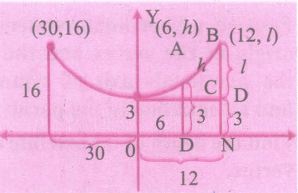
Since (30, 16) is a point on (1),
we get 302 = 4 \(\times\) a \(\times\) 16
⇒ a = \(\frac { 30\times 30 }{ 4\times 16 } =\frac { 225 }{ 16 } \)
∴ becomes, x2 = \({ x }^{ 2 }=\frac { 4\times 225 }{ 16 } y=\frac { 225 }{ 4 } y\)
Let AC = h m and BD = lm
∴ A(6, h) is a point on the parabola [∵ OD = 6]
∴ \({ 6 }^{ 2 }=\frac { 225 }{ 4 } \times h\)
⇒ \(h=\frac { 36\times 4 }{ 225 } \Rightarrow h=0.52\)
∴ AD = 3 + h = 3 + 0.52 = 3.52 m
Also (12, 1) is a point on the parabola
[∵ ON = 6 + 6 = 12]
∴ \({ 12 }^{ 2 }=\frac { 225 }{ 4 } \times l\)
⇒ l = \(\frac { 12\times 12\times 4 }{ 225 } =\frac { 576 }{ 225 } =2.08\) = 5.08 m
Hence the length of first two vertical cables are 3.52 m and 5.08 m.
32.
The parametric equation of tangent at 't1' to the parabola y2 = 4ax is yt1 = x + at12 ...(1)
Also, the parametric equation of tangent at 't2' to the parabola y = 4ax is yt2 = x+ at22 ...(2)
(1) ➝ yt1 = x + at12
(2) ➝ yt2 = x + at22
(1) - (2) y(t1 -t2) = a(t12 - t22)
.JPG)
⇒ y = a(t1 + t2)
Substitutingy = a(t1 + t2) in (1) we get,
a(t1 + t2)t1 = x + at12
.JPG)
⇒ x = at1t2
Hence, the point of intersection of two lengths is
[at1t2, a(t1 + t2)]
33.
Equation of ellipse is
x2+ 4y2 = 32
\(\frac { { x }^{ 2 } }{ 32 } + \frac { { y }^{ 2 } }{ 8 } =1\)
a2 = 32, b2 = 8
\(a=4\sqrt { 2 } ,b=2\sqrt { 2 } \)
Equation of tangent at \(\theta =\frac { \pi }{ 4 } \) is \(\frac { xcos\frac { \pi }{ 4 } }{ 4\sqrt { 2 } } \frac { ysin\frac { \pi }{ 4 } }{ 2\sqrt { 2 } } =1\)
\(\frac { x }{ 8 } +\frac { y }{ 4 } =1\)
x+2y−8 = 0.
Equation of normal is \(\frac { 4\sqrt { 2X } }{ cos\frac { \pi }{ 4 } } -\frac { 2\sqrt { 2Y } }{ sin\frac { \pi }{ 4 } } =32-8\)
That is 8x-4y = 24
2x-y-6 = 0
Aliter:
At, \(\theta =\frac { \pi }{ 4 } \)
\((a\ cos \theta ,b\ sin \theta )=\left( 4\sqrt { 2 }\ cos\frac { \pi }{ 4 } ,2\sqrt { 2 }\ sin\frac { \pi }{ 4 } \right) \)
= (4, 2)
∴ Equation of tangent at \(\theta =\frac { \pi }{ 4 } \) is same at (4, 2)
Equation of tangent in cartesian form is \(\frac { { xx }_{ 1 } }{ { a }^{ 2 } } +\frac { { yy }_{ 1 } }{ { b }^{ 2 } } =1\)
x+2y−8 = 0
Slope of tangent is -\(\frac { 1 }{ 2 } \)
Slope of normal is 2 Equation of normal is y - 2 = 2(x -4)
y−2x+6 = 0
34.
Let the equation of the circle be
x2 + y2 + 2gx + 2fy + c = 0 ........... (1)
(1) passes through (1, 0)
⇒ 1 + 0 + 2g(1) + 2f(0) + c = 0
⇒ 2g + c = -1 ................(2)
(1) passes through (-1, 0)
⇒ (-1)2 + 0 + 2g(-1) + 2f(0)+ c = 0
⇒ -2g + c = -1 ..............(3)
Also (1) passes through (0, 1)
⇒ 0 + 12+ 2g(0) +2f(1) + c = 0
⇒ 2f + c = -1 .................(4)
(2) + (3) ⇒ 2c = -2
⇒ c = -1
Substituting c = -1 in (2), we get
2g-1 = -1
⇒ 2g = 0
⇒ g = 0
Substituting c = -1 in (4) we get,
2f -1 = -1
⇒ 2f = 0
⇒ f = 0
∴ The required equation of the circle
x2 + y2 - 1 = 0
35.
(a)
esec x
36.
(d)
37.
(d)
-tan x
38.
(b)
39.
(d)
\(\left( \frac { 10 }{ 5 } \right) \left( \frac { 3 }{ 5 } \right) ^{ 5 }\left( \frac { 2 }{ 5 } \right) ^{ 5 }\)
40.
(a)
41.
(b)
2i- n, i = 0,1,2... n
42.
(d)
2
43.
(c)
\(\frac{1}{x}\)
44.
(d)
45.
(a)
46.
(a)
47.
(b)
\(\frac { { d }^{ 2 }y }{ { dx }^{ 2 } }+y=0\)
48.
(b)
circle
49.
(a)
x2 + 8y = 32
50.
(d)
9
51.
(b)
2(a2+b2)
52.
(c)
10
53.
(c)
\( \sqrt {10}\)
54.
(d)
−35 < m < 15

12th Standard Syllabus & Materials
12th Standard
TN 12th Computer Applications வலையமைப்பு வடமிடல் Sample Question Papers Study Material - QB365 Set A
NEW12th Standard
TN 12th Computer Applications களப்பெயர் முறைமை (DNS) Sample Question Papers Study Material - QB365 Set A
NEW12th Standard
TN 12th Computer Applications வலையமைப்பு எடுத்துக்காட்டுகள் மற்றும் நெறிமுறைகள் Sample Question Papers Study Material - QB365 Set A
NEW12th Standard
TN 12th Computer Applications கணினி வலையமைப்பு ஓர் அறிமுகம் Sample Question Papers Study Material - QB365 Set A



Tamilnadu Stateboard 12th Standard Subjects
Maths

Chemistry

Physics

Biology

Computer Science

Business Maths and Statistics

Economics

Commerce

Accountancy

History

Computer Applications
Biology
Computer Technology
Computer Applications
Computer Science
Business Maths and Statistics
Commerce
Economics
Maths
Chemistry
Physics
Computer Technology
History
Accountancy

Tamil

English

French
Tamilnadu Stateboard Standards


