
 100% FREE ACCESS
12th Standard Syllabus & Materials
12th Standard
TN 12th Maths Applications of Matrices and Determinants Sample Question Papers Study Material - QB365 Set A
NEW12th Standard
TN 12th Computer Applications மின்னணு தரவு பரிமாற்றம் Sample Question Papers Study Material - QB365 Set A
NEW12th Standard
TN 12th Computer Applications மின் - வணிக பாதுகாப்பு அமைப்புகள் Sample Question Papers Study Material - QB365 Set A
NEW12th Standard
TN 12th Computer Applications மின்னணு செலுத்தல் முறைகள் Sample Question Papers Study Material - QB365 Set A
NEW12th Standard
TN 12th Computer Applications மின் - வணிகம் Sample Question Papers Study Material - QB365 Set A
NEW12th Standard
TN 12th Computer Applications திறந்த மூல கருத்துருக்கள் Sample Question Papers Study Material - QB365 Set A

Published on: 04/11/2019
Application of Differential Calculus
Download Tamil Nadu 12th Standard Maths question papers, model tests, one-mark questions, important questions, and public exam papers in PDF format. Free study materials and answer keys for TN State Board students.
Questions + Answers key
Take MCQ Maths Test1.
Find the equation of the tangent and normal to the Lissajous curve given by x = 2cos 3t and y = 3sin 2t, t ∈ R
2.
Find the points of x the curve y = x3 − 3x2 + x − 2 at which the tangent is parallel to the line y = x
3.
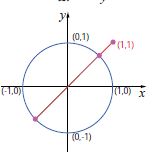
Find the points on the unit circle x2 + y2 = 1 nearest and farthest from (1, 1).
4.
Prove that among all the rectangles of the given area square has the least perimeter.
5.
Find the intervals of monotonicity and local extrema of the function f(x) = x log x + 3x.
6.
Discuss the monotonicity and local extrema of the function \(f(x)=log(1+x)-\frac{x}{1+x},x>-1\) and hence find the domain where, \(log(1+x)>\frac{x}{1+x}\)
7.
Find the intervals of monotonicity and hence find the local extrema for the function \(f(x)=x^{\frac{2}{3}}\).
8.
Expand tan x in ascending powers of x upto 5th power for \(-\frac{\pi}{2} <x<\frac{\pi}{2}\)
9.
Expand log(1+ x) as a Maclaurin’s series upto 4 non-zero terms for –1 < x ≤ 1.
10.
Find the intervals of monotonicity and hence find the local extrema for the function f(x) = x2 − 4x + 4
1.
Observe that the given curve is neither a circle nor an ellipse. For your reference the curve is shown in Figure.
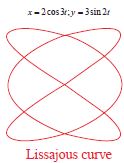
Now, \(\frac{dy}{dx}=\frac{\frac{dy}{dt} }{\frac{dx}{dt} } \)
= -\(\frac{6 cos2t}{6sin3t} = -\frac{cos2t}{sin3t} \).
Therefore, the tangent at any point is
\(y-3sin2t= -\frac{cos2t}{sin3t}(x-2cos3t)\)
That is, x cos 2t + y sin 3t = 3sin 2t sin 3t + 2cos 2t cos 3t.
The slope of the normal is the negative of the reciprocal of the tangent which in this case is \(\frac{sin3t}{cos2t}\). Hence, the equation of the normal is \(y-3sin2t=\frac{sin3t}{cos2t}(x-2cos3t)\).
That is, x sin 3t - y cos 2t = 2sin 3t cos3t 3sin 2t cos 2t = sin 6t - \(\frac{3}{2}\) sin 4t.
2.
The slope of the line y = x is 1. The tangent to the given curve will be parallel to the line, if the slope of the tangent to the curve at a point is also 1. Hence,
\(\frac{dy}{dx}=3x^{2}-6x+1=1\)
which gives \( 3x^{2}-6x=0\)
Hence, x = 0 and x = 2.
Therefore, at (0, –2) and (2, –4) the tangent is parallel to the line y = x.
3.
The distance from the point (1, 1) to any point (x, y) is d =\(\sqrt { { \left( x-1 \right) }^{ 2 }+{ \left( y-1 \right) }^{ 2 } } \). Instead of extremising d, for convenience we extremise D = d2 = (x−1)2+ (y− 1)2 subject to the condition, x2 + y2 = 1 Now, \(\frac { dD }{ dx } \) = 2( x −1)+2(y −1) \(\times\) \(\frac { dy }{ dx } \) where the \(\frac { dy }{ dx } \) will be computed by differentiating x2 y2 + = 1 with respect to x . Therefore we get, 2x + 2y \(\frac { dy }{ dx } \) = 0 which gives \(\frac { dy }{ dx } \) = -\(\frac { x }{ y } \)
Substituting this, we get \(\frac { dD }{ dx } \) = 2(x −1) +2(y −1)\(\left(- \frac { x }{ y } \right) \)
= \(\frac { 2\left[ xy-y-xy+x \right] }{ y } \)
Substituting this, we get \(\frac { dD }{ dx } \) =2\(\left[ \frac { x-y }{ y } \right] \)=0
⇒x = y
Since (x, y) lie on the circle x2 + y2 + =1 we get, 2x2 = 1 gives x = 土\(\frac { 1 }{ \sqrt { 2 } } \).
Hence the points at which the extremum distance occur are \(\left( \frac { 1 }{ \sqrt { 2 } } ,\frac { 1 }{ \sqrt { 2 } } \right) \), \(\left( -\frac { 1 }{ \sqrt { 2 } } ,-\frac { 1 }{ \sqrt { 2 } } \right) \)
To find the extrema, we apply second derivative test. So,
\(\frac { { d }^{ 2 }D }{ { dx }^{ 2 } } =2\frac { { y }^{ 2 }+{ x }^{ 2 } }{ { y }^{ 3 } } \)
The value of \({ \left( \frac { { d }^{ 2 }D }{ { dx }^{ 2 } } \right) }_{ \left( \frac { 1 }{ \sqrt { 2 } } ,\frac { 1 }{ \sqrt { 2 } } \right) }>0;{ \left( \frac { { d }^{ 2 }D }{ { dx }^{ 2 } } \right) }_{ \left( -\frac { 1 }{ \sqrt { 2 } } ,-\frac { 1 }{ \sqrt { 2 } } \right) }<0\)
This implies the nearest and farthest points are \(\left( \frac { 1 }{ \sqrt { 2 } } ,\frac { 1 }{ \sqrt { 2 } } \right) \) and \(\left( -\frac { 1 }{ \sqrt { 2 } } ,-\frac { 1 }{ \sqrt { 2 } } \right) \)
Therefore, the nearest and the farthest distances are respectively \(\sqrt { 2 } \)-1 and \(\sqrt { 2 } \)+1
4.
Let x, y be the sides of the rectangle. Hence the area of the rectangle is xy = k (given). The perimeter of the rectangle P is 2(x+ y). So the problem is to minimize 2(x+ y) suject to the condition xy = k. Let \(P(x)=2\left( x+\frac { k }{ x } \right) \)
\(P'(x)=2\left( 1-\frac { k }{ { x }^{ 2 } } \right) \)
P'(x) = 0 gives \(\left( 1-\frac { k }{ { x }^{ 2 } } \right) =0\)
As x, y are sides of the rectangle, \(x=\sqrt { k } \) is a critical number.
Now, P''(x) = \(\frac{4k}{x^3}\) and P''(\(\sqrt k\)) >0 \(\Rightarrow\) p(x) and has its minimum value at \(\sqrt k\)
Substituting \(x=\sqrt { k } \) in xy = k we get \(y=\sqrt { k } \) . Therefore the minimum perimeter rectangle of a given area is a square.
5.
The given function is defined and is differentiable at all \(x \in(0, \infty)\)
f(x) = x log x + 3x.
Therefore f'(x) = log x+1+3 = 4 + log x.
The stationary points are given by 4 + log x = 0
That is x = e-4
Hence the intervals of monotonicity are (0, e-4) and \((e^{-4}, \infty)\)
At \(x=e^{-5}\in(0,e^{-4})\), f'(e-5) = -1<0 and hence in the interval (0, e-4) -the function is strictly decreasing.
At \(x=e^{-3}\in(0,e^{-4})\), f'(e-3) = 1>0 and hence strictly increasing in the interval \((e^{-4}, \infty)\).
Since f′(x) changes from negative to positive when passing through x = e−4, the first derivative test tells us there is a local minimum at x = e-4 and it is f(e-4) = -e-4.
6.
We have,
\(f(x)=log(1+x)-\frac{x}{1+x}\)
Therefore, \(f'(x)=\frac{1}{1+x}-\frac{1}{(1+x)^{2}}\)
= \(\frac{x}{(1+x)^{2}}\).
Hence, f′(x) is \(\begin{cases} <0 \ when-1
Therefore f (x) is strictly increasing for x > 0 and strictly decreasing for x < 0. Since f′(x) changes from negative to positive when passing through x = 0, the first derivative test tells us there is a local minimum at x = 0 which is f (0) = 0. Further, for x > 0, f(x) > f (0) = 0 gives
\(log(1+x)-\frac{x}{1+x}>0 \Rightarrow log(1+x)>\frac{x}{1+x}\).
7.
We have , f(x) = \(x^\frac{2}{3}\) then \(f'(x)=\frac{2}{3}x^{-\frac{1}{3}}\)\(=\frac{2}{3x^{\frac{1}{3}}}, f'(x)\ne 0 \forall x \in R\) and f'(x) does not exist at x = 0.
Therefore, there are no stationary points but there is a critical point at x = 0.
| Interval | \((-\infty,0)\) | \((0,\infty)\) |
| Sign of f'(x) | - | + |
| Monotonicity | strictly decreasing | strictly increasing |
| \(\searrow \) | ↗️ |
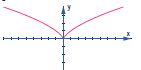
Because f'(x) changes its sign from negative to positive when passing through x = 0 for the function it has a local minimum at x = 0. The local minimum value is f(0) = 0. Note that here the local minimum occurs at a critical point which is not a stationary point.
8.
Let f (x) = tan x, then the Mclaurin series of f (x) is
\(f(x)=\sum^{n=\infty}_{n=0} a_{n}x^{n}\), where , \(a_{n}=\frac{f^{(n)}(0)}{n!}\).
Various derivative’s of the function f (x) evaluated at x = 0 is given below :
Now,
\(f'(x)=\frac{d}{dx}(tanx)=sec^{2}(x)\)
\(f''(x)=\frac{d}{dx}sec^{2}(x))=2sec x.sec x.tan x= 2sec^{2}x.tanx\)
\(f'''(x)=\frac{d}{dx}(2sec^{2}(x).tan x)= 2sec^{2}(x).sec^{2}x+tan x.4secx.secx.tanx\)
=\(2sec^{4}x+4sec^{2}x.tan^{2}x\)
\(f^{(iv)}(x)=8sec^{3}(x).secx+tan x+4sec^{2}x.2tanx sec^{2}x+8secx.secx.tanx.tan^{2}x\)
=\(16sec^{4}xtanx+8sec^{2}x.tan^{3}x\)
\(f^{(v)}(x)=16sec^{4}x.sec^{2}x+64sec^{3}x.sec x.tan x.tan x+8 sec^{2}x.3tan^{2}x.sec^{2}x+16secx.secx.tanx.tan^{3}x\)
=\(16sec^{6}x+88sec^{4}x.tan^{2}x+16sec^{2}x.tan^{4}x\).
| Function and its derivatives | tan x and its derivatives | value at x = 0 |
| f(x) | tan x | 0 |
| f'(x) | sec2x | 1 |
| f''(x) | 2sec2x tanx | 0 |
| f'''(x) | 2sec4x+4sec2x.tan2x | 2 |
| f(iv)(x) | 16sec4x.tanx+8sec2x.tan3x | 0 |
| f(v)(x) | 16sec6x+88sec4x.tan2x+16sec2x.tan4x | 16 |
Substituting the values and on simplification we get the required expansion of the function as
\(tan x=x+\frac{1}{3}x^{3}+\frac{2}{15}x^{5}+...; -\frac{\pi}{2}
9.
Let f(x) = log(1+x) then the Maclaurin series of f (x) is f (x) \(\sum _{ n=0 }^{ n=\infty }{ { a }_{ n }{ x }^{ n } } \) where, \(a_{n}=\frac{f^{n}(0)}{n!}\) f(x) various derivatives of the function f(x) evaluated at x = 0 are given below:
| Function and its derivatives |
log(1+ x) and its derivatives |
value at x = 0 |
| f(x) | log(1+x) | 0 |
| f'(x) | \(\frac{1}{1+x}\) | 1 |
| f''(x) | \(-\frac{1}{(1+x)^{2}}\) | -1 |
| f'''(x) | \(\frac{2}{(1+x)^{3}}\) | 2 |
| f(iv)(x) | \(-\frac{6}{(1+x)^{4}}\) | -6 |
Substituting the values and on simplification we get the required expansion of the function given by,
\((log(1+x)=x-\frac{x^{2}}{2}+\frac{x^{3}}{3}+\frac{x^{4}}{4}+... -1\)
10.
We have,
f(x) = (x-2)2, then
\(f'(x)=2(x-2)=0 \) gives x = 2.
The intervals of monotonicity are \((-\infty,2)\) and \((2,\infty)\)
Since \(f'(x)<0, \forall x \in (-\infty,2)\) for \((-\infty,2)\) the f(x) is strictly decreasing on \((2,\infty)\)
As \(f'(x)>0, \) for \(x \in(2, \infty)\) the function f(x) is strictly increasing on \((2,\infty)\)
Becasue f'(x) changes its sign from negative to positive when passing through x = 2 for the function f(x) it has a local minimum at x = 2
The local minimum value is f(2) = 0.

12th Standard Syllabus & Materials
12th Standard
TN 12th Computer Applications வலையமைப்பு வடமிடல் Sample Question Papers Study Material - QB365 Set A
NEW12th Standard
TN 12th Computer Applications களப்பெயர் முறைமை (DNS) Sample Question Papers Study Material - QB365 Set A
NEW12th Standard
TN 12th Computer Applications வலையமைப்பு எடுத்துக்காட்டுகள் மற்றும் நெறிமுறைகள் Sample Question Papers Study Material - QB365 Set A
NEW12th Standard
TN 12th Computer Applications கணினி வலையமைப்பு ஓர் அறிமுகம் Sample Question Papers Study Material - QB365 Set A



Tamilnadu Stateboard 12th Standard Subjects
Maths

Chemistry

Physics

Biology

Computer Science

Business Maths and Statistics

Economics

Commerce

Accountancy

History

Computer Applications
Biology
Computer Technology
Computer Applications
Computer Science
Business Maths and Statistics
Commerce
Economics
Maths
Chemistry
Physics
Computer Technology
History
Accountancy

Tamil

English

French
Tamilnadu Stateboard Standards

