
 100% FREE ACCESS
12th Standard Syllabus & Materials
12th Standard
TN 12th Maths Applications of Matrices and Determinants Sample Question Papers Study Material - QB365 Set A
NEW12th Standard
TN 12th Computer Applications மின்னணு தரவு பரிமாற்றம் Sample Question Papers Study Material - QB365 Set A
NEW12th Standard
TN 12th Computer Applications மின் - வணிக பாதுகாப்பு அமைப்புகள் Sample Question Papers Study Material - QB365 Set A
NEW12th Standard
TN 12th Computer Applications மின்னணு செலுத்தல் முறைகள் Sample Question Papers Study Material - QB365 Set A
NEW12th Standard
TN 12th Computer Applications மின் - வணிகம் Sample Question Papers Study Material - QB365 Set A
NEW12th Standard
TN 12th Computer Applications திறந்த மூல கருத்துருக்கள் Sample Question Papers Study Material - QB365 Set A

Published on: 06/01/2020
Application of Differential Calculus
Download Tamil Nadu 12th Standard Maths question papers, model tests, one-mark questions, important questions, and public exam papers in PDF format. Free study materials and answer keys for TN State Board students.
Questions + Answers key
Take MCQ Maths Test1.
The ends of a rod AB which is 5 m long moves along two grooves OX, OY which at the right angles. If A moves at a constant speed of \(\frac { 1 }{ 2 } \) m/sec, what is the speed of B, when it is 4m from O?
2.
Find the equation of normal to the cure y = sin2x at \(\left( \frac { \pi }{ 3 } ,\frac { 3 }{ 4 } \right) \).
3.
Prove that \(\frac { x }{ 1+x } \) < < log (1+ x) for x > 0.
4.
Find the values in the interval \((\frac{1}{2},2)\) satisfied by the Rolle's theorem for the function \(f(x)=x+\frac{1}{x}, x\in[\frac{1}{2},2]\)
5.
Find the point on the curve y = x2 − 5x + 4 at which the tangent is parallel to the line 3x + y = 7.
6.
A particle moves along a straight line in such a way that after t seconds its distance from the origin is s = 2t2 + 3t metres.
7.
A point moves along a straight line in such a way that after t seconds its distance from the origin is s = 2t2 + 3t metres.
(i) Find the average velocity of the points between t = 3 and t = 6 seconds.
(ii) Find the instantaneous velocities at t = 3 and t = 6 seconds.
8.
Prove that the semi-vertical angle of a cone of maximum volume and of given slant height is tan-1(\(\sqrt { 2 } \)).
9.
If f(x) = a log x + bx2+ x has entreme values at x = - 1 and x = 2, then find a and b.
10.
A particle moves along a line according to the law s(t) = 2t3 − 9t2 +12t − 4, where t ≥ 0.
11.
A particle moves along a line according to the law s(t) = 2t3 − 9t2 +12t − 4, where t ≥ 0.
12.
Find the intervals of increasing and decreasing function for f(x) = x3 + 2x2 - 1.
13.
A particle moves in a line so that x =\(\sqrt { t } \). Show that the acceleration is negative and proportional to the cube of the velocity.
14.
A stone is dropped into a pond causing ripples in the form of concentric circles. The radius r of the outer ripple is increasing at a constant rate at 2 cm per second. When the radius is 5 cm find the rate of changing of the total area of the disturbed water?
15.
The value of \(\underset { x\rightarrow \infty }{ lim } { e }^{ -x }\) is __________
0
∞
e
\(\frac{1}{e}\)
16.
The point on the curve y = x2 is the tangent parallel to X-axis is __________
(1, 1)
(2, 2)
(4, 4)
(0, 0)
17.
The number given by the Mean value theorem for the function \(\frac { 1 }{ x } \), x ∈ [1, 9] is
2
2.5
3
3.5
18.
The tangent to the curve y2 - xy + 9 = 0 is vertical when
y = 0
\(\\ \\ y=\pm \sqrt { 3 } \)
\(y=\frac { 1 }{ 2 } \)
\(y=\pm 3\)
19.
1.
Let OA = x m, OB = y m
Then x2 + y2 = 25
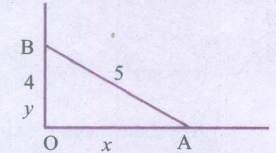
Differentiating, \(2x\frac { dx }{ dt } +2y\frac { dy }{ dt } \) = 0
⇒ \(\frac { dy }{ dx } =-\frac { x }{ y } \frac { dx }{ dt } \)
When \(\frac { dx }{ dt } =\frac { 1 }{ 2 } ,\frac { dy }{ dt } =\frac { -x }{ 2y } \)
When y = 4, x2 = 25-y2
⇒ x =\(\sqrt { 25-16 } \) = 3
Thus \(\frac { dy }{ dt } =-\frac { 3 }{ 2\times 4 } =\frac { -3 }{ 8 } \).
2.
y = sin2x
\(\frac { dy }{ dx } \) = 2 sin x cos x = sin 2x
∴ m = \(\left( \frac { dy }{ dx } \right) _{ \left( \frac { \pi }{ 3 } ,\frac { 3 }{ 4 } \right) }=sin\frac { 2\pi }{ 3 } =\frac { \sqrt { 3 } }{ 2 } \)
∴ Slope of the normal = \(-\frac { 1 }{ m } =-\frac { 2 }{ \sqrt { 3 } } \)
∴ Equation of normal is y-y1 = \(-\frac { 1 }{ m } \)(x-x1)
⇒ \(y-\frac { 3 }{ 4 } =-\frac { 2 }{ \sqrt { 3 } } \left( x-\frac { \pi }{ 3 } \right) \)
⇒ 12\(\sqrt { 3 } \)y-9\(\sqrt { 3 } \) = -24x + 8π [ multiply 12\(\sqrt { 3 } \)]
∴ 24x + 12\(\sqrt { 3 } \)y = 8π + 9\(\sqrt { 3 } \).
3.
Let f(x) = log(1+x)-\(\frac { x }{ 1+x } \)
f'(x) =\(\frac { 1 }{ 1+x } -\frac { (1+x)-x }{ (1+x)^{ 2 } } \)
=\(\frac { 1 }{ 1+x } -\frac { 1 }{ (1+x)^{ 2 } } \)
=\(\frac { x }{ (1+x)^{ 2 } } \) > 0 for x>0
∴ f(x) is strictly increasing in (0, ∞)
∴ x>0 ⇒ f(x) > f(0)
⇒ log (1+x) - \(\frac { x }{ 1+x } \) >0
⇒ log(1+x) > \(\frac { x }{ 1+x } \)
⇒ \(\frac { x }{ 1+x } \) < log (1+x).
4.
We have, f (x) is continuous in \([\frac{1}{2},2 ]\) and differentiable in \((\frac{1}{2},2 )\) with \(f(\frac{1}{2})=\frac{5}{2}=f(2) \).
By the Rolle’s theorem there must exist a \(c \in (\frac{1}{2},2 )\) such that, \(f'(c)=1-\frac{1}{c^{2}}=0 \Rightarrow c^{2}=1 \) gives \(\Rightarrow c=\pm1, \) As \(1\in(\frac{1}{2},2)\) we choose c = 1.
5.
Given curve is y = x2 − 5x + 4 and the line is 3x + y = 7
Slope of the tangent to the curve
\({ m }_{ 1 }=\frac { dx }{ dt } \) = 2x - 5
Slope of the line = \({ m }_{ 2}=\frac { dx }{ dt } \) = -3
\(\left[ \because m=\frac { co-efficient \ of \ x }{ co-efficient \ of \ y } \right] \)
Since the tangent of the curve and the lines are parallel, their slopes are equal.
∴ m1 = m2
⇒ 2x - 5 = -3
⇒ 2x = 2
⇒ x = 1
Substituting x = 1 in y = x2 - 5x + 4 we get
y = 12-5(1)+4 = 0
∴ The required point is (1, 0).
6.
7.
Given s = 2t2 + 3t
s(3) = 2 \(\times\) 32 + 3 (3)
= 2\(\times\)9+9
= 27 m ....(1)
s(6) = 2\(\times\) 62 + 3 (6)
= 72 + 18 = 90m ... (2)
Average velocity = \(\frac { s(6)-s(3) }{ 6-3 } \)
= \(\frac { 90-27 }{ 3 } \) = 21 m/s
(ii) Instantaneous Velocity V(t) = \(\frac { ds }{ dt } \)
Instantaneous Velocity at t = 3
= V(3) = 15 m/sec
Instantaneous Velocity at t = 6
= V(6) = 27m/sec
8.
Let r be the radius of the base, h be the height of the cone, I be the slant height and θ be the semi vertical angle.
In ΔOAB l2 = h2+r2
⇒ r2 =l2-h2
⇒ V =\(\frac { 1 }{ 3 } { \pi }r^{ 2 }h=\frac { \pi }{ 3 } \)(l2-h2)h
=\(\frac { \pi }{ 3 } \) (l2h - h3)
\(\frac { dv }{ dh } =\frac { \pi }{ 3 } \)(l2-3h2)
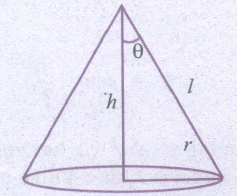
\(\frac { dv }{ dh } \)=0
⇒ \(\frac { \pi }{ 3 } \)(l2 - 3h2) = 0
⇒ l2 - 3h2 = 0 ⇒ \(\frac { { l }^{ 2 } }{ { h }^{ 2 } } \) =3
⇒ \(\frac { l }{ h } \) = \(\sqrt { 3 } \) ⇒ h=\(\frac { 1 }{ \sqrt { 3 } } \)
Now, \(\frac { d^{ 2 }V }{ dh^{ 2 } } =\frac { \pi }{ 3 } \)(-6h) = -2πh
at h =\(\frac { l }{ \sqrt { 3 } } ,\frac { d^{ 2 }V }{ dh^{ 2 } } =-2\pi \left( \frac { l }{ \sqrt { 3 } } \right) \) < 0
V is max at h =\(\frac { l }{ \sqrt { 3 } } \)
∴ r2 =l2-\(\frac { { l }^{ 2 } }{ 3 } =\frac { 2{ l }^{ 2 } }{ 3 } \) =2h2
\(\\ \left[ \because h=\frac { l }{ \sqrt { 3 } } \Rightarrow h^{ 2 }=\frac { { l }^{ 2 } }{ 3 } \right] \)
∴ \(\frac { { r }^{ 2 } }{ { h }^{ 2 } } \) =2
⇒ \(\frac { r }{ h } =\sqrt { 2 } \)
⇒ tanθ =\(\sqrt { 2 } \)
⇒ θ = tan-1(\(\sqrt { 2 } \))
9.
f(x) = a log x + bx2 + x
f'(x) = \(\frac { a }{ x } \) + 2bx +1
Since f (x) has extreme values at x = -1 and x = 2,
f'(-1) = 0 and f'(2) = 0
f'(-1) = 0
⇒ -a - 2b + 1 = 0.....(1)
f'(2) = 0
⇒ \(\frac { a }{ 2 } \) + 4b + 1 = 0
⇒ a + 8b + 2 = 0....(2)
(1) + (2) ⟶
6b + 3 = 0
⇒ b = \(\frac { -1 }{ 2 } \)
Substituting b = \(\frac { -1 }{ 2 } \) in (1) ⇒ -a - 2\(\left( -\frac { 1 }{ 2 } \right) \)+1 = 0
⇒ -a + 1 + 1 = 0
⇒ a = 2
∴ a = 2, b = \(\frac { -1 }{ 2 } \)
10.
11.
Given s (t) = 2t3 − 9t2 + 12t ≥ 0
12.
f(x) = x3+ 2x2-1
f'(x) = 3x2 + 4x = 0
⇒ x (3x + 4) = 0
⇒ x = 0 or \(\frac { 4 }{ 3 } \)
The possible intervals are \(\left( -\infty ,-\frac { 4 }{ 3 } \right) \left( -\frac { 4 }{ 3 } ,0 \right) \) and (0, ∞).
| Interval | \(\left( -\infty ,-\frac { 4 }{ 3 } \right) \) | \(\left( -\frac { 4 }{ 3 } ,0 \right) \) | (0, ∞) |
| Sign of f'(x) | Say x = -2 3(-2)2+4(-2) = 4 +ve |
say x = -1 3(-1)2+4(-1) = -1 -ve |
say x = 1 3(1)2+4(1) = 7 +ve |
| Monotonicity | Strictly increasing | Strictly decreasing | Strictly increasing |
13.
x =\(\sqrt { t } \)
V = \(\frac { dx }{ dt } =\frac { 1 }{ 2 } t^{ -\frac { 1 }{ 2 } }\) ..(1)
Acceleration = \(\frac { { d }^{ 2 }x }{ { dt }^{ 2 } } =\frac { 1 }{ 2 } \left( -\frac { 1 }{ 2 } t^{ -\frac { 3 }{ 2 } } \right) =\frac { -t^{ -\frac { 3 }{ 2 } } }{ 4 } \)
∴ Acceleration is negative
Acceleration = \(-\frac { 1 }{ 4 } \left( { t }^{ -\frac { 1 }{ 2 } } \right) ^{ 3 }\)
= \(-2\left( \frac { 1 }{ 2 } t^{ -\frac { 1 }{ 2 } } \right) ^{ 3 }\) = 2V3 [using (1)]
Hence, acceleration is negative proportional to the cube of the velocity.
14.
Let r be the radius of the ripple and A be the area of the ripple.
GIven \(\frac { dr }{ dt } \) = 2 cm/sec and r = 5 cm ... (1)
We know A = πr2
Differentiating with respect to 't' we get,
\(\frac { dA }{ dt } \) = π(2r).\(\frac { dr }{ dt } \)
= π(2) (5) (2) [using (1)]
\(\frac { dA }{ dt } \) = 20 πsq.cm/sec.
15.
(a)
0
16.
(d)
(0, 0)
17.
(c)
3
18.
(d)
\(y=\pm 3\)
19.
(b)

12th Standard Syllabus & Materials
12th Standard
TN 12th Computer Applications வலையமைப்பு வடமிடல் Sample Question Papers Study Material - QB365 Set A
NEW12th Standard
TN 12th Computer Applications களப்பெயர் முறைமை (DNS) Sample Question Papers Study Material - QB365 Set A
NEW12th Standard
TN 12th Computer Applications வலையமைப்பு எடுத்துக்காட்டுகள் மற்றும் நெறிமுறைகள் Sample Question Papers Study Material - QB365 Set A
NEW12th Standard
TN 12th Computer Applications கணினி வலையமைப்பு ஓர் அறிமுகம் Sample Question Papers Study Material - QB365 Set A



Tamilnadu Stateboard 12th Standard Subjects
Maths

Chemistry

Physics

Biology

Computer Science

Business Maths and Statistics

Economics

Commerce

Accountancy

History

Computer Applications
Biology
Computer Technology
Computer Applications
Computer Science
Business Maths and Statistics
Commerce
Economics
Maths
Chemistry
Physics
Computer Technology
History
Accountancy

Tamil

English

French
Tamilnadu Stateboard Standards

