
 100% FREE ACCESS
12th Standard Syllabus & Materials
12th Standard
TN 12th Computer Applications மின்னணு தரவு பரிமாற்றம் Sample Question Papers Study Material - QB365 Set A
NEW12th Standard
TN 12th Computer Applications மின் - வணிக பாதுகாப்பு அமைப்புகள் Sample Question Papers Study Material - QB365 Set A
NEW12th Standard
TN 12th Computer Applications மின்னணு செலுத்தல் முறைகள் Sample Question Papers Study Material - QB365 Set A
NEW12th Standard
TN 12th Computer Applications மின் - வணிகம் Sample Question Papers Study Material - QB365 Set A
NEW12th Standard
TN 12th Computer Applications திறந்த மூல கருத்துருக்கள் Sample Question Papers Study Material - QB365 Set A
NEW12th Standard
TN 12th Computer Applications வலையமைப்பு வடமிடல் Sample Question Papers Study Material - QB365 Set A

Published on: 03/12/2019
Application of Differential Calculus
Download Tamil Nadu 12th Standard Maths question papers, model tests, one-mark questions, important questions, and public exam papers in PDF format. Free study materials and answer keys for TN State Board students.
Questions + Answers key
Take MCQ Maths Test1.
Find the intervals of increasing and decreasing function for f(x) = x3 + 2x2 - 1.
2.
Find the maximum and minimum values of f(x) = |x+3| ∀ \(x\in R\).
3.
A particle is fired straight up from the ground to reach a height of s feet in t seconds, where s(t) = 128t −16t2.
(1) Compute the maximum height of the particle reached.
(2) What is the velocity when the particle hits the ground?
4.
If the curves ax2+ by2 = 1 and cx2+ dy2 = 1 intersect each other orthogonally then, \(\frac{1}{a}-\frac{1}{b}=\frac{1}{c}-\frac{1}{d}\)
5.
A particle moves along a line according to the law s(t) = 2t3 − 9t2 +12t − 4, where t ≥ 0.
(i) At what times the particle changes direction?
(ii) Find the total distance travelled by the particle in the first 4 seconds.
(iii) Find the particle’s acceleration each time the velocity is zero.
6.
A camera is accidentally knocked off an edge of a cliff 400 ft high. The camera falls a distance of s =16t2 in t seconds
7.
If we blow air into a balloon of spherical shape at a rate of 1000 cm3 per second. At what rate the radius of the baloon changes when the radius is 7cm? Also compute the rate at which the surface area changes.
8.
Verify LMV theorem for f(x) = x3 - 2x2 - x + 3 in [0, 1].
9.
Find the equation of normal to the cure y = sin2x at \(\left( \frac { \pi }{ 3 } ,\frac { 3 }{ 4 } \right) \).
10.
Find the local extrema for the following function using second derivative test:
f(x) = x2 e-2x
11.
Prove using the Rolle’s theorem that between any two distinct real zeros of the polynomial \(a_{n}x^{n}+a_{n-1}x^{n-1}+...+a_{1}x+a_{0}\) there is a zero of the polynomial \(na_{n}x^{n-1}+(n-1)a_{n-1}x^{n-2}+...+a_{1}\)
12.
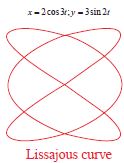
Find the equation of the tangent and normal to the Lissajous curve given by x = 2cos 3t and y = 3sin 2t, t ∈ R
13.
The equation of the tangent to the curve y = x2-4x+2 at (4, 2) is __________
x + 4y + 12 = 0
4x + y + 12 = 0
4x - y - 14 = 0
x + 4y - 12 = 0
14.
The point on the curve y = x2 is the tangent parallel to X-axis is __________
(1, 1)
(2, 2)
(4, 4)
(0, 0)
15.
The slope of the line normal to the curve f(x) = 2cos 4x at \(x=\cfrac { \pi }{ 12 } \) is
\(-4\sqrt { 3 } \)
-4
\(\cfrac { \sqrt { 3 } }{ 12 } \)
\(4\sqrt { 3 } \)
16.
The abscissa of the point on the curve \(f\left( x \right) =\sqrt { 8-2x } \) at which the slope of the tangent is -0.25 ?
-8
-4
-2
0
17.
The point on the curve 6y = x3 + 2 at which y-coordinate changes 8 times as fast as x-coordinate is
(4, 11)
(4, -11)
(-4, 11)
(-4,-11)
1.
f(x) = x3+ 2x2-1
f'(x) = 3x2 + 4x = 0
⇒ x (3x + 4) = 0
⇒ x = 0 or \(\frac { 4 }{ 3 } \)
The possible intervals are \(\left( -\infty ,-\frac { 4 }{ 3 } \right) \left( -\frac { 4 }{ 3 } ,0 \right) \) and (0, ∞).
| Interval | \(\left( -\infty ,-\frac { 4 }{ 3 } \right) \) | \(\left( -\frac { 4 }{ 3 } ,0 \right) \) | (0, ∞) |
| Sign of f'(x) | Say x = -2 3(-2)2+4(-2) = 4 +ve |
say x = -1 3(-1)2+4(-1) = -1 -ve |
say x = 1 3(1)2+4(1) = 7 +ve |
| Monotonicity | Strictly increasing | Strictly decreasing | Strictly increasing |
2.
f(x) -|x+3| = ∀ \(x\in R\).
Now, |x+3| ≥ 0 ∀ \(x\in R\).
⇒ f(x) ≥ 0 ∀ \(x\in R\).
So, the minimum value of f(x) is 0
Also, f(x) = |x + 3| does not have the maximum value.
3.
(i) At the maximum height, the velocity v(t) of the particle is zero.
Now, we find the velocity of the particle at time t.
\(v(t)=\frac{ds}{dt}=128-32t\)
\(v(t)=0 \Rightarrow 128-32t=0 \Rightarrow t=4.\)
After 4 seconds, the particle reaches the maximum height.
The height at t = 4 is s(4) = 128(4) - 16(4)2 = 256 ft.
(ii) When the particle hits the ground then s = 0 .
s = 0 ⇒ 128t −16t2 = 0
⇒ t = 0, 8 seconds.
The particle hits the ground at t = 8 seconds. The velocity when it hits the ground v(8) = –128 ft /s.
4.
Let the two curves intersect at a point (x0 , y0) This leads to (a-c)x02 + (b-d)y02 = 0
Let us now find the slope of the curves at the point of intersection (x0, y0). The slopes of the curves are as follows :
For the curve ax2 + by2 = 1, \(\frac{dy}{dx}= -\frac{ax}{by}\)
For the curve cx2 + dy2 = 1, \(\frac{dy}{dx}= -\frac{cx}{by}\)
Now, two curves cut orthogonally, if the product of their slopes intersection (x0, y0) is −1. Hence, for the above two curves to cut orthogonally at (x0, y0) if
\((-\frac{ax_{0}}{by_{0}})\times(-\frac{cx_{0}}{dy_{0}})=-1\)
That is, acx02 + bdy02 = 0,
together with \((a-c)x^{2}_{0}+(b-d)y_{0}^{2}=0\)
gives, \(\frac{a-c}{ac}=\frac{b-d}{bd}\)
That is, \(\frac{1}{c}-\frac{1}{a}=\frac{1}{d}-\frac{1}{b}\).
Hence, \(\frac{1}{a}-\frac{1}{b}=\frac{1}{c}-\frac{1}{d}\).
5.
Given s (t) = 2t3 − 9t2 + 12t ≥ 0
On differentiating we get
V(t) = 6t2-18t+ 12 ... (1)
= 6 (t2 - 3t+ 2)
= 6 (t - 1) (t - 2)
Now V(t) = 0
⇒ 6 (t-1)(t- 2) = 0
⇒ t = 1, 2
The particle changes direction when V(t) changes its sign.
If 0 ≤ t < 1 then both (t - 1) and (t - 2) < 0
⇒ V(t) > 0
If 1 < t < 2 then (t -1) > 0 and (t - 2) < 0
⇒ V(t) < 0
If t > 2 then both (t - 1) and (t - 2) > 0
⇒ V(t) > 0
∴ The particle changes direction when t = 1 and t = 2 sec.
(ii) Total distance travelled by the particle in the first 4 seconds is |s(0)- s (1)| + |s (1) - s (2)| + |s (2) -s (4)|
s(0) = -4
s(1) = 2(1)3 - 9(1)2 + 12 (1) - 4
= 2 - 9 + 12 - 4 = 1
s (2) = 2 \(\times\) 23 - 9 \(\times\) 22 + 12 \(\times\) 2 - 4
= 16 - 36 + 24 - 4
= 0
s (4) = 2(4)3 - 9(4)2 + 12 (4) - 4
= 128 - 144 + 48 - 4 = 28
∴ Is (0) -s (1)|+ Is (1) -s (2)|+ Is (2) -s(4)|
= |-4 - 1| + |1 - 0| + |0 - 28|
= |-5| + |1| + |0 - 28|
= 5 + 1 + 28 = 34 m
(iii) Given s (t) = 2t3 − 9t2 + 12t ≥ 0
[acceleration = \(\frac { dv }{ dt } \)]
When t = 1,
Acceleration = 12 (1) - 18 = -6 m/sec2
When t = 2
Acceleration = 12 (2) - 18 = 6 m/sec2
6.
7.
The volume of the baloon of radius r is \(V =\frac{4}{3}\pi r ^{3} \)
We are given \(\frac{dV }{dt }=1000 \) and we need to find \(\frac{dr }{dt} \) when r = 7. Now,
\(\frac{dV}{dt}=3\times\frac{4}{3}\pi r^{2}\times \frac{dr}{dt}\)
Substituting r = 7 an \(\frac{dV}{dt}\) = 1000, we get 1000 \(= 4\pi \times 49 \times \frac{dr}{dt}\)
Hence, \(\frac{dr}{dt}=\frac{1000}{4\times49\times \pi}=\frac{250}{49\pi}\)
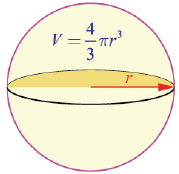
The surface area S of the baloon is S = 4ㅠr2. Therefore, \(\frac{dS}{dt}=8\pi \times r \times \frac{dr}{dt}\)
Substituting\(\frac{dr}{dt}=\frac{250}{49\pi}\) and r = 7, we get \(\frac{dS}{dt}=8\pi\times7\times \frac{250}{49\pi}=\frac{2000}{7}\)
Therefore, the rate of change of radius is \(\frac{250}{49 \pi}\) cm/sec and the change of surface area is \(\frac{2000}{7}\) cm2 / sec
8.
f(x) = x3-2x2-x+3
f'(x) = 3x2 - 4x - 1
f'(c) = 3c2 - 4c- 1
f(a) = f(0) = 3
f(b) = f(1) = 13-2-1+3 = 1
Then, if atleast one C \(\in \) (0, 1) such that f'(c) = \(\frac { f(b)-f(a) }{ b-a } \)
⇒ 3c2-4c-1 = \(\frac { 1-3 }{ 1-0 } \)
⇒ 3c2-4c+1 = 0
⇒ c = \(\frac { 4\pm \sqrt { 16-4(3) } }{ 2(3) } \)
⇒ c = \(\frac { 4\pm 2 }{ 6 } =\frac { 6 }{ 6 } \) or \(\frac { 2 }{ 6 } \)
⇒ 1 or \(\frac { 1 }{ 3 } \).
9.
y = sin2x
\(\frac { dy }{ dx } \) = 2 sin x cos x = sin 2x
∴ m = \(\left( \frac { dy }{ dx } \right) _{ \left( \frac { \pi }{ 3 } ,\frac { 3 }{ 4 } \right) }=sin\frac { 2\pi }{ 3 } =\frac { \sqrt { 3 } }{ 2 } \)
∴ Slope of the normal = \(-\frac { 1 }{ m } =-\frac { 2 }{ \sqrt { 3 } } \)
∴ Equation of normal is y-y1 = \(-\frac { 1 }{ m } \)(x-x1)
⇒ \(y-\frac { 3 }{ 4 } =-\frac { 2 }{ \sqrt { 3 } } \left( x-\frac { \pi }{ 3 } \right) \)
⇒ 12\(\sqrt { 3 } \)y-9\(\sqrt { 3 } \) = -24x + 8π [ multiply 12\(\sqrt { 3 } \)]
∴ 24x + 12\(\sqrt { 3 } \)y = 8π + 9\(\sqrt { 3 } \).
10.
f(x) = x2e-2x
f(x) = x2 e-2x
f'(x) = x2 (-2) e-2x + e-2x(2x)
f''(x) = 2xe-2x (1 -x)
f'(x) = 0
⇒ 2x e-2x(1 - x) = 0
⇒ x = 0,1
∴ The critical numbers are x = 0, 1
f"(x) = [x e-2x (-1) + x (-2)e-2x(1-x)+1e-2x(1-x)]
= 2e-2x(-x-2x+2x2+ 1-x)
= 2e-2x(2x2- 4x + 1)
f"(0) = 2(1)(1) = 2 > 0
f"(1) = 2e-2 (2 - 4 + 1)
= 2e-2 (-1)
= \(-{ 2e }^{ 2 }=\frac { -2 }{ { e }^{ 2 } } <0\)
Since f"(0) > 0, there is a local minimum at x = 0.
ஃ(0) = 02 e0 = 0
Since f"(1) < 0, there is a local maximum at x = 1.
\(\therefore f(1)={ 1 }^{ 2 }e^{ -2(1) }={ e }^{ -2 }=\frac { 1 }{ { e }^{ 2 } } \)
11.
Let P(x) = \(a_{n}x^{n}+a_{n-1}x^{n-1}+...+a_{1}x+a_{0}\). Let \(\alpha<\beta \) be two real zeros of P(x). Therefore, \(P(\alpha)=P(\beta)=0.\) Since P(x) is continuous in \([\alpha, \beta]\) and differentiable in \((\alpha, \beta)\) by an application of Rolle’s theorem there exists \(\gamma \in (\alpha,\beta)\) such that \(P'(\gamma)=0\). Since,
\(P'(x)=na_{n}x^{n-1}+(n-1)a_{n-1}x^{n-2}+...+a_{1}\) which completes the proof.
12.
Observe that the given curve is neither a circle nor an ellipse. For your reference the curve is shown in Figure.
Now, \(\frac{dy}{dx}=\frac{\frac{dy}{dt} }{\frac{dx}{dt} } \)
= -\(\frac{6 cos2t}{6sin3t} = -\frac{cos2t}{sin3t} \).
Therefore, the tangent at any point is
\(y-3sin2t= -\frac{cos2t}{sin3t}(x-2cos3t)\)
That is, x cos 2t + y sin 3t = 3sin 2t sin 3t + 2cos 2t cos 3t.
The slope of the normal is the negative of the reciprocal of the tangent which in this case is \(\frac{sin3t}{cos2t}\). Hence, the equation of the normal is \(y-3sin2t=\frac{sin3t}{cos2t}(x-2cos3t)\).
That is, x sin 3t - y cos 2t = 2sin 3t cos3t 3sin 2t cos 2t = sin 6t - \(\frac{3}{2}\) sin 4t.
13.
(c)
4x - y - 14 = 0
14.
(d)
(0, 0)
15.
Given equation of the curve is y = 1 + x3 and the line is x + 12y = 12
Slope of the tangent to the curve
m1 = \(\frac { dy }{ dx } \) = 3x2 and the
Slope of the line = m2
= \(\frac{-1}{2}\) \(\left[ \because m=\frac { co-efficient\quad of\quad x }{ co-efficient\quad of\quad y } \right] \)
Since the slope of the tangent to the curve and the line are orthogonal, m1 m2 = - 1.
∴ 3x2\(\left( \frac { -1 }{ 2 } \right) \) = -1
⇒ \(\frac{x^2}{4}\) = 1
⇒ x2 = 4
⇒ x = ±2
When x = 2, y = 1 + 23 = 9
When x = -2, y = 1+ (-2)3
= 1-8 = -7
∴ Equation of the tangent at (2, 9) is
y-9 = 12(x-2) [∵ m1 = 3x2 = 3(2)2 = 12]
∴ y - 9 = 12x - 24
∴ 12x - y = 15
Equation of the tangent at (-2, -7) is
y + 7= 12(x + 2)
⇒ y + 7 = 12x + 24
⇒ 12x - y = -17
16.
(b)
-4
17.
(a)
(4, 11)

12th Standard Syllabus & Materials
12th Standard
TN 12th Computer Applications களப்பெயர் முறைமை (DNS) Sample Question Papers Study Material - QB365 Set A
NEW12th Standard
TN 12th Computer Applications வலையமைப்பு எடுத்துக்காட்டுகள் மற்றும் நெறிமுறைகள் Sample Question Papers Study Material - QB365 Set A
NEW12th Standard
TN 12th Computer Applications கணினி வலையமைப்பு ஓர் அறிமுகம் Sample Question Papers Study Material - QB365 Set A
NEW12th Standard
TN 12th Computer Applications PHP-உடன் MySQL-ஐ இணைத்தல் Sample Question Papers Study Material - QB365 Set A



Tamilnadu Stateboard 12th Standard Subjects
Maths

Chemistry

Physics

Biology

Computer Science

Business Maths and Statistics

Economics

Commerce

Accountancy

History

Computer Applications
Biology
Computer Technology
Computer Applications
Computer Science
Business Maths and Statistics
Commerce
Economics
Maths
Chemistry
Physics
Computer Technology
History
Accountancy

Tamil

English

French
Tamilnadu Stateboard Standards

