
 100% FREE ACCESS
12th Standard Syllabus & Materials
12th Standard
TN 12th Computer Applications மின்னணு தரவு பரிமாற்றம் Sample Question Papers Study Material - QB365 Set A
NEW12th Standard
TN 12th Computer Applications மின் - வணிக பாதுகாப்பு அமைப்புகள் Sample Question Papers Study Material - QB365 Set A
NEW12th Standard
TN 12th Computer Applications மின்னணு செலுத்தல் முறைகள் Sample Question Papers Study Material - QB365 Set A
NEW12th Standard
TN 12th Computer Applications மின் - வணிகம் Sample Question Papers Study Material - QB365 Set A
NEW12th Standard
TN 12th Computer Applications திறந்த மூல கருத்துருக்கள் Sample Question Papers Study Material - QB365 Set A
NEW12th Standard
TN 12th Computer Applications வலையமைப்பு வடமிடல் Sample Question Papers Study Material - QB365 Set A

Published on: 02/01/2020
Application of Differential Calculus
Download Tamil Nadu 12th Standard Maths question papers, model tests, one-mark questions, important questions, and public exam papers in PDF format. Free study materials and answer keys for TN State Board students.
Questions + Answers key
Take MCQ Maths Test1.
Find the maximum and minimum values of f(x) = |x+3| ∀ \(x\in R\).
2.
The temperature T in celsius in a long rod of length 10 m, insulated at both ends, is a function of length x given by T = x(10 − x). Prove that the rate of change of temperature at the midpoint of the rod is zero.
3.
The ends of a rod AB which is 5 m long moves along two grooves OX, OY which at the right angles. If A moves at a constant speed of \(\frac { 1 }{ 2 } \) m/sec, what is the speed of B, when it is 4m from O?
4.
Find the absolute maximum and absolute minimum values of the function f (x) = 2x3 + 3x2 −12x on [−3, 2]
5.
Find the tangent and normal to the following curves at the given points on the curve
y = x sin x at \(\left( \frac { \pi }{ 2 } ,\frac { \pi }{ 2 } \right) \)
6.
A particle moves so that the distance moved is according to the law s(t) = \(s(t)=\frac{t^{3}}{3}-t^{2}+3\). At what time the velocity and acceleration are zero.
7.
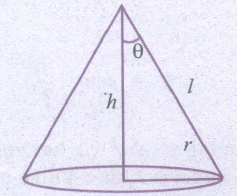
Prove that the semi-vertical angle of a cone of maximum volume and of given slant height is tan-1(\(\sqrt { 2 } \)).
8.
9.
A road running north to south crosses a road going east to west at the point P. Car A is driving north along the first road, and car B is driving east along the second road. At a particular time car A 10 kilometres to the north of P and traveling at 80 km/hr, while car B is 15 kilometres to the east of P and traveling at 100 km/hr. How fast is the distance between the two cars changing?
10.
A particle moves along a horizontal line such that its position at any time t ≥ 0 is given by s(t) = t3 − 6t2 +9 t +1, where s is measured in metres and t in seconds?
(1) At what time the particle is at rest?
(2) At what time the particle changes its direction?
(3) Find the total distance travelled by the particle in the first 2 seconds.
11.
The statement "If f has a local extremum at c and if f'(c) exists then f'(c) = 0" is ________
the extreme value theorem
Fermat's theorem
Law of mean
Rolle's theorem
12.
The critical points of the function f(x) = \((x-2)^{ \frac { 2 }{ 3 } }(2x+1)\) are __________
-1, 2
1, \(\frac { 1 }{ 2 } \)
1, 2
none
13.
One of the closest points on the curve x2 - y2 = 4 to the point (6, 0) is
(2,0)
\(\left( \sqrt { 5 } ,1 \right) \)
\(\left( 3,\sqrt { 5 } \right) \)
\(\left( \sqrt { 13 } ,-\sqrt { 3 } \right) \)
14.
The function sin4 x + cos4 x is increasing in the interval
\(\left[ \frac { 5\pi }{ 8 } ,\frac { 3\pi }{ 4 } \right] \)
\(\left[ \frac { \pi }{ 2 } ,\frac { 5\pi }{ 8 } \right] \)
\(\left[ \frac { \pi }{ 4 } ,\frac { \pi }{ 2 } \right] \)
\(\left[ 0,\frac { \pi }{ 4 } \right] \)
15.
The point on the curve 6y = x3 + 2 at which y-coordinate changes 8 times as fast as x-coordinate is
(4, 11)
(4, -11)
(-4, 11)
(-4,-11)
16.
Which of the following statement is incorrect?
(1) Initial velocity means velocity at t = 0.
(2) Initial acceleration means, acceleration at t = 0.
(3) If the motion is upward, at the maximum height the velocity is not zero.
(4) If the motion is horizontal, u = 0 when the particle comes to rest.
1.
f(x) -|x+3| = ∀ \(x\in R\).
Now, |x+3| ≥ 0 ∀ \(x\in R\).
⇒ f(x) ≥ 0 ∀ \(x\in R\).
So, the minimum value of f(x) is 0
Also, f(x) = |x + 3| does not have the maximum value.
2.
We are given that, T = 10x − x2
Hence, the rate of change at any distance from one end is given by \(\frac{dT}{dx}=10-2x \)
The mid point of the rod is at x = 5
Substituting x = 5, we get \(\frac{dT}{dx}=0\)
3.
Let OA = x m, OB = y m
Then x2 + y2 = 25
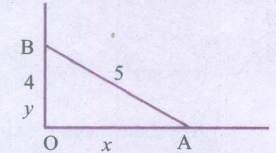
Differentiating, \(2x\frac { dx }{ dt } +2y\frac { dy }{ dt } \) = 0
⇒ \(\frac { dy }{ dx } =-\frac { x }{ y } \frac { dx }{ dt } \)
When \(\frac { dx }{ dt } =\frac { 1 }{ 2 } ,\frac { dy }{ dt } =\frac { -x }{ 2y } \)
When y = 4, x2 = 25-y2
⇒ x =\(\sqrt { 25-16 } \) = 3
Thus \(\frac { dy }{ dt } =-\frac { 3 }{ 2\times 4 } =\frac { -3 }{ 8 } \).
4.
Differentiating the given function, we get
f'(x) = 6x2 + 6x -12
= 6(x2 + x - 2)
f'(x) = 6(x + 2)(x + 1)
Thus, f'(x) = 0 \(\Rightarrow\) x = -2, 1 \(\in\) (-3, 2).
Therefore, the critical numbers are, x = -2, 1. Evaluating f(x) at the endpoints x = -3, 2 and at critical numbers x = -2,1 we get f(-3) = 9, f(2) = 4, f(-2) = 20 and f(1) = -7.
From these values, the absolute maximum is 20 which occurs at, x = -2 and the absolute minimum is −7 which occurs at x = 1
5.
Equation of the given curve is y = x sin x
∴ slope = m = \(\left( \frac { dy }{ dx } \right) \)\(\left( \frac { \pi }{ 2 } ,\frac { \pi }{ 2 } \right) \)
= \(\frac { \pi }{ 2 } cos\frac { \pi }{ 2 } +sin\frac { \pi }{ 2 } \)
= \(\frac { \pi }{ 2 } \) (0) + 1 = 1
∴ Equating of the tangent is y - y1 = m (x - x1)
⇒ y - \(\frac { \pi }{ 2 } \) = 1 \(\left( x-\frac { \pi }{ 2 } \right) \)
\(\Rightarrow \frac{2 y-\pi}{\not 2}=\frac{2 x-\pi}{\not 2}\)
Equating of the normal is y - y1 = \(\frac{-1}{m}\) (x - x1)
\(\Rightarrow \frac{2 y-\pi}{\not 2}=\frac{2 x-\pi}{\not 2}\)
⇒ 2x + 2y = 2π
⇒ x + y- π = 0
6.
Distance moved in time 't' is s = \(\frac{t^{3}}{3}-t^{2}+3\)
Velocity at time 't ' is V = \(\frac{ds}{dt}=t^{2}-2t\)
Acceleration at time 't ' is a(t) = \(\frac{dV}{dt}=2t-2\)
Therefore, the velocity is zero when t2 − 2t = 0, that is t = 0, 2. The acceleration is zero when 2t − 2 = 0 . That is at time at time t = 1
7.
Let r be the radius of the base, h be the height of the cone, I be the slant height and θ be the semi vertical angle.
In ΔOAB l2 = h2+r2
⇒ r2 =l2-h2
⇒ V =\(\frac { 1 }{ 3 } { \pi }r^{ 2 }h=\frac { \pi }{ 3 } \)(l2-h2)h
=\(\frac { \pi }{ 3 } \) (l2h - h3)
\(\frac { dv }{ dh } =\frac { \pi }{ 3 } \)(l2-3h2)
\(\frac { dv }{ dh } \)=0
⇒ \(\frac { \pi }{ 3 } \)(l2 - 3h2) = 0
⇒ l2 - 3h2 = 0 ⇒ \(\frac { { l }^{ 2 } }{ { h }^{ 2 } } \) =3
⇒ \(\frac { l }{ h } \) = \(\sqrt { 3 } \) ⇒ h=\(\frac { 1 }{ \sqrt { 3 } } \)
Now, \(\frac { d^{ 2 }V }{ dh^{ 2 } } =\frac { \pi }{ 3 } \)(-6h) = -2πh
at h =\(\frac { l }{ \sqrt { 3 } } ,\frac { d^{ 2 }V }{ dh^{ 2 } } =-2\pi \left( \frac { l }{ \sqrt { 3 } } \right) \) < 0
V is max at h =\(\frac { l }{ \sqrt { 3 } } \)
∴ r2 =l2-\(\frac { { l }^{ 2 } }{ 3 } =\frac { 2{ l }^{ 2 } }{ 3 } \) =2h2
\(\\ \left[ \because h=\frac { l }{ \sqrt { 3 } } \Rightarrow h^{ 2 }=\frac { { l }^{ 2 } }{ 3 } \right] \)
∴ \(\frac { { r }^{ 2 } }{ { h }^{ 2 } } \) =2
⇒ \(\frac { r }{ h } =\sqrt { 2 } \)
⇒ tanθ =\(\sqrt { 2 } \)
⇒ θ = tan-1(\(\sqrt { 2 } \))
8.
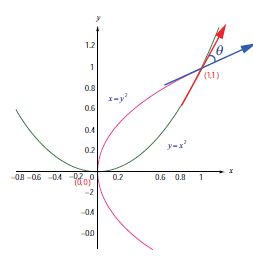
9.
Let a(t) be the distance of car A north of P at time t, and b (t) the distance of car B east of P at time t, and let c(t) be the distance from car A to car B at time t. By the Pythagorean Theorem, c(t)2 = a(t)2 + b(t)2
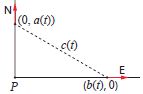
Taking derivatives, we get 2c(t)c'(t) = 2a(t)a'(t) + 2b(t)b'(t).
So, c′ = \(\frac { { aa }^{ ' }+{ bb }^{ ' } }{ c } =\frac { { aa }^{ ' }+{ bb }^{ ' } }{ \sqrt { { a }^{ 2 }+{ b }^{ 2 } } } \)
Substituting known values, we get
\(c' =\frac { (10\times 80)+(15\times 100) }{ \sqrt { { 10 }^{ 2 }+{ 15 }^{ 2 } } } =\frac { 460 }{ \sqrt { 13 } } \) ≈ 127.6 km/hr at the time of intersect
10.
Given that s(t) = t3 − 6t2 + 9t + 1. On differentiating, we get v(t) = 3t2 -12t + 9 and a(t) = 6t −12.
(i) The particle is at rest when v(t) = 0 . Therefore, v(t) = 3(t −1)(t − 3) = 0 gives t = 1 and t = 3.
(ii) The particle changes direction when v (t) changes its sign. Now.
if 0 ≤ t < 1 then both (t −1) and (t − 3) < 0 and hence, v(t) > 0.
If 1< t < 3 then (t −1) > 0 and (t − 3) < 0 and hence, v(t) < 0.
If t > 3 then both (t −1) and (t − 3) > 0 and hence, v(t) > 0.
Therefore, the particle changes direction when t = 1 and t = 3.
(iii) The total distance travelled by the particle from time t = 0 to t = 2 is given by,
|s(0) − s(1)| + |s(1) − s(2)| = |1− 5 | + | 5 − 3| = 6 metres.
11.
(b)
Fermat's theorem
12.
(c)
1, 2
13.
(c)
\(\left( 3,\sqrt { 5 } \right) \)
14.
(c)
\(\left[ \frac { \pi }{ 4 } ,\frac { \pi }{ 2 } \right] \)
15.
(a)
(4, 11)
16.
If the motion is upward, at the maximum height the velocity is not zero.

12th Standard Syllabus & Materials
12th Standard
TN 12th Computer Applications களப்பெயர் முறைமை (DNS) Sample Question Papers Study Material - QB365 Set A
NEW12th Standard
TN 12th Computer Applications வலையமைப்பு எடுத்துக்காட்டுகள் மற்றும் நெறிமுறைகள் Sample Question Papers Study Material - QB365 Set A
NEW12th Standard
TN 12th Computer Applications கணினி வலையமைப்பு ஓர் அறிமுகம் Sample Question Papers Study Material - QB365 Set A
NEW12th Standard
TN 12th Computer Applications PHP-உடன் MySQL-ஐ இணைத்தல் Sample Question Papers Study Material - QB365 Set A



Tamilnadu Stateboard 12th Standard Subjects
Maths

Chemistry

Physics

Biology

Computer Science

Business Maths and Statistics

Economics

Commerce

Accountancy

History

Computer Applications
Biology
Computer Technology
Computer Applications
Computer Science
Business Maths and Statistics
Commerce
Economics
Maths
Chemistry
Physics
Computer Technology
History
Accountancy

Tamil

English

French
Tamilnadu Stateboard Standards

