
 100% FREE ACCESS
12th Standard Syllabus & Materials
12th Standard
TN 12th Computer Applications மின்னணு தரவு பரிமாற்றம் Sample Question Papers Study Material - QB365 Set A
NEW12th Standard
TN 12th Computer Applications மின் - வணிக பாதுகாப்பு அமைப்புகள் Sample Question Papers Study Material - QB365 Set A
NEW12th Standard
TN 12th Computer Applications மின்னணு செலுத்தல் முறைகள் Sample Question Papers Study Material - QB365 Set A
NEW12th Standard
TN 12th Computer Applications மின் - வணிகம் Sample Question Papers Study Material - QB365 Set A
NEW12th Standard
TN 12th Computer Applications திறந்த மூல கருத்துருக்கள் Sample Question Papers Study Material - QB365 Set A
NEW12th Standard
TN 12th Computer Applications வலையமைப்பு வடமிடல் Sample Question Papers Study Material - QB365 Set A

Published on: 04/11/2019
Application of Differential Calculus
Download Tamil Nadu 12th Standard Maths question papers, model tests, one-mark questions, important questions, and public exam papers in PDF format. Free study materials and answer keys for TN State Board students.
Questions + Answers key
Take MCQ Maths Test1.
Sketch the graph of the function \(y=\frac { 3x }{ { x }^{ 2 }-1 } \)
2.
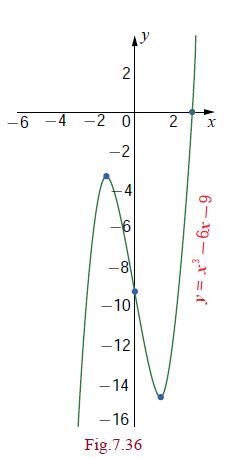
Sketch the curve y = f (x) = x3−6x-9
3.
Find the local maximum and minimum of the function x2 y2 on the line x + y = 10
4.
Find the local extremum of the function f (x) = x4 + 32x
5.
The price of a product is related to the number of units available (supply) by the equation Px + 3P −16x = 234, where P is the price of the product per unit in Rupees(Rs) and x is the number of units. Find the rate at which the price is changing with respect to time when 90 units are available and the supply is increasing at a rate of 15 units/week.
6.
A particle moves along a horizontal line such that its position at any time t ≥ 0 is given by s(t) = t3 − 6t2 +9 t +1, where s is measured in metres and t in seconds?
(1) At what time the particle is at rest?
(2) At what time the particle changes its direction?
(3) Find the total distance travelled by the particle in the first 2 seconds.
7.
For the function f(x) = x2, x∈ [0, 2] compute the average rate of changes in the subintervals [0, 0.5], [0.5, 1], [1, 1.5], [1.5, 2] and the instantaneous rate of changes at the points x = 0.5,1, 1.5, 2
8.
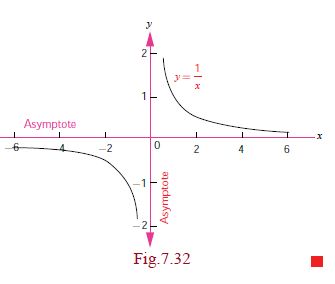
Find the asymptotes of the function f(x) = \(\frac{1}{x}\)
9.
Evaluate the limit \(\underset{x\rightarrow 0}{lim}(\frac{sin \ mx}{x})\)
10.
Compute the limit \(\underset{x\rightarrow a}{lim}(\frac{x^{n}-a^{n}}{x-a})\)
11.
The temperature T in celsius in a long rod of length 10 m, insulated at both ends, is a function of length x given by T = x(10 − x). Prove that the rate of change of temperature at the midpoint of the rod is zero.
12.
Prove, using mean value theorem, that \(|sin \alpha-sin\beta|\le |\alpha-\beta|, \alpha, \beta \in R\)
13.
Prove that there is a zero of the polynomial \(2x^{3}-9x^{2}-11x+12\) in the interval (2, 7) given that 2 and 7 are the zeros of the polynomial \(x^{4}-6x^{3}-11x^{2}+24x+28\)
14.
Without actually solving show that the equation x4+2x3-2 = 0 has only one real root in the interval (0, 1).
15.
Compute the value of 'c' satisfied by the Rolle’s theorem for the function f (x) = x2 (1 - x)2, x ∈ [0,1]
1.
(1) The domain of f (x) is R \{−1,1}.
(2) Since f (−x,−y) = f (x, y) , the curve is symmetric about the origin.
(3) Putting y = 0, we get x = 0 . Hence the x -intercept is (0, 0).
(4) Putting x = 0, we get y = 0. Hence the y -intercept is (0, 0).
(5) To determine monotonicity, we find the first derivative as \(f'(x)\frac { -3\left( { x }^{ 2 }+1 \right) }{ { ({ x }^{ 2 }-1) }^{ 2 } } \)
Hence, f'( x) does not exist at x = −1,1. Therefore, critical numbers are x = −1, 1. The intervals of monotonicity is tabulated
| Interval | (-\(\infty\), -1) | (-1, 1) | (1, \(\infty\)) |
| Sign of f'(x) | - | - | - |
| Monotonicity | strictly decreasing | strictly decreasing | strictly decreasing |
6) Since there is no sign change in f'( x) when passing through critical numbers. There is no local extrema.
(7) To determine the concavity, we find the second derivative as \(f"(x)=\frac { 6x({ x }^{ 2 }-3) }{ { ({ x }^{ 2 }-1) }^{ 3 } } \) f"( x) = 0\(\Rightarrow\) x = 0 and f"(x) does not exist at x = −1, 1.
The intervals of concavity is tabulated.
| Interval | (-\(\infty\),-1) | (-1, 0) | (0,1) | (1,\(\infty\)) |
| Sign of f'(x) | - | + | - | + |
| Concavity | concave down |
concave up | concave down |
concave up |
(8) As x = −1 and 1are not in the domain of f(x) and at x = 0, the second derivative is zero and f"(x) changes its sign from positive to negative when passing through x = 0. Therefore, the point of inflection is (0, f (0)) = (0,0) .
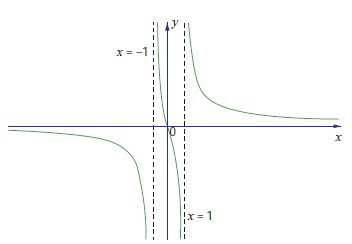
(9) \(\underset { x\rightarrow \pm \infty }{ lim } f(x)=\underset { x\rightarrow \pm }{ lim } \cfrac { 3x }{ { x }^{ 2 }-1 } =\underset { x\rightarrow \pm \infty }{ lim } \cfrac { 3 }{ x\frac { 1 }{ x } } =0\) Therefore y = 0 is a horizontal asymptote.
Since the denominator is zero, when x = 士1.\(\underset { x{ \rightarrow -1 }^{ - } }{ lim } \frac { 3x }{ { x }^{ 2 }-1 } -\infty ,\underset { x{ \rightarrow -1 }^{ + } }{ lim } \frac { 3x }{ { x }^{ 2 }-1 } =\infty ,\underset { x{ \rightarrow 1 }^{ - } }{ lim } \frac { 3x }{ { x }^{ 2 }-1 } -\infty ,\underset { x{ \rightarrow 1 }^{ + } }{ lim } \frac { 3x }{ { x }^{ 2 }-1 } =\infty .\)
Therefore x = −1 and x = 1 are vertical asymptotes.
The rough sketch of the curve is shown on the right side.
2.
Factorising the given function, we have
y = f (x) = (x − 3)(x2 + 3x + 3).
(1) The domain and the range of the given function f(x) are the entire real line.
(2) Putting y = 0, we get the x = 3. The other two roots are imaginary. Therefore, the x -intercept is (3, 0) . Putting x = 0, we get y = −9. Therefore, the y-intercept is (0, −9)
(3) f'(x) = 3(x2 -2) and hence the critical points of the curve occur at x = \(\pm \sqrt { 2 } \)
(4) f"(x) = 6x. Therefore at x =\(\sqrt{2}\) the curve has a local minimum because f"(\(\sqrt{2}\)) = 6\(\sqrt{2}\) > 0. Then local minimum is f(\(\sqrt{2}\)) = -4\(\sqrt{2}\)-9.
Similarly x = -\(\sqrt{2}\) the curve has a local maximum because f"(-\(\sqrt{2}\)) = -6\(\sqrt{2}\) < 0. The local maximum is f (-\(\sqrt{2}\)) = 4\(\sqrt{2}\) - 9.
(5) Since f "(x) = 6x > 0, ∀x > 0 the function is concave upward in the positive real line. As f"(x) = 6x < 0,∀x < 0 the function is concave downward in the negative real line.
(6) Since f"(x) = 0 at x = 0 and f′′(x) changes its sign when passing through x = 0. Therefore the point of inflection is (0, f (0)) = (0, 9).
(7) The curve has no asymptotes.
The rough sketch of the curve is shown on the right side.
3.
Let the given function be written as f (x) = x2 ( 10− x)2 . Now
f(x) = x2(100 - 20x + x2) = x4-20x3+100x2
Therefore, f'(x) = 4x3- 60x3 + 200x = 4x(x2-15x+50)
f'(x) = 4x(x2-15x + 50) = 0 ⇒ x = 0, 5, 10
and f"(x) = 12x2-120x + 200
The stationary points of f(x) are x = 0, 5, 10 at these points the values of f′′(x) are respectively 200, −100 and 200. At x = 0, it has local minimum and its value is f(0) = 0. At x = 5, it has local maximum and its value is f(5) = 625. At x = 10, it has local minimum and its value is f(10) = 0.
4.
We have,
f'(x) = 4x3+32 = 0 gives x3 = -8
⇒ x = −2
and f′′(x) = 12 x2
As f''(−2)>0, the function has local minimum at x = −2. The local minimum value is f (−2) = −48
Therefore, the extreme point is (−2, −48) .
5.
We have, \(P=\frac{234+16x}{x+3}\)
Therefore, \(\frac{dP}{dt}= - \frac{186}{(x+3)^{2}}\times \frac{dx}{dt}\).
Substituting \(x=90, \frac{dx}{dt}=15\) we get\(\frac{dP}{dt}= -\frac{186}{93^{2}}\times 15= -\frac{10}{31}\approx -0.32\) repee/ week.
That is the price is changing, in fact decreasing at the rate of Rs. 0.32 per unit.
6.
Given that s(t) = t3 − 6t2 + 9t + 1. On differentiating, we get v(t) = 3t2 -12t + 9 and a(t) = 6t −12.
(i) The particle is at rest when v(t) = 0 . Therefore, v(t) = 3(t −1)(t − 3) = 0 gives t = 1 and t = 3.
(ii) The particle changes direction when v (t) changes its sign. Now.
if 0 ≤ t < 1 then both (t −1) and (t − 3) < 0 and hence, v(t) > 0.
If 1< t < 3 then (t −1) > 0 and (t − 3) < 0 and hence, v(t) < 0.
If t > 3 then both (t −1) and (t − 3) > 0 and hence, v(t) > 0.
Therefore, the particle changes direction when t = 1 and t = 3.
(iii) The total distance travelled by the particle from time t = 0 to t = 2 is given by,
|s(0) − s(1)| + |s(1) − s(2)| = |1− 5 | + | 5 − 3| = 6 metres.
7.
The average rate of change in an interval [a, b] is \(\frac { f(b)-f(a) }{ b-a } \) whereas, the instantaneous rate of change at a point x is f′(x) for the given function. They are respectively, b + a and 2x.
| a | b | x | Average rate is \(\frac { f(b)-f(a) }{ b-a } \) = b+a | Instantaneous rate is f'(x) = 2x |
| 0 | 0.5 | 0.5 | 0.5 | 1 |
| 0.5 | 1 | 1 | 1.5 | 2 |
| 1 | 1.5 | 1.5 | 2.5 | 3 |
| 1.5 | 2 | 2 | 3.5 | 4 |
8.
We have,
\(\underset { x\rightarrow { 0 }^{ - } }{ lim } =-\infty \ and\ \underset { x\rightarrow { 0 }^{ x } }{ lim } =\frac { 1 }{ x } =\infty \). Hence, the required vertical asymptote is x = 0 or the y -axis.
As the curve is symmetric with respect to both the axes, y = 0 or the x -axis is also an asymptote.
Hence this (rectangular hyperbola) curve has both the vertical and horizontal asymptotes.
9.
If we directly substitute x = 0 we get an indeterminate form \(\frac{0}{0}\) and hence we apply the l’Hôpital’s rule to evaluate the limit as
\(\underset{x\rightarrow 0}{lim}(\frac{sin \ mx}{x})\)=\(\underset{x\rightarrow 0}{lim}(\frac{m\times cos \ mx}{1})\)
= m
The next example tells that the limit does not exist.
10.
If we put directly x = a we observe that the given function is in an indeterminate form \(\frac00\).
As the numerator and the denominator functions are polynomials they both are differentiable.
Hence by an application of the l’Hôpital Rule we get,
\(\underset{x\rightarrow a}{lim}(\frac{x^{n}-a^{n}}{x-a})\) = \(\underset{x\rightarrow a}{lim}(\frac{n\times x^{n-1}}{1})\)
= \(n \times a^{n-1} \).
11.
We are given that, T = 10x − x2
Hence, the rate of change at any distance from one end is given by \(\frac{dT}{dx}=10-2x \)
The mid point of the rod is at x = 5
Substituting x = 5, we get \(\frac{dT}{dx}=0\)
12.
Let f (x) = sin x which is a differentiable function in any open interval. Consider an interval \([\alpha, \beta]\). Applying the mean value theorem there exists \(c \in (\alpha, \beta)\) such that,
\(\frac{sin \beta - sin \alpha}{\beta-\alpha}=f'(c)=cos(c)\)
Therefore, \(\frac{sin \beta - sin \alpha}{\beta-\alpha}=|cos(c)|\le1\)
Hence, \(|sin\alpha-sin\beta|\le |\alpha-\beta|\)
Remark
If we take \(\beta=0\) in the above problem, we ge \(|sin \alpha|\le |\alpha|\)
13.
P(x) = \(x^{4}-6x^{3}-11x^{2}+24x+28\), \(\alpha\) = 2, \(\beta\) = 7
and observing \(\frac{P'(x)}{2}=2x^{3}-9x^{2}-11x+12=Qx\), (say).
This implies that there is a zero of the polynomial Q(x) in the interval (2, 7)
For verification,
Q(2) = 16 - 36 - 22 +12 = 28 - 58 = -30 < 0
Q(7) = 686 - 441 - 77 +12 = 698 - 518 = 180 > 0
From this we may see that there is a zero of the polynomial Q(x) in the interval (2, 7)
14.
Let f (x) = x4 + 2x3-2
Then f (x) is continuous in [0, 1] and differentiable in (0, 1)
Now, f'(x) = 4x3+6x2
If f'(x) = 0, then
2x2(2x+3) = 0
Therefore, \(x=0, -\frac{3}{2}\) but \(0,-\frac{3}{2} \notin (0,1)\).
Thus, \(f'(x)>0, \forall x\in (0,1)\).
Hence by the Rolle’s theorem there do not exist \(a,b \in(0,1)\) such that, f(a) = 0 = f(b). Therefore the equation f(x ) = 0 cannot have two roots in the interval (0, 1) . But, f (0, 2) = −2 < 0 and f (1) = 1 > 0 tells us the curve y f = (x) crosses the x -axis between 0 and 1 only once by the Intermediate value theorem. Therefore the equation x4 + 2x3 − 2 = 0 has only one real root in the interval (0, 1) .
15.
Observe that, f(0) = 0 = f (1), is continuous in the interval [0,1] and is differentiable in (0,1). Now,
\(f'{x}=2x(1-x)(1-2x)\).
Therefore, \(f'(c)=0 \) gives c = 0, 1 and \(\frac{1}{2}\)
which \(\Rightarrow c= \frac{1}{2}\in (0,1)\).

12th Standard Syllabus & Materials
12th Standard
TN 12th Computer Applications களப்பெயர் முறைமை (DNS) Sample Question Papers Study Material - QB365 Set A
NEW12th Standard
TN 12th Computer Applications வலையமைப்பு எடுத்துக்காட்டுகள் மற்றும் நெறிமுறைகள் Sample Question Papers Study Material - QB365 Set A
NEW12th Standard
TN 12th Computer Applications கணினி வலையமைப்பு ஓர் அறிமுகம் Sample Question Papers Study Material - QB365 Set A
NEW12th Standard
TN 12th Computer Applications PHP-உடன் MySQL-ஐ இணைத்தல் Sample Question Papers Study Material - QB365 Set A



Tamilnadu Stateboard 12th Standard Subjects
Maths

Chemistry

Physics

Biology

Computer Science

Business Maths and Statistics

Economics

Commerce

Accountancy

History

Computer Applications
Biology
Computer Technology
Computer Applications
Computer Science
Business Maths and Statistics
Commerce
Economics
Maths
Chemistry
Physics
Computer Technology
History
Accountancy

Tamil

English

French
Tamilnadu Stateboard Standards

