
 100% FREE ACCESS
12th Standard Syllabus & Materials
12th Standard
TN 12th Computer Applications மின்னணு தரவு பரிமாற்றம் Sample Question Papers Study Material - QB365 Set A
NEW12th Standard
TN 12th Computer Applications மின் - வணிக பாதுகாப்பு அமைப்புகள் Sample Question Papers Study Material - QB365 Set A
NEW12th Standard
TN 12th Computer Applications மின்னணு செலுத்தல் முறைகள் Sample Question Papers Study Material - QB365 Set A
NEW12th Standard
TN 12th Computer Applications மின் - வணிகம் Sample Question Papers Study Material - QB365 Set A
NEW12th Standard
TN 12th Computer Applications திறந்த மூல கருத்துருக்கள் Sample Question Papers Study Material - QB365 Set A
NEW12th Standard
TN 12th Computer Applications வலையமைப்பு வடமிடல் Sample Question Papers Study Material - QB365 Set A

Published on: 02/11/2019
Application of Differential Calculus
Download Tamil Nadu 12th Standard Maths question papers, model tests, one-mark questions, important questions, and public exam papers in PDF format. Free study materials and answer keys for TN State Board students.
Questions + Answers key
Take MCQ Maths Test1.
Find the smallest possible value x2+y2 given that x +y = 10.
2.
Does there exist a differentiable function f(x) such that f(0) = -1, f(2) = 4 and f'(x) ≤ 2 for all x. Justify you answer.
3.
Find intervals of concavity and points of inflexion for the following function:
f(x) = sin x + cos x, 0 < x < 2
4.
Find the intervals of monotonicities and hence find the local extremum for the following function:
\(f(x)=\frac { x }{ x-5 } \)
5.
A police jeep, approaching an orthogonal intersection from the northern direction, is chasing a speeding car that has turned and moving straight east. When the jeep is 0.6 km north of the intersection and the car is 0.8 km to the east. The police determine with a radar that the distance between them and the car is increasing at 20 km/hr. If the jeep is moving at 60 km/hr at the instant of measurement, what is the speed of the car?
6.
A particle moves along a line according to the law s(t) = 2t3 − 9t2 +12t − 4, where t ≥ 0.
7.
A particle moves along a line according to the law s(t) = 2t3 − 9t2 +12t − 4, where t ≥ 0.
8.
Explain why Rolle’s theorem is not applicable to the following functions in the respective intervals.
\(f(x)=|\frac{1}{x}|, x\in [-1,1]\)
9.
Find the slope of the tangent to the following curves at the respective given points
y = x4 + 2x2 − x at x = 1
10.
Find two positive numbers whose product is 20 and their sum is minimum.
11.
Show that the value in the conclusion of the mean value theorem for
\(f(x)=\frac{1}{x}\) on a closed interval of positive numbers [a, b] is \(\sqrt{ab} \)
12.
Using the Rolle’s theorem, determine the values of x at which the tangent is parallel to the x -axis for the following functions:
\(f(x)=\sqrt{x}-\frac{x}{3}, x\in [0,9]\)
13.
Using the Rolle’s theorem, determine the values of x at which the tangent is parallel to the x -axis for the following functions:
\(f(x)=\frac{x^{2}-2x}{x+2}, x\in [-1,6]\)
14.
Find the equations of the tangents to the curve y = \(\frac{x+1}{x-1}\) which are parallel to the line x + 2y = 6.
15.
Find the equations of the tangents to the curve y = 1 + x3 for which the tangent is orthogonal with the line x +12y = 12.
1.
Given x + y = 10
⇒ y = 10 -x ...(1)
Let f(x) = x2+y
= x2+ (10 -x)2
= x + 100 +x2- 20x
f(x) = 2x2 - 20x+ 100
f'(x) = 4x - 20
f'(x) = 0
4x-20 = 0
4x = 20
⇒ x = 5
∴The critical number is 5
f"(x) = 4
ஃ f"(5) = 4 > 0
ஃf(x) is minimum when x = 5
When x = 5, y = 10- 5 = 5
[From (1)]
ஃ Smallest possible value of x2+y2
= 52 + 52 = 25 + 25 = 50
2.
Given f(0) = -1, f(2) = 4
∴ f(x) is a continuous function in [0,2]
By Lagrange's mean value theorem,
f'(x) = \(\frac { f(b)-f(a) }{ b-a } \) = \(\frac{f(2)-f(0)}{2-0}\)
= \(\frac{4-(-1)}{2}\) = \(\frac{5}{2}\) = 2.5
= 2.5 ∉ [0, 2]
Since f'(x) cannot be 2.5 at any point in [0, 2], there does not exist a differentiable function f(x).
3.
Givenf(x) = sin x + cos x, 0
f"(x) = sin x - cos x
\(\therefore\) f"(x) = 0
\(\Rightarrow\) sin x - cos X = 0
\(\Rightarrow\) -sin x = cosx
\(\Rightarrow\) sin (-x) = cos x
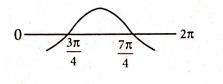
\(\Rightarrow\) \(x=\frac { 3\pi }{ 4 } ,\frac { 7\pi }{ 4 } ,2\pi \)
ஃ The possible intervals are \(\left( 0,\frac { 3\pi }{ 4 } \right) \left( \frac { 3\pi }{ 4 } ,\frac { 7\pi }{ 4 } \right) \left( \frac { 7\pi }{ 4 } ,2\pi \right) \)
| Interval | \(\left( 0,\frac { 3\pi }{ 4 } \right) \) | \(\left( \frac { 3\pi }{ 4 } ,\frac { 7\pi }{ 4 } \right) \) | \(\left( \frac { 7\pi }{ 4 } ,2\pi \right) \) |
| Say x = -1 \(f''\left( x \right) =-\frac { 1 }{ \sqrt { 2 } } -\frac { 1 }{ \sqrt { 2 } } =-\frac { 2 }{ \sqrt { 2 } } \) |
Say x = π f''(x) = -sinπ-cosπ = 0-(1) = 1 +ve |
Say x = 320° f" (x) = - sin 320 - cos 320 = -sin (270 + 60) - cos (270 + 60) = cos 60 - sin 60 = \(\frac { 1 }{ 2 } -\frac { \sqrt { 3 } }{ 2 } \) -ve |
|
| Concavity | Concave down | Concave up | Concave down |
ஃf (x) is concave upward in \(\left( \frac { 3\pi }{ 4 } ,\frac { 7\pi }{ 4 } \right) \) and concave downward in \(\left( 0,\frac { 3\pi }{ 4 } \right) \left( \frac { 7\pi }{ 4 } ,2\pi \right) \)
Since f" (x) changes its sign from negative to positive at \(\frac { 3\pi }{ 4 } \) and positive at \(\frac { 7\pi }{ 4 } \) f(x) has point of inflection at \(\left( \frac { 3\pi }{ 4 } ,f\left( \frac { 3\pi }{ 4 } \right) \right) \) and
\(\left( \frac { 7\pi }{ 4 } ,f\left( \frac { 7\pi }{ 4 } \right) \right) \)
\(\therefore f\left( \frac { 3\pi }{ 4 } \right) =sin\frac { 3\pi }{ 4 } -cos\frac { \pi }{ 4 } \)
= \(sin\left( \pi -\frac { \pi }{ 4 } \right) +cos\left( \frac { \pi }{ 4 } \right) \)
= \(\frac { 1 }{ \sqrt { 2 } } -\frac { 1 }{ \sqrt { 2 } } =0\)
ஃ The points of inflection are \(\left( \frac { 3\pi }{ 4 } ,0 \right) \) and \(\left( \frac { 7\pi }{ 4 } ,0 \right) \)
4.
Given \(f(x)=\frac { x }{ x-5 } \)
f(x) is defined and differentiable for all x∈R-[5]
\(\therefore f'(x)=\frac { (x-5)(1)-x(1) }{ (x-5)^{ 2 } } \)
= \(\frac { x-5-x }{ (x-5)^{ 2 } } =\frac { -5 }{ (x-5)^{ 2 } } \)
f'(x) = 0
\(\Rightarrow \frac { -5 }{ (x-5)^{ 2 } } \neq 0\)
There is no stationary point. The possible intervals are (-∞, 5) and (5, ∞).
| Interval | (-∞, 5) | (5, ∞) |
| Sign of f'(x) | Say x = 0 \(\frac { -5 }{ (-5)^{ 2 } } =\frac { -5 }{ 25 } \) |
Say x = 6 \(\frac { -5 }{ (1)^{ 2 } } =-ve\) |
| monotonicity | Strictly decreasing | Strictly decreasing |
ஃ f (x) is strictly decreasing on (-∞, 5) and (5, ∞).
Since there is no stationary point, the curve does not changes its position.
Hence there is no local extremum.
5.
Let x represent the distance covered by the car, y represent the distance covered by the police jeep, and s represent the distance between the car and jeep.
ஃ Given = x = 0.8 km, y = 0.6 km,
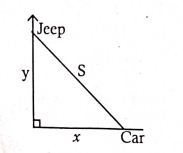
\(\frac { dy }{ dt } \) = -60km/hr,
\(\frac { ds }{ dt } \) = 20 km/hr,
In ΔABC, S2 = x2 + y2 ......(1)
⇒ S2 = (0.8)2 + (0.6)2
= 0.64 + 0.36
⇒ S2 = 1
⇒ s = 1 ....(2)
Differentiating (1) with respect to 't' we get,
\(2s\frac { ds }{ dt } =2x\frac { dx }{ dt } +2y\frac { dy }{ dt } \)
⇒ \(s\frac { ds }{ dt } =x\frac { dx }{ dt } +y\frac { dy }{ dt } \) [Divided by 2]
⇒\(1\left( \frac { ds }{ dt } \right) =(0.8)\left( \frac { dx }{ dt } \right) +(0.6)(-60)\)
⇒ 1(20) = (0.8) \(\left( \frac { dx }{ dt } \right) \) + (0.6)(-60)
⇒ 20 = (0.8) \(\left( \frac { dx }{ dt } \right) \) - 36
⇒ 20 + 36 = (0.8) \(\frac { dx }{ dt } \)
⇒ \(\frac { dx }{ dt } =\frac { 56 }{ 0.8 } \) = 70km/hr.
⇒Speed of the car is 70 km/hr.
6.
7.
Given s (t) = 2t3 − 9t2 + 12t ≥ 0
8.
Given \(f(x)=|\frac{1}{x}|, x\in [-1,1]\)
Rolle's theorem is not applicable since \(f(x)=(\frac{1}{x})\) is not continuous at x = 0 in [-1, 1] and not differentiable in (-1, 1)
9.
Given y = x4 + 2x2 - x
\(\frac { dy }{ dx } \) = 4x3 + 4x - 1
Slope of the tangent at x = 1 is
m = \(\left( \frac { dy }{ dx } \right) \)(x = 1)
= 4(1)3+ 4 (1) - 1
= 4+4-1 = 7
∴ m = 7
10.
Let the two positive numbers be x and y.
Given xy = 20
\(\Rightarrow y=\frac { 20 }{ x } \)
Let f(x) = x+y
\(f(x)=x+\frac { 20 }{ x } \)
\(f'(x)=1-\frac { 20 }{ { x }^{ 2 } } \)
f'(x) = 0
\(\Rightarrow 1-\frac { 20 }{ { x }^{ 2 } } =0\)
\(\Rightarrow 1=\frac { 20 }{ { x }^{ 2 } } \)
\(\Rightarrow { x }^{ 2 }=20\)
\(\Rightarrow x=\pm \sqrt { 20 } \)
\(\Rightarrow x=\pm 2\sqrt { 5 } \)
∴ The critical number are \(2\sqrt { 5 } -2\sqrt { 5 } \)
\(f''(x)=\frac { 40 }{ { x }^{ 3 } } \)
When \(x=2\sqrt { 5 } \)
\(f''\left( x \right) =\frac { 40 }{ \left( 2\sqrt { 5 } \right) ^{ 3 } } >0\)
ஃ f(x) is minimum when \(x=2\sqrt { 5 } \)
When \(x=2\sqrt { 5 } ,y=\frac { 20 }{ 2\sqrt { 5 } } \)
= \(\frac { 10 }{ \sqrt { 5 } } \times \frac { \sqrt { 5 } }{ \sqrt { 5 } } =\frac { 10\sqrt { 5 } }{ 5 } =2\sqrt { 5 } \)
Hence the required positive numbers are \(2\sqrt { 5 } \)
Minimum sum = \(2\sqrt { 5 } \) + \(2\sqrt { 5 } \) = \(4\sqrt { 5 } \)
11.
Given \(f(x)=\frac{1}{x}\), x ∈ [a, b]
a) f(x) is continuous in [a, b]
b) f(x) is differentiable in (a, b)
c) f(b) = \(\frac1b\), f(b) = \(\frac1a\)
Using mean value theorem, there exists c ∈ [a, b] such that f'(c) = \(\frac { f(b)-f(a) }{ b-a } \)
\(\frac { -1 }{ { c }^{ 2 } } =\frac { \frac { 1 }{ b } -\frac { 1 }{ a } }{ b-a } \)
⇒ \(\frac { 1 }{ { c }^{ 2 } } =\frac { a-b }{ ab(b-a) } =-\frac { (b-a) }{ ab(b-a) } \)
= - \(\frac{1}{ab}\)
⇒ c2 = cb
⇒ c = 土 \(\sqrt { ab} \)
ஃ c = \(\sqrt { ab} \) ∈ [a, b]
[∵ c = - \(\sqrt { ab} \) ∈ [a, b]]
12.
a) f(x) is continuous in [0, 9]
b) f(x) is differentiable in (0, 9)
c) f(0) = 0
\(f(9)=\sqrt { 9 } -\frac { 9 }{ 3 } =3-3=0\)
∴ f(0) = f(9)
∴ By Rolle's theorem, there exists C ∈ [0, 9] such that f'(c) = 0
⇒ \({ \frac { 1 }{ 2 } c }^{ \frac { 1 }{ 2 } -1 }-\frac { 1 }{ 3 } =0\)
⇒ \({ \frac { 1 }{ 2 } c }^{ \frac { 1 }{ 2 } -1 }=\frac { 1 }{ 3 } \)
⇒ \(\frac { 1 }{ 2\sqrt { c } } =\frac { 1 }{ 3 } \)
⇒ \(\frac { 1 }{ \sqrt { c } } =\frac { 2 }{ 3 } \)
⇒ \(\sqrt { c } =\frac { 2 }{ 3 } \)
Squaring both sides, c = \(\frac94\) ∈ [0, 9]
13.
Given \(f(x)=\frac{x^{2}-2x}{x+2}, x\in [-1,6]\)
a) f(x) is continuous in [-1, 6]
b) f(x) is differentiable in (-1,6)
c) \(f(-1)=\frac { ({ 1) }^{ 2 }-2(-1) }{ -1+2 } =\frac { 1+2 }{ 1 } =3\)
\(f(6)=\frac { { 6 }^{ 2 }-2(6) }{ 6+2 } \)
\(=\frac { 36-12 }{ 8 } =\frac { 24 }{ 8 } =3\)
∴ (-1) = f(6)
By Rolle's theorem, there exists c ∈ [-1, 6] such that
f'(c) = 0
⇒ \(\frac { (c+2)(2c-2)-({ c }^{ 2 }-2c)(1) }{ (c+{ 2 })^{ 2 } } \) = 0 [By Quotient Rule]
⇒ 2c2 + 4c - 2c - 4 - c2 + 2c = 0
⇒ c2+4c-4 = 0
⇒ \(c=\frac { -4\pm \sqrt { { 4 }^{ 2 }-4(1)(-4) } }{ 2(1) } \) [∵ x = \( {-b \pm \sqrt{b^2-4ac} \over 2a}\)]
⇒ \(\frac { -4+\sqrt { 16+16 } }{ 2(1) } =\frac { -4\pm \sqrt { 2\times 16 } }{ 2 } \)
\(=\frac{-4 \pm 4 \sqrt{2}}{2}=+\not 2 \frac{(-2 \pm 2 \sqrt{2})}{\not 2}\)
\(c=-2\pm \sqrt { 2 } \)
\(c=-2+\sqrt { 2 } \) ∈ [-1, 6]
[∵ \(-2+\sqrt { 2 } \) ∉ [-1, 6]]
14.
Given equation of curve is y = \(\frac{x+1}{x-1}\) and the line is x + 2y = 6
Slope of the tangent to the curve
m1 = \(\frac{dy}{dx}\)
= \(\frac { (x-1)(1)-(x-1)(1) }{ { (x-1) }^{ 2 } } \)
= \(\frac { x-1-x-1 }{ { (x-1) }^{ 2 } } =\frac { -2 }{ { (x-1) }^{ 2 } } \) [Quotient rule]
Slope of the line m2 = \(\frac{-1}{2}\) \(\left[ \frac { co-efficient\ of\ x }{ co-efficient\ of\ y } \right] \)
Since the tangent to the curve and the lines are parallel, m1 = m2
⇒ \(\frac { -2 }{ { (x-1) }^{ 2 } } =\frac { -1 }{ 2 } \)
⇒ 4 = (x - 1)2
⇒ x - 1 = 土 2
⇒ x-1 = 2 or x- 1 = -2
⇒ x = 3 or x = -1
⇒ When x = 3, y = \(\frac{3+1}{3-1}\) = \(\frac42\) = 2
⇒ When x = -1, y = \(\frac{-1+1}{-1-1}=\frac{0}{-2}\) = 0
∴ Equation of the tangent at (3, 2) is
y - 2 = \(\frac{-1}{2}\)(x - 3)
⇒ 2y - 4 = -x + 3
x + 2y -7 = 0
15.
Given equation of the curve is y = 1 + x3 and the line is x + 12y = 12
Slope of the tangent to the curve
m1 = \(\frac { dy }{ dx } \) = 3 x2 and the
Slope of the line = m2
= \(\frac{-1}{2}\) \(\left[ \because m=\frac { co-efficient\ of\ x }{ co-efficient\ of\ y } \right] \)
Since the slope of the tangent to the curve and the line are orthogonal, m1 m2 = - 1.
∴ 3x2\(\left( \frac { -1 }{ 2 } \right) \) = -1
⇒ \(\frac{x^2}{4}\) = 1
⇒ x2 = 4
⇒ x = ±2
When x = 2, y = 1 + 23 = 9
When x = -2, y = 1+ (-2)3
= 1-8 = -7
∴ Equation of the tangent at (2, 9) is
y-9 = 12(x-2) [∵ m1 = 3x2 = 3(2)2 = 12]
∴ y - 9 = 12x - 24
∴ 12x - y = 15
Equation of the tangent at (-2, -7) is
y+7= 12(x + 2)
⇒ y + 7 = 12x + 24
⇒ 12x-y+17 = 0

12th Standard Syllabus & Materials
12th Standard
TN 12th Computer Applications களப்பெயர் முறைமை (DNS) Sample Question Papers Study Material - QB365 Set A
NEW12th Standard
TN 12th Computer Applications வலையமைப்பு எடுத்துக்காட்டுகள் மற்றும் நெறிமுறைகள் Sample Question Papers Study Material - QB365 Set A
NEW12th Standard
TN 12th Computer Applications கணினி வலையமைப்பு ஓர் அறிமுகம் Sample Question Papers Study Material - QB365 Set A
NEW12th Standard
TN 12th Computer Applications PHP-உடன் MySQL-ஐ இணைத்தல் Sample Question Papers Study Material - QB365 Set A



Tamilnadu Stateboard 12th Standard Subjects
Maths

Chemistry

Physics

Biology

Computer Science

Business Maths and Statistics

Economics

Commerce

Accountancy

History

Computer Applications
Biology
Computer Technology
Computer Applications
Computer Science
Business Maths and Statistics
Commerce
Economics
Maths
Chemistry
Physics
Computer Technology
History
Accountancy

Tamil

English

French
Tamilnadu Stateboard Standards

