
 100% FREE ACCESS
12th Standard Syllabus & Materials
12th Standard
TN 12th Computer Applications மின்னணு தரவு பரிமாற்றம் Sample Question Papers Study Material - QB365 Set A
NEW12th Standard
TN 12th Computer Applications மின் - வணிக பாதுகாப்பு அமைப்புகள் Sample Question Papers Study Material - QB365 Set A
NEW12th Standard
TN 12th Computer Applications மின்னணு செலுத்தல் முறைகள் Sample Question Papers Study Material - QB365 Set A
NEW12th Standard
TN 12th Computer Applications மின் - வணிகம் Sample Question Papers Study Material - QB365 Set A
NEW12th Standard
TN 12th Computer Applications திறந்த மூல கருத்துருக்கள் Sample Question Papers Study Material - QB365 Set A
NEW12th Standard
TN 12th Computer Applications வலையமைப்பு வடமிடல் Sample Question Papers Study Material - QB365 Set A

Published on: 02/11/2019
Applications of Integration
Download Tamil Nadu 12th Standard Maths question papers, model tests, one-mark questions, important questions, and public exam papers in PDF format. Free study materials and answer keys for TN State Board students.
Questions + Answers key
Take MCQ Maths Test1.
A watermelon has an ellipsoid shape which can be obtained by revolving an ellipse with major-axis 20 cm and minor-axis 10 cm about its major-axis. Find its volume using integration.
2.
Find the area of the region common to the circle x2 + y2 = 16 and the parabola y2 = 6x.
3.
If \(\int _{ 0 }^{ \infty }{ { e }^{ -a{ x }^{ 2 } }{ x }^{ 3 }dx=32,\alpha >0,\ find\ \alpha } \)
4.
Evaluate the following:
\(\int _{ 0 }^{ \frac { \pi }{ 2 } }{ \frac { { e }^{ -tanx } }{ { cos }^{ 6 }x } } dx\)
5.
Evaluate the following integrals using properties of integration:
\(\int _{ 0 }^{ 1 }{ \frac { log(1+x) }{ 1+{ x }^{ 2 } } } dx\)
6.
Evaluate the following integrals using properties of integration:
\(\int _{ 0 }^{ 1 }{ |5x-3|dx } \)
7.
Evaluate the following integrals using properties of integration:
\(\int _{ 0 }^{ 2\pi }{ { sin }^{ 4 }{ x\ cos }^{ 3 }xdx } \)
8.
Evaluate the following integrals as the limits of sums.
\(\int _{ 1 }^{ 2 }{( 4x^2-1)dx } \)
9.
Evaluate the following integrals as the limits of sums.
\(\int _{ 0 }^{ 1 }{ (5x+4)dx } \)
10.
Evaluate the following
\(\int _{ 0 }^{ \pi /2 }{ { sin }^{ 10 }x\quad dx } \)
11.
Evaluate the following definite integrals:
\(\int _{ 3 }^{ 4 }{ \frac { dx }{ { x }^{ 2 }-4 } } \)
12.
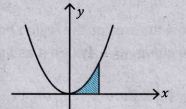
Find, by integration, the volume of the solid generated by revolving about the x-axis, the region enclosed by y = 2x2, y = 0 and x = 1.
13.
Evaluate the following
\(\int _{ 0 }^{ \pi /4 }{ { sin}^{ 6}2x\ dx } \)
14.
Evaluate the following integrals using properties of integration:
\(\int _{ 0 }^{ 2\pi }{ xlog\left( \frac { 3+cos\ x }{ 3-cos\ x } \right) } dx\)
15.
Evaluate the following definite integrals:
\(\int _{ -1 }^{ 1 }{ \frac { dx }{ { x }^{ 2 }+2x+5 } } \)
1.
Given 2a = 20 cm \(\Rightarrow\) a = 10 cm;
2b = 10 cm \(\Rightarrow\)a = 5 cm
\(\therefore\) Equation of the ellipse is \(\frac { { x }^{ 2 } }{ { a }^{ 2 } } +\frac { { y }^{ 2 } }{ { b }^{ 2 } } =1\)
\(\Rightarrow \frac { { x }^{ 2 } }{ 100 } +\frac { { y }^{ 2 } }{ 25 } =1\Rightarrow \frac { { y }^{ 2 } }{ 25 } =1-\frac { { x }^{ 2 } }{ 100 } =\frac { 100-{ x }^{ 2 } }{ 100 } \)
\(\Rightarrow { y }^{ 2 }=\frac { 25 }{ 100 } (100-{ x }^{ 2 })\)
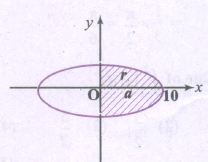
\(\therefore\) Required volume \(=2\pi \int _{ 0 }^{ 10 }{ { y }^{ 2 }dx } \)
\(=2\pi \int _{ 0 }^{ 10 }{ \frac { 25 }{ 100 } (100-{ x }^{ 2 })dx=\frac { 50\pi }{ 100 } \int _{ 0 }^{ 10 }{ (100-{ x }^{ 2 })dx } } \)
\(=\frac { \pi }{ 2 } { \left[ 100x-\frac { { x }^{ 3 } }{ 3 } \right] }_{ 0 }^{ 10 }=\frac { \pi }{ 2 } \left[ 100-\frac { 1000 }{ 3 } \right] \)
\(V=\frac { \pi }{ 2 } \left( \frac { 3000-1000 }{ 3 } \right) =\frac { \pi }{ 2 } \left( \frac { 2000 }{ 3 } \right) \)
\(=\frac { 1000\pi }{ 3 } \)
2.
Equation of the given circle is x2 + y2 = 16 ...(1)
and the parabola is y2 = 6x. ...(2)
Substituting (2) in (1) we get,
x2 + 6x - 16 = 0 \(\Rightarrow\) (x + 8) (x - 2) = 0
\(\Rightarrow\) (x-4) (x-2) = 0 \(\Rightarrow\) x = 2, 4
\(\Rightarrow\) x = -8, 2
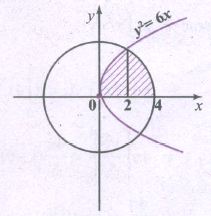
\(\therefore\) Required area = 2
\(\\ \\ \\ \\ \\ \\ \\ \int _{ 0 }^{ 2 }{ Area\ below\ the\ parabola } +\int _{ 2 }^{ 4 }{ Area\ below\ the\ circle } \)
\(=2\left[ \int _{ 0 }^{ 2 }{ \sqrt { 6x } } dx+\int _{ 2 }^{ 4 }{ \sqrt { 16-{ x }^{ 2 } } dx } \right] \)
\(=2\left[ { \left( \frac { \sqrt { 6 } .{ x }^{ \frac { 3 }{ 2 } } }{ \frac { 3 }{ 2 } } \right) }_{ 0 }^{ 2 }+{ \left( \frac { x }{ 2 } \sqrt { 16-{ x }^{ 2 } } +\frac { 16 }{ 2 } { sin }^{ -1 }\left( \frac { x }{ 4 } \right) \right) }_{ 0 }^{ 4 } \right] \)
\(=2\left[ \frac { 2 }{ 3 } \sqrt { 6. } 2\sqrt { 2 } +8{ sin }^{ -1 }\left( \frac { 1 }{ 2 } \right) \right] \)
\(=2\left[ \frac { 4\sqrt { 12 } }{ 3 } +8\left( \frac { \pi }{ 2 } \right) -\sqrt { 12 } -8\left( \frac { \pi }{ 6 } \right) \right] \)
\(=2\left[ \frac { 4\sqrt { 12 } }{ 3 } +4\pi -2\sqrt { 3 } -\frac { 4\pi }{ 3 } \right] \)
\(=2\left[ \frac { 8\sqrt { 3 } -6\sqrt { 3 } }{ 3 } +\frac { 12\pi -4\pi }{ 3 } \right] \)
\(=\left[ \frac { 2\sqrt { 3 } }{ 3 } +\frac { 8\pi }{ 3 } \right] =2\times \frac { 2 }{ 3 } \left[ \sqrt { 3 } +4\pi \right] \)
\(=\frac { 4 }{ 3 } \left[ 4\pi +\sqrt { 3 } \right] \)sq.units
3.
Given \(\int _{ 0 }^{ \infty }{ { e }^{ -a{ x }^{ 2 } }{ x }^{ 3 }dx=32,\alpha >0} \)
| x | 0 | \(\infty\) |
| t | 0 | \(\infty\) |
\(\Rightarrow \int _{ 0 }^{ \infty }{ { e }^{ { -\alpha x }^{ 2 } } } .{ x }^{ 2 }.dx=32\)
\(put\ t= { x }^{ 2 }\)
\(\Rightarrow dt=2x\ dx\)
\(\\ \Rightarrow \frac { dt }{ 2 } = xdx\)
\( \int _{ 0 }^{ \infty }{ { e }^{ -\alpha t }\frac{dt}{2}} \frac { 1 }{ 2 } \int _{ 0 }^{ \infty }{ { e }^{ -\alpha t }.tdt } \)
\( \frac { 1 }{ 2 } \times\frac{1} { \alpha}^{ 2 } \) ...... (1)
Given \(\int^x_0e^{-ax^2}x^3 dx = 32\)
By (1),
\(\Rightarrow \frac { 1! }{ { \alpha }^{ 2 } } =32\times 2\left[ \because \int _{ 0 }^{ \infty }{ { e }^{ -ax }{ x }^{ n }dx=\frac { n! }{ { a }^{ n+1 } } } \right] \)
\(\frac{1}{2}\times \frac{1}{\alpha^2}= 32 \Rightarrow \frac {1}{\alpha ^2}= 64\\ \alpha ^2 = \frac{1}{64}\)
\(\Rightarrow \alpha =\frac { 1 }{ 8 } \)
4.
\(=\int _{ 0 }^{ \pi /2 }{ { e }^{ -tan\quad x }{ sec }^{ 6 }xdx\ \left[ \because sec\ x=\frac { 1 }{ cos\quad x } \right] } \)
\(Put\quad t=tan\quad x\Rightarrow dt={ sec }^{ 2 }xdx\)
\(=\int _{ 0 }^{ \pi /2 }{ { e }^{ -tanx }{ sec }^{ 4x }{ sec }^{ 2x }dx } \)
\(=\int _{ 0 }^{ \pi /2 }{ { e }^{ -tanx }{ (1+{ tan }^{ 2 }) }^{ 2 } } { sec }^{ 2 }xdx\)
\(put\quad t=tanx\Rightarrow dt={ sec }^{ 2 }xdx\)
| x | 0 | \(\frac{\pi}{2}\) |
| t | 0 | \(\infty\) |
\(=\int _{ 0 }^{ \infty }{ { e }^{ -t }{ (1+{ t }^{ 2 }) }^{ 2 } } dt\)
\(=\int _{ 0 }^{ \infty }{ { e }^{ -t }(1+{ t }^{ 4 }+{ 2t }^{ 2 })dt } \)
\(=\int _{ 0 }^{ \infty }{ { e }^{ -t }(1)dt+\int _{ 0 }^{ \infty }{ { e }^{ -t }{ t }^{ 4 }dt+2 } } \int _{ 0 }^{ \infty }{ { e }^{ -t }{ t }^{ 2 }dt } \)
\(=0!+4!+2(2!)\left[ \because \int _{ 0 }^{ \infty }{ { e }^{ -x }{ x }^{ n }dx=n! } \right] \)
\(=1+4\times 3\times 2\times 1+2\times 2=1+24+4\)
\(\therefore I=29\)
5.
Let x = tan \(\theta \Rightarrow\)dx = sec2\(\theta d \theta\)
| x | 0 | 1 |
| \(\theta\) | 0 | \(\frac{\pi}{4}\) |
\(\therefore I=\int _{ 0 }^{ \frac { \pi }{ 4 } }{ \frac { log(1+tan\theta ) }{ { sec }^{ 2 }\theta } } { sec }^{ 2 }\theta d\theta \)
\(=\int _{ 0 }^{ \frac { \pi }{ 4 } }{ log(1+tan\theta )d\theta } \quad ...(1)\)
Using property,
\(I=\int _{ 0 }^{ \frac { \pi }{ 4 } }{ log(1+tan(\frac { \pi }{ 4 } -\theta ))d\theta } \)
\(I=\int _{ 0 }^{ \frac { \pi }{ 4 } }{ log\left( \frac { 1+tan\theta +1-tan\theta }{ 1+tan\theta } \right) } d\theta \)
\(I=\int _{ 0 }^{ \frac { \pi }{ 4 } }{ log\left( \frac { 2 }{ 1+tan\theta } \right) } d\theta \quad ..(2)\)
(1)+(2)
\(2I=\int _{ 0 }^{ \frac { \pi }{ 4 } }{ log(1+tan\theta )d\theta } +\int _{ 0 }^{ \frac { \pi }{ 4 } }{ log\left( \frac { 2 }{ 1+tan\theta } \right) } d\theta \)
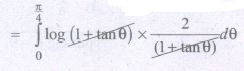
\(=\int _{ 0 }^{ \frac { \pi }{ 4 } }{ log2d\theta =log2{ [\theta ] }_{ 0 }^{ \frac { \pi }{ 4 } } } \)
\(2I=log2(\frac { \pi }{ 4 } -0)=\frac { \pi }{ 4 } log2\)
\(\therefore I=\frac { \pi }{ 8 } log2\)
6.
\(=\int _{ 0 }^{ \frac { 3 }{ 5 } }{ -(5x-3)dx+\int _{ \frac { 3 }{ 5 } }^{ 1 }{ -(5x-3)dx } } \)
\(={ { \left[ 3x-\frac { { 5x }^{ 2 } }{ 2 } \right] }_{ 0 }^{ \frac { 3 }{ 5 } }+\left[ \frac { { 5x }^{ 2 } }{ 2 } -3x \right] }_{ 3 }^{ 1 }\)
\(=\frac { 9 }{ 5 } -\frac { 5 }{ 2 } \left( \frac { 9 }{ 25 } \right) -0+\frac { 5 }{ 2 } -3-\frac { 5 }{ 2 } \left( \frac { 9 }{ 25 } \right) +\frac { 9 }{ 5 } \)
\(=\frac { 9 }{ 5 } -\frac { 9 }{ 10 } +\frac { 5 }{ 2 } -3-\frac { 9 }{ 10 } +\frac { 9 }{ 5 } \)
\(=\frac { 18-9+25-30-9+18 }{ 10 } =\frac { 13 }{ 10 } \)
7.
Let \(I=\int _{ 0 }^{ 2\pi }{ { sin }^{ 4 }x{ cos }^{ 3 }xdx } \quad ...(1)\)
By the property \(\left[ \because \int _{ 0 }^{ a }{ f(x)dx=\int _{ 0 }^{ a }{ f(a-x)dx } } \right] \)
we get
\(I=\int _{ 0 }^{ 2\pi }{ { \left[ sin(2\pi -x) \right] }^{ 4 } } { \left[ cos(2\pi -x) \right] }^{ 3 }dx\)
\(=\int _{ 0 }^{ 2\pi }{ { [-sin\quad x] }^{ 4 }{ [-cos\quad x] }^{ 3 }dx } \)
\(=-\int _{ 0 }^{ 2\pi }{ { sin }^{ 4 }x{ cos }^{ 3 }xdx\quad ..(2) } \)
\(\therefore (1)+(2)\Rightarrow \)
\(2I=\int _{ 0 }^{ 2\pi }{ { sin }^{ 4 }x{ cos }^{ 3 }xdx } \)
\(-\int _{ 0 }^{ 2\pi }{ { sin }^{ 4 }x{ cos }^{ 3 }xdx=0 } \)
\(\Rightarrow I=0\)
8.
Here a = 1, b = 2,f(x) = 4x2-1
\(\therefore f(a+(b-a)\frac { r }{ n } )=f(1+1(\frac { r }{ n } ))\)
\(=f\left( 1+\frac { r }{ n } \right) \)
\(=4{ \left( 1+\frac { r }{ n } \right) }^{ 2 }-1=4\left( 1+\frac { { r }^{ 2 } }{ { n }^{ 2 } } +\frac { 2r }{ n } \right) -1\)
\(=4+\frac { { 4r }^{ 2 } }{ { n }^{ 2 } } +\frac { 8r }{ n } -1=3+\frac { { 4r }^{ 2 } }{ { n }^{ 2 } } +\frac { 8r }{ n } \)
\(\int _{ a }^{ b }{ f(x)dx= } \underset { n\rightarrow \infty }{ lim } \frac { b-a }{ n } \sum _{ r=1 }^{ n }{ f } \left( a+(b-a)\frac { r }{ n } \right) \)
\(\therefore \int _{ 1 }^{ 2 }{ ({ 4x }^{ 2 }-1)dx } =\underset { n\rightarrow \infty }{ lim } \frac { 1 }{ n } \sum _{ r=1 }^{ n }{ \left( 3+\frac { { 4r }^{ 2 } }{ { n }^{ 2 } } +\frac { 8r }{ n } \right) } \)
\(=\underset { n\rightarrow \infty }{ lim } \left[ \frac { 1 }{ n } \sum _{ r=1 }^{ n }{ 3+\frac { 1 }{ n } } \sum _{ r=1 }^{ n }{ \frac { { 4r }^{ 2 } }{ { n }^{ 2 } } } +\frac { 1 }{ n } \sum _{ r=1 }^{ n }{ \frac { 8r }{ n } } \right] \)
\(=\left[ \underset { n\rightarrow \infty }{ lim } \frac { 1 }{ n } .3n+\frac { 1 }{ n } \frac { 4 }{ { n }^{ 2 } } ({ 1 }^{ 2 }+{ 2 }^{ 2 }+...+{ n }^{ 2 })+\frac { 1 }{ n } .\frac { 8 }{ n } (1+2+3....+n) \right] \)\(=\underset { n\rightarrow \infty }{ lim } \left[ 3+\frac { 4 }{ { n }^{ 3 } } \frac { n(n+1)(2+1) }{ 6 } +\frac { 8 }{ { n }^{ 2 } } \frac { n(n+1) }{ 2 } \right] \)
\(\left[ \because \sum { r } =\frac { n(n+1) }{ 2 } \sum { { r }^{ 2 }=\frac { n(n+1)(2n+1) }{ 6 } } \right] \)
\(=\underset { n\rightarrow \infty }{ lim } \left[ 3+\frac { 4 }{ { n }^{ 3 } } \frac { { n }^{ 3 }(1+\frac { 1 }{ n } )(2+\frac { 1 }{ n } ) }{ 6 } +\frac { 8 }{ { n }^{ 2 } } \frac { { n }^{ 2 }(1+\frac { 1 }{ n } ) }{ 2 } \right] \)
\(=[3+\frac { 2 }{ 3 } (1+0)(2+0)+4(1+0)]\)
\([\because when\quad n\rightarrow \infty ,1/n\rightarrow 0]\)
\(=3+\frac { 4 }{ 3 } +4=\frac { 9+4+12 }{ 3 } =\frac { 25 }{ 3 } \)
\(\therefore \int _{ 1 }^{ 2 }{ (4{ x }^{ 2 }-1)dx=\frac { 25 }{ 3 } } \)
9.
Here a = 0, b = 1,f (x) = 5x + 4
\(\therefore f(a+(b-a)\frac { r }{ n } )=f\left( 0+1(\frac { r }{ n } ) \right) =f(\frac { r }{ n } )=5(\frac { r }{ n } )+4\)
\(\int _{ a }^{ b }{ f(x)dx } =\underset { n\rightarrow \infty }{ lim } \frac { b-a }{ n } \sum _{ r=1 }^{ n }{ f(a+(b-a)\frac { r }{ n } } \)
\(\therefore \int _{ 0 }^{ 1 }{ (5x+4)dx } =\underset { n\rightarrow \infty }{ lim } \frac { 1 }{ n } \sum _{ r=1 }^{ n }{ \left( \frac { 5r }{ n } +4 \right) } \)
\(=\underset { n\rightarrow \infty }{ lim } \left[ \frac { 1 }{ n } \sum _{ r=1 }^{ n }{ \frac { 5r }{ n } +\frac { 1 }{ n } \sum _{ r=1 }^{ n }{ 4 } } \right] \)
\(=\underset { n\rightarrow \infty }{ lim } \left[ \frac { 1 }{ n } .\frac { 5 }{ n } .(1+2+3+...+n)+\frac { 1 }{ n } .4n \right] \)
\(=\underset { n\rightarrow \infty }{ lim } \left[ \frac { 5 }{ { n }^{ 2 } } \frac { n(n+1) }{ 2 } +4 \right] \)
\([\because \sum { r=\frac { n(n+1) }{ 2 } ;\sum { { r }^{ 2 }=\frac { n(n+1)(2n+1) }{ 6 } } } ]\)
\(=\underset { n\rightarrow \infty }{ lim } \frac { 5 }{ { n }^{ 2 } } { n }^{ 2 }\frac { (1+\frac { 1 }{ n } ) }{ 2 } +4\)
\(=\frac { 5 }{ 2 } (1+0)+4=\frac { 5 }{ 2 } +4\)
\([wehen\quad n\rightarrow \infty ,1/n\quad \rightarrow 0]\)
\(=\frac { 5+8 }{ 2 } =\frac { 13 }{ 2 } \)
\(\therefore \int _{ 0 }^{ 1 }{ (5x+4)dx } =\frac { 13 }{ 2 } \)
10.
\({ I }_{ n }=\int _{ 0 }^{ \pi /2 }{ { sin }^{ n }x } =\frac { n-1 }{ n } { I }_{ n-2 },n\ge 2\)
\(Let\quad { I }_{ 10 }=\int _{ 0 }^{ \pi /2 }{ { sin }^{ 10 }xdx=\frac { 9 }{ 10 } { I }_{ 8 } } \)
\(=\frac { 9 }{ 10 } \times \frac { 7 }{ 8 } \times { I }_{ 6 }=\frac { 9 }{ 10 } \times \frac { 7 }{ 8 } \times \frac { 5 }{ 6 } \times { I }_{ 4 }\)
\(\\ =\frac { 9 }{ 10 } \times \frac { 7 }{ 8 } \times \frac { 5 }{ 6 } \times \frac { 3 }{ 4 } { I }_{ 2 }\)
\(=\frac { 9 }{ 10 } \times \frac { 7 }{ 8 } \times \frac { 5 }{ 6 } \times \frac { 3 }{ 4 } \times \frac { 1 }{ 2 } \times \frac { \pi }{ 2 } \)
\(=\frac { 315 }{ 1280 } \times \frac { \pi }{ 2 } =\frac { 63\pi }{ 256(2) } =\frac { 63\pi }{ 512 } \)
11.
\(\int _{ 3 }^{ 4 }{ \frac { dx }{ { x }^{ 2 }-4 } } \)
\(\int _{ 3 }^{ 4 }{ \frac { dx }{ { x }^{ 2 }-4 } } =\int _{ 3 }^{ 4 }{ \frac { dx }{ { x }^{ 2 }-{ 2 }^{ 2 } } } \)
\(\left[ \because \int { \frac { dx }{ { x }^{ 2 }-{ a }^{ 2 } } } =\frac { 1 }{ 2a } log\left| \frac { x-a }{ x+a } \right| +c\right] \)
\(=\frac { 1 }{ 4 } \left[ log\left( \frac { 4-2 }{ 4+2 } \right) -log\left( \frac { 3-2 }{ 3+2 } \right) \right] \)
\(=\frac { 1 }{ 4 } log\left[ \left( \frac { 2 }{ 6 } \right) - log \ \frac { 1 }{ 5 } \right] \\ =\frac { 1 }{ 4 } log\left( \frac { 1 }{ 3 } \times 5 \right) \)
\(=\frac { 1 }{ 4 } log\left( \frac { 5 }{ 3 } \right) \)
12.
Equation of the given curve is y = 2x2
Volume \(=\pi \int _{ a }^{ b }{ { y }^{ 2 }dx } \)
\(=\pi \int _{ 0 }^{ 1 }{ { (2{ x }^{ 2 }) }^{ 2 } } dx=\pi \int _{ 0 }^{ 1 }{ { 4x }^{ 4 }dx } \)
\(=4\pi { \left[ \frac { { x }^{ 5 } }{ 5 } \right] }_{ 0 }^{ 1 }=\frac { 4\pi }{ 5 } (1-0)\)
\(v=\frac { 4\pi }{ 5 } \) cubic units
13.
\(Let\quad t=2x\Rightarrow dt=2dx\Rightarrow \frac { dt }{ 2 } =dx\)
\(\therefore I=\frac { 1 }{ 2 } \int _{ 0 }^{ \frac { \pi }{ 2 } }{ { sin }^{ 6 }t\quad dt=\frac { 1 }{ 2 } { I }_{ 6 } } \)
| x | 0 | \(\frac{\pi}{4}\) |
| t | 0 | \(\frac{\pi}{t}\) |
\([\int _{ 0 }^{ \pi /2 }{ { sin }^{ n }xdx=\frac { n-1 }{ n } { I }_{ n-2 }, } n\ge 2]\)
\(\\ =\frac { 1 }{ 2 } \times \frac { 5 }{ 6 } \times \frac { 3 }{ 4 } \times \frac { 1 }{ 2 } \times \frac { \pi }{ 2 } =\frac { 5\pi }{ 64 } \)
14.
Let \(I=\int _{ 0 }^{ \pi }{ xlog\left( \frac { 3+cos\quad x }{ 3-cos\quad x } \right) \left( \frac { 3-cos\quad x }{ 3+cos\quad x } \right) dx } \quad ...(1)\)
\(I=\int _{ 0 }^{ 2\pi }{ (2\pi -x)log\left( \frac { 3+cos(2\pi -x) }{ 3-cos(2\pi -x) } \right) } dx\)
\(\left[ \because \int _{ 0 }^{ a }{ f(x)dx=\int _{ 0 }^{ a }{ (a-x)dx } } \right] \)
\(=\int _{ 0 }^{ 2\pi }{ 2\pi log\left( \frac { 3+cos\quad x }{ 3-cos\quad x } \right) dx } \)
\(-\int _{ 0 }^{ 2\pi }{ xlog\left( \frac { 3+cos\quad x }{ 3-cos\quad x } \right) dx } \)
\(\left[ \because cos(2\pi -x)=cos\quad x \right] \)
\(I=2\pi \int _{ 0 }^{ 2\pi }{ log\left( \frac { 3+cos\quad x }{ 3-cos\quad x } \right) dx-I } [using(1)]\)
\(\\ 2I=2\pi \int _{ 0 }^{ 2\pi }{ log\left( \frac { 3+cos\quad x }{ 3-cos\quad x } \right) dx } \quad \quad ...(2)\)
\(\left[ \because \int _{ 0 }^{ a }{ f(x)dx=2\int _{ 0 }^{ \frac { a }{ 2 } }{ f(x)dx\quad if(a-x)=f(x) } } \right] \)
I = 2 pi integral limit 0 to pi
\(\left[ log3+\frac { x }{ 3-x } \right] dx\)
\(\Rightarrow I=2\pi \int _{ 0 }^{ \pi }{ log\left( \frac { 3+cos(\pi -x) }{ 3-cos(\pi -x) } \right) dx } \)
\(\Rightarrow I=2\pi \int _{ 0 }^{ \pi }{ log\left( \frac { 3-cos\quad x }{ 3+cos\quad x } \right) dx...(3) } \)
\([\because cos(\pi -x)=cosx]\)
Adding (2) and (3) we get,
\(2I=\int _{ 0 }^{ \pi }{ log\left( \frac { 3+cos\quad x }{ 3-cos\quad x } \right) \left( \frac { 3-cos\quad x }{ 3+cos\quad x } \right) dx } \)
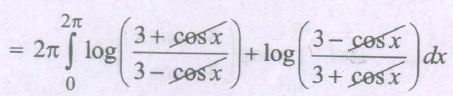
\(\Rightarrow 2\pi \int _{ 0 }^{ 2\pi }{ 0dx=0 } \)
\(\Rightarrow 2I=0\Rightarrow I=0\)
\(\therefore \int _{ 0 }^{ 2\pi }{ xlog\left( \frac { 3+cos\ x }{ 3-cos\ x } \right) dx=0 } \)
15.
\(\int _{ -1 }^{ 1 }{ \frac { dx }{ { x }^{ 2 }+2x+5 } } \)
\(=\int _{ -1 }^{ 1 }{ \frac { dx }{ { x }^{ 2 }+2x+1+4 } } =\int _{ -1 }^{ 1 }{ \frac { dx }{ { (x+1) }^{ 2 }{ 2 }^{ 2 } } } \)
\(\left[ \because \int { \frac { dx }{ { x }^{ 2 }-{ a }^{ 2 } } } =\frac { 1 }{ 2a } log\left| \frac { x-a }{ x+a } \right| \right] \)
\(={ \left[ \frac { 1 }{ 2 } { tan }^{ -1 }\left( \frac { x+1 }{ 2 } \right) \right] }_{ -1 }^{ 1 }\)
\(=\frac { 1 }{ 2 } \left[ { tan }^{ -1 }(1)-{ tan }^{ -1 }(0) \right] \)
\(\\ =\frac { 1 }{ 2 } \left[ \frac { \pi }{ 4 } \right] =\frac { \pi }{ 8 } \)

12th Standard Syllabus & Materials
12th Standard
TN 12th Computer Applications களப்பெயர் முறைமை (DNS) Sample Question Papers Study Material - QB365 Set A
NEW12th Standard
TN 12th Computer Applications வலையமைப்பு எடுத்துக்காட்டுகள் மற்றும் நெறிமுறைகள் Sample Question Papers Study Material - QB365 Set A
NEW12th Standard
TN 12th Computer Applications கணினி வலையமைப்பு ஓர் அறிமுகம் Sample Question Papers Study Material - QB365 Set A
NEW12th Standard
TN 12th Computer Applications PHP-உடன் MySQL-ஐ இணைத்தல் Sample Question Papers Study Material - QB365 Set A



Tamilnadu Stateboard 12th Standard Subjects
Maths

Chemistry

Physics

Biology

Computer Science

Business Maths and Statistics

Economics

Commerce

Accountancy

History

Computer Applications
Biology
Computer Technology
Computer Applications
Computer Science
Business Maths and Statistics
Commerce
Economics
Maths
Chemistry
Physics
Computer Technology
History
Accountancy

Tamil

English

French
Tamilnadu Stateboard Standards

