
 100% FREE ACCESS
12th Standard Syllabus & Materials
12th Standard
TN 12th Computer Applications மின்னணு தரவு பரிமாற்றம் Sample Question Papers Study Material - QB365 Set A
NEW12th Standard
TN 12th Computer Applications மின் - வணிக பாதுகாப்பு அமைப்புகள் Sample Question Papers Study Material - QB365 Set A
NEW12th Standard
TN 12th Computer Applications மின்னணு செலுத்தல் முறைகள் Sample Question Papers Study Material - QB365 Set A
NEW12th Standard
TN 12th Computer Applications மின் - வணிகம் Sample Question Papers Study Material - QB365 Set A
NEW12th Standard
TN 12th Computer Applications திறந்த மூல கருத்துருக்கள் Sample Question Papers Study Material - QB365 Set A
NEW12th Standard
TN 12th Computer Applications வலையமைப்பு வடமிடல் Sample Question Papers Study Material - QB365 Set A

Published on: 03/12/2019
Applications of Vector Algebra
Download Tamil Nadu 12th Standard Maths question papers, model tests, one-mark questions, important questions, and public exam papers in PDF format. Free study materials and answer keys for TN State Board students.
Questions + Answers key
Take MCQ Maths Test1.
If \(\vec { a } =-2\hat { i } +3\hat { j } -2\hat { k } ,\vec { b } =3\hat { i } -\hat { j } +3\hat { k } ,\vec { c } =2\hat { i } -5\hat { j } +\hat { k } \) find \((\vec { a } \times \vec { b } )\times \vec { c } \) and \((\vec { a } \times \vec { b } )\times \vec { c } \). State whether they are equal.
2.
Prove by vector method that sin(α + β ) = sin α cos β + cos α sin β
3.
In triangle, ABC the points, D, E, F are the midpoints of the sides BC, CA and AB respectively. Using vector method, show that the area of ΔDEF is equal to \(\frac{1}{4}\)(area of ΔABC )
4.
Show that the four points whose position vectors are \(6\overset { \wedge }{ i } -7\overset { \wedge }{ j } ,16\overset { \wedge }{ i } -29\overset { \wedge }{ j } -4\overset { \wedge }{ k } ,3\overset { \wedge }{ i } -6\overset { \wedge }{ j } \) are co-planar
5.
Prove that \(\left[ \overset { \rightarrow }{ a } +\overset { \rightarrow }{ b } +\overset { \rightarrow }{ c } ,\overset { \rightarrow }{ b } +\overset { \rightarrow }{ c } ,\overset { \rightarrow }{ c } \right] \)=\(\left[ \overset { \rightarrow }{ a } \overset { \rightarrow }{ b } \overset { \rightarrow }{ c } \right] \)
6.
Find the equation of the plane through the intersection of the planes 2x-3y+ z-4 -0 and x - y + z + 1 = 0 and perpendicular to the plane x + 2y - 3z + 6 = 0
7.
Prove by vector method that the diagonals of a rhombus bisect each other at right angles.
8.
If the planes \({ \overset { \rightarrow }{ r } }.\left( \overset { \wedge }{ i } +2\overset { \wedge }{ j } +3\overset { \wedge }{ k } \right) =7\) and \({ \overset { \rightarrow }{ r } }.\left( \lambda \overset { \wedge }{ i } +2\overset { \wedge }{ j } -7\overset { \wedge }{ k } \right) =26\) are perpendicular. Find the value of λ.
9.
Find the parametric form of vector equation of the plane passing through the point (1, -1, 2) having 2, 3, 3 as direction ratios of normal to the plane.
10.
Find the Cartesian equation of a line passing through the points A(2, -1, 3) and B(4, 2, 1)
11.
Find the volume of the parallelepiped whose coterminous edges are represented by the vectors \(-6\hat { i } +14\hat { j } +10\hat { k } ,14\hat { i } -10\hat { j } -6\hat { k } \) and \(2\hat { i } +4\hat { j } -2\hat { k } \)
12.
If \(\vec { a } =\hat { i } -2\hat { j } +3\hat { k }, \vec { b } =2\hat { i } +\hat { j } -2\hat { k }, \vec { c } =3\hat { i } +2\hat { j } +\hat { k } \) find \(\vec { a } .(\vec { b } \times \vec { c } )\).
13.
If \(\overset { \rightarrow }{ d } =\overset { \rightarrow }{ a } \times \left( \overset { \rightarrow }{ b } \times \overset { \rightarrow }{ c } \right) +\overset { \rightarrow }{ b } \times \left( \overset { \rightarrow }{ c } \times \overset { \rightarrow }{ a } \right) +\overset { \rightarrow }{ c } \times \left( \overset { \rightarrow }{ a } +\overset { \rightarrow }{ b } \right) \), then __________
\(\left| \overset { \rightarrow }{ d } \right| \)
\(\overset { \rightarrow }{ d } =\overset { \rightarrow }{ a } +\overset { \rightarrow }{ b } +\overset { \rightarrow }{ c } \)
\(\overset { \rightarrow }{ d } =\overset { \rightarrow }{ 0 } \)
a, b, c are coplanar
14.
The number of vectors of unit length perpendicular to the vectors \(\left( \overset { \wedge }{ i } +\overset { \wedge }{ j } \right) \) and \(\left( \overset { \wedge }{ j } +\overset { \wedge }{ k } \right) \)is __________
1
2
3
\(\infty\)
15.
If \(\vec { a } ,\vec { b } ,\vec { c } \) are three non-coplanar vectors such that \(\vec { a } \times (\vec { b } \times \vec { c } )=\frac { \vec { b } +\vec { c } }{ \sqrt { 2 } } \), then the angle between \(\vec { a } \ and \ \vec { b } \) is
\(\frac { \pi }{ 2 } \)
\(\frac { 3\pi }{ 4 } \)
\(\frac { \pi }{ 4 } \)
\( { \pi }\)
16.
If \(\vec { a } \) and \(\vec { b } \) are unit vectors such that \([\vec { a } ,\vec { b },\vec { a } \times \vec { b } ]=\frac { 1}{ 4 } \), then the angle between \(\vec { a } \) and \(\vec { b } \) is
\(\frac { \pi }{ 6 } \)
\(\frac { \pi }{ 4 } \)
\(\frac { \pi }{ 3 } \)
\(\frac { \pi }{ 2 } \)
17.
If a vector \(\vec { \alpha } \) lies in the plane of \(\vec { \beta } \) and \(\vec { \gamma } \), then
\([\vec { \alpha } ,\vec { \beta } ,\vec { \gamma } ]\) = 1
\([\vec { \alpha } ,\vec { \beta } ,\vec { \gamma } ]\) = -1
\([\vec { \alpha } ,\vec { \beta } ,\vec { \gamma } ]\) = 0
\([\vec { \alpha } ,\vec { \beta } ,\vec { \gamma } ]\) = 2
1.
By definition, \(\vec { a } \times \vec { b } \) \(=\left| \begin{matrix} \hat { i } & \hat { j } & \hat { k } \\ -2 & 3 & -2 \\ 3 & -1 & 3 \end{matrix} \right| =7\hat { i } -7\hat { k } \)
Then, \((\vec { a } \times \vec { b } )\times \vec { c } =\left| \begin{matrix} \hat { i } & \hat { j } & \hat { k } \\ 7 & 0 & -7 \\ 2 & -5 & 1 \end{matrix} \right| =-35\hat { i } -21\hat { j } -35\hat { k } \)......(1)
\(\vec { b } \times \vec { c } =\left| \begin{matrix} \hat { i } & \hat { j } & \hat { k } \\ 3 & -1 & 3 \\ 2 & -5 & 1 \end{matrix} \right| =14\hat { i } +3\hat { j } -13\hat { k } \)
\(\vec { a } (\vec { b } \times \vec { c } )=\left| \begin{matrix} \hat { i } & \hat { j } & \hat { k } \\ -2 & 3 & -2 \\ 14 & 3 & -13 \end{matrix} \right| =-33\hat { i } -54\hat { j } -48\hat { k } \)....(2)
Therefore, equations (1) and (2) show that \((\vec { a } \times \vec { b } )\times \vec { c } \)\(\neq \)\((\vec { a } \times \vec { b } )\times \vec { c } \)
2.
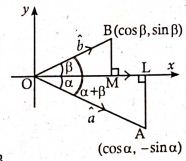
Let \(\hat { a } =\vec { OA } \) and \(\hat { b } =\vec { OB } \) be the unit vectors and which make angles α,β respectively with positive x-axis
Draw AL and BM 丄 to x-axis
Then \(|\vec { OL } |=|\vec { OA } |cos\alpha \Rightarrow \vec { OL } =\vec { |OL| } \hat { i } =cos\alpha \hat { i } \)
\(|\vec { LA } |=|\vec { OB } |\) sin α
⇒ \(\vec { LA } =|\vec { OB } |\hat { j } =sin\alpha (-\hat { j } )=-sin\alpha \hat { j } \)
[\(\vec { LA } \) is in the opp direction of y axis]
\(\hat { a } =\vec { OA } =\vec { OL } +\vec { LA } =cos\alpha \hat { i } -sin\alpha \check { j } \) ..(1)
Similarly \(\hat { b } =\vec { OB } =\vec { OM } +\vec { MB } =cos\beta \hat { i } +sin\beta \hat { j } \) ...(2)
Now \(\hat { a } \times \hat { b } =|\hat { a } ||\hat { b } |sin(\alpha +\beta )\hat { k } =sin(\alpha +\beta )\hat { k } \) ....(3)
[\(|\hat { a } |=|\hat { b } |\) = 1]
Also \(\hat { a } \times \hat { b } =\left| \begin{matrix} \hat { i } & \hat { j } & \hat { k } \\ cos\alpha & -sin\alpha & 0 \\ cos\beta & cos\beta & 0 \end{matrix} \right| \)
= \(\hat { i } (0)-\hat { j } (0)+\hat { k } \)(cosα sinβ + sinα cosβ)
= (sin α cos β + cos α sin β)\(\hat { k } \) .(4)
using (3) and (4), sin(α+β) = sin α cos β + cos α sin β
3.
In triangle ABC, consider A as the origin. Then the position vectors of D, E, F are given by \(\frac { \vec { AB } +\vec { AC } }{ 2 } ,\frac { \vec { AC } }{ 2 } ,\frac { \vec { AB } }{ 2 } \) respectively.
Since \(\left| \vec { AB } \times \vec { AC } \right| \) is the area of the parallelogram formed by the two vectors \(\vec { AB }\), \(\vec { AC } \) as adjacent sides, the area of ΔABC is \(\frac{1}{2}\) \(\left| \vec { AB } \times \vec { AC } \right| \). Similarly, considering ΔDEF, we get
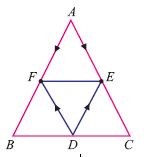
the area of ΔDEF = \(\frac{1}{2}\) \(\left| \vec { DE } \times \vec { DF } \right| \)
= \(\frac{1}{2}\) \(\left| (\vec { AE }-\vec{AD}) \times (\vec { AF }-\vec{AD}) \right|\)
= \(\left| \frac { \vec { AB } }{ 2 } \times \frac { \vec { AC } }{ 2 } \right| \)
= \(\frac14\) \(\left( \frac { 1 }{ 2 } \left| \vec { AB } \times \vec { AC } \right| \right) \)
= \(\frac14\)(the area of ΔABC)
4.
Given \(\overset { \rightarrow }{ OA } =6\overset { \wedge }{ i } -7\overset { \wedge }{ j } ,\overset { \rightarrow }{ OB } =16\overset { \wedge }{ i } -29\overset { \wedge }{ j } -4\overset { \wedge }{ k } ,\overset { \rightarrow }{ OC } =3\overset { \wedge }{ i } -6\overset { \wedge }{ j } \) and \(\overset { \rightarrow }{ OD } =2\overset { \wedge }{ i } +5\overset { \wedge }{ j } +10\overset { \wedge }{ k } \)
\(\overset { \rightarrow }{ AB } =\overset { \rightarrow }{ OB } -\overset { \rightarrow }{ OA } =10\overset { \wedge }{ i } -22\overset { \wedge }{ j } -4\overset { \wedge }{ k } \)
\(\overset { \rightarrow }{ AC } =\overset { \rightarrow }{ OC } -\overset { \rightarrow }{ OA } =-6\overset { \wedge }{ i } +10\overset { \wedge }{ j } -6\overset { \wedge }{ k } \)
\(\overset { \rightarrow }{ AD } =\overset { \rightarrow }{ OD } -\overset { \rightarrow }{ OA } =-4\overset { \wedge }{ i } +12\overset { \wedge }{ j } +10\overset { \wedge }{ k } \)
\(\therefore \left[ \overset { \rightarrow }{ AB } \overset { \rightarrow }{ AC } \overset { \rightarrow }{ AD } \right] =\left| \begin{matrix} 10 \\ -6 \\ -4 \end{matrix}\begin{matrix} -22 \\ -10 \\ 12 \end{matrix}\begin{matrix} -4 \\ -6 \\ 10 \end{matrix} \right| \)
= 10 (100 + 75) + 22(-60 -24) -4(-72 +40)
= 1720 - 1848 + 128 = 0
Hence , the given points are coplanar.
5.
L. H. S = \(\left[ \overset { \rightarrow }{ a } +\overset { \rightarrow }{ b } +\overset { \rightarrow }{ c } ,\overset { \rightarrow }{ b } +\overset { \rightarrow }{ c } ,\overset { \rightarrow }{ c } \right] \)
\(=\left( \overset { \rightarrow }{ a } +\overset { \rightarrow }{ b } +\overset { \rightarrow }{ c } \right) .\left\{ \left( \overset { \rightarrow }{ b } \times \overset { \rightarrow }{ c } \right) \times \overset { \rightarrow }{ c } \right\} \)
\(=\left( \overset { \rightarrow }{ a } +\overset { \rightarrow }{ b } +\overset { \rightarrow }{ c } \right) .\left\{ \overset { \rightarrow }{ b } \times \overset { \rightarrow }{ c } \times \overset { \rightarrow }{ c } \right\} \)
\(=\left( \overset { \rightarrow }{ a } +\overset { \rightarrow }{ b } +\overset { \rightarrow }{ c } \right) .\left\{ \overset { \rightarrow }{ b } \times \overset { \rightarrow }{ c } \right\} \ \left[ \because \overset { \rightarrow }{ c } \times \overset { \rightarrow }{ c } =\overset { \rightarrow }{ 0 } \right] \)
\(=\overset { \rightarrow }{ a } .\left( \overset { \rightarrow }{ b } \times \overset { \rightarrow }{ c } \right) +\overset { \rightarrow }{ b } .\left( \overset { \rightarrow }{ b } \times \overset { \rightarrow }{ c } \right) +\overset { \rightarrow }{ c } .\left( \overset { \rightarrow }{ b } \times \overset { \rightarrow }{ c } \right) \)
\(=\left[ \overset { \rightarrow }{ a } \overset { \rightarrow }{ b } \overset { \rightarrow }{ c } \right] +0+0\)
\(\left[ \because \left[ \overset { \rightarrow }{ b } \overset { \rightarrow }{ b } \overset { \rightarrow }{ c } \right] =\left[ \overset { \rightarrow }{ c } \overset { \rightarrow }{ b } \overset { \rightarrow }{ c } \right] =0 \right] \)
\(=\left[ \overset { \rightarrow }{ a } \overset { \rightarrow }{ b } \overset { \rightarrow }{ c } \right] \)= R. H. S
Hence proved
6.
The equation of the requir d plane through the intersection of the given plane is
(2x - 3y + z - 4) + λ (x- y + z + 1) = 0 (1)
⇒ (2 + λ) x - (3 + λ) y + (1 + λ) z - 4 + λ = 0
Since this plane perpendicular to x + 2y - 3z + 6 - 0,
We have 1(2 + λ) - 2(3 + λ) - 3(1 + λ)= 0
⇒ 2 + λ - 6 - 2λ - 3 - 3λ = 0
⇒ -4λ - y = 0
⇒ \(\lambda =\frac { 7 }{ 4 } \)
Substituting \(\lambda =\frac { 7 }{ 4 } \) in (1) we get,
(2x - 3y + z - 4) - \(\frac { -7 }{ 4 } \) (x - y + z + 1) = 0
⇒ 4 (2x - 3y + z -4) -7 (x - y + z + 1) = 0
⇒ x - 5y - 3z - 23 = 0 which is the equation of the required plane.
7.
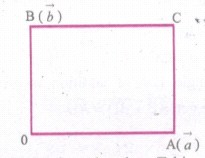
Let OACB be a rhombus. Taking O as the origin, let the position vectors of A and B be \(\vec { a } \) and \(\vec { b } \) respectively.
Then \(\vec { OA } =\vec { a } \) and \(\vec { OB } =\vec { b } \) [∵ \(\vec { AC } =\vec { OB } \)]
So, the p.v. of C is \(\vec { a } +\vec { b } \)
∴ Position vector O f the miid-point of OC is \(\frac { \vec { a } +\vec { b } }{ 2 } \)
Similarly, the position vector of mid-point of AB is \(\frac { \vec { a } +\vec { b } }{ 2 } \).
Hence, the mid-point of OC coincides with the mid-point of AB.
Now, \(\vec { OC } .\vec { AB } =(\vec { a } +\vec { b } ).(\vec { b } -\vec { a } )=|\vec { b } |^{ 2 }-|\vec { a } |^{ 2 }\)
= OB2- OA2 = 0 [∵ OB = OA]
⇒ \(\vec { OC } \bot \vec { AB } \).
Hence, the diagonals of a rhombus bisect each other at right angles.
8.
The planes \(\overset { \rightarrow }{ r } .\overset { \rightarrow }{ { n }_{ 1 } } ={ d }_{ 1 }\) and \(\overset { \rightarrow }{ r } .\overset { \rightarrow }{ { n }_{ 2 } } ={ d }_{ 2 }\) are perpendicular if \(\overset { \rightarrow }{ { n }_{ 1 } } .\overset { \rightarrow }{ { n }_{ 2 } } =0\)
Here \(\overset { \rightarrow }{ { n }_{ 1 } } =\overset { \wedge }{ i } +2\overset { \wedge }{ j } +3\overset { \wedge }{ k } \) and \(\overset { \rightarrow }{ { n }_{ 2 } } =\lambda \overset { \wedge }{ i } +2\overset { \wedge }{ j } -7\overset { \wedge }{ k } \)
\(\therefore \overset { \rightarrow }{ { n }_{ 1 } } .\overset { \rightarrow }{ { n }_{ 2 } } =\left( \overset { \wedge }{ i } +2\overset { \wedge }{ j } +3\overset { \wedge }{ k } \right) .\left( \lambda \overset { \wedge }{ i } +2\overset { \wedge }{ j } -7\overset { \wedge }{ k } \right) =0\)
⇒ λ + 4 - 21 = 0
⇒ λ - 17 = 0
⇒ λ = 17
9.
Since the plane passing through the point \(\overset { \rightarrow }{ a } =\overset { \wedge }{ i } -\overset { \wedge }{ j } +2\overset { \wedge }{ k } \) and is normal to the vector \(\overset { \rightarrow }{ n } =2\overset { \wedge }{ i } +3\overset { \wedge }{ j } +2\overset { \wedge }{ k } \)
the vector equation of the plane is \(\overset { \rightarrow }{ r } .\overset { \rightarrow }{ n } =\overset { \rightarrow }{ a } .\overset { \rightarrow }{ n } \)
\(\Rightarrow { \overset { \rightarrow }{ r } }.\left( 2\overset { \wedge }{ i } +3\overset { \wedge }{ j } +2\overset { \wedge }{ k } \right) =\left( \overset { \wedge }{ i } -\overset { \wedge }{ j } +2\overset { \wedge }{ k } \right) .\left( 2\overset { \wedge }{ i } +3\overset { \wedge }{ j } +2\overset { \wedge }{ k } \right) \)
\(\Rightarrow { \overset { \rightarrow }{ r } }.\left( 2\overset { \wedge }{ i } +3\overset { \wedge }{ j } +2\overset { \wedge }{ k } \right) \)= 2 - 3 + 4 = 3
\(\therefore { \overset { \rightarrow }{ r } }.\left( 2\overset { \wedge }{ i } +3\overset { \wedge }{ j } +2\overset { \wedge }{ k } \right) \)= 3
10.
Given (x1, y1, z1) is (2, -1, 3) (x2, y2, z2) is (4, 2, 1)
Cartesian equation of a line passing through two points is \(\frac { x-{ x }_{ 1 } }{ { x }_{ 2 }-{ x }_{ 1 } } =\frac { y-{ y }_{ 1 } }{ { y }_{ 2 }-{ y }_{ 1 } } =\frac { z-{ z }_{ 1 } }{ { z }_{ 2 }-{ z }_{ 1 } } \)
\(\Rightarrow \frac { x-2 }{ 2 } =\frac { y+1 }{ 3 } =\frac { z-3 }{ -2 } \)
11.
Let \(\vec { a } =-6\hat { i } +14\hat { j } +10\hat { k } \), \(\vec { b } =14\hat { i } -10\hat { j } -6\hat { k } \) and \(\vec { c } =2\hat { i } +4\hat { j } -2\hat { k } \)
Volume of the parallelepiped having \(\vec { a } ,\vec { b } \) and \(\vec { c } \) as its co-terminus edges is \(\vec { a } .(\vec { b } \times \vec { c } )\).
∴ \(\vec { a } .(\vec { b } \times \vec { c } )=\left| \begin{matrix} -6 & 14 & 10 \\ 14 & -10 & -6 \\ 2 & 4 & -2 \end{matrix} \right| \)
= \(-6\left| \begin{matrix} -10 & -6 \\ 4 & -2 \end{matrix} \right| -14\left| \begin{matrix} 14 & -6 \\ 2 & -2 \end{matrix} \right| +10\left| \begin{matrix} 14 & -10 \\ 2 & 4 \end{matrix} \right| \)
= -6(20 + 24) - 14(-28 + 12) + 10(56 + 20)
= -6(44) -14(-16) + 10(76)
= -264 + 224 + 760 = 720.
∴ Volume of the required parallelepiped = 720 cubic units.
12.
Given \(\vec { a } =\hat { i } -2\hat { j } +3\hat { k }, \vec { b } =2\hat { i } +\hat { j } -2\hat { k }, \vec { c } =3\hat { i } +2\hat { j } +\hat { k } \)
∴ \(\vec { a } .(\vec { b } \times \vec { c } )=\left| \begin{matrix} 1 & -2 & 3 \\ 2 & 1 & -2 \\ 3 & 2 & 1 \end{matrix} \right| \)
= \(1\left| \begin{matrix} 1 & -2 \\ 2 & 1 \end{matrix} \right| +2\left| \begin{matrix} 2 & -2 \\ 3 & 1 \end{matrix} \right| +3\left| \begin{matrix} 2 & 1 \\ 3 & 2 \end{matrix} \right| \)
= 1(1+4)+2(2+6)+3(4-3)
= 1(5)+2(8)+3(1)
= 5+16+3 = 24
\(\vec { a } .(\vec { b } \times \vec { c } )\) = 24
13.
(c)
\(\overset { \rightarrow }{ d } =\overset { \rightarrow }{ 0 } \)
14.
(b)
2
15.
(b)
\(\frac { 3\pi }{ 4 } \)
16.
(a)
\(\frac { \pi }{ 6 } \)
17.
(c)
\([\vec { \alpha } ,\vec { \beta } ,\vec { \gamma } ]\) = 0

12th Standard Syllabus & Materials
12th Standard
TN 12th Computer Applications களப்பெயர் முறைமை (DNS) Sample Question Papers Study Material - QB365 Set A
NEW12th Standard
TN 12th Computer Applications வலையமைப்பு எடுத்துக்காட்டுகள் மற்றும் நெறிமுறைகள் Sample Question Papers Study Material - QB365 Set A
NEW12th Standard
TN 12th Computer Applications கணினி வலையமைப்பு ஓர் அறிமுகம் Sample Question Papers Study Material - QB365 Set A
NEW12th Standard
TN 12th Computer Applications PHP-உடன் MySQL-ஐ இணைத்தல் Sample Question Papers Study Material - QB365 Set A



Tamilnadu Stateboard 12th Standard Subjects
Maths

Chemistry

Physics

Biology

Computer Science

Business Maths and Statistics

Economics

Commerce

Accountancy

History

Computer Applications
Biology
Computer Technology
Computer Applications
Computer Science
Business Maths and Statistics
Commerce
Economics
Maths
Chemistry
Physics
Computer Technology
History
Accountancy

Tamil

English

French
Tamilnadu Stateboard Standards

