
 100% FREE ACCESS
12th Standard Syllabus & Materials
12th Standard
TN 12th Computer Applications மின்னணு தரவு பரிமாற்றம் Sample Question Papers Study Material - QB365 Set A
NEW12th Standard
TN 12th Computer Applications மின் - வணிக பாதுகாப்பு அமைப்புகள் Sample Question Papers Study Material - QB365 Set A
NEW12th Standard
TN 12th Computer Applications மின்னணு செலுத்தல் முறைகள் Sample Question Papers Study Material - QB365 Set A
NEW12th Standard
TN 12th Computer Applications மின் - வணிகம் Sample Question Papers Study Material - QB365 Set A
NEW12th Standard
TN 12th Computer Applications திறந்த மூல கருத்துருக்கள் Sample Question Papers Study Material - QB365 Set A
NEW12th Standard
TN 12th Computer Applications வலையமைப்பு வடமிடல் Sample Question Papers Study Material - QB365 Set A

Published on: 21/11/2019
Complex Numbers
Download Tamil Nadu 12th Standard Maths question papers, model tests, one-mark questions, important questions, and public exam papers in PDF format. Free study materials and answer keys for TN State Board students.
Questions + Answers key
Take MCQ Maths Test1.
If \(\frac { (a+i)^{ 2 } }{ 2a-i } \) = p + iq, show that p2+q2 = \(\frac { ({ a }^{ 2 }+i)^{ 2 } }{ 4a^{ 2 }+1 } \).
2.
Find the principal value of -2i.
3.
Show that \(\left( \frac { \sqrt { 3 } }{ 2 } +\frac { i }{ 2 } \right) ^{ 5 }+\left( \frac { \sqrt { 3 } }{ 2 } -\frac { i }{ 2 } \right) ^{ 5 }=-\sqrt { 3 } \)
4.
Simplify \(\left( \frac { 1+i }{ 1-i } \right) ^{ 3 }-\left( \frac { 1-i }{ 1+i } \right) ^{ 3 }\) into rectangular form
5.
If z1 = 3, z2 = -7i, and z3 = 5 + 4i, show that z1(z2 + z3) = z1 z2 + z1 z3
6.
Find the values of the real numbers x and y, if the complex numbers (3−i)x−(2−i)y+2i +5 and 2x+(−1+2i)y+3+ 2i are equal.
7.
Find the modules of (1+ 3i)3
8.
If z =\(\left( \frac { \sqrt { 3 } }{ 2 } +\frac { i }{ 2 } \right) ^{ 107 }+\left( \frac { \sqrt { 3 } }{ 2 } -\frac { i }{ 2 } \right) ^{ 107 }\), then show that Im (z) = 0
9.
Find the modulus of the following complex numbers
2i(3−4i)(4−3i).
10.
If z = 2−2i, find the rotation of z by θ radians in the counter clockwise direction about the origin when \(\theta =\frac { \pi }{ 3 } \).
11.
If z1= 3 - 2i and z2 = 6 + 4i, find \(\frac { { z }_{ 1 } }{ z_{ 2 } } \) in the rectangular form.
12.
If x + iy = \(\frac { 3+5i }{ 7-6i } \), they y = ___________
\(\frac { 9 }{ 85 } \)
-\(\frac { 9 }{ 85 } \)
\(\frac { 53 }{ 85 } \)
none of these
13.
If z = cos\(\frac { \pi }{ 4 } \) + i sin\(\frac { \pi }{ 6 } \), then ______
|z| = 1, arg(z) =\(\frac { \pi }{ 4 } \)
|z| = 1, arg(z) = \(\frac { \pi }{ 6 } \)
|z| = \(\frac { \sqrt { 3 } }{ 2 } \), arg(z) = \(\frac { 5\pi }{ 24 } \)
|z| = \(\frac { \sqrt { 3 } }{ 2 } \), arg (z) = tan-1\(\left( \frac { 1 }{ \sqrt { 2 } } \right) \)
14.
15.
If \(\left| z-\frac { 3 }{ z } \right| =2\), then the least value |z| is
1
2
3
5
16.
If |z - 2 + i | ≤ 2, then the greatest value of |z| is
\(\sqrt { 3 } -2\)
\(\sqrt { 3 } +2\)
\(\sqrt { 5 } -2\)
\(\sqrt { 5 } +2\)
17.
Find the radius and centre of the circle \(z\bar { z } \)-(2+3i)z-(2-3i)\(\bar { z } \)+9 = 0 where z is a complex number.
18.
Find all the roots \((2-2i)^{ \frac { 1 }{ 3 } }\) and also find the product of its roots.
19.
Solve the equation z3+ 27 = 0
1.
Given p+iq = \(\frac { (a+i)^{ 2 } }{ 2a-i } \) ...........(1)
Taking conjugate both sides we get,
p-iq =\(\frac { (a+i)^{ 2 } }{ 2a+i } \) ..........(2)
Multiplying (1) and (2) we get,
(p+iq)(p-iq) = \(\frac { (a+i)^{ 2 } }{ 2a-i } \times \frac { (a-i)^{ 2 } }{ 2a+i } \)
p2+q2 = \(\frac { [(a+i)(a-i)^{ 2 }] }{ 4a^{ 2 }+1 } =\frac { ({ a }^{ 2 }+1)^{ 2 } }{ 4a^{ 2 }+1 } \).
Hence proved
2.
Let z = -2i = 2(-i)
= 2\(\left[ cos\left( -\frac { \pi }{ 2 } \right) +isin\left( -\frac { \pi }{ 2 } \right) \right] \)
[∵ cos(-θ) = cos θ and sin(-θ) = -sinθ]
Principal value of -2i c is\(\frac { \pi }{ 2 } \).
3.
Let \(\frac { \sqrt { 3 } }{ 2 } +\frac { i }{ 2 } \) = r(cos θ + i sin θ)
r = \(\sqrt { \left( \frac { \sqrt { 3 } }{ 2 } \right) ^{ 2 }+\left( \frac { 1 }{ 2 } \right) ^{ 2 } } =\sqrt { \frac { 3 }{ 4 } +\frac { 1 }{ 4 } } =\sqrt { \frac { 4 }{ 4 } } \)=1
α = \(tan^{ -1 }\left| \frac { y }{ x } \right| =tan^{ -1 }\left| \frac { \frac { 1 }{ 2 } }{ \frac { \sqrt { 3 } }{ 2 } } \right| =tan^{ -1 }\left( \frac { 1 }{ \sqrt { 3 } } \right) =\frac { \pi }{ 6 } \)
Since \(\frac { \sqrt { 3 } }{ 2 } +\frac { i }{ 2 } \) lies is the I quadrant, θ = α
∴ \(\frac { \sqrt { 3 } }{ 2 } +\frac { i }{ 2 } =1\left( cos\frac { \pi }{ 6 } +isin\frac { \pi }{ 6 } \right) \)
∴ \(\left( \frac { \sqrt { 3 } }{ 2 } +\frac { i }{ 2 } \right) ^{ 5 }=1^{ 5 }\left( cos\frac { \pi }{ 6 } +isin\frac { \pi }{ 6 } \right) ^{ 5 }\)
= \(cos\frac { 5\pi }{ 6 } +isin\frac { 5\pi }{ 6 } \) ....(1) [De moivres theorem]
Similarly \(\frac { \sqrt { 3 } }{ 2 } +\frac { i }{ 2 } =1\left( cos\frac { \pi }{ 6 } -isin\frac { \pi }{ 6 } \right) \)
∴ \(\left( \frac { \sqrt { 3 } }{ 2 } -\frac { i }{ 2 } \right) ^{ 5 }=1^{ 5 }\left[ cos\frac { \pi }{ 6 } +isin\frac { \pi }{ 6 } \right] ^{ 5 }\)
= \(cos\frac { 5\pi }{ 6 } -isin\frac { 5\pi }{ 6 } \) ....(2)
Adding (1) and (2) we get,
\(\left( \frac { \sqrt { 3 } }{ 2 } +\frac { i }{ 2 } \right) ^{ 5 }+\left( \frac { \sqrt { 3 } }{ 2 } -\frac { i }{ 2 } \right) ^{ 5 }\)

= \(2cos\frac { 5\pi }{ 6 } =2cos\left( \pi -\frac { \pi }{ 6 } \right) \)
= \(-2cos\ \frac { \pi }{ 6 } \) [∵ \(\frac { 5\pi }{ 6 } \) lies in the II quard]
= \(-2\left( \frac { \sqrt { 3 } }{ 2 } \right) =-\sqrt { 3 } \).
4.
We consider \(\frac { 1+i }{ 1-i } =\frac { \left( 1+i \right) \left( 1+i \right) }{ \left( 1-i \right) \left( 1+i \right) } =\frac { 1+2i }{ 1+1 } =\frac { 2i }{ 2 } =i\)
and \(\frac { 1-i }{ 1+i } =\left( \frac { 1+{ i } }{ 1-i } \right) ^{ -1 }=\frac { 1 }{ i } =-i\)
Therefore,\(\left( \frac { 1+i }{ 1-i } \right) ^{ 3 }-\left( \frac { 1-i }{ 1-i } \right) ^{ 2 }\)= i3-(-i)3 = - i - i = -2i
5.
z1(z2 + z3) = z1z2 + z1z3
Given z1= 3, z2 = -7i, z3 = 5+4i
LHS = z1(z2 + z3)
= 3 [-7i + 5 + 4i]
= 3[5-3i]
= 15-9i
RHS = z1z2 + z1z3
= 3(-7i) + 3(5 + 4i)
= -21i +15 +12i
= -9i +15
= 15-9i
LHS = RHS
∴ z1(z1 + z3) = z1z2 + z1z3
Hence proved
6.
Given (3 -i) x - (2 - i) y + 2i + 5
= 2x + (-1 + 2i) y + 3 + 2i
⇒ 3x - ix - 2y + iy + 2i + 5 = 2x - y + 2iy + 3 + 2i
choosing the real and imaginary parts
(3x-2y + 5) + i (-x + y + 2) = 2x - y + 3 + i (2y+ 2)
Equating the real and imaginary parts both sides, we get
3x- 2y+ 5 = 2x-y+3
⇒ 3x - 2y + 5 - 2x +y - 3 = 0
⇒ x-y = -2... (1)
-x+y+2 = 2y+2
⇒ -x+y+2-2y-2 = 0
⇒ -x-y = 0 ⇒ x+y = 0.. (2)
(1)-(2) we get,
| x - y | = -2 |
| x + y | = 0 |
| 2y | = -2 |
y = 1
Substituting y = 1 in (2) we get.
x+1 = 0 ⇒ x = -1
∴ x = -1 and y = 1
7.
|(1+3i)3| = |1+3i|3 = \(\left[ \sqrt { { 1 }^{ 2 }+{ 3 }^{ 2 } } \right] ^{ 3 }\) =\(\left( \sqrt { 10 } \right) ^{ 3 }\)
=\((\sqrt { 10 } )^{ 3 }=\sqrt { 10 } \times \sqrt { 10 } \times \sqrt { 10 } \times \sqrt { 10 } =10\sqrt { 10 } \).
8.
Z = \(\left( \frac { \sqrt { 3 } }{ 2 } +\frac { i }{ 2 } \right) ^{ 107 }+\left( \frac { \sqrt { 3 } }{ 2 } -\frac { i }{ 2 } \right) ^{ 107 }\)
\(\bar { z } =\left( \overline { \frac { \sqrt { 3 } }{ 2 } +\frac { i }{ 2 } } \right) ^{ 107 }+\left( \overline { \frac { \sqrt { 3 } }{ 2 } -\frac { i }{ 2 } } \right) ^{ 107 }\)
= \(\left( \frac { \sqrt { 3 } }{ 2 } -\frac { i }{ 2 } \right) ^{ 107 }+\left( \frac { \sqrt { 3 } }{ 2 } +\frac { i }{ 2 } \right) ^{ 107 }\) = z
Since z = \(\bar { z } \), Im(z) = 0
9.
2i(3−4i)(4−3i)
Let z = 2i(3−4i)(4−3i).
∴ |z| = |2i(3-4i)(4-3i)|
= |2i| |3-4i| |4-3i|
= \(\sqrt { { 2 }^{ 2 } } \sqrt { { 3 }^{ 2 }+(-4)^{ 2 } } \sqrt { { 4 }^{ 2 }+(-3)^{ 2 } } \)
= \(\\ 2.\sqrt { 9+16 } \sqrt { 16+9 } =2.\sqrt { 25 } .\sqrt { 25 } \)
= 2(5)(5) = 50
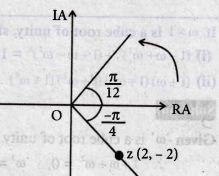
10.
\(\theta =\frac { \pi }{ 3 } \)
Given z = 2-2i
θ = \(\frac { \pi }{ 3 } \)
Let z = 2-2i = r(cos θ + i sin θ)
r =\(\sqrt { { 2 }^{ 2 }+(-2)^{ 2 } } =\sqrt { 4+4 } =\sqrt { 8 } =2\sqrt { 2 } \)
α = \(\\ tan^{ -1 }\left| \frac { y }{ x } \right| =tan^{ -1 }\left| \frac { -2 }{ 2 } \right| \)
= tan-1(1) = \(\frac { \pi }{ 4 } \)
The complex number 2-2i lie in the IV quadrant
∴ θ = -α = - \(\frac { \pi }{ 4 } \) [∵ x is +ve, y is -ve]
∴ 2-2i = 2\(\sqrt{2}\)\(\left[ cos\left( -\frac { \pi }{ 4 } \right) +isin\left( -\frac { \pi }{ 4 } \right) \right] \)
Z = \(2\sqrt { 2 } { e }^{ -i\frac { \pi }{ 4 } }\) ......... (1) [By uler'e formula]
Th rotation of z by θ radians in the counter clockwise direction about the origin in zeiθ
∴ Rotaton of z is \(z{ e }^{ i\frac { \pi }{ 3 } }\)
= \(2\sqrt { 2 } { e }^{ -i\frac { \pi }{ 4 } }.{ e }^{ i\frac { \pi }{ 3 } }\) [using (1)]
= \(2\sqrt { 2 } \left[ { e }^{ \left( i\frac { \pi }{ 3 } -\frac { \pi }{ 4 } \right) } \right] =2\sqrt { 2 } e^{ i\frac { \pi }{ 12 } }\)
11.
Using the given value for z1 and z2 the value of \(\frac { { z }_{ 1 } }{ { z }_{ 2 } } =\frac { 3-2i }{ 6+4 } =\frac { 3-2i }{ 6+4i } \times \frac { 6-4i }{ 6-4i } \)
= \(\frac { \left( 18-8 \right) +i\left( 12-12 \right) }{ { 6 }^{ 2 }+{ 4 }^{ 2 } } =\frac { 10-24i }{ 52 } =\frac { 10 }{ 52 } =\frac { 24i }{ 52 } \)
= \(\frac { 5 }{ 26 } -\frac { 6 }{ 13 } i\)
12.
(c)
\(\frac { 53 }{ 85 } \)
13.
(d)
|z| = \(\frac { \sqrt { 3 } }{ 2 } \), arg (z) = tan-1\(\left( \frac { 1 }{ \sqrt { 2 } } \right) \)
14.
(b)
15.
(a)
1
16.
(d)
\(\sqrt { 5 } +2\)
17.
Let z = x+iy be the given complex number
∴ \(\bar { z } \) = x-iy
z\(\bar { z } \) = (x+iy) (x-iy) = x2+y2
∴ z\(\bar { z } \) -(2+3i)z -(2-3i)\(\bar { z } \)+9
⇒ x2+y2-(2+3i)(x+iy)-(2-3i)(x-iy)+9 = 0
⇒ x2+y2-[2x+2iy+3ix+i2y] - [2x-2iy-3ix+3i2y]+9 = 0
\(\Rightarrow x^{2}+y^{2}-2 x -\not 2 i y-\not 3i x +3 y-2 x+\not 2 i y+\not 3 i x+3 y+9=0 \)
⇒ x2+y2-4x+6y+9 = 0
Here 2u = -4 ⇒ u = -2
2v = 6 ⇒ v = 3 and d = 9
∴ Centre of the circle is (-u, -v) = (2, -3)
Radius =\(\sqrt { { u }^{ 2 }+{ v }^{ 2 }-d } =\sqrt { 4+9-9 } \)
=\(\sqrt { 4 } \) = 2 units
Hence, the centre of the circle is (2, -3) and radius is 2 units.
18.
Let 2-2i = r(cosθ + isinθ)
r =\(\sqrt { { 2 }^{ 2 }+(-2)^{ 2 } } =\sqrt { 4+4 } =\sqrt { 8 } =2\sqrt { 2 } \)
The principal value α =tan-1\(\left| \frac { y }{ x } \right| =tan^{ -1 }\left| \frac { -z }{ z } \right| |\)
= tan-1(1) = \(\frac { \pi }{ 4 } \)
Since the complex number 2 - 2i lies in the quadrant
θ = -α = -\(\frac { \pi }{ 4 } \)
∴ 2-2i = \(2\sqrt { 2 } \left[ cos\left( -\frac { \pi }{ 4 } \right) +isin\left( \frac { \pi }{ 4 } \right) \right] ^{ \frac { 1 }{ 3 } }\)
∴ \((2\sqrt { 2 } )^{ \frac { 1 }{ 3 } }\left[ cos\left( -\frac { \pi }{ 4 } \right) +isin\left( \frac { \pi }{ 4 } \right) \right] ^{ \frac { 1 }{ 3 } }\)
= \(8^{ \frac { 1 }{ 6 } }\left[ cos\frac { 1 }{ 3 } \left( 2k\pi -\frac { \pi }{ 4 } \right) +isin\frac { 1 }{ 3 } \left( 2k\pi -\frac { \pi }{ 4 } \right) \right] \)
k = 0, 1, 2
The roots are
∴ When k = 0, \(8^{ \frac { 1 }{ 6 } }cis\left( -\frac { \pi }{ 12 } \right) \)
when k = 1, \(8^{ \frac { 1 }{ 6 } }cis\left( \frac { 7\pi }{ 12 } \right) \)
when k = 2, \(8^{ \frac { 1 }{ 6 } }cis\left( \frac { 15\pi }{ 12 } \right) \)
∴ The product of the root
= \(8^{ \frac { 1 }{ 6 } }cis\left( -\frac { \pi }{ 12 } +\frac { 7\pi }{ 12 } +\frac { 15\pi }{ 12 } \right) \)
= \(8^{ \frac { 1 }{ 6 } }cis\left( \frac { 21\pi }{ 12 } \right) =8^{ \frac { 1 }{ 6 } }cis\left( \frac { 7\pi }{ 12 } \right) \)
= \(8^{ \frac { 1 }{ 6 } }cis\left( 2\pi -\frac { \pi }{ 4 } \right) =8^{ \frac { 1 }{ 6 } }cis\left( -\frac { \pi }{ 4 } \right) \)
= \(8^{ \frac { 1 }{ 6 } }\left[ cos\left( -\frac { \pi }{ 4 } \right) +isin\left( -\frac { \pi }{ 4 } \right) \right] \)
= \(8^{ \frac { 1 }{ 6 } }\left[ cos\left( \frac { \pi }{ 4 } \right) +isin\left( \frac { \pi }{ 4 } \right) \right] \)
= \(8^{ \frac { 1 }{ 6 } }\left[ \frac { 1 }{ \sqrt { 2 } } -\frac { i }{ \sqrt { 2 } } \right] =2^{ 3\times \frac { 1 }{ 6 } }\left( \frac { 1-i }{ \sqrt { 2 } } \right) =2^{ 1/2 }\left( \frac { 1-i }{ \sqrt { 2 } } \right) \)
= 1-i
19.
z3 = -27 = (-1 \(\times\) 3)3 = -1 \(\times\) 33
z = \((-1)^{ \frac { 1 }{ 3 } }\times 3^{ 3\times \frac { 1 }{ 3 } }=(-1)^{ \frac { 1 }{ 3 } }\)\(\times\) 3
∴ z = 3\(\left[ cos\pi +isin\pi \right] ^{ \frac { 1 }{ 3 } }\)
[∵ cos π = -1 and sin π = 0]
= 3\(\left[ cos\frac { 1 }{ 3 } (2k\pi +\pi )isin\frac { 1 }{ 3 } (2k\pi +\pi ) \right] \)
k = 0, 1, 2
When k = 0,
z = 3\(\left[ cos\frac { 1 }{ 3 } (\pi )isin\frac { 1 }{ 3 } (\pi ) \right] =3cos\frac { \pi }{ 3 } \)
When k = 1
z = 3\(\left[ cos\frac { 1 }{ 3 } (3\pi )isin\frac { 1 }{ 3 } (3\pi ) \right] \)
= 3[cos π + i sin π] = 3(-1+0)
When k = 2
z = 3\(\left[ cos\frac { 1 }{ 3 } (5\pi )isin\frac { 1 }{ 3 } (5\pi ) \right] =3\left[ cos5\frac { \pi }{ 3 } \right] \)
Hence, the roots are 3 cis\(\frac { \pi }{ 3 } \), -3, 3 c is 5\(\frac { \pi }{ 3 } \)

12th Standard Syllabus & Materials
12th Standard
TN 12th Computer Applications களப்பெயர் முறைமை (DNS) Sample Question Papers Study Material - QB365 Set A
NEW12th Standard
TN 12th Computer Applications வலையமைப்பு எடுத்துக்காட்டுகள் மற்றும் நெறிமுறைகள் Sample Question Papers Study Material - QB365 Set A
NEW12th Standard
TN 12th Computer Applications கணினி வலையமைப்பு ஓர் அறிமுகம் Sample Question Papers Study Material - QB365 Set A
NEW12th Standard
TN 12th Computer Applications PHP-உடன் MySQL-ஐ இணைத்தல் Sample Question Papers Study Material - QB365 Set A



Tamilnadu Stateboard 12th Standard Subjects
Maths

Chemistry

Physics

Biology

Computer Science

Business Maths and Statistics

Economics

Commerce

Accountancy

History

Computer Applications
Biology
Computer Technology
Computer Applications
Computer Science
Business Maths and Statistics
Commerce
Economics
Maths
Chemistry
Physics
Computer Technology
History
Accountancy

Tamil

English

French
Tamilnadu Stateboard Standards

