
 100% FREE ACCESS
12th Standard Syllabus & Materials
12th Standard
TN 12th Computer Applications மின்னணு தரவு பரிமாற்றம் Sample Question Papers Study Material - QB365 Set A
NEW12th Standard
TN 12th Computer Applications மின் - வணிக பாதுகாப்பு அமைப்புகள் Sample Question Papers Study Material - QB365 Set A
NEW12th Standard
TN 12th Computer Applications மின்னணு செலுத்தல் முறைகள் Sample Question Papers Study Material - QB365 Set A
NEW12th Standard
TN 12th Computer Applications மின் - வணிகம் Sample Question Papers Study Material - QB365 Set A
NEW12th Standard
TN 12th Computer Applications திறந்த மூல கருத்துருக்கள் Sample Question Papers Study Material - QB365 Set A
NEW12th Standard
TN 12th Computer Applications வலையமைப்பு வடமிடல் Sample Question Papers Study Material - QB365 Set A

Published on: 02/01/2020
Differentials and Partial Derivatives
Download Tamil Nadu 12th Standard Maths question papers, model tests, one-mark questions, important questions, and public exam papers in PDF format. Free study materials and answer keys for TN State Board students.
Questions + Answers key
Take MCQ Maths Test1.
Using differentials find the approximate value of tan 46° if it is given that 10 = 0.01745 radians
2.
Let g(x, y) = \(\frac { { x }^{ 2 }y }{ { x }^{ 4 }+{ y }^{ 2 } } \) for (x, y) ≠ (0, 0) and f(0, 0) = 0
Show that \(\begin{matrix} lim \\ (x,y)\rightarrow (0,0) \end{matrix}\) g(x, y) = 0 along every line y = mx, m ∈ R
3.
Assuming log10e = 0.4343, find an approximate value of log10 1003
4.
Find a linear approximation for the following functions at the indicated points.
f(x) = x3 - 5x + 12, x0 = 2
5.
IF u(x, y) = x2 + 3xy + y2, x, y, ∈ R, find tha linear appraoximation for u at (2, 1)
6.
If f (x, y) = 2x3 - 11x2y + 3y3, prove that \(x\frac { \partial f }{ \partial x } +y\frac { \partial f }{ \partial y } =3f\)
7.
Find differential dy for each of the following function
y = (3 + sin(2x)) 2/3
8.
Find \(\frac { \partial f }{ \partial x } ,\frac { \partial f }{ \partial y } ,\frac { { \partial }^{ 2 }f }{ \partial { x }^{ 2 } } ,\frac { { \partial }^{ 2 }f }{ { \partial y }^{ 2 } } \) at x = 2, y = 3 if f(x,y) = 2x2 + 3y2 - 2xy
9.
prove that g(x, y) = x log\(\left( \frac { y }{ x } \right) \) is homogeneous; what is the degree? Verify Euler's Theorem for g.
10.
For each of the following functions find the gxy, gxx, gyy and gyx.
g(x, y) = log (5x + 3y)
11.
The trunk of a tree has diameter 30 cm. During the following year, the circumference grew 6cm.
(i) Approximately, how much did the tree's diameter grow?
(ii) What is the percentage increase in area of the tree's cross-section?
12.
13.
If f(x, y, z) = sin (xy) + sin (yz) + sin (zx) then fxx is _____________
-y sin (xy) + z2 cos (xz)
y sin (xy) - z2 cos (xz)
y sin (xy) + z2 cos (xz)
-y2 sin (xy) - z2 cos (xz)
14.
If u(x, y) = x2+ 3xy + y - 2019, then \(\left.\frac{\partial u}{\partial x}\right|_{(4,-5)}\) is equal to
-4
-3
-7
13
15.
If \(g(x, y)=3 x^{2}-5 y+2 y^{2}, x(t)=e^{t}\) and y(t) = cos t, then \(\frac{dg}{dt}\) is equal to
6e2t + 5 sin t - 4 cos t sin t
6e2t- 5 sin t + 4 cos t sin t
3e2t+ 5 sin t + 4 cos t sin t
3e2t - 5 sin t + 4 cos t sin t
16.
If u = log \(\left( \frac { { x }^{ 2 }+{ y }^{ 2 } }{ xy } \right) \) then
(1) u is a homogeneous function
(2) \(x\frac { { \partial }u }{ \partial { x } } +y\frac { { \partial }u }{ { \partial y } } \) = 0
(3) \(\frac { { x }^{ 2 }+{ y }^{ 2 } }{ xy } \) is a homogeneous function
(4) \(\frac { { x }^{ 2 }+{ y }^{ 2 } }{ xy } \) is a homogeneous function of degree 0.
1.
Let f(x) = tan x, xo= 45, dx = 1
f(xo) = f(45) = tan 45 = 1
f'(x) = sec2 x dx
f'(xo) = f'(45) = sec2 45 (1)
\((\sqrt{2})^2\) =2 (0.01745)
= 0.03490
∴ tan 46° = f(xo) +f'(xo) dx
=- 1 + 0.03490 = 1.03490
2.
Given g(x, y) = \(\frac { { x }^{ 2 }y }{ { x }^{ 4 }+{ y }^{ 2 } } \)
Given y = mx
∴ g(x, y) = \(\frac { { x }^{ 2 }.mx }{ { x }^{ 4 }+{ m }^{ 2 }{ x }^{ 2 } } \)
= \(\frac { m{ x }^{ 3 } }{ { x }^{ 2 }({ x }^{ 2 }+{ m }^{ 2 }) } =\frac { mx }{ { x }^{ 2 }+{ m }^{ 2 } } \)
Now, \(\begin{matrix} lim \\ (x,y)\rightarrow (0,0) \end{matrix}g(x,y)=\frac { m(0) }{ { 0 }^{ 2 }+{ m }^{ 2 } } =\frac { 0 }{ { m }^{ 2 } } =0\) for all values of m
∴ \(\begin{matrix} lim \\ (x,y)\rightarrow (0,0) \end{matrix}\) g(x, y) = 0 along every line y = mx, m ∈ R.
3.
log10e = 0.4343 to find log10g 1003
f(1000) = log101000 = log10103 = 3log10103 = 3 log1010
= 3(1) = 3
f'(x) = \(\frac1x\). log10e
f'(1000) = \(\frac{1}{1000}\)(0.4343)
∴ L(x) = f(x0) f'(x0) (x - x0)
= 3 + \(\frac{1}{1000}\) (0.4343) (3)
= 3 + \(\frac{1.3029}{1000}\)
= 3 + 0.0013029
log101003 = 3.0013029
4.
f(x) = x3 - 5x + 12, x0 = 2
f(xo) = 23 - 5(2) + 12
= 8 - 10 + 12 = 10
f'(x) = 3x2 - 5
⇒ f'(xo) = 3 (22) - 5 = 7
∴ L(x) = f(xo) +f'(xo) (x - xo)
= 10 + 7(x - 2)
= 10 + 7x - 14
L(x) = 7x- 4
5.
Given u(x, y) = x2 + 3xy + y2
u(xo, yo) = u(2,1)
= 22 + 3(2)(1) + 12
= 4 + 6 + 1 = 11
\(\frac { \partial u }{ \partial x } \) = 2x+ 3y
\({ \left( \frac { \partial u }{ \partial x } \right) }_{ (2,1) }\)= 2 + 3 = 5
\(\frac { \partial u }{ \partial y } \) = 3x+ 2y
\({ \left( \frac { \partial u }{ \partial y } \right) }_{ (2,1) }\) = 6 + 2 = 8
Linear approximation
L(x,y) = U(xo, yo) + \({ \left( \frac { \partial u }{ \partial x } \right) }_{ ({ x }_{ 0 },{ y }_{ 0 }) }\) (x - xo) + \({ \left( \frac { \partial u }{ \partial y} \right) }_{ ({ x }_{ 0 }{ ,y }_{ 0 }) }\)(y - yo)
L (x,y) = 11 + 5 (x - 2) + 8 (y - 1)
= 11 + 5x - 10 + 8y - 8
L(x,y) = 5x + 8y - 7
6.
Given f(x, y) = 2x3 - 11x2y + 3y3
f(tx, ty) = 2t3 x3 - 11 t2 x2ty + 3t3y3
= t3(2x3 - 11x2y + 3y3)
= t3. f(x,y)
∴ f (x, y) is a homogeneous function of degree 3.
∴ By Euler's theorem,
\(x\frac { \partial f }{ \partial x } +y\frac { \partial f }{ \partial y } =3f\)
7.
Given = (3 + sin(2x)) 2/3
Taking differentilas,
dy = \(\frac23\)(3 + sin(2x)) 2/3-1 (cos 2x) (2)dx
dy = \(\frac { 4 }{ 3 } .\frac { cos2x }{ { (3+sin2x) }^{ \frac { 1 }{ 3 } } } dx\)
8.
Given f(x, y) = 2x2 + 3y2 - 2xy
\(\frac { \partial f }{ \partial x } \) = 4x - 8y
\({ \left( \frac { \partial f }{ \partial x } \right) }_{ (2,3) }\) = 4(2) - 8(3)
= 8 - 24 = -16
\(\frac { \partial f }{ \partial y } \) = 6y-8x
\({ \left( \frac { \partial f }{ \partial y } \right) }_{ (2,3) }\) = 6(3)- 8(2)
= 18-16 = 2
\(\frac { { \partial }^{ 2 }f }{ { \partial x }^{ 2 } } =\frac { \partial }{ \partial x } { \left( \frac { \partial f }{ \partial x } \right) }=4\)
\(\frac { { \partial }^{ 2 }f }{ { \partial y }^{ 2 } } =\frac { \partial }{ \partial y } { \left( \frac { \partial f }{ \partial y } \right) }=6\)
9.
Given g (x, y) = x log \(\left( \frac { y }{ x } \right) \)
g(λx, λy) = λx log \(\left( \frac { \lambda y }{ \lambda x } \right) \)
= λx log \(\left( \frac { \lambda y }{ \lambda x } \right) \)
= λ x log \(\left( \frac { y }{ x } \right) \)
= λ1 g (x, y)
∴ g (x, y) is a homogeneous function of degree 1.
To verify \(x\frac { \partial g }{ \partial x } +y\frac { \partial g }{ \partial y } =1g\) [Euler's theorem]
∴ \(\frac { \partial g }{ \partial x } \) = \(x.\frac { 1 }{ \frac { y }{ x } } \left( -\frac { y }{ { x }^{ 2 } } \right) +log\left( \frac { y }{ x } \right) \)(1)
= \(-\frac { { x }^{ 2 } }{ y } \left( \frac { y }{ { x }^{ 2 } } \right) log\left( \frac { y }{ x } \right) \)
= - 1 + log \(\left( \frac { y }{ x } \right) \)
\(\frac { \partial g }{ \partial y } =x.\frac { 1 }{ \left( \frac { y }{ x } \right) } \left( \frac { 1 }{ x } \right) =\frac { 1 }{ \frac { y }{ x } } =\frac { x }{ y } \)
Consider \(x\frac { \partial g }{ \partial x } +y\frac { \partial g }{ \partial y } \)
= \(x\left( -1+log\frac { y }{ x } \right) +y\left( \frac { x }{ y } \right) \)
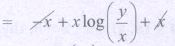
= x log \(\left( \frac { y }{ x } \right) \) = g
\(\therefore x\frac { \partial g }{ \partial x } +y\frac { \partial g }{ \partial y } \) = 1(g)
Hence, Euler's theorem is verified.
10.
g(x, y) = log (5x + 3y)
\({ g }_{ x }=\frac { 1 }{ 5x+3y } (5)=\frac { 5 }{ 5x+3y } \)
\({ g }_{ y }=\frac { 1 }{ 5x+3y } (3)=\frac { 3 }{ 5x+3y } \)
\({ g }_{ xy }=\frac { \partial }{ \partial x } ({ g }_{ y })\)
= 3(-1)(5x + 3y)-2 (5)
\(=\frac { -15 }{ { (5x+3y) }^{ 2 } } \)
\({ g }_{ xx }=\frac { \partial }{ \partial x } ({ g }_{ x })=\frac { -5 }{ ({ 5x+3y) }^{ 2 } } (5)\)
\(=\frac { -25 }{ ({ 5x+3y) }^{ 2 } } \)
\({ g }_{ yy }=\frac { \partial }{ \partial y } ({ g }_{ y })=\frac { -3 }{ ({ 5x+3y) }^{ 2 } } (3)\)
\(=\frac { -9 }{ ({ 5x+3y) }^{ 2 } } \)
\({ g }_{ yx }=\frac { \partial }{ \partial y } ({ g }_{ x })=\frac { -5 }{ 5x+3y } (3)\)
\(=\frac { -15 }{ ({ 5x+3y) }^{ 2 } } \)
11.
Diameter = 30 cm
Radius = 15 cm
Circumference (c) = 2πr
\(\frac{dc}{dr}\) = 2π(3) = 6πcm
dc = 2πdr
\(\frac{6}{2π}\) cm = dr
\(\frac{3}{π}\) cm = dr
Approximate growth of the diameter
= 2dr = 2 \(\times\) \(\frac{3}{π}\) cm = \(\frac{6}{2π}\)cm
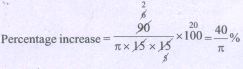
(ii) A = πr2
dA = π 2r dr
\(d \mathrm{~A}=\not \pi 2(15) \frac{3}{\not \pi} \mathrm{cm}^{2}\)
dA = 90 cm2
Area = πr2 = π \(\times\)15 \(\times\) 15 cm2
12.
(b)
13.
(d)
-y2 sin (xy) - z2 cos (xz)
14.
(c)
-7
15.
(a)
6e2t + 5 sin t - 4 cos t sin t
16.
(4) \(\frac { { x }^{ 2 }+{ y }^{ 2 } }{ xy } \) is a homogeneous function of degree 0.

12th Standard Syllabus & Materials
12th Standard
TN 12th Computer Applications களப்பெயர் முறைமை (DNS) Sample Question Papers Study Material - QB365 Set A
NEW12th Standard
TN 12th Computer Applications வலையமைப்பு எடுத்துக்காட்டுகள் மற்றும் நெறிமுறைகள் Sample Question Papers Study Material - QB365 Set A
NEW12th Standard
TN 12th Computer Applications கணினி வலையமைப்பு ஓர் அறிமுகம் Sample Question Papers Study Material - QB365 Set A
NEW12th Standard
TN 12th Computer Applications PHP-உடன் MySQL-ஐ இணைத்தல் Sample Question Papers Study Material - QB365 Set A



Tamilnadu Stateboard 12th Standard Subjects
Maths

Chemistry

Physics

Biology

Computer Science

Business Maths and Statistics

Economics

Commerce

Accountancy

History

Computer Applications
Biology
Computer Technology
Computer Applications
Computer Science
Business Maths and Statistics
Commerce
Economics
Maths
Chemistry
Physics
Computer Technology
History
Accountancy

Tamil

English

French
Tamilnadu Stateboard Standards

