
 100% FREE ACCESS
12th Standard Syllabus & Materials
12th Standard
TN 12th Computer Applications மின்னணு தரவு பரிமாற்றம் Sample Question Papers Study Material - QB365 Set A
NEW12th Standard
TN 12th Computer Applications மின் - வணிக பாதுகாப்பு அமைப்புகள் Sample Question Papers Study Material - QB365 Set A
NEW12th Standard
TN 12th Computer Applications மின்னணு செலுத்தல் முறைகள் Sample Question Papers Study Material - QB365 Set A
NEW12th Standard
TN 12th Computer Applications மின் - வணிகம் Sample Question Papers Study Material - QB365 Set A
NEW12th Standard
TN 12th Computer Applications திறந்த மூல கருத்துருக்கள் Sample Question Papers Study Material - QB365 Set A
NEW12th Standard
TN 12th Computer Applications வலையமைப்பு வடமிடல் Sample Question Papers Study Material - QB365 Set A

Published on: 20/01/2020
Download Tamil Nadu 12th Standard Maths question papers, model tests, one-mark questions, important questions, and public exam papers in PDF format. Free study materials and answer keys for TN State Board students.
Questions + Answers key
Take MCQ Maths Test1.
If A = \(\left[ \begin{matrix} 4 & 3 \\ 2 & 5 \end{matrix} \right] \), find x and y such that A2 + xA + yI2 = O2. Hence, find A-1.
2.
A population grows at the rate of 2% per year. How long does it take for the population to double?
3.
Verify (p ∧ ~p) ∧ (~q ∧ p) is a tautlogy, contradiction or contingency.
4.
Prove that \(\int _{ 0 }^{ \frac { \pi }{ 2 } }{ sin2x\ log(tan\ x)dx } =0\)
5.
Using differential find the approximate value of cos 61; if it is given that sin 60° = 0.86603 and 10 = 0.01745 radians.
6.
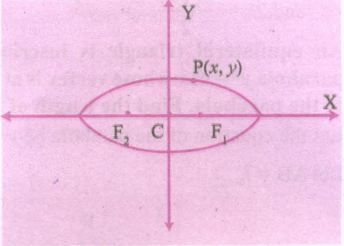
A kho-kho player In a practice session while running realises that the sum of tne distances from the two kho-kho poles from him is always 8m. Find the equation of the path traced by him of the distance between the poles is 6m.
7.
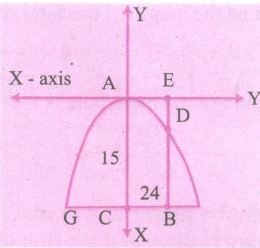
The girder of a railway bridge is a parabola with its vertex at the highest point 15 m above the ends. If the span is 120 m, find the height of the bridge at 24 m from the middle point.
8.
Find the domain of the following functions
(i) f(x) = sin-1(2x - 3)
(ii) f(x) = sin-1x + cos x
9.
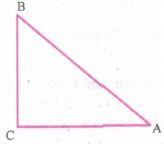
Show that the points A, B, C with position vector \(2\overset { \wedge }{ i } -\overset { \wedge }{ j } +\overset { \wedge }{ k } ,\overset { \wedge }{ i } -3\overset { \wedge }{ j } -5\overset { \wedge }{ k } \) and \(3\overset { \wedge }{ i } -4\overset { \wedge }{ j } +4\overset { \wedge }{ k } \) respectively are the vector of a right angled, triangle. Also, find the remaining angles of the triangle.
10.
For what value of λ, the system of equations x + y + z = 1, x + 2y + 4z = λ, x + 4y + 10z = λ2 is consistent.
11.
If c ≠ 0 and \(\frac { p }{ 2x } =\frac { a }{ x+x } +\frac { b }{ x-c } \) has two equal roots, then find p.
12.
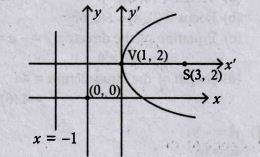
Find the vertex, focus, equation of directrix and length of the latus rectum of the following: y2−4y−8x+12 = 0
13.
Solve the following systems of linear equations by Cramer’s rule:
3x + 3y − z = 11, 2x − y + 2z = 9, 4x + 3y + 2z = 25.
14.
Determine the values of λ for which the following system of equations (3λ − 8)x + 3y + 3z = 0, 3x + (3λ − 8)y + 3z = 0, 3x + 3y + (3λ − 8)z = 0. has a non-trivial solution.
15.
Find the non-parametric form of vector equation of the plane passing through the point (1, −2, 4) and perpendicular to the plane x + 2y −3z = 11 and parallel to the line \(\frac { x+7 }{ 3 } =\frac { y+3 }{ -1 } =\frac { z }{ 1 } \)
16.
Solve the equation z3+ 8i = 0, where \(z \in \mathbb{C}\)
17.
An engineer designs a satellite dish with a parabolic cross section. The dish is 5 m wide at the opening, and the focus is placed 1.2 m from the vertex
(a) Position a coordinate system with the origin at the vertex and the x -axis on the parabola’s axis of symmetry and find an equation of the parabola.
(b) Find the depth of the satellite dish at the vertex.
18.
In a T20 match, a team needed just 6 runs to win with 1 ball left to go in the last over. The last ball was bowled and the batsman at the crease hit it high up. The ball traversed along a path in a vertical plane and the equation of the path is y = ax2 + bx + c with respect to a xy-coordinate system in the vertical plane and the ball traversed through the points (10, 8), (20, 16) (40, 22) can you conclude that the team won the match?
Justify your answer. (All distances are measured in metres and the meeting point of the plane of the path with the farthest boundary line is (70, 0).)
19.
Find all zeros of the polynomial x6- 3x5- 5x4 + 22x3- 39x2- 39x + 135, if it is known that 1+2i and \(\sqrt{3}\) are two of its zeros.
20.
Find the vertex, focus, directrix, and length of the latus rectum of the parabola x2−4x−5y−1 = 0.
1.
Since A2 = \(\left[ \begin{matrix} 4 & 3 \\ 2 & 5 \end{matrix} \right] \left[ \begin{matrix} 4 & 3 \\ 2 & 5 \end{matrix} \right] =\left[ \begin{matrix} 22 & 27 \\ 18 & 31 \end{matrix} \right] \).
A2 + xA + yI2 = O2 ⇒ \(\left[ \begin{matrix} 22 & 27 \\ 18 & 31 \end{matrix} \right] +x\left[ \begin{matrix} 4 & 3 \\ 2 & 5 \end{matrix} \right] +y\left[ \begin{matrix} 1 & 0 \\ 0 & 1 \end{matrix} \right] =\left[ \begin{matrix} 0 & 0 \\ 0 & 0 \end{matrix} \right] \)
⇒ \(\left[ \begin{matrix} 22+4x+y & 27+3x \\ 18+2x & 31+5x+y \end{matrix} \right] =\left[ \begin{matrix} 0 & 0 \\ 0 & 0 \end{matrix} \right] \).
So, we get 22 + 4x + y = 0, 31 + 5x + y = 0, 27 + 3x = 0 and 18 + 2x = 0.
Hence x = −9 and y = 14. Then, we get A2 - 9A + 14I2 = O2.
Postmultiplying this equation by A-1, we get A - 9I2 + 14A-1 = O2. Hence, we get
A-1 = \(\frac { 1 }{ 14 } \) (9I2 - A) = \(\frac { 1 }{ 14 } \left( 9\left[ \begin{matrix} 1 & 0 \\ 0 & 1 \end{matrix} \right] -\left[ \begin{matrix} 4 & 3 \\ 2 & 5 \end{matrix} \right] \right) =\frac { 1 }{ 14 } \left[ \begin{matrix} 5 & -3 \\ -2 & 4 \end{matrix} \right] \).
2.
Let Po be the initial population and the population after t year be P.
Given \(\frac { dp }{ dt } =\frac { 2p }{ 100 } \Rightarrow \frac { dp }{ dt } =\frac { p }{ 50 } \)
⇒ \(\frac { dp }{ p } =\frac { dt }{ 50 } \Rightarrow \int { \frac { dp }{ p } } =\int { \frac { dt }{ 50 } } \)
⇒ log p =\(\frac { t }{ 50 } \) + c ...(1)
when t = 0, p = 0
⇒ log p0 = 0+c ⇒ log p0 ....(1)
∴ (1) becomes, log p =\(\frac { t }{ 50 } \)+log P0.
⇒ log\(\left( \frac { P }{ { p }_{ 0 } } \right) =\frac { t }{ 50 } \)
⇒ t = 50 log\(\left( \frac { P }{ { p }_{ 0 } } \right) \)
when p = 2p0, t = 50 log\(\left( \frac { 2P_{ 0 } }{ { p }_{ 0 } } \right) \) = 50 log 2
= 50(0.3) = 15 years.
Hence the population doubles in 15 years.
3.
| p | q | ~p | p∧~p) | ~q | (~q)∧p | (p∧~p) ∧ (~q∧p) |
| T | T | F | F | F | F | F |
| T | F | F | F | T | T | F |
| F | T | T | F | F | F | F |
| F | F | T | F | T | F | F |
Since the entries in the last column are F, (p ∧ ~p) ∧ (~q ∧ P) is a contradiction
4.
Let \(I=\int _{ 0 }^{ \frac { \pi }{ 2 } }{ sin2x \ log(tan \ x)dx } \) ...(1)
Using the property \(\int _{ 0 }^{ a }{ f(x) } dx=\int _{ 0 }^{ a }{ f(a-x) } dx\) we get
\(I=\int _{ 0 }^{ \frac { \pi }{ 2 } }{ sin \ 2(\frac { \pi }{ 2 } -x)log \ tan(\frac { \pi }{ 2 } -x)dx } \)
\(=\int _{ 0 }^{ \frac { \pi }{ 2 } }{ sin(\pi -2x) } log\ cot \ x \ dx\)
\(=\int _{ 0 }^{ \frac { \pi }{ 2 } }{ sin2 \ x \ log\left( \frac { 1 }{ tanx } \right) } dx\)
\(=\int _{ 0 }^{ \frac { \pi }{ 2 } }{ sin2x( } log1-log \ tan \ x)dx\)
[\(\because \) log 1 = 0]
\(=-\int _{ 0 }^{ \frac { \pi }{ 2 } }{ sin \ 2 \ x } log \ (tan \ x)d\) ...(2)
\(\therefore (1)+(2)\rightarrow \)
\(2I=\int _{ 0 }^{ \frac { \pi }{ 2 } }{ sin2x } log \ (tanx)dx-\int _{ 0 }^{ \frac { \pi }{ 2 } }{ sin \ 2 \ x } \ log(tan \ x)dx=0\)
\(\therefore I=0\)
5.
Let f(x) = cos x, x = 60° dx = 1°
f(xo) = cos 60° = \(\frac12\) = 0.5
f'(x) = - sinx dx
f'(xo) = - sin xo dx
f'(60) = - sin 60° (1°)
= - (0.86603) (0.01745)
= - 0.0154
∴ f(x) = f(xo) +f(xo) dx
f(61) = 0.5 - 0.0154
∴ tan 46° = f(xo) +f(xo) dx
cos 61° = 0.4849
6.
Given F1P + F2P = 8
By the focal property of ellipse
F1P + F2P = 2a
∴ 2a = 8 ⇒ a = 4
and distance between the foci = F1F2 = 6
2ae = 6 ⇒ ae = 3
∴ 4(e) = 3 ⇒ e \(\frac34\)
∴ b2 = a2(1- e2)
= \(16\left( { 1-\left( \frac { 3 }{ 4 } \right) }^{ 2 } \right) =16\left( 1-\frac { 9 }{ 10 } \right) =16\left( \frac { 7 }{ 16 } \right) =7\)
∴ The path traced by him is an ellipse and its equation is \(\frac { { x }^{ 2 } }{ { a }^{ 2 } } +\frac { { y }^{ 2 } }{ { b }^{ 2 } } =1\)
⇒ \(\frac { { x }^{ 2 } }{ 16 } -\frac { { y }^{ 2 } }{ 7 } \) = 1
7.
Let us take the axis AX as the and the tangent AY at A as y-axis.
Equation of the parabola is y2 = 4ax
CA 15, FG = 120
CF = CG= 60
F is (15, 60)
Since F lies on (1), 602 = Aa(15) ∴ ⇒ a = 60
y2 = 240x
When y = 24, 242 = 240(x)
⇒ x = \(\frac { 24\times 24 }{ 240 } \)
x = \(\frac{24}{10}\) = \(\frac{12}{5}\) = 2.4
From the diagram
BD = BE - ED = 15-2.4 = 12.6m.
Hence the required height is 12.6 m.
8.
The domain of sin-1x is [-1, 1]
\(\therefore\) f(x) = sin-1(2x - 3) is defined for all x, satisfying
\(-1\le 2x-3\le 1\)
\(\Rightarrow 3-1\le 2x\le 1+3\)
\(\Rightarrow 2\le 2x\le 4\Rightarrow 1\le x\le 2\Rightarrow x\epsilon \left[ 1,2 \right] \)
\(\therefore\) Domain of f(x) = sin-1(2x - 3) is [1, 2].
(ii) The domain of f(x) is [-1, 1] and that of cosx is R
\(\therefore\) Domain of f(x) = sin-1x + cos x is
\(\left[ -1,1 \right] \cap R=\left[ -1,1 \right] \)
9.
Given \(\overset { \rightarrow }{ OA } =2\overset { \wedge }{ i } -\overset { \wedge }{ j } +\overset { \wedge }{ k } ,\overset { \rightarrow }{ OB } =\overset { \wedge }{ i } -3\overset { \wedge }{ j } -5\overset { \wedge }{ k } ,\) and \(\overset { \rightarrow }{ OC } =3\overset { \wedge }{ i } -4\overset { \wedge }{ j } +4\overset { \wedge }{ k } \)
\(\therefore \overset { \rightarrow }{ AB } =\overset { \rightarrow }{ OB } -\overset { \rightarrow }{ OA } =-\overset { \wedge }{ i } -2\overset { \wedge }{ j } -6\overset { \wedge }{ k } \)
\(\overset { \rightarrow }{ BC } =\overset { \rightarrow }{ OC } -\overset { \rightarrow }{ OB } =2\overset { \wedge }{ i } -\overset { \wedge }{ j } +\overset { \wedge }{ k } \)
\(\overset { \rightarrow }{ CA } =\overset { \rightarrow }{ OA } -\overset { \rightarrow }{ OC } =\overset { \wedge }{ -i } +3\overset { \wedge }{ j } +5\overset { \wedge }{ k } \)
\(\overset { \rightarrow }{ AB } +\overset { \rightarrow }{ BC } +\overset { \rightarrow }{ CA } =\overset { \rightarrow }{ 0 } \)
Also, \(\overset { \rightarrow }{ BC } \). \(\overset { \rightarrow }{ CA } \)=\(\left( 2\overset { \wedge }{ i } -\overset { \wedge }{ j } +\overset { \wedge }{ k } \right) .\left( \overset { \wedge }{ -i } +3\overset { \wedge }{ j } +5\overset { \wedge }{ k } \right) \)
= -2 -3 + 5 = 0
\(\Rightarrow \overset { \rightarrow }{ BC } .\overset { \rightarrow }{ CA } \Rightarrow \angle BCA=\frac { \pi }{ 2 } \)
Hence, ABC is a right angled triangle.
\(\cos { A } =\frac { \overset { \rightarrow }{ AB } .\overset { \rightarrow }{ AC } }{ \left| \overset { \rightarrow }{ AB } \right| \left| \overset { \rightarrow }{ AC } \right| } \)
\(=\frac { \left( -\overset { \wedge }{ i } -2\overset { \wedge }{ j } -6\overset { \wedge }{ k } \right) .\left( \overset { \wedge }{ -i } -3\overset { \wedge }{ j } -5\overset { \wedge }{ k } \right) }{ \sqrt { 1+4+36 } .\sqrt { 1+9+25 } } \)
\(=\frac { 35 }{ \sqrt { 41 } .\sqrt { 35 } } =\sqrt { \frac { 35 }{ 41 } } =A={ Cos }^{ -1 }\left( \sqrt { \frac { 35 }{ 41 } } \right) \)
\(\cos { B } =\frac { \overset { \rightarrow }{ BA. } \overset { \rightarrow }{ BC } }{ \left| \overset { \rightarrow }{ BA } \right| \left| \overset { \rightarrow }{ BC } \right| } =\frac { \left( \overset { \wedge }{ i } +2\overset { \wedge }{ j } +6\overset { \wedge }{ k } \right) .\left( 2\overset { \wedge }{ i } -\overset { \wedge }{ j } +\overset { \wedge }{ k } \right) }{ \sqrt { 1+4+36 } +\sqrt { 4+1+1 } } \)
\(=\sqrt { \frac { 6 }{ 41 } } \Rightarrow B={ Cos }^{ -1 }\left( \sqrt { \frac { 6 }{ 41 } } \right) \)
10.
Augmented matrix = [A|B] = \(\left[ \begin{matrix} 1 & 1 & 1 \\ 1 & 2 & 4 \\ 1 & 4 & 10 \end{matrix}|\begin{matrix} 1 \\ \lambda \\ { \lambda }^{ 2 } \end{matrix} \right] \)
[A|B] = \(\overset { { R }_{ 2 }\rightarrow { R }_{ 2 }-{ R }_{ 1 }\\ { R }_{ 3 }\rightarrow { R }_{ 3 }-{ R }_{ 1 } }{ \longrightarrow } \left[ \begin{matrix} 1 & 1 & 1 \\ 0 & 1 & 3 \\ 0 & 3 & 9 \end{matrix}|\begin{matrix} 1 \\ \lambda -1 \\ { \lambda }^{ 2 }-1 \end{matrix} \right] \)
\(\overset { { R }_{ 3 }\rightarrow { R }_{ 3 }-3{ R }_{ 2 } }{ \longrightarrow } \left[ \begin{matrix} 1 & 1 & 1 \\ 0 & 1 & 3 \\ 0 & 0 & 0 \end{matrix}|\begin{matrix} 1 \\ \lambda -1 \\ { \lambda }^{ 2 }-1-3\lambda +3 \end{matrix} \right] \)
⟶ \(\left[ \begin{matrix} 1 & 1 & 1 \\ 0 & 1 & 3 \\ 0 & 0 & 0 \end{matrix}|\begin{matrix} 1 \\ \lambda -1 \\ { \lambda }^{ 2 }-3\lambda +2 \end{matrix} \right] \)
Here \(\rho\)(A) = 2
The given system of equations is consistent only when \(\rho\)([AIB]) = 2
\(\rho\)([AIB]) = 2 only when λ2-3λ + 2 = 0
⇒ (λ-1) (λ-2) = 0 ⇒ λ = 1 or λ = 2
∴ The given system is consistent when the values of A are 1 and 2.
11.
Given \(\frac { p }{ 2x } =\frac { a }{ x+x } +\frac { b }{ x-c } \)
\(\frac { p }{ 2x } =\frac { (a+b)x+c(-a) }{ { x }^{ 2 }-{ c }^{ 2 } } \)
⇒ P (x2 - c2) = 2 (a + b) x2 - 2c(a-b)x
⇒ (2a + 2b - p)x2 - 2c (a - b)x +pc2 = 0
This equation has equal roots
if b2-4ac = 0
⇒ c2(a-b)2 - pc2 (2a + 2b - b) = 0
⇒ (a - b)2 - 2p (a + b) +p2 = 0 [∵ c2 ≠ 0]
⇒ [p - (a + b)]2 = (a + b)2 - (a - b)2 = 4ab
⇒ p-(a+b) = 土2\(\sqrt{ab}\)
⇒ p-(a+b)土2\(\sqrt{ab}\) = (\(\sqrt{a}\) 土\(\sqrt{b}\))2
12.
y2 - 4y - 8x + 12 = 0
y2-4y = 8x-12
Adding 4 both sides, we get,
y - 4y + 4 = 8x - 12 + 4 = 8x - 8
⇒ (y - 2)2 = 8(x - 1)
This is a right open parabola and latus
rectum is 4a = 8 ⇒ a = 2.
(a) Vertex is (1, 2) ⇒ h = 1, k = 2
(b) focus is (h + a, 0 + k)
⇒ (1 + 2, 0 + 2)
⇒ (3, 2)
(c) Equation of directrix is x = h - a
⇒ x = 1-2
⇒ x = -1
(d) Length of latus rectum is 4a = 8 units.
13.
3x + 3y − z = 11, 2x − y + 2z = 9, 4x + 3y + 2z = 25.
Δ = \(\left| \begin{matrix} 3 & 3 & -1 \\ 2 & -1 & 2 \\ 4 & 3 & 2 \end{matrix} \right| \)
= \(3\left| \begin{matrix} -1 & 2 \\ 3 & 2 \end{matrix} \right| -3\left| \begin{matrix} 2 & 2 \\ 4 & 2 \end{matrix} \right| -1\left| \begin{matrix} 2 & -1 \\ 4 & 3 \end{matrix} \right| \)
= 3(-2-6)-3(4-8)-1(6+4)·
= 3(- 8) - 3(- 4) - 1(10)
= - 24 + 12 - 10 = - 22
Δ2 = \(\left| \begin{matrix} 11 & 3 & -1 \\ 9 & -1 & 2 \\ 25 & 3 & 2 \end{matrix} \right| \)
= \(11\left| \begin{matrix} -1 & 2 \\ 3 & 2 \end{matrix} \right| -3\left| \begin{matrix} 9 & 2 \\ 25 & 2 \end{matrix} \right| -1\left| \begin{matrix} 9 & -1 \\ 25 & 3 \end{matrix} \right| \)
= 11(-2-6)-3(18-50)-1(27+25)
= 11(-8)-3(-32)-1(52)
= -88+96-52 = -44
Δ2 = \(\left| \begin{matrix} 3 & 11 & -1 \\ 2 & 9 & 2 \\ 4 & 25 & 2 \end{matrix} \right| \)
= \(3\left| \begin{matrix} 9 & 2 \\ 25 & 2 \end{matrix} \right| -11\left| \begin{matrix} 2 & 2 \\ 4 & 2 \end{matrix} \right| -1\left| 2\begin{matrix} 2 & 9 \\ 4 & 25 \end{matrix} \right| \)
= 3(18 - 50) -11(4 - 8) - 1(50- 36)
= 3(- 32) - 11(- 4) - 1(14)
= -96+44-14 = - 66
Δ3 = \(\left| \begin{matrix} 3 & 3 & 11 \\ 2 & -1 & 9 \\ 4 & 3 & 25 \end{matrix} \right| \)
\(3\left| \begin{matrix} -1 & 9 \\ 3 & 25 \end{matrix} \right| -3\left| \begin{matrix} 2 & 9 \\ 4 & 25 \end{matrix} \right| -11\left| \begin{matrix} 2 & -1 \\ 4 & 3 \end{matrix} \right| \)
= 3(-25-27)-3(50-36)+ 11(6+4)
= 3(- 52) - 3(14) + 11(10)
= -156 - 42 + 110= - 88
∴ x = \(\frac { { \triangle }_{ 1 } }{ \triangle } =\frac { -44 }{ -22 } \) = 2
y = \(\frac { { \triangle }_{ 2 } }{ \triangle } =\frac { -66 }{ -22 } \) = 3
z = \(\frac { { \triangle }_{ 3 } }{ \triangle } =\frac { -88 }{ -22 } \) = 4
∴ Solution set is {2, 3, 4}
14.
Here the number of unknowns is 3. So, if the system is consistent and has a non-trivial solution, then the rank of the coefficient matrix is equal to the rank of the augmented matrix and is less than 3.
So the determinant of the coefficient matrix should be 0.
Hence we get
\(\left| \begin{matrix} 3\lambda -8 & 3 & 3 \\ 3 & 3\lambda -8 & 3 \\ 3 & 3 & 3\lambda -8 \end{matrix} \right| \) = 0 or \(\left| \begin{matrix} 3\lambda -2 & 3\lambda -2 & 3\lambda -2 \\ 3 & 3\lambda -8 & 3 \\ 3 & 3 & 3\lambda -8 \end{matrix} \right| \) = 0 (by applying R1 ➝ R1 + R2 + R3)
or (3λ - 2) \(\left| \begin{matrix} 1 & 1 & 1 \\ 3 & 3\lambda -8 & 3 \\ 3 & 3 & 3\lambda -8 \end{matrix} \right| \) = 0 (by taking out (3λ − 2) from R1)
or (3λ - 2) \(\left| \begin{matrix} 1 & 1 & 1 \\ 3 & 3\lambda -11 & 3 \\ 3 & 3 & 3\lambda -11 \end{matrix} \right| \) = 0 (by applying R2 ➝ R2 - 3R1, R3 ➝ R3 - 3R1)
or (3λ - 2)(3λ - 11)2 0. So λ = \(\frac { 2 }{ 3 } \) and λ = \(\frac { 11 }{ 3 } \).
We now give an application of system of linear homogeneous equations to chemistry. You are already aware of balancing chemical reaction equations by inspecting the number of atoms present on both sides.
15.
Equation of the plane passing through the point
\(=\vec { a } =\hat { i } -2\hat { j } +4 \) .......(1)
Equation of the given plane is x + 2y - 3z = 11
\(\Rightarrow \vec { r } .(\hat { i } +2\hat { j } -3\hat { k } )=11\)
The given plane is perpendicular to the vector \(\hat { i } +2\hat { j } -3\hat { k } \)
∴ The required plane is parallel to the vector
\(\vec { b } =\hat { i } +2\hat { j } -3\hat { k } \).......(2)
The given plane is parallel to the line
\(\frac { x+7 }{ 3 } =\frac { y+3 }{ -1 } =\frac { z }{ 1 } \) Whose direction ratios are 3,-1,1
The required plane is parallel to the vector
\(\vec { c } =3\hat { i } -\hat { j } +\hat { k } \) (3)
∴ The non-parametric vector equation of the plane passing through a point (\(\vec { a } \)) and parallel to two vectors \(\vec { b } \) and \(\vec { c } \) is
\((\vec { r } -\vec { a } ).(\vec { b } \times \vec { c } )=0\)
\(\vec { b } \times \vec { c } =\left| \begin{matrix} \hat { i } & \hat { j } & \hat { k } \\ 1 & 2 & -3 \\ 3 & -1 & 1 \end{matrix} \right| \)
\(=\hat { i } (2-3)-\hat { j } (1+9)+\hat { k } (-1-6)\)
\(=-\hat { i } -10\hat { j } -7\hat { k } \)
\(\therefore (\vec { r } -(\hat { i } -2\hat { j } +4\hat { k } )).(-\hat { i } -10\hat { j } -7\hat { k } )=0\)
\([\vec { r } -(-\hat { i } -10\hat { j } -7\hat { k } )]-[(\hat { i } -2\hat { j } +4\hat { k } ).(-\hat { i } -10\hat { j } -7\hat { k } )]=0\)
\(\Rightarrow \vec { r } .(-\hat { i } -10\hat { j } -7\hat { k } )-[-1+20-28]=0\)
\(\Rightarrow \vec { r } .(-\hat { i } -10\hat { j } -7\hat { k } )\times 9=0\)
\(\Rightarrow \vec { r } .(\hat { i } +10\hat { j } +7\hat { k } )-9=0\)
\(\Rightarrow \vec { r } .(\hat { i } +10\hat { j } +7\hat { k } )=9\)
Let \(\Rightarrow \vec { r } =x\hat { i } +y\hat { j } +z\hat { k } \)
\(\therefore (x\hat { i } +y\hat { j } +z\hat { k } ).(\hat { i } +10\hat { j } +7\hat { k } )=9\)
⇒ x+10y+7z = 9 which is the required Cartesian equation of the plane.
16.
Let \({ z }^{ 3 }+8i=0\)
\(\Rightarrow\) z3 = -8i
= \(8(-i)=8\left( cos\left( -\frac { \pi }{ 2 } +2k\pi \right) isin\left( -\frac { \pi }{ 2 } +2k\pi \right) \right) \),k\(\in Z\)
\(z=\sqrt [ 3 ]{ 8 } \left( cos\left( \frac { -\pi +4k\pi }{ 6 } \right) +isin\left( \frac { -\pi +4k\pi }{ 6 } \right) \right) \)
Taking k = 0, 1, 2 we get,
k = 0, \(z=2\left( cos\left( -\frac { \pi }{ 6 } \right) +isin\left( -\frac { \pi }{ 6 } \right) \right) =2\left( -\frac { 1 }{ 2 } -i\frac { \sqrt { 3 } }{ 2 } \right) =2\left( \frac { \sqrt { 3 } }{ 2 } -i\frac { 1 }{ 2 } \right) \)
k = 1, \(z=2\left( cos\left( \frac { \pi }{ 2 } \right) +isin\left( \frac { \pi }{ 2 } \right) \right) =2=\left( 0+i \right) =0+2i=2i\)
k = 2,\(z=2\left( xcos\left( \frac { 7\pi }{ 6 } \right) +isim\left( \frac { 7\pi }{ 6 } \right) \right) =2\left( cos\left( \pi +\frac { \pi }{ 6 } \right) \right) +isin\left( \pi +\frac { \pi }{ 6 } \right) \)
= \(2\left( -cos\left( \frac { \pi }{ 6 } \right) -isin\left( \frac { \pi }{ 6 } \right) \right) =2\left( -\frac { \sqrt { 3 } }{ 2 } -i\frac { 1 }{ 2 } \right) =-\sqrt { 3 } -i\)
The values of z are \(\sqrt { 3 } -i,2i\) and \(-\sqrt { 3 } -i\)
17.
Let the cross section of the satellite dish be an right open parabola.
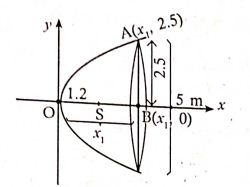
Its equation is y2 = 4ax
Since focus is placed 1.2 m from the vertex OA = 1.2 m and BC = 2.5 m since the width of the dish is 5 m.
From the diagram, a = 1.2 m
∴ y2 = 4(1.2)x
(a) ⇒ y2 = 4.8x ...(1)
(b) Since (x1, 2.5) lines on (1)(2.5)2 = 4.8(x1)
x1 = \(\frac { 2.5\times 2.5 }{ 4.8 } \)
x1 = 1.3 m
∴ Depth of the satellite dish at the vertex is 1.3 m.
18.
The path y = ax2 + bx + c passes through the points (10, 8), (20, 16), (40, 22). So, we get the system of equations 100a + 10b + c = 8, 400a + 20b + c = 16, 1600a + 40b + c = 22. To apply Cramer’s rule, we find
Δ = \(\left| \begin{matrix} 100 & 10 & 1 \\ 400 & 20 & 1 \\ 1600 & 40 & 1 \end{matrix} \right| =1000\left| \begin{matrix} 1 & 1 & 1 \\ 4 & 2 & 1 \\ 16 & 4 & 1 \end{matrix} \right| \) = 1000 [-2 + 12 - 6] = -6000,
Δ1 = \(\left| \begin{matrix} 8 & 10 & 1 \\ 16 & 20 & 1 \\ 22 & 40 & 1 \end{matrix} \right| =20\left| \begin{matrix} 4 & 1 & 1 \\ 8 & 2 & 1 \\ 11 & 4 & 1 \end{matrix} \right| \) = 20[-8 + 3 + 10] = 100,
Δ2 = \(\left| \begin{matrix} 100 & 8 & 1 \\ 400 & 16 & 1 \\ 1600 & 22 & 1 \end{matrix} \right| =200\left| \begin{matrix} 1 & 4 & 1 \\ 4 & 8 & 1 \\ 16 & 11 & 1 \end{matrix} \right| \) = 200[-3 + 48 - 84] = -7800,
Δ3 = \(\left| \begin{matrix} 100 & 10 & 8 \\ 400 & 20 & 16 \\ 1600 & 40 & 22 \end{matrix} \right| =2000\left| \begin{matrix} 1 & 1 & 4 \\ 4 & 2 & 8 \\ 16 & 4 & 11 \end{matrix} \right| \) = 2000[-10 + 84 - 64] = 20000.
By Cramer’s rule, we get a = \(\frac { { \Delta }_{ 1 } }{ \Delta } =-\frac { 1 }{ 60 } \), b = \(\frac { { \Delta }_{ 2 } }{ \Delta } =\frac { 7800 }{ 6000 } =\frac { 78 }{ 60 } =\frac { 13 }{ 10 } \), c = \(\frac { { \Delta }_{ 3 } }{ \Delta } =\frac { 20000 }{ 6000 } =-\frac { 20 }{ 6 } =-\frac { 10 }{ 3 } \).
So, the equation of the path is y = \(\frac { 1 }{ 60 } { x }^{ 2 }+\frac { 13 }{ 10 } x-\frac { 10 }{ 3 } \).
When x = 70, we get y = 6. So, the ball went by 6 metres high over the boundary line and it is impossible for a fielder standing even just before the boundary line to jump and catch the ball. Hence the ball went for a super six and the team won the match.
19.
Let f(x) x6-3x5-5x4+22x3-39x2-39x+135
Given (1+2i) is a root \(\Rightarrow\)(-2i) is also a root
Also \(\sqrt3\) is a root \(\Rightarrow\)-\(\sqrt3\) is also a root.
Hence, the factors of f(x) are [x - (1 + 2i)]
[x-(1-2i)] [x\(\sqrt3\)] [x+\(\sqrt3\)]
[(x-1)-2i] [(x-1)+2i] [x-\(\sqrt3\)][x+\(\sqrt3\)]
((x-1)2+22)(x2-3) = (x2-2x+1+4)(x2-3)
\(\Rightarrow\) factor of f(x) is (x2-2x+5)(x2-3)
\(\Rightarrow\)x4-3x2-2x3+6x+5x2-15
\(\Rightarrow\)(x4-3x2-2x3+6x-15) is a factor of f(x)
To find the other factor, let us divide f(x) by
x4 - 2x3 + 2x2 + 6x - 15
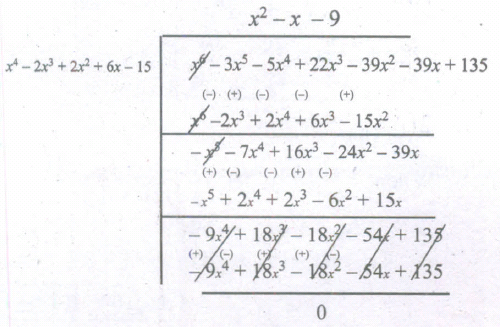
The other factor is x2 - x - 9
\(\Rightarrow x=\frac { 1\pm \sqrt { { (-1) }^{ 2 }-4(1)(-9) } }{ 2 } \left[ \because x=\frac { -b\pm \sqrt { { b }^{ 2 }-4ac } }{ 2a } \right] \)
\(\Rightarrow x=\frac { 1\pm \sqrt { 37 } }{ 2 } \)
Hence the roots are
1 - 2i, 1 + 2i, \(\sqrt { 3 }, -\sqrt { 3 }, \frac { 1+\sqrt { 37 } }{ 2 } ,\frac { 1-\sqrt { 37 } }{ 2 } \).
20.
For the parabola,
x2- 4x - 5y -1 = 0
x2- 4x = 5y +1
x2−4x +4 = 5y +1+ 4
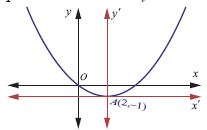
(x − 2)2 = 5(y +1) which is in standard form.
Therefore 4a = 5 and the vertex is (2, -1) , and focus is \(\left( 2,\frac { 1 }{ 4 } \right) \)
Equation of directrix is
y-k+ a = 0
y+1+\(\frac { 5 }{ 4 } \)
4y +9 = 0
Length of latus rectum is 5 units.

12th Standard Syllabus & Materials
12th Standard
TN 12th Computer Applications களப்பெயர் முறைமை (DNS) Sample Question Papers Study Material - QB365 Set A
NEW12th Standard
TN 12th Computer Applications வலையமைப்பு எடுத்துக்காட்டுகள் மற்றும் நெறிமுறைகள் Sample Question Papers Study Material - QB365 Set A
NEW12th Standard
TN 12th Computer Applications கணினி வலையமைப்பு ஓர் அறிமுகம் Sample Question Papers Study Material - QB365 Set A
NEW12th Standard
TN 12th Computer Applications PHP-உடன் MySQL-ஐ இணைத்தல் Sample Question Papers Study Material - QB365 Set A



Tamilnadu Stateboard 12th Standard Subjects
Maths

Chemistry

Physics

Biology

Computer Science

Business Maths and Statistics

Economics

Commerce

Accountancy

History

Computer Applications
Biology
Computer Technology
Computer Applications
Computer Science
Business Maths and Statistics
Commerce
Economics
Maths
Chemistry
Physics
Computer Technology
History
Accountancy

Tamil

English

French
Tamilnadu Stateboard Standards

