
 100% FREE ACCESS
12th Standard Syllabus & Materials
12th Standard
TN 12th Computer Applications மின்னணு தரவு பரிமாற்றம் Sample Question Papers Study Material - QB365 Set A
NEW12th Standard
TN 12th Computer Applications மின் - வணிக பாதுகாப்பு அமைப்புகள் Sample Question Papers Study Material - QB365 Set A
NEW12th Standard
TN 12th Computer Applications மின்னணு செலுத்தல் முறைகள் Sample Question Papers Study Material - QB365 Set A
NEW12th Standard
TN 12th Computer Applications மின் - வணிகம் Sample Question Papers Study Material - QB365 Set A
NEW12th Standard
TN 12th Computer Applications திறந்த மூல கருத்துருக்கள் Sample Question Papers Study Material - QB365 Set A
NEW12th Standard
TN 12th Computer Applications வலையமைப்பு வடமிடல் Sample Question Papers Study Material - QB365 Set A

Published on: 20/01/2020
Download Tamil Nadu 12th Standard Maths question papers, model tests, one-mark questions, important questions, and public exam papers in PDF format. Free study materials and answer keys for TN State Board students.
Questions + Answers key
Take MCQ Maths Test1.
Let G = {1, i, -1, -i} under the binary operation multiplication. Find the inverse of all the elements.
2.
Evaluate \(\int _{ 0 }^{ \frac { \pi }{ 2 } }{ \frac { \sqrt { cot \ x } }{ \sqrt { cot \ x } +\sqrt { tan \ x } } dx } \)
3.
Find the equation of normal to the cure y = sin2x at \(\left( \frac { \pi }{ 3 } ,\frac { 3 }{ 4 } \right) \).
4.
Suppose a pair of unbiased dice is rolled once. If X denotes the total score of two dice, write down
(i) the sample space
(ii) the values taken by the random variable X,
(iii) the inverse image of 10, and
(iv) the number of elements in inverse image of X.
5.
In a pack of 52 playing cards, two cards are drawn at random simultaneously. If the number of black cards drawn is a random variable, find the values of the random variable and number of points in its inverse images.
6.
Show that the differential equation representing the family of curves \({ y }^{ 2 }=2a\left( x+a^\frac { 2 }{ 3 } \right) \) where a is a positive parameter, is \({ \left( { y }^{ 2 }-2xy\frac { 2 }{ 3 } \right) }^{ 3 }=8{ \left( y\frac { dy }{ dx } \right) }^{5 }\).
7.
Find the principal value of -2i.
8.
Find the condition for the line lx + my + n = 0 is tangent to the circle x2 + y2 = a2
9.
Prove that \(\left[ \overset { \rightarrow }{ a } +\overset { \rightarrow }{ b } +\overset { \rightarrow }{ c } ,\overset { \rightarrow }{ b } +\overset { \rightarrow }{ c } ,\overset { \rightarrow }{ c } \right] \)=\(\left[ \overset { \rightarrow }{ a } \overset { \rightarrow }{ b } \overset { \rightarrow }{ c } \right] \)
10.
Find the rank of the matrix math \(\left[ \begin{matrix} 4 \\ -2 \\ 1 \end{matrix}\begin{matrix} 4 \\ 3 \\ 4 \end{matrix}\begin{matrix} 0 \\ -1 \\ 8 \end{matrix}\begin{matrix} 3 \\ 5 \\ 7 \end{matrix} \right] \).
11.
If adj(A) = \(\left[ \begin{matrix} 2 & -4 & 2 \\ -3 & 12 & -7 \\ -2 & 0 & 2 \end{matrix} \right] \), find A.
12.
The complex numbers u, v, and w are related by \(\frac { 1 }{ u } =\frac { 1 }{ v } +\frac { 1 }{ w } \) If v = 3−4i and w = 4+3i, find u in rectangular form.
13.
Verify whether the following compound propositions are tautologies or contradictions or contingency
( p ⟶ q) ↔️ (~ p ⟶ q)
14.
Verify the
(i) closure property,
(ii) commutative property,
(iii) associative property
(iv) existence of identity and
(v) existence of inverse for the arithmetic operation + on Ze = the set of all even integers
15.
Find the area of the region bounded by the y-axis and the parabola x = 5 − 4y − y2.
16.
Solve the Linear differential equation:
\(x\frac { dy }{ dx } +y=xlogx\)
17.
Solve: \({ tan }^{ -1 }\left( \cfrac { x-1 }{ x-2 } \right) +{ tan }^{ -1 }\left( \cfrac { x+1 }{ x+2 } \right) =\cfrac { \pi }{ 4 } \)
18.
If (x1 + iy1)(x2 + iy2)(x3 + iy3)...(xn+ iyn) = a + ib, show that
(x12 + y12)(x22 + y22)(x32 + y32)...(xn2 + yn2) = a2 + b2
19.
Four men and 4 women can finish a piece of work jointly in 3 days while 2 men and 5 women can finish the same work jointly in 4 days. Find the time taken by one man alone and that of one woman alone to finish the same work by using matrix inversion method.
20.
Solve the equation 2x3+11x2−9x−18 = 0.
1.
Clearly 1 is the identity element of (G1)
Inverse of 1 is 1 [∴ (1)(1) = 1]
Inverse of i is -i [∴ (i) (-i) = -i2 = 1]
Inverse of -1 is -1 [∴ (-1)(-1) = 1]
Inverse of is i [∴ (-i)(i) = -i2 = 1]
2.
Let I = \(\int _{ 0 }^{ \frac { \pi }{ 2 } }{ \frac { \sqrt { cot \ x } }{ \sqrt { cot \ x } +\sqrt { tan \ x } } dx } \) ....(1)
By the property, \(\int _{ 0 }^{ a }{ f(x)dx } =\int _{ 0 }^{ a }{ f(a-x) } dx\)
∴ I = \(\int _{ 0 }^{ \frac { \pi }{ 2 } }{ \frac { \sqrt { cot(\frac { \pi }{ 2 } -x) } }{ \sqrt { cot(\frac { \pi }{ 2 } -x) } +\sqrt { tan(\frac { \pi }{ 2 } -x) } } dx } \)
= \(\int _{ 0 }^{ \frac { \pi }{ 2 } }{ \frac { \sqrt { tanx } }{ \sqrt { tanx } +\sqrt { cotx } } dx } \) ...(2)
(1) + (2) ⇒ 2I = \(\int _{ 0 }^{ \frac { \pi }{ 2 } }{ \frac { \sqrt { cot \ x } +\sqrt { tan \ x } }{ \sqrt { cot \ x } +\sqrt { tan \ x } } dx } \)
=\(\int _{ 0 }^{ \frac { \pi }{ 2 } }{ dx } ={ \left[ x \right] }_{ 0 }^{ \frac { \pi }{ 2 } }=\frac { \pi }{ 2 } -0=\frac { \pi }{ 2 } \)
∴ I = \(\frac { \pi }{ 4 } \)
3.
y = sin2x
\(\frac { dy }{ dx } \) = 2 sin x cos x = sin 2x
∴ m = \(\left( \frac { dy }{ dx } \right) _{ \left( \frac { \pi }{ 3 } ,\frac { 3 }{ 4 } \right) }=sin\frac { 2\pi }{ 3 } =\frac { \sqrt { 3 } }{ 2 } \)
∴ Slope of the normal = \(-\frac { 1 }{ m } =-\frac { 2 }{ \sqrt { 3 } } \)
∴ Equation of normal is y-y1 = \(-\frac { 1 }{ m } \)(x-x1)
⇒ \(y-\frac { 3 }{ 4 } =-\frac { 2 }{ \sqrt { 3 } } \left( x-\frac { \pi }{ 3 } \right) \)
⇒ 12\(\sqrt { 3 } \)y-9\(\sqrt { 3 } \) = -24x + 8π [ multiply 12\(\sqrt { 3 } \)]
∴ 24x + 12\(\sqrt { 3 } \)y = 8π + 9\(\sqrt { 3 } \).
4.
\(S=\left\{\begin{array}{l} (1,1),(1,2),(1,3),(1,4),(1,5),(1,6) \\ (2,1),(2,2),(2,3),(2,4),(2,5),(2,6) \\ (3,1),(3,2),(3,3),(3,4),(3,5),(3,6) \\ (4,1),(4,2),(4,3),(4,4),(4,5),(4,6) \\ (5,1),(5,2),(5,3),(5,4),(5,5),(5,6) \\ (6,1),(6,2),(6,3),(6,4),(6,5),(6,6) \end{array}\right\}\)
(i) The sample space
S = {1, 2, 3, 4, 5, 6}\(\times\){1, 2, 3, 4, 5, 6}
consists of 36 ordered pairs (α, β) where α and β can take any integer value between 1 and 6 as shown. X is assigned to each point (α, β) the sum of the numbers on the dice .
That is X (α, β) = α + β
Therefore
X (1,1) = 1+1 = 2
X (1, 2) = X (2,1) = 3
X (1,3) = X (2,2) = X (3,1)= 4
X (1, 4) = X (2,3) = X (3, 2) X (4,1) = 5
X (1,5) = X (2,4) = X (3,3) = X (4, 2) = X (5,1) = 6
X (1,6) = X (2,5) = X (3, 4) = X (4,3 = X (5, 2) X (6,1) = 7
X (2,6) = X (3,5) = X (4,4) = X (5,3) = X (6,2) = 8
X (3,6) = X (4,5) = X (5,4) X (6,3) = 9
X (4,6) = X (5,5) X (6,4) = 10
X (5,6) = (6,5) = 11
X (6,6) = 12
(ii) Then the random variable X takes on the values 2, 3, 4, 5, 6, 7, 8, 9, 10, 11, 12.
(iii) The inverse images of 10 is {(4, 6), (5, 5), (6, 4)}.
(iv) The number of inverse images are given below
| Values of the random variable | 2 | 3 | 4 | 5 | 6 | 7 | 8 | 9 | 10 | 11 | 12 | Total |
| Number of elements in inverse image | 1 | 2 | 3 | 4 | 5 | 6 | 5 | 4 | 3 | 2 | 1 | 36 |
5.
Let X be the random variable of number of black cards occur.
X = {0,1,2}
Sample space 52C2 = 1326
Let X denote the number of black cards drawn.
X = 0, X (both are red cards) = 26C2 = 325
X = 1 (1 black card and 1 red card) = 26C1 \(\times\) 26C1 = 676
X = 2 (both are black cards) = 26C2 = 325
∴ X takes the values 0, 1, 2
| Values of random variable X | 0 | 1 | 2 | Total |
| Number of elements in inverse images | 325 | 676 | 325 | 1326 |
6.
Given y2 = 2a\(\left( x+a\frac { 2 }{ 3 } \right) \)
\(\Rightarrow { y }^{ 2 }=2ax+2a\frac { 2 }{ 3 } \)
Differentiating with respect to 'x' we get,
\(
2 y \frac{d y}{d x}=2 \mathrm{a}+0 \Rightarrow \frac{d y}{d x}=\frac{2 a}{2 y} \\
\frac{d y}{d x}=\frac{a}{y} \Rightarrow a=y \frac{d y}{d x}
\)
Substituting the values of a in equation (1), we get
\(
y^2=2\left(y \frac{d y}{d x}\right) x+2\left(y \frac{d y}{d x}\right)^{\frac{5}{3}} \\
y^2=2 x y \frac{d y}{d x}+2\left(y \frac{d y}{d x}\right)^{\frac{5}{3}}
\)
\(y^2-2 x y \frac{d y}{d x}=2\left(y \frac{d y}{d x}\right)^{\frac{5}{3}}\)
Raising to cubical power on both sides, we get
\(\left(y^2-2 x y \frac{d y}{d x}\right)^3=8\left(y \frac{d y}{d x}\right)^5\)
Hence \(y^2=2 a x+2 a^{\frac{5}{3}}\) is a solution of the differential equation
\(\left(y^2-2 x y \frac{d y}{d x}\right)^3=8\left(y \frac{d y}{d x}\right)^5\)
7.
Let z = -2i = 2(-i)
= 2\(\left[ cos\left( -\frac { \pi }{ 2 } \right) +isin\left( -\frac { \pi }{ 2 } \right) \right] \)
[∵ cos(-θ) = cos θ and sin(-θ) = -sinθ]
Principal value of -2i c is\(\frac { \pi }{ 2 } \).
8.
Given line in Ix + my + n = 0 ....(1)
tangent at (x1, y1) to the circle x2 + y2 = 92 is
xx1 + yy1= a2 ...(2)
Comparing the co-efficients of like terms in (1)
and (2), we get, \(\frac { { x }_{ 1 } }{ l } =\frac { { y }_{ 1 } }{ m } =\frac { -{ { a }^{ 2 } } }{ n } \)
\({ x }_{ 1 }=\frac { -{ a }^{ 2 }l }{ n } \), and \({ y }_{ 1 }=\frac { -{ a }^{ 2 }m }{ n } \)
Since (x1 , y1) is a point on the circle, x21 + y21 = a2
\(\left( \frac { -{ a }^{ 2 }l }{ n } \right) +\left( \frac { -{ a }^{ 2 }m }{ n } \right) ={ a }^{ 2 }\)
\(\frac { -{ a }^{ 4 }{ l }^{ 2 } }{ { n }^{ 2 } } +\frac { { a }^{ 4 }{ m }^{ 2 } }{ { n }^{ 2 } } ={ a }^{ 2 }\)
⇒ \(-{ a }^{ 4 }{ l }^{ 2 }+{ a }^{ 4 }{ m }^{ 2 }={ a }^{ 2 }\)
\({ a }^{ 2 }({ l }^{ 2 }+{ m }^{ 2 })=1\)
9.
L. H. S = \(\left[ \overset { \rightarrow }{ a } +\overset { \rightarrow }{ b } +\overset { \rightarrow }{ c } ,\overset { \rightarrow }{ b } +\overset { \rightarrow }{ c } ,\overset { \rightarrow }{ c } \right] \)
\(=\left( \overset { \rightarrow }{ a } +\overset { \rightarrow }{ b } +\overset { \rightarrow }{ c } \right) .\left\{ \left( \overset { \rightarrow }{ b } \times \overset { \rightarrow }{ c } \right) \times \overset { \rightarrow }{ c } \right\} \)
\(=\left( \overset { \rightarrow }{ a } +\overset { \rightarrow }{ b } +\overset { \rightarrow }{ c } \right) .\left\{ \overset { \rightarrow }{ b } \times \overset { \rightarrow }{ c } \times \overset { \rightarrow }{ c } \right\} \)
\(=\left( \overset { \rightarrow }{ a } +\overset { \rightarrow }{ b } +\overset { \rightarrow }{ c } \right) .\left\{ \overset { \rightarrow }{ b } \times \overset { \rightarrow }{ c } \right\} \ \left[ \because \overset { \rightarrow }{ c } \times \overset { \rightarrow }{ c } =\overset { \rightarrow }{ 0 } \right] \)
\(=\overset { \rightarrow }{ a } .\left( \overset { \rightarrow }{ b } \times \overset { \rightarrow }{ c } \right) +\overset { \rightarrow }{ b } .\left( \overset { \rightarrow }{ b } \times \overset { \rightarrow }{ c } \right) +\overset { \rightarrow }{ c } .\left( \overset { \rightarrow }{ b } \times \overset { \rightarrow }{ c } \right) \)
\(=\left[ \overset { \rightarrow }{ a } \overset { \rightarrow }{ b } \overset { \rightarrow }{ c } \right] +0+0\)
\(\left[ \because \left[ \overset { \rightarrow }{ b } \overset { \rightarrow }{ b } \overset { \rightarrow }{ c } \right] =\left[ \overset { \rightarrow }{ c } \overset { \rightarrow }{ b } \overset { \rightarrow }{ c } \right] =0 \right] \)
\(=\left[ \overset { \rightarrow }{ a } \overset { \rightarrow }{ b } \overset { \rightarrow }{ c } \right] \)= R. H. S
Hence proved
10.
Let A =\(\left[ \begin{matrix} 4 \\ -2 \\ 1 \end{matrix}\begin{matrix} 4 \\ 3 \\ 4 \end{matrix}\begin{matrix} 0 \\ -1 \\ 8 \end{matrix}\begin{matrix} 3 \\ 5 \\ 7 \end{matrix} \right] \)
A\(\overset { { R }_{ 1 }\leftrightarrow { R }_{ 3 } }{ \longrightarrow } \left[ \begin{matrix} 1 \\ -2 \\ 4 \end{matrix}\begin{matrix} 4 \\ 3 \\ 4 \end{matrix}\begin{matrix} 8 \\ -1 \\ 0 \end{matrix}\begin{matrix} 3 \\ 5 \\ 7 \end{matrix} \right] \)
\(\overset { { R }_{ 2 }\rightarrow { R }_{ 2 }+2{ R }_{ 1 }\\ { R }_{ 3 }\rightarrow { R }_{ 3 }-4{ R }_{ 1 } }{ \longrightarrow } \left[ \begin{matrix} 1 \\ 0 \\ 0 \end{matrix}\begin{matrix} 4 \\ 11 \\ -12 \end{matrix}\begin{matrix} 8 \\ 15 \\ -32 \end{matrix}\begin{matrix} 7 \\ 19 \\ -25 \end{matrix} \right] \)
A is in row - echelon form and it has 3 non-zero rows.
∴ \(\rho\) (A) = 3
11.
Given adj A =\(\left[ \begin{matrix} 2 & -4 & 2 \\ -3 & 12 & -7 \\ -2 & 0 & 2 \end{matrix} \right] \)
We know that A = \(\pm \frac { 1 }{ \sqrt { |adjA| } } \) adj (adj A)..(1)
|adj A| = \(2\left| \begin{matrix} 12 & -7 \\ 0 & 2 \end{matrix} \right| +4\left| \begin{matrix} -3 & -7 \\ -2 & 2 \end{matrix} \right| +2\left| \begin{matrix} -3 & 12 \\ -2 & 0 \end{matrix} \right| \)
[Expanded along R1]
= 2(24-0)+4(-6-14)+2(0+24)
= 2(24)+4(-20)+2(24) = 48-80+48
= 96-80 = 16
Now, adj (adj A)
=\(\left[ \begin{matrix} +\left| \begin{matrix} 12 & -7 \\ 0 & 2 \end{matrix} \right| & -\left| \begin{matrix} -3 & -7 \\ -2 & 2 \end{matrix} \right| & +\left| \begin{matrix} -3 & 12 \\ -2 & 0 \end{matrix} \right| \\ -\left| \begin{matrix} -4 & 2 \\ 0 & 2 \end{matrix} \right| & +\left| \begin{matrix} 2 & 2 \\ -2 & 2 \end{matrix} \right| & -\left| \begin{matrix} 2 & -4 \\ -2 & 0 \end{matrix} \right| \\ +\left| \begin{matrix} -4 & 2 \\ 12 & -7 \end{matrix} \right| & -\left| \begin{matrix} 2 & 2 \\ -3 & -7 \end{matrix} \right| & +\left| \begin{matrix} 2 & -4 \\ -3 & 12 \end{matrix} \right| \end{matrix} \right] ^{ T }\)
=\(\left[ \begin{matrix} +(24-0)-(6-14)+(0+24) \\ -(-8-0)+(4+4)-(0-8) \\ +(28-24)-(-14+6)+(24-12) \end{matrix} \right] ^{ T }\)
=\(\left[ \begin{matrix} 24 & 20 & 24 \\ 8 & 8 & 8 \\ 4 & 8 & 12 \end{matrix} \right] ^{ T }=\left[ \begin{matrix} 24 & 8 & 4 \\ 20 & 8 & 8 \\ 24 & 8 & 12 \end{matrix} \right] \)
= \(4\left[ \begin{matrix} 6 & 2 & 1 \\ 5 & 2 & 2 \\ 6 & 2 & 3 \end{matrix} \right] \)
Substituting (2) and (3) in (1) we get,
A = \(\frac { 1 }{ \sqrt { 16 } } .4\left[ \begin{matrix} 6 & 2 & 1 \\ 5 & 2 & 2 \\ 6 & 2 & 3 \end{matrix} \right] \)
A = \(\pm \frac { 4 }{ 4 } \left[ \begin{matrix} 6 & 2 & 1 \\ 5 & 2 & 2 \\ 6 & 2 & 3 \end{matrix} \right] =\pm \left[ \begin{matrix} 6 & 2 & 1 \\ 5 & 2 & 2 \\ 6 & 2 & 3 \end{matrix} \right] \)
12.
Given v = 3-4i, w = 4+3i and \(\frac { 1 }{ u } =\frac { 1 }{ v } +\frac { 1 }{ w } \)
∴ \(\frac { 1 }{ u } =\frac { 1 }{ 3-4i } +\frac { 1 }{ 4+3i } \)
= \(\frac { 3+4i }{ (3-4i)(3+4i) } +\frac { 4-3i }{ (4+3i)(4-3i) } \)
= \(\\ \frac { 3+4i }{ 9-(4i)^{ 2 } } +\frac { 4-3i }{ 16-(3i)^{ 2 } } =\frac { 3+4i }{ 9+16 } +\frac { 4-3i }{ 16+9 } \)
= \(\frac { 3+4i }{ 25 } +\frac { 4-3i }{ 25 } =\frac { 3+4i+4-3i }{ 25 } \)
\(\frac { 1 }{ u } =\frac { 7+i }{ 25 } \)
∴ u = \(\frac { 25 }{ 7+i } \times \frac { 7-i }{ 7-i } =\frac { 25(7-i }{ 7^{ 2 }-({ i }^{ 2 }) } \)
= \(\frac { 25(7-i) }{ 49+1 } =\frac { 25(7-i) }{ 50 } =\frac { 1 }{ 2 } \)(7-i)
∴ u = \(\frac { 1 }{ 2 } \)(7-i) or \(\frac { 7 }{ 2 } \) - \(\frac { i }{ 2 } \)
13.
| p | q | p ⟶ q | ~p | ~p ⟶ q | ( p ⟶ q) ↔️ (~p ⟶ q) |
| T | T | T | F | T | T |
| T | F | F | F | T | F |
| F | T | T | T | T | T |
| F | F | T | T | F | F |
Since this is neither a tautology not a contradiction
( p ⟶ q) ↔️ (~p ⟶ q) is a contingency.
14.
Consider the set of all even integers Ze = {2k | k ∈ Z} = {...,−6, −4, −2, 0, 2, 4, 6,...}.
Let us verify the properties satisfied by + on Ze.
(i) The sum of any two even integers is also an even integer.
Because x, y∈Ze, ⇒ x = 2m and y = 2n , m,n∈Z.
So (x + y) = 2m + 2n = 2(m+n)∈Ze. Hence + is a binary operation on Ze.
(ii) ∀ x, y∈Ze, (x + y) = 2(m + n) = 2(m + n) = 2(n + m) = (2n + 2m) = (y + x).
So + has commutative property
(iii) Similarly it can be seen that ∀x, y, z∈Ze, (x + y) + z = x + ( y + z).
Hence the associative property is true.
(iv) Now take x = 2k , then 2k + e = e + 2k = 2k ⇒ e = 0.
Thus ∀ x ∈ Ze, ヨ0∈Ze, ⋺x+0 = 0+x = x.
So, 0 is the identity element.
(v) Taking x = 2k and x′ as its inverse, we have 2k+x' = 0 = x'+2k ⇒ x' = −2k. i.e., x' = −x.
Thus ∀x ∈ Ze, ヨ-x∈Ze ⋺x + (−x) = (−x) + x = 0
Hence -x is the inverse of x ∈Ze.
15.
The equation of the parabola is ( y + 2)2 = −(x−9). The parabola crosses the y- axis at (0, −5) and (0, 1). The vertex is at (9, −2) and the axis of the parabola is y = −2. The required area is sketched
Viewing in the positive direction of x-axis, and making horizontal strips, the required area A is given by
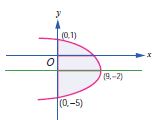
\(A=\int _{ -5 }^{ 1 }{ xdy } =\int _{ -5 }^{ 1 }{ (5-4y-{ y }^{ 2 })dy={ \left[ 5y-2{ y }^{ 2 }-\frac { { y }^{ 3 } }{ 3 } \right] }_{ -5 }^{ 1 }=\frac { 8 }{ 3 } -\left( -\frac { 100 }{ 3 } \right) =36 } \)
16.
Dividing by x we get,
\(\frac { dy }{ dx } +\frac { 1 }{ x } y=xlogx\)
This is a linear differential equation
\(\therefore P=\frac { 1 }{ x } ;Q=logx\)
\(\int { pdx } =\int { \frac { 1 }{ x } } dx=logx\)
\(I.F={ e }^{ \int { pdx } }={ e }^{ log\quad x }=x\)
\(\therefore\) The solution is \({ e }^{ \int { pdx } }=\int { Q{ e }^{ \int { pdx } }=dx+c } \)
\(u=cos\quad x;dv=x\)
\(du=\frac { 1 }{ x } ,v=\frac { { x }^{ 2 } }{ x } \)
\(\int { udv } =uv-\int { vdu } \)
\(yx=\int { xlogxdx+c } \)
\(\Rightarrow xy=\frac { { x }^{ 2 } }{ x } logx-\int { \frac { { x }^{ 2 } }{ 2 } } .\frac { 1 }{ x } dx\)
\(\Rightarrow xy=\frac { { x }^{ 2 } }{ x } logx-\frac { 1 }{ 2 } \int { xdx } \)
\(\Rightarrow xy=\frac { { x }^{ 2 } }{ x } logx-\frac { 1 }{ 2 } .\frac { { x }^{ 2 } }{ 2 } +c\)
\(\Rightarrow xy=\frac { { 2x }^{ 2 }logx-{ x }^{ 2 }+4c }{ 4 } \)
\(\Rightarrow 4xy=2{ x }^{ 2 }logx-{ x }^{ 2 }+4c\)
17.
\({ tan }^{ -1 }\left( { \frac { x-1 }{ x-2 } } \right) +{ tan }^{ -1 }\left( \frac { x+1 }{ x+2 } \right) =\frac { \pi }{ 4 }\)
\(\Rightarrow { tan }^{ -1 }\left( \cfrac { \frac { x-1 }{ x-2 } +\frac { x+1 }{ x+2 } }{ 1-\left( \frac { x-1 }{ x-2 } \right) \left( \frac { x+1 }{ x+2 } \right) } \right) =\frac { \pi }{ 4 }\)
\(\begin{aligned}
& \Rightarrow\left(\frac{\frac{(x-1)(x+2)+(x+1)(x-2)}{(x-2)(x+2)-(x-1)(x+1)}}{\frac{(x-2)(x+2)}{(x+2)}}\right)=\tan \frac{\pi}{4}=1 \\
& \Rightarrow \quad \frac{x^2+x-2+x^2-x-2}{\left(x^2-4\right)-\left(x^2-1\right)}=1
\end{aligned}\)
\(\Rightarrow \frac { 2{ x }^{ 2 }-4 }{ { x }^{ 2 }-4-{ x }^{ 2 }+1 } =1\)
\(\Rightarrow\) 2x2- 4 = -3
\(\Rightarrow\) 2x2- 4 = -3
\(\Rightarrow\) 2x2 = -3 + 4 = 1
\(\Rightarrow\) \({ x }^{ 2 }=\frac { 1 }{ 2 }\)
\(\Rightarrow\) \(x=\frac { 1 }{ \sqrt { 2 } }\)
18.
Given (x1 + iy1)(x2 + iy2) ....(xn + iyn) = a + ib
Taking modulus
|(x1+ iy1)(x2 + iy2) ....(xn + iyn)| = |a + ib|
|x1 + iy1| + |x2 + iy2|+...+ |xn + iyn| = |a + ib|
\(
\sqrt{x_{1}^{2}+y_{1}^{2}} \sqrt{x_{2}^{2}+y_{2}^{2}} \sqrt{x_{3}^{2}+y_{3}^{2}} \cdots \sqrt{x_{n}{ }^{2}+y_{n}^{2}}
=\sqrt{a^{2}+b^{2}}
\)
Squaring on both sides
\(
\left(x_{1}^{2}+\mathrm{y}_{1}^{2}\right)\left(x_{2}^{2}+\mathrm{y}_{2}^{2}\right)\left(x_{3}^{2}+\mathrm{y}_{3}^{2}\right) \ldots\left(x_{\mathrm{n}}^{2}+\mathrm{y}_{\mathrm{n}}^{2}\right)
=\mathrm{a}^{2}+\mathrm{b}^{2}
\)
Hence proved.
19.
Let the time by one man alone be x days and one woman alone be y days
∴ By the given data,
\(\frac { 4 }{ x } +\frac { 4 }{ y } =\frac { 1 }{ 3 } \)
and \(\frac { 2 }{ x } +\frac { 5 }{ y } =\frac { 1 }{ 4 } \)
put \(\frac { 1 }{ x } \) = s and \(\frac { 1 }{ y } \) = t
∴ 4s + 4t = \(\frac { 1 }{ 3 } \)
and 2s + 5t = \(\frac { 1 }{ 4 } \)
The matrix form of the system of equation is
\(\left[ \begin{matrix} 4 & 4 \\ 2 & 5 \end{matrix} \right] \left[ \begin{matrix} s \\ t \end{matrix} \right] =\left[ \begin{matrix} \frac { 1 }{ 3 } \\ \frac { 2 }{ 4 } \end{matrix} \right] \) ⇒ AX = B where
A = \(\left[ \begin{matrix} 4 & 4 \\ 2 & 5 \end{matrix} \right] \) and B =\(\left[ \begin{matrix} \frac { 1 }{ 3 } \\ \frac { 2 }{ 4 } \end{matrix} \right] \)
X = A-1B
Now |A| = \(\left| \begin{matrix} 4 & 4 \\ 2 & 5 \end{matrix} \right| \) = 20 - 8 =12 ≠ 0
∴ A-1 =\(\frac { 1 }{ |A| } adjA=\frac { 1 }{ 12 } \left[ \begin{matrix} 5 & -4 \\ -2 & 4 \end{matrix} \right] \)
∴ X = A-1B = \(\frac { 1 }{ 12 } \left[ \begin{matrix} 5 & -4 \\ -2 & 4 \end{matrix} \right] \left[ \frac { \begin{matrix} 1 \\ 3 \end{matrix} }{ \begin{matrix} 1 \\ 4 \end{matrix} } \right] \)
=\(\frac { 1 }{ 12 } \left[ \begin{matrix} \frac { 5 }{ 3 } & -1 \\ \frac { -2 }{ 3 } & +1 \end{matrix} \right] \)
= \(\frac { 1 }{ 12 } \left[ \frac { \begin{matrix} 2 \\ 3 \end{matrix} }{ \begin{matrix} 1 \\ 3 \end{matrix} } \right] =\left[ \begin{matrix} \frac { 2 }{ 3 } \times \frac { 1 }{ 12 } \\ \frac { 1 }{ 3 } \times \frac { 1 }{ 12 } \end{matrix} \right] =\left[ \begin{matrix} \frac { 1 }{ 18 } \\ \frac { 1 }{ 36 } \end{matrix} \right] \)
∴ \(\frac { 1 }{ 18 } \Rightarrow \frac { 1 }{ x } =\frac { 1 }{ 18 } \Rightarrow \)x = 18
t = \(\frac { 1 }{ 36 } \Rightarrow \frac { 1 }{ y } =\frac { 1 }{ 36 } \Rightarrow \)y = 36
one man can do 18 days
one woman can do 36 days.
20.
We observe that the sum of the coefficients of the odd powers and that of the even powers are equal.
Hence −1 is a root of the equation.
To find other roots, we divide 2x3+11x2-9x-18 by x+1 and get 2x2+9x-18 as the quotient.
Solving this we get \(\frac{3}{2}\) and -6 as roots.
Thus -6, -1, \(\frac{3}{2}\) are the roots or solutions of the given equation.

12th Standard Syllabus & Materials
12th Standard
TN 12th Computer Applications களப்பெயர் முறைமை (DNS) Sample Question Papers Study Material - QB365 Set A
NEW12th Standard
TN 12th Computer Applications வலையமைப்பு எடுத்துக்காட்டுகள் மற்றும் நெறிமுறைகள் Sample Question Papers Study Material - QB365 Set A
NEW12th Standard
TN 12th Computer Applications கணினி வலையமைப்பு ஓர் அறிமுகம் Sample Question Papers Study Material - QB365 Set A
NEW12th Standard
TN 12th Computer Applications PHP-உடன் MySQL-ஐ இணைத்தல் Sample Question Papers Study Material - QB365 Set A



Tamilnadu Stateboard 12th Standard Subjects
Maths

Chemistry

Physics

Biology

Computer Science

Business Maths and Statistics

Economics

Commerce

Accountancy

History

Computer Applications
Biology
Computer Technology
Computer Applications
Computer Science
Business Maths and Statistics
Commerce
Economics
Maths
Chemistry
Physics
Computer Technology
History
Accountancy

Tamil

English

French
Tamilnadu Stateboard Standards

