
 100% FREE ACCESS
12th Standard Syllabus & Materials
12th Standard
TN 12th Maths Applications of Matrices and Determinants Sample Question Papers Study Material - QB365 Set A
NEW12th Standard
TN 12th Computer Applications மின்னணு தரவு பரிமாற்றம் Sample Question Papers Study Material - QB365 Set A
NEW12th Standard
TN 12th Computer Applications மின் - வணிக பாதுகாப்பு அமைப்புகள் Sample Question Papers Study Material - QB365 Set A
NEW12th Standard
TN 12th Computer Applications மின்னணு செலுத்தல் முறைகள் Sample Question Papers Study Material - QB365 Set A
NEW12th Standard
TN 12th Computer Applications மின் - வணிகம் Sample Question Papers Study Material - QB365 Set A
NEW12th Standard
TN 12th Computer Applications திறந்த மூல கருத்துருக்கள் Sample Question Papers Study Material - QB365 Set A

Published on: 12/11/2019
Download Tamil Nadu 12th Standard Maths question papers, model tests, one-mark questions, important questions, and public exam papers in PDF format. Free study materials and answer keys for TN State Board students.
Questions + Answers key
Take MCQ Maths Test1.
Let A be Q\{1}. Define ∗ on A by x*y = x + y − xy. Is ∗ binary on A? If so, examine the commutative and associative properties satisfied by ∗ on A.
2.
Find the constant C such that the function
\(f(x)= \begin{cases}C x^2, & 1<x<4 \\ 0, & \text { otherwise }\end{cases}\)
is a density function, and compute
(i) P(1.5 < X < 3.5)
(ii) P(X ≤ 2)
(iii) P(3 < X )
3.
A six sided die is marked ‘1’ on one face, ‘2’ on two of its faces, and ‘3’ on remaining three faces. The die is rolled twice. If X denotes the total score in two throws.
(i) Find the probability mass function.
(ii) Find the cumulative distribution function.
(iii) Find P(3 ≤ X< 6)
(iv) Find P(X ≥ 4) .

4.
Two balls are drawn in succession without replacement from an urn containing four red balls and three black balls. Let X be the possible outcomes drawing red balls. Find the probability mass function and mean for X.
5.
Evaluate \(\int _{ 0 }^{ \frac { \pi }{ 2 } }{ \frac { dx }{ 4{ sin }^{ 2 }x+5{ cos }^{ 2 }x } } \)
6.
Sketch the curve \(y=\frac { { x }^{ 2 }-3x }{ (x-1) } \)
7.
Find the local extrema for the following function using second derivative test:
f(x) = -3x5 +5x3
8.
Solve: \(\frac{dv}{dx}+2y\ cot\ x=3x^2 cosec^2x\)
9.
Find the angle between y = x2 and y = (x − 3)2.
10.
Verify that arg(1+i) + arg(1-i) = arg[(1+i) (1-i)]
11.
Prove that \({ tan }^{ -1 }\left( \frac { 1-x }{ 1+x } \right) -{ tan }^{ -1 }\left( \frac { 1-y }{ 1+y } \right) ={ sin }^{ -1 }\left( \frac { y-x }{ \sqrt { 1+{ x }^{ 2 } } .\sqrt { 1+{ y }^{ 2 } } } \right)\)
12.
ABCD is a quadrilateral with \(\overset { \rightarrow }{ AB } =\overset { \rightarrow }{ \alpha } \) and \(\overset { \rightarrow }{ AD } =\overset { \rightarrow }{ \beta } \) and \(\overset { \rightarrow }{ AC } =2\overset { \rightarrow }{ \alpha } +3\overset { \rightarrow }{ \beta } \). If the area of the quadrilateral is λ times the area of the parallelogram with \(\overset { \rightarrow }{ AB } \) and \(\overset { \rightarrow }{ AD } \) as adjacent sides, then prove that \(\lambda =\frac { 5 }{ 2 } \)
13.
Show that the equations -2x + y + z = a, x - 2y + z = b, x + y -2z = c are consistent only if a + b + c = 0.
14.
If the sum of the roots of the quadratic equation ax2+ bx + c = 0 (abc ≠ 0) is equal to the sum of the squares of their reciprocals, then \(\frac { a }{ c } ,\frac { b }{ a } ,\frac { c }{ b } \) are H.P.
15.
Show that the straight lines \(\vec { r } =(5\hat { i } +7\hat { j } -3\hat { k } )+s(-4\hat { i } +4\hat { j } -5\hat { k } )\) and \(\vec { r } =(8\hat { i } +4\hat { j } +5\hat { k } )+t(7\hat { i } +\hat { j } +3\hat { k } )\)are coplanar. Find the vector equation of the plane in which they lie.
16.
Let z1, z2 and z3 be complex numbers such that \(\left| { z }_{ 1 } \right\| =\left| { z }_{ 2 } \right| =\left| { z }_{ 3 } \right| =r>0\) and z1+ z2+ z3 \(\neq \) 0 prove that \(\left| \frac { { z }_{ 1 }{ z }_{ 2 }+{ z }_{ 2 }{ z }_{ 3 }+{ z }_{ 3 }{ z }_{ 1 } }{ { z }_{ 1 }+{ z }_{ 2 }+{ z }_{ 3 } } \right| \) = r
17.
For the ellipse 4x2 + y2 + 24x − 2y + 21 = 0, find the centre, vertices and the foci. Also prove that the length of latus rectum is 2
18.
Solve the equation 3x3 - 16x2 + 23x - 6 = 0 if the product of two roots is 1.
19.
Let \(A=\left( \begin{matrix} 1 & 0 \\ 0 & 1 \\ 1 & 0 \end{matrix}\begin{matrix} 1 & 0 \\ 0 & 1 \\ 0 & 1 \end{matrix} \right) ,B=\left( \begin{matrix} 0 & 1 \\ 1 & 0 \\ 1 & 0 \end{matrix}\begin{matrix} 0 & 1 \\ 1 & 0 \\ 0 & 1 \end{matrix} \right) ,C=\left( \begin{matrix} 1 & 1 \\ 0 & 1 \\ 1 & 1 \end{matrix}\begin{matrix} 0 & 1 \\ 1 & 0 \\ 1 & 1 \end{matrix} \right) \)be any three boolean matrices of the same type. Find AVB
20.
Examine the binary operation (closure property) of the following operations on the respective sets (if it is not, make it binary)
a*b = a + 3ab − 5b2; ∀a,b∈Z
21.
If (cosθ + i sinθ)2 = x + iy, then show that x2+y2 =1
22.
Find x If \(x=\sqrt { 2+\sqrt { 2+\sqrt { 2+....+upto\infty } } } \)
23.
Find the parametric form of vector equation of a line passing through a point (2, -1, 3) and parallel to line \({ \overset { \rightarrow }{ r } }=\left( \overset { \wedge }{ i } +\overset { \wedge }{ j } \right) +t\left( 2\overset { \wedge }{ i } +\overset { \wedge }{ j } -2\overset { \wedge }{ k } \right) \)
24.
Find the principal value of cos-1\((\frac{1}{2})\).
25.
Find cos-1 \((-\frac{1}{\sqrt2})\)
26.
If A is symmetric, prove that then adj A is also symmetric.
27.
Let g(x, y) = \(\frac { { e }^{ y }sinx }{ x } \), for x ≠ 0 and g(0, 0) = 1. Show that g is continuous at (0, 0).
28.
Consider g(x,y) = \(\frac { 2{ x }^{ 2 }y }{ { x }^{ 2 }+{ y }^{ 2 } } \), if (x, y) ≠ (0, 0) and g(0, 0) = 0 Show that g is continuous on R2
29.
Show that y = ax + \(\frac { b }{ x } \), x ≠ 0 is a solution of the differential equation x2 y" + xy' - y = 0.
30.
Find the locus of z if Re\(\\ \left( \frac { \bar { z } +1 }{ \bar { z } -i } \right) \) = 0.
31.
Find the Cartesian form of the equation of the plane \(\overset { \rightarrow }{ r } =\left( s-2t \right) \overset { \wedge }{ i } +\left( 3-t \right) \overset { \wedge }{ j } +\left( 2s+t \right) \overset { \wedge }{ k } \)
32.
Verify that (A-1)T = (AT)-1 for A =\(\left[ \begin{matrix} -2 & -3 \\ 5 & -6 \end{matrix} \right] \).
33.
Prove that
\({ sin }^{ -1 }(\frac { 3 }{ 5 } )-{ cos }^{ -1 (}\frac { 12 }{ 13 } )={ sin }^{ -1 }(\frac { 16 }{ 65 }) \)
34.
A circle of area 9π square units has two of its diameters along the lines x + y = 5 and x−y = 1. Find the equation of the circle.
35.
Which one of the following statements has truth value F?
Chennai is in India or \(\sqrt 2\) is an integer
Chennai is in India or \(\sqrt 2\) is an irrational number
Chennai is in China or \(\sqrt 2\) is an integer
Chennai is in China or \(\sqrt 2\) is an irrational number
36.
The value of \(\int _{ 0 }^{ 1 }{ { ({ sin }^{ -1 }x) }^{ 2 } } dx\) is
\(\frac { { \pi }^{ 2 } }{ 4 } -1\)
\(\frac { { \pi }^{ 2 } }{ 4 } +2\)
\(\frac { { \pi }^{ 2 } }{ 4 } +1\)
\(\frac { { \pi }^{ 2 } }{ 4 } -2\)
37.
The percentage error of fifth root of 31 is approximately how many times the percentage error in 31?
\(\frac{1}{31}\)
\(\frac15\)
5
31
38.
A rod of length 2l is broken into two pieces at random. The probability density function of the shorter of the two pieces is
\(f(x)=\left\{\begin{array}{ll} \frac{1}{l} & 0< x < l \\ 0 & l <x<2l \end{array}\right.\)
The mean and variance of the shorter of the two pieces are respectively.
\(\frac { l }{ 2 } ,\frac { { l }^{ 2 } }{ 3 } \)
\( \frac { l }{ 2 } ,\frac { { l }^{ 2 } }{ 6 } \)
\(l,\frac { { l }^{ 2 } }{ 12 } \)
\(\frac { l }{ 2 } ,\frac { { l }^{ 2 } }{ 12 } \)
39.
The integrating factor of the differential equation \(\frac{d y}{d x}+P(x) y=Q(x)\) is x, then P(x)
x
\(\frac { { x }^{ 2 } }{ 2 } \)
\(\frac{1}{x}\)
\(\frac{1}{x^2}\)
40.
Angle between y2 = x and x2 = y at the origin is
\({ tan }^{ -1 }\cfrac { 3 }{ 4 } \)
\({ tan }^{ -1 }\left( \cfrac { 4 }{ 3 } \right) \)
\(\cfrac { \pi }{ 2 } \)
\(\cfrac { \pi }{ 4 } \)
41.
If z = cos\(\frac { \pi }{ 4 } \) + i sin\(\frac { \pi }{ 6 } \), then ______
|z| = 1, arg(z) =\(\frac { \pi }{ 4 } \)
|z| = 1, arg(z) = \(\frac { \pi }{ 6 } \)
|z| = \(\frac { \sqrt { 3 } }{ 2 } \), arg(z) = \(\frac { 5\pi }{ 24 } \)
|z| = \(\frac { \sqrt { 3 } }{ 2 } \), arg (z) = tan-1\(\left( \frac { 1 }{ \sqrt { 2 } } \right) \)
42.
43.
If x < 0, y < 0 such that xy = 1, then tan-1(x) + tan-1(y) =_____
\(\frac { \pi }{ 2 } \)
\(\frac { -\pi }{ 2 } \)
\(-\pi \)
none
44.
The domain of cos-1(x2 - 4) is______
[3, 5]
[-1, 1]
\(\left[ -\sqrt { 5 } ,-\sqrt { 3 } \right] \cup \left[ \sqrt { 3 } ,\sqrt { 5 } \right] \)
[0, 1]
45.
If the distance between the foci is 2 and the distance between the direction is 5, then the equation of the ellipse is __________
6x2 + 10y2 = 5
6x2 + 10y2 = 15
x2 + 3y2 = 10
none
46.
lf the root of the equation x3 + bx2+ cx - 1 = 0 form an lncreasing G.P, then ___________
one of the roots is 2
one of the roots is 1
one of the roots is -1
one of the roots is -2
47.
The number of solutions of the system of equations 2x+y = 4, x - 2y = 2, 3x + 5y = 6 is ____________
0
1
2
infinitely many
48.
If \(\vec { a } ,\vec { b } ,\vec { c } \) are non-coplanar, non-zero vectors such that \([\vec { a } ,\vec { b } ,\vec { c } ]\) = 3, then \({ \{ [\vec { a } \times \vec { b } ,\vec { b } \times \vec { c } ,\vec { c } \times \vec { a } }]\} ^{ 2 }\) is equal to
81
9
27
18
49.
50.
If x + y = k is a normal to the parabola y2 = 12x, then the value of k is
3
-1
1
9
51.
The equation \(\tan ^{-1} x-\cot ^{-1} x=\tan ^{-1}\left(\frac{1}{\sqrt{3}}\right)\)has
no solution
unique solution
two solutions
infinite number of solutions
52.
The principal argument of \(\cfrac { 3 }{ -1+i } \) is
\(\cfrac { -5\pi }{ 6 } \)
\(\cfrac { -2\pi }{ 3 } \)
\(\cfrac { -3\pi }{ 4 } \)
\(\cfrac { -\pi }{ 2 } \)
53.
According to the rational root theorem, which number is not possible rational zero of 4x7 + 2x4 - 10x3 - 5?
-1
\(\frac { 5 }{ 4 } \)
\(\frac { 4 }{ 5 } \)
5
1.
given A = {Q\{1}}
A is defined on A by x*y = x+y-xy
Let x,y ≠ 1
∴ x*y = x + y - xy
Now to prove that x + y - xy ≠ 1
Let us assume that x + y - xy = 1
x+y-xy-1 = 0
(x-1)-y(x-1) = 0
(x-1)(1-y) = 0
x =1 or y = 1 which is a false [∵x, y ≠ 1]
∴ is a binary operation on A.
Commutative property:
Let x,y ∈A ⇒ x, y≠1
∴x*y = x+y-xy
and y*x = y+x-yx
⇒x+y = y*x∀x, y∈A
A has commutative property under *
Associative property:
Let x,y,z ∊A ⇒x,y,z≠1
Consider (x*y)*z = (x+y-xy)*z
= x +y~xy +z- (x +y-xy)z
= x +y-xy+ z-xz- yz + xyz
= x +y+z-xy-yz-zx +xyz ...(1)
= x +y+z - yz - x (y + z - yz)
= x +y +z-yz-zy-xz +xyz ..(2)
From (1) & (2), (x*y)*z = x*(y*z)
A has associative property under *.
2.
Since the given function is a probability density function

\(\int _{ -\infty }^{ \infty }{ f(x) } dx=1\)
That is \(\int _{ -\infty }^{ 1 }{ f(x) } dx+\int _{ 1 }^{ 4 }{ f(x) } dx+\int _{ 4 }^{ \infty }{ f(x) } dx=1\)
From the given information
\(\int _{ -\infty }^{ 1 }{ 0dx } +\int _{ 1 }^{ 4 }{ { Cx }^{ 2 }dx } +\int _{ 4 }^{ \infty }{ 0dx } =1\)
\(0+C\left[ \cfrac { { x }^{ 3 } }{ 3 } \right] _{ 1 }^{ 4 }+0=1\Rightarrow C\left[ \cfrac { 64-1 }{ 3 } \right] =1\Rightarrow 21C\Rightarrow C=\cfrac { 1 }{ 21 }\)
Therefore the probability density function is
\(\)\(f(x)=\left\{C x^2, \quad x>1\right.\)
Since f (x) is continuous, the probability that X is equal to any particular value is zero. Therefore when the random variable is continuous, either or both of the signs < by ≤ and > by ≥ can be interchanged. Thus
(i) P(1.5 < X < 3.5) = P(1.5 ≤ X< 3.5)= P(1.5 < X ≤3.5) = P(1.5 ≤X ≤ 3.5)
Therefore
\(P(1.5<X<3.5)=\int_{1.5}^{3.5} f(x) d x\)

\(\begin{aligned} & =\frac{1}{21}\left(\frac{x^3}{3}\right)=\frac{1}{21}\left(\frac{(3.5)^3-(1.5)^3}{3}\right) \\ & =\frac{79}{126} \end{aligned}\)
(ii) \(P(X \leq 2)=\int_{-\infty}^2 f(x) d x=\int_{-\infty}^1 f(x) d x+\int_1^2 f(x) d x\)
Therefore
\(\begin{aligned} & P(X \leq 2)=0+\frac{1}{21} \int_1^2 x^2 d x=\frac{1}{21}\left(\frac{x^3}{3}\right)_1^2 \\ & =\frac{1}{21}\left(\frac{2^3-1^3}{3}\right)=\frac{7}{63} \end{aligned}\)
(iii) P(3 < X )

\(\begin{aligned} & =\frac{1}{21} \int_3^4 x^2 d x+0=\frac{1}{21}\left(\frac{x^3}{3}\right)_3^4 \\ & =\frac{1}{21}\left(\frac{4^3-3^3}{3}\right)=\frac{37}{63} \end{aligned}\)
3.
Since X denotes the total score in two throws, it takes on the values 2, 3, 4, 5 and 6. From the Sample space S, we have

Values of the Random Variable | 2 | 3 | 4 | 5 | 6 | Total |
Number of elements in inverse images | 1 | 4 | 10 | 12 | 9 | 36 |
\(P(X=2)=\frac { 1 }{ 36 }\), \(P(X=3)=\frac { 4 }{ 36 }\)
\(P\left( X=4 \right) =\frac { 10 }{ 36 }\) , \(P(X=5)=\frac { 12 }{ 36 }\) and
\(P(X=6)=\frac { 9 }{ 36 }\)
(i) Probability mass function is

x | 2 | 3 | 4 | 5 | 6 |
f(x) | \(\cfrac { 1 }{ 36 }\) | \(\cfrac { 4 }{ 36 }\) | \(\cfrac { 10 }{ 36 }\) | \(\cfrac { 12}{ 36 }\) | \(\cfrac { 9 }{ 36 }\) |
(ii) Cumulative distribution function By definition of the cumulative distribution function for discrete random variable we have
\(f(x)=P(X\le x)=\underset { x_{ 1 }\le x }{ \Sigma } P(X={ x }_{ 1 })\)
\(P(X=x)= \begin{cases}0, & -\infty<x<\cdots \\ \cdots & \end{cases}\)
\(\begin{aligned} & \left.F(2)=P(X \leq 2)=\sum_{-\infty}^2 P(X=x)=P(X)<2\right)+P(X=2)=0+\frac{1}{36}=\frac{1}{36} \\ & F(3)=P(X \leq 3)=\sum_{-\infty}^3 P(X=x)=P(x<2)+P(X=2)+P(X=3)+P(X=4)=0+\frac{1}{36}+\frac{4}{36}+\frac{10}{36}=\frac{15}{36} \end{aligned}\)
\(\begin{aligned} & F(4)=P(X \leq 3)=\sum_{-\infty}^3 P(X=x)=P(x<2)+P(X=2)+P(X=3)+P(X=4) \\ & 0+\frac{1}{36}+\frac{4}{36}+\frac{10}{36}=\frac{15}{36} \\ & F(5)=P(X \leq 5)=\sum_{-\infty}^5 P(X=x)=P(X<2)+P(X=3)+P(X=4)+P(X=5) \\ & =0+\frac{1}{36}+\frac{4}{36}+\frac{10}{36}+\frac{12}{36}=\frac{27}{36} \end{aligned}\)
\(\begin{aligned} & F(6)=P(X \leq 6)=\sum_{-\infty}^6 P(X=x) \\ & =P(X<2)+P(X=2)+P(X=3)+P(x=4)+P(x=5) P(X=6) \\ & 0+\frac{1}{36}+\frac{4}{36}+\frac{10}{36}+\frac{12}{36}+\frac{9}{36}=1 \end{aligned}\)
Therefore the cumulative distribution function is
\(F(x)= \begin{cases}0, & -\infty<x<2, \\ \frac{1}{36}, & 2 \leq x<3, \\ \frac{5}{36}, & 3 \leq x<4, \\ \frac{15}{36}, & 4 \leq x<5, \\ \frac{27}{36}, & 5 \leq x<6, \\ 1, & 6 \leq x<\infty .\end{cases}\)
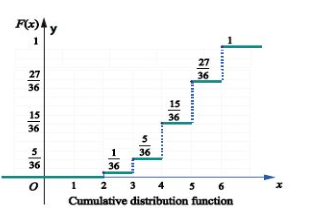
\(\text { (iii) } P(3 \leq X \leq 6)=\sum_{x=3}^5 P\left(X=x_1\right)=P(X=3)+P(X=4)+P(X=5)\)
\(\begin{aligned} & =\frac{4}{36}+\frac{10}{36}+\frac{12}{36}+\frac{26}{36} \\ & \text { (iv) } X \geq 4)=\sum_{x=4}^5 P\left(X=x_1\right) \end{aligned}\)
\(=\frac{10}{36}+\frac{12}{36}+\frac{9}{36}=\frac{31}{36}\)
4.
Let X be the random variablc denotes number of red balls.
Then X take the values 0, 1, 2
Sample space = 7C2 = 21
Let X denote the drawing the red ball.
Then X take the values 0, 1, 2
P(X = 0), X-1 (BB) = 3C2 = 3
P(X = 1), X-1 (BR) = 3C1 x 4C1 = 12
P(X = 2), X-1 (BR) = 3C2 = 6
| Values of random variable | 0 | 1 | 2 | Total |
| Number of elements in inverseimage | 3 | 12 | 6 | 21 |
The probability mass function is
| x | 0 | 1 | 2 |
| f(x) | \(\cfrac { 1 }{ 7 } \) | \(\cfrac { 4 }{ 7 } \) | \(\cfrac { 2 }{ 7 } \) |
Mean :
\(E(x)=\Sigma x.f\left( x \right) \)
= \(0(\frac { 1 }{ 7 } )+1\left( \frac { 4 }{ 7 } \right) +2\left( \frac { 2 }{ 7 } \right) \)
= \(\frac { 4 }{ 7 } +\frac { 4 }{ 7 } =\frac { 8 }{ 7 }\)
5.
\(Let\quad I=\int _{ 0 }^{ \frac { \pi }{ 2 } }{ \frac { dx }{ 4x{ sin }^{ 2 }x+5{ cos }^{ 2 }x } } \)
\(=\int _{ 0 }^{ \frac { \pi }{ 2 } }{ \frac { { sec }^{ 2 }x }{ 4{ tan }^{ 2 }x+5 } } dx\)
(Dividing both numerator and denominator by cos2 x).
Let u = tan x
Then du = sec2 x dx
When x = 0, u = tan 0 = 0
When x = \(\frac{\pi}{2}\), u = tan\(\frac{\pi}{2}\) = \(\infty\)
\(\therefore I=\int _{ 0 }^{ \infty }{ \frac { du }{ 4{ u }^{ 2 }+5 } } \) (This is an improper integral)
\(\frac { 1 }{ 4 } \int _{ 0 }^{ \infty }{ \frac { du }{ \left[ { u }^{ 2 }+\left( \frac { \sqrt { 5 } }{ 2 } \right) \right] } =\frac { 1 }{ 4 } \times \frac { 2 }{ \sqrt { 5 } } { \left[ { tan }^{ -1 }\left( \frac { u }{ \frac { \sqrt { 5 } }{ 2 } } \right) \right] }_{ 0 }^{ \infty } } =\frac { 1 }{ 2\sqrt { 5 } } \left( { tan }^{ -1 }\infty -{ tan }^{ -1 }0 \right) =\frac { 1 }{ 2\sqrt { 5 } } \left( \frac { \pi }{ 2 } \right) =\frac { \pi }{ 4\sqrt { 5 } } \)
6.
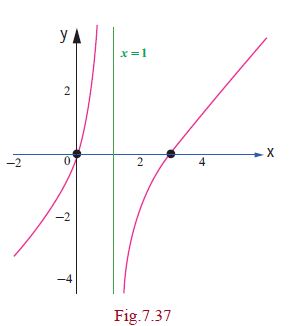
Factorising the given function we have
\(y=f(x)\frac { { x(x }-3x) }{ (x-1) } \)
(1) The domain and the range of f (x) are respectively R \{1} and the entire real line.
(2) Putting y = 0 we get the x = 0, 3. Therefore the x -intercept is (3,0). Putting x = 0, we get y = 0. Therefore the curve passes through the origin.
(3) \(f'(x)\frac { { x }^{ 2 }-2x+3 }{ { (x-1) }^{ 2 } } \) and hence the critical point of the curve occurs at x =1 as f′(1) does not exist. But x2 -x − 2 + 3 = 0 has no real solution. Hence the only critical point occurs at x = 1.
(4) x =1 is not in the domain of the function and f'(x) ≠0 ∀x ∈R \{1}, there is no local maximum or local minimum.
(5) \(f"(x)=-\frac { 4 }{ { (x-1) }^{ 3 } } \)∀x∈R\{1}. Therefore when x <1, f"(x)>0the curve is concave upwards in (-∞,1) and x>1, f"(x)<0 the curve is concave downwards in (1,∞). Since f"(x} ≠ 0 ∈ R\{1} there is no point of infection for f(x).
(6) Since, \(\underset { x\rightarrow { 1 }^{ - } }{ lim } \frac { { x }^{ 2 }-3x }{ (x-1) } =+\infty \ and\ \underset { x\rightarrow { 1 }^{ + } }{ lim } \frac { { x }^{ 2 }-3x }{ (x-1) } =-\infty ,\ x=1\) is a vertical asymptote.
The rough sketch is shown.
7.
f'(x) = -3.x5 + 5x3
f'(x) = -3x5 + 5x
f'(x) = - 15x4 + 15x2
f''(x) = 0
⇒ - 15x4 + 15x2 = 0
⇒ - 15x2 (1 - x2) = 0
⇒ x2 = 0, 1-x2 = 0
⇒ x = 0, x = 1, x = -1
ஃ The critical numbers are 0, 1,-1.
f"(x) - 60x3 + 30 x
f"(0) = 0
f"(1) - 60(1)3 + 30 (1)
-60 + 30 = -30
- 60(-1)3 + 30 (-1)
60- 30 = -30
Since f"(-1) < 0, it has a local maximum at
x = 1.
ஃ f(1) = -3(-1)5 + 5(-1)3
= -3 + 5 = 2
Since f"(-1) > 0, it has a local maximum at
x = -1.
ஃ f(-1) -3(1)5 + 5(1)3
3 - 5 = -2
∴ Local maximum is 2 which occurs at,
x = 1 and local minimum is -2 which occurs at
x = -1.
8.
Given that the equation is \(\frac{dv}{dx}+2y\ cot\ x=3x^2 cosec^2x\)
This is a linear differential equation. Here, P = 2 cot x ; Q = 3x2cosec2x.
\(\int { Pdx=\int { 2cot\quad xdx=2log|sin\quad x|=log|sin\quad x{ | }^{ 2 } } =log{ sin }^{ 2 }x } \)
Thus, \(I.F={ e }^{ \int { Pdx } }={ e }^{ log{ sin }^{ 2 } }x={ sin }^{ 2 }x\)
Hence, the solution is \({ ye }^{ \int { Pdx } }={ \int { Qe } }^{ \int { Pdx } }dx+C\)
That is, \(y{ sin }^{ 2 }x=\int { { 3x }^{ 2 }cose{ c }^{ 2 }x.{ sin }^{ 2 }xdx+C=\int { { 3x }^{ 2 }dx+C={ x }^{ 3 }+C } } \)
Hence, \(y{ sin }^{ 2 }x={ x }^{ 3 }+C\) is the required solution
9.
Let us now find the point of intersection of the two given curves. Equating x2 = (x - 3)2 we get, x = \(\frac32\). Therefore, the point of intersection is \({(\frac{3}{2},\frac{9}{4})}\). Let θ be the acute angle between the curves. The slopes of the curves are as follows:
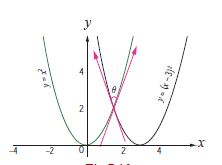
For the curve y = x2
\(\frac{dy}{dx}=2x\)
\(m_{1}=(\frac{dy}{dx})\ at\ {(\frac{3}{2},\frac{9}{4})}=3\).
For the curve y = (x-3)2
\(\frac{dy}{dx}=2(x-3)\)
\(m_{2}=(\frac{dy}{dx}) \ at \ {(\frac{3}{2},\frac{9}{4})}= -3\)
Using (3), we get
\(tan \theta=|\frac{3-(-3)}{1-9}|=\frac{3}{4}\)
Hence, \(\theta\) = \(tan^{-1}(\frac{3}{4})\).
10.
arg(1+i) + arg(1-i) = arg[(1+i) (1-i)]
LHS = arg (1+i) + arg(1-i)
1+i = \(\sqrt { 2 } \left( \frac { 1 }{ \sqrt { 2 } } +\frac { i }{ \sqrt { 2 } } \right) \)
= \(\sqrt { 2 } \left( cos\frac { \pi }{ 4 } +isin\frac { \pi }{ 4 } \right) \)
∴ arg (1+i) = π/4
-1+i =\(\sqrt { 2 } \left( \frac { -1 }{ \sqrt { 2 } } +\frac { i }{ \sqrt { 2 } } \right) \)
= \(\sqrt { 2 } \left( cos3\frac { \pi }{ 4 } +isin3\frac { \pi }{ 4 } \right) \)
∴ (-1+i) = 3\(\frac { \pi }{ 4 } \)
∴ LHS = \(\frac { \pi }{ 4 } +\frac { 3\pi }{ 4 } =\frac { 4\pi }{ 4 } =\pi \)
RHS = arg[(1+i) (-1+i)]
= arg[-1-i + i + i2]
= (-1-i + i-1) = arg(-2)
= arg(2) - (1) = 2 arg(-1)
= 2 (cos π + isin π) = π
∴ LHS = RHS
11.
LHS =\({ tan }^{ -1 }\left( \frac { 1-x }{ 1+x } \right) -{ tan }^{ -1 }\left( \frac { 1-y }{ 1+y } \right) \)
= tan-1(1) - tan-1 (x) - (tan-1(1) - tan-1(y)
\(\left[ \because { tan }^{ -1 }(\frac { x-y }{ 1+xy } )={ tan }^{ -1 }x-{ tan }^{ -1 }y \right] \)
= tan-1(1) - tan-1 (x) - tan-1(1) + tan-1(y)
= tan-1(y) - tan-1(x)
= \({ tan }^{ -1 }\left( \frac { y-x }{ 1+xy } \right) \)
= \({ sin }^{ -1 }\left( \frac { y-x }{ \sqrt { 1+\left( yx \right) ^{ 2 }+\left( y-x \right) ^{ 2 } } } \right) \)
= \({ sin }^{ -1 }\left( \frac { y-x }{ \sqrt { (1+{ x }^{ 2 })(1+{ x }^{ 2 }) } } \right) \)
RHS
12.
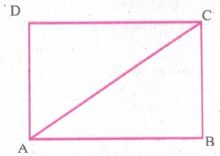
Given \(\overset { \rightarrow }{ AB } =\overset { \rightarrow }{ \alpha } \), \(\overset { \rightarrow }{ AD } =\overset { \rightarrow }{ \beta } \) and \(\overset { \rightarrow }{ AC } =2\overset { \rightarrow }{ \alpha } +3\overset { \rightarrow }{ \beta } \)
Area of the quadrilateral ABCD
∴ = are of ∆ ABC + area of ∆ ACD
\(=\frac { 1 }{ 2 } \left| \overset { \rightarrow }{ AB } \times \overset { \rightarrow }{ AC } \right| +\frac { 1 }{ 2 } \left| \overset { \rightarrow }{ AC } \times \overset { \rightarrow }{ AD } \right| \)
\(=\frac { 1 }{ 2 } \left| \overset { \rightarrow }{ \alpha } \times \left( 2\overset { \rightarrow }{ \alpha } +3\overset { \rightarrow }{ \beta } \right) \right| +\frac { 1 }{ 2 } \left| \left( 2\overset { \rightarrow }{ \alpha } +3\overset { \rightarrow }{ \beta } \right) \times \overset { \rightarrow }{ \beta } \right| \)
\(=\frac { 1 }{ 2 } \left| 2\left( \overset { \rightarrow }{ \alpha } \times \overset { \rightarrow }{ \alpha } \right) +3\left( \overset { \rightarrow }{ \alpha } \times \overset { \rightarrow }{ \beta } \right) \right| +\frac { 1 }{ 2 } \left| 2\left( \overset { \rightarrow }{ \alpha } \times \overset { \rightarrow }{ \beta } \right) +3\left( \overset { \rightarrow }{ \beta } \times \overset { \rightarrow }{ \beta } \right) \right| \)
\(=\frac { 1 }{ 2 } \left| 3\left( \overset { \rightarrow }{ \alpha } \times \overset { \rightarrow }{ \beta } \right) \right| +\frac { 1 }{ 2 } \left| 2\left( \overset { \rightarrow }{ \alpha } \times \overset { \rightarrow }{ \beta } \right) \right| \quad \quad \quad \left[ \because \overset { \rightarrow }{ \alpha } \times \overset { \rightarrow }{ \alpha } =\overset { \rightarrow }{ \beta } \times \overset { \rightarrow }{ \beta } =0 \right] \)
\(=\left( \frac { 3 }{ 2 } +\frac { 2 }{ 2 } \right) \left( \overset { \rightarrow }{ \alpha } \times \overset { \rightarrow }{ \beta } \right) =\left( \frac { 5 }{ 2 } \right) \left| \overset { \rightarrow }{ \alpha } \times \overset { \rightarrow }{ \beta } \right| \quad \quad (1)\)
Now, Area of the parallelogram with \(\overset { \rightarrow }{ AB } \) and \(\overset { \rightarrow }{ AD } \) as
adjacent sides = \(\left| \overset { \rightarrow }{ AB } \times \overset { \rightarrow }{ AD } \right| =\left| \overset { \rightarrow }{ \alpha } \times \overset { \rightarrow }{ \beta } \right| .... (2)\)
From (1) & (2), \(\frac { 5 }{ 2 } \left| \overset { \rightarrow }{ \alpha } \times \overset { \rightarrow }{ \beta } \right| =\lambda \left| \overset { \rightarrow }{ \alpha } \times \overset { \rightarrow }{ \beta } \right| \) [Given]
\(\lambda =\frac { 5 }{ 2 } \)
13.
Augmented matrix [A|B] is \(\left[ \begin{matrix} -2 & 1 & 1 \\ 1 & -2 & 1 \\ 1 & 1 & -2 \end{matrix}|\begin{matrix} a \\ b \\ c \end{matrix} \right] \)
[A|B]\(\overset { { R }_{ 1 }\leftrightarrow { R }_{ 2 } }{ \longrightarrow } \left[ \begin{matrix} 1 & -2 & 1 \\ -2 & 1 & 1 \\ 1 & 1 & -2 \end{matrix}|\begin{matrix} b \\ a \\ c \end{matrix} \right] \)
\(\overset { { R }_{ 2 }\rightarrow { R }_{ 2 }+2{ R }_{ 1 }\\ { R }_{ 3 }\rightarrow { R }_{ 3 }+{ R }_{ 1 } }{ \longrightarrow } \left[ \begin{matrix} 1 & -2 & 1 \\ 0 & -3 & 3 \\ 0 & 3 & -3 \end{matrix}|\begin{matrix} b \\ a+2b \\ c-b \end{matrix} \right] \)
\(\overset { { R }_{ 3 }\rightarrow { R }_{ 3 }+{ R }_{ 2 } }{ \longrightarrow } \left[ \begin{matrix} 1 & -2 & 1 \\ 0 & -3 & 3 \\ 0 & 0 & 0 \end{matrix}|\begin{matrix} b \\ c+2b \\ a+b+c \end{matrix} \right] \)
Here \(\rho\) (A) = 2
The given system is consistent only when \(\rho\)([A|B]) = 2\(\rho\)([A|B]) = 2 only if a + b + c = 0 Hence proved.
14.
\(\alpha +\beta =\frac { 1 }{ { \alpha }^{ 2 } } +\frac { 1 }{ { \beta }^{ 2 } } =\frac { { \alpha }^{ 2 }+{ \beta }^{ 2 } }{ { \alpha }^{ 2 }{ \beta }^{ 2 } } =\frac { { (\alpha +\beta ) }^{ 2 }-2\alpha \beta }{ { \alpha }^{ 2 }{ \beta }^{ 2 } } \)
\(\Rightarrow \frac { -b }{ a } =\frac { \frac { { b }^{ 2 } }{ { a }^{ 2 } } -2\frac { c }{ a } }{ \frac { { c }^{ 2 } }{ { a }^{ 2 } } } =\frac { { b }^{ 2 }-2ac }{ { c }^{ 2 } } \)
\(\Rightarrow \frac { 2a }{ c } =\frac { { b }^{ 2 } }{ { c }^{ 2 } } +\frac { b }{ a } \)
\(\frac { 2a }{ c } =\frac { { ab }^{ 2 }+{ bc }^{ 2 } }{ { ac }^{ 2 } } \)
\(2{ a }^{ 2 }c={ ab }^{ 2 }+{ b }^{ 2 }\)
\(\frac { 2a }{ b } =\frac { b }{ c } +\frac { c }{ a } \) [Dividing by abc]
\(\Rightarrow \frac { c }{ a } ,\frac { a }{ b } ,\frac { b }{ c } \) are in A.P \(\Rightarrow \frac { a }{ c } ,\frac { b }{ a } ,\frac { c }{ b } \) are in H.P
15.
\(\vec { r } =(5\hat { i } +7\hat { j } -3\hat { k } )+s(-4\hat { i } +4\hat { j } -5\hat { k } )\) and \(\vec { r } =(8\hat { i } +4\hat { j } +5\hat { k } )+t(7\hat { i } +\hat { j } +3\hat { k } )\)
Let \(\vec { a } =5\hat { i } +7\hat { j } -3\hat { k } ,\vec { b } =4\hat { i } +4\hat { j } -5\hat { k } \)
\(\vec { c } =8\hat { i } +4\hat { j } +5\hat { k } \ and\ \vec { d } =7\hat { i } +\hat { j } +3\hat { k } \)
We know that the two given lines are co-planar
if \(\left( \vec { c } -\vec { a } \right) .\left( \vec { b } \times \vec { d } \right) =0\)
\(\vec { b } \times \vec { d } =\left| \begin{matrix} \hat { i } & \hat { j } & \hat { k } \\ 4 & 4 & -5 \\ 7 & 1 & 3 \end{matrix} \right| \)
= \(\hat { i } \left( 12+5 \right) -\hat { j } \left( 12+35 \right) +\hat { k } \left( 4-28 \right) \)
= \(17\hat { i } -47\hat { j } -24\hat { k } \)
\(\left( \vec { c } -\vec { a } \right) =\left( 8-5 \right) \hat { i } +\left( 4-7 \right) \hat { j } +\left( 5+3 \right) \hat { k } \)
= \(3\hat { i } -3\hat { j } +8\hat { k } \)
Now,\(\left( \vec { c } -\vec { a } \right) .\left( \vec { b } \times \vec { d } \right) =\left( 3\hat { i } -3\hat { j } +8\hat { k } \right) \)
\(\left( 17\hat { i } -47\hat { j } -24\hat { k } \right) \)
= \(51+141-192=192-192=0\)
\(\therefore\) The two given lines are co-planar.
The plane containing the two given co-planar lines is
\(\left( \vec { r } -\vec { a } \right) .\left( \vec { b } \times \vec { d } \right) =0\)
\(\Rightarrow \left( \vec { r } -5\hat { i } +7\hat { j } -3\hat { k } \right) \times \left( 17\hat { i } -47\hat { j } -24\hat { k } \right) =0\)
\(\Rightarrow \vec { r } .\left( 17\hat { i } -47\hat { j } -24\hat { k } \right) -\left[ \left( 5\hat { i } +7\hat { j } -3\hat { k } \right) .\left( 17\hat { i } -47\hat { j } -24\hat { k } \right) \right] =0\)
\(\Rightarrow \vec { r } .\left( 17\hat { i } -47\hat { j } -24\hat { k } \right) =\left[ 85-329+72 \right] \)
\(\Rightarrow \vec { r } .\left( 17\hat { i } -47\hat { j } -24\hat { k } \right) =-172 \)
which is the required vector equation of the plane.
16.
Given that \(\left| { z }_{ 1 } \right| =\left| { z }_{ 2 } \right| =\left| { z }_{ 3 } \right| =r\Rightarrow { z }_{ 1 }\bar { { z }_{ 1 } } ={ z }_{ 2 }\bar { { z }_{ 2 } } ={ r }^{ 2 }\)
\(\Rightarrow { z }_{ 1 }=\frac { { r }^{ 2 } }{ \bar { { z }_{ 1 } } } ,{ z }_{ 2 }=\frac { { r }^{ 2 } }{ \bar { { z }_{ 2 } } } ,{ z }_{ 3 }=\frac { { r }^{ 2 } }{ { \bar { z } }_{ 3 } } \)
Therefore \({ z }_{ 1 }+{ z }_{ 2 }+{ z }_{ 3 }=\frac { { r }^{ 2 } }{ { \bar { z } }_{ 1 } } +\frac { { r }^{ 2 } }{ \bar { { z }_{ 2 } } } +\frac { { r }^{ 2} }{ \bar { { z }_{ 3 } } } \)
= \({ r }^{ 2 }\left( \frac { \bar { { z }_{ 2 } } \bar { { z }_{ 3 } } +\bar { { z }_{ 1 } } \bar { { z }_{ 3 } } +\bar { { z }_{ 1 } } { \overline { z } }_{ 2 } }{ \overline { { z }_{ 1 } } \bar { { z }_{ 2 } } \bar { { z }_{ 3 } } } \right) \)
\(\left| { z }_{ 1 }+{ z }_{ 2 }+{ z }_{ 3 } \right| =\left| { r }^{ 2 } \right| \left| \frac { \overline { { z }_{ 2}{ z }_{ 3 }+{ z }_{ 1 }{ z }_{ 3 }+{ z }_{ 1 }{ z }_{ 2 } } }{ \overline { { z }_{ 1 }{ z }_{ 2 }{ z }_{ 3 } } } \right| \) \(\left(\because \bar{z}_{1}+\bar{z}_{2}=\overline{z_{1}+z_{2}}\right)\)
= \({ r }^{ 2 }\frac { \left| { z }_{ 2 }{ z }_{ 3 }+{ z }_{ 1 }{ z }_{ 3 }+{ z }_{ 1 }{ z }_{ 2 } \right| }{ \left| { z }_{ 1 } \right| \left| { z }_{ 2 } \right| \left| { z }_{ 3 } \right| } \) \(\left( \because |z|=|\bar { z } |and\ \left| { z }_{ 1 }{ z }_{ 2 }{ z }_{ 3 } \right| =\left| { z }_{ 1 } \right| \left| { z }_{ 2 } \right| \left| { z }_{ 3 } \right| \right) \)
= \(\left| { z }_{ 1 }+{ z }_{ 2 }+{ z }_{ 3 } \right| ={ r }^{ 2 }\frac { \left| { z }_{ 2 }{ z }_{ 3 }+{ z }_{ 1 }{ z }_{ 3 }+{ z }_{ 1 }{ z }_{ 2 } \right| }{ { r }^{ 3 } } =\frac { \left| { z }_{ 2 }{ z }_{ 3 }+{ z }_{ 1 }{ z }_{ 3 }+{ z }_{ 1 }{ z }_{ 2 } \right| }{ r } \)
\(\frac { \left| { z }_{ 2 }{ z }_{ 3 }+{ z }_{ 1 }{ z }_{ 3 }+{ z }_{ 1 }{ z }_{ 2 } \right| }{ \left| { z }_{ 1 }+{ z }_{ 2 }+{ z }_{ 3 } \right| } \) = r (given that \(z_{1}+z_{2}+z_{3} \neq 0\))
Thus,\(\left| \frac { { z }_{ 2 }{ z }_{ 3 }+{ z }_{ 1 }{ z }_{ 3 }+{ z }_{ 1 }{ z }_{ 2 } }{ { z }_{ 1 }+{ z }_{ 2 }+{ z }_{ 3 } } \right| \) = r
17.
Rearranging the terms, the equation of ellipse is 4x2 + 24x + y2− 2y + 21 = 0
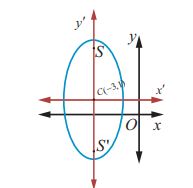
That is, 4(x2 + 6x + 9 − 9) + (y2 − 2y + 1 − 1) + 21 = 0,
4(x + 3)2 − 36 + (y−1)2 −1 + 21 = 0,
4(x + 3)2 + (y − 1)2 = 16,
\(\frac { { \left( x+3 \right) }^{ 2 } }{ 4 } +\frac { { \left( y+1 \right) }^{ 2 } }{ 16 } =1\)
Centre is (-3, 1) a = 4, b = 2, and the major axis is parallel to y-axis c2 = 16−4 = 12
c = ±2\(\sqrt { 3 } \)
Therefore, the foci are (−3, 2\(\sqrt { 3 } \) +1) and (−3, −2\(\sqrt { 3 } \) +1).
Vertices are (3, ±4 +1).
That is the vertices are (3, 5) and (3, -3) and the length of Latus rectum = \(\frac { { 2b }^{ 2 } }{ a } \) = 2 units.
18.
Given cubic equation 3x2-16x2+23x-6 = 0
Let ∝, \(\frac{1}{\alpha}\) and ૪ be the roots of the equation
[∵ product of two roots is 1]
\((1)\rightarrow { x }^{ 2 }-\frac { 16 }{ 3 } { x }^{ 2 }+\frac { 23 }{ 3 } -2=0 \) ......(1)
comparing (1) with
\({ x }^{ 3 }-\left( \frac { \alpha +\beta +\gamma }{ \alpha } \right) +\left( \alpha \frac { 1 }{ \alpha } +\frac { 1 }{ \alpha } .\gamma +\gamma \alpha \right) \)
\(-\alpha \frac { 1 }{ \alpha } .\gamma =0\) ..........(2)
We get,
\(\alpha +\frac { 1 }{ \alpha } +\gamma =\frac { 16 }{ 3 } \) .......(3)
\(1+\frac { \gamma }{ \alpha } +\gamma \alpha =\frac { 23 }{ 3 } \)
\(\alpha .\frac { 1 }{ \alpha } .\gamma =2\Rightarrow \gamma =2\) ............(4)
Substituting ૪ = 2 in (3)
\(\alpha +\frac { 1 }{ \alpha } +2=\frac { 16 }{ 3 } \)
\(\Rightarrow \alpha +\frac { 1 }{ \alpha } =\frac { 16 }{ 3 } -2=\frac { 16-6 }{ 3 } =\frac { 10 }{ 3 } \)
\(\Rightarrow \frac { { \alpha }^{ 2 }+1 }{ \alpha } =\frac { 10 }{ 3 } \)
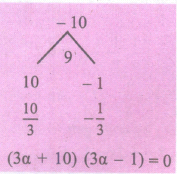
\({ 3x }^{ 2 }+3=10\alpha \)
\({ 3\alpha }^{ 2 }-10\alpha +3=0\)
\(\alpha =\frac { -10 }{ 3 } or\ \alpha =\frac { 1 }{ 3 } \)
\((3\alpha +10)(3\alpha -1)=0\)
\(\alpha =\frac { -10 }{ 3 } \) is not possible \(\Rightarrow \alpha =\frac { 1 }{ 3 } \)
[\(\because \alpha =\frac { -10 }{ 3 } \) will not satisfy(5)]
∴ The roots are 3, \(\frac{1}{3}\), 2.
19.
Given \(A=\left( \begin{matrix} 1 & 0 \\ 0 & 1 \\ 1 & 0 \end{matrix}\begin{matrix} 1 & 0 \\ 0 & 1 \\ 0 & 1 \end{matrix} \right) ,B=\left( \begin{matrix} 0 & 1 \\ 1 & 0 \\ 1 & 0 \end{matrix}\begin{matrix} 0 & 1 \\ 1 & 0 \\ 0 & 1 \end{matrix} \right) and\quad C=\left( \begin{matrix} 1 & 1 \\ 0 & 1 \\ 1 & 1 \end{matrix}\begin{matrix} 0 & 1 \\ 1 & 0 \\ 1 & 1 \end{matrix} \right) \)
\(=\left( \begin{matrix} 1 & 0 \\ 0 & 1 \\ 1 & 0 \end{matrix}\begin{matrix} 1 & 0 \\ 0 & 1 \\ 0 & 1 \end{matrix} \right) \vee \left( \begin{matrix} 0 & 1 \\ 1 & 0 \\ 1 & 0 \end{matrix}\begin{matrix} 0 & 1 \\ 1 & 0 \\ 0 & 1 \end{matrix} \right) \)
\(=\left( \begin{matrix} 1\vee 0 & 0\vee 1 \\ 0\vee 1 & 1\vee 0 \\ 1\vee 1 & 0\vee 0 \end{matrix}\begin{matrix} 1\vee 0 & 0\vee 1 \\ 0\vee 1 & 1\vee 0 \\ 0\vee 0 & 1\vee 1 \end{matrix} \right) \)
\(=\left( \begin{matrix} 1 & 1 \\ 1 & 1 \\ 1 & 0 \end{matrix}\begin{matrix} 1 & 1 \\ 1 & 1 \\ 0 & 1 \end{matrix} \right) \) [∵ a∨b=max(a,b)]
20.
Since × is binary operation on Z, a,b ∈ Z⇒ a × b = ab∈Z and b × b = b2∈Z ...(1)
The fact that + is binary operation on Z and (1) ⇒ 3ab = (ab + ab + ab) ∈Z and 5b2= (b2+b2+b2+b2+b2)∈Z ...(2)
Also a∈Z and 3ab ∈Z implies a+3ab∈Z ...(3)
(2),(3), the closure property of -on Z yield a * b = (a+3ab-5b2)∈Z. Since a * b belongs to Z, * is a binary operation on Z.
21.
(cos θ + i sin θ )2 = cos 2θ + isin 2θ
[By De moivre's theorem]
⇒ cos 2θ + isin 2θ = x + iy
Equating the real and imaginary parts we get,
x = cos 2θ, y = sin 2θ
∴ x2 + y2 = cos22θ + sin22θ = 1
Hence proved
22.
We have \(x=\sqrt { 2+x } \)
\(\Rightarrow { x }^{ 2 }=2+x \Rightarrow { x }^{ 2 }-x-2=0\)
\(\Rightarrow x=\frac { 1\pm \sqrt { 1+8 } }{ 2 } \Rightarrow x=\frac { 1\pm 3 }{ 2 } \)
\(\Rightarrow x=\frac { 1+3 }{ 2 } ,\frac { 1-3 }{ 2 } \Rightarrow x=2,-1\)
Also x>0, we get x = 2
23.
The parametric form of vector equation of a line passing through a point \(\left( \overset { \rightarrow }{ a } \right) \) and parallel to \(\overset { \rightarrow }{ b } \) is
\({ \overset { \rightarrow }{ r } }=\overset { \rightarrow }{ a } +t\overset { \rightarrow }{ b } \), t ∈ R
⇒ Here \(\overset { \rightarrow }{ a } =2\overset { \wedge }{ i } -\overset { \wedge }{ j } +3\overset { \wedge }{ k } \) and \(\overset { \rightarrow }{ b } =2\overset { \wedge }{ i } +\overset { \wedge }{ j } -2\overset { \wedge }{ k } \)
\(\therefore { \overset { \rightarrow }{ r } }=\left( 2\overset { \wedge }{ i } -\overset { \wedge }{ j } +3\overset { \wedge }{ k } \right) +t\left( 2\overset { \wedge }{ i } +\overset { \wedge }{ j } -2\overset { \wedge }{ k } \right) \), t ∈ R which is the required equation of a line.
24.
Let \(x={ cos }^{ -1 }\left( \frac { 1 }{ 2 } \right) \)
\(\Rightarrow cosx=\frac { 1 }{ 2 } \)
\(\Rightarrow cosx=\frac { 1 }{ 2 } \) \(\left[ \because \frac { \pi }{ 3 } \varepsilon \left[ 0,\pi \right] \right] \)
\(\Rightarrow x=\frac { \pi }{ 3 } \)
\(\therefore \) The principal value of \(cos^{ -1 }\left( \frac { 1 }{ 2 } \right) \) is \(\frac { \pi }{ 3 } \)
25.
It is known that cos-1 x : [-1, 1]\(\rightarrow\)[0, \(\pi\)] is given by
cos−1x = y if and only if x = cos y for -1\(\le x\le1 and 0\le y \le\pi\)
Thus, we have
cos-1 \((-\frac{1}{\sqrt2})\) = \(\frac{3\pi}{4}\), since \(\frac{3\pi}{4}\)\(\in[0,\pi]\)cos\(\frac{3\pi}{4}\) = cos\((\pi=\frac{\pi}{4})=-cos \frac{\pi}{4}=-\frac{1}{\sqrt2}\)
26.
Suppose A is symmetric. Then, AT = A and so, by theorem (vi), we get
adj(AT) = (adj A)T ⇒ adj A = (adj A)T ⇒ adj A is symmetric.
27.
Given g(x, y) = \(\frac { { e }^{ y }sinx }{ x } \) for x ≠ 0 and g(0, 0) = 1
g(0, 0) = 1
The function g is defined for all (x, y) ∈ R2
To check if g has a limit L at (0,0) and if L= g(0,0) = 1
Consider \(\left| g(x,y)-g(0,y) \right| =\left| \frac { { e }^{ y }sinx }{ x } -0 \right| \)
= \(\left| \frac { { e }^{ y }sinx }{ x } \right| =\left| \frac { \left| { e }^{ y } \right| \left| sinx \right| }{ x } \right| =\left| { e }^{ x } \right| \left| \frac { sinx }{ x } \right| =1\)
\(\left[ \because (x,y)\longrightarrow (0,0)\Rightarrow \left| { e }^{ y } \right| =1and\left| \frac { sinx }{ x } \right| =1 \right] \)
\(\because \begin{matrix} lim \\ (x,y)\rightarrow (0,0) \end{matrix}\frac { { e }^{ y }sinx }{ x } =1=g(0,0)\) Which proves that is continuous at (0, 0)
∴ g(x, y) is continuous at (0, 0)
28.
Observe that the function g is defined for all (x, y)∈R2 It is easy to check, as in the above examples, that g is continuous at all point (x, y) ≠ (0, 0). Next, we shall check the continuity of g at (0, 0). For that we see if g has a limit L at (0, 0) and if L = g(0, 0) = 0. So we consider
\(\left| g\left( x,y \right) -g\left( 0,0 \right) \right| =\left| \frac { 2{ x }^{ 2 }y }{ { x }^{ 2 }+{ y }^{ 2 } } -0 \right| =\frac { 2\left| { x }^{ 2 }y \right| }{ \left| { x }^{ 2 }+{ y }^{ 2 } \right| } =\frac { 2\left| xy \right| \left| x \right| }{ { x }^{ 2 }+{ y }^{ 2 } } \le \frac { \left( { x }^{ 2 }+{ y }^{ 2 } \right) \left| x \right| }{ { x }^{ 2 }+{ y }^{ 2 } } \le \left| x \right| \) ...(9)
Note that in the final step above we have used 2 \(\left| xy \right| \) \(\le \) x2 + y2 (which follows by considering 0\(\le \) (x - y)2 for all x, y∈ R . Note that (x, y)→(0, 0) implies |x| → 0. Then from (9) it follows that \(\underset { (x,y)\longrightarrow (0,0) }{ lim } \) \(\frac { 2{ x }^{ 2 }y }{ { x }^{ 2 }+{ y }^{ 2 } } \) = 0 = g (0, 0) which proves that g is continuous at (0, 0). So g is continuous at every point of R2
29.
Given y = ax + \(\frac { b }{ x } \) .......(1)
Differentiating with respect to x
y' = ax - \(\frac { b }{ x ^2} \) ......(2)
Differentiating again with respect to x
\(y'' = \frac{-b(-2)}{x^3}= \frac{2b}{x^3}
\)
\(Now, x^2y'' + xy'-y
\)
\( = x^2 \times \frac{2b}{x^3}+x(a- \frac{b}{x^2})-(ax+\frac{b}{x})
\)
\(= 2\times (\frac{b}{x})+ax-(\frac{b}{x})-ax-(\frac{b}{x})\)
= 0
Hence, y = ax + b is the solution of the differential equation x2y"+xy'-y = 0.
30.
Let z = x+iy ⇒ \(\bar { z } \) = x+iy
∴ \(\\ \frac { \bar { z } +1 }{ z-1 } =\frac { z-iy+1 }{ x-iy-i } =\frac { (x+1)iy }{ x-i(y+1) }\)
= \(\frac { (x+1)-iy }{ x-i(y+1) } \times \frac { x+i(y+1) }{ x+i(y+1) } \)
Choosing the real part alone we get,
\(\frac { x(x+1)+y(y+1) }{ { x }^{ 2 }+(y+1)^{ 2 } } \) = 0
⇒ x(x+1) + y(y+1) = 0
⇒ x2+x+y2+y = 0 which is the locus of z.
31.
Let \(\overset { \rightarrow }{ r } =x\overset { \wedge }{ i } +y\overset { \wedge }{ j } +z\overset { \wedge }{ k } \)
\(\therefore x\overset { \wedge }{ i } +y\overset { \wedge }{ j } +z\overset { \wedge }{ k } =\left( s-2t \right) \overset { \wedge }{ i } +\left( 3-t \right) \overset { \wedge }{ j } +\left( 2s+t \right) \overset { \wedge }{ k } \)
Equating the co-efficients of like components both sides,
We get, x = s - 2t
y = 3 - t
z = 2s + t
Eliminating x and t using determinates we get
\(\left| \begin{matrix} x \\ y-3 \\ z \end{matrix}\begin{matrix} 1 \\ 0 \\ 2 \end{matrix}\begin{matrix} -2 \\ -1 \\ 1 \end{matrix} \right| =0\)
⇒ x (0+2) -1(y - 3 + z) -2 (2y - 6 - 0) = 0
⇒ 2x - y + 3 - z- 4y + 12 = 0
⇒ 2x - 5y - z + 15 = 0
32.
|A| =\(\left[ \begin{matrix} -2 & -3 \\ 5 & -6 \end{matrix} \right] \) = 12+15 = 27
∴ A-1 = \(\frac { 1 }{ |A| } adjA=\frac { 1 }{ 27 } \left[ \begin{matrix} -6 & 3 \\ -5 & 2 \end{matrix} \right] \)
(A-1)T = \(\frac { 1 }{ 27 } \left[ \begin{matrix} -6 & -5 \\ 3 & 2 \end{matrix} \right] \)...(1)
AT =\(\left[ \begin{matrix} -2 & 5 \\ -3 & -6 \end{matrix} \right] \)
|AT| =\(\left[ \begin{matrix} -2 & 5 \\ -3 & -6 \end{matrix} \right] \) = 12+15 = 27
∴ (AT)-1 = \(\frac { 1 }{ |A^{ T }| } adj(A^{ T })=\frac { 1 }{ 27 } \left[ \begin{matrix} -6 & -5 \\ 3 & -2 \end{matrix} \right] \)...(2)
From (1) and (2), (A-1)T = (AT)-1
33.
\({ sin }^{ -1 }(\frac { 3 }{ 5 } )-{ cos }^{ -1 (}\frac { 12 }{ 13 } )={ sin }^{ -1 }(\frac { 16 }{ 65 }) \)
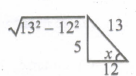
Let \({ sin }^{ -1 }\left( \frac { 3 }{ 5 } \right) =x\Rightarrow sinx=\frac { 3 }{ 5 } \)

and \(cosx=\frac { adj }{ hyp } =\frac { 4 }{ 5 } \)
and \({ cos }^{ -1 }\left( \frac { 12 }{ 13 } \right) =y\Rightarrow cosy=\frac { 12 }{ 13 } \)
\(siny=\frac { opp }{ hyp } =\frac { 5 }{ 12 } \)
We know that
sin (x - y) = sin x cos y -cos x siny
= \(\frac { 3 }{ 5 } \times \frac { 12 }{ 13 } -\frac { 4 }{ 5 } \times \frac { 5 }{ 12 } =\frac { 36 }{ 65 } -\frac { 20 }{ 6g } =\frac { 16 }{ 65 } \)
\(\therefore x-y={ sin }^{ -1 }\left( \frac { 16 }{ 65 } \right) \)
\(\Rightarrow { sin }^{ -1 }\left( \frac { 3 }{ 5 } \right) -{ cos }^{ -1 }\left( \frac { 12 }{ 13 } \right) ={ sin }^{ -1 }\left( \frac { 16 }{ 65 } \right) \)
Hence proved
34.
Area of the circle = 9π sq.units

πr2 = 9π ⇒ r2 ⇒ 9 ⇒ r ⇒ 3
Diameters are x + y = 5 ................(1)
and x - y = 1 .................(2)
We know that centre is the point of intersection of diameters.
∴ To find the centre, solve (1) and (2).
JPG.JPG)
⇒ 2x = 6
⇒ x = 3
∴ (1) ⇒ 3 + y = 5
⇒ y = 5 - 3 = 2
∴ Centre is (3, 2)
Hence, equation of the circle is
(x - h)2 + (y - k)2 = r2
⇒ (x - 3)2 + (y - 2)2 = 32
\(\Rightarrow x^{2}-6 x+9+y^{2}-4 y+4=9\)
⇒ x2 + y2 − 6x − 4y + 4 = 0
35.
(c)
Chennai is in China or \(\sqrt 2\) is an integer
36.
(d)
\(\frac { { \pi }^{ 2 } }{ 4 } -2\)
37.
(b)
\(\frac15\)
38.
(d)
\(\frac { l }{ 2 } ,\frac { { l }^{ 2 } }{ 12 } \)
39.
(c)
\(\frac{1}{x}\)
40.
(c)
\(\cfrac { \pi }{ 2 } \)
41.
(d)
|z| = \(\frac { \sqrt { 3 } }{ 2 } \), arg (z) = tan-1\(\left( \frac { 1 }{ \sqrt { 2 } } \right) \)
42.
(b)
43.
(b)
\(\frac { -\pi }{ 2 } \)
44.
(c)
\(\left[ -\sqrt { 5 } ,-\sqrt { 3 } \right] \cup \left[ \sqrt { 3 } ,\sqrt { 5 } \right] \)
45.
(b)
6x2 + 10y2 = 15
46.
(b)
one of the roots is 1
47.
(b)
1
48.
(a)
81
49.
(d)
50.
(d)
9
51.
(b)
unique solution
52.
(c)
\(\cfrac { -3\pi }{ 4 } \)
53.
(c)
\(\frac { 4 }{ 5 } \)

12th Standard Syllabus & Materials
12th Standard
TN 12th Computer Applications வலையமைப்பு வடமிடல் Sample Question Papers Study Material - QB365 Set A
NEW12th Standard
TN 12th Computer Applications களப்பெயர் முறைமை (DNS) Sample Question Papers Study Material - QB365 Set A
NEW12th Standard
TN 12th Computer Applications வலையமைப்பு எடுத்துக்காட்டுகள் மற்றும் நெறிமுறைகள் Sample Question Papers Study Material - QB365 Set A
NEW12th Standard
TN 12th Computer Applications கணினி வலையமைப்பு ஓர் அறிமுகம் Sample Question Papers Study Material - QB365 Set A



Tamilnadu Stateboard 12th Standard Subjects
Maths

Chemistry

Physics

Biology

Computer Science

Business Maths and Statistics

Economics

Commerce

Accountancy

History

Computer Applications
Biology
Computer Technology
Computer Applications
Computer Science
Business Maths and Statistics
Commerce
Economics
Maths
Chemistry
Physics
Computer Technology
History
Accountancy

Tamil

English

French
Tamilnadu Stateboard Standards

